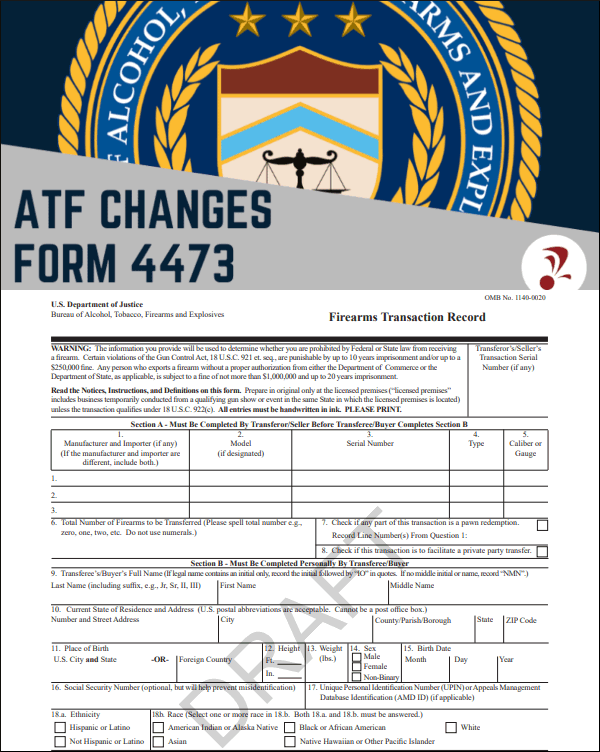
The Federal Bureau of Alcohol, Tabacco, Firearms and Explosives (ATF) is set to release its newest version of the Form 4473. The Updated Form 4473 is used by all Federal Firearm License (FFL) holders to record pertinent information from persons seeking to purchase a firearm or firearms prior to the FFL performing a background check via the National Instant Criminal Background Check System (NICS) or state-approved point-of-contact law enforcement agency. FFLs may start using the new Form 4473 immediately. The FBI intends to start shipping these new forms in July 2020.
IMPORTANT: Use of the updated Forum 4473 becomes MANDATORY as of November 1, 2020, for paper applications (not using the FBI E-Check system).
The May 2020 Form 4473 includes several changes from the previous version, including:
— The warning at the top of the form includes information about illegal exportation.
— Information on the firearm/s to be transferred is now Section A, which must be completed before the transferee completes Section B.
— The Citizenship information (Country of Citizenship and US-issued alien or admission number) has been moved to precede the prohibitor questions.
— The “County” block has been changed to “County/Parish/Borough” to accommodate Louisiana and Alaska, respectively.
— The “Sex” box has been revised to include a third option of “Non-Binary”. [Comment: Really? And how does this prevent crime? Thank you SJWs.]
— Item 26b, which previously applied to situations in which the identification document did not show the current residence address of the transferee, has been updated to include situations in which the identification document does not include the full legal name of the transferee.
— New item 26c has been included for the recording of official military orders establishing permanent change of station.
OTHER Changes: A detailed summary of ALL Form 4473 changes has been prepared by Orchid Advisers, which provides ATF and ITAR compliance services to manufacturing, distribution, and retail FFLs.
Expected Delivery Dates and Pre-Order Links
Use of the May 2020-approved Form 4473 will be mandatory for all FFLs beginning November 1, 2020. FFLs may use supplies of their current Form 4473s (October 2016 version) until that date. The new Form 4473 and continuation sheets are available for preorder in both English and Spanish. FFLs can expect their preorders to begin shipping in late July 2020. In addition, ATF expects to ship 50-quantity starter packs of the new Form 4473 to all FFLs in late July 2020, and the agency intends to have an updated eForm 4473 up and running during that same time period for those FFLs utilizing the FBI’s NICS E-Check system instead of the paper Form 4473.
NSSF has ordered both Spanish and English overlays for the new Form 4473 and we will notify our members when they are in stock and available through the member portal. These overlays, which complement an FFL’s compliance best practices, help improve accuracy and completion of this critical form and are available free to NSSF members.
Never had a chance to hunt prairie dogs in the American west? Then check out this video. Dan Eigen, host of the We Love It Outdoors Television series, ventured to South Dakota for some varmint hunting. Dan teamed up with Varmint Hunter Association President Jeff Rheborg to patrol some South Dakota Dogtowns where things get serious. In the video, you’ll see p-dog hits at distances from 70 yards to roughly 450 yards. The hunters were shooting from portable, wood-topped swivel rests, using AR-platform rifles on X-type sandbag rest. (Rifle zeroing session is shown at the 5:30+ mark.)
Multiple cameras were employed so you can see both the shooter’s POV and close-ups of the prairie dogs downrange. Watch the shooters having fun with a prairie dog cut-out and some Tannerite at the 9:00-minute mark. This guys are having a grand old time sending critters to Prairie Dog Heaven — we think you’ll enjoy the video.
Prairie Dog Hunting Starts at 2:20 Time-Mark in Video:
NOTE: This video actually covers three sequences: 1) Three-gun training; 2) Prairie Dog Hunting; and 3) Coyote Hunting. The Prairie Dog segment runs from 2:20 to 15:15. If you wish, you can slide the controls forward or back to watch the other segments.
Video found by EdLongrange. We welcome reader submissions.
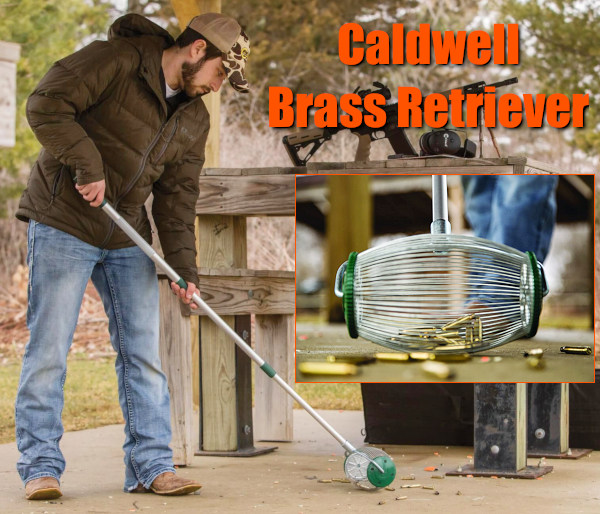
Caldwell Brass Retriever
Tired of bending over or kneeling down to retrieve your fired cartridge brass? For older shooters (including this Editor) getting down on the ground to pick up brass is tough on the lower back and knees. Here’s a product that makes brass retrieval quick, easy, and pain-free. The Caldwell Brass Retriever works quite well with a little practice, once you apply the correct pressure. While it won’t always grab every fired case, it will capture nearly all, and that can really make the job go much faster.
One owner praises this as a “very good tool” that is “a lot easier on my back.” While it can work on grass, gravel, and hard-packed earth, the unit works best on smooth, hard surfaces. Currently priced under $40, it is a good value.
Caldwell states: “Spend less time bending over and picking up brass at the range and more time shooting. The Caldwell® Brass Retriever picks up brass, saving your back and time. Picking up spent brass is as easy as pushing a mop. The Brass Retriever can pick up rifle and pistol brass quickly and efficiently. The Brass Retriever works anywhere, even on grass and gravel. The retriever comes complete with a roll cage separator that allows you to dump the collected brass into a bucket quickly. It is collapsible as well, making it convenient to transport. The retriever’s handle expands from 28″ up to 57″ tall.”
Brass Retriever Owner Reviews
Here are Amazon reviews from actual purchasers. It’s clear the device is not perfect and can miss a case or two. However, as you can see from the videos, the Brass Retriever does grab the vast majority of brass on the ground, sized .223 Rem or larger diameter. This will save time and reduces stress on your back and joints:
“This thing … does a terrific job of collecting the brass from a standing posture quickly and efficiently. It helps to have the cases on a smooth surface like concrete or dirt without a lot of vegetation. But we used it on open desert yesterday and it collected nearly every case with a single pass. It’s now a permanent piece of gear in the stuff we take when target or ground squirrel shooting.” — Hans H.
“This WILL save your back. The only drawback is you can’t overload it with brass. After couple dozen pieces (or less) it will start dropping brass while you’re attempting to collect others. That’s the limitation (one of them). There is a short learning curve (15 min.) in which you’ll learn how much brass is too much And how you need to orientate the wires to pick up the brass. It doesn’t do as well on gravel or high grass as it does on a smooth, firm surface. Even with its limitations, it’s a keeper. Just empty every dozen or so pieces and it works very well. It comes with a wire form that attaches to a bucket for easy emptying. I normally just use my fingers to spread wires and give a shake to allow the contents to fall out. Again not perfect but when used within its design capabilities, it does pretty well. I would buy again.” — Jeff M.
“It’s not perfect. But neither is using a broom or picking it up by hand. Sure, a 9mm might drop out while you’re picking up a .45 ACP. But you roll back over the 9mm and pick it up again. I now pick up my brass in a fraction of the time it used to take me and I stand upright while doing it. I should add the disclaimer that I’ve only used it to pick up handgun brass and it’s picked up everything from .22 LR to .44 Magnum. I have not tried it with rifle brass.” — Johnny C.
Specialized Tool for .22 LR Brass
NOTE: The Caldwell Brass Retriever is designed primarily to recover reloadable rifle and pistol brass, with case diameters as fat as .223 Rem or larger. Some people state it can be used for smaller .22 LR cartridges too, but there is a much better product for that.
The UniqueTek Rimfire Brass Wizard is optimized for picking up .22 LR rimfire cases. It has a smaller basket with wires spaced closer together. It can also pick up pistol and rifle cartridge brass but will hold fewer cases than the original Brass Wizard or the Caldwell Brass Retriever.
Wyoming-based Gunwerks LLC is a highly visible producer of high-grade rifles, modern optics, and rifle accessories. Gunwerks had its own television show and operated upscale long-range shooting clinics and guided hunts. Now the company may be in tough financial straights.
K2radio.com reports that: “Wells Fargo Bank has sued the Cody-based custom-rifle maker Gunwerks, LLC, for $2.8 million for unpaid loans and wants the company’s equipment, according to federal court records filed Wednesday. Gunwerks … also owes $1 million to creditors and and for unpaid sales taxes, according to the complaint by the bank and Wells Fargo Equipment Finance, Inc., through its attorneys[.]”
For full details, we recommend you read the full 5/20/2020 news story from Wyoming Radio Station KTWO (K2) in Casper, Wyoming. That report provides extensive details of the legal claims by Wells Fargo. The lawsuit was filed in U.S. District Court for the District of Wyoming. View Court Documents HERE.
Wells Fargo’s complaint alleges that Gunwerks owes the bank roughly $2.8 Million. Wells Fargo further alleges that a Gunwerks financial report reveals that Gunwerks owes approximately $622,000 in creditors’ bills. The complaint also alleges Gunwerks owes $365,000 in unpaid state sales taxes.
Wells Fargo’s Motion for a Receiver states the loan amount owed is $2,783,757.82, with interest accumulating at more than $20,000 a month.
Wells Fargo is seeking to recover and secure inventory and other Gunwerks property used as collateral for the bank’s loans. The complaint filed in Federal Court alleges: “These circumstances require the immediate appointment of a receiver to recover, salvage, and retain the value of the Collateral.”
Wells Fargo has alleged that Gunwerks has already sold part of the collateral inventory and deposited the proceeds in different banks: “The Borrower has taken control of Wells Fargo’s collateral, refuses to disclose the names and addresses of account obligors for accounts that constitute collateral for Wells Fargo and has removed and refused to remit proceeds of Wells Fargo’s collateral to prevent such collateral from being applied to the Borrower’s loans[.]”
Gunwerks has not made a public statement about the situation: “What all this means for the company’s future and its employees is unknown. A Gunwerks’ spokesman did not return calls seeking comment.” (Source KTWO Report.)
All shooters, even rimfire enthusiasts, should always wear ear protection when at the range. A typical rifle gunshot is very loud — in the region of 140 to 170 decibels (the pain threshold is 130-140 db). Without ear protection, you can permanently damage your hearing during a single shooting session. We all know older shooters who are partially deaf, or who suffer from Tinnitus, because they didn’t use earplugs or muffs when they were younger.
How Humans Hear Sounds — Amazing Video Reveals All
The human sense of hearing involves multiple delicate internal membranes, bones, organs, and nerves. Shooters understand the importance of protecting their hearing, but they may not understand the bio-mechanics of human hearing. We hear sounds through Auditory Transduction. Sound waves vibrate the ear drum (tympanic membrane), but that is only the beginning. These vibrations are passed along via tiny rocker-arm-like bones to be “processed” in a spiral chamber, the cochlea.
This remarkable VIDEO explains how humans hear sounds. We strongly recommend you take the time to watch and learn. The hearing you save may be your own!
Click Speaker Icon to turn on the video’s soundtrack.
Vibrations moving through the cochlea are separated into frequencies and then sent as neural messages to the brain. It is an astonishingly complex process, one that truly seems miraculous when you examine the bio-engineering involved. In the Video above, the process of human Auditory Transduction is explained and illustrated with 3D animation. You really should watch this amazing video. By the end you will have a new-found appreciation for your ability to hear.
Every shooter should own a pair of Electronic muffs, even if you prefer shooting with earplugs and/or standard muffs. Electronic muffs are great when you are spotting for other shooters or are working near the firing line. They let you hear ordinary conversations while still providing vital hearing protection. You can also wear ear-plugs under muffs for extra sound attenuation.
Plugs PLUS Ear-Muffs — The Benefits of “Doubling-Up” Your Hearing Protection
According to OHS Online: “The combined attenuation of an ear plug and an ear muff is not simply the algebraic sum of the performance of each individual protector. This is due to an acoustic and vibratory interaction between the ear muff and the ear plug that causes them to behave together as a system rather than as independent hearing protectors.
Generally speaking, when you combine two hearing protectors, ear muffs over ear plugs, you can expect an increase [in noise reduction] of between 3 and 10 dB over the higher-performing hearing protector. OSHA [now advises] 5 dB as the [typical] benefit offered by combining hearing protectors.” Source: OHSonline.com
Shooting Sports USA (SSUSA) has a good article on the origins and history of the National Rifle Association. This timeline feature covers the first 36 years of NRA history from 1871 to 1907. The NRA was founded in 1871, and 1907 marked the first year of Matches at Camp Perry, Ohio.
SSUSA explains the NRA’s original mission: “The NRA’s program during its youthful years centered mainly on improving marksmanship among the military. Rifle tournaments at ranges in Creedmoor (NY), Sea Girt (NJ), and Camp Perry (OH) captured the country’s spirit of nationalism and resulted in key improvements in rifles and target scoring. NRA also set standards for military rifle training and even inspired the federal government to form its own segment within the War Department to focus on promoting rifle practice among soldiers as well as civilians.”
1871 — A group of New York National Guardsmen founded the National Rifle Association to promote marksmanship training. Figures such as Capt. George Wingate had called for better rifle marksmanship to support the nation’s defense.
1872 — The NRA acquires Creed’s Farm in Long Island, New York for $26,250. Renamed “Creedmoor”, this becomes the NRA’s first range. The first match was held in 1873.
1874 — The NRA hosts its first International Match, shot at the Creedmoor Range in New York.
The First-Ever Creedmoor Challenge Match in 1874
The Irish International Shooting team arrived in New York on the 16th of September and proceeded to “take in the sights”, which was understandable, before some practice at the Creedmoor range. On September 26th they presented themselves for the match with confidence and in high spirits. The crowds that day were reported to be between 5,000 and 10,000 strong, which showed the huge support already growing for the fledgling sport in America.
The course of fire was 15 shots to each man at 800, 900, and 1000 yards. Unfortunately, the details of each mans scores at the individual distances have been lost to time but we do know that the Americans were well ahead after the 800-yard shoot. The Irish then caught up after the 900-yard and finished the 1000-yard shoot ahead by 1 point. The Americans still had one man left to shoot and it came down to his very last shot with which he scored a 4 giving the American team the win over the Irish by 3 points.
1892 — The NRA moves its Annual Matches to the Sea Girt Range in New Jersey, which was less than 60 Miles from New York City, NY. The Sea Girt Range was maintained by the New Jersey State Rifle Association, founded in 1878.
1903 — The U.S. War Department sets up a National Board for the Promotion of Rifle Practice (NBPRP). In 1903, an amendment to the War Dept. Appropriations Bill established the NBPRP to promote both Military and Civilian marksmanship. This government advisory board became the predecessor to today’s Corporation for the Promotion of Rifle Practice and Firearms Safety that now governs the CMP.
1907 — The NRA commences National Matches at Camp Perry, Ohio.
History of Camp Perry
The National Matches have been held at Camp Perry since 1907. The range is located along the shores of Lake Erie in northern Ohio near Port Clinton. The site was first acquired in 1906, in response to the need for a larger facility for military training and the NRA’s shooting programs. In 1906 Gen. Ammon B. Crichfield, Adjutant General of Ohio, ordered construction of a new shooting facility on the shores of Lake Erie, 45 miles east of Toledo, Ohio. The original land for Camp Perry was purchased in 1906, and the reservation was named after Commodore Oliver Hazard Perry, the American naval commander who won the Battle of Put-in-Bay during the War of 1812.
On August 19, 1907, Cpl. L. B. Jarrett fired the first shot at the new Camp Perry Training Site. And that year, 1907, Camp Perry held its first National Pistol and Rifle Championship events. This location has hosted the annual NRA National Matches ever since. Today, over 4,000 competitors attend the National Matches each year, making it the most popular shooting competition in the western hemisphere.
Federal legislation originally launched the National Matches. The 1903 legislation also established the National Matches, commissioned the National Trophy and provided funding to support the Matches.
Memorial Day is just five days away, and Brownells is running a big Memorial Day Sale right now to mark the occasion. You’ll find dozens of popular products at significant discounts — up to 56% Off. Save on AR Lowers/Uppers, Triggers, Optics, Chassis Systems, Magazines, Tools, Ammo and more. If you are a black rifle fan — this is a great opportunity to pick up AR-platform components and accessories at deep discounts. But you don’t want to delay too long — Brownells Memorial Day Sale runs through 11:59 pm on Monday, May 25, 2020. And take note — inventory may be limited on some of the sale items.
Looking downrange at the Ojai Valley Gun Club in Ventura County, California, where our Editors shoot.
In California, Democratic Governor Newsom has allowed local city/county officials to shut down FFLs and gun retailers by local order. Some California counties allowed gun stores to operate, but most did not, creating legal confusion and inconsistency. And because of strict California laws on ammunition sales, this has meant that the majority of Californians could not purchase ammunition, a clear violation of their Second Amendment Constitutional rights.
The Firearms Policy Coalition (FPC), Second Amendment Foundation (SAF) and California Gun Rights Foundation (CGF) challenged these gun store closures. And today we’re happy to report a big victory. After being sued in Federal District Court, the County of Ventura (population 846,000) has allowed firearm and ammunition dealers to open again. Effectively County officials conceded that their orders were unjustified and unconstitutional. See filings in the case of McDougall v. County of Ventura.
Just days before a hearing on a motion for preliminary injunction against orders banning gun stores from operating, lawyers for the County of Ventura filed documents saying the defendants* have issued a new order to re-open firearm and ammunition dealers throughout the county.
Gun Store Closures Violated Citizens’ Second Amendment Rights
“County of Ventura officials were either outrageously ignorant or arrogant to think they had the authority to redline fundamental, individual rights”, said FPC President Brandon Combs. “They should remember that they are just local officials on a power trip, not dictators, and we will continue to seek justice for their abusive constitutional violations”. Adam Kraut of the FPC added: “Ultimately, they have already admitted in court that they violated constitutionally enumerated rights”. Other Federal Courts have recently held that the Second Amendment DOES protect citizens’ right to buy guns and ammunition. (See McCarthy v. Baker, in Massachusetts District Court.)
“The facts are that the Ventura County defendants made it a crime for individuals to patronize … firearm and ammunition retailers, and worse, these government officials banned travel for firearms and ammunition as ‘non-essential’. Those are precisely the kinds of actions our Constitution was designed to protect against, so we look forward to the next phase of litigation in this lawsuit,” said the plaintiffs’ co-counsel, attorney Raymond DiGuiseppe.
“The county choosing to re-open firearm and ammunition transactions rather than face our motion in court is a victory for gun owners and the Second Amendment”. — SAF Exec. V.P. Alan Gottlieb.
Ronda N. Baldwin-Kennedy, an attorney for the plaintiffs, said that the County’s latest filing was a move to avoid losing the case early. “The defendants were obviously wrong on the law… We are delighted that this lawsuit moved the County to issue another order so that our clients and the people of Ventura County can exercise their constitutional rights”.
“Onerous California laws make access to operating gun stores a requirement to exercise your Second Amendment rights”, explained CGF Chairman Gene Hoffman. “The right to self-defense is only more important during times of crisis[.]” Individual firearm or ammunition purchasers, retailers, and ranges affected by ‘stay-home’ or shutdown orders are encouraged to report their concerns and potential civil rights violations to Firearm Policy Coalition COVID-19 Issue Hotline at FPChotline.org.
* Defendants in the case include Ventura County Sheriff William “Bill” Ayub, William T. Foley, the Director of the Ventura County Public Health Care Agency, Robert Levin, the Public Health Medical Director and Health Officer for Defendant County of Ventura, and the County of Ventura, California.
You have to admire someone with serious do-it-yourself skills. Not just hammer and nail skills, but formidable design and fabrication skills. Well Forum Member Dave D. (aka “AKShooter”) has a DIY skill set that might put some trained machinists to shame. You see, “DIY Dave” crafted his own pedestal front rest from scratch, using his own design and about $100.00 in materials (not counting the Edgewood front bag). Dave estimates he put 20 hours of labor into the project, but the end result was worth it: “This Do-It-Yourself rest drives like a dream. I’ve played with the Caldwell and a Sinclair, they have nothing on this one.”
Dave tells us: “Here is my Do-It-Yourself front rest. I wanted to show other folks who are handy that a solid front rest is doable with a bit of time — and you don’t need to spend $1000.00. (You could say this is a design for shooters with more time than money.) This is for F-Class. I was originally overwhelmed by the equipment needed, so I decided to make my own rest. I didn’t have the money for a SEB or Farley Coaxial. This is what I’ll run this season (my second as an F-Class competitor).”
We asked Dave what equipment was used to make the rest. He explained: “My brother has a CNC cutter. But most water-jet outfits would do the work for $100 or less. All the plates are tapped and screwed. I found small machine screws on eBay.” Dave says there are other ways to build a front rest: “You could do the same with a welder and plate stock for base. It’s easier to do the top out of aluminum though, with all the tapping.”
Dave enjoys fabricating his own gear, but he admits the process can be time-consuming: “I’m a DIY guy. Sometimes I wrap up a project and wonder why the heck I just spent X amount of time on it.” Dave has other projects in the works: “Another option we are making for a friend is taking a cheap front rest and bolting to a 3/4″ thick, wide MDF base and adding additional adjustment screws. The hardware store is your friend!”
On the competition front, Dave is tuning up a 6mm Dasher: “My rifle last year was a .260 Rem Savage repeater. I was about middle of the pack in my group of shooters. Just went with unsorted Bergers and Lapua brass, and had a ton of fun. Now I’m in — hook, line, and sinker. I have an unfired 6 Dasher barreled action from the folks at Kelbly’s to break in. I’m cheap, so I ended up with a Do-It-Yourself stock for the Dasher.” Hopefully Dave will send us a photo of his DIY-stocked Dasher when the gun is dialed-in and “ready to rumble”.
The 41st Edition of the Blue Book of Gun Values will be released later this month. Purchase this popular price guide through Blue Book Publications for $49.95. Or you can from order from Amazon for a few dollars more. The Blue Book of Gun Values by S.P. Fjestad is the leading gun valuation resource. There are now over 1.8 million copies in circulation worldwide. This book continues to be the “Bible” for buyers, sellers, collectors, and connoisseurs in the firearms industry. This 41st Edition is dedicated to long-time author and publisher S.P. Fjestad, who passed away in 2019.
Blue Book of Gun Values, 41st Edition, May 2020
The 41st Edition contains 2,512 pages covering nearly 1,900 manufacturers/trademarks, with almost 30,000 gun model descriptions, and over 180,000 values, with new-for-2020 data!
Review by Tom Gresham, Gun Talk Radio Host
“At some point, every gun owner asks the question, ‘What’s it worth?’ The leading reference for decades has been the Blue Book of Gun Values. Whether you are a seller, a buyer, a shopper, or just curious, this constantly-updated gold mine of research is your friend.”
Features of the new Blue Book of Gun Values:
· Includes the new 2020 makes and models, with many new handguns and rifles, and important pricing updates.
· 2,512 Pages covering nearly 1,900 manufacturers and trademarks, with almost 30,000 gun model descriptions. 60 NEW manufacturers/trademarks have been added.
· 180,000+ up-to-date values are provided — most complete resource in print.
· Important pricing updates on major trademark current, antique, and discontinued models, including Colt, Winchester, Smith & Wesson, and Ruger.
· An 80-page color Photo Percentage Grading System (PPGS) which makes firearms grading even easier and more accurate.
· More information, more values, more illustrations, and more history than any other gun price guide on the market.




 Never had a chance to hunt prairie dogs in the American west? Then check out this video. Dan Eigen, host of the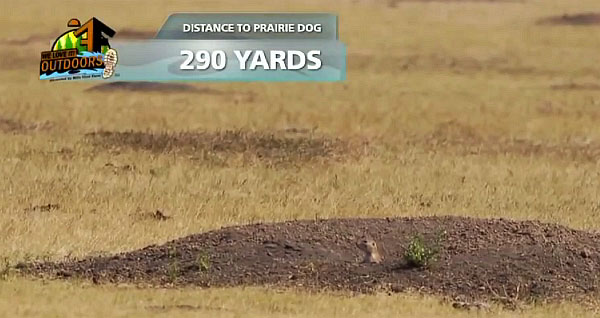


 Specialized Tool for .22 LR Brass


 All shooters, even rimfire enthusiasts, should always wear ear protection when at the range. A typical rifle gunshot is very loud — in the region of 140 to 170 decibels (the pain threshold is 130-140 db). Without ear protection, you can permanently damage your hearing during a single shooting session. We all know older shooters who are partially deaf, or who suffer from
 Plugs PLUS Ear-Muffs — The Benefits of “Doubling-Up” Your Hearing Protection





 The Firearms Policy Coalition (FPC), Second Amendment Foundation (SAF) and California Gun Rights Foundation (CGF) challenged these gun store closures. And today we’re happy to report a big victory. After being sued in Federal District Court, the County of Ventura (population 846,000) has allowed firearm and ammunition dealers to open again. Effectively County officials conceded that their orders were unjustified and unconstitutional. See filings in the case of
 You have to admire someone with serious do-it-yourself skills. Not just hammer and nail skills, but formidable design and fabrication skills. Well Forum Member Dave D. (aka “AKShooter”) has a DIY skill set that might put some trained machinists to shame. You see, “DIY Dave” crafted his own pedestal front rest from scratch, using his own design and about $100.00 in materials (not counting the Edgewood front bag). Dave estimates he put 20 hours of labor into the project, but the end result was worth it: “This Do-It-Yourself rest drives like a dream. I’ve played with the Caldwell and a Sinclair, they have nothing on this one.”


