Given the Coronovirus Pandemic, many Americans are looking to acquire handguns for personal protection, both in the home and while away from the house. Thus, many folks are looking for slim, relatively lightweight pistols that can be carried comfortably and discretely. There are dozens of carry guns on the market currently. But our friends at GunsAmerica.com have recently reviewed three of the best “micro-compact” 9mm pistols: SIG Sauer P365, Smith & Wesson Shield, and the Glock 43.
Note: There seem to be some connection issues with GunsAmerica on 4/11/20.
After looking at a variety of factors, including accuracy, reliability, ergonomics, build quality, size/weight, and price, GunsAmerica’s tester Jeff Cramblit concluded that the SIG P365 was the best of the three: “Bottom Line — The SIG P365 wins this shootout in my humble opinion. The MSRP of $599 is a bit higher than the other guns but SIG brings a bit more to the game. The outstanding grip design, higher capacity, great sights, lighter trigger pull, smaller length, light weight and just a great overall feel make it a winning product. The other two guns are great, they have been the cornerstones of concealed carry for many years, and I have personally carried both of them, but SIG has changed the game.”
Choosing a Carry Pistol — Performance, Reliability, Value
This Editor owns two SIG Sauer pistols, a P226 and P232. Both are “old school” metal-framed handguns. I can attest to their quality and reliability over many years. So I’m not surprised to see that SIG’s new P365 took top honors in this recent test. But I also think the Smith & Wesson Shield also offers excellent value for the dollar. The S&W 9mm Shield is ON SALE now for $289.99 at Palmetto State Armory.
This YouTube Video Compares the SIG P365 and the S&W Shield
Accuracy with Various Ammo
In the GunsAmerica Test, the SIG P365 had the best accuracy, based on five (5) different types of 9x19mm ammo shot off-hand at 25 yards. The SIG’s average 5-shot, 25-yard group size was 1.45″, vs. 1.7″ for the Glock 43, and 2.1″ for the S&W Shield. The P365’s accuracy edge may be due in part to its lighter, 5.1-lb trigger pull compared to 6 lbs. for the S&W Shield, and 6.25 lbs. for the Glock 43.
Dimensions — Width and Weights
Size matters — particularly when it comes to a carry pistol. The S&W Shield is the narrowest of the three guns at 1.03″ wide vs. 1.11″ for the P365 and 1.36″ for the Glock 43. Though it has the highest round capacity, the SIG P365 actually has the smallest grip circumference and grip depth. Weight-wise, the Glock 43, at 18 oz. unloaded, is the lightest. The SIG P365 is 18.8 oz., while S&W Shield is the heaviest at 20.5 oz. weight.
Capacity — SIG P365 Has the Edge
The SIG P365, holding 10+1 rounds, has the highest ammo capacity. This is remarkable as the P365 has the smallest grip circumference of the three pistols. Kudos to SIG for clever design. The S&W Shield has an 8+1 capacity, while the Glock 43 only holds 6+1. Advantage SIG.
AR-platform rifles are fun and versatile, but the standard, mil-spec triggers leave much to be desired. They tend to be gritty, with creep and heavy pull weight. One of the easiest, most effective AR upgrades is a trigger group swap. An improved fire control group makes a huge difference. There are many aftermarket trigger options for the AR platform rifles. Choose single-stage or two-stage, either standard trigger assembly or unitized “drop-in” trigger, such as those made by Timney or Triggertech.
When upgraded with a precision trigger and match barrel, AR-platform rigs work great in NRA High Power competitions (Photo from NRA Blog, at Camp Perry).
Two-Stage vs. Single-Stage Triggers
Two-stage triggers have two separate movements. The first stage offers a light, spring-loaded pressure that works against the shooter’s pull until stopping at the second stage – this is called “take-up”. If there is no spring pressure, it is known as “slack”. Should the shooter continue to pull the trigger once he’s arrived at the second stage, the mechanism will operate like a single-stage trigger from there until engaging the sear and firing the gun. Some shooters prefer a two-stage trigger because it allows a mental preparation (first stage) before the final decision to “break the shot”.
Single-stage triggers feature no take-up or slack, as they begin engaging the sear as soon as the shooter begins pulling the trigger. Some competitive shooters prefer the two-stage trigger because of the feedback it provides during its first stage, while other shooters, including those using their rifle in tactical scenarios, may want the surety of a single-stage trigger, ready to engage and fire once their finger is inside the trigger guard. Regardless of preference, a good trigger will feature minimal creep and should be free of grittiness, providing a smooth, even break.
Drop-In Trigger Assembly vs. Standard Trigger Group
Once you decide between a single-stage or two-stage trigger, you can choose between standard and drop-in trigger groups. Standard trigger groups feature all the fire control group parts separated, and need to be pieced together and installed much like a mil-spec trigger, while drop-in trigger are pre-assembled and contained within a casing that simply drops in to the receiver and accepts the pins, hence the name.
After-Market Trigger Comparison
Some shooters prefer drop-in triggers due to the ease of installation, while others opt for standard groups so they can access the components individually for cleaning adjustment or replacement. If one piece of a drop-in trigger fails, you’ll need to either replace the entire unit or send it to the manufacturer for repair, whereas you may be able to simply replace the broken component of a standard trigger without needing a whole new trigger set.
Trigger Terminology — “Creep”, “Stacking”, “Overtravel”
“Creep” or “travel” is the distance the trigger moves between the end of take-up and when the trigger breaks to fire the fun. Too much creep can affect accuracy, but no creep can be unsafe, as the shooter may not be prepared to fire. “Stacking” occurs when the trigger weight actually increases during travel — this shouldn’t happen. Lastly, “overtravel” is the distance the trigger continues moving back after the gun fires.
This article is based on a longer story in the NRA Blog.
“Garbage In, Garbage Out.” You have to input key variables with precision if you want your Ballistics Apps to deliver reliable long-range trajectories. So says Tom Beckstrand, Field Editor for Guns & Ammo magazine. A former U.S. Army Special Forces Officer, and avid long-range competitor, Beckstrand knows the importance of using your ballistic calculator correctly. Here are his tips on how to achieve the best results using Ballistics Calculators.
“The most important inputs to make any ballistic calculator work correctly are muzzle velocity, ballistic coefficient, and sight height,” says Beckstrand.
Ascertain Accurate Muzzle Velocity with a Good Chronograph
“Cheap chronographs will not give an accurate muzzle velocity, so the serious shooter needs to spend the money on a quality chrono.” When you chronograph, make sure to measure the distance from the muzzle to the chrono unit. That input is also important to your Ballistic calculations.
Use Reliable G1 and G7 Ballistic Coefficients
Beckstrand added, “Ballistic Coefficients are available from ammunition and bullet manufacturers, and most of these coefficients the manufacturers provide are really quite accurate.” Ballistic Coefficient or BC, is a number that reflects how well a bullet cuts through the air. The higher the BC, the less the bullet is affected by air drag.
Measure Sight Height Correctly Using Calipers
Beckstrand has found that many shooters aren’t inputting sight height or they are guessing at the correct height. As target distance increases, just a half-inch of sight height inaccuracy can mean several inches up or down.
“Sight height is the input most often overlooked and is usually the source of greatest error. I think a lot of shooters, especially those new to long-range shooting, simply don’t understand the importance of this input.”
Sight height is the distance from the centerline of the scope to the centerline of the bore. Some shooters, Beckstrand believes, just “eye it up” and estimate the distance. “Really, you should use a set of calipers to measure the sight height distance … within 0.1 inch”.
This Video Explains How to Set Up and Use Ballistic AE:
Need a top-notch Ballistics App for your iPhone, iPad, or iPod? Start with Ballistic AE, the number 1 (i.e. most installed) App for iOS systems. Ballistics AE (Advanced Edition) is the most popular iOS ballistics program for many good reasons. Full-featured and easy to use, Ballistics AE has been refined over many years, and it supplies rock-solid solutions derived from JBM Ballistics solver (created by James B. Millard). Unlike some other Apps, Ballistics AE is STABLE on iPhones (with various OS levels). What’s cool is that Ballistics AE is now on sale for just $9.99.
We’ve used the Ballistic AE program on an iPhone 5S, iPhone 6, and iPad, and it performed well. Here are some of the features we liked:
1. Mirrors output from online version of JBM Ballistics we often use for initial calculations.
2. Controls are simple to use and (mostly) intuitive.
3. Handy comparison feature lets you compare ballistics for different projectiles side by side.
4. Advanced Wind Kit allows you to account for complex wind situations.
5. Projectile and BC Databases are very comprehensive.
6. Software is regularly updated to match Apple OS changes.
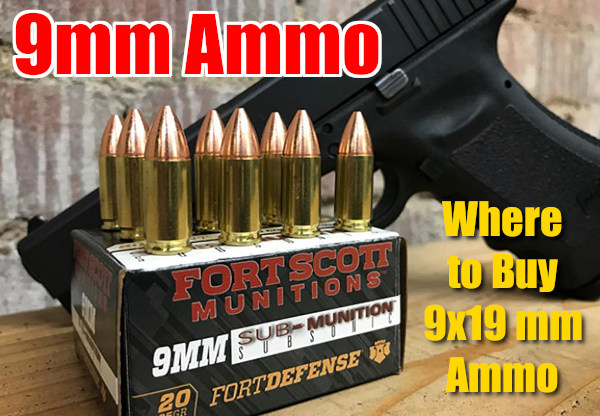
Fort Scott Munitions produces 9mm Luger ammo with lead-free solid copper bullets. Shown here is specialized subsonic ammo designed to be used with a suppressor. See FortScottMunitions.com.
The 9mm Luger, aka 9x19mm, is the most popular ammunition type for semi-automatic handguns. As such, with panic buying caused by the Coronavirus pandemic, 9mm ammo is becoming harder to find — or the ammo vendors have jacked up their prices. We found most of the bulk 9mm FMJ out of stock. However, you can still find defensive hollowpoint ammo.
Thankfully, many large vendors such as Brownells, Natchez, and MidwayUSA still have 9mm pistol ammo in stock at reasonable prices. If you can’t find what you need from these vendors, you can source many other ammo retailers via AmmoSeek.com. In addition, Sportsman’s Warehouse has limited 9mm ammo for in-store pick-up in some stores (search online for particular store availablity).
Here are three leading sources for 9mm Luger (9x19mm pistol) ammo. Natchez still has bulk, lower cost lead-core FMJ ammo. Elsewhere cheap 9mm FMJ is mostly sold out, but you can still get 20- or 25-round boxes of defensive ammunition. This stuff is expensive for target practice, to be sure, but at least it can be found.
1. MidwayUSA 9mm Ammo in Stock
Midway USA has quite a bit of hollow-point 9mm luger defensive ammo Available. CLICK HERE to see items in stock, or go to the Midway USA home page and search for “9mm Luger Ammunition”.
2. Natchez Shooters Supplies 9mm Ammo in Stock
As of the time of publication, Natchez Shooters Supplies still has large 1000-round boxes of 9mm FMJ ammunition from CCI and Fiocchi. If you want big quanities of target practice ammo — grab these while you can. In addition, Natchez has NovX defensive ammo.
3. Brownells 9mm Ammo in Stock
Brownells still has a limited selection of 9mm Luger ammunition in stock. Most of the cheaper bulk 9mm is sold out, but here are a few of the brands available on April 10, 2020 at time of publication.
Need a 9mm Pistol? Consider the Walther Creed — Great Value
Need a 9mm carry pistol? The Walther Creed offers excellent ergonomics, good accuracy, and well-designed controls at a killer price — $269.99 at CDNN Sports. This gun, designed to be a value-leader, emulates Walther’s more expensive PPQ model (MSRP $649.00) at a much lower price. The Creed’s frame size and shape is the same as the PPQ, but the Creed lacks interchangeable backstraps. Slide and trigger are very similar. The Creed features a snag-free bobbed hammer. Testers have praised the new Creed, saying that, despite the bargain price, it “sacrifices little to nothing in… ergonomics, accuracy, and reliability.”
As folks are stuck at home with the Pandemic lock-downs, many guys are thinking about projects involving their AR-15s sitting in their safes. We’ve seen some threads in our Forum asking about the .224 Valkyrie, an AR-centric cartridge that offers significantly better long-range performance than the .223 Remington (5.56×45). If you own a .224 Valkyrie, or are thinking about adding a .224 Valkyrie upper to your MSR (Modern Sporting Rifle) arsensal, here is load information from industry leaders Hodgdon and Sierra.
With the 90gr SMK (or similar High-BC projectiles), the .224 Valkyrie offers ballistics similar to the 6.5 Creedmoor but with significantly less felt recoil.
Hodgdon has reloading data for the .224 Valkyrie, a popular new cartridge optimized for the AR15 platform. “At Hodgdon, we’ve been researching this cartridge since before its introduction and are excited to release load data for the Valkyrie featuring powders like Hodgdon CFE 223, IMR 8208 XBR, and Hodgdon Varget” reports Ron Reiber, Hodgdon product manager/ballistician. Access the .224 Valkyrie Data via Hodgdon’s Reloading Data Center.
While new load data will continue to be updated, there is currently data for 80 different loads with bullet weights ranging from 50 to 90 grains. NOTE: The load data covers Hodgdon, IMR, and Winchester brand powders only. See Sierra Data for other powder brands. Bullet brands included are: Federal, Hornady, Nosler, Sierra and Swift.
About the .224 Valkyrie Cartridge
Basically a 6.8 SPC necked down to .22, the Valkyrie has a shorter case than the .223 Remington (and 5.56×45 NATO). This allows you to load the longest, heaviest .224-caliber bullets and still feed reliably from an AR15-type magazine. Designed to rival the .22 Nosler while still running well in ARs, the .224 Valkyrie offers excellent long-range performance when loaded with modern, high-BC bullets. We expect some bolt-action PRS shooters might adopt the .224 Valkyrie. Why? Reduced recoil. With the 90gr SMK, the .224 Valkyrie offers ballistics similar to the 6.5 Creedmoor but with significantly less felt recoil.
The new .224 Valkyrie has already developed a loyal following: “Shooting heavier bullets in an AR-platform rifle that maintain supersonic speeds beyond 1,300 yards has captured the interest of shooters and handloaders everywhere” — Hodgdon Powders
Our friend Gavin Gear of Ultimate Reloader.com found a superbly accurate load with Berger 80.5gr bullets.
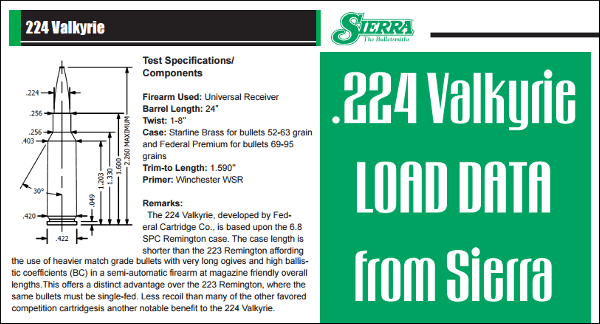
IMPORTANT: Check Out Sierra’s .224 Valkyrie DATA
Sierra Bullets has also published extensive load data for the .224 Valkyrie. This covers over a dozen powder types — many more than the Hodgdon database. Sierra’s .224 Valkyrie load data covers projectiles from 50 grain all the way up to 95 grains. With the 90 to 95 grain bullets, the little Valkyrie can give 6mm match cartridges a real run for their money — offering similar ballistics with less recoil. When selecting a barrel for the long .224-cal bullets, specify a fast enough twist rate: “Sierra recommends a 1:6.5″-twist barrel for the #9290 22 cal 90 gr HPBT bullet. However, for cartridges like the Valkyrie, that can push them over 2650 fps muzzle velocity, a 1:7″-twist barrel will stabilize the bullet correctly.”
Due to concerns about the Coronavirus Pandemic, large numbers of Americans are acquiring firearms for self-protection. Many of these citizens are purchasing a gun for the first time. It is important that these new gun owners learn about gun safety and responsible gun storage.
The National Shooting Sports Foundation (NSSF) has released a new Infographic for first-time gun owners. If you recently purchased your first firearm, we recommend you review this document. Additionally NSSF released a new Firearm Storage and Safety Assessment Quiz. This walks gun owners through questions related to safe handling and storage of firearms. The Quiz also links to helpful gun safety resources.
Below is the latest NSSF Infographic for new gun owners. This provides questions to ask before buying a gun, plus information on safe gun storage at home. This Infographic is part of a large collection of NSSF Resources for New Gun Owners. Among those resources you will find links to gun storage options, training videos, guidance on talking to children about gun safety, and much more.
Here’s the NSSF Infographic for New Gun Owners. CLICK HERE for the Interactive Version. On that Interactive PDF, click on the smaller buttons to get additional information, or to watch related videos.
Sadly, this year the “Zombie Pandemic” 3-Gun match in Nebraska has been replaced with a true health pandemic, one of the greatest challenges facing the United States since WWII. Due to the public health measures in response to the spread of the Coronavirus. The event organizers issued this statement:
“The Hornady 2020 Zombies in the Heartland 3-Gun Match has been canceled due to the ongoing challenges presented by COVID-19. Although the match wouldn’t have taken place until May 28-31 at the Heartland Public Shooting Park in Grand Island, current health and safety protocols would have precluded preparing the range for the event. Hornady and the Heartland Public Shooting Park plan to resume the battle against the zombie scourge in 2021.
Refunds will be issued by the City of Grand Island to all registered shooters, but please be patient as this will take some time. Hornady is also working with companies to return prizes and cash sponsorships. Should there be any questions, please contact the shooting park directly.”
About the Zombies in the Heartland Match
For many years, Hornady has hosted the popular Zombies in the Heartland event. This “Pandemic” 3-Gun fun match, one of the biggest three-gun shoots in the nation, was to be held at the Heartland Public Shooting Park in Grand Island, Nebraska. The Pandemic traditionally has a rich prize table worth over $150,000. Prizes included pistols, rifles, shotguns, scopes, AR uppers, gun parts, and gear of all kinds.
The Pandemic was a veritable theme park for shootists, with many fun stages and innovative targets. Many unique, reactive zombie targets were developed specifically for this match. The use of paper targets was minimized — so it was mostly “bang and clang”.
Shotguns, rifles, and handguns were used on most stages, which feature handgun targets from 1-15 yards, shotgun targets from 10-20 yards, and rifle targets from 1-200 yards. There were also side matches with full-auto demo firearms, exploding targets, specialty targets.
This video from 2017 offers a Shooter’s POV views of many stages including full auto:
Operated by the Grand Island Parks and Recreation Department, the Heartland Public Shooting Park is the largest and most complete public shooting facility in the Midwest. For more information, call 308-385-5048.
OK guys, you probably want to keep this page confidential. Your spouse probably doesn’t want to be reminded about all the times you ignored the “Honey Do” list and headed off to the range instead. And she certainly doesn’t want to know how much you spend every year on your gun hobby.
Answer these two polls to see how dedicated (or should we say “obsessed”) a gun guy you really are. Once you vote you can see how your shooting (and spending) habits compare to other readers. Full results display after you select an answer and click the “Vote” button.
Click to vote in our current Readers’ polls.
Click “View Results” to see what other readers have selected.
The rifle cartridge money clip is a real product from ReleaseMeCreations.com. You can, of course, make your own cartridge money clip with a Dremel tool for free.
Want to see new-born Pandas? No, not the furry kind — rather Stolle Panda actions produced with state-of-the-art CNC machinery. If you’ve ever wondered how precision benchrest, long-range, and tactical rifles are built, check out video from Kelbly’s. You’ll see actions finished, barrels chambered and crowned, pillars installed in stocks, barreled actions bedded, plus a host of other services performed by Kelbly’s gunsmiths and machinists.
If you’re a fan of fine machine-work, this video should be both informative and entertaining. You can see how precision gun work is done with 21st-Century technology. Tip of the hat to Ian Kelbly and crew for producing this excellent video visit to the Kelbly’s production center.
Click Volume Control to Activate Sound for Kelbly’s Video:
Stuck at home because of the Covid-19 Pandemic? Here’s a project you can craft at home pretty easily. And your shooting buddies will be inpressed with your ingenuity. Plus the wife won’t mind having a spare knife-holder for the kitchen.
Forum member Alex W. (aka “zfastmalibu”) came up with a clever adaptation of an item you may already have on your kitchen counter. By drilling a few strategically-placed holes in a wood knife-holding block, Alex created a handy, 20-round ammo holder for the bench. We’re not sure the wife will appreciate the new holes in her kitchen accessory, but we think this is a smart invention. Alex asked fellow Forum members: “What do you think, is there a market for it?” We think there is. Of course, with a ruler and an electric drill you could probably make your own version easily enough.
Get a Solid Wood Knife Block for under $25.00 Hardwood Knife blocks can be purchased for under $25.00 through Amazon.com. They are also available in bamboo ($18.14), beechwood ($39.95), acacia ($49.95), and solid walnut ($59.95).


 Dimensions — Width and Weights






 About the Zombies in the Heartland Match


