Editor’s Comment: Here’s the bottom line folks — unless we bring in new shooters, we will lose our rights, and lose our ranges. It’s that simple. If you enjoy shooting and hunting, and believe in the Second Amendment, make a commitment to introduce at least one new person to the shooting sports this year. That’s the mission of the NSSF’s +ONE (“Plus One”) program.
For the shooting sports to thrive, we need to get new people involved in marksmanship and competitive shooting. Unless we add new shooters, we can expect more range closures, and more political attacks on our gun rights. The goal of the +ONE campaign is to build the ranks of shooters. The idea is basic — make a commitment to act as a MENTOR and encourage at least ONE new person to get involved. As the NSSF says: “If just one in three of America’s recreational shooters adds one new person to the shooting sports, we’ll secure a strong future for generations to come.”
The +ONE Movement — The Mission
The goal of the +ONE program is to provide mentors for new shooters: “We all know that getting involved in hunting and the shooting sports can be a challenge for people who have never gone before,” said NSSF President Joe Bartozzi. “Having a mentor at your side makes it much easier for someone to get started. With the +ONE Movement, we’re challenging every hunter and target shooter in America to introduce at least one new person to the sports we love.”
These Videos Explain How to Get New Shooters Involved:
Learn more about the NSSF’s +ONE Movement at LetsGoShooting.org and LetsGoHunting.org. Those sites offer how-to articles and videos, along with tips on getting folks involved in the shooting sports (and hunting). But honestly, the websites are only an invitation. For this program to succeed, each of us needs to make a commitment to mentoring a new shooter in 2020.
Sako has a new S20 line of “hybrid” rifles. These feature an internal aluminum chassis, adjustable trigger, and integral Picatinny rail on top. Users can change fore-ends and rear sections to suit different disciplines. Use the rifle for a PRS match one weekend and hunt with it the next. Sako states: “The user will be able to switch between the stocks and fore-ends quickly and easily and can change the rifle from a tactical to a hunting rifle or vice versa in a matter of minutes with no need to re-zero optics after assembly. The stocks can be taken down easily by loosening up two screws between the rear stock and fore-end.” Both 20″ and 24″ barrel versions will be offered, with a wide variety of chamberings: .243 Win, 6.5 Creedmoor, 6.5 PRC, .270 Win, 7mm Rem Mag, .308 Win, .30-06 Sprg, .300 Win Mag.
Unboxing Video of New S20 with Thumbhole Hunter Stock
This S20 “first look” video was created by the UK Fieldsports channel. The reviewer was impressed with the S20’s interchangeable stock system: “The modularity allows the rifle to be configured to the shooter’s preferences with different rear stocks and fore-ends. At launch, Sako introduced both the tactical precision stock and the ergonomic hunting stock, the latter being an improved version of a traditional thumbhole stock more like a pistol grip. Switching between rear stocks is fast and easy, virtually changing the rifle from a target rifle to a hunting rifle, or vice versa, with the correct grip, in a matter of minutes.”
The S20’s aluminum chassis is covered by a strong but comfortable outer shell material that Sako calls H.I.R. – High Impact Resistant. The same H.I.R. material is used on car dashboards. The outer shell is currently offered in two styles — a thumbhole hunter (photo below) and a more tactical style with straight toe and conventional grip.
The Picatinny rail is machined directly on the receiver. The S20 action features a 3-lug bolt with 60° bolt throw. Sako says the “high locking-lug surface area increases both safety and performance.” The full length of the action mates with a matching V-bed in the aluminum chassis.
Full Adjustability — Even Trigger Position
Adjustable ergonomics are a big part of the S20 design. The multi-adjustable trigger (available in both single-stage and two-stage variants) can be moved backwards or forwards to better fit different hand sizes. An adjustable cheek piece and LOP spacers help provide a proper fit.
M-Lok System Allows Easy Mounting of Accessories
The new Sako S20 can accept a wide range of accessories, attached via aluminum M-LOK placements. Sako-made accessories include Rear Mono-Pod, Barricade Stop, and Thumbrest. And yes Sako threads the muzzles 5/8×24 for use with brakes and suppressors. This video shows how accessories mount:
The Sako S20 features a full aluminum chassis under a comfortable composite exterior. Watch this video to see how the S20’s barreled action fits in the chassis.
March is just four days away. That means the spring shooting season will soon be starting. Before you head to the range for the first time, we recommend you do some basic tasks with your firearms. Here’s some good advice on readying your rifles for the 2020 shooting season.
by Ron Dague, Sinclair International I give my rifles a pre-season check before the shooting season starts. This starts with a general inspection starting with the butt-plate or recoil pad and making sure that all the screws and adjustable parts (on an adjustable butt-plate) move freely up or down and side to side. If you got caught in rain some of these screws and adjustable parts may not move when needed. I disassemble parts as needed and put rust preventative or a light oil and/or grease on threads and sliding parts. On rifles with recoil pads and fixed butt-plates, make sure the screws are tight and that holes in the stock aren’t stripped out. Make sure there are no cracks in the stock and around the butt-plate. If the recoil pad is glued-on, just make sure it hasn’t come loose.
Next I take the action out of the stock and check for cracks and wear marks. I look at the bedding to make sure that oils and cleaning solvents have not damaged the bedding. While the action is out of the stock, I look for any surface rust or dirt/dust in the recoil lug area and magazine well. Clean as needed and repair or re-bed if needed.
Trigger Assembly and Action With the barreled action out of the stock, it is a good time to spray out the trigger with cleaner. I use Ronson oil or lighter fluid. [Editor’s Note: Some trigger-makers advise against using any kind of lubricant, grease or oil — so plain lighter fluid is preferred.] After the trigger is cleaned you may want to check the trigger pull weight. If you don’t feel comfortable doing this, take it to a gun smith and have it checked. It is worth every penny to not have a trigger issue and/or a safety malfunction. I also take the bolt apart and clean the firing pin spring and bolt housing with Gun Scrubber or automotive brake cleaner. Then lube the firing pin-spring and firing pin with light oil. I use Kel Lube and/or Butch’s gun oil. Put a small dab of gun grease on the [bolt locking lugs] and cocking ramp.
I will also spray the outside of the action and barrel and give that a light coating of oil for rust prevention. I clean the action with Sinclair’s action cleaning tool. Don’t forget to clean the bore. Even though you didn’t fire the rifle, this makes sure nothing obstructs your barrel.
Checking Metal Fixtures and Fasteners Next I look at the trigger guard and hinged floor plate and make sure it works as designed. Make sure there are no cracks in the trigger guard from an accidental drop. Check guard screws and /or action screws for tightness and tighten to proper spec. There are torque specs for this, but on wood stocks the wood can crush and this should be checked throughout the year as weather change can affect this. My entire collection of rifles are bedded and I just tighten them just snug with screw driver or Allen wrench. The rimfire rifles have a spec of 55 to 74 inch/lbs and I think would carry over to center fire as well. I would caution you about torque wrenches as you need a good quality wrench, and read the directions on how to use it. You can over torque if not careful. Check the swivel studs and bipod to make sure there tight as well. You may want to take scope off and check the base screws and check the rings.
Test Fire the Rifle After Maintenance
After all cleaning and is done and everything is reassembled, take a few rounds out to the range and test fire to make sure everything works as it should. Don’t forget to run 3-5 rounds through the magazine at least two times for function. I look at this as preventive maintenance on the rifle. If you give it a look over you shouldn’t have any trouble during the rifle matches or hunting trip.
Ron Dague
Certified Reloading Instructor
Certified Range Safety Officer
Email: rond [at] sinclairintl.com
Phone: 800-717-8211
This Article Originally Appeared in Sinclair International’s The Reloading Press.
We think everyone should have a .22 LR pistol or revolver (and probably both). Whether for plinking, target shooting, or “back-up” self-defense, a good .22 can perform a multitude of roles. Today, with the help of YouTube reviewers, we look at a variety of .22 LR pistols, focusing on compact .22s that can serve for self-protection, as well as plinking fun.
Can a .22 LR be an effective defense weapon? One retired officer posted: “As a police officer I saw more people killed by .22 or small caliber than with a 9mm or larger. I would not want to be shot by one. The benefits I see are minimal recoil, the ability to conceal, easier follow-up shots, [and] cheap ammo meaning more range time and training.”
Top .22 LR Handguns for Self-Defense — Video Reviews
22 Plinkster has shot hundreds of thousands of .22 LR rounds, through dozens of .22 LR handguns and rifles. Here are his “Pick Six” of compact .22 LR handguns that can work for self-defense. All of these pistols are compact and relatively light-weight. 22 Plinkster adds: “I didn’t list a few handguns in this video for a few reasons. Yes, there are other great options out there, but other guns can’t be concealed as easy as the guns that are in this video. Pistols like the Walther PPQ or the Taurus TX22 will make my top 5 list, just not this one.”
This lengthy 53-minute video reviews over a dozen semi-auto .22 LR Pistols. This is one of the most comprehensive comparison on the internet. The reviewers compare the new Glock 44 with many other options on the market, including rimfire pistols from Beretta, Ruger, SIG Sauer, Smith & Wesson, Taurus, Walther and more. Target-style pistols are reviewed as well as smaller carry-style .22 LR pistols.
This video is another round-up with ten different .22 LR handguns. There are semi-autos from Beretta, Ruger, Smith & Wesson, and Walther. This video also features the tiny North American Arms .22 revolver, the classic S&W Model 63 revolver, and the Ruger LCR-22 compact carry revolver. The reviewer praised the Ruger SR22, which his wife carries. He says the “SR22 has so far been flawless — not one misfire. It is incredibly accurate and reliable. At only 0.9″ thick it is very conceable”.
The Effectiveness of .22 LR Round is Under-Rated
The folks from Lucky Gunner state: “Pocket pistols and revolvers chambered for the humble .22 LR are easily dismissed as carry guns suitable only for novices and the elderly. While there are some definite drawbacks to relying on a small gun that fires small bullets for self-defense, it also may have significant advantages that even skilled and experienced shooters can benefit from.” This video has been viewed over 1.5 million times.
.22 LR Mini-Mag Tested in Ballistic Gel — You May Be Surprised
Here are two videos that reveal how a .22 LR Mini-Mag performs in test gel. In both videos, testers shoot the CCI .22 Mini-Mag into Ballistic Gel. The results are pretty impressive. This is still a .22 LR cartridge, but the potent Mini-Mag packs some punch, particularly at close ranges.
Yes a larger centerfire round carries more energy. But the Mini-Mag can do the job. One knowledgeable YouTube commenter, a retired LEO with 41 years of service, stated: “NEVER underestimate the power of a .22 CCI Mini-Mag. During my career, when working with a Medical Examiner, I [witnessed] bodies riddled with a .22. I don’t have to paint GORY details.”
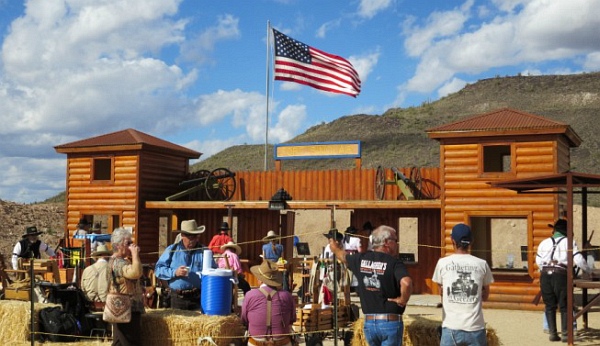
Earlier this month the Ben Avery Range in Phoenix hosted America’s top long-range shooters at the Berger SW Nationals. This week, Feb. 24 – March 1, 2020, over 1000 cowboys and cowgirls take over Ben Avery during Winter Range, the SASS National Championship for Cowboy Action Shooting. Winter Range is the second largest Cowboy Action event of the year, after End of Trail, the Single Action Shooting Society World Championship held each year in Edgewood, New Mexico.
If you want to check out the action at Winter Range, admission is free. The Ben Avery Shooting Facility is located on Carefree Highway, west of Interstate 17. For more information, visit WinterRange.com.
This video, produced by the Arizona Fish and Game Commission, covers the full Winter Range experience, including the main shooting competitions, the side matches, the Western costumes, the socializing, and more. Worth watching if you like action shooting or are a fan of the Wild West.
Hundreds of cowboy action shooters, ages 12-80, will compete in multiple classifications based on age, and type/caliber of firearms. In addition, this year the Cowboy Mounted Shooting Association and the SASS Mounted Shooters will hold a two-day mounted shooting event February 29 through March 1, in nearby Queen Creek, Arizona.
Cowboy Action Shooting requires that contestants compete with firearms typical of those used in the taming of the Old West: single-action revolvers, lever-action rifles, and period shotguns. Participants each have a registered cowboy shooting alias (such as “Deadeye Dave”), used in SASS events. Competitors, organized in “Posses”, shoot a series of multi-gun stages. In addition to the primary competitions, Winter Range 2020 will feature displays of period militaria, exhibitions of western skills and crafts, a fast-draw contest, and nearly 100 vendors selling vintage-style clothing and “sundries”.
Ranges have re-opened in many places, albeit with some social distancing requirements or other health precautions. When you head to the range you’ll want to be prepared. That means collecting all the gear you’ll need at the range. It’s easy to forget small, critical items, so we’ve provided a checklist of the small “extras” you should pack before you head out to the range. In addition to rifle, rests, ammo, targets, and cleaning gear, here are a dozen essentials you should include in your range bag.
• Shell-Holder — If you don’t have calipers, you can use a shell-holder to check for excessive case expansion from hot loads. If a fired case doesn’t slip into the shell-holder easily, your load is definitely TOO HOT.
• Extra Earplugs — Always use ear protection when shooting. We bring a 35mm film canister with extra sets of foam earplugs.
• Hex Wrench or Screwdriver for action screws — Action screws can work loose with time. Always bring the appropriate hex wrench or screwdriver whenever you go to the range.
• Small Wrench for Scope Rings — Check the tension of your scope base and ring fasteners before you go. Bring along a small Torx wrench for the ring screws (or other tool that fits your fasteners).
• Normal and Under-sized Jags — It is often wise to use one-caliber undersize jags when applying solvent with cotton patches. You should have a couple sizes in your range kit.
• Extra Batteries — Bring extra batteries for all your electronic gear — which can include chronograph, windmeter, digital camera, GPS etc.
• Small Notebook and Pen or Pencil — Use the notebook to record chron data, log group sizes, and make notes about wind and weather conditions.
• Adhesive dots — Bring a few sheets of adhesive dots (sold at office supply stores). Use small white or black dots as target pasters. Use larger red or orange dots as aiming points (target centers).
• Folding Chair or Camp Stool — This comes in handy if you’re spotting for another shooter, or if you reload away from the firing line.
• Water Bottle — You can’t shoot well if you’re dehydrated. Bring at least two quarts of water with you and keep a bottle at the bench.
• Surveyors’ Tape and Wood Stakes — You can make inexpensive wind indicators using surveyors’ tape attached to the top of wood stakes.
• Small Plastic Ruler — Use this to measure your group sizes. A transparent (see-through) ruler works best. Rulers are also useful for drawing lines on targets.
This list is not intended to be exclusive. There are many other items you may wish to include. Obviously bring safety glasses, and Sharpie-type pens are always handy to mark targets. We invite our readers to add other “essentials” to the list. The important thing is to plan ahead, packing your key items before you drive to the range.
At the request of our readers, we provide select “Deals of the Week”. Every Sunday afternoon or Monday morning we offer our Best Bargain selections. Here are some of the best deals on firearms, hardware, reloading components, optics, and shooting accessories. Be aware that sale prices are subject to change, and once clearance inventory is sold, it’s gone for good. You snooze you lose.
1. Sportsman’s Warehouse — Primer SALE, 30-42% Off
Editor’s Note: This primer sale proved one of our more popular Deals-of-the-Week ever, so we are repeating it. But act soon — we don’t know how long these prices will last.
Finding primers is still tough and getting them on sale (at huge discounts) is even harder. But right now, for a limited time, you can save up to 42% on Major Brand primers at Sportsman’s Warehouse. All types of CCI, Federal, Remington, and Winchester primers are on sale, including hard-to-find Federal 205Ms and CCI 450s. And yes, pistol and shotshell primers are on sale too. These are GREAT prices — stock up now! NOTE: Some primers are limited to 10 boxes (1000 primers) per order. However, one of our Editors just got 10,000 Fed 210M primers — saving over $80 compared to the best price he found elsewhere!
2. Midsouth — Rock Chucker Supreme Reloading Kit, $279.49
Everything you see above can be yours for just $279.49. Great Deal. Right now, Midsouth is selling the Rock Chucker Supreme Master Reloading Kit for $279.49, a fine price considering all the hardware you get: Press, Primer Tool, Scale, Powder Measure, Loading Tray, Reloading Manual and more. Heck, the Rock Chucker press alone retails for $165.00+. This is good starter kit for any reloader, with sturdy items (such as the Rock Chucker press), that will last a lifetime.
3. EuroOptic — Nikon BLACK Riflescope Closeout Sale
Nikon’s decision to stop selling riflescopes shocked many in the industry. However, Nikon’s exit from the scope marketplace has created an amazing opportunity. If you’re in the market for a tactical scope, check out EuroOptic’s Nikon BLACK riflescope sale. EuroOptic has a big selection at prices up to 47% off. Choose MOA or MRAD versions with a variety of reticle options. NOTE: These BLACK Nikons are quality scopes that have performed well in the field. You’d have to pay hundreds more to do much better.
This package deal includes a Bushnell 3.5-10x36mm scope and 200 rounds of CCI .17 HMR varmint ammo. The optic, with 1/4-MOA clicks and front parallax control, includes three interchangeable BDC turrets. Optimized for Savage’s A17 rifle, this 2650 fps ammo is 100 fps faster than most other 17 HMR loads with 17gr bullet weight. This is a great package bargain — 200 rounds of CCI A17 ammo retails for $46.99 by itself, so you’re getting the scope and extra turrets for just $33.00!
5. Cabela’s — Ruger 10/22 Carbine, $179.97
Shooting .22 LR is more popular than ever. With its low cost and wealth of aftermarket accessories, the Ruger 10/22 still dominates the .22 LR entry-level rifle market. Right now, Cabela’s offers the Ruger 10/22 Carbine (blued barrel, gray stock, no sights) for a super-low $179.97 price. A basic 10/22 rifle is $249.99 at MidwayUSA so you can see Cabela’s is offering a great deal.
6. Amazon — Wheeler Digital Trigger Pull Gauge, $53.83
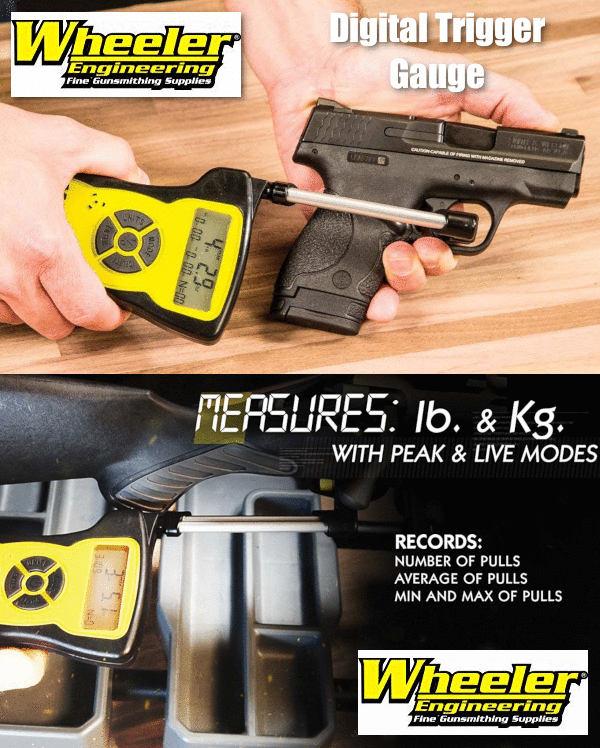
Every serious shooter should have a good trigger gauge. The Wheeler digital trigger gauge is precise and repeatable, measuring pull weights up to 12 pounds, making it suitable for all types of firearms. The load cell directly contacts the trigger making it extremely accurate with +/- 0.2 ounce precision. There are two modes: “Peak” and “Live.” Peak mode shows max force for each pull and calculates the minimum, maximum and average pull weights. Live mode continuously shows the force on the sensor. It even has a special adapter for Savage-style triggers with bladed inserts.
7. Amazon — Range Station for Pistol Shooters, $29.99
The Range Station combines an ammo compartment with a roll-out mat. Great idea. Some gun ranges only have concrete benches, or shooting stations with horizontal surfaces covered with dirt, powder residues, and other debris. You don’t want to put your $2000 Colt Python on that mess. The 12″x24″ Padded Gun Mat stays put on the bench-top. The case snaps to either the right or left side of the mat. Interior trays are sized for standard ammo boxes and magazines. Separate compartments hold smaller range gear such as rulers, target markers, and more. When finished, the mat can be rolled and stored neatly in the case. This handy Range Station is $29.99 on Amazon.
8. MidwayUSA — Dogtown Ammo, $21.24 for 50 rounds
Dogtown Ammo, made with Nosler tipped FB bullets, offers great “bang for the buck” for .223 Rem shooters, particularly high-volume varminters. Right now get 50 rounds for just $21.24 (43¢/rd). Or order 200 rounds for $86.99 (42¢/rd). Forum member NDAE15MAN states: “This stuff shoots in all of my .223 Rem guns — 7/8″ to 1″ at 100 yards. Best kept secret for ammo. Shoot exact same groups as Black Hills.” NOTE: MidwayUSA also sells .204 Ruger Dogtown Ammo with 32gr tipped flat-base bullets.
9. Amazon — MTM Cleaning Rod Case, $22.89
Good cleaning rods are expensive and can be easily damaged if you’re not careful. To protect those valuable cleaning rods, we recommend the MTM cleaning rod case which holds four rods as well as cleaning supplies. This case protects your rods both at home and while traveling. With this handy, durable case you can stop worrying about bending or breaking those important cleaning rods.
10. Amazon — Two Rolls of 3″ Neon Target Stickers, $12.99
We like these bright, Neon 3″ target stickers. They are big enough to see easily at 600 yards, giving you a 1/2 MOA target center at that distance. For $12.99 at Amazon.com, you get 250 3″-diameter self-adhesive centers (125 targets per roll) that stick to almost any surface The high-contrast fluorescent red/orange color provides an excellent HI-VIZ aiming point, along with good contrast for bullet holes that fall within the 3″ circle. To help line up your reticle cross-hairs, the target centers feature black markers at 3, 6, 9, and 12 0’Clock. NOTE: These stickers may qualify for FREE Shipping with combined orders over $25.00.
When we first ran this story a while back, it spurred a hot debate, with strong opinions on both sides of the issue. Some guys argued vehemently that volumetric powder dispensing was best — citing the experience of short-range benchresters, most of whom still throw their charges. Others say weighing your charges is best, so long as you have a very precise, and very repeatable scale. Many of the top F-Class and 1000-yard shooters now weigh their charges to the kernel.
Most competitive long-range shooters weigh powder charges for their handloads. Some even use ultra-precise magnetic force restoration scales to load to single-kernel tolerances. But is weight-based measuring always the best way to fill a case with powder? Another option is volumetric charging. This method fills a precisely-sized cavity with powder and then dumps the charge into the case. A Harrell’s rotary powder measure works this way, as does the sliding powder filler on a Dillon progressive press.
For long-range applications, most people believe that precise weighing of powder charges is the best way to achieve optimal accuracy and low ES/SD. However, those short-range Benchrest guys do pretty darn well with their thrown charges, at least at 100 and 200 yards.
Our friend Dennis Santiago recently observed something that made him scratch his head and wonder about weighing charges. His AR-15 match rifle shot better with volumetric (cavity-measured) charges than with weighed charges dispensed by an RCBS ChargeMaster. Here’s what he reports:
Cavity vs. Dribble (Dennis Santiago Report) I had the chance to compare nominally identical ammunition loaded two ways. These were all .223 Remington match loads using 77gr Sierra Match Kings over 23.4 grains of Hodgdon Varget. Same gun. However I loaded some ammo with charges dispensed with a Lee cavity-style powder measure while other rounds were loaded with powder weighed/dispensed by an RCBS ChargeMaster. The cavity-drop ammo (with powder dropped from the Lee unit) was consistently better than the weighed-charge ammo. I have no idea why…
So, ladies and gentlemen — what do you think? Why did Mr. Santiago’s volumetrically-charged ammo shoot better than ammo filled with weighed charges? What’s your theory? Gary Eliseo suspects that Dennis’s Chargemaster might have been drifting. What do you think? Post your theories in the comments area below.
Do you have a talented high school student in your family or community who needs help with future college expenses? Then here is an opportunity.
SSSF to Award $1,000 and $500 Scholarships To High School Senior Athletes
The Scholastic Shooting Sports Foundation (SSSF), is offering financial awards to deserving, graduating High School seniors in the Scholastic Clay Target Program (SCTP) and Scholastic Action Shooting Program (SASP). The main objective is to award as many scholarships as possible to qualifying SCTP/SASP graduating seniors. This is a one-time, non-renewable scholarship for college tuition.
NOTE: Application Deadline (for the entire application packet) is Midnight, April 19th, 2020. All materials must be received together as one packet by deadline — No Exceptions!
Since 2013, the SSSF has awarded over $450,000 in scholarship funds benefiting over 450 student-athletes in the Scholastic Clay Target and Scholastic Action Shooting programs. In 2019, the Scholarship Program awarded over $100,000 to qualifying applicants in $500 or $1,000 amounts.
Applicants must be a current and paid member of the SCTP or SASP national organization at the time of application submission and a graduating senior within the year of the awarded scholarship. Awardees must be registered for college before the scholarship is awarded.
Program Requirements for NSSF Scholarship:
Shooting Sports Athlete — Applicants must have participated during 2019-2020 in one of their SCTP / SASP State Championships, National Championships, or regional events in Trap, Skeet, Sporting Clays, Olympic Bunker, Olympic Skeet Championships, Pistol, or Rifle.
Good Academic Standing — Applicant must have a minimum 3.0 cumulative Grade Point Average through the most recent grading period ending on or before April 1, 2020.
Pursuing Full-time College Education — Each prospective recipient must be registered as a full-time college student before the scholarship is awarded.
Needs-Based Eligibility — Applicants may not already have secured any “full” scholarship support (e.g. athletics, military academy, academic, etc.).
Ian Klemm won back-to-back 2017/2018 USA F-TR National Championships. His next big challenge will be the 2021 World Championships, where his father Ken Klemm will be one of his teammates on Team USA.
Over the last 30 years, a family saga has been playing out in rural Wisconsin: a father fosters within his son the joy of competitive target shooting. It started in a basement shooting range of a small-town elementary school, shooting single-shot rimfire target rifles while cementing the fundamentals of sight alignment, breathing, trigger control, and safety. With a background of competitive smallbore shooting in school and the U.S. Navy, Ken Klemm coached his son, Ian, in a father/son indoor winter shooting league. Ian was determined to shoot as well or better than his Dad and would pursue that goal for the next 30 years. Even after his engineering career took him to the Washington DC area for defense-related work, Ian continued to compete with his Dad by mailing “postal match” targets back and forth for many years.
Ian and Ken Klemm have shot successfully together as members of Team X-Men.
Ken even came to visit Ian out east, with rifle in tow, where they entered the Virginia State 1000-yard Benchrest Championship on a whim with their entry-level (factory) F-Class rifles. Ken’s record target measured 0.003″ smaller than his son’s but Ian was getting closer to matching his Dad. Ian eventually moved back to Wisconsin after taking a design job with Vortex Optics, only a few miles from his hometown, and now he and his Dad could compete in earnest, both against each other and as teammates on the X-Men F-Class club team.
Ian’s trigger time increased significantly with his new vocation and he was lucky enough to design a new competition scope, the Vortex Golden Eagle, for both to use. Armed with two nearly identical new rifles and their new optics, Ian and Ken began traveling cross-country together to compete alongside their X-Men teammates, winning multiple National F-Class Championships together.
Matched F-TR Rifles with Kelbly Actions, McMillan X-It Stocks, Bartlein Barrels
Both Ken’s and Ian’s match rifles are built using the same winning hardware — Kelbly actions, McMillan X-It stocks, and Bartlein barrels. Also, Ian and Ken both run similar loads: Lapua .308 Win Palma brass, Vihtavuori N150 Powder, and Berger 200-20X bullets. In addition to the components listed below, they use some special equipment: bipod lowering kits from FClassProducts.com, large rear bigfoot bags from Seb Lambang (SebRests.com), and “Dri-Gun” rain protection from BarrelCool.com.
Gun Specifications
Vortex Golden Eagle 15-60x52mm scopes
Kelbly Panda actions
McMillan X-It stocks
Bartlein 1:10″-twist, 30″ barrels
Phoenix Precision Bipods
Father and Son Share their Winning Strategies
Having each other to share tips and techniques and confirm winning strategies with has certainly helped Ken and Ian compete successfully together over the last few years. Common between them are the strategies of bracketing wind conditions with sighters as well as using the Golden Eagle’s aperture stop ring (ASR) to more effectively observe mirage and ultimately quantify wind value. They both try to shoot in a building wind condition as it more slowly increases in velocity while challenging each other to stop during a string at the first sign of a potential “let off” or sudden decrease in wind velocity.
Ian and Ken competed successfully as teammates on Team X-Men. They shared winning strategies, such as bracketing wind conditions with sighters.
The only significant difference in how each of them wins is in their gun handling. Ken maintains the most consistent form and smallest groups by assuming very light shoulder pressure and virtually no grip contact with his rifle. In contrast, Ian is most competitive with a medium-firm pressure on both the grip and forearm of the McMillan X-It stock as well as medium shoulder pressure. Both techniques have proven themselves during competition when employed consistently.
Unlike many F-TR shooters, two-time F-TR National Champion Ian Klemm grips the fore-end of this rifle when he shoots. Ian explains:
“I use a piece of Kydex thermoplastic (commonly used in holsters) that I formed around the forearm (see photo above). I index off it when gripping the stock with my weak hand to ensure that I’m always contacting [the stock] in the same spot. I grip this while shooting, for every shot. It was quickly assigned to my subconscious since I was so used to gripping the fore-end after years of hunting. It felt unnatural to me to not be doing anything with my off-hand. By letting my subconscious do what comes naturally, I am able to achieve a higher level of consistency that if my conscious mind was ‘trying’ to accomplish something with that other hand. The relatively stiff McMillan X-IT stock feels like it benefits from more contact in terms of vibration during the shot as well.”
Father and Son Will Shoot for Team USA in 2021 World Championships
The United States F-Class Rifle team has just completed a 2-year tryout period consisting of multiple tests and scored drills designed to determine which developmental candidates would be named to the final travel team ultimately representing our country against the rest of the world during the next quadrennial World F-Class Championship in South Africa, April 2021. Ken and Ian were just recently informed that they had both been named as shooters on that Final Team USA Selection. This is the first time, to our knowledge, that a father and son have shared that honor as teammates on a USA Rifle Team.
Here are Ken and Ian on the 2019 FCNC Team. Both father and son have been selected to shoot with the 2021 USA National F-TR Team which will compete at the World F-Class Championships South Africa.
The level of competition from the leading countries around the world is expected to be even stronger this cycle than in previous ones, with correspondingly slimmer margins of victory. Along with the rest of their US teammates and coaches, they will practice and prepare as a dedicated team over the next year to build a sense of confidence and trust in one another. Ken and Ian are thankful for the opportunity to share this experience of a lifetime together and for the 30-year long practice session leading up to it.
Ian Klemm and Ken Klemm at 2017 Berger SW Nationals.





 I give my rifles a pre-season check before the shooting season starts. This starts with a general inspection starting with the butt-plate or recoil pad and making sure that all the screws and adjustable parts (on an adjustable butt-plate) move freely up or down and side to side. If you got caught in rain some of these screws and adjustable parts may not move when needed. I disassemble parts as needed and put rust preventative or a light oil and/or grease on threads and sliding parts. On rifles with recoil pads and fixed butt-plates, make sure the screws are tight and that holes in the stock aren’t stripped out. Make sure there are no cracks in the stock and around the butt-plate. If the recoil pad is glued-on, just make sure it hasn’t come loose.
 With the barreled action out of the stock, it is a good time to spray out the trigger with cleaner. I use Ronson oil or lighter fluid. [Editor’s Note: Some trigger-makers advise against using any kind of lubricant, grease or oil — so plain lighter fluid is preferred.] After the trigger is cleaned you may want to check the trigger pull weight. If you don’t feel comfortable doing this, take it to a gun smith and have it checked. It is worth every penny to not have a trigger issue and/or a safety malfunction. I also take the bolt apart and clean the firing pin spring and bolt housing with Gun Scrubber or automotive brake cleaner. Then lube the firing pin-spring and firing pin with light oil. I use Kel Lube and/or Butch’s gun oil. Put a small dab of gun grease on the [bolt locking lugs] and cocking ramp.
 Next I look at the trigger guard and hinged floor plate and make sure it works as designed. Make sure there are no cracks in the trigger guard from an accidental drop. Check guard screws and /or action screws for tightness and tighten to proper spec. There are torque specs for this, but on wood stocks the wood can crush and this should be checked throughout the year as weather change can affect this. My entire collection of rifles are bedded and I just tighten them just snug with screw driver or Allen wrench. The rimfire rifles have a spec of 55 to 74 inch/lbs and I think would carry over to center fire as well. I would caution you about torque wrenches as you need a good quality wrench, and read the directions on how to use it. You can over torque if not careful. Check the swivel studs and bipod to make sure there tight as well. You may want to take scope off and check the base screws and check the rings.




 Ranges have re-opened in many places, albeit with some social distancing requirements or other health precautions. When you head to the range you’ll want to be prepared. That means collecting all the gear you’ll need at the range. It’s easy to forget small, critical items, so we’ve provided a checklist of the small “extras” you should pack before you head out to the range. In addition to rifle, rests, ammo, targets, and cleaning gear, here are a dozen essentials you should include in your range bag.
 • Shell-Holder — If you don’t have calipers, you can use a shell-holder to check for excessive case expansion from hot loads. If a fired case doesn’t slip into the shell-holder easily, your load is definitely TOO HOT.
 • Hex Wrench or Screwdriver for action screws — Action screws can work loose with time. Always bring the appropriate hex wrench or screwdriver whenever you go to the range.
 • Extra Batteries — Bring extra batteries for all your electronic gear — which can include chronograph, windmeter, digital camera, GPS etc.
 • Folding Chair or Camp Stool — This comes in handy if you’re spotting for another shooter, or if you reload away from the firing line.
 • Small Plastic Ruler — Use this to measure your group sizes. A transparent (see-through) ruler works best. Rulers are also useful for drawing lines on targets.




 Most competitive long-range shooters weigh powder charges for their handloads. Some even use ultra-precise magnetic force restoration scales to load to single-kernel tolerances. But is weight-based measuring always the best way to fill a case with powder? Another option is volumetric charging. This method fills a precisely-sized cavity with powder and then dumps the charge into the case. A


