This USAMU article explores three different “Philosophies” of precision reloading. Some handloaders seek to produce ammo that yields the very tightest groups (without factoring in the wind). Other shooters load their ammo to deliver the highest safe velocity. That’s because a projectile launched at higher velocity will drift less in the wind. The theory is that even if fast ammo doesn’t produce the tightest groups in zero wind conditions, it will yield higher scores in a the real world (where the wind blows). Lastly, some handloaders favor ammo that is ultra-consistent across a wide temperature range. This last philosophy dictates selection of a powder that is temp-insensitive, even if it may not produce the very best raw accuracy (or speed).
What’s Your Handloading Philosophy?
Objectives of Reloading — Accuracy, Velocity, Temp Stability What do you, the reader, primarily value in your handloads?
Viewpoint ONE: Accuracy Trumps Everything
Some shooters prize consistent, excellent medium/long range accuracy enough that they’re willing to give up some extra velocity (and reduced wind deflection) to obtain that. Their underlying philosophy could be stated: “Superior accuracy is present for every shot, but the wind isn’t”. One’s ability to hold well, aim well and read the wind are all factors in making this type decision. The photo below shows stellar raw accuracy. This is an 0.67″, 10-shot group at 300-yards fired from a text fixture. The group measures just 0.67″. (This shows the USAMU’s 600-yard load with 75gr bullets).
Viewpoint TWO: Load to Highest Safe Velocity for Less Wind Drift
Some shooters value obtaining the highest safe velocity, even if one’s pure, consistent mechanical accuracy at medium/long range isn’t quite as brilliant. The theory here seems to be that a really good hold extracts as much mechanical accuracy from the rifle/ammo as possible, and faster bullets equal occasional “bonus” points snatched from the jaws of wind.
[For example] one of the USAMU’s many Service Rifle National Champions revealed his philosophy. It can be stated thus: a super-accurate, but [relatively] “slow” load “required him to have a Ph.D. in wind reading for every shot, while a faster, but less accurate load netted him more points.”
Note — this was not mere speculation; his score book data backed up his claims, due to less wind effects. Remember, however, this fellow has a consistent, National Championship-level hold, and other Champions on the same team would have opted differently.
Viewpoint THREE: Temperature Stability Is Key
Still another approach is to place heavy emphasis on fine accuracy with absolute stability in changing temperatures. When this writer was actively earning his Distinguished Rifleman badge, that was his goal. The reason? Sighting shots are not allowed in EIC (“Leg”) matches. The first shot out of the barrel was for score. It had to be 100% consistent, with very reliable, predictable elevation and wind deflection regardless of the ambient temperature — even if it wasn’t the lowest wind deflection possible.
Naturally, selecting a powder that is insensitive to temperature changes is a key element here. Elevation zeros and wind effects HAD to be consistent every time. Hunters and military snipers might be among those who fall into this camp, as well as those in pursuit of their Distinguished Rifleman badges.
Contrast that with a traditional High Power shooter who gets two sighter shots before each event (offhand, sitting rapid, prone rapid, prone slow fire.) If there is a zero change on any given day, he/she can correct during sighters. This writer well remembers talking with another very high-level Service Rifle competitor who was happy to have high temperatures boost the velocities of his ammunition above their usual level… As far as this SR competitor was concerned, 60-80 fps more velocity -– even if only due to high ambient temperatures -– meant less wind deflection, and he was mighty happy to have it.
Particularly in the summer, with hot daily conditions, you need to be concerned about temperature stability. Loads worked up in winter may not work in the summer time.
This article has been confined to NRA High Power Rifle competition, which has relatively generous 10-ring dimensions in relation to the accuracy of well-built competition rifles. Hopefully, it will provide food for thought. For some, this might be an opportunity to ensure that one’s load development approach helps them attain their desired results.
Precision Benchrest and F-Class shooters favor premium brass from Lapua, Norma, Peterson, or RWS. (Lake City also makes quality brass in military calibers.) Premium brass delivers better accuracy, more consistent velocities, and longer life. Shooters understand the importance of good brass, but many of us have no idea how cartridge cases are actually made. Here’s how it’s done.
The process starts with a brass disk stamped from strips of metal. Then, through a series of stages, the brass is extruded or drawn into a cylindrical shape. In the extrusion process the brass is squeezed through a die under tremendous pressure. This is repeated two or three times typically. In the more traditional “draw” process, the case is progressively stretched longer, in 3 to 5 stages, using a series of high-pressure rams forcing the brass into a form die. While extrusion may be more common today, RWS, which makes some of the most uniform brass in the world, still uses the draw process: “It starts with cup drawing after the bands have been punched out. RWS cases are drawn in three ‘stages’ and after each draw they are annealed, pickled, rinsed and subjected to further quality improvement measures. This achieves specific hardening of the brass cases and increases their resistance to extraordinary stresses.” FYI, Lapua also uses a traditional draw process to manufacture most of its cartridge brass (although Lapua employs some proprietary steps that are different from RWS’s methods).
After the cases are extruded or drawn to max length, the cases are trimmed and the neck/shoulder are formed. Then the extractor groove (on rimless cases) is formed or machined, and the primer pocket is created in the base. One way to form the primer pocket is to use a hardened steel plug called a “bunter”. In the photos below you see the stages for forming a 20mm cannon case (courtesy OldAmmo.com), along with bunters used for Lake City rifle brass. This illustrates the draw process (as opposed to extrusion). The process of draw-forming rifle brass is that same as for this 20mm shell, just on a smaller scale.
River Valley Ordnance explains: “When a case is being made, it is drawn to its final draw length, with the diameter being slightly smaller than needed. At this point in its life, the head of the draw is slightly rounded, and there are no provisions for a primer. So the final drawn cases are trimmed to length, then run into the head bunter. A punch, ground to the intended contours for the inside of the case, pushes the draw into a cylindrical die and holds it in place while another punch rams into the case from the other end, mashing the bottom flat. That secondary ram holds the headstamp bunter punch.
This video employs DEFORM-2D software to show the draw process for brass casings.
The headstamp bunter punch has a protrusion on the end to make the primer pocket, and has raised lettering around the face to form the headstamp writing. This is, of course, all a mirror image of the finished case head. Small cases, such as 5.56×45, can be headed with a single strike. Larger cases, like 7.62×51 and 50 BMG, need to be struck once to form a dent for the primer pocket, then a second strike to finish the pocket, flatten the head, and imprint the writing. This second strike works the brass to harden it so it will support the pressure of firing.”
Thanks to Guy Hildebrand, of the Cartridge Collectors’ Exchange, OldAmmo.com, for providing this 20mm Draw Set photo. Bunter photo from River Valley Ordnance.
At the request of our readers, we provide select “Deals of the Week”. Every Sunday afternoon or Monday morning we offer our Best Bargain selections. Here are some of the best deals on firearms, hardware, reloading components, optics, and shooting accessories. Be aware that sale prices are subject to change, and once clearance inventory is sold, it’s gone for good. You snooze you lose.
NOTE: All listed products are for sale to persons 18 years of age or older. No products are intended for use by minors.
1. Natchez — Weaver Optics Sale
⏺️ » Major savings on Weaver scopes, spotting scopes, binocs and more
Are you putting together a new build and need optics that won’t break the bank? Then check out the Weaver Optics Sale at Natchez. You’ll find competition scopes, hunting scopes, red dots, and binoculars at prices up to 60% off. A 3-9x40mm hunting scope is now just $89.99, and a 6-24x50mm SFP Weaver Classic scope is just $199.99. If you need a new optic, you can save big bucks this week at Natchez.
2. Midsouth — Federal Gold Medal Primers on Sale
⏺️ » Great prices on top-quality primers including 205M.
For quite some time, top-quality American-made primers have been in short supply, or have been extremely expensive. Take heart, you can get great primers at good prices with Midsouth’s Federal Gold Medal Match Primer Sale. Offering optimum ignition and great consistency, Federal Premium Gold Medal primers are the choice of match shooters everywhere. These are some of the best primers on the market at prices lower than we’ve seen in years.
3. Creedmoor Sports — TriggerTech Trigger Sale
⏺️ » Good prices on triggers for bolt-actions and ARs.
If you need to replace a factory trigger in your AR or Rem 700 action-type rifles, TriggerTech Triggers are tough to beat for the price. With a very crisp break and adjustable pull weight, these easy-to-install triggers are an affordable upgrade that can improve your on-target results.
4. Graf & Sons — Shooter’s World Powders In Stock, Good Value
⏺️ » Positive field reports on these powders — good value, good ES/SD
If you need very good propellants at reasonable prices consider Shooters World Powders. Customers report these powders rival top Hodgdon and Alliant brands delivering good accuracy, temp stability, and low ES/SD. With its wide range of powders, Shooters World offers good choices for most popular cartridge types — small to magnum. Best of all, these Shooters World Powders are IN STOCK now at great prices.
5. Palmetto State Armory — Walther PPQ .22 LR, $269.99
⏺️ » Affordable .22 LR pistol with good trigger, great ergonomics.
When developing handgun skills, we recommend starting with a .22 LR pistol. The mild recoil helps with follow-up shots, and ammo is inexpensive. It’s also fun to shoot a .22 LR at reactive targets. If you’re shopping for a rimfire pistol, check out the Walther PPQ .22 LR 4″ PISTOL on sale now for just $269.99. The PPQ .22 delivers advanced design and ergonomics with the cost savings of .22 rimfire. The sculpted grip is comfortable and the trigger is very good — crisp and reasonably light.
6. Amazon — RCBS Auto Priming Tool, $129.99
⏺️ » Excellent benchmounted tool with primer dispensing tube
Are your hands tired of hand priming and you’d like an alternative? Consider the RCBS Automatic Priming Tool. This bench-mounted Automatic Priming Tool is fast, accurate and highly sensitive due to its single-stage lever system. Primers feed through the auto primer feed tube one by one, preventing potential contamination by oily fingers. Two primer rod assemblies and two primer feed tubes are included.
7. Amazon — Caldwell Wind Wizard II, $35.99
⏺️ » Good, reliable and affordable wind gauge
To calculate precision ballistics you need the current wind speed and ambient temperature. The Caldwell Wind Wizard II can provide that key information (wind speed and temp) at a very modest $35.99 price. The Caldwell Wind Wizard II Wind Meter may well be the best value wind meter on the market. It reads wind speed quickly and accurately, with various unit options (e.g. Mph, km/hr). A easy-to-grip rubber sleeve helps protect the unit and ensure a firm grip.
8. Amazon — Lyman Case Prep Tool, $26.99
⏺️ » Handy double-ended tool with internal parts storage
Do you need a simple but effective tool to help with case prep? We like the Lyman Case Prep Multi-Tool which has essential case prep accessories in one compact, double-ended tool. This handy tool can perform key case prep tasks (e.g. neck chamfering/deburring) on rifle and pistol brass from .17-.45 caliber. Both handle ends of the handle are threaded so two tool heads can be used simultaneously. In addition the Case Prep multi-Tool can be used with any other standard case prep tools and brushes.
9. Amazon — Rifle Storage Rods, Assorted Packages
⏺️ » Handy rods help organize in-safe storage
Need to fit more long guns in your safe? Want them to be secure and not lean on each other? Gun Storage Solutions Rifle Rodscan help you store more long guns more securely. A 5-rod set is just $21.95 (orange) and $20.70 (black). There are also rod sets with 10, 20, 30, or 40 rods. These Rifle Rods utilize a hook & loop (Velcro-type) system to stabilize long guns in the upright position. These rod sets work great with a variety of gun safes and come complete with the nylon loop fabric placed on the underside of shelves.
As an Amazon affiliate, this site can earn revenues through sales commissions.
Shooting steel targets is fun. You get “instant gratification” when a a hit produces a “clang” and visible target movement. Birchwood Casey has introduced an expanded lineup of Rimfire and Centerfire steel targets with interesting new target shapes, including a large male elk, howling wolf, and a walking “Bigfoot”. There are centerfire targets with 3/8″ AR500 steel and thinner steel targets for rimfire guns and air rifles. Targets that can hang from racks and supports are offered in one-hole and three-hole versions. One-hole targets are available in these styles: turkey, Texas map, alien, boar’s head, rabbit, raccoon, crow, gopher, armadillo, skull, yeti, milk jug, and howling coyote. The heavier three-hole targets are available in the shapes of deer, elk, bison, bear, ram, boar, bobcat, and coyote.
Along with many animal profile targets, Birchwood cases offers multiple geometric targets — circles (gongs), squares, torso profiles, and various IPSC and other offical steel match targets. The heaviest steel targets can handle bullet types with up to 3000 ft/lbs of energy.
Rimfire and Centerfire Steel Target Products
Listed below are the steel targets currently offered by Birchwood Casey. Available in a wide array of rimfire and centerfire options, these target boas smooth, burr-free gongs, and silhouette-shaped targets, and bright white powder-coated finishes for improved visibility in any conditions.
1/4″ AR500 Rimfire Target Kit ideal for use with airguns and rimfire firearms, handles up to 400 FPE.
3/8″ AR500 Centerfire Gong Target Kit (6″ and 8″, 8″ and 10″) with two steel gongs that withstand bullets with up to 3000 foot-pounds of energy.
3/8″ AR500 Centerfire Silhouette Steel Target Kit with one-hole targets available in shapes of turkey, Texas, alien, boar’s head, rabbit, raccoon, crow, gopher, armadillo, skull, yeti, milk jug and howling coyote, and three-hole targets available in shapes of deer, elk, bison, bear, ram, boar, bobcat, coyote.
3/8″ AR500 Round Gong Centerfire Steel Targets available in 4″, 6″, 8″, 10″, 12″ and 15″, each with multiple mounting options and capable of handling bullets with up to 3000 foot-pounds of energy.
3/8″ AR500 Square Gong Centerfire Steel Targets available in 4″, 6″, 8″ and 10″, each with multiple mounting options and capable of handling bullets with up to 3000 foot-pounds of energy.
3/8″ AR500 Silhouette Centerfire Steel Targets (official competition targets used by the Int’l Practical Shooting Confederation, or IPSC), which come in full size, 66%, 33% options, have multiple mounting options and handle bullets with up to 3000 foot-pounds of energy.
For more information about Birchwood Casey’s new steel rimfire and centerfire target offerings visit BirchwoodCasey.com/new.
Today’s featured rifle comes from the land Down Under — Australia. This impressive .300 WSM F-Open rig has top-tier components/accessories from multiple countries. From the USA comes the Borden BRMXD action, Krieger barrel, McMillan Kestros ZR stock, and R.A.D. 2 recoil system. The 10-60x56mm March scope comes from Japan. The Lenzi rear bag is from Italy, and the SEB front rest is from Indonesia, with a Rodzilla top from America. This rifle proved very accurate from the get-go, winning its first match, emerging with the top 600m Aggregate. This .300 WSM F-Open beast is definitely a winner.
Impressive .300 WSM F-Open Rifle from Australia
This rifle belongs to Kris Wilson, aka “Willow” on our AccurateShooter Forum. Just last week Kris posted in the Pride and Joy Rifle thread: “Got my latest build up and running — a .300 WSM F-Open rifle. Never shot a .300 WSM (Winchester Short Magnum) before today and I have to say that, while the recoil is on the sharp side, it’s entirely manageable thanks to the stock design and front rest.” Kris resides in Sydney, New South Wales, Australia and shoots at the Hornsby RSL Rifle Club. He has been his club’s F-Open Champion, even with some very tough competition — his club boasts two Australian F-Open championship-winning club members. Kris loves the F-Class game: “I started rifle shooting in 2015 when I was introduced to the world of F-class through shopping for a riflescope. Once I saw what F-class was all about, I was hooked.”
Kris produced this video on December 5, 2020. He reports: “Here is my first real outing with my new .300 WSM. I had previously sighted in at 50 meters at an indoor range to establish a wind zero. Had a rough idea of velocity so I threw together two loads to run at 600 meters. Our Aussie targets have a max numerical ring value of 6 (equivalent to “10” on USA targets). On Stage One I shot a 60.8X (60.10X max possible), grouping about 3.7 inches. On Stage Two, shown in this video, I shot a a 66.9X (66.11X max possible) with a 3-inch grouping. I took first place in both stages and won the overall Aggregate for the day. That earned me a Christmas ham and turkey for my trouble!”
.300 WSM Rifle Hardware, Cartridge Choice, and Reloading
Report by Kris Wilson, NSW, Australia
Stock: McMillan Kestros ZR with R.A.D. 2 system. 70% black, 15% grey, 15% red.
Action: Borden Rimrock BRMXD, left bolt, right port, left eject. The action is fully DLC coated and fitted with a +20 MOA rail
Trigger: TriggerTech Diamond
Barrel: Krieger 1:10″-twist, 4 groove finished at 31″ and fitted with an Ezell tuner.
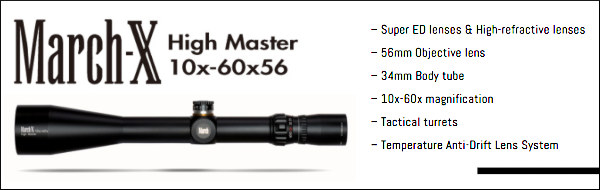
Scope: March High Master 10-60x56mm with MTR-1 reticle, illuminated
Rings: ARC M10 High Rings
Front Rest: SEB Mini Rest, with Rodzilla Rest Top system
Rest Feet: Bryan Blake (F-Class Products) adjustable stainless feet
Rear Support: Lenzi (Italy) LR Rear bag, with custom metal base plate
Cartridge Selection — Why the .300 WSM Was Chosen over a 7mm Cartridge
I set out with the goal of building my ultimate F-Open rifle. Now “ultimate” is of course subjective, but I did not want to leave any stone unturned when it came to building a .300 WSM. When researching the equipment for my new build I had a couple of ideas in mind. I was already shooting a 7mm, in the form of a 280AI which had served me well, but I already had plans to switch to a .284 Shehane with the introduction of Peterson .284 Win brass, coupled with the fact Norma stopped making 280AI brass (Note: Peterson now makes 280AI brass). While I was reasonably well-covered with my .284 Shehane, I wanted something with a bit more horsepower to hold up at long range in choppy conditions. A lot of the top guys here shoot 7mm SAUMs but I wasn’t keen on going down that path. Why? For every accurate SAUM I’ve seen, I’ve seen others struggle and given that the 7mm SAUM seems to be particularly hard on barrels, I wanted something that could match the 7mm SAUM ballistically, but have better barrel life.
After plenty of research on AccurateShooter.com, and speaking with some shooters, both locally and in the USA, I decided to give the .300 WSM a go. This cartridge is not particularly popular in Australia for F-Open, primarily because most states enforce muzzle energy restrictions, so pushing the .300 WSM to its potential simply isn’t viable for many shooters here. It IS viable in my home state however, along with the ACT, so I can at least use it in major competitions in two Australian states without having to run at lower nodes where it would otherwise be trumped by the 7 SAUM shooters. I was also attracted to the cartridge through its general design, having a 35-degree shoulder angle similar to the inherently accurate .284 Winchester. I also think the .300 WSM resembles a super-sized Dasher, another devastatingly accurate cartridge. Most .300 WSM shooters report ease of tuning, another key factor I considered.
Choice of Stock, Action, and Barrel
My gunsmith, Matt Paroz (aka MattP on the AccurateShooter Forum) is one of Australia’s top gunsmiths as well as one of Australia’s top F-Open shooters. He knows what it takes to build match-winning rifles. Matt is also an agent for McMillan stocks and I was sold on the Kestros ZR after seeing how it well it tracked — the lower center of gravity it offers cannot be underestimated once you start stepping up in caliber size. I had previously seen a couple of rifles that Matt built for an Australian F-Open team member and I was blown away not only by the quality of the builds, but how well the components worked with one another. I already own a Barnard action, a match-winning action in its own right, but I was desperate to get my hands on a Borden. I liked the fact that Jim Borden times his actions as they leave his factory, so I ordered a BRMXD, left bolt, right port, left eject. I ordered my BRMXD fully DLC-coated, for both longevity and aesthetics.
I opted for a TriggerTech Diamond trigger which has been timed to the action and offers a level of crispness the factory Barnard trigger cannot replicate. The synergy between action and trigger is just superb. I managed to get my hands on a 10-twist, 4-groove Krieger barrel that looks like a winner so far. Finished at 31″, this barrel has been super-easy to tune so far, with Berger 215gr hybrids showing very good promise. NOTE — Overall the rifle comes in 500 grams (1.1 lbs.) below F-Open max weight, so the next barrel will probably finish at 32″.
The barrel sports an Ezell tuner. I don’t touch the tuner until I’ve sorted my load and bullet seating depth. The tuner just affords me that extra flexibility in tightening up an already good grouping. At the end of the day, like any competitive shooter, I’m chasing tight vertical and horizontal, something which will run inside 1 MOA at 1000 yards. If I drop a shot, I want it to be my fault, not the rifle’s.
About my optics choice — when the chance to own a March High Master came up, I didn’t think twice. I have used March previously and got a sneak peek through an original High Master prototype which was doing the rounds in Australia. With superb image quality, it left a lasting impression. March has built up an excellent following and reputation in Australia, and so far I have to say it was money well spent. The March is held in place with a set of beefy ARC M10 rings.
The rest of my F-Open setup includes a modified SEB Mini up front, with a Rodzilla Rest top and Bryan Blake adjustable feet. I chose the SEB Mini because it has a wide, stable footprint but relatively light weight. That makes the Mini easier to transport. At the rear I use an extremely well-crafted Lenzi LR bag which sits on a custom rear plate. This heavy combination keeps things nice and planted. That aids in straight tracking.
Reloading for the .300 WSM — Process and Die Choice
When it comes to reloading, I keep it simple and don’t over-think things. I use Norma .300 WSM brass. I ensure case mouths are always deburred on the inside and out but I do not neck turn. I am set up to turn necks with a 21st Century unit, but after neck turning previously for a 6mm SLR, I just didn’t see a noticeable benefit in doing so. I always full length re-size after firing and prefer bushings, generally opting for .002″ of neck tension on anything I shoot. So far it seems to be working. With my .300 WSM I run a Redding Type-S full-length bushing die with a .335 bushing. A loaded round comes in at 0.337″ across the neck and I opted for a no-neck turn reamer which comes in at 0.343″, so there’s plenty of clearance. I use a Forster micrometer seating die. I prefer the feel of the Forster and I use Redding dry lube media to assist in smooth bullet seating.
Reloading room with MEC single-stage press on left and AutoTrickler with Force Restoration Scale on right. Note there are plenty of bullets — Kris got his supplies before the shortage.
I use an AMP Annealer and anneal after every firing. Powder charges are measured and dropped with a V3 AutoTrickler and A&D FZ500i scale. The 215gr Berger Hybrid seemed like a pretty good place to start as far as bullet selection. I point them with a Whidden bullet pointing die. Powder options can sometimes be a contentious choice and if you’re lucky you’ll get a couple of powders which will work well in any given barrel. For my .300 WSM I use Alliant Reloder 23. It is very temp-stable. My primer of choice is S&B Standard Large Rifle Primers. How does it all come together? The first nine shots through the barrel while zeroing the scope resulted in an ES of 17 and SD of 6 — promising signs for a light initial load of 63 grains.
Kris has been impressed with his .300 WSM beast: “Suffice to say I was very pleased with how things turned out! Despite the bigger bang this rifle makes, the Kestros ZR and R.A.D. 2 system made it remarkably compliant. The recoil is sharp but the R.A.D. system just takes all the sting out of it — it reminded me of shooting my old 280AI in terms of felt recoil. I was able to get back on target with a minimum of fuss and didn’t find the rifle fatiguing at all, so it gets a massive thumbs up from me.”
CONCLUSION — The .300 WSM is Very Effective for F-Open
With recent trends in F-Open equipment, such as rifle stock technology making a lower center of gravity possible, bigger F-Open options such as the .300 WSM are now quite manageable. That’s not to say this caliber is a pussy cat — it definitely kicks more than the .284s out there. But with my choice of components, the recoil is manageable and the R.A.D. 2 system takes the sting out, so I’m not left nursing a sore shoulder at the end of a stage. The rifle is off to a very positive start so far but I know it’s capable of more. The lead up to Christmas will keep me busy fine-tuning a load in time for the NSW State Title match to be held in late January 2021. With COVID-19 halting most competitive shooting in Australia in 2020, this 2021 NSW competition is sure to prove popular. I intend to have my .300 WSM rifle humming in time for it.
Kris Wilson (NSW, Australia) Talks About Competitive Shooting
When I was introduced to F-Class shooting, I was fascinated with the level of accuracy shooters were obtaining with their rifles and it was something that just drew me in. Since then it has been a gradual learning curve, not to mention the fact everyone I have met has been super friendly and willing to share their knowledge. The shooting fraternity is a great community to be part of…. Mixing it with Australia’s best is what drives me right now.
I’ve been working hard to maintain my skills and the new rifle is motivation. As reloading equipment and rifle components continue to improve, it’s a great sport which encourages learning and provides many opportunities to keep improving your shooting.
Planning a Prairie Dog hunting adventure this summer? Consider bringing a .17 HMR rimfire rifle. Of course, for long shots you’ll definitely want a centerfire. We like the 20 Practical in an AR and a 22 BR/BRA in a bolt-action. That will have you covered out to 700 yards. But for shorter shots on small critters — say inside 150 yards — it makes sense to have an accurate .17 HMR rimfire rig. Today’s 17 HMRs are capable of surprising accuracy, rivaling a good centerfire rig, but with less recoil and much lower cost per shot. And the .17 HMR offers more than double the velocity of a .22 LR — up to 2650 fps with a 17-grain bullet.
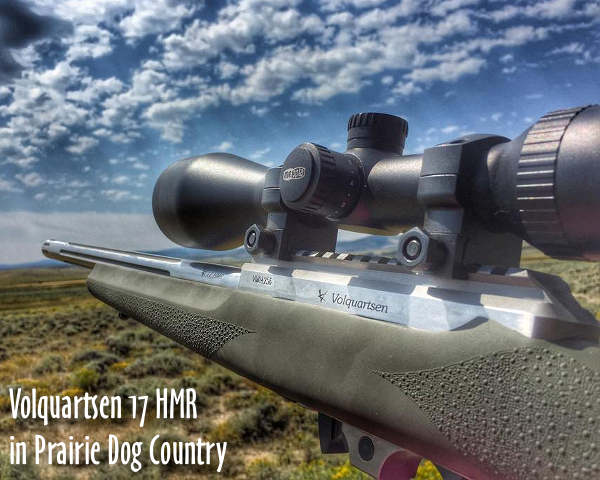
Top Shot former Champion Dustin Ellerman likes his Volquartsens, and we can see why. With one of his favorite .17 HMR rimfire varmint rigs, he’s seen some outstanding accuracy with CCI ammo. A few seasons back, on his Facebook page, Dustin reported: “Prepping for prairie dogs and I’m floored by this cold, sub-half-inch group shot with the Volquartsen Custom .17 HMR at 100 yards.” This thumbhole-stock rifle features a Bowers Group USS suppressor, and 3-12x56mm Meopta Scope. Dustin tried different types of CCI .17 HMR ammo. This small group was shot with CCI A17 ammo.
What’s the effective range of a .17 HMR on prairie dogs? You might be surprised. in 2015, Dustin took another Volquartsen .17 HMR on a Prairie Dog hunt in Wyoming. He was impressed with the rifle (shown below) and the little rimfire cartridge. Dustin says the effective range of the .17 HMR is farther than one might expect: “I made hits out to 300 yards. 200 yards was easy as long as the wind wasn’t too bad.”
Here’s the Volquartsen .17 HMR Dustin used in Wyoming in 2015:
After that 2015 P-Dog expedition, Dustin became a fan of the .17 HMR cartridge: “Never paid it much attention before now because the ammo is five times more expensive than .22 LR and I mostly target shoot. However, for prairie dogs, the .17 HMR is amazing!” Consider this — Hornady’s .17 HMR ammo pushes a 17gr V-Max bullet at 2550 fps, twice as fast as typical .22 LR rounds.
Prairie Dog Adventure with Savage A17
This video shows a successful Prairie Dog hunt. Watch and you’ll see hits out to 160 yards (00:50), proving the effective range of the .17 HMR cartridge. The host is shooting a Savage A17 semi-auto .17 HMR rifle in a Boyds laminated stock.
This video shows the process of cut-rifled barrel-making by Krieger Barrels, one of the world’s best barrel manufacturers. Krieger cut-rifled barrels have set numerous world records and are favored by many top shooters. The video show the huge, complex machines used — bore-drilling equipment and hydraulic riflers. You can also see how barrels are contoured, polished, and inspected.
For anyone interested in accurate rifles, this is absolutely a “must-watch” video. Watch blanks being cryogenically treated, then drilled and lathe-turned. Next comes the big stuff — the massive rifling machines that single-point-cut the rifling in a precise, time-consuming process. Following that you can see barrels being contoured, polished, and inspected (with air gauge and bore-scope). There is even a sequence showing chambers being cut.
Click Arrow to Watch Krieger Barrels Video:
Here is a time-line of the important barrel-making processes shown in the video. You may want to use the “Pause” button, or repeat some segments to get a better look at particular operations. The numbers on the left represent playback minutes and seconds.
Krieger Barrel-Making Processes Shown in Video:
00:24 – Cryogenic treatment of steel blanks
00:38 – Pre-contour Barrels on CNC lathe
01:14 – Drilling Barrels
01:28 – Finish Turning on CNC lathe
01:40 – Reaming
01:50 – Cut Rifling
02:12 – Hand Lapping
02:25 – Cut Rifling
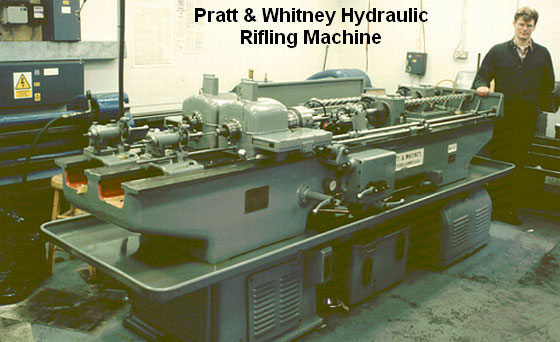
“At the start of World War Two, Pratt & Whitney developed a new, ‘B’ series of hydraulically-powered rifling machines, which were in fact two machines on the same bed. They weighed in at three tons and required the concrete floors now generally seen in workshops by this time. Very few of these hydraulic machines subsequently became available on the surplus market and now it is these machines which are sought after and used by barrel makers like John Krieger and ‘Boots’ Obermeyer. In fact, there are probably less of the ‘B’ series hydraulic riflers around today than of the older ‘Sine Bar’ universal riflers.” — Geoffrey Kolbe, Border Barrels.
Brownells is a well-known retailer of guns, gun parts, tools, accessories, ammo, and pretty much everything gun-related. What you may not know is that Brownells has a very active video production department that releases new “how-to” and product information videos every week. These videos offer helpful advice on gun cleaning/maintenance, reloading, as well as selecting/assembling components for various kinds of rifles. And every week Brownells serves up a new products video. There now over 3000 videos on the Brownells YouTube Channel, which is truly a remarkable resource.
Here are seven of our favorite videos from Brownells. There’s a helpful guide to scope installation, a guide to using the OAL tool properly, and a good video on building a rifle with a Howa barreled action. There’s a helpful video on air travel with rifles, and all gun owners should watch the video on ammunition storage.
Scope-Mounting — Common Mistakes to Avoid
Always be careful when mounting a rifle scope. This isn’t a super-complex or highly technical task, but there are ways you can mess it up. This video explains common pitfalls to avoid when mounting a scope.
1. Make sure the rings don’t touch ANY part of the turret housing, objective bell, or eyepiece.
2. Be certain the scope rings are tightly clamped to the scope base. Grasp the scope with one hand and the rifle with the other, then ensure there is no play.
3. Make sure there’s clearance between the objective bell and the rifle. No part of the scope should touch the rifle itself.
4. NEVER over-tighten the scope rings. You can actually crush the scope tube and damage the optic beyond repair. Stick to the torque specs!
Affordable Precision Rifle Build with Howa 1500 Barreled Action
In this video, Caleb from Brownells walks through a step-by-step build of an affordable precision rifle using a Howa 1500 barreled action, MDT stock, and Vortex optic — putting together a highly capable long-range setup for under $1,200. The video covers key components and shows the assembly tools needed (4:38). The video explains how to build a reliable, accurate bolt gun on a budget, with honest insight into gear selection and assembly techniques. From the stock and trigger to rings, base, and scope setup, this video is a very helpful guide for anyone looking to build an affordable precision rifle. Installation of the Howa 1500 barreled action into the MDT stock is shown in detail at 6:00 minute mark.
How to Use Hornady OAL Tool and Hornady Bullet Comparator
Gun Tech Steve Ostrem explains how to properly use Hornady’s Overall Length Gauge to determine length-to-land precisely. The OAL Gauge uses a “Modified Case” that threads onto the tool and holds a bullet. Push on the back of the gauge until you feel the bullet just touch the rifling. (We do this gently at first, tapping the rod a couple time to ensure the bullet is aligned correctly). Once you’ve got the length, then use the tool with a comparator on your calipers to get the length-to-lands. NOTE: We recommend taking the measurement 3-4 times in a row to get a reliable number. With a little practice your should be able to get repeatable measurements within .0015″.
How to Store Ammunition Safely and Securely
This is one of the most popular Brownells videos — with over 2.5 million views. Here’s the deal — ammunition WILL keep for a long time if you store it properly. DO store ammunition in a cool, dry place that doesn’t have wide temperature swings. Temperature cycling will also degrade primers and powder. Put it in airtight ammo cans to keep out the moisture. Tupperware containers will work too. Brownells also recommends putting moisture-absorbing silica packs in your ammo containers. DON’T just keep ammo in factory cardboard factory boxes stacked in the basement, attic, or garage (especially on the floor). Factory ammo boxes can absorb moisture which can degrade primers and corrode the brass cases. Yes, sealed military ammo will usually handle this kind of storage for quite a while, but it’s still not wise.
Air Travel with Firearms — Key Regulations You Must Follow
You can travel on commercial airlines with firearms. But you must follow the TSA regulations, and your particular airline’s rules. First, make sure your guns are UNLOADED before your leave home. Guns need to be carried in proper hard-sided cases that cannot be pried open. Be prepared to unlock the case if the TSA wants to inspect what’s inside. TSA agents can cut the locks if they need to open the case but can’t locate you. If you use special TSA-approved locks, TSA agents have master keys that let them open the case without destroying your locks. You CAN transport up to 11 pounds of ammunition — with restrictions explained in the video.
Cleaning Advice for .22 LR Rimfire Rifles
Gun Techs Steve Ostrem and Caleb Savant debunk some myths about cleaning .22 LR barrels. One myth is that cleaning will harm the accuracy of a .22 LR barrel. Caleb thinks this myth is the result of people cleaning a barrel from the muzzle and damaging the muzzle crown, which CAN diminish accuracy. If it’s done right, cleaning won’t damage the bore. However, you certainly do NOT have to clean your 22 LR’s bore every time you go to the range. But DO clean the action every time you shoot the rifle, especially on a semi-auto. What about shooting a lot of lead bullets? Won’t that lead up the bore? The guys give us the straight skinny on lead fouling, too. When you see your .22 LR rifle’s groups opening up, you may want to consider cleaning.
Must-Have Spare Parts for AR-Platform Rifles
In this video, two knowledgeable gun techs answer the question: “What spare parts should I keep on hand for my AR-15?” On the list are: Gas Rings, Buffer Spring, Extractor Spring and Pin. NOTE: You may want to try the one-piece spiral gas ring rather than the standard rings which require alignment. The cotter pin and cam pin can also easily get lost when the Bolt Carrier Group is disassembled for cleaning. On the lower receiver you’ll want spare springs and detents for the pivot/takedown pins. If you’re using lighter-power springs, keep standard-power spares on hand. If your rifle stops working, swap in the factory-spec springs to find out if the problem is the gun or your ammo. Also, if you have upgraded your trigger, always keep the original trigger as a backup.
This article is Copyright 2023 AccurateShooter.com. Reproduction on any other website gives rise to monetary damages.
For load development, some guys shoot 3-shot groups. Other guys shoot 5-shot groups, or even 10-shot strings. But for testing its projectiles, Sierra Bullets takes it to another level entirely. A while back Sierra was testing its .30-Caliber 175gr HPBT MatchKing in the Sierra underground tunnel. The results appear above — a FIVE HUNDRED Round group!
500 Shots Form 0.82 MOA Group at 300m (328 yards)
Sierra’s trigger-pullers sent five full boxes of bullets down-range at a single target. The photo above shows the result of 500 shots taken in a 300 meter test tunnel. The raw group size, edge to edge of the farthest shots, is about 3.13 inches, as shown on the calipers’ metal linear scale. Subtract a .308″ nominal bullet diameter* to get the 2.823″ on the digital readout. So you’re seeing a 2.823″ group at 300 meters (328 yards). One MOA at this distance is 3.435″ so this 500-round group is 2.823 divided by 3.435 or 0.82 MOA (0.8218 MOA to be precise).
This 500-round group was shoot as part of a pressure/velocity test for a commercial customer. The cartridge was .308 Winchester, loaded at 2.800″. The powder was Reloder 15. A 26″ barrel was shot from a return to battery rest. The gun was cleaned every 125 rounds and two foulers shot.
What do you think — could you beat this group from a bench for 500 rounds?
One Facebook poster joked: “500-round group? Everyone knows anything less than 1000-round groups are a waste of time and statistically irrelevant.”
Sierra’s 300 Meter Testing Tunnel
Ever wonder how (and where) Sierra tests its bullets? The answer is underground, in a 300-meter test tunnel located under Sierra’s factory in Sedalia, Missouri. The photo above shows the construction of the tunnel back in May, 1990. Like most bullet manufacturers, Sierra does live-fire bullet testing of its projectiles. Sierra’s 300-meter test range is the longest, manufacturer-owned underground bullet test facility in the world. In years past, Sierra offered free visits to the test tunnel as part of a factory tour.
* Normally, to get an exact group size, you should subtract the TRUE bullet hole size, which is usually smaller than the nominal bullet diameter. E.g. a .308 bullet hole may show on paper as .298 or so. But here, for simplicity, we are subtracting .308″ because we do not have the original target to measure.
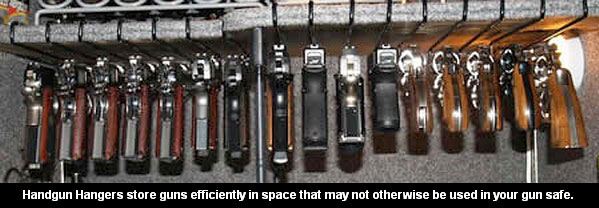
If you’re looking for a space-saving handgun storage system, consider the Easy Use Gun Hangers from AmeriGun Club. These vinyl-coated, wire hangers organize handguns below the shelves in your gunsafe, freeing up storage space above the shelves. To use the handgun hangers, simply slide each hanger on the shelf and then slip your pistol’s barrel over the lower rod. Handgun Hangers are intended for guns with an overall length of 10 inches or shorter. They will fit shelves that are at least 11 inches deep and 5/8-1 inch in thickness. Handgun Hangers will hold handguns .22 caliber and up, though the fit is a bit snug on .22s. A four-pack of AmeriGun Club Handgun Hangers costs $9.99.
WARNING — ALWAYS Make Sure Handgun is UNLOADED when using Handgun Hangers!!
Boomstick also offers Over-Under Hangers that hold two handguns — one above the shelf, and one below. A two-pack of Over-Under Hangers (capable of holding four handguns) costs $9.99 on Amazon. This may be a good solution for you. This Editor personally prefers standard hangers which place pistols BELOW the shelf. That way I can use the upper surface of the shelf to hold odd-shaped items such as cameras, binoculars, and miscellaneous valuables.





 Precision Benchrest and F-Class shooters favor premium brass from


 The headstamp bunter punch has a protrusion on the end to make the primer pocket, and has raised lettering around the face to form the headstamp writing. This is, of course, all a mirror image of the finished case head. Small cases, such as 5.56×45, can be headed with a single strike. Larger cases, like 7.62×51 and 50 BMG, need to be struck once to form a dent for the primer pocket, then a second strike to finish the pocket, flatten the head, and imprint the writing. This second strike works the brass to harden it so it will support the pressure of firing.”








 The popular AmeriGun Club


