Since its introduction in 2001, the .300 Winchester Short Magnum (.300 WSM), has proven very popular for hunting and long-range competition. The case has ample capacity to drive the heavy .30-caliber bullets, and with proper case prep and annealing, the WSM is capable of outstanding accuracy. When Nebraskan Greg Anderson decided to build his “ultimate long-range hunter”, he selected the .300 WSM for its accuracy and its ability to drop large game at long distances. Teaming up with Chris Matthews of LongShot Rifles, Greg developed an impressive long-range hunting rig, with high-tech components to reduce weight. The 26″ barrel is a carbon-wrapped composite over a Rock Creek stainless blank. The carbon technology saved about 3 pounds over an all-steel barrel of similar length/contour.
The Manners Composite stock also features carbon fiber construction for stiffness and reduced weight. Greg’s carbon/carbon rifle tips the scales at just 10.8 pounds, including scope and bipod. A conventional rig could easily weigh 15 pounds or more. Greg’s carbon hunter has proven accurate as well as innovative. With 175gr Sierra MKs, the gun shoots well under 1/2-MOA out to 600 yards and beyond.
The Ideal Spot and Stalk Rifle
by Greg Anderson
The purpose of this project was to create a hunting rifle that would be inherently accurate at long range and have an acceptable weight for hunting in rough country. I researched the question of overall weight with several gunsmiths. The smiths confirmed that while fat-contour barrels could deliver improved accuracy, there was a price to pay and a lot more weight. With a heavy barrel, the finished rifle would be most likely weigh about 15 pounds. That’s more than I wanted to haul around in the field. To reduce barrel weight, the suggested “traditional” solutions were fluting, which would reduce barrel weight by at least one-half pound, or going with a smaller diameter barrel.
The Quest for Reduced Weight without Accuracy Loss
Fluting didn’t promise enough weight savings, and a slim, sporter barrel probably wasn’t going to deliver the kind of consistent accuracy I wanted (particularly as the barrel heated up). Accordingly, I decided to “think outside the box”. My research on lightweight barrel options lead me to Advanced Barrel Systems, (ABS) a company in Lincoln, Nebraska that once produced custom carbon-wrapped barrels. ABS President Mike Degerness could wrap a barrel to virtually any shape and diameter, allowing great stiffness even with a huge reduction in barrel weight. As the “core” for his carbon-wrapped barrels, Mike recommends a cut-rifled blank made by any of the quality cut-barrel makers. [NOTE: ABS is not taking orders at this time. You cannow get excellent carbon-wrapped barrels from Proof Research].
Significant Weight Saving with Carbon
How much weight can you save with a carbon-wrapped barrel? Well a 24-inch, #7 contour ABS carbon-wrapped barrel will weigh about 2.5 pounds compared to about 5.5 pounds for a steel barrel of the same length and contour. So, this means that you can put a fat, stiff competition-contour barrel on your hunting rifle and save over half the barrel weight compared to an all-steel barrel. Saving three pounds is a blessing when you’re carrying the rifle all day long in the field. I placed an order for a 30-caliber Rock Creek barrel blank with an 1:11.25″ twist and a finished length of 26″. Mike wrapped the barrel and finished it to an M24 contour.
Carbon Can Also Improve Barrel Vibration Damping
One interesting benefit of carbon barrel-wrapping is that the carbon components have a vibration-dampening effect. According to ABS, the extreme rigidity of the finished composite barrel dampens the vibration nodes of the barrel making it shoot like a plain steel barrel of much greater mass. Carbon fiber has a high modulus of elasticity that has the effect of lowering the amplitude of the vibration of the barrel when fired. This is what makes the ABS barrels perform so well, according to Mike.
Impressive Accuracy For a Hunting Rifle
Looking at the targets below, one may ask, “Does the rifle always shoot this well?” The answer, not surprisingly, is: “it depends on the trigger-puller”. The rifle is capable of outstanding accuracy. But it took some time and effort for me to develop the skills required to shoot up to the rifle’s inherent accuracy. I nearly always practice prone from bipod. Initially, I was getting horizontal stringing until I changed my grip and learned to be more consistent from shot to shot. Shooting a heavy-recoiling .30-caliber rifle from the ground is not the same as shooting a .223 Rem from the bench.
3-Shot Group at 200 yards | 6-Shot Group at 500 Yards
Completing the Project Build
To smith the rifle, I selected Chris Matthews of LongShot Rifles, LLC because of his expertise with the WSM cartridges and long-range shooting equipment. Because cost was a factor, we decided to use a donor Remington long action that had been used on a Remington 7mm magnum. Chris trued the action and we had Dave Kiff from Pacific Tool & Gauge grind us a bolt to fit the action more perfectly. Chris chambered the Rock barrel and installed a .300 Badger recoil lug.
Carbon-reinforced Hunting Stock from Tom Manners
Being a fan of carbon fiber technology, I selected an MCS-T stock from Manners Composite Stocks. These stocks have an extremely high strength-to-weight ratio and the high comb of the MCS-T gave an almost perfect alignment with the scope. The finished rifle was topped off with a Leupold 4.5-14x40mm LR scope equipped with M1 windage and elevation turrets. A Harris bipod completed the package. All up, including scope, steel rings, and bipod, my .300 WSM rifle with 26″ barrel weighs 10.8 pounds.
Load Development for Accuracy
I developed a load using 63.0 grains of H4350, 175gr Sierra Match Kings with Federal 210M primers in Winchester-brand brass. This load gives 2960 FPS out of my rifle. The load would shoot sub-MOA from bipod from 100 yards to 600 yards and was adopted as the “go to” load. I have also tried the 208gr Hornady A-Max in this gun. The A-Maxs shot well but the Sierras work well for everything (paper punching and hunting) so the 175gr SMK is my bullet of choice.
Brass Prep and Annealing Are Very Important
The Winchester-brand brass is good, but you have to prep it thoroughly if you want good results. My brass prep consisted of turning the necks, de-burring the flash holes (inside and out), and chamfering the case necks. Using a Sinclair neck-turning tool, I turn the necks to .0135″ per side. That provides a complete clean-up of the necks, which run about .015″ neck-wall thickness out of the box.
One thing I’ve learned to do is anneal the brass every 3-4 firings. I started to do that after I noticed that the force required to seat bullets became inconsistent after just a few loading cycles. I also experienced flyers that were going out of the group for no apparent reason. Annealing the cases every 3-4 firings has eliminated most of the unexplained flyers and annealing has also made bullet seating much, much more consistent. I’ve also noticed a significant improvement in my groups at 500 and 600 yards now that I anneal regularly. Group sizes at 600 yards can be as much as 2″ smaller with annealed brass than with un-annealed, work-hardened brass.
Greg Anderson was successful with his .300 WSM on his very first hunt, dropping a nice buck at 364 yards. Chris reports: This was on some private land in Nebraska. As daylight faded… there were a couple of bucks, but one looked to be the best of the lot. The buck gave me a broadside shot ranged at 364 yards. I settled behind the scope and took one shot. It hit right where I aimed and the buck just folded.”
Politicians need to justify their existence. That means they are constantly writing new laws, even when none are needed. For example, in California, corrupt Democratic Gov. Newsom signed 15 new gun laws last month, none of which will actually do much to cut crime (but these statutes will create problems for law-abiding gun owners). With each passing year, it gets more difficult to comply with all the new gun laws. With legal requirements constantly in flux, it can be difficult for gun owners to keep track of their responsibilities under state and federal law. Thankfully, USLawshield.com has prepared summaries of recent federal and state legislation.
In addition, U.S. Law Shield has created a series of videos that spotlight important legal issues (and situational challenges) gun owners can face. Here are five Law Shield videos covering important legal matters for firearms owners.
Five Important Videos That Can Keep You Out of Jail
Every day innocent legal gun owners are questioned by police in public. Understand the three types of contact you might have with police, what your rights are during the contacts, and if you have to tell the officers you are carrying a firearm.
Do you plan to travel through multiple states with firearms in your vehicle? Federal AND state laws are involved. You should check the regulations of ALL the states (and big cities) you will be visiting along the way. There are definitely some areas to avoid (such as New Jersey and New York City).
Gun owners can find themselves in trouble with the police for a variety of reasons. You need to know what to do after a self-defense use of firearms. You also need to know how to comply with regulations on carry, storage, and transport of firearms.
Laws governing gift transfers of firearms vary from state to state. Before giving a gun, even to a close family member, you should check the statutes in your jurisdiction. If you have any doubts, it may be better to give a pre-paid gunshop gift card, rather than the firearm itself.
Your firearm was just stolen. What are your next moves? Most people aren’t taking the right steps in this situation. Law Shield Attorney Richard Hayes helps you avoid three common mistakes gun owners when guns have been stolen.
Halloween 2019 is history, so it’s time to start thinking about Thanksgiving — Turkey Day. What better way to celebrate the occasion than to blast away at some bearded gobblers (of the paper variety). Here’s our custom Turkey Target, ready for family fun. This special Turkey Bullseye Target was created by our friend and Forum member Pascal (aka “DesertFrog”). CLICK HERE for FREE Turkey Target.
Get a Full Set of Animal Targets
For your convenience, we’ve packaged the Turkey Target along with five (5) other varmint/animal-themed targets. These are all offered in .pdf (Adobe Acrobat) format for easy printing.
Looking to acquire a handgun for personal protection of home and family? There are countless options on the market. Your buying decision may be simplified by seeing what other consumers have chosen, as revealed by nationwide sales trends. You can now check firearms sales figures using “Gun Genius”, a new data-crunching service of Gunbroker.com. On GunGenius.com you can select any type of firearm (handgun, rifle, shotgun)* and see the top sellers for that category.
Here are the five (5) top-selling NEW semi-auto handguns for October 2019:
And here are the five (5) top-selling USED semi-auto handguns for October 2019:
*Chose semi-auto pistols, revolvers, semi-auto rifles, bolt-action rifles, lever-action rifles, single-shot rifles, semi-auto shotguns, pump shotguns, and more. You can also filter for sales trends (upwards and downwards). Drill down to see detailed product specifications and current prices.
Noted gun writer Glen Zediker (author of Top Grade Ammo), regularly contributes tech articles to the Midsouth Shooters Blog. One of Glen’s Midsouth Blog articles covers Bullet Design. We suggest you read the article — even seasoned hand-loaders will learn a few things about projectile properties (and how to choose the right bullet design for your needs). Glen also wrote a recent Blog article on cartridge pressure signs, linked below
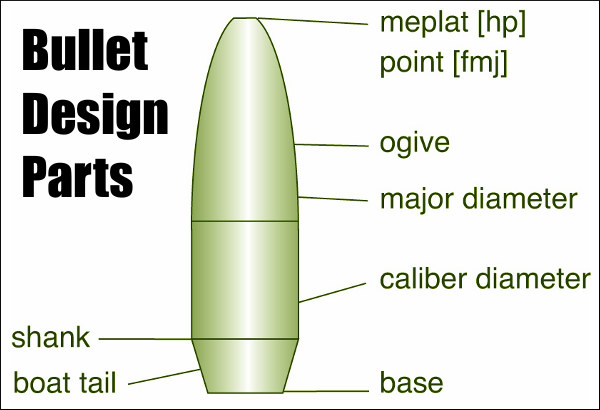
Glen explains: “A ‘match’ bullet’s job is to perforate a piece of paper. A bullet designed for varmint hunting, on the other hand, is designed to produce explosive impact, and one for larger game hunting strives to strike a balance between expansion and penetration. However! No matter how it’s built inside, there are universal elements of any bullet design, and those are found on the outside.”
In his article, Glen identifies the key elements of a bullet and explains how they are defined: “Base, that’s the bottom; boat-tail, or not (flat-base); shank, portion of full-caliber diameter; ogive, the sloping ‘nosecone'; tip, either open or closed (open it’s called the ‘meplat’). The shape of the ogive and the first point of ‘major diameter’ are extremely influential elements. The first point of major diameter can vary from barrel brand to barrel brand because it’s the point on the bullet that coincides with land diameter in the barrel — the first point that will actually contact the barrel as the bullet moves forward. When there’s a cartridge sitting in the rifle chamber, the distance or gap between the first point of major diameter and the lands is called ‘jump’, and, usually, the less there is the better.”
Ogives Analyzed — Tangent vs. Secant Bullet Designs
Glen notes that bullet designs reflect secant or tangent profiles, or a combination of both: “The two essential profiles a bullet can take are ‘secant’ and ‘tangent’. This refers to the shape of the ogive. A tangent is a more rounded, gradual flow toward the tip, while a secant is a more radical step-in, more like a spike. Secants fly with less resistance (less aerodynamic drag), but tangents are [often] more tolerant of jump [or to put it another way, less sensitive to seating depth variations].”
Glen adds: “Ogives are measured in ‘calibers’. That’s pretty simple: an 8-caliber ogive describes an arc that’s 8 times caliber diameter; a 12-caliber is based on a circle that’s 12 times the caliber. The 8 will be a smaller circle than the 12, so, an 8-caliber ogive is more ‘blunt’ or rounded. Bullets with lower-caliber ogives are more tolerant of jump and (usually) shoot better, easier. Higher-caliber ogives [generally] fly better, farther. This is an important component in the ‘high-BC’ designs.”
Learn More in Zediker Books
Glen has authored a number of excellent books for hand-loaders and competitive shooters. Here are three of his most popular titles, including his latest book, Top Grade Ammo:
All these titles are available from Midsouth Shooters Supply. Click each cover above to purchase from Midsouth.
In this NSSF Video, Ryan Cleckner, a former Sniper Instructor for the 1st Ranger Battalion, explains how to gather and organize D.O.P.E. (Data On Previous Engagements) and how to organize this information to make it readily available in the field. As the term is used by Cleckner, D.O.P.E. includes observed bullet drop information at various distances, as well as the effects of wind, temperature changes, humidity and other environmental variables.
If you know your muzzle velocity, and bullet BC, a modern Ballistics App should be able to calculate bullet drop with great precision at distances from 100-1000 yards — often within a couple 1/4-MOA clicks. However, because a bullet’s BC is actually dynamic (changing with speed), and because ballistics solvers can’t perfectly account for all variables, it’s useful to collect actual, verified bullet drop data.
It’s smart to start with ballistics data from a solver app, but, as Cleckner explains: “Odds are, you’re going to have to fine-tune that data to your gun and your system. Every scope and every rifle and every bullet [type] act differently. Your scope may not track the same from rifle to rifle, so it’s important you get the data that’s unique to you.” Cleckner also explains that the ballistic data supplied with some factory ammo may only give you a crude approximation of how that ammo will actually shoot through your gun.
Keeping Your Drop Data with the Rifle
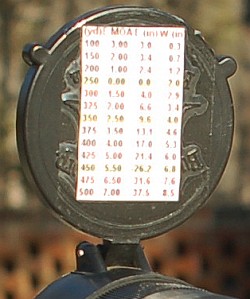
Cleckner also offers some good advice on how to record D.O.P.E. on simple index cards, and how to keep your ballistics data with your rifle. This can be done with a laminated drop chart or data transferred to a scope cover (photo right). CLICK HERE, to learn more about creating handy field data cards.
At the 4:15 mark on the video, Cleckner shows a calibrated tape he has fitted around the turret of his riflescope. The tape shows distance numbers (e.g. “4” for 400 yards, “5” for 500 yards etc.) that correspond with the number of clicks (rotation) required to be zeroed at that particular distance. With that system, you simply “dial your distance” and your point of impact should equal your point of aim. It takes some skill (and the right software) to create these tapes, but the concept is great.
Chances are that many of you have packed away your ammo and shooting supplies for the winter. Maybe you put your brass in a storage bin that might also contain solvents, old rags, or used bore swabs. Well, if you use any ammonia-based solvents, we suggest you separate the brass and ammo and keep it away from potential ammonia vapors. This is because long-term exposure to ammonia fumes can cause cracks to form in your brass. This can lead to case ruptures and possible injury.
This case-cracking phenomenon has been called Season Cracking, a form of stress-corrosion cracking of brass cartridge cases. Season cracking is characterized by deep brittle cracks which penetrate into affected components. If the cracks reach a critical size, the component can suddenly fracture, sometimes with disastrous results. If the concentration of ammonia is very high, then corrosion is much more severe, and damage over all exposed surfaces occurs. The brass cracking is caused by a reaction between ammonia and copper that forms the cuprammonium ion, Cu(NH3)4, a chemical complex which is water-soluble. The problem of cracking can also occur in copper and copper alloys such as bronze.
Season Cracking was originally observed by the British forces in India a century ago. During the monsoon season, military activity was reduced, and ammunition was stored in stables until the dry weather returned. Many brass cartridges were subsequently found to be cracked, especially where the case was crimped to the bullet. In 1921, in the Journal of the Institute of Metals, the phenomenon was explained by Moor, Beckinsale, and Mallinson. Apparently ammonia from horse urine, combined with the residual stress in the cold-drawn metal of the cartridges, was responsible for the cracking.
Don’t store ammunition (or brass) for long periods in a box or container holding ammoniated solvents:
The Australia Department of Defense (AUSDOD) has also explored the problem of brass cracking caused, at least in part, by exposure to ammonia. A study was done to see whether the amount of cracking (from ammonia exposure) varied according to the duration and temperature of the annealing process used on the brass. CLICK HERE to read AUSDOD Research Report.
Story idea from Boyd Allen. We welcome reader submissions.
Today is October 31st, Halloween (originally “All Hallows Eve”). That means it’s pumpkin time. Just how much fun can you have with pumpkins? Watch these two videos and find out. In the first video, the RatedRR team sends a few orange gourds to pumpkin heaven using Det Cord, C4, and binary explosives. The sequence starting at the 2:00 minute mark in the first video is truly amazing. WARNING: DO NOT TRY THIS AT HOME!
Watch Pumpkin Blasting with Explosives
In the next video, a pumpkin carved as a Death Star serves as the target for a .50 caliber rifle (looks like a Barrett M82 .50 BMG). As you may guess, the pumpkin Death Star suffers the same fate as the Hollywood version in Star Wars. NOTE: At the 0:42 mark in the video, a graphic displays “30,000 FPS”. That’s the high-speed camera’s frame-per-second rate, NOT the projectile velocity in feet-per-second.
Watch .50 BMG Rifle vs. Death Star Pumpkin
Warning: These demonstrations were carried out on closed ranges by experienced professionals certified to use explosives. Possession of C4 and Det Cord may be a violation of various Federal, State, and local laws. Detonating cord and C4 are classified as high explosives and are regulated by the BATFE. Don’t even think about trying to repeat these stunts on your own.
Most of us own a .223 Rem rifle. Now, thanks to our friends at Rifleshooter.com we can assess exactly how velocity changes with barrel length for this popular cartridge.
Rifleshooter.com performed an interesting test, cutting the barrel of a .223 Rem rifle from 26″ all the way down to 16.5″. The cuts were made in one-inch intervals with a rotary saw. At each cut length, velocity was measured with a Magnetospeed chronograph. To make the test even more interesting, four different types of .223 Rem/5.56 ammo were chron’d at each barrel length. The Rifleshooter.com team that conducts these tests has a full-service gun shop, 782 Custom Gunworks — visit 782guns.com.
Test Barrel Lost 25.34 FPS Per Inch (.223 Rem Chambering)
How much velocity do you think was lost, on average, for each 1″ reduction in barrel length? The answer may surprise you. The average speed loss of the four types of .223/5.56 ammo, with a 9.5″ shortening of barrel length, was 240.75 fps total (from start to finish). That works out to an average loss of 25.34 fps per inch.
5.56/.223 Barrel Cut-Down Speed Test 26″ to 16.5″
Start FPS at 26″
End FPS at 16.5″
Total Loss
Average Loss Per Inch
UMC .223 55gr
3182*
2968
214
22.5 FPS
Federal M193 55gr
3431
3187
244
25.7 FPS
Win m855 62gr
3280
2992
288
30.3 FPS
Blk Hills .223 68gr
2849
2632
217
22.8 FPS
*There may have been an error. The 25″ velocity was higher at 3221 fps.
Rifleshooter.com observed: “Cutting the barrel from 26″ to 16.5″ resulted in a velocity reduction of 214 ft/sec with the UMC 223 55-grain cartridge, 244 ft/sec with the Federal M-193 cartridge, 288 ft/sec with the Winchester M855 cartridge and 217 ft/sec with the Back Hills 223 68-grain match cartridge.”
How the Test Was Done
The testers described their procedure as follows: “Ballistic data was gathered using a Magnetospeed barrel-mounted ballistic chronograph. At each barrel length, the rifle was fired from a front rest with rear bags, with five rounds of each type of ammunition. Average velocity and standard deviation were logged for each round. Once data was gathered for each cartridge at a given barrel length, the rifle was cleared and the bolt was removed. The barrel was cut off using a cold saw. The test protocol was repeated for the next length. Temperature was 45.7° F.”
See More Barrel Cut-Down Tests on Rifleshooter.com
Rifleshooter.com has performed barrel cut-down tests for many other calibers/chamberings including 6mm Creedmoor, .308 Winchester, and .338 Lapua Magnum. See these test results at Rifleshooter.com.
Much Different Results with 6mmBR and a Longer Barrel
The results from Rifleshooter.com’s .223/5.56 test are quite different than the results we recorded some years ago with a barrel chambered for the 6mmBR cartridge. When we cut our 6mmBR barrel down from 33″ to 28″ we only lost about 8 FPS per inch. Obviously this is a different cartridge type, but also our 6mmBR barrel end length was longer than Rifleshooter.com’s .223 Rem start length. Velocity loss may be more extreme with shorter barrel lengths. And, of course, different cartridge types and powder/bullet combinations will yield different results.
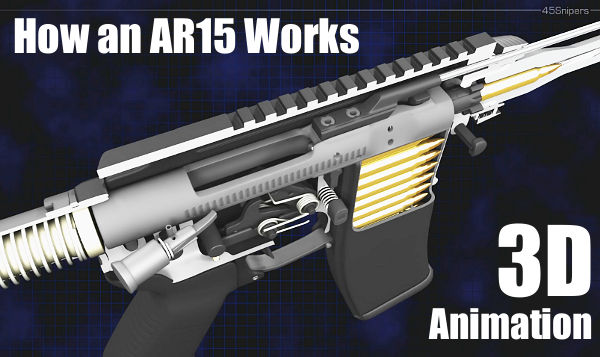
Ever wondered how the parts inside an AR15 work together? Just exactly how does the reciprocating bolt carrier feed rounds from the magazine? How do the elements in the trigger group work and reset after each shot? How does the gas system bleed gas from the barrel and operate the bolt carrier? These and other questions are answered in this eye-opening video from 45Snipers. Using “cutaway” 3D computer animation, this 5-minute video shows all features of an AR15 inside and out. This fascinating firearms animation allows the viewer to look inside the upper and lower receivers, into the bolt carrier, chamber, barrel, and magazine.
This video starts off slow and has annoying background music, but it is well worth watching if you own or shoot any AR-platform rifle. It illustrates all the key operations during the charging, loading, firing, and ejection processes. The cutaway animation shows how rounds are stripped from the magazine and then chambered. It then shows how every part of the trigger group works, and how the firing pin strikes the primer. You can even watch the bullet move down the barrel before the empty shell casing is removed from the chamber and tossed out the ejection port. Here are sample frames from the video:
Video find by Grant Ubl. We welcome reader submissions.


One thing I’ve learned to do is anneal the brass every 3-4 firings. I started to do that after I noticed that the force required to seat bullets became inconsistent after just a few loading cycles. I also experienced flyers that were going out of the group for no apparent reason. Annealing the cases every 3-4 firings has eliminated most of the unexplained flyers and annealing has also made bullet seating much, much more consistent. I’ve also noticed a significant improvement in my groups at 500 and 600 yards now that I anneal regularly. Group sizes at 600 yards can be as much as 2″ smaller with annealed brass than with un-annealed, work-hardened brass.




 Keeping Your Drop Data with the Rifle