Ric Horst’s 7 WSM is a game-slayer with serious long-range accuracy. Here’s a hunting rifle (with tactical trappings) that performs as well as some purpose-built benchrest rifles, delivering half-MOA ten-shot groups at 1000 yards–from bipod no less! That was noteworthy in itself. But Ric’s rifle, built to take game in Wyoming’s backcountry, also proves the viability of the 7mm Win Short Mag as a true precision cartridge. With the capacity to drive hard-hitting, ultra-high-BC bullets, the 7 WSM is a bonafied rival to the big 30s. This rifle sets a very high bar for long-range hunting rigs.
The Challenge: Creating the Ultimate Long-Range Hunting Rifle
Q: Tell us how you got interested in the 7 WSM and how you got started on this project?
Ric Horst: Chris Matthews and I were invited to help out with a new hunting show on a cable network. We wanted to showcase a rifle that wasn’t typical for the TV program which was about Antelope and Mule Deer hunting in Wyoming. We considered a variety of calibers, but then Sierra announced their new 175gr (.284) MatchKing and that got our attention. In Wyoming, the key thing in choosing a caliber is the availability of good high-BC bullets–the wind will own you out here. After seeing Sierra’s projected BC for the 175s this seemed to be a no brainer. So I told Chris to make the rifle a 7mm WSM.
Q: What were your objectives with this project rifle? Sounds like you wanted to build a state of the art long-range hunting rig?
Our goals were simple–we wanted a tack-driver with long-range capabilities, from 400 to 1000 yards. Really, at the time, the choice of the 7 WSM was easy–no one else was really doing it, and if they were, they weren’t talking about it. So we wanted to be the first make it work, one way or another. There were actually no real surprises or problems along the way, other than it was the first time I was shooting a 7mm and the accuracy of the 175gr bullets was better than I expected. I have total faith in Chris’s gunsmithing abilities. This 7 WSM is the sixth rifle he’s built for me–and they’ve all been tack-drivers.
Q: Give us your perspectives on living and shooting in Wyoming. What makes it such a great hunting ground? How do the game mix and terrain dictate your selection of a rifle?
My requirements for my rifles are, I guess, unique. I like tactical-style rifles. This “style” seems to fit my type of hunting here in Wyoming–tough, rugged terrain where you need to be able to make the long shot should one present itself. Living in Wyoming? Well, if you choose to live in the “out of town” places you need to be well-prepared and tough. Going to town means a 50-mile trip. You don’t just run to the convenience store if you need something. Plus the weather is hard in the winter and always windy. We joke that we have just two seasons, three months of summer and nine months of winter. Our spring and fall are each about two weeks long.
Despite the weather, Wyoming is a great place for a hunter. Game here is second to none: deer (whitetail and mulies ), antelope, elk, sheep, moose, plus varmints galore. What is great about my location is that I can shoot just about anytime I want. I have the ability to shoot as far as 3500 yards out my back door if I choose. Here’s a shot of my playground.
Putting It Together: Exceptional Components and Accurate Ammo
Q: Your 7 WSM has logged 10-shot groups at 1000 yards that could win many 1K benchrest matches. What kind of components does it take to deliver this kind of accuracy?
There is nothing super-exotic in this rifle, but it IS fitted out with some of the best components on the market. We did start with a factory action, however, a Remington 700 short action. Chris trued the action, added an SSG over-sized bolt knob, and fitted the action with a Broughton 5C, 9-twist #7 contour barrel finished at 24″. To reduce recoil we added a Badger brake. The stock is a fiberglass McMillan HTG (General Purpose Hunting) stock in Desert Camo. (This McMillan stock design replicates the original M40A1 Marine Sniper Rifle stock.) Since this is a repeater we added a Wyatts Mag Box. The gun features Badger bottom metal, Badger scope rail and Badger Rings. The Scope is a 4-16 Nikon Tactical, which, so far, has proven to be excellent. All the metal is Teflon-coated in Mil-Spec OD Green. I have a bubble-level mounted on the scope rail.
Q: To achieve the results you’re getting you must have exceptional hand-loads. What is your reloading procedure and do you have any “secret tips” to share?
I use Winchester-brand brass and Winchester Large Rifle Magnum primers. My current load is 64.0 grains of H4831sc for the Hornady 162s (2950 fps) and 61.0 grains of H4831sc for the Sierra 175s (2830 fps).
The only sizing dies I have used are the Basic Redding FL dies–I have since started using the Forester Ultra-Seater and used it when I shot the outstanding groups. My reloading technique is pretty basic. I full-length size and trim all to length. I use the RCBS powered Trim Mate™ station to do most of the brass prep. I do use the VLD case mouth deburrer. I uniform the primer pocket and chamfer as well. I then fire-form those prepped cases. I’ve noted that the new brass usually shoots just as well as fire-formed cases. I then use the FL die to bump the shoulder back .002″. I haven’t really noticed and major difference between Forester and Redding dies except price. I don’t have any “special” secret loading techniques. If you use quality components, I’ve found that you don’t need to weigh this weigh that etc. I tried that for years and it never really showed results to justify the time and effort. I quit doing all the weighing ( except for bullets ) and I shoot just as well. The two things I am anal about are the powder charge and seating depth–these all have to be exactly the same for each round!
I do take time to uniform the brass. First, when I get a bag of brass, I’ll check to make sure all the flash holes are centered, and I’ll pitch the ones that aren’t. Then I’ll measure the shortest case and trim all to that length (after ensuring that fits my chamber). Next, I’ll uniform the primer pockets, and debur and bevel the flash hole on both sides. Beveling both sides is one trick I think helps keep ES down. By beveling the flash side it basically takes the flash and tapers/funnels it to the hole. I think you get more consitency with the primer flash this way. Finally I’ll debur/champfer the inside and outside of the neck using a VLD chamferer.
After firing the cases once, I clean them all up and make one pass on the neck turner just to “clean” the necks to a consistient diameter. Note, I am not necessarily turning for a specific diameter because I have enough clearance to start with. I do this light turn just for consistency. Sometimes the neck turner might only shave a bit off one side.
Q: What’s your load-testing procedure? Do you have any special methods to evaluate/tune your loads?
Again, my methods are pretty simple. I start with the Sierra Load Manual, select the bullet weight, then find the max load for a recommended accurate powder. I like Hodgdon powders, so I start with an “H” powder with an appropriate burn rate, drop the “max” load about 0.5 grains and start there. Typically there is a sweet spot within half a grain up or down from that starting point. I usually seat my bullets to touch the lands or seat just in a bit. I feel this makes up for any bullet-run out when seating them.
When load-testing, I try to get 100-yard groups to be half an inch or less (quarter-MOA is pretty good for me, but not something I can count on regularly.) I then go to the 300- and 500-yard steel plates to see if the load holds its accuracy. If it does, then the load is good to go. However, I will shoot a 5-shot group every now and again to see if I am still in tune. In fact I was re-testing the 162gr A-Max and 175 gr SMK loads the day I shot the screamers at 1013 yards. Two great groups back to back.
Q: How does your 7 WSM perform in terms of recoil and accuracy? Has it met your expectations?
This rifle is by far one of the most fun rifles I have ever had. The recoil is very minimal with either of the loads and the rifle just plain flat-out shoots. The break-in took all of 21 rounds I think. This rifle shoots sub-2″ groups at 500 yards all day every day (often closer to 1″). Note that I don’t do any shooting from a bench and rests except for the initial load work up. The rest of the time I shoot from a bipod. I would really like to stress that I shoot exclusively with bi-pod and “sand-sock”. So many guys out there think that you have to shoot from a bench to get outstanding results. This simply isn’t true. If you are a disciplined shooter and have correct shooting techniques you can do amazing things from any shooting position. Long Range doesn’t have to be from a rest or bench!
What makes this rifle special is that it has an identical twin, built by Chris for my hunting partner Steve. Both rifles shoot exactly the same–same accuracy, same velocity, same trajectories. I never shot a 1K group with Steve’s gun, but at other distances, including 500 yards, it has performed identically to mine. I shot a sub-moa group of 12 shots one day with the Twins. I shot six shots from each rifle, alternating rifles between shots. Remember this is from the prone position and off a bipod–same load, two different rifles–and it produced a single, sub-MOA group. Now that’s consistency. Both these rifles I call point and shoot rifles–point them on target and they’ll shoot it.
Q: What technique do you use when shooting from bipod?
I basically do Froggy’s technique when shooting from a bipod. I get my natural point of aim, then push forward a bit to pre-load the bipod legs. In gripping the stock, I use just my two middle fingers to apply firm pressure straight back into my shoulder. I’m careful not to torque with the thumb or pinky finger. With my focus on the intended point of aim, I’ll let the cross hairs blur a bit and gently press the trigger until it goes boom. Then follow through, watch for the impact, and chamber the next round.
Looking Out to 1000 Yards, and the Results from Ric’s 7 WSM
Well folks, it’s July 6th already — the means we’re moving into “peak heat” summer conditions. It’s vitally important to keep your ammo at “normal” temps during the hot summer months. Even if you use “temp-insensitive” powders, studies suggest that pressures can still rise dramatically when the entire cartridge gets hot, possibly because of primer heating. It’s smart to keep your loaded ammo in an insulated storage unit, possibly with a Blue Ice Cool Pak if you expect it to get quite hot. Don’t leave your ammo in the car or truck — temps can exceed 140° in a vehicle parked in the sun.
To learn more about how ambient temperature (and primer choice) affect pressures (and hence velocities) you should read the article Pressure Factors: How Temperature, Powder, and Primer Affect Pressure by Denton Bramwell. In that article, the author uses a pressure trace instrument to analyze how temperature affects ammo performance. Bramwell’s tests yielded some fascinating results.
For example, barrel temperature was a key factor: “Both barrel temperature and powder temperature are important variables, and they are not the same variable. If you fail to take barrel temperature into account while doing pressure testing, your test results will be very significantly affected. The effect of barrel temperature is around 204 PSI per F° for the Varget load. If you’re not controlling barrel temperature, you about as well might not bother controlling powder temperature, either. In the cases investigated, barrel temperature is a much stronger variable than powder temperature.”
Powder Heat Sensitivity Comparison Test
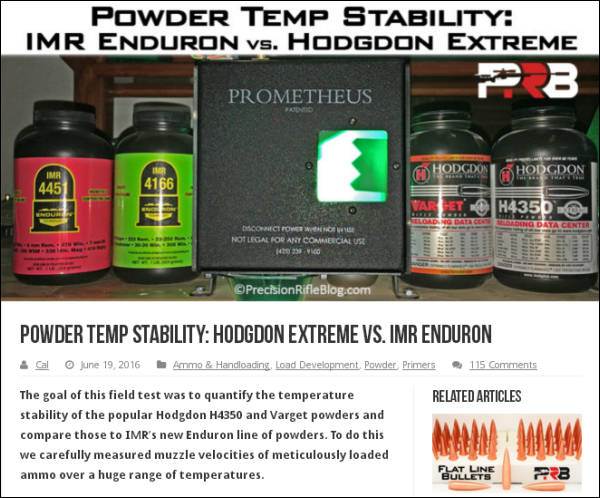
Our friend Cal Zant of the Precision Rifle Blog recently published a fascinating comparison test of four powders: Hodgdon H4350, Hodgdon Varget, IMR 4451, and IMR 4166. The first two are Hodgdon Extreme powders, while the latter two are part of IMR’s Enduron line of propellants.
The testers measured the velocity of the powders over a wide temperature range, from 25° F to 140° F. Hodgdon H4350 proved to be the most temp stable of the four powders tested.
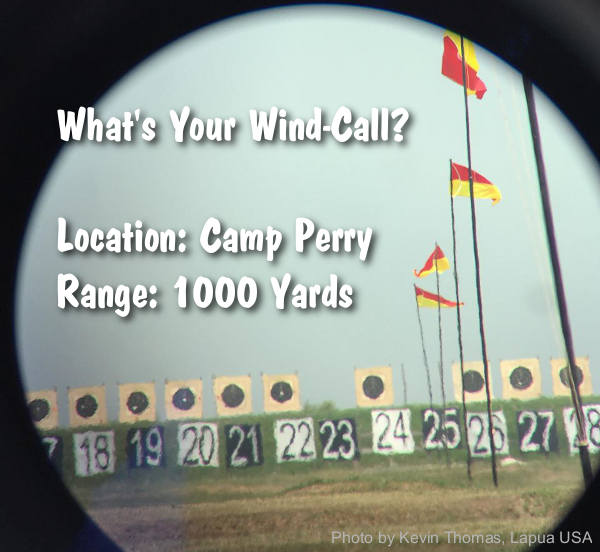
“The pessimist complains about the wind; the optimist expects it to change; the realist adjusts the sails.” — William Arthur Ward
Readers often ask us: “Is there a decent, easy-to-comprehend book that can help my wind-reading?” Many of our Forum members have recommended The Wind Book for Rifle Shooters by Linda Miller and Keith Cunningham.
New Hardback Edition Releases February 19th
A NEW hardback edition of The Wind Book will released on February 19, 2019. This 152-page book, first published in 2007, is a very informative resource. But you don’t have to take our word for it. If you click this link, you can read book excerpts and decide for yourself. When the Amazon page opens, click the book cover (labeled “Look Inside”) and another screen will appear. This lets you preview the first few chapters, and see some illustrations. Along with the new hardback edition ($21.99) Amazon offers a Kindle (eBook) edition for $14.99.
Other books cover wind reading in a broader discussion of ballistics or long-range shooting, such as Applied Ballistics for Long-Range Shooting by Bryan Litz. But the Miller & Cunningham book is ALL about wind reading from cover to cover, and that is its strength. The book focuses on real world skills that can help you accurately gauge wind angle, wind velocity, and wind cycles.
All other factors being equal, it is your ability to read the wind that will make the most difference in your shooting accuracy. The better you understand the behavior of the wind, the better you will understand the behavior of your bullet. — Wind Book for Rifle Shooters
The Wind Book for Rifle Shooters covers techniques and tactics used by expert wind-readers. There are numerous charts and illustrations. The authors show you how to put together a simple wind-reading “toolbox” for calculating wind speed, direction, deflection and drift. Then they explain how to use these tools to read flags and mirage, record and interpret your observations, and time your shots to compensate for wind. Here are two reviews from actual book buyers:
I believe this is a must-have book if you are a long-range sport shooter. I compete in F-Class Open and when I first purchased this book and read it from cover to cover, it helped me understand wind reading and making accurate scope corrections. Buy this book, read it, put into practice what it tells you, you will not be disappointed. — P. Janzso
If you have one book for wind reading, this should be it. Whether you’re a novice or experienced wind shooter this book has something for you. It covers how to get wind speed and direction from flags, mirage, and natural phenomenon. In my opinion this is the best book for learning to read wind speed and direction. — Muddler
After the 2019 King of 2 Miles competition last weekend, some readers asked whether it’s possible to shoot Extreme Long Range with a regular factory rifle — a rig that costs thousandths less than the full custom 40-lb ELR beasts used by top KO2M teams. The answer is a definite yes. Here’s a story from Forum member Mark Dalzell. A few seasons back, Mark showed what can be done with a factory Savage 110 BA at extreme long range — 1760 yards (one mile). Mark did a great job with the video, which features multiple camera views so you can see the shooter and the target at the same time. Enjoy!
This video by Mark Dalzell demonstrates the long-range capabilities of the Savage 110 BA chambered in .338 Lapua Magnum. Mark took his “BadAss” rig out to the southwest Nevada desert just north of Jean Dry Lakes. He placed a 2’x3′ target way, way out there — a full mile (1760 yards) away. At that range, flight time to target was 3.75 seconds! Sighting with a Nightforce 5-22x50mm NXS scope, Mark needed a few shots to get on target, but eventually made multiple hits, using 67 MOA of elevation and 2.25 MOA left windage. You can view the hits starting at 1:56 time-mark on the video. (Mark had a second camera set up closer to the target — this displays frame in frame in the video, and if you watch carefully you can see the strikes.) The ammo was HSM 250gr HPBT match with a 3.600″ COAL. The shooting was done at 8:13 in the morning, with clear conditions, very light winds. Temp was 57°, humidity 24.5, Density Altitude 3666. Video soundtrack is La Grange by ZZ Top.
PLAY BUTTON
LISTEN TO MARK TALK about One Mile Shooting:
CLICK Play Button to hear Mark Dalzell TALK about his .338 LM Savage 110 BA and how he scored hits at 1760 yards.
Good Shooting Mark. That’s darn good for a factory rifle. You also had the elevation dialed in real close before the firing started! That shows a good knowledge of your ammo’s long-range ballistics. We also noticed how effective that muzzle brake was. Recoil looked about the same as an un-braked .308 Win.
If you thought Mark’s 1760-yard shooting was impressive, Mark has produced another video that shows a session at even greater distances — out to 2300 yards. Watch Mark Dalzell Shoot at 2300 Yards.
Berger Twist-Rate Stability Calculator
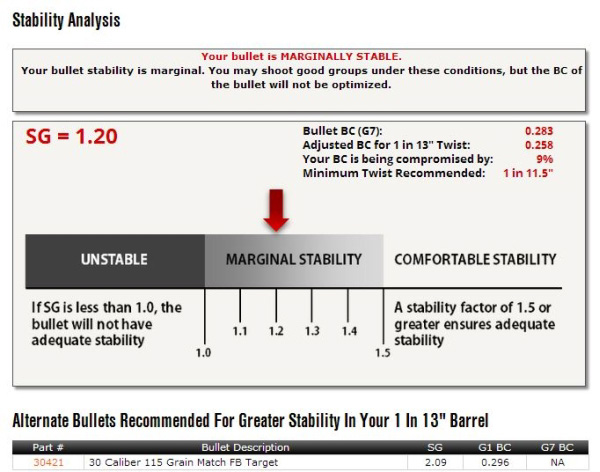
On the Berger Bullets website you’ll find a handy Twist-Rate Stability Calculator that predicts your gyroscopic stability factor (SG) based on mulitiple variables: velocity, bullet length, bullet weight, barrel twist rate, ambient temperature, and altitude. This cool tool tells you if your chosen bullet will really stabilize in your barrel.
How to Use Berger’s Twist Rate Calculator
Using the Twist Rate Calculator is simple. Just enter the bullet DIAMETER (e.g. .264), bullet WEIGHT (in grains), and bullet overall LENGTH (in inches). On its website, Berger conveniently provides this info for all its bullet types. For other brands, we suggest you weigh three examples of your chosen bullet, and also measure the length on three samples. Then use the average weight and length of the three. To calculate bullet stability, simply enter your bullet data (along with observed Muzzle Velocity, outside Temperature, and Altitude) and click “Calculate SG”. Try different twist rate numbers (and recalculate) until you get an SG value of 1.4 (or higher).
Gyroscopic Stability (SG) and Twist Rate
Berger’s Twist Rate Calculator provides a predicted stability value called “SG” (for “Gyroscopic Stability”). This indicates the Gyroscopic Stability applied to the bullet by spin. This number is derived from the basic equation: SG = (rigidity of the spinning mass)/(overturning aerodynamic torque).
If you have an SG under 1.0, your bullet is predicted not to stabilize. If you have between 1.0 and 1.1 SG, your bullet may or may not stabilize. If you have an SG greater than 1.1, your bullet should stabilize under optimal conditions, but stabilization might not be adequate when temperature, altitude, or other variables are less-than-optimal. That’s why Berger normally recommends at least 1.5 SG to get out of the “Marginal Stability” zone.
In his book Applied Ballistics For Long-Range Shooting, Bryan Litz (Berger Ballistician) recommends at least a 1.4 SG rating when selecting a barrel twist for a particular bullet. This gives you a safety margin for shooting under various conditions, such as higher or lower altitudes or temperatures.
Story idea from EdLongrange. We welcome reader submissions.
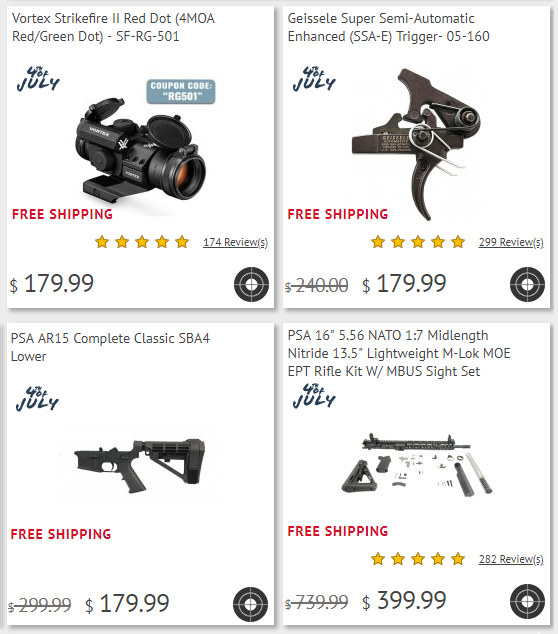
The fireworks are over, and folks are returning to their jobs, but many Fourth of July Sales are still running through the weekend. We found some great deals at Palmetto State Armory (PSA). If you’re a black rifle fan, or a pistol shooter, you should definitely check out these deals. Many high-quality products are deeply discounted, including Vortex Optics, Geissele triggers, and Smith & Wesson pistols. You’ll also find great deals on AR components — stripped lowers, complete lowers, and complete uppers.
Here are a few deals we found on the PSA website. There are hundreds of other items on sale. The super-low prices for PSA’s 4th of July Sale are good through 11:59 PM EST on Monday, July 8, 2019. If you see a deal that appeals, grab it before the prices go back up Tuesday morning.
In this video, Bill Geissele explains how to install a Geissele SSA Trigger:
Today, July 4th, we are celebrating a special birthday — the launching of a new nation that would become the world’s greatest exemplar of freedom and democracy. In our modern world, it is easy to lose sight of the challenges that faced our fore-fathers, and the continuing burdens we all share, as Americans, to maintain the struggle for freedom, both at home and abroad. It is more important than ever that we remember the ideals on which the nation was founded, and remember that our nation became great through the efforts and talents of a free citizenry, not through an all-powerful central government.
In the Beginning — Overcoming Great Odds
In a July 4th speech, Navy Lt. Ellen Connors wrote: “Our nation declared its independence in order for our families to live free –- not just for one generation but for future generations. And what odds [the founding fathers] faced. It must have seemed impossible. Our forefathers went up against the world’s most colossal empire since ancient Rome. No colony had ever successfully left a mother country to set up a self-governing state.”
The Price of Freedom… The Pride of A Nation
Here is a selection from Daniel Webster’s July 4th, 1851 Oration. His words ring true even now:
On the 4th of July, 1776, the assembled Representatives of the United States of America in Congress declared that these United Colonies are, and of right ought to be, FREE and INDEPENDENT States. This Declaration, made by most patriotic and resolute men, trusting in the justice of their cause and the protection of Heaven, and yet made not without deep solicitude and anxeity, has now stood for seventy-five years, and still stands. It was sealed in blood. It has met dangers, and overcome them; it has had enemies, and conquered them; it has had detractors, and abashed them all….
Every mans’ heart swells within him… as he remembers that seventy-five years have rolled away, and that the great inheritance of liberty is still his — his, undiminished and unimpaired, his in all its original glory; his to enjoy; his to protect; and his to transmit to future generations.
Many leading shooting sports online retailers are offering money-saving promotions this holiday weekend. With appropriate discount codes you can save 10%, get free shipping, or qualify for other significant savings. Here are some of the best current promotions we’ve found. Note — these promo codes change frequently. Check www.Retailmenot.com for new codes after these expire.
Precision Reloading offers three ways to save for this holiday weekend. The sale runs through 11:59 pm on July 8, 2019 and applies to in-stock inventory.
Natchez Shooters Supplies is offering multiple specials right now. But act quickly — these deals expire at 11:59 pm CDT on July 4, 2019. With these promo codes you can save 10% right off the top, and/or get Free Shipping or Free Hazmat.
Pyramyd Air is offering 11% Off nearly every product in stock, during its 4th of July Sale with runs through July 6, 2019 at 11:59 pm. In addition, orders over $150.00 qualify for Free Shipping.
Here’s something fitting for the Fourth of July, Independence Day. Ruger has just announced a new line of Flag Series firearms. Arriving just in time to celebrate the birth-date of our nation, the Ruger Flag Series handguns and rifles boast painted flag Cerakote® and flag camo-dipped finishes. There are both Stars and Stripes offerings as well as State flag models.
The first four models in the Ruger American Flag series are built on the following platforms: AR-556 MPR, AR-556 Pistol, Ruger Precision® Rimfire, and PC Carbine™ rifles, as well as the AR-556 Pistol. Additional, distributor-exclusive models with state flag Cerakote finishes are also available. These will include SR22 pistols with North Carolina State flag or Arizona State flag Cerakote finish. In addition there will be a 6.5 Creedmoor Ruger Precision Rifle (RPR) with a Texas State flag camo dip.
Impact Guns also has an American Flag Special Edition of the SR22 pistol with Stars and Stripes finish on the metal slide. As seen below, this limited-edition SR22 runs $399.99.
“We are very excited about the introduction of the Flag Series,” said Shawn Leska, Ruger Vice President of Sales. “This new lineup of firearms is our most patriotic yet and we hope our customers will feel a sense of pride owning a pistol or rifle from this American-made series.”
Would you like to become a respected gun journalist/editor — and work with the nation’s most talented benchrest shooters (from 100 to 1000 yards). Do you enjoy photography, and like to see images of beautiful ranges and the world’s most accurate rifles? Then here is a great opportunity…
The International Benchrest Shooters (IBS) is looking for a new Match Reports Editor. This individual will work with AccurateShooter.com to deliver photo-illustrated reports on important IBS matches around the country. These match reports can appear here in the Daily Bulletin, on the main Accurateshooter.com site, and on the IBS website (in modified format).
IBS Match Report Editor Job Opportunity
IBS seeks a part-time Editor to manage reports on the IBS Nationals and Featured Matches on Accurateshooter.com. The duties include communicating with match organizers, receiving match reports and equipment lists, and managing digital images. In addition, the Editor will help with some special IBS features and equipment articles. Salary is negotiable, based on experience and work output.
Contact IBS President, Jeff Stover at: ibsprez @ yahoo.com
No Expert Skills Required — Just Enthusiasm for the Sport
You don’t need to be a computer whiz — no programming is involved. If you can use a basic writing program and can email photos then you’ve got the skill set needed. Basically the IBS is looking for someone who enjoys benchrest shooting and would like to help the sport by showcasing the fun and camaraderie of IBS matches. Here are some images from past IBS match reports:


 There is nothing super-exotic in this rifle, but it IS fitted out with some of the best components on the market. We did start with a factory action, however, a Remington 700 short action. Chris trued the action, added an SSG over-sized bolt knob, and fitted the action with a Broughton 5C, 9-twist #7 contour barrel finished at 24″. To reduce recoil we added a Badger brake. The stock is a fiberglass McMillan HTG (General Purpose Hunting) stock in Desert Camo. (This McMillan stock design replicates the original M40A1 Marine Sniper Rifle stock.) Since this is a repeater we added a Wyatts Mag Box. The gun features Badger bottom metal, Badger scope rail and Badger Rings. The Scope is a 4-16 Nikon Tactical, which, so far, has proven to be excellent. All the metal is Teflon-coated in Mil-Spec OD Green. I have a bubble-level mounted on the scope rail.
 I use Winchester-brand brass and Winchester Large Rifle Magnum primers. My current load is 64.0 grains of H4831sc for the Hornady 162s (2950 fps) and 61.0 grains of H4831sc for the Sierra 175s (2830 fps).
 This rifle is by far one of the most fun rifles I have ever had. The recoil is very minimal with either of the loads and the rifle just plain flat-out shoots. The break-in took all of 21 rounds I think. This rifle shoots sub-2″ groups at 500 yards all day every day (often closer to 1″). Note that I don’t do any shooting from a bench and rests except for the initial load work up. The rest of the time I shoot from a bipod. I would really like to stress that I shoot exclusively with bi-pod and “sand-sock”. So many guys out there think that you have to shoot from a bench to get outstanding results. This simply isn’t true. If you are a disciplined shooter and have correct shooting techniques you can do amazing things from any shooting position. Long Range doesn’t have to be from a rest or bench!


 To learn more about how ambient temperature (and primer choice) affect pressures (and hence velocities) you should read the article