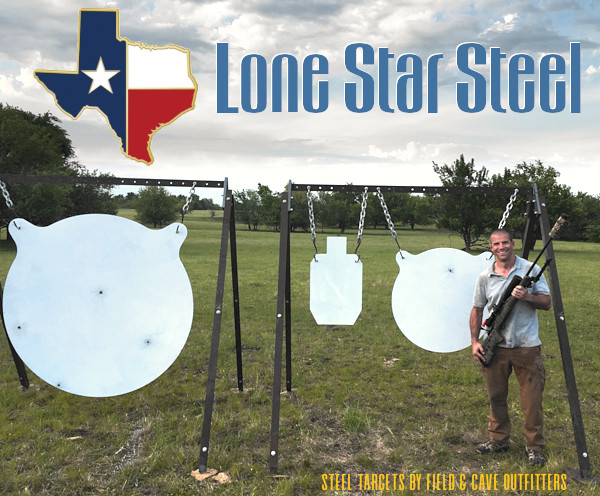
These targets were set at one mile (1760 yards). Travis Frazer (with rifle) and friend Curtis went a combined 5 for 5 at this distance.
They say that “Everything is Bigger in Texas”. Well that’s apparently true, at least when it comes to steel targets — really BIG steel targets. Our friends at Field & Cave Outfitters (FCO), based in Mesquite, Texas, recently delivered a trailer-load of super-sized steel targets to a large ranch. The Field & Cave team placed a total of 117 steel targets on 34 frames at distances from 25 yards to 1760 yards (one statute mile).
It took Field & Cave Outfitters a big trailer to haul 117 steel targets.
Naturally, after setting the targets up (on 34 frames), Travis Frazer and buddy Curtis Attaway tested the steel — with considerable success. In fact, Travis and Curtis managed to go five-for-five with the One Mile targets. That’s mighty impressive when you consider neither man had ever shot past 1200 yards before. Travis provides a yardage-by-yardage account of his Steel Shooting Adventure below. Enjoy!
Along with the jumbo-sized targets for Extreme Long Range (ELR), Field & Cave Outfitters supplied numerous smaller gongs and plates for shorter distances, starting at 25 yards.
Building a Rifle Shooter’s Paradise and Ringing Steel at One Mile
Friend and gunsmith Johnathon Stigall of Crimson Accuracy introduced me to a customer looking to build a private range on his very expansive ranch. Curtis Attaway, a fellow shooting nut, served as facilitator for the ranch owners who ordered a vast array — 117 steel targets and 34 frames to be set up from 25 yards to a full mile. The largest was a 63″-diameter round gong cut from 3/8″ A46100 armor to serve as a One Milliradian-sized target at one mile. (Meaning the diameter of the target equals 1 Mil at 1 Mile.)
“What do you get the guy that has everything — several sections of land, a range out to one mile? Lots of steel, naturally. We delivered 117 steel targets and 34 frames!” — Travis Frazer
After about eight weeks of production time, we delivered and set up the targets in late April 2019. Upon arrival at the property, Curtis and I met the ranch manager and two hands. Luckily we had a tractor, truck, trailer, and mobile power — all the tools necessary to get things done. We worked from 10:00 am to 6:30 pm and only managed to get the long-range rifle targets set. We put steel at 200, 300, 400, 500, 600, 750, 1000, 1100, 1320 (3/4 mile), 1450, 1600, and 1760 yards (1 mile). All the targets were accessible from the same elevated shooting position on the side of a hill.
Shooting Steel from 200 Yards to One Mile
Luckily, after the work was done there was still some daylight left. Optical conditions were near perfect and the wind, while still pretty stiff, had come around to straight out of 6 O’Clock. Curtis brought his 6.5×55 Swede and 28 Nosler. I brought my 6.5×47 Lapua hunting rifle. We took turns shooting — Curtis was prone on his UTV trailer, I was lying in the bed of my truck. We started at 200 yards, each shooting a single round at a steel torso silhouette. We continued taking one shot per distance, making adjustments to what our ballistic APPs suggested, based on the observed impacts on the targets. We continued scoring first-round hits until we reached one thousand yards. After a few shots, getting centered at 1K, we continued on, hitting more than we missed.
I ran out of elevation trying to engage the 1450-yard target. I needed 67 MOA of “up” and only had 60. After three shots and zero hits with varying amounts of hold-over on a Full Scale IPSC torso, I called it quits with the little 47.
Meanwhile, Curtis put a 195gr Berger out of his 28 Nosler on a half-inch-thick AR550 torso at 200 yards to confirm his zero and stress-test the steel. Both passed with flying colors. After that, it was straight to 1100 yards where he scored a first-shot hit, then followed it up with a second shot about two inches to the right. He continued to walk it out, scoring a first round hit at 1320 then 1600. We couldn’t see the hit at 1600 because a tree line obscured the lower third of the 58″ diameter gong. We only knew he hit it because of the glorious ring!
Knowing that he hit it low, Curtis dialed up to one mile, but ran out of travel three minutes short. He backed the power down to 24X so his reticle would subtend properly, held the three minutes and let one fly. He was rewarded with a first-, second-, and third-round hits — the third being almost perfectly centered on the 63-incher. He let me get behind the trigger and told me where to hold. I hit the 63″ gong on the first try, so I decided to give the smaller, half-Mil 37″ target a shot.
That two and a half-second flight time seemed like an eternity. I had resigned to the fact that I missed… but then I saw the 37″ plate swing with the impact. Incredible! The impact was centered horizontally, about 10″ below the top edge (see top photo). That Crimson Accuracy-smithed 28 Nosler made two newbies look like old pros at ELR. The ranch manager watching through the spotting scope couldn’t believe what he was seeing. What he didn’t know is that neither could we!
Efficient cartridges make excellent use of their available powder and case/bore capacity. They yield good ballistic performance with relatively little recoil and throat erosion.
Cartridge Efficiency: A Primer (pun intended!)by USAMU Staff
Each week, the U.S. Army Marksmanship Unit (USAMU) publishes a reloading article on its Facebook Page. In this week’s article, the USAMU discusses cartridge case efficiency and its benefits. While this is oriented primarily toward NRA High Power Rifle and Long Range (1000-yard) competition, these factors also apply to medium/big game hunters. Assuming one’s rifle and ammunition are accurate, key considerations include ballistic performance (i.e., resistance to wind effects, plus trajectory), recoil, and throat erosion/barrel life.
Efficient cartridges make excellent use of their available powder and case/bore capacity. They yield good ballistic performance with relatively little recoil and throat erosion. A classic example in the author’s experience involved a featherweight 7x57mm hunting/silhouette rifle. When loaded to modern-rifle pressures, just 43-44 grains of powder pushed a 139gr bullet at 2900 fps from its 22” barrel. Recoil in this light rifle was mild; it was very easy to shoot well, and its performance was superb.
An acquaintance chose a “do everything” 7mm Remington Magnum for use on medium game at short ranges. A larger, heavier rifle, it used ~65 grains of powder to achieve ~3200 fps with similar bullets — from its 26″ barrel. Recoil was higher, and he was sensitive to it, which hampered his shooting ability.
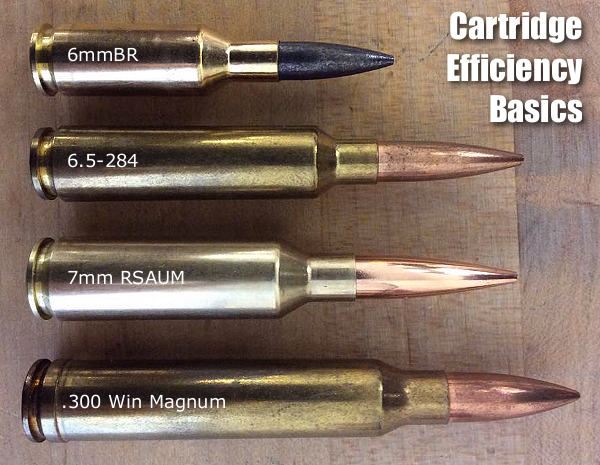
Similarly efficient calibers include the 6mm BR [Norma], and others. Today’s highly-efficient calibers, such as 6mm BR and a host of newer developments might use 28-30 grains of powder to launch a 105-107gr match bullet at speeds approaching the .243 Winchester. The .243 Win needs 40-45 grain charges at the same velocity.
Champion-level Long Range shooters need every ballistic edge feasible. They compete at a level where 1″ more or less drift in a wind change could make the difference between winning and losing. Shooters recognized this early on — the then-new .300 H&H Magnum quickly supplanted the .30-06 at the Wimbledon winner’s circle in the early days.
The .300 Winchester Magnum became popular, but its 190-220gr bullets had their work cut out for them once the 6.5-284 and its streamlined 140-142gr bullets arrived on the scene. The 6.5-284 gives superb accuracy and wind performance with about half the recoil of the big .30 magnums – albeit it is a known barrel-burner.
Currently, the 7mm Remington Short Action Ultra-Magnum (aka 7mm RSAUM), is giving stellar accuracy with cutting-edge, ~180 grain bullets, powder charges in the mid-50 grain range and velocities about 2800+ fps in long barrels. Beyond pure efficiency, the RSAUM’s modern, “short and fat” design helps ensure fine accuracy relative to older, longer cartridge designs of similar performance.
Recent design advances are yielding bullets with here-to-fore unheard-of ballistic efficiency; depending on the cartridge, they can make or break ones decision. Ballistic coefficients (“BC” — a numerical expression of a bullet’s ballistic efficiency) are soaring to new heights, and there are many exciting new avenues to explore.
The ideal choice [involves a careful] balancing act between bullet BCs, case capacity, velocity, barrel life, and recoil. But, as with new-car decisions, choosing can be half the fun!
Factors to Consider When Evaluating Cartridges
For competitive shooters… pristine accuracy and ballistic performance in the wind are critical. Flat trajectory benefits the hunter who may shoot at long, unknown distances (nowadays, range-finders help). However, this is of much less importance to competitors firing at known distances.
Recoil is an issue, particularly when one fires long strings during competition, and/or multiple strings in a day. Its effects are cumulative; cartridges with medium/heavy recoil can lead to shooter fatigue, disturbance of the shooting position and lower scores.
For hunters, who may only fire a few shots a year, recoil that does not induce flinching during sight-in, practice and hunting is a deciding factor. Depending on their game and ranges, etc., they may accept more recoil than the high-volume High Power or Long Range competitor.
Likewise, throat erosion/barrel life is important to competitive shooters, who fire thousands of rounds in practice and matches, vs. the medium/big game hunter. A cartridge that performs well ballistically with great accuracy, has long barrel life and low recoil is the competitive shooter’s ideal. For the hunter, other factors may weigh more heavily.
Cartridge Efficiency and Energy — Another Perspective
Lapua staffer Kevin Thomas explains that efficiency can be evaluated in terms of energy:
“Cartridge efficiency is pretty straight forward — energy in vs. energy out. Most modern single-based propellants run around 178-215 ft/lbs of energy per grain. These figures give the energy potential that you’re loading into the rifle. The resulting kinetic energy transferred to the bullet will give you the efficiency of the round. Most cases operate at around 20-25% efficiency. This is just another way to evaluate the potential of a given cartridge. There’s a big difference between this and simply looking at max velocities produced by various cartridges.”
Do you shoot a Springfield M1A rifle chambered for the .308 Win/7.62×51? Or maybe you have a rugged, semi-auto FN-FAL in 7.62×51 NATO? Are you looking for very strong, durable brass you can shoot in these semi-auto battle rifles, without breaking the bank?
Photo of 2009 M1A Match at Camp Perry. Shooter is Nick Till, 2007 Service Rifle Champion.
Semi-autos such as the M1A are tough on brass. You want brass that isn’t too costly, but at the same time is very strong and durable. For decades, USA-made Lake City brass have been a solid choice for 7.62×51 semis, and now you can get quality, unfired 7.62×51 Lake City brass for just $49.99 for 250 cases at Midsouth. That’s just $0.20 (twenty cents) per case! That’s a fourth what you’ll pay for premium, virgin .308 Winchester brass. These cases are never-fired brass, with CCI #34 primers seated in crimped, military-style primer pockets.
This 7.62×51 Lake City brass comes from disassembled “pull-down” ammunition. It has NOT been fired, but it has been previously assembled. So, there may be some cosmetic issues with the brass. Note that these are primed cases. If you choose to neck-size or FL-size the brass before loading for the first time, REMOVE the decapping rod in your sizing die. This brass has LIVE PRIMERS!! Do NOT use a die with a decapping rod for the first loading of this brass. Got that guys? This is important!!
We have shot FN-FAL-type rifles built on DS Arms semi-auto lowers with European uppers. Those beasts were tough on brass, so we relied on Lake City brass when available. If you have a FN-FAL or STG-58, you should give this Lake City primed, pull-down brass a try. (Federal Gold Medal Match ammo shot great in our DSA/STG-58 but the brass was toast after a few firings).
We frequently receive inquiries about compact self-defense pistols. Many folks ask: “What’s a good compact pistol I can carry or keep in a vehicle during trips?” Of course, there is the Glock 19. And the new Sig Sauer P365 is quite good. But they are both around $500.00. You can spend half that and still get a reliable carry pistol with lifetime warranty and good ergonomics.
Here are five compact and sub-compact handguns, all available now for under $250.00. In fact, our final choice, the Keltec P32, is currently just $149.00. That’s a serious bargain … it’s a buyers’ market right now.
1. Walther Creed 9mm — $249.99 at CDNN sports
The Walther Creed offers excellent ergonomics, good accuracy, and well-designed controls at a killer price — $249.99 at CDNN Sports. This gun, designed to be a value-leader, emulates Walther’s more expensive PPQ model (MSRP $649.00) at a much lower price. The Creed’s frame size and shape is the same as the PPQ, but the Creed lacks interchangeable backstraps. Slide and trigger are very similar. The Creed features a snag-free bobbed hammer. Testers have praised the new Creed, saying that, despite the bargain price, it “sacrifices little to nothing in… ergonomics, accuracy, and reliability.”
2. Smith & Wesson 9mm Shield — $249.00 at GunPrime.com
We like Smith & Wesson compact pistols. Many users find the grip more comfortable than a Glock, and we like Smith & Wesson customer support. Right now Smith & Wesson 9mm Shield on sale for just $249.00. This striker-fired, polymer-framed pistol features a 3.125″ barrel, thumb safety, and ships with two magazines. You’ll find a full review of this pistol, from a lady’s perspective, on Guns.com.
3. Ruger EC9 9mm — $209.99 at Brownells with CODE M8Y
The striker-fired Ruger EC9 features a 3.12″ barrel and measures 6.0″ overall. This 1.07-lb EC9 is slim for easy concealment. Weighing just 1.07 lbs., this is definitely an “all-day carry” option. With Brownell’s current sale pricing and promo codes, you can get this little pistol for just $209.99 delivered (see right). You heard that right. Sale price is currently $219.99 with a $10 handling charge. However, during check-out you can use code “M8Y” to receive $20 Off and get FREE delivery. That lowers your net cost, so that your all-up price, delivered to your FFL, is just $209.99.
That’s a great price for a reliable gun backed by Ruger. Here is a recent review from verified buyer: “It’s an LC9 with fixed sights that are milled into the slide. Same trigger. Same frame. Sweet shooter. Perfect for concealed carry. Can’t beat it for the price.”
4. Taurus G2c 9mm — $184.99 with Factory Rebate
This is a good little gun at a great price. Taurus is running a factory rebate through the end of May 2013. Palmetto State Armory has the OD Green-frame Taurus G2c 9mm for just $209.99 with FREE shipping. But the Taurus $25 Factory Rebate lowers your price to just $184.99 for this G2C. Or, if you like basic black, you can get a black-framed G2c for $174.99 after rebate. Despite its small size, the G2c has a 12-round magazine. We like the fact it has a left-side manual safety (unlike the Glock).
5. KelTec P32 .32 ACP – $149.00 at GunPrime
Here’s a very small gun, in a small caliber. This is a choice for those seeking “ultimate concealability”. The P32 can be carried in a pants pocket, or small purse. The .32 ACP cartridge doesn’t have the stopping power of a 9mm of course, but this can be a good back-up gun (with ankle carry), or it can serve when a larger 9mm just isn’t practical. Currently Gunprime.com has the Keltec P32 for just $149.00. That’s just about the cheapest price you’ll find for a new American-made carry gun. The P32 has low-profile sites and a 7-round magazine.
Didn’t make it to the NRA Annual Meetings & Exhibits in Indianapolis last week? Not to worry. Here are four videos created at the NRA convention. There was so much to see, with 800+ exhibitors, and 15 acres of guns and gear. Most of these video creators have additional NRA Meetings & Exhibits segments on their respective YouTube Channels.
Address by President Donald Trump at NRA-ILA Leadership Forum
This hour-long video includes the full speech by the President. Definitely worth watching. We are lucky to have a Chief Executive who respects the Second Amendment and gun rights.
Featured Rifles at NRA Convention — GunBlast.com
Jeff Quinn of GunBlast.com visits multiple booths in this video, the first of four 2019 NRA Show videos produced by Gunblast. Quinn visits Colt (0:26), Ruger (1:00), Savage (3:16), Springfield Armory (3:46), CZ-USA/Dan Wesson (4:30), Henry Rifles (4:20), Auto-Ordnance (7:05), Smith-Wesson & T/C (9:35) Alexander Arms (10:47) among others. The “Trump AR” from Auto-Ordnance (shown above) is featured at the 12-minute mark. CLICK HERE to see three other GunBlast videos from the 2019 NRA Show. This page has links to ALL the 50+ manufacturers showcased in the four GunBlast Show Videos.
Pistols and Rifle at NRA Convention — ClassicFirearms
This lengthy 25-minute video showcases a wide variety of interesting firearms, starting with Remington rifles. Next up are some innovative FosTech AR-platform rifles (6:20), followed by Beretta (11:48), Delton (15:00), and some other smaller vendors. There are two other NRA Show videos (Day 1, Day 2) from Classic Firearms.
Women Talk Guns at NRA Convention — The Daily Caller
Here ladies from the Daily Caller interviewed attendees at the 2019 NRA Convention. One hot topic was how women can protect themselves with CCW handguns. One video viewer noted: “We need more of these videos promoting positive and healthy firearm ownership. Women, families, mother or daughter etc… enjoying their right to enjoy sport shooting or have self defense confidence.” Another viewer posted: “There’s nothing more attractive than beautiful conservative women who love the 2nd Amendment!”
Shown are funnel with ultra-long drop tube (which helps get more kernels in the cases), RCBS Chargemaster (in wood box), and Hood Press (similar to Harrell’s Combo press).
Loading at the range remains important in the Benchrest for Group discipline. In a Special Report below, IBS President Jeff Stover explains how loading methods (and hardware) have evolved over the years. The advent of accurate, affordable electronic powder dispensers, such as the RCBS ChargeMaster and Frankford’s new Intellidropper, have changed the game and made it easier to load efficiently at the range. And quality manual powder measures are fast and can be very consistent, with a little practice. Loading at the range permits competitors to tune their load to the conditions, change seating depths, or even choose different bullets to suit the barrel’s preferences on any given day.
Although pre-loading is not uncommon, most 100/200-yard group shooters usually load at the match, often between relays. The goal is to shoot smaller groups by staying “in tune”. In a game where 5-shot groups “in the 1s and Zeros” is the goal, tuning loads for the conditions helps deliver match-winning accuracy. Nearly all competitors in this short-range discipline shoot the 6mm PPC cartridge, or a PPC variant.
Loading at the Range — Then and Now
In benchrest shooting for group, loading at the range has been de rigueur for decades. In the Score discipline, preloading is usually the custom. The main reason is that, in Score competition, only one Aggregate (warm-up match and five record targets) per day is usually shot. That would be less than 50 shots, assuming a few sighter shots. Also, the 30BR, the dominant Benchrest-for-Score cartridge, is very amenable to pre-loading.
By contrast, the Group discipline includes 21 targets (two warm-ups and twenty record targets) over a weekend, usually shot with 6PPC-chambered rifles. Many times, the 6PPC shooters may tweak their loads through the day given changing atmospheric conditions or simply trying to find the correct tune to “dot up”. This term, “Dot up”, means the shots are essentially going through the same hole, or closely so.
Loading at the range was a bit different when benchrest competition was in its infancy. The 1951 book, Modern Accuracy by Bob Wallack, is the best of the early benchrest books. Copies can be found, from time to time, on eBay or Alibris. It is a fascinating survey of benchrest as it existed more than six decades ago. There’s even coverage of a controversial target that was argued over at the time. In it, there is a photo of Wallack using the rear bumper of a car at the bench to clamp his reloading tools. Things have come a long way compared to the range loading set-ups of modern shooters. Here you can see Bob Wallack way back in 1950:
Modern loading bench set-ups shown in this Special Report belong to top shooters Howie Levy, Bob Hamister, and Kent Harshman.
The shooting sports are not a “man’s game” these days. Far from it. More and more women have taken up target shooting. A recent survey showed an 80% increase in the number of women target shooters from 2001 to 2016. In total, six million American ladies participated in target shooting in 2016. Likewise hunting has become more popular with American women. Female hunters in the USA numbered 1.1 million in 2016. That represents a 104% increase from 2001.
Recognizing that ladies are an ever-increasing part of the shooting sports, Shooting Industry Magazine just released its first-ever Woman’s Issue dedicated to female shooters and huntresses. This May 2019 special issue can be accessed for FREE online. CLICK HERE to READ.
While the issue is focused primarily on SELLING products to women, there is some very useful information that can help match directors and club officials. The magazine interviews many business owners and range directors who have developed female-focused shooting and training programs.
Above and below — the world’s best female Action Pistol shooter, Jessie Harrison.
Female Participation in Shooting Sports and Hunting
The Shooting Industry Woman’s Issue spotlights female participation in target shooting and hunting. One key article summarizes a nationwide survey conducted by Southwick Associates. One interesting finding was that much of the increase in female participation can be tracked to younger ladies: “Female participation in both hunting and shooting may be highest among younger women[.]” Notably, 16% of respondents among target shooters in the 16-24 age category were female. Southwick concludes: “Future generations of hunters and shooters will contain more women than ever before”.
The Shooting Industry Magazine Woman’s Issue has more than a dozen articles focusing on women in the shooting sports. We found some good advice from industry leaders and shop owners on developing products for women shooters, CCW holders, and hunters:
“When the ‘shrink it and pink it’ mentality is applied to hunting and outdoor gear, it can be perceived by some as an insult to a woman’s ability and competence. Women, expecially avid female hunters, want to be taken seriously.” –Brenda Weatherby, Weatherby Inc.
“I’m glad to bring a female perspective to a predominantly male industry. In general, men and women have different concerns/issues specifically when carrying a concealed handgun.” — Melissa Torres, Owner Scoots Place
“Seek a woman’s advice and input on any gear you want to bring to market for a female.” — Jessica Hazelaar, Owner Eclipse Holsters
Today, May 1st, 2019, Shooting USA TV features The Brawl at Rifles Only, a tactical competition that draws top long-range shooters from military, law enforcement and civilian shooting communities. The match is held at the famed Rifles Only range in Kingsville, Texas. The Brawl is a one-of-a-kind physical and mental challenge that tests shooters’ abilities to read wind, figure ballistics, and adapt to difficult shooting scenarios. There is even a helicopter stage. This Shooting USA episode airs on the Outdoor Channel at 9:00 pm Eastern and Pacific, 8:00 pm Central.
Helicopter Stage at 2014 Brawl in Texas:
Shooting from a helicopter, shooting off of a wire, and shooting from the physically demanding maze called the Mouse Trap. These are just a few of the unique courses of fire at the Bushnell Brawl, part of the PRS series. Over the course of two days, competitors tackle more than a dozen stages. In addition, Bushnell hosted a special one-day event for the new PRS Production Class. This new division should attract new shooters by limiting the cost of equipment — making PRS competition more affordable.
PRS Production Division — Lowering the Cost of Entry
The Production Division is a new PRS classification. Under Production Division rules, the rifle must not exceed $2000.00, and rifle + scope combined must not exceed $4000.00. All other accessories, such as bipod, support bag, and the sling, can be added at the shooter’s own discretion. Even with these cost limits, you can put together a great rig: “There’s a lot of gear out there that’s not that expensive,” says Production Division Match Director Jacob Bynum. For example, you can get the new Howa KRG Bravo in 6.5 Creedmoor for $1034.99. Then use Brownells CODE V2F to save 10% for a net price of $941.50 with Free Shipping. NOTE this is a 1-DAY Special 10% OFF Code (check for other discount codes in the future). With an $800 Nikon FX1000 FFP MRAD optic, and $109 Game Changer Bag, you’re good to go for well under $2000.00 complete. Here’s the Howa KRG Bravo:
H.R. 1222 will help States build and maintain shooting ranges with Federal funding assistance.
Great news from Washington for a change…
The U.S. House of Representatives has passed H.R. 1222, the Target Practice and Marksmanship Training Support Act. This legislation, together with U.S. Senate companion bill S. 94, will help states access Federal funds to build and maintain shooting ranges and marksmanship training facilities.
The Target Practice and Marksmanship Training Support Act, also known as the “Range Bill”, would allow states to use their allocation of Pittman-Robertson funds to begin construction of new ranges, or improve existing state-run public recreational shooting ranges. Currently, states are required to put up 25 percent of the cost of range construction projects to access the matching 75 percent of funds from Pittman-Robertson allocation. This legislation would allow states to access those funds with a 10 percent match and allow states five fiscal years to acquire land for range construction or expansion projects.
This legislation should definitely help states create new ranges and upgrade existing ranges. By reducing the state share from 25% to 10%, the Range Bill effectively lowers state costs of range projects by 60%. That’s a big deal says Lawrence Keane, NSSF Sr. VP and General Counsel: “This is crucial legislation that will give state fish and game agencies more flexibility to use Pittman-Robertson excise taxes dollars raised from the sale of firearms and ammunition to enhance existing public shooting ranges and to build new ones to meet the growing need for additional places for target shooters to participate in their sport.”
Pittman-Robertson Funds Come from Gun and Ammo Taxes
Pittman-Robertson funds are derived from excise taxes paid through firearms and ammunition sales. Since 1937, the fund has generated more than $12.1 billion that has funded wildlife conservation and safety education programs in all 50 states. NSSF estimates more than 80 percent of Pittman-Robertson excise tax contributions are generated by sales attributed to recreational shooting.
H.R. 1222 Goes to Senate and Then to President Trump
The bipartisan H.R. 1222 was sponsored by U.S. Reps. Ron Kind (D-Wis.), Rob Bishop (R-Utah), and Duncan Hunter (R-Calif.). Companion legislation (S. 94) was previously passed by the Senate. H.R. 1222 will return to the U.S. Senate, but is expected to pass by unanimous consent as the bill language is identical. When approved, the bill goes to President Donald Trump for enactment.
Are you feelin’ lucky? Then enter the latest EuroOptic Rifle Give-Away Contest. At the end of May 2019, EuroOptic will give away a New 6.5 Creedmoor Remington 700 SPS Barreled Action in a Magpul Hunter Stock (value $969.00). The Prize Rifle comes complete with a Steiner Optics H4Xi 4-16x56mm Scope (value $1174.99). Total Prize value is $2143.99!
6.5 Creedmoor Barreled Action with Magpul Hunter Stock
The Remington 700 SPS 6.5 Creedmoor Barreled Action with Magpul Hunter ODG Stock Kit is a rugged rifle designed for both hunters and precision shooters alike. The classic Rem 700 action paired with this heavy threaded barrel can deliver impressive accuracy with the 6.5 Creedmoor cartridge. The Magpul Hunter Stock offers good ergonomics and functionality while keeping the weight down. SEE Rifle Details HERE.
Steiner H4Xi 4-16×56 LRS Scope
The Steiner H4Xi 4-16x56mm riflescope is a good choice for long-range target shooting and challenging hunting scenarios. The illuminated Steiner Plex-S1 reticle features ballistic lines and crosswind markers for long range accuracy under pressure. The H4Xi’s large objective diameter and superb optical glass present a bright and clear sight picture in most lighting conditions.







 The striker-fired


 Great news from Washington for a change…


