Everyone should own a nice .22 LR rimfire pistol. The Browning Buck Mark is a classic, and for good reason. These pistols are reliable, well-balanced, have a good trigger, and they are very accurate. We have nothing but praise for the bull-barreled Buck Marks. And now you can get one for a super-low price. Sportsman’s Guide has the Browning Buck Mark Camper UFX with 5.5″ Barrel on sale for $299.99 ($284.99 member price). But it gets even better — if you use Code “WARRIOR” during check-out, you save $20.00, putting your total price at just $279.99 (or $264.99 for SG members). That’s a great deal on a very solid rimfire pistol that can serve you well for decades.
The accurate and ergonomic Buck Mark Camper UFX was selected as an NRA Gun of the Week last year. This video explains the pistol’s features in detail.
This video shows how to Field Strip and disassemble the Buck Mark Camper UFX. To Field Strip the pistol, you need to remove three screws.
Browning Buck Mark Camper UFX Features:
• Blowback, Single Action Only
• Tapered 5.5″ Bull Barrel
• Alloy receiver w/matte black finish
• Overmolded Ultragrip FX ambidextrous grips
• Pro-Target™ adjustable sights with Fiber Optic
Caliber/Cartridge: .22 LR (22 Long Rifle)
Capacity: 10+1
Safety: Manual
Sights: Fiber Optic
Weight: 2.12 lbs
At SHOT Show 2019, Meprolight introduced a new tactical sighting system that may be a precursor of “intelligent” optics in the years ahead. The new MEPRO FORESIGHT, a “digitally augmented” weapon sight, provides essential tactical data projected on to the transparent optical lens. The sight will display a variety of data including a compass, sight level, a variety of reticles, shot counter and even a compass, all for a $714.00 MSRP.
This system offers a 1.3″ x 0.8″ viewing screen in a fairly compact package. Overall the FORESIGHT is 4.6″ x 2.65″ x 2.35″ and weighs a mere 9.9 ounces.
The data, projected in real-time, includes battery level, sensor data, Bluetooth connectivity and a shot counter (with future software upgrade). The FORESIGHT boasts five pre-set reticle types, a horizontal level indicator (very useful!), and even a built-in compass. Display Brightness for the digital reticles and info items are controlled automatically with a built-in sensor.
The FORESIGHT offers a digitally-controlled zeroing system (which controls the center of the reticle relative to the target downrange). This allows you to modify your zero with different loads. And more importantly, you can more the FORESIGHT from gun to gun, and have different zeros for each rifle. The Meprolight MEPRO FORESIGHT APP allows up to 10 zeroed weapon profiles or user profiles. Simply load a present zeroing profile from Meprolight’s mobile APP (Android and iOS) through a Bluetooth interface. The APP also offers a reticle database along with the previously-stored profiles.
At the request of our readers, we provide select “Deals of the Week”. Every Monday morning we offer our Best Bargain selections. Here are some of the best deals on firearms, hardware, reloading components, optics, and shooting accessories. Be aware that sale prices are subject to change, and once clearance inventory is sold, it’s gone for good. You snooze you lose.
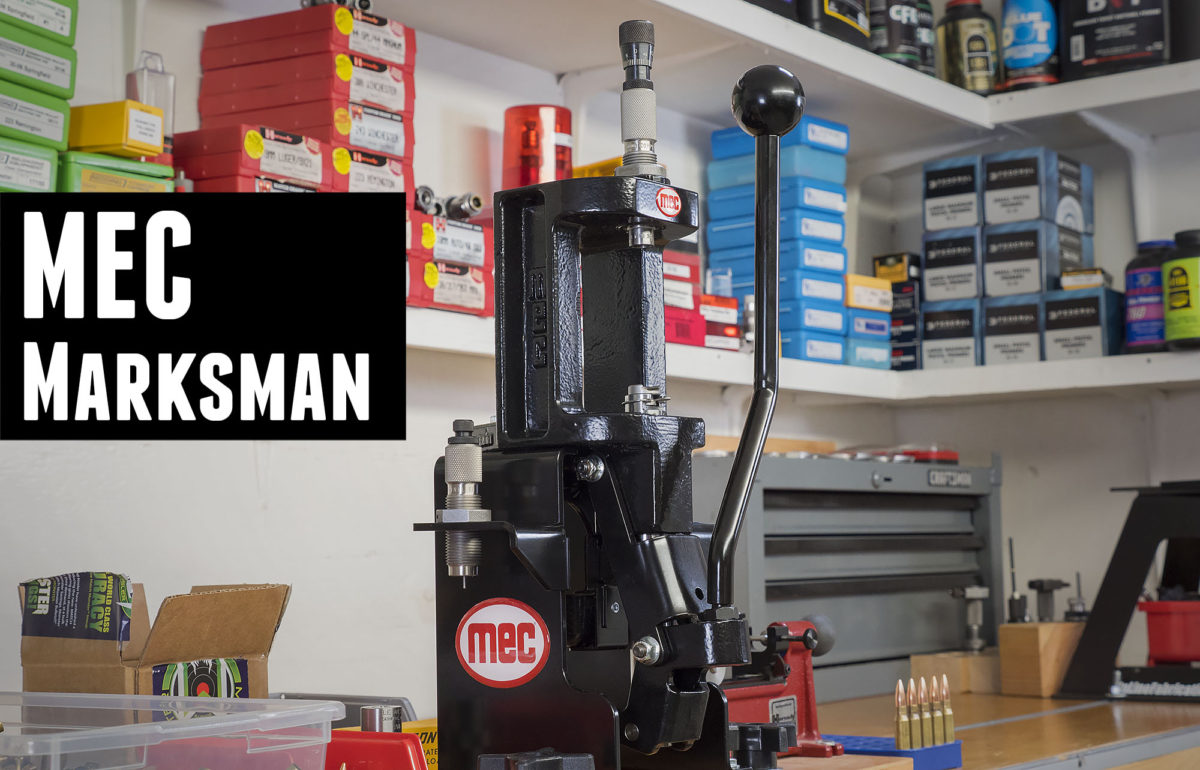
1. Brownells — MEC Marksman Press $164.99 with CODE “NCS”
The MEC Marksman is an outstanding single stage press — very strong, with convenient open front and a patent-pending self-centering shell holder (that can improve loading consistency). Right now, with discount CODE “NCS”, you can get this beefy USA-made Marksman from Brownells for just $164.99, including FREE Shipping. That’s a bargain — this press sells elsewhere for up to $208.00. The MEC Marksman has strong, cast-iron construction and offers plenty of leverage. It is compatible with all 7/8-14 thread dies, so you can reload from .22 Hornet to .416 Rigby. If you are looking for a premium single-stage press you won’t be disappointed. Act soon as this Brownells discount offer may expire soon.
2. Bullet Central — Kelbly Atlas Tactical Action, $895
The rifle action is the cornerstone of accuracy in any rifle build. If you don’t start with a strong precision made action then all your other money will be wasted. That’s why so many people choose Kelbly Actions. They’re make the most rugged action possible for practical, tactical, or hunting. Using a Black Nitride finish from H & M Metal Processing. This allows you to use this action “dry” or without lubrication for extreme environments. In addition to the Black Nitride process they use a fluted bolt, to help move dirt into the flutes allowing better function of the action. Magazine wells use the Accuracy International single stack magazines. Another key feature of this action is the TG ejector, it is a mechanical ejector that does not put any chamber pressure on the round. It is also a “never fail” setup, meaning that there are no springs to get gummed up and stop working. Actions rarely go on sale which is why we couldn’t resist highlighting this Kelby Atlas Tactical Action over at Bullet Central for the low price of $895.00.
The Walther Creed offers excellent ergonomics, good accuracy, and well-designed controls at a killer price — $249.99 at CDNN Sports. This gun, designed to be a value-leader, emulates Walther’s more expensive PPQ model (MSRP $649.00) at a much lower price. The Creed’s frame size and shape is the same as the PPQ, but the Creed lacks interchangeable backstraps. Slide and trigger are very similar. The Creed features a snag-free bobbed hammer. Testers have praised the new Creed, saying that, despite the bargain price, it “sacrifices little to nothing in… ergonomics, accuracy, and reliability.”
4. Midsouth — CCI Rimfire Ammo Rebate, up to $200
The days of .22 LR shortages are over, and now there is ample supply of rimfire ammo at reasonable prices, and the ammo-maker are even offering REBATES. Right now, Midsouth Shooters Supply has a great selection of CCI 22LR, 17 HMR, and 2 WMR Rimfire Ammo. Plus, for every five boxes of CCI rimfire ammo you buy, you get a rebate for the value of one box. That basically works out to buy 4 get 1 free. The limit is $200.00 in rebates per household. CLICK HERE for the CCI Rimfire Rebate Program.
Finding the right tools to work on your guns, scopes, rings and other items can often be frustrating. Regular tools from the hardware store work in a pinch but often aren’t hollow ground to protect your screws and the sizes are rarely correct for the firearms parts we work on. Solve your tool dilemma with the Lyman Master Gunsmith Tool Kit. This handy kit includes nearly all the common sizes and shapes to fit just about anything in your gun safe, all in a convenient case.
6. Bruno Shooters Supply — Bore Tech Cleaning Rod SALE
Cleaning rods are a way of life for anyone who shoots. No matter the caliber or brand, every gun needs to be cleaned and using quality rods will help prevent your barrel from being damaged. Most cleaning rods on the market using metals that can react with your cleaning solvent causing false readings on your patches. Bore Tech has solved that problem by using a non-reactive tip ensuring that copper shows up if you have it and doesn’t if you don’t. These Bore Tech rods are very stron and feature one of the best ball-bearing handles, which provides a smooth motion that really lets you feel the barrel. You can get the excellent Bore Tech Proof Positive cleaning rods from Bruno Shooters Supply and treat your barrels to a new level of care.
7. Natchez — Fed GM Match .308 Win + Range Bag, $84.99
Show up to any range and .308 Win is still one of the most prolific rounds available, for good reason. The .308 Win is good for both hunting and target shooting and you’ll get excellent barrel life. In the .308 Win world, a top ammo brand is Federal. Right now Natchez offers 80 rounds (four 20rd boxes) of Federal Gold Medal Match 168gr SMK along with a FREE range bag for the sale price of $84.99. We’ve shot this ammo and it delivered outstanding accuracy in an M1A and a bolt gun.
8. Amazon — Steiner Military-Marine 8x30mm, $193
Steiner is a quality optics brand with practical features. The very popular, highly-rated Steiner 8x30mm Military-Marine binoculars are now on sale for just $193.00. With 8x magnification, the Steiner Military-Marine 8×30 binoculars are a rugged design with a unique focus system that puts everything from 20 yards to infinity in focus. These Steiners use flexible silicone lens mounts to absorb severe shock, impact and abuse without damage. NBR rubber armoring shields a lightweight, rugged chassis that withstands 11 Gs of impact. Your Editor personally owns and uses the Steiner Military-Marine. The glass is excellent considering the price, and the focus system is a huge advantage — once you set the individual eye-pieces, no fiddling with focus knobs required — everything beyond 20 yards is sharp.
9. Amazon – Proster Wind Meter, $16.99
Wish you had a modern impeller-style wind meter but only shoot a couple matches a year and can’t justify spending $150 (or more) on one? This Proster wind meter has a very impressive 4.5 star overall rating (with hundreds of reviews), so buy with confidence. Now on sale for just $16.99, this is a very useful tool for a bargain basement price. Get this affordable Wind Meter to ensure you have reliable wind readings for ballistics calculations. And unlike a costly Kestrel, with this low-priced wind meter, you won’t feel too bad if it gets lost or misplaced some time.
The U.S. Army Marksmanship Unit publishes reloading “how-to” articles on the USAMU Facebook page. One Wednesday “Handloading Hump Day” post covered preparation of once-fired 5.56x45mm brass. This article, the first in a 3-part series, has many useful tips. If you shoot a rifle chambered in .223 Rem or 5.56x45mm, this article is worth reading. And visit the USAMU Facebook page for other hand-loading tips.
This week, Handloading Hump-Day will answer a special request from several competitive shooters in Alaska. They asked about procedures for morphing once-fired GI 5.56mm brass into accurate match brass for NRA High Power Rifle use. The USAMU has used virgin Lake City (LC) 5.56 brass to win National Championships and set National Records for many years. In this 3-part series, we’ll share techniques proven to wring match-winning accuracy from combat-grade brass.
Preparing Once-Fired GI 5.56 Brass for Reloading (Part 1 of 3)
Assuming our readers will be getting brass once-fired as received from surplus dealers, the following steps can help process the low-cost raw material into reliably accurate components.
1. Clean the Brass
First, clean the brass of any dirt/mud/debris, if applicable. Depending on the brass’s condition, washing it in a soap solution followed by a thorough rinsing may help. [This step also extends the life of the tumbling media.] Approaches range from low-tech, using gallon jugs 1/2 full of water/dish soap plus brass and shaking vigorously, to more high-tech, expensive and time-consuming methods.
2. Wet-Tumbling Options (Be Sure to Dry the Brass)
When applying the final cleaning/polish, some use tumblers with liquid cleaning media and stainless steel pins for a brilliant shine inside and out, while others take the traditional vibratory tumbler/ground media approach. Degree of case shine is purely personal preference, but the key issue is simple cleanliness to avoid scratching ones’ dies.
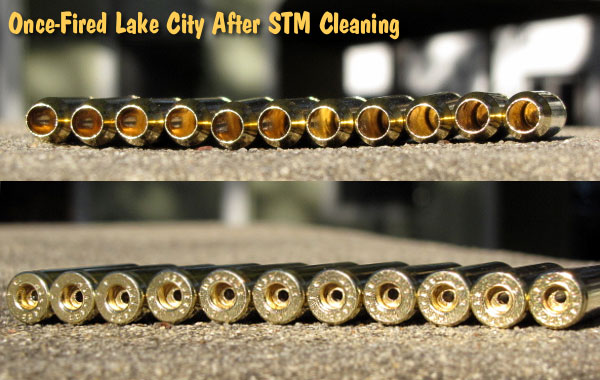
Shown below are Lake City cases after cleaning with Stainless Media (STM). Note: STM Case cleaning was done by a third party, not the USAMU, which does not endorse any particular cleaning method.
If a liquid cleaner is used, be SURE to dry the cases thoroughly to preclude corrosion inside. One method is to dump the wet brass into an old pillow case, then tilt it left/right so the cases re-orient themselves while shifting from corner to corner. Several repetitions, pausing at each corner until water stops draining, will remove most water. They can then be left to air-dry on a towel, or can be dried in a warm (150° F-200° F max) oven for a few minutes to speed evaporation.
3. Inspect Every Case
Once dry, inspect each case for significant deformation (i.e., someone stepped on it), damaged mouths/necks and case head/rim damage. Some rifles’ ejectors actually dig small chunks of brass out of the case head — obviously, not ideal for precision shooting. Similarly, some extractors can bend the case rims so badly that distortion is visible when spinning them in one’s fingers. These can be used for plinking, but our match brass should have straight, undamaged rims.
Dented case mouths are common, and these can easily be rounded using a conical, tapered tool, [such as a .223 expander mandrel. A dummy 7.62 or .30-06 cartridge with a FMJ spitzer can also work.] If most of your brass is of one headstamp, this is a good time to cull out any odd cases.
4. Check the Primers Before Decapping
Your clean, dry and inspected brass is now ready for full-length sizing, decapping and re-priming. Historically, primer crimps on GI brass have caused some head-scratching (and vile language) among handloaders. Our next installment will detail efficient, easy and practical methods to remove primer crimp, plus other useful handloading tips. Until next week, Good Shooting!
NOTE: The USAMU Handloading (HL) Shop does not RE-load fired 5.56 brass. We use virgin LC brass with our chosen primer already staked in place. However, our staff has extensive personal experience reloading GI brass for competition, which will supplement the Shop’s customary steps. In handloading, as in life, there are many ways to accomplish any given task. Our suggestions are note presented as the “only way,” by any means. Time for loading/practicing is always at a premium. Readers who have more efficient, alternative methods that maintain top accuracy are invited to share them here.
One of the most interesting new pistols at SHOT Show 2019 was the SIG Sauer P320 XCompact, the latest in the P320 X-Series. What is most noteworthy about this pistol (and other X-Series guns) is that the TRIGGER GROUP, not the frame, carries the serial number. That means that after you process one SIG P320 X handgun through an FFL, you can put that same trigger group in different frames. So you could have a full-sized pistol for slow-fire target work, plus a compact version for concealed carry. Or you can have a 9mm AND a 40 S&W version of the same pistol. SIG calls this “unprecedented modularity”. We agree — this is very, very clever. Glock, Walther, Ruger — take note!
SIG’s P320 XCompact is a modular, striker-fired pistol with a serialized trigger group that makes it adaptable to multiple calibers, size, and grip options. The P320 XCompact is available in 9mm and features X-RAY3 day/night sights, a flat trigger, and night sight rear plate making it optic ready. There are both a striker safety and a disconnect safety. The P320 XCompact comes standard with two, 15-round magazines.
P320 XCompact is Comfortable in the Hand, Like Classic P226/P228 Pistols
At SHOT we tried the P320 XCompact and found it very comfortable in the hand — with ergonomics similar to our much-loved metal-framed P226. SIG says the XCompact has a “completely redesigned grip module with an improved beavertail and fastback profile, contoured magwell, and a deep trigger guard undercut”.
“The P320 XCOMPACT redefines what a compact pistol should be by combining concealability with full size XSERIES features. Through extensive end-user feedback, the P320 XCOMPACT provides for smoother handling and optimizes the user experience,” said Tom Taylor, Chief Marketing Officer and Executive Vice President, Commercial Sales.
There is so much to see at SHOT Show, with nearly 2000 exhibitors showcasing tens of thousands of products. SHOT Show is the largest trade show of its kind in the world, attracting 60,000+ attendees from more than 100 countries.
Thankfully there are many teams of reporters who covered SHOT Show this year, and they’ve now posted a wide selection of video reports. In today’s SHOT Show video showcase, we post our “pick of the litter” — ten of our favorite video reports from SHOT Show 2019, plus one great video “blast from the past”.
FREE Digital Editions of SHOT Show Daily
Below you’ll find FREE digital editions of the SHOT Show Daily. This is the publication handed out at SHOT Show. Packed with stories and photos, each edition has a special theme for the new products covered. The daily news of the 2019 Las Vegas SHOT Show is produced by Bonnier Corporation and NSSF®. These are definitely worth checking out — there are hundreds of photos of new products.
NOTE: To READ TEXT, Click Full Screen Bracket Icon at lower right of each frame: [ ]
OK, you’ve paid the tax stamp and acquired your new suppressor (aka “silencer” or “moderator”). Do you still need to wear earplugs or muffs? Absolutely. Even with that expensive new “can”, your rifle could be generating over 140 decibels (dB) of noise — about the same as as an unmuffled 9mm pistol shot. That’s loud enough to create permanent hearing loss with repeated exposure.
Firearms Are Loud: 140 dB to 175 dB
Audiology group ASHA explains: “Exposure to noise greater than 140 dB can permanently damage hearing. Almost all firearms create noise that is over the 140-dB level. A small .22-caliber rifle can produce noise around 140 dB, while big-bore rifles and pistols can produce sound over 175 dB. Firing guns in a place where sounds can reverberate, or bounce off walls and other structures, can make noises louder and increase the risk of hearing loss. Also, adding muzzle brakes or other modifications can make the firearm louder. People who do not wear hearing protection while shooting can suffer a severe hearing loss with as little as one shot[.] Audiologists see this often, especially during hunting season when hunters and bystanders may be exposed to rapid fire from big-bore rifles, shotguns, or pistols.” Source: ASHA, Recreational Firearm Noise Exposure.
Suppressors, On Average, Reduce Noise Levels about 30 Decibels
In an article for Ammoland, gunwriter Sam Hoober says that you can expect about 30 decibels (dB) of noise reduction from the average suppressor: “Looking at a few different products, SilencerCo attests their suppressors reduce the sound pressure of a 9mm gunshot to anywhere from 125.7 dB to 131.5 dB, depending on the model. Advanced Armament Co, another popular supplier, attests a 23 dB to 33 dB reduction or down to 127 dB. Liberty Suppressors, another manufacturer, attests a reduction of 24 dB to 38 dB, depending on model and other factors. In short, we can presume something on the order of 30 dB of attenuation as an average.”
Using that 30 dB number you can quickly discern that you’ll still need hearing protection — good hearing protection — when shooting any suppressed firearm (even a .22 LR). “Spikes of 130 dB and more can result in permanent hearing damage instantly”. Source: NRA Blog.
The Myth of the “Quiet” .22 LR
The NRA Blog notes that “many rimfire shooters, particularly those using the beloved .22 Long Rifle cartridge, argue that the small .22 LR caliber doesn’t produce enough sound to damage your hearing”. So, is that really true. or is it a myth?
In fact, a .22 LR can be much louder than you think — a .22 LR pistol can produce sound levels of 134 dB. That’s well above the normal human pain threshhold.
Sound Levels for Common Noises:
9mm Luger pistol: 160 dB
Jet aircraft engine (near): 140 dB
.22 LR pistol: 134 dB
Normal human pain threshold: 120 dB
Noisy Nightclub: 110 db
Riding Motorcycle at 65 mph: 103 db
Power Lawnmower: 95 dB
Hearing damage possible: 85 dB (sustained for 8+ hours)
Ringing Telephone: 80 dB
Normal conversation: 60 dB
The Risk of Hearing Loss
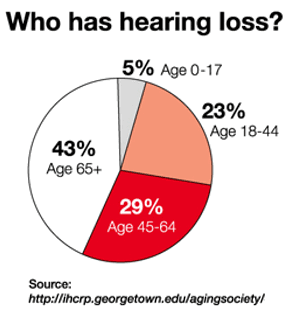
Hearing loss can be progressive and irreversible. If you are a shooter, this is serious business. As the NRA Blog cautions: “You may not even realize you’re harming your hearing. Hearing loss occurs gradually, and can go effectively unnoticed until symptoms become severe. By then, the damage is done.”
Nobody wants to go deaf. But we often see shooters without effective hearing protection when they are walking around a few yards behind the firing line. That’s bad — even if you are away from the firing line, gunshot noises can damage your hearing. You MUST use effective hearing protection every time you go to the range. Good foam earplugs costs mere pennies but they can prevent deafness in your later years. Many folks also wear muffs over plugs.
At SHOT Show 2019, some of the most impressive new products were in the realm of scopes and electro-optics. We are seeing big companies like Leica, SIG Sauer, Swarovski, and Zeiss moving big-time into the technological marriage of microchips and lenses. With the release of the $4500 Swaro dS, a scope with no manual windage or elevation controls, we are really entering a new era in aiming systems for shooters.
Swarovski dS Rangefinder Scope with Ballistics “Brain”
Swarovski rolled out a new flagship scope this year at SHOT Show, the remarkable dS 5-25×52 P. This $4500+ wonder features a built-in laser rangefinder (like the Burris Eliminator). But there’s more — working with a smartphone App, the dS incorporates a sophisticated ballistics computer that calculates your trajectory at any distance and then displays an aim point on your reticle. It even adjusts the aim point for the wind (with data entered wirelessly via mobile device).
This really is a state-of-the-art electro-optical system. However, there are some negatives to consider. First there are no conventional elevation or windage knobs/turrets. So, if your battery dies in the field, you are SOL. (FYI that big “turret” in the middle is actually just a battery and tool holder). Secondly, all that smart calculation depends on extremely accurate BC and velocity data. If you switch ammo, and don’t have an accurate velocity or BC, you won’t get the right solution and there are no knobs to turn to fix that. The dS will give you an aim point, but it might not match your true ballistics. (NOTE: There are hidden mechanical controls for setting your zero, but these are not intended for conventional shot to shot adjustments).
High-Magnification Competition Scopes
Kahles K1050 — Central Parallax, Great Glass
Kahles scopes are now being used by many of the top shooters in PRS game. Kahles optics offer great European glass, precise controls, and some unique features. Our readers may not realize that Kahles makes an outstanding high-magnification zoom scope suitable for long-range benchrest and F-Class comptition, the Kahles K1050. This 10-50x56mm optic has a unique centrally mounted parallax control — great for lefties or guys who run a left port/right eject. The Kahles K1050 has a true 8 meters to infinity parallax adjustment range making it suitable for everything from Field Target air gun, 1000-yard competition, and long range tactical. The Kahles K1050 costs $2899.00 — that’s midway between a Vortex Golden Eagle and a 10-60x56mm March High Master (starting at $3425.00).
Sightron SIII 10-50x60mm
Sightron offers a very affordable 10-50x60mm scope in its SIII optics line. There is a special version for Field Target competition that comes with a “Big Wheel” parallax control. Field Target competitors use the Parallax control to determine target range.
ELR Scope — For 2 Miles and Beyond
March 6-60X Genesis with 400 MOA elevation
A typical premium riflescope might have 50-60 MOA of elevation. That’s enough for shooting out to 1500 yards or so with a high-BC bullet launched at 2900 fps. But for Extreme Long Range (ELR) shooting you need more elevation adjustment, and that’s where the innovative March 6-60X Genesis optic stands out. This unique optic offers a whopping 400 MOA of elevation adjustment. That ample elevation doesn’t come cheap however — the 6-60x56mm Genesis sells for $6950.00. CLICK HERE for full specifications.
Lightweight Hunting Scopes
As scopes have grown increasingly sophisticated and complex, they have also become bulkier and HEAVIER. That’s a big deal for a hunter who may be carrying a rifle, plus another 20-30 pounds of gear and food/water. The average dear hunter will be taking a shot well inside 400 yards so he doesn’t need 25X power or fancy features. He does need clarity, good low-light performance, and reliability — and LOW WEIGHT. We think a good deer hunting scope should come in under 1.5 pounds (without rings). Here are two smart hunting optics, both under 20 ounces.
Leupold VX Freedom — 12.2 ounce Weight, Simple, Affordable
The Leupold VX-Freedom 3-9x40mm weighs just 12.2 ounces and street price is under $200. It has a 4.7mm exit pupil, 60 MOA of elevation, and a 33.7 ft Field of View at 100 yards.
Zeiss 3-12x44mm Conquest — 18.2 ounce Weight, 90% Light transmission, 4X Zoom
These riflescopes were designed as a lightweight, high-performance product line for demanding hunting and shooting applications. The Zeiss 3-12x44mm Conquest delivers 90% to-the-eye light transmission, along with 70 MOA of both elevation and windage travel. This premium second focal plane scope weighs just 18.2 ounces, slightly over one pound.
Compact Spotting Scopes for Field Carry
Many shooters and hunters don’t want or need a heavy, bulky spotting scope. They need a spotter to see mirage, and to deliver more magnification than can be comfortably handheld with binoculars. For hunters, weight and overall size are key. The hunter wants a spotting scope that can be packed and carried easily. Here are two clear, sharp spotter options in a smaller format. The Leupold Gold Ring 15-30x50mm Compact Spotter is particularly well-suited to hunters and tactical shooters.
Nikon Monarch Fieldscope 60ED-A
Small but powerful — that describes the Nikon 60ED-A Monarch Fieldscope with 16-48X eyepiece. This unit delivers big spotter performance in a much smaller package. It focuses fast and showed very good sharpness though we observed the image darkens at higher magnifications. This has ED glass and Nikon’s proprietary “field flattener” lens system that enhances sharpness throughout the entire field of view.
Leupold 15-30x50mm Gold Ring Compact Spotting Scope
The affordable Leupold Gold Ring Compact Spotter offers 15-30X magnification. That’s plenty for spotting game or viewing mirage. This unit is remarkably compact and we like the simple right-side focus knob. Half the size of typical spotting scopes, this Compact Leupold spotter weighs just 21.5 ounces (1.34 pounds).
Superb Binoculars — When Cost is No Object
Leica Noctivid 8x42mm Binoculars
Our Hunting Editor Colton Reid is a Ph.D. who works with specialized electro-optical devices costing over $30,000. So he knows a few things about light waves and glass quality. When he looked through the 8×42 Leica Noctivid his comment was simple but telling: “These are the best compact binoculars I’ve ever looked through. The clarity and brightness are truly exceptional”. At nearly $2700.00, Noctivids are crazy expensive, but the quality will be worth it to some buyers.
Parting Shot — Think about the Warranty BEFORE You Buy
This patched-up Razor spotting scope was on display at the Vortex booth. We actually know the history of this particular spotter — it belonged to one of our Forum members. He sent this busted unit back to Vortex, and Vortex sent him a brand new Razor spotter. That Forum member told us: “Vortex earned a customer for life when they replaced my spotter, no questions asked. When Vortex says its warranty is ‘Unlimited, Unconditional, Lifetime’, believe it.”
When it comes to long-range optics, some folks can’t have too much magnification. At 500 yards and beyond, when the air’s misty or the mirage is thick, you can’t always use extreme magnification. But, when the conditions are excellent, it’s nice to have 50X magnification (or more) on tap. You can always “crank it back down”.
Higher magnification (when conditions are good), can help you see your bullet holes at long range, and that makes it easier to judge your hold-offs and keep your group centered.
In addition, there’s no doubt that high magnification lets you aim more precisely, no matter what the distance. Even at 100 and 200 yards, short-range benchresters are using 40X, 50X, and even 60X power scopes. This allows you to position your cross-hairs with extreme precision — something you need when you’re trying to put multiple shots through the same hole.
Raising the Optics Bar
How much power is usable? A few years back, folks said you can’t use more than 45X or so at long range. Well, as modern optics have evolved, now guys are buying scopes with even more magnification — way more. There are practical limits of course — with a 56 to 60mm front objective, the exit pupil of a 60X or higher-power scope will be very tiny, making head orientation ultra-critical. Any many scopes get darker as you bump up the magnification.
Despite the exit pupil and brightness issues, shooters are demanding “more power” these days and the scope manufacturers are providing new products with ever-greater magnification levels. Right now, the most powerful conventional riflescope you can buy is the March X-Series 8-80x56mm scope. Featuring a 34mm main tube and 56mm objective lens, this offers a true 10-times zoom ratio and up to 80X magnification. This scope has minimal distortion thanks to high-quality ED lenses designed in-house by Deon Optical, which also machines the main tube from one solid piece of billet aluminum.
MORE INFO: Learn more about the March 8-80x56mm at MarchScopes.com
To demonstrate the capabilities of high-magnification March scopes, Aussie Stuart Elliot has created a cool through-the-lens video with the March 8-80x56mm scope set at 80-power (See 0:30 timeline). Along with being one of Australia’s top benchrest shooters, Stuart runs BRT Shooters Supply, dealer for March Scopes in Australia. In the video below you can see the March 8-80X focused on a target at 1000 yards (910m). For best resolution, watch this video in fullscreen, 720p mode.
Look through the Lens of 80-power March Scope at Target 1000 Yards Away
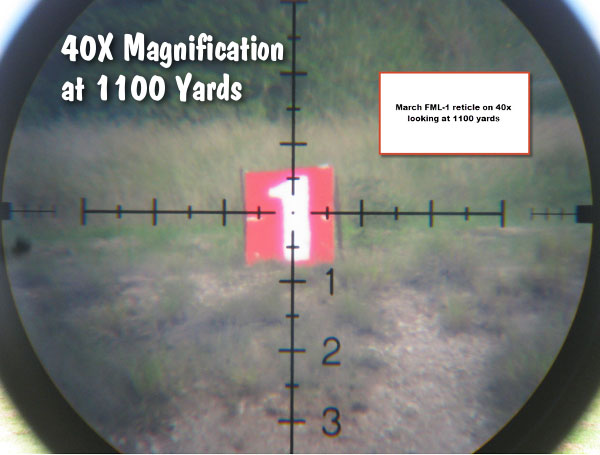
Through-the-Lens Views at 40X and 80X at 1100 Yards
To reveal the difference between 40X and 80X magnification, here are two through-the-lens still images taken with March scopes sighting to 1100 yards. The top photo is at 80X magnification, looking through the March 8-80x56mm. The lower photo is at 40X magnification viewed through a 5-50x56mm March X-Series scope. You can see there is a big difference in perceived target size! Click on the “Larger Image” button to see full-screen version at 80X.
Video Find by Boyd Allen. We welcome reader submissions.







 The Risk of Hearing Loss


 When it comes to long-range optics, some folks can’t have too much magnification. At 500 yards and beyond, when the air’s misty or the mirage is thick, you can’t always use extreme magnification. But, when the conditions are excellent, it’s nice to have 50X magnification (or more) on tap. You can always “crank it back down”.