Want to learn long-range benchrest skills from the best in the business? Then head to Williamsport, PA this June. The registration period for the 2019 PA 1000 Yard Benchrest School is now open. This year’s session will be held Saturday and Sunday, June 8-9, 2019, with a “Meet and Greet” on Friday night, June 7. Classes, taught by top 1K shooters, are held at the Original Pennsylvania 1000-Yard Benchrest Club Range, one of the best 1000-yard ranges in the country. The school will be limited to 24-30 students with one instructor for every two students.
Praise from a 1K Benchrest School Grad
Here’s a testimonial from a recent graduate: “I can attest to the knowledge that you gain. I went last year and loved it. Have renewed my membership in the Club and would love to go this year. I would love to take the course again. In the photo above I am in the back row, fourth from the right — sunglasses and blue shirt.” — Bob, Class of 2016
Participants will learn all aspects of long-range benchrest shooting from some of the most skilled marksmen in the country. Much time is spent at the loading bench and on the firing line. Classes cover load development, precision reloading, bench skills, and target analysis. You don’t even need guns and ammo — all equipment and ammunition will be provided.
School instructors tell us: “This year’s benchrest school will be a 2-day weekend event. (There is also an optional ‘Meet and Greet’ gathering Friday evening). The school is a beginner class designed to teach the fundamental skills needed to be competitive at at 600 and 1000 yards. Saturday will be spent in class covering a range of topics including reloading ‘dos and don’ts’, load development and equipment handling. Sunday we will shoot an actual match to see what you’ve learned.”
After taking this class, you might be the guy who shoots an amazing 100-8X at 1000 yards like this:
Cost for the class is $475.00 including lunches on Sat/Sun and dinner on Saturday. Act soon if you want to attend the 2019 school — the program fills quickly. The classroom is limited to only 24 (possibly 30) students and instruction is one instructor per two students. A one year membership is included with the cost of the school.
If you have any questions regarding the school send email to: amurtagh6mm [at] gmail.com.
Andy Murtagh
Vice President and Public Relations Officer
Original PA 1000 Yard Benchrest Club
This helpful video from our friend Kirsten Joy Weiss explains how to avoid “scope bite”. This can occur when the scope, on recoil, moves back to contact your forehead, brow, or eye socket area. That’s not fun. While common sense tells us to avoid “scope bite” — sooner or later this happens to most shooters. One viewer noted: “I have come close. I had a Win Model 70 in .375 H & H Mag and I was shooting over a large rock in a strange position. The scope hit my eye glasses hard enough to bend the wire frames and cause a little pain on the bridge of the nose from the nose piece. [That] made a believer out of me.”
Kirsten offers a good basic principle — she suggests that you mount your rifle-scope so that the ocular (eyepiece) of the scope is positioned at least three inches or more from your eyeball when you hold the rifle in your normal shooting position. From a technical standpoint, optical eye relief is a property of the scope, so you want to purchase an optic that offers sufficient optical eye relief (meaning that it allows you to see the full circle of light with your head at least three inches from the eyepiece). Then you need to position the optic optimally for your head/eye position when shooting the rifle — with at least three inches of eyeball-to-scope separation (i.e. physical eye relief).
NOTE: You should mount the scope to provide adequate eyeball-to-scope separation for the actual position(s) you will be shooting most of the time. For an F-TR rig, this will be prone. For a hunting rifle, your most common position could be sitting or standing. Your head position will vary based on the position. You can’t assume the scope placement is correct just because it seems OK when you are testing or zeroing the gun from the bench. When shooting from a prone or kneeling position you may find your eye considerably closer to the eyepiece.
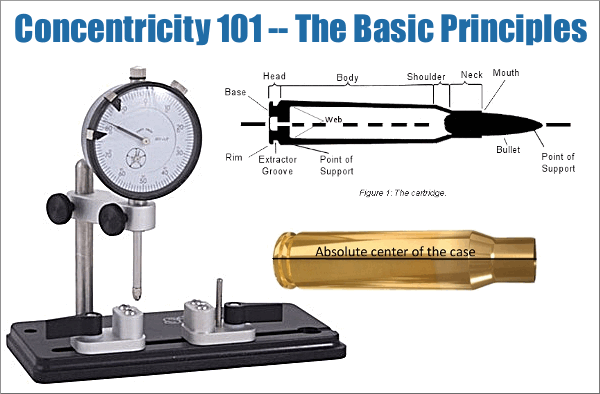
Sinclair Internationalhas released an interesting article about Case Concentricity* and bullet “run-out”. This instructional article by Bob Kohl explains the reasons brass can exhibit poor concentricity, and why high bullet run-out can be detrimental to accuracy.
Concentricity, Bullet Alignment, and Accuracyby Bob Kohl
The purpose of loading your own ammo is to minimize all the variables that can affect accuracy and can be controlled with proper and conscientious handloading. Concentricity and bullet run-out are important when you’re loading for accuracy. Ideally, it’s important to strive to make each round the same as the one before it and the one after it. It’s a simple issue of uniformity.
The reason shooters work with tools and gauges to measure and control concentricity is simple: to make sure the bullet starts down the bore consistently in line with the bore. If the case isn’t properly concentric and the bullet isn’t properly aligned down the center of the bore, the bullet will enter the rifling inconsistently. While the bore might force the bullet to align itself with the bore (but normally it doesn’t), the bullet may be damaged or overstressed in the process – if it even it corrects itself in transit. These are issues we strive to remedy by handloading, to maintain the best standard possible for accurate ammunition.
The term “concentricity” is derived from “concentric circle”. In simple terms it’s the issue of having the outside of the cartridge in a concentric circle around the center. That goes from case head and center of the flash hole, to the tip of the bullet.
Factors Affecting Concentricity
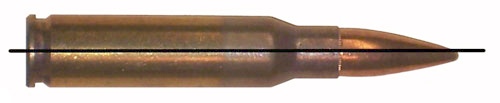
The point of using this term is to identify a series of issues that affect accurate ammunition. Ideally this would work best with a straight-walled case; but since most rifle cartridge cases are tapered, it equates to the smallest cross section that can be measured point by point to verify the concentric circle around the center. For the examples below, I’m working with .308 Winchester ammo.
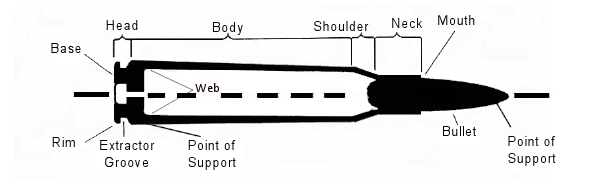
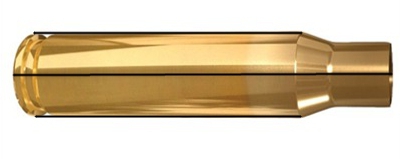
Figure 1: The cartridge.
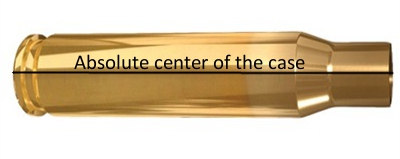
Figure 2: Centerline axis of the case, extending from flash hole to case mouth.
The case walls have to be in perfect alignment with the center, or axis, of that case, even if it’s measured at a thousandth of an inch per segment (in a tapered case).
Figure 3: Case body in alignment with its axis, or centerline, even in a tapered case.
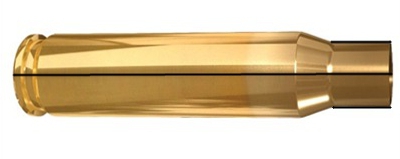
The case neck must also be in alignment with its axis. By not doing so you can have erratic bullet entry into the bore. The case neck wall itself should be as uniform as possible in alignment and in thickness (see the M80 7.62x51mm NATO cartridge in Figure 5) and brass can change its alignment and shape. It’s why we expand the case neck or while some folks ream the inside of the neck and then turn the outside for consistent thickness, which affects the tension on the bullet when seated.
Figure 4: Neck in alignment with center of the case axis.
Figure 5: Variations in case neck wall thickness, especially on some military brass, can cause an offset of the bullet in its alignment. This is an M80 ball round. Note the distinct difference of the neck walls.
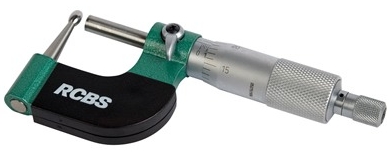
Having a ball micrometer on hand helps, especially with military brass like 7.62x51mm in a semi-auto rifle, where there are limits as to how thin you want the neck walls to be. In the case of 7.62 ball brass you want to keep the wall to .0145″.
Figure 6: A ball micrometer like this RCBS tool (#100-010-268) can measure case neck thickness.
Turning the outside of the neck wall is important with .308 military cases regardless of whether you expand or ream the neck walls. There are several outside neck turning tools from Forster, Hornady, Sinclair, and others. I’ve been using classic Forster case trimming (#100-203-301) and neck turning (#749-012-890) tools for 40 years.
Bullet Run-Out
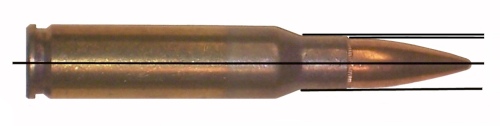
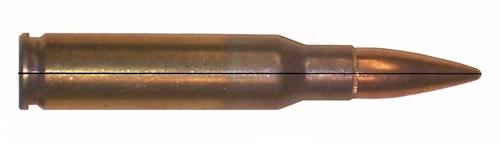
The cartridge, after being loaded, still needs to be in alignment with the center of the case axis. Figure 7 shows a bad example of this, a round of M80 ball. A tilted bullet is measured for what’s known as bullet “run-out”.
Figure 7: An M80 round with the bullet tilted and not aligned with the axis. This will be a flyer!
Run-out can be affected by several things: (1) improperly indexing your case while sizing, which includes not using the proper shell holder, especially while using a normal expander ball on the sizing die (it also can stretch the brass). (2) The head of a turret press can flex; and (3) improper or sloppy bullet seating. This is also relevant when it comes to using a progressive press when trying to load accuracy ammo.
Mid Tompkins came up with a simple solution for better bullet seating years ago. Seat your bullet half way into the case, back off the seater die and rotate the case 180 degrees before you finish seating the bullet. It cuts down on run-out problems, especially with military brass. You also want to gently ream the inside of the neck mouth to keep from having any brass mar the surface of the bullet jacket and make proper seating easier. A tilted bullet often means a flyer.
Figure 8: Proper alignment from the center of the case head to the tip of the bullet.
(NOTE: This links to a Web Archive version of older Sinclair Int’l article.)
*Actually some folks would say that if we are talking about things being off-center or out-of-round, we are actually talking about “eccentricity”. But the tools we use are called “Concentricity Gauges” and Concentricity is the term most commonly used when discussing this subject.
Story Tip from EdLongrange. We welcome reader submissions.
Ultimate Reloader’s Gavin Gear is working on the most comprehensive reloading press comparison video.
UltimateReloader.com is a leading website showcasing reloading hardware and methodologies. Ultimate Reloader’s founder, Gavin Gear, regularly tests the latest and greatest reloading gear, including presses, case prep centers, cleaning systems and more. Gavin, shown above, is currently hard at work on “the mother of all” reloading press comparisons. He has secured 14 single-stage presses and set them up in his workroom/studio. This will be the most comprehensive reloading press video ever created.
Last week, Gavin was working hard in SHOT Show 2019 in Las Vegas, finding new products, and interviewing some important folks in the shooting sports industry. Here are four videos Gavin released this week for his Ultimate Reloader YouTube Channel.
New Products from Ruger for 2019
Gavin says: “I’m a big fan of Ruger rifles, in fact my first rifle was a Ruger 10/22! Since then I’ve published a lot of stories covering the Ruger Precision Rifle, and other Ruger products. While at the SHOT show this year I visited the Ruger booth, and got the scoop on the latest rifle offerings from Ruger.” Below is also an Ultimate Reloader preview video of the Ruger American Rifle in 6.5 Creedmoor and “Go Wild Camo” livery.
Here are some interesting comments from Gavin’s YouTube viewers:
“It’s amazing how low price [Rugers are] while still being made in the USA. Great job Ruger!” — J. Allen
“I own the RPR in 6.5, 5.56 [.223 Rem], .22 rimfire. The rifles are cheap it’s the bi-pods, rings, optics that make you dig deep in the wallet.” — 2d Amendment
“I am really digging the Ruger American Go Wild Camo, what an absolutely beautiful gun[.] I had a friend … with the 22 inch barrel and is hitting solid MOA groups out to 200.” — F. Earnest
New Products from Lyman for 2019
Lyman Products rolled out three impressive new reloading presses last year. This included an 8-station turret press, a beefy O-frame press, and a versatile C-Frame compact press.
Following up on last year’s successful product launches, for 2019 Lyman is releasing some impressive new tools and gear, including a cool new case trimmer and a deluxe shooting mat. In this video, Gavin interviews Lyman engineer Spencer Karoll, who discusses Lyman’s new product offerings.
Interview with Hornady President Steve Hornady
Gavin reports: “One of the great things about going to the SHOT Show is the people you get to talk with. At last year’s SHOT Show, I met Steve Hornady and talked for a few minutes. This year I [wanted] to have a conversation with Steve on camera! Steve was game, so here it is– a discussion about Hornady’s history, Hornady’s business philosophy, and Steve’s thoughts on new products like the 300 PRC.”
.224 Valkyrie Status Report — Info from Federal
Since its debut just before SHOT Show last year, the new .224 Valkyrie cartridge has been a “hot topic” in the gun industry. In this video interview Gavin covers the .224 Valkyrie’s first year. This video reveals key facts, clarifies misconceptions, and explains how Federal Premium has worked with the shooting community to realize the full potential of this cartridge.
We are big fans of the .17 HMR round. It’s just about perfect for ground squirrels, and is effective on prairie dogs out to about 200 yards. The two main .17 HMR producers have been CCI and Hornady. Now we have a new player in the .17 HMR world — Norma — and that’s a good thing. For 2019, Norma® has expanded its rimfire line-up with the introduction of its new .17 HMR V-MAX. A great round for varmint hunters and small game hunters, the Norma .17 HMR V-MAX delivers fine accuracy and hard-hitting performance all the way out to 200 yards.
Norma’s .17 HMR V-MAX is engineered to deliver high energy upon impact combined with good accuracy. With a 2560 FPS muzzle velocity rating, this ammo features a 17gr polymer-tipped V-MAX bullet designed for rapid expansion. MSRP for a 50-round box is $12.78. Expect “street price” under $10.00.
“The .17 HMR has a very loyal following among hunters and target shooters alike,” said Paul Lemke, General Manager for RUAG Ammotec USA. “With outstanding accuracy and excellent energy transfer, Norma’s new .17 HMR V-MAX lives up to the reputation of this … rimfire caliber.”
What rifle would you feed Norma’s new .17 HMR ammo? How about the new .17 HMR version of the Ruger Precision Rimfire Magnum. Here’s an informative video on that new modular bolt-gun, which is also available in .22 WMR. Reviewer 22 Plinkster gets good accuracy at 100 yards shooting 17gr CCI .17 HMR ammo. (The 20gr ammo was much worse).
About Norma — A company from Sweden
Norma is a registered trademark of RUAG Ammotec, a RUAG Group Company. Established in 1902 and based out of Amotfors, Sweden, Norma has built a reputation world-wide for its dedication to quality, precision and reliability For more information, visit Norma-ammunition.com.
The NRA and Pyramyd Air are bringing AirGun shooting to the people in 2019. The Range in a Box program presented by Pyramyd Air provides temporary air gun ranges to approved clubs and organizations free of charge to facilitate basic firearm safety training and “fun shoot” types of events for people with disabilities. The traveling Range in a Box includes backstops, air guns, tripods — essentially all that participants need, except pellets and paper targets.
Pyramyd Air’s Range in a Box provides nearly everything needed to set up a temporary air gun range, including air rifles, air pistols, the portable range, rifle rests, and reactive targets. The key components are: seven T-200 Sporter Rifles; three Air Venturi Pistols; one large Crosman Portable Range (24 feet long by 8 feet wide; three Ultimate Tripod rifle rests from McFadden Machine Company; and various reactive target systems from Pyramyd Air. Shipping to and from the event location is also provided at no cost to the user. Consumable materials such as air and tanks, pellets, and paper targets are not included.
This resource is intended for use by any organization planning an event to include people with disabilities — the most common participants being veterans’ groups, rehabilitation facilities and gun clubs. To get started, you can contact the NRA Adaptive Shooting Program at adaptiveshooting@nrahq.org or visit adaptiveshooting.nrahq.org to print the application and user agreement. Each organization may use the Range in a Box two times to establish the viability of such an event and is then encouraged to apply for grants through The NRA Foundation to purchase its own equipment.
The NRA Adaptive Shooting Program strives to remove barriers that prevent interested groups from hosting more events for people with disabilities by merging the resources of industry partners such as Pyramyd Air with the commitment of the community to spread firearm safety training to a very deserving segment of the population. For more information, visit: adaptiveshooting.nrahq.org.
Plastix Plus, a Texas-based business founded by a volunteer fireman, is a leading builder of custom storage systems for Fire Departments, Police Agencies, Emergency Response teams, and Federal Agencies such as the U.S. Marshals and the FBI. Using CNC design and thermal plastic welding technology, Plastix Plus can create an infinite variety of in-vehicle storage systems with trays, bins, boxes, shelves, and lockable secure storage. Below is a Plastix Plus storage system fitted in the back of an SUV. Note the AR-type rifles stored in a sliding compartment with fast-access locks.
Modern Plastics Are Superior to Wood or Metal for Vehicle Storage
While other companies offer storage systems for SUVs and trucks, these are usually fabricated from wood and metal. Plastix Plus President Mike Snow says that the Vycom Hitec HDPE ½ inch-thick plastic used by his company is a superior material. In an interview with Tactical-Life.com, Snow explained: “When you have a $7,000 item like a Jaws of Life tool, metal on metal is not a good combination when you are carrying it in the truck and deploying it. The tool gets destroyed by the metal bracket designed to hold it. Plus, you have high moisture situations with fire fighting, so you need to worry about rust. The Hitec material is moisture-resistant and very forgiving for emergency tool transport.”
Likewise the Hitec plastic is easier on fine gun finishes than metal boxes, and it won’t warp or absorb moisture like wood can. Snow says that his plastic storage systems will last for decades. By contrast, Snow says some fire departments that opted for wood storage systems have been forced to replace or rebuild their storage units after just a couple seasons.
Plastix Plus hopes to expand to the general consumer market, providing custom in-vehicle storage solutions for trucks, RVs, and SUVs. Plastix Plus can match the exact dimensions of your vehicle, providing your choice of drawers, bins, and locking compartments, including gun storage lockers. A custom Plastix Plus storage system is not cheap. But it may be a smart purchase — when you consider the value of the guns and gear you haul around. Your investment in multiple match rifles (with $3K scopes), along with fancy rests, electronics, and accessories, could easily top $20,000.
GunsAmerica.com has published very extensive coverage of SHOT Show 2019, releasing dozens of articles over the past two weeks. Lead by GunsAmerica Digest Editor True Pearce, a large team of writers/reporters has provided detailed reviews (most with videos) of many interesting new products.
Here are some of the most notable GunsAmerica.com product reports. You can find many more in the GunsAmerica Digest SHOT Show Archive. Click each title to read full stories.
Comment: We like the Bravo stock, and the Seekins action used in this gun has some interesting features, such as four locking lugs with 90° bolt throw. Definitely read this report.
Comment: We used the new Sensight and think this represents a significant new technology. It is basically a camera with a digital screen that includes a reticle. With the Sensight you can actually record your shooting session or live-stream it to another device. That makes it great for training.
Comment: You can buy a darn nice used 4×4 truck for what this rifle (along with spare equipment and shipping case) costs. The “Deployment Kit” includes many spare parts, magazines, bipods, and much more. We doubt many private buyers will part with the $20K, but that’s small change for Uncle Sam.
Comment: This new Keltec CP33 is quite large for a .22 LR pistol, but balances well and is not too heavy. It has a very, very good trigger — crisp with a light pull weight. Honestly this trigger is way better than you’d expect. The Picatinny rail on top makes it easy to mount optics. The clear magazine holds 33 rounds.
Comment: Very interesting new .22 LR rimfire that has some significant advantages over the venerable Ruger 10/22, though it does take 10/22 magazines. The trigger is crisp at 4-5 pounds and the entire “action group” is easily removed from the bottom of the stock with the push of a button. This allows the barrel to be cleaned from the breech.
Comment: Umarex has really entered into new territory with the Hammer, a .50-caliber air rifle. This appropriately named Hammer, we are told, is the most powerful airgun ever produced.
Comment: We were quite impressed with the new First Focal Plane 7-25x56mm Leupold. The glass is excellent, controls are precise, and it enjoys a weight and price advantage over some competitive scopes such as the Nightforce ATACR. GunsAmerica notes: “This front focal scope is available in MOA or MIL adjustments and reticles. The Mark 5HD 7-35×56 will retail for $2,299 – $2,799 depending on reticle choice and illumination.”
Don’t have time to neck-turn hundreds of cases? Don’t want to invest in your own annealer? Want to try a Dasher or 6 BRA but don’t like the hassle of fire-forming? Then give Darrell Jones at DJ’s Brass a call at 205-461-4680. He can handle all the difficult brass forming/brass restoration chores efficiently and affordably. And Darrell’s turn-around time is typically very fast.
Hydro-Forming News — .284 Shehane, 6 PPC, 6 BRA, 6 Dasher and More
NEW for 2019! Darrell also just got a custom hydro die for the .284 Shehane, a wildcat based on the .284 Winchester. This is a very popular option for F-Open Shooters. He is also doing a ton of fire-forming for the 100/200 benchrest crowd, hydro-forming 220 Russian into 6 PPC. And he tells us “Those guys in Montana are keeping me very busying hydro-forming the 6BR Ackley (6 BRA). NOTE: Darrell offers Free Annealing with hydro-forming services, which starts at $60 per 100 cases.
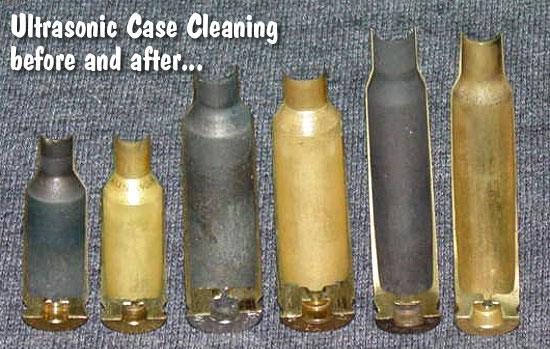
With the price of premium brass topping $1.00 per case for popular match cartridges, it makes sense to consider annealing your brass to extend its useful life. You don’t want to chuck out brass that costs a buck a case (or more)! Forum member Darrell Jones offers a full range of brass prep, brass forming, and brass restoration (annealing, ultra-sonic cleaning) at very affordable prices. Starting at just $20 per 100 cases ($25/100 for magnum cases), Darrell’s company, DJ’s Brass, will anneal your used brass using the impressive Bench-Source annealing machines. Annealing plus ultrasonic cleaning starts at $35 per 100 cases ($45 for magnum cases). For a bit more money Darrell can also uniform the primer pockets and chamfer the case necks.
Custom Neck-Turning Services
Another great service DJ’s Brass provides is precision neck-turning. Darrell can neck-turn any size case to your specified neck-wall thickness. The price starts at $60.00 per hundred for standard cases or $75.00/100 for magnum size. And if you’ve got a bucket of brass to neck-turn, that’s fine with Darrell — he recently neck-turned 1500 pieces of brass for one customer!
DJ’s Brass can process everything from .17 Fireball all the way up to the big magnum cases. And the job gets done quickly. Darrell normally offers a 10-day turn-around. For most jobs, Darrell tells us, he gets the processed brass to the Post Office within three business days. For more info, visit DJsBrass.com or call Darrell Jones at 205-461-4680. IMPORTANT: Contact Darrell for shipping instructions BEFORE sending any brass for processing. ALL BRASS MUST BE DE-PRIMED before you send it.
• Anneal Case Necks Only ($20.00/100 normal or $25.00/100 magnum)
• Ultrasonic Cleaning, Check Necks, and Annealing ($35.00/100 normal or $45.00/100 magnum)
• Full Service: Uniform primer pockets, Chamfer case mouths, Ultrasonic cleaning, Anneal case necks (Starting at $60.00/100 call for quote)
• Neck Turning or trim-to-length Custom Order Service (Starting at $60.00/100 for standard cases and $75.00/100 for magnums)
• Hydro-Form Specialty cases (such as Dasher) $0.60 (sixty cents) each minimum of 100 pieces plus actual return shipping cost
• Expand Case Necks and Anneal brass (Call for Price)
• Create False Shoulder for Fire-Forming (Call for Price)
Hydro-Forming Cartridge Brass
Hydro-forming by Darrell costs $0.60 per case with 100-ct minimum. All hydro-formed cases are annealed at no extra charge after the forming process. After hydro-forming, Darrell can also neck-turn the case for an additional charge (call for combined quote). In addition to the 6mmBR-based cases shown below, Darrell can now hydro-form 6PPC cases from .220 Russian brass, and he also offers .284 Shehane.
With Darrell’s hydro-forming service you don’t have to buy any special dies or other equipment. Darrell says: “Simply send me the brass you need or have it dropped-shipped to me along with a fired case that has not been sized. If you need formed brass for a new build (gun not yet fired), let me know and I will size the brass to fit within .001″ of a PT&G GO gauge.”
DJ’s Brass Offers Specialized Custom Services
Darrell tells us: “At DJ’s Brass, we can handle all your brass refurbishing needs. From ultrasonic cleaning to custom annealing for specific wildcat cartridges. We can expand your necks from .22 caliber to .30 caliber and anneal shoulders for consistent bump-back. We can turn your case-necks and trim the brass to your specs. For some cartridge types, I can pre-form cases to assist in fire-forming a wildcat cartridge. We also remove the carbon build-up in muzzle brakes. Don’t lose your accuracy by having carbon build up and close off the clearance required for the most accurate bullet release through a muzzle brake.” Note: Extra charges apply for neck-turning and neck expansion operations, or specialized cartridge-forming operations. Please call Darrell at 205-461-4680 for special services pricing.
In the video below, Forum member (and F-Class ace) Erik Cortina shows how to install a Jewell Benchrest trigger into a Kelbly F-Class Panda action. You could follow the same simple procedure to install a Jewell in a standard Panda action. Kelbly’s sell both standard and long versions of the F-Class Panda action. Both versions feature integral recoil lugs in the front.
To see more detail in this “how-to” video, you can zoom it to full-screen size. Simply click the full-screen icon (4-cornered frame) just to the right of the YouTube logo in the lower right.


 Want to learn long-range benchrest skills from the best in the business? Then head to Williamsport, PA this June. The registration period for the 2019 PA 1000 Yard Benchrest School is now open. This year’s session will be held Saturday and Sunday, June 8-9, 2019, with a “Meet and Greet” on Friday night, June 7. Classes, taught by top 1K shooters, are held at the Original Pennsylvania 1000-Yard Benchrest Club Range, one of the best 1000-yard ranges in the country. The school will be limited to 24-30 students with one instructor for every two students.





 This resource is intended for use by any organization planning an event to include people with disabilities — the most common participants being veterans’ groups, rehabilitation facilities and gun clubs. To get started, you can contact the NRA Adaptive Shooting Program at adaptiveshooting@nrahq.org or visit



 With the price of premium brass topping $1.00 per case for popular match cartridges, it makes sense to consider annealing your brass to extend its useful life. You don’t want to chuck out brass that costs a buck a case (or more)! Forum member