SHOT Show is the largest gun/hunting trade show in the world, with tens of thousands of products and accessories on display. For a gun guy, going to SHOT Show is like being a kid in a candy store.
We’ve seen that the SHOT Show 2019 videos we’ve showcased thus far have been very popular with our readers. So today we are bringing you five more SHOT Show videos, featuring products from Accuracy International, Proof Research, Savage, Thompson Center (T/C), and five pistol-makers.
Proof Research — Hi-Tech Barrels and Rifles
Here our friend Gavin Gear of UltimateReloader.com learns about the carbon-wrapped Proof Research barrels. Being lighter than conventional barrels, these Proof Research barrels definitely offer an advantage for hunters packing into the wild.
The Proof Research carbon barrels have also performed very well in PRS/NRL tactical competitions. There is a lot of technical information shared in this interview, so it is definitely worth watching.
Thompson Center Arms (T/C) — Value Leader
Thompson Center Arms (T/C), a Smith & Wesson Company, is known for value-priced rifles that offer great “bang for the buck”. We’ve regularly featured T/C rifles in our Deals of the Week. There are some impressive guns in the T/C line-up, including the T/C LRR (Long Range Rifle).
With an $1100 street price, this rig is a great value choice for PRS factory class. The rig balances well and we like the thumbwheel adjustments for LOP and cheek height.
Accuracy International $19.5K ASR with 3-Barrel Deployment Kit
If T/C guns are bargains, then the Accuracy International (AI) line of rifles is at the other end of the spectrum. At SHOT Show this year AI displayed its Advanced Sniper Rifle (ASR) which will be submitted for SOCOM’s multi-caliber rifle program. This rig costs a hefty $19,544.00 as a “deployment kit” including three barrels (.308 Win, .300 Norma Mag, and .338 Norma Mag), two bolt bodies, key spare parts, magazines and a MilSpec transport case.
The AI ASR employs a QuickLoc barrel change system for rapid caliber swaps. The rifle features a new two-position, AR-type safety and redesigned 2.5-lb trigger. The fore-end tube includes an RRS™-compatible rail, integrated top rail, and M-Lok™ mounting interface.
Savage Hunting Rifles — Model 110 High Country
For 2019 Savage unveiled some handsome, versatile rifles for backcountry hunters. These rigs feature nice camo finishes, adjustable AccuFit cheekpieces and buttpads, and barrels threaded at the muzzle for brakes or suppressors.
We liked these new rifles, particularly the Model 110 High Country featured above. It has a tough corrosion-resistant finish and spiral-fluted barrel for weight savings.
Handguns — Some of the Best New Pistols for 2019
In this video, The Firearm Blog (TFB) presents its five favorite new-for-2019 handguns. TFB praised the new KelTec CP33, a VERY impressive new .22 LR rimfire target pistol, boasting a 33-round clear magazine. On Media Day, we shot the CP33 with a suppressor and were extremely impressed. The gun balances well, and the trigger is EXCELLENT — really surprisingly good. Glock attracted attention with the new Glock 43X and 48 silver-slide models. The 43X does offer more capacity (10 rounds) with a longer grip vs. the Glock 43. Buyers may be attracted by the silver PVD-finished slide. Frankly, that’s nothing more than cosmetics and the Glock still retains not-so-great ergonomics and a mediocre trigger. There are better striker-fired, DAO polymer-framed pistols out there, for less money.
New KelTec CP33 is a high-capacity winner, with a great trigger.
Splatterburst 1″ circles, 62 per sheet, 10-pk $8.99. These can be pasted on other paper backers.
We’ve all seen conventional splatter targets with a single large black bullseye. When a shot hits the target, a halo (usually neon yellow) appears around the bullet hole. This makes it easier to see your shot placements indoors, or at long range outdoors. Today we feature a variety of other targets that also offer the cool halo/splatter effect. We’ve found grids, multiple bull targets, sheets with 62 one-inch circle pasters, handgun training targets, and even white background splatter targets (that produce black halos). Try out some of these targets for fun (kids love plinking with splatter targets).
Here’s another killer promo that can save you a fistful of dollars. Right now, for two days, February 6th and 7th, you can get 15% off all orders from Precision Reloading. That is a major discount. For example, if you purchased $350 worth of products you’d save over fifty bucks ($52.50 to be precise).
To qualify for the discount, go to PrecisionReloading.com and use Code “FLASH15″ during checkout. Remember, this sale is good for TWO DAYS ONLY — February 6 and 7 (today and tomorrow). The promotion ends at 11:59 pm on Thursday, February 7, 2019.
This week we return to our 6mmBR.com roots with an article on David Bergen’s slick 24″ Drop-Port Viper. This was one of the first 6BR rifles we featured. David, who hails from Belgium, developed this project over many months, and the gun proved to be a true tack-driver, with the ability to group in the Ones, even with the heavy boat-tail bullets. David talks about the build and his reloading methods while action designer Jerry Stiller provides technical insights into the design features of his Viper action.
It was a long journey looking for the perfect custom action to build my new rifle. I searched the internet and visited various forums. I even re-read all my old Precision Shooting magazines to find what I was looking for. One evening I conferred by telephone with Mr. Jerry Stiller of Stiller’s Actions in Texas. He patiently answered all my questions. That moment I decided that I wanted a Viper Drop-Port action. [Editor: Sadly, the Viper Drop-Port is no longer in production.]
Component Selection At the heart of this gun is a Viper action. This medium-sized action can handle cartridges from a small BR up to a 6.5-284. (Stiller’s smaller Cobra action is for PPC and BRs only.) The Viper is milled from aluminum. This keeps weight down while still allowing Vipers to have a large bedding surface like a Stolle Panda.
At first I was a bit sceptical about the aluminum’s toughness, but Mr. Stiller informed me that the action is the perfect marriage between steel and aluminum. The bolt is hard-chromed and the action body is hard-anodized. This gives it two surfaces that resist wear and make an already-slick action even slicker. Stainless steel is used for all the heavy-stress points including barrel threads, locking lugs, and the rear camming surface. The bolt is made of steel with a very light, small-diameter firing pin to prevent primer piercing with heavy loads. Everything is held very concentric to the bore axis. The Viper is a very smooth action mainly because the design and the precise machining of the camming surfaces. Combined with optimal bolt-lift timing, this gives a smooth action. Stiller also keeps the tolerances very tight on these actions, though they are as fast-handling as any you can buy. The trigger is of course a Jewell BR model.
The rifle is chambered in 6mmBR Norma, my favorite cartridge. I have two HV-contour Shilen match barrels, both with 1 in 8″ twists and finished lengths of 24 inches. The chamber has a .266″ neck so neck-turning is necessary. Freebore is .060″ but combined with a 1.5° throat angle this lets me seat a wide range of bullets from 58 grains up to 107 grains.
The stock is a McMillan Edge with moulded-in gray and black marble swirl. I specified 60% black and dark and light gray both at 20%. I went with the Edge stock because I was always pleased with McMillan products and because it had a very low center of gravity. I wanted the barrels very low in the stock because I think it makes the gun track better.
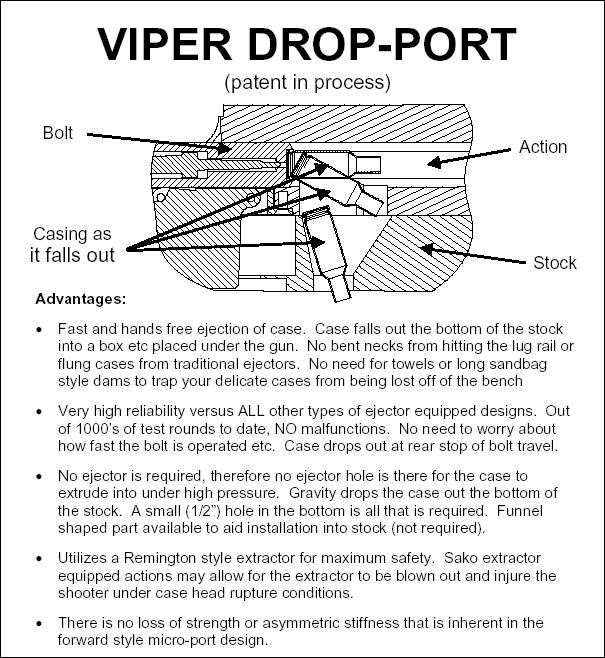
Details of the Drop-Port–with VIDEO! The visible part of the Drop-Port is a cartridge-sized cut-out in the floor of the action. This tapers into a funnel shape that lets the spent case fall nose-first through a single hole in the underside of the stock. The Drop-Port is carefully sized so that empty brass will fall through from gravity but a loaded round won’t. I’ve found that getting a BR case to eject 100% reliably in a standard action is not easy. The round is short and fat so it clears the chamber too early and the ejector pushes the cases out the extractor too fast. This can result in an empty case sitting in your action, no longer held by the extractor. Needless to say, this can slow you down during a stressful competition. When you get a Drop-Port you can forget all those problems.
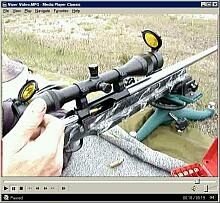
Failure to eject is NOT going to happen with a Drop-Port. The system just works every time, and it’s FAST. Right-Click on the Media Player image and “Save As” to download a video (6.9 megs) showing me cycling the action during live fire.
One smart feature of the Drop-Port is the extractor location. A Remington extractor is located at the bottom of the bolt. This way the case is supported by the extractor until the front of the case lines up with the cut-out in the action. At that moment the front of the case tilts down and the rim slips out of the extractor. In the stock there is a funnel which collects the case. The case drops out of the rifle through a single small hole in front of the trigger guard.
Building an Accurate Load Tools and Recipes I start with new Lapua cases and after full-length sizing I trim them with a Wilson trimmer. Then I turn the necks for a .264″ neck diameter with a Lapua 105 seated in the brass. After fire-forming I use a “semi-custom” Harrell’s full-length sizing die with bushing. I use a .262 bushing with the moly-coated bullets. This Harrell’s die is the best I ever used — it gives very low run out. [Editor’s Note: Harrell’s stocks a number of dies with various internal dimensions. You send them three fire-formed cases and they’ll pick out a die that fits your brass the best. The cost is very reasonable.] Overall the excellent concentricity I’m seeing with my rounds is a combination of a superb chambering job, a neck-turned Lapua case and the Harrell’s sizing die. The die is supplied with a brass bushing that allows you to measure the amount of sizing you are doing.
For seating I use both a Wilson inline seater (hand die) and a Forster seating die that threads into a press. The latter gets the most use because I find it easier to use. Run out with both is around 0.001″ or better measured on the bullet.
Load development was very easy. I started with Varget and all loads … shot well. Vihtavuori N150 also shot very well with… moly-coated Lapua 105s. To my delight, the light bullets are also shooting very well in the 1:8″ twist. Nosler Ballistic Tips are giving very good results with a case full of N140. I’ve also tried N150, N540 and AA 2520. For all loads I’ve been using CCI BR4. Bullets are seated well into the lands with square marks showing. This gives an overall length around 59 mm (2.32″), depending on the bullet used.
Shooting the Rifle–How It Performs The rifle is very easy to shoot and it is very accurate, but it had some drawbacks in the beginning. First there is the stock. It is designed for bench shooting and on a table it does this very well. I use a Caldwell front rest and a Protektor rear bag. When shooting prone I’ll also use the rest but the cheek weld is not ideal (the Edge was optimized for free recoil shooting from the bench). The rings that are supplied with the action are rather high. I looked around and found some that were lower. This made shooting easier, but I still wasn’t satisfied. The gun was a bit nose-heavy. There is a weight system built into the stock, but it wasn’t enough to bring the gun in balance. I like the balance point to be just in front of the receiver ring. So I cut the rear off the stock and put in a larger tube and turned some weights to put in it. I also made up an aluminum butt plate. Then I installed a Harrell’s brake to cut recoil to a minimum. With these modifications, the rifle is now shooting the way I want. I think the Edge stock is a very good design for benchrest shooting but for prone shooting it has some shortcomings. I think the MBR is a better stock for shooting prone.
Muzzle Brake–Less Recoil, Same Excellent Accuracy After testing the barrel with different loads, I decided to put a brake on one barrel. Most of my guns are muzzle-braked and since I had two virtually identical barrels, I put a Harrell’s brake on one. The barrel had to be threaded to mount the brake and here I was a little concerned–I remembered the advice to “never mess with a winner”. The un-braked barrel was ultra-accurate and I was curious whether the process of fitting the brake might affect the accuracy.
Thankfully, my worries were unfounded. My targets showed no loss of accuracy — there was no evidence that the brake had caused any changes (except as to recoil). I have wondered though, perhaps the brake makes the gun more shootable and in that way compensates for some small accuracy loss that may be there? Whatever the case, the gun shoots just as tight as before, except now it’s a lot more user-friendly with less muzzle hop and less “push” on recoil.
This Rifle Literally Shoots Bug-Holes
And now I come to the end of the story. One day when testing the rifle at 100 meters (with brake installed), I spied a fly on the target. Well now, I thought, here is an interesting “precision shooting” challenge. I put the crosshair on the fly, squeezed the trigger, and the fly was history.
One shot, one kill. Now THAT is impressive precision. If you look closely you’ll see what’s left of Mr. Fly around the bullet hole. Or “bug-hole” as you Americans would say. This kind of performance is a real confidence-booster for the trigger-puller, let me tell you.
The Drop-Port — Simple Yet Advanced
Jerry Stiller tells us: “The drop-port ejects the case out the bottom of the action using only gravity. No ejector plunger is required so the system is as foolproof as anything can be. (A normal spring-loaded ejector creates an uneven load on one side of the case head.) Unlike other ejection systems, micro-ports etc., a Drop-Port doesn’t require tuning or adjusting, and just works. Many top shooters tell us they can cycle rounds faster with a Drop-Port action than with any other design.”
“The engineering of the Viper reflects some key design objectives. I wanted it to be able to fit standard commercially available stocks and have a barrel fit-up that was well known in the industry. I liked the idea of the larger bedding area and higher stiffness of the aluminum actions, so I chose the Panda footprint and barrel tenon for the Viper. I also made some changes to what was available at the time to make the product better. I used a smaller diameter firing pin to eliminate primer piercing, hard anodized all the aluminum parts for corrosion resistance and to make the surface hard and slick. The bolts are also coated for the same reasons.
Three-Position (3P) Air Rifle Shooting is the most popular and fastest-growing form of shooting sports competition for junior shooters (High School age and younger). The Civilian Marksmanship Program (CMP) conducts two different 3P Air Rifle events. Precision Air Rifle is modeled after Olympic-style shooting and allows the use of specialized target rifles and equipment. Sporter Air Rifle is designed for new competitors or those who desire to compete with a minimum of equipment and expense.
In both types of shooting, competitors fire at targets at a distance of 10 meters in three different positions, prone, standing and kneeling. Three-Position Air Rifle provides young competitors with competitive shooting sports opportunities that can be offered on a wide variety of easily accessible or easily constructed ranges, with equipment that is commonly available at affordable costs.
The CMP actively promotes Three-Position Air Rifle shooting as a premier youth marksmanship competition by providing low-cost equipment and pellets as well as training materials and competition activities. In addition, other air gun events for juniors and adults are hosted by CMP throughout the year. CMP facilities have Open Public Shooting evenings, and matches for air rifle and air pistol take place at the CMP Marksmanship Centers.
At the request of our readers, we provide select “Deals of the Week”. Every Monday morning we offer our Best Bargain selections. Here are some of the best deals on firearms, hardware, reloading components, optics, and shooting accessories. Be aware that sale prices are subject to change, and once clearance inventory is sold, it’s gone for good. You snooze you lose.
1. Grafs.com — All Lapua Products on Sale — Brass, Bullets, Ammo
If you want to win, and want brass that lasts, think Lapua. Over 90% of all modern benchrest records have been set with Lapua brass. What’s more, Lapua makes outstanding bullets. Lapua Scenars have delivered superb accuracy in our site’s benchrest and tactical rifles. As for factory ammo, again Lapua is hard to beat. We got our hands on some Lapua 90gr 6mmBR factory ammo a few seasons back. That stuff was amazing. It delivered honest 5-shot, quarter-MOA groups! If you want these superior Lapua products, now is a great time to buy. Grafs.com is running a giant sale on all Lapua-brand products, including brass, bullets, and loaded ammo. You’ll save at least 10% on everything, with many items 20-24% off, and select loaded ammo up to 59% off. Lapua 6.5 Creedmoor SR brass is discounted 22%, a great deal. Plus, if you spend $250 or more you’ll get a free box of Lapua Center-X.
Get a Ruger Precision Rifle in 6mm Creedmoor for $788.00 complete. That price, which includes rings, is great for a Gen 2 model. If you’ve been thinking of purchasing a Ruger Precision Rifle (RPR) chambered for the 6mm Creedmoor cartridge, this is a killer deal. Right now GunPrimer.com is offering this popular tactical rig for under $800.00, in the 6mm Creedmoor chambering. This shoots faster and flatter than the 6.5 Creedmoor — so many PRS guys have switched to it. This is a good choice for the PRS production class, or you can take in to another level of performance with a Pre-Fit 26″ cut-rifled barrel from Krieger. This is the lastest RPR Gen 2 version with the upgraded handguards. Heck of a bargain boys — you can pay $1200 or more elsewhere for the same rifle.
3. Midsouth — 6.5mm 123gr Match Bullets, $119.99 for 500
This is a great option for PRS and tactical shooters. These 6.5mm bullets work great with the popular 6.5mm cartridges such as 6.5 Creedmoor, 6.5 Grendel, and 6.5×47 Lapua. With a shorter length than the 140s, these fit magazines better. Plus we’ve found you can run these significantly faster than the 140gr class 6.5 mm bullets, so you are not giving up that much in drop or windage. G1 Ballistic Coefficient is .510
Reloading information is interchangeable with 6.5mm Nosler Custom Competition bullets with the same grain weight. NOTE: These Match Monster Bullets are NOT BLEMS!
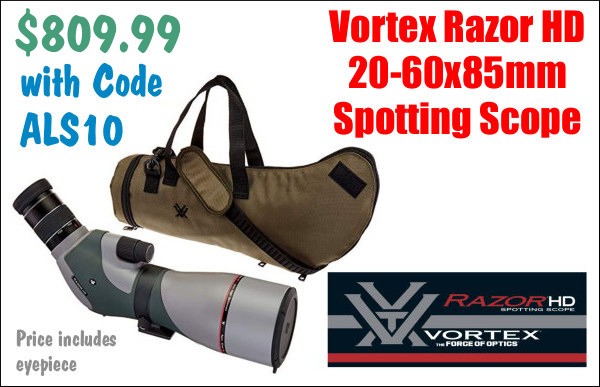
4. Al’s — Vortex Razor HD 20-60x85mm Spotting Scope, $809.99
AMAZING DEAL — save $390.00! Other vendors sell this very same Razor HD spotter for $1199.
Here’s a great deal on a high-quality spotting scope from a top optics maker. AL’s Sporting Goods has last year’s model Vortex Razor 20-60x85mm spotter for only $899.99, including eyepiece. This impressive HD-glass spotter sells elsewhere for $1200.00. But it gets better — use Code ALS10 for another 10% Off, bringing the final price down to $809.99. This is a very good spotter for the money and Vortex has one of the best warranties in the business.
5. Powder Valley — Hodgdon Powders In-Stock at Great Prices
H4895, Varget, H4350 — these are all great powders for competition cartridges such as the 6mmBR Norma, 6 Dasher, 6.5 Creemoor, and .284 Shehane. Because these powders work so well, they can be hard to find. Right now Powder Valley has a great supply of these and other excellent Hodgdon powders (such as H4198 and H4831sc) in both 1-lb and 8-lb containers. For example H4350 and Varget are $27.35 for 1-pounders, while H4895 and H4198 are just $26.35 for a 1-lb bottle. An 8-lb jug of H4350 is $194.50, a lot less than you’d pay in most retail stores.
6. Sportsman’s Guide — Browning Buck Mark, $279.99 with Code
Everyone should own a nice .22 LR rimfire pistol. The Browning Buck Mark is a classic, and for good reason. These pistols are reliable, well-balanced, have a good trigger, and they are very accurate. We have nothing but praise for the bull-barreled Buck Marks. And now you can get one for a super-low price. Sportsman’s Guide has the Browning Buck Mark Camper UFX with 5.5″ Barrel on sale for $299.99 ($284.99 member price). But it gets even better — if you use Code “WARRIOR” during check-out, you save $20.00, putting your total price at just $279.99 (or $264.99 for SG members). That’s a great deal on a very solid rimfire pistol that can serve you well for decades.
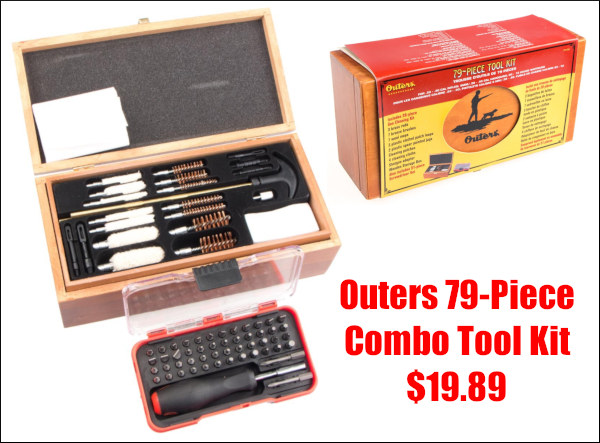
7. CDNN — Cleaning Set and Tool Kit in Wooden Box, $19.89
We doubt $20 spent any other way could deliver more utility (for a gun owner) than this Outers Combo Cleaning Kit and Driver Set. In a nice wooden box there is a 28-piece gun cleaning set, PLUS you get a 51-piece screwdriver and tool kit that includes Flat, Phillips, and Torx heads in multiple sizes. Here’s what you get for just $19.89:
51-Piece Screwdriver Driver Kit
Molded Driver with Magnetic Tip
15 Flat Head Bits
10 Hex Bits (inch)
9 Hex Bits (metric)
4 Phillips Bits
9 Torx Bits
2 Extra Long Phillips Bits
1 Hex to Square Adapter
8. Stocky’s — LR Stocks with Aluminum Bedding Block, $199.99
Here’s a good deal on a versatile Stocky’s Long Range Stock with aluminum V-block bedding system. For just $199.99, order this for Rem/Rem Clone long actions or short actions, with either narrow or wide (varmint/tactical) barrel channel. This would be a good choice for a varmint rifle. This is also offered with handsome hydrographic or web-pattern baked-on textured finishes for $219.99.
9. Amazon — Jialitte Scope Bubble Level, $10.99
All serious rifle shooters need a scope level. This nicely designed Jialitte Scope Bubble Level features a 30mm milled inside diameter, plus an inner insert ring so it will also fit 1″-diameter main tubes — that dual-diameter versatility is a nice feature. We also like the way the unit is nicely radiused, and has a low profile in the middle. Price is just $10.99 with free shipping. User reviews have been very positive. You could easily pay $35.00 or more for a 30mm scope level. Purchasers have praised this product — nearly all verified buyers rated this five stars.
10. Amazon — 12″ x 12″ Splatter Grid Targets, 10 for $9.99
This 12″x12″ Splatterburst Target combines splatter shot marking with a grid background, with five aiming points. The bright neon shot circles make it easy to see your shots. And the handy grid lets you quickly estimate your group size. Get a 10-pack for $9.99, or a 25-pack for $17.99 (better deal). This particular target has earned rave reviews — 87% of verified buyers gave this a FIVE-Star rating. One example: “Excellent quality and durability. The adhesive is really strong. High contrast makes down range targeting easy and the splatter contrast is [great].”
Where in the USA are guns most popular, on a per-capita basis? Look at this chart. The states with darker purple have the most background checks per capita. The Top 10, in order, are:
Kentucky has a far higher number than any other state — 1012 per 1000 residents, and 4,508,298 overall per year. That’s not because the Bluegrass State has more avid gun owners (per capita) than elsewhere in the country. Rather, Kentucky has more background checks per capita because it is the only state that requires all concealed carry permit holders to undergo automatic monthly rechecks. That means 12 checks per year. Other states might have a single background check when the firearm is acquired.
Trends in Background Checks and Gun Ownership
The total number of background checks has risen steadily for nearly the past 20 years (though there was a slight decrease in 2017). In 2018, Federal Firearms License (FFL) dealers initiated more than 23 million background checks, with significant variations in how many requests came in from each state.
Gun Control Legislation on the Rise Nationwide
In 2018, the 50 U.S. states passed 69 new gun control measures. Those 69 new laws are more than three times the number passed in 2017.
The struggle between gun rights and gun control continues on both a state and a national level. Seeing this wave of new legislation makes one wonder, “how many of these new laws will really reduce crime or enhance personal safety?” Or, rather, are the vast majority of these laws merely intended to restrict the rights of law-abiding citizens, banning new classes of arms or creating new costs (and hassles) for gun owners. The anti-gunners’ strategy is to work incrementally, banning one type of firearm after another. The goal, ultimately, is to ban handguns altogether, and to ban all semi-automatic rifles.
We’re starting to see barrel tuners employed in more competitive disciplines than ever — from 100 yards to 1000 yards. And even some varmint hunters are employing tuners or tuner/brakes now. This allows them to dial in accuracy with different loads (when shooting hundreds of rounds in a weekend). Here’s a quick over-view of the potential benefits of tuners.
Commentary by Mark Walker, Sierra Bullets Product Development Manager This story originally appeared in the Sierra Bullets Blog. Visit SierraBullets.com.
Some people love tuners and others hate them. I use them on my rifles and I’ve had more than one person ask me why on earth I would put one of those things on my barrel. I’ve even had a national long range champion tell me to unscrew it and throw it into Lake Erie on my next trip to the pits at Camp Perry. However, there are other shooters that swear by them and have many match wins to back it up.
It’s an indisputable fact that tuners do have an effect on a rifle’s accuracy, however how much is somewhat open for debate. The large heavy target barrels that we use for benchrest or F-class may not be affected as much by a tuner as a lighter weight sporter type barrel. Each barrel that I’ve installed a tuner on not only showed improvement in accuracy but also displayed a wider load window. The increased accuracy is because of the ability to adjust the tuner to the load, however I believe the wider load window is due to the added weight of the tuner slowing down the barrel vibrations. These are both very important aspects of having a very accurate rifle.
While better accuracy and a wider load window are two areas of improvement, I believe the most important feature of a tuner is the ability to adjust the tune during the middle of a match. This is especially important during matches where you must load all your ammo earlier and cannot make adjustments to the load during the match. If you happen to miss the load, instead of having to deal with a gun that isn’t shooting you can make an adjustment to the tuner and hopefully improve the accuracy of the rifle.
While I’ve laid out several ways that a tuner can help, there are also a few ways that tuners can cause problems. They add weight so if you are shooting a discipline that has weight limits on the rifle, you may not be able to install a tuner and still make weight. Sometimes, a barrel just doesn’t show improvement with a tuner installed. These are few and far between, but it is something to consider. If you make an adjustment to the tuner in a match, you need to make sure you move it in the right direction. Adjusting a tuner in the wrong direction can cause very large groups. And finally, if they aren’t tightened properly, tuners can come loose during firing which will cause a lot of problems as well.
As you can see, tuners have both positive and negative aspects. In my personal experience, the positives far outweigh the negatives so I will continue to use them on all of my competitive rifles. If you’ve been thinking about installing a tuner, hopefully some of the information that I’ve presented will help you make an informed decision.
Want to learn long-range benchrest skills from the best in the business? Then head to Williamsport, PA this June. The registration period for the 2019 PA 1000 Yard Benchrest School is now open. This year’s session will be held Saturday and Sunday, June 8-9, 2019, with a “Meet and Greet” on Friday night, June 7. Classes, taught by top 1K shooters, are held at the Original Pennsylvania 1000-Yard Benchrest Club Range, one of the best 1000-yard ranges in the country. The school will be limited to 24-30 students with one instructor for every two students.
Praise from a 1K Benchrest School Grad
Here’s a testimonial from a recent graduate: “I can attest to the knowledge that you gain. I went last year and loved it. Have renewed my membership in the Club and would love to go this year. I would love to take the course again. In the photo above I am in the back row, fourth from the right — sunglasses and blue shirt.” — Bob, Class of 2016
Participants will learn all aspects of long-range benchrest shooting from some of the most skilled marksmen in the country. Much time is spent at the loading bench and on the firing line. Classes cover load development, precision reloading, bench skills, and target analysis. You don’t even need guns and ammo — all equipment and ammunition will be provided.
School instructors tell us: “This year’s benchrest school will be a 2-day weekend event. (There is also an optional ‘Meet and Greet’ gathering Friday evening). The school is a beginner class designed to teach the fundamental skills needed to be competitive at at 600 and 1000 yards. Saturday will be spent in class covering a range of topics including reloading ‘dos and don’ts’, load development and equipment handling. Sunday we will shoot an actual match to see what you’ve learned.”
After taking this class, you might be the guy who shoots an amazing 100-8X at 1000 yards like this:
Cost for the class is $475.00 including lunches on Sat/Sun and dinner on Saturday. Act soon if you want to attend the 2019 school — the program fills quickly. The classroom is limited to only 24 (possibly 30) students and instruction is one instructor per two students. A one year membership is included with the cost of the school.
If you have any questions regarding the school send email to: amurtagh6mm [at] gmail.com.
Andy Murtagh
Vice President and Public Relations Officer
Original PA 1000 Yard Benchrest Club
This helpful video from our friend Kirsten Joy Weiss explains how to avoid “scope bite”. This can occur when the scope, on recoil, moves back to contact your forehead, brow, or eye socket area. That’s not fun. While common sense tells us to avoid “scope bite” — sooner or later this happens to most shooters. One viewer noted: “I have come close. I had a Win Model 70 in .375 H & H Mag and I was shooting over a large rock in a strange position. The scope hit my eye glasses hard enough to bend the wire frames and cause a little pain on the bridge of the nose from the nose piece. [That] made a believer out of me.”
Kirsten offers a good basic principle — she suggests that you mount your rifle-scope so that the ocular (eyepiece) of the scope is positioned at least three inches or more from your eyeball when you hold the rifle in your normal shooting position. From a technical standpoint, optical eye relief is a property of the scope, so you want to purchase an optic that offers sufficient optical eye relief (meaning that it allows you to see the full circle of light with your head at least three inches from the eyepiece). Then you need to position the optic optimally for your head/eye position when shooting the rifle — with at least three inches of eyeball-to-scope separation (i.e. physical eye relief).
NOTE: You should mount the scope to provide adequate eyeball-to-scope separation for the actual position(s) you will be shooting most of the time. For an F-TR rig, this will be prone. For a hunting rifle, your most common position could be sitting or standing. Your head position will vary based on the position. You can’t assume the scope placement is correct just because it seems OK when you are testing or zeroing the gun from the bench. When shooting from a prone or kneeling position you may find your eye considerably closer to the eyepiece.


 Building an Accurate Load
 Shooting the Rifle–How It Performs
 This Rifle Literally Shoots Bug-Holes

 Three-Position (3P) Air Rifle Shooting is the most popular and fastest-growing form of shooting sports competition for junior shooters (High School age and younger). The Civilian Marksmanship Program (CMP) conducts two different 3P Air Rifle events. Precision Air Rifle is modeled after Olympic-style shooting and allows the use of specialized target rifles and equipment. Sporter Air Rifle is designed for new competitors or those who desire to compete with a minimum of equipment and expense.






 Want to learn long-range benchrest skills from the best in the business? Then head to Williamsport, PA this June. The registration period for the 2019 PA 1000 Yard Benchrest School is now open. This year’s session will be held Saturday and Sunday, June 8-9, 2019, with a “Meet and Greet” on Friday night, June 7. Classes, taught by top 1K shooters, are held at the Original Pennsylvania 1000-Yard Benchrest Club Range, one of the best 1000-yard ranges in the country. The school will be limited to 24-30 students with one instructor for every two students.


