This gun production chart appears in the July 2018 issue of Shooting Industry magazine. Factoid: U.S. total firearms production has more than tripled since we launched this website in 2004.
Move over Ruger, Remington, Savage … Smith & Wesson is the new Big Kid on the Block. According to 2016 firearms industry production reports from Shooting Industry magazine, S&W has taken over as the number one firearms producer in the United States. That’s good news for S&W, but bad news for Ruger, which had been number one for the past eight years.
Smith & Wesson was the top overall U.S. firearms manufacturer in 2016 with 2,120,910 firearms produced, a stunning 44% increase over the previous year. Ruger was second in 2016 with 1,981,590 firearms, an 18.8% gain over 2015. The last time S&W was ranked number one was way back in 2007. While S&W is generally seen as a handgun maker, it also produces a wide variety of rifles both under the S&W banner and its subsidiary Thompson/Center Arms. Last year the historic Smith & Wesson enterprise was officially renamed American Outdoor Brands Corp. (NASDAQ: AOBC) in part to reflect the fact that it is more than just a handgun maker.
Key Industry Production Numbers in 2016
There were some other interesting facts revealed in the Shooting Industry magazine report:
1. For only the second time ever, U.S. gun-makers produced over 10 million firearms (rifles, pistols, and shotguns) in 2016. The 10,664,318 total was nearly 20% more than in 2015.
2. For the first time ever, in 2016 American gun-makers produced over 4 million rifles. The 4,239,335 rifle output set a new high mark, that was 6.5% more than the previous record year, 2013 (3,979,570).
3. A record number of handguns were also produced in 2016. The 5,576,366 pistols produced in 2016 marked a 7.9% increase from 2013, the previous record-holding year (5,167,008).
4. Gun sales increased dramatically in 2016, influenced by fears over the election: “NICS background checks achieved record-setting levels in 2016 — with 15,700,471 background checks (NSSF-Adjusted), an increase of 10.2 percent over 2015 (14,244,240 [NSSF-Adjusted]).”
Top Overall U.S. Firearms Manufacturers in 2016
(Percentage change over 2015)
• Smith & Wesson: 2,120,910 (+44.0%)
• Ruger: 1,981,590 (+18.8%)
• Remington: 1,240,665 (+8.5%)
• SIG Sauer: 633,533 (+27.4%)
• O.F. Mossberg: 508,466 (+0.8%)
Top U.S. Rifle Makers:
(Percentage change over 2015)
• Remington: 769,942 (-0.5%)
• Ruger: 701,992 (+6%)
• Anderson Mfg.: 453,763 (+51.1%)
• Smith & Wesson: 396,710 (+89.7%)
• Savage Arms: 311,878 (-18.3%)
Top U.S. Handgun Makers:
(Percentage change over 2015)
• Smith & Wesson: 1,724,131 (+36.4%)
• Ruger: 1,279,415 (+27.4%)
• SIG Sauer: 581,807 (+26.6%)
• Glock: 368,140 (+70%)
• Kimber: 223,785 (+69.6%)
Current Outlook for American Firearms Industry
So far, 2018 has been a fairly tough year for the gun industry: “The U.S. firearms industry finds itself at a crossroads in 2018. Facing attacks from state governments, financial institutions, tech companies and students (all while experiencing sluggish demand) it’s currently in a challenging position.” However, there are many indicators that the gun industry is still strong. Kimber and Tauras have both opened new factories in the U.S. Southeast, and Remington has emerged from Chapter 11 Bankruptcy with creditors exchanging debt for equity: “It is morning in Remington country — We are excited about the future…” said Anthony Acitelli, Remington CEO.
For more insights, read the full version of the U.S. Firearms Industry 2018 Report. There are many more detailed charts and tables breaking down production, imports, and exports. This appears in the July 2018 issue of Shooting Industry Magazine.
AR-platform rifles are fun and versatile, but the standard, mil-spec triggers leave much to be desired. They tend to be gritty, with creep and heavy pull weight. One of the easiest, most effective AR upgrades is a trigger group swap. An improved fire control group makes a huge difference. There are many aftermarket trigger options for the AR platform rifles. Choose single-stage or two-stage, either standard trigger assembly or unitized “drop-in” trigger, such as those made by Timney or Triggertech.
When upgraded with a precision trigger and match barrel, AR-platform rigs work great in NRA High Power competitions (Photo from NRA Blog, at Camp Perry).
Two-Stage vs. Single-Stage Triggers
Two-stage triggers have two separate movements. The first stage offers a light, spring-loaded pressure that works against the shooter’s pull until stopping at the second stage – this is called “take-up”. If there is no spring pressure, it is known as “slack”. Should the shooter continue to pull the trigger once he’s arrived at the second stage, the mechanism will operate like a single-stage trigger from there until engaging the sear and firing the gun. Good trigger reset requires the shooter to keep pressure on the trigger, even during reset, to minimize movement of the muzzle.
Single-stage triggers feature no take-up or slack, as they begin engaging the sear as soon as the shooter begins pulling the trigger. Some competitive shooters prefer the two-stage trigger because of the feedback it provides during its first stage, while other shooters, including those using their rifle in tactical scenarios, may want the surety of a single-stage trigger, ready to engage and fire once their finger is inside the trigger guard. Regardless of preference, a good trigger will feature minimal creep and should be free of grittiness, providing a smooth, even break.
Drop-In Trigger Assembly vs. Standard Trigger Group
Once you decide between a single-stage or two-stage trigger, you can choose between standard and drop-in trigger groups. Standard trigger groups feature all the fire control group parts separated, and need to be pieced together and installed much like a mil-spec trigger, while drop-in trigger are pre-assembled and contained within a casing that simply drops in to the receiver and accepts the pins, hence the name.
After-Market Trigger Comparison
Some shooters prefer drop-in triggers due to the ease of installation, while others opt for standard groups so they can access the components individually for cleaning adjustment or replacement. If one piece of a drop-in trigger fails, you’ll need to either replace the entire unit or send it to the manufacturer for repair, whereas you may be able to simply replace the broken component of a standard trigger without needing a whole new trigger set.
Trigger Terminology — “Creep”, “Stacking”, “Overtravel”
“Creep” or “travel” is the distance the trigger moves between the end of take-up and when the trigger breaks to fire the fun. Too much creep can affect accuracy, but no creep can be unsafe, as the shooter may not be prepared to fire. “Stacking” occurs when the trigger weight actually increases during travel — this shouldn’t happen. Lastly, “overtravel” is the distance the trigger continues moving back after the gun fires.
This article is based on a longer story in the NRA Blog.
PMA Tool offers lightweight yet sturdy cleaning cradles that are handy, affordable, and easy to transport. PMA’s single-gun cradle, priced at $75.95, is ideal for benchrest rigs. It measures about 17″ in length and weighs about one pound. PMA now also offers a two-gun cradle for $119.95. Both single and double cradles secure your rifle(s) in a muzzle-down position that allows easy cleaning and prevents solvents from running back into the action. The front “saddle” and all contact surfaces are covered by thick silicone rubber padding which grips the rifle securely yet protects the stock and components from scratches.
These cradles are currently available either with a 3″-wide front saddle for Benchrest and F-Open style stocks, or a 2.5″-wide front saddle for rifles with narrower narrower, flat fore-ends such as those found on Hunter Class and modern varmint stocks.
Double Rifle Cradle is a Smart, Versatile Design
PMA’s double rifle cleaning cradle was was designed from the ground up to work perfectly for two rifles side-by-side. Using the same tie bar and protective saddles found on the single cradel, PMA widened the base and created new uprights to support the saddles, making the cradle as narrow and light as possible, while retaining all the protective and non-slip features from our single unit. This unit is available in double 3″ front saddles, double 2.5″ front saddles or combination 3″ / 2.5″ front saddle configurations to accommodate multiple classes of rifles for centerfire and rimfire benchrest competition.
Product Tip by EdLongrange. We welcome reader submissions.
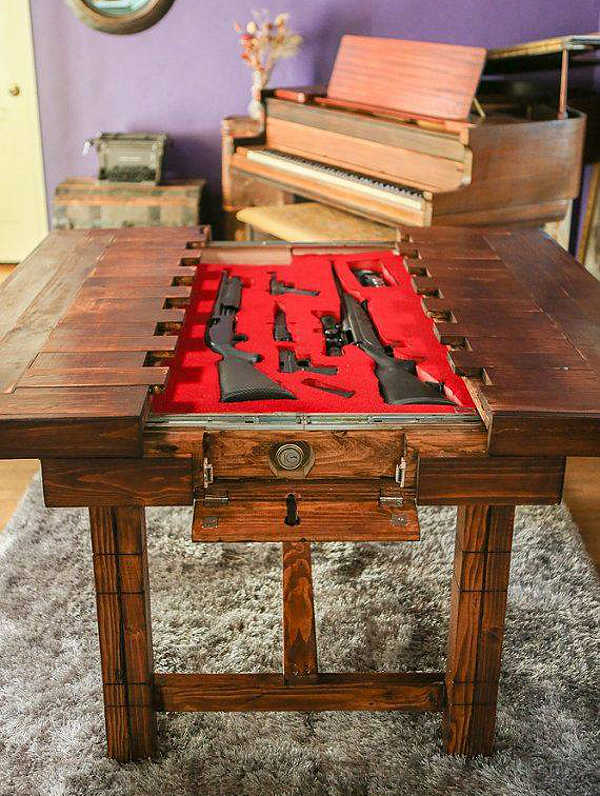
Here’s something that will teach unwanted guests some “table manners”. We’ve seen handguns hidden in books, and stowed behind faux baseboard vents, but this hand-crafted, slide-open table takes the cake. We doubt that anyone could sit down at this table and suspect that a shotgun, scoped rifle, two pistols and a knife were stored securely inside. There’s an arsenal hiding in there!
To access the guns under the sliding table-top, first you flip down a wood trap-door on the side. That exposes a key-lock which unlatches the interleaved left and right table segments. These slide open horizontally on metal tracks, exposing the full arsenal underneath. This “table vault” is a very clever design, built with fine craftsmanship. You can purchase this table from the maker for $1799.00.
Table Description
This table has a secret latch which pops down. Behind it is a deadbolt (or Kevo enabled Bluetooth lock). Once unlocked the table slides open toe reveal your valuables and/or guns. The table comes with a piece of blank white foam you can customize for whatever you would like to put inside. MORE INFO.
Dimensions and Features
Outside: 55.5″ long x 33.5″ wide x 31″ high
Interior: 42” long x 29” wide by 3.25” deep
– Customizable Color (paint or stain) (American Walnut shown)
– Seats 6 (standard size chairs)
– Standard keyed deadbolt or Kevo Bluetooth lock ($299.00 Extra for Kevo)
Slide-Open 20″-High Coffee Table
There is also a coffee table version, 55.5″ long x 33.5″ wide x 20″ high. That may be better for folks who just can’t bear the thought of dinner being served on top of ones precious gun collection. This offers the same storage space as the regular dining table.
Our friend, Texas gunsmith Richard King, recently posted some images of a new .50 BMG target rifle he built for a customer. Equipped with a beefy McMillan stock, this rig has shown some impressive accuracy — even during break-in. Check out that target. Using On Target software, we measured this 3-shot group at 0.476″ or 0.454 MOA. Not bad for a beast with some very serious recoil. Do you think you could beat that 0.476″ with your AR15 shooting puny .223-caliber bullets?
Compare the dimensions of that massive 50-Cal action to a Rem 700 action in the middle. When you’re shooting a Fifty, size matters!
On Facebook, some folks were surprised a guy could wring that kind of accuracy out of a monster .50 BMG. One wag posted: “Yikes! He will need flinch therapy after shooting that beast.”
Another Facebooker joked: “When shooting a .50 BMG you say…In your best Crocodile Dundee voice…that’s not a gun, THIS is a gun!”
Richard King responded that this customer has quite a bit of experience with jumbo-caliber rifles: “Remember this is the guy that shot a .338 Lapua in a two-day F-Class match. Recoil might actually be easier on this 50, given the fact that it has more weight and a brake.”
Before this rifle was completed, Richard King showed us the monster 13-lb BAT action at the 2018 Berger SWN. Honestly, the big BAT .50 BMG action was HUGE — with the bolt fully extended it was the size of your forearm (to the finger tips). Richard joked “This weighs almost as much as an F-TR rifle (before optic) all by itself”.
Specialty Tools for the Big .50 BMG
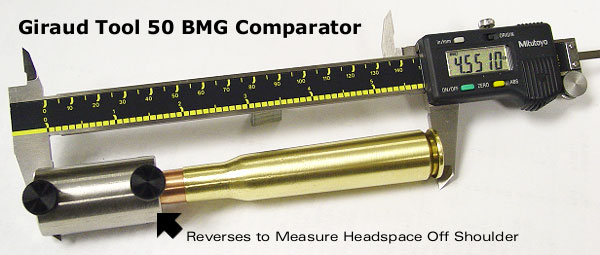
Yes, the .50 BMG is one huge cartridge. Thankfully, there are some special tools for loading the jumbo-size round. Giraud Tool makes a specialty comparator for 50-Cal cartridges. The double-ended comparator is quite versatile. In one orientation you can measure base-to-ogive bullet length and also measure cartridge OAL from rim to bullet ogive. When reversed, you can use the comparator to measure cartridge headspace. The Giraud 50 BMG Comparator gauge is constructed of 303 stainless and fits most any vernier, dial, or digital caliper. CLICK HERE for more info.
The Precision Rifle Series (PRS) keeps growing in popularity — attracting more shooters and spinning off sub-disciplines such as Gas Gun division and Tactical Rimfire. Along with the PRS, the National Rifle League (NRL) has developed in parallel, sponsoring successful tactical centerfire and rimfire matches. With this exploding interest in PRS-style shooting, now the Precision Rifle world has its own annual “gathering of the faithful” — the Precision Rifle Expo.
The First Annual Precision Rifle Expo will be held September 15-16, 2018 at the Arena Training Facility in Blakely, Georgia. The event is specifically designed to connect precision rifle enthusiasts with top manufacturers, precision rifle instructors, and ace competitors. The goal is to promote this fast-growing shooting sport and advance the skill set of attendees. To register for the event ($25 fee), or learn more about the Arena Training facility visit PrecisionRifleExpo.com. Get Expo updates on the Precision Rifle Expo Facebook Page.
Arena Training Facility — 2300 Acres
The 2300-acre Arena Training Facility is a premier shooting facility with multiple shooting ranges from 50m to 2100m. Arena’s 1000-yard covered Known Distance range offers multiple benches, steel and paper targets out to 1000 yards. On Arena’s UKD (unknown distance) range shooters can engage steel out to 2300 yards. This 2100m UKD range boasts a 3-Story Shooting Tower, Air-Conditioned Shoot House, and multiple Positional Challenges. Situated two hours from the Atlanta airport, the Arena complex offers multiple climate-controlled classrooms, a main building, and a clubhouse, along with the impressive range facilities.
Precision Rifle Expo attendees will be able to meet industry experts, get hands-on product experience, and attend a variety of shooting seminars — all for a modest $25 entry fee. Seminars will include: Precision Hand-loading, Wind Reading, Position Building, Competition Preparedness, Long Range Precision Shooting Intro, and the Fundamentals of Marksmanship. Live-fire skills training and product demos will include shooting with suppressors, precision rimfire shooting, 1000-yard shooting, and even a one-mile target challenge.
All Types of Products Will Be on Display
Exhibitors will showcase optics, actions, barrels, stocks/chassis systems, complete rifles, suppressors, and the latest in electronics. In addition, targets, ear and eye protection, bags and support equipment, and other accessories will be on display.
Along with exhibitors, the first-ever Precision Rifle Expo will attract leading Gun Media members. Sniper’s Hide founder Frank Galli will be there, serving as one of the long distance precision instructors. AccurateShooter.com will have a correspondent. The Precision Rifle Blog will cover the Expo and highlight new products. Recoil Magazine will spotlight the Expo on the web and in print.
The Arena Training Facility is two hours from the Atlanta Airport:
REGISTER Now to Secure Your Place
Interested in attending? Act soon. The inaugural Precision Rifle Expo is expected to sell out early. CLICK HERE to Register. It costs just $25.00 to attend. For more information, visit PrecisionRifleExpo.com. You can also contact Ryan Castle at 912-344-1607, Phil Cashin at 770-401-3572, Brandon Zielinksi at 920-664-3098, or Mark Kuczka at 770-364-7607.
In a helpful NSSF video, Ryan Cleckner explains why you normally should avoid canting your rifle — rotating it clockwise or counter-clockwise. Cleckner explains that canting the rifle in one direction or another will change the point of impact: “When you rotate the rifle, not only does the [POI move] in the direction that you’re rotated, [but] it also loses some of its elevation as it rolls down.” This, Cleckner explains, can make you miss on one side or the other:
Cant to the Left — You’re going to miss low and left.
Cant to the Right — You’re going to miss low and right.
In this video, starting at the one-minute mark, Cleckner shows the effect of rifle canting when engaging a 600-yard target. A few degrees of cant (either to the left or to the right), moves the shot POI completely off the steel silhouette target. The POI change occurs mainly because you are lowering (and laterally shifting) the scope sight-line relative to the bore axis, effectively changing your zero.
David Tubb has explained: “Every 1 degree you are off on a cant, is about six inches of difference laterally at 1000 yards”.
Position Shooting with Sling — Rifle Cant Considerations
Cleckner’s discussion assumes that the scope or sights are set to hit center with the rifle level and plumb. That works for most situations when shooting prone off bipod, front mechanical rest, or front sandbag. However, many sling shooters, including David Tubb and John Whidden, do tilt or cant their rifles slightly inward because this allows a more comfortable hold with sling, or allows better eye-to-sight alignment. Holding the rifle at an angle can work — but the angle of cant must be consistent for every shot. Canting the rifle is not a sin by itself. However, after you confirm your zero on your target, the degree of cant must be the same for EVERY shot. You must maintain that exact same degree of rotation on each shot or you will experience the shot POI movement Cleckner illustrates. Consistency is the key.
John Whidden, 5-time Nat’l Long Range Champion, holds a Palma rifle. John now shoots a match rifle with an Anschutz stock which he holds more upright, but still with some counter-clockwise cant. John also installed his iron sights at an angle so that the adjustments are correct (and plumb) even with his canted hold: “While it may not be obvious in the picture, the sights on my rifle are set up so that they’re straight vertical and horizontal while I hold the rifle canted. Making sure your adjustments (scope or sights) are vertical and horizontal is a critical piece of the pie.”
Inexpensive Dual-Diameter Scope-Mounted Bubble Level
The best way to avoid inconsistent rifle canting is to use a bubble level fitted to rail or scope. One very affordable and versatile product is the Jialitte Scope Bubble Level. This features a 30mm milled inside diameter, plus an inner insert ring so it will also fit 1″-diameter main tubes. The Jialitte unit is nicely radiused, and has a low profile in the middle. User reviews have been very positive. You could easily pay $35.00 or more for a 30mm scope level. This costs just $10.99 on Amazon.
Editor: Many new barrels will deliver higher velocities with the same load after 100-150 rounds through the bore. The exact reasons for this speed-up are not 100% certain, and velocity increases (if any) will vary from one barrel to the next. But this “speeding up” phenomenon is common, so be prepared if this happens with your next barrel. If you do experience a significant velocity increase you should probably re-tune your load AFTER the velocity stabilizes at the higher level.
From the Sierra Bullets Blog Article by Mark Walker, Sierra New Product Development Director
In a previous post, I discussed a couple of methods to tune a load to your barrel to help achieve the best accuracy possible. People most often work on load tuning if they get a new rifle or have a different barrel installed. In both instances, the barrel is new and has not been fired very much. According to most competitive shooters, this is the most accurate your barrel will ever be, so getting it tuned and shooting accurately is a priority.
The Speed Up Phenomenon After 100-150 Rounds
Even though after you work up a load and your new barrel is shooting great, a lot of shooters notice that at around 100 to 150 rounds their rifle may stop shooting as accurately. I had this happen to a rifle and I was confused as to why something that worked so well to begin with would all of a sudden quit shooting. I decided to break out the chronograph to do another load work up to see what was going on. To my surprise, the velocity had increased around 80 fps over the original velocity! After performing another ladder test and adjusting the seating depth, the rifle was once again shooting well.
There are several thoughts on why this may happen, however, you can rest assured that it does happen. One thought is that as the barrel breaks in, the tooling marks in the throat of the chamber smooth out and allow less resistance to the bullet as it exits the bore thereby increasing speed. Another idea is that the throat area starts to get a little rough which in turn causes more resistance which increases pressure and therefore more velocity. I’m sure there are some out there who have a better understanding as to why this happens, but it can definitely affect the accuracy of your rifle. So be aware and never be afraid to rework a load to keep your rifle in tune.
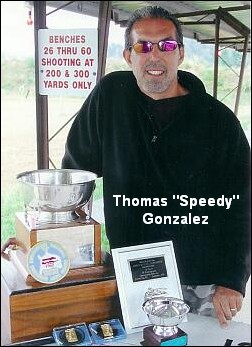
Experts Confirm That Barrel Speed-Up Is Common Two respected shooters have observed an increase in velocity with new barrels, typically after 100 rounds. Gunsmith and Hall-of-Fame benchrest shooter Thomas “Speedy” Gonzalez has documented barrel speed-up with testing. Moreover, Speedy’s bore-scope barrel inspections revealed a smoothing of the barrel lands. Jim See, a top PRS competitor, has encountered barrel speed-up many times. Accordingly, he re-tunes his load at 150 rounds.
“Alex Lipworth and I documented this phenomenon about four years ago and I have told all my customers about this. My son Mikee would shoot 100 rounds through all new barrels we planned on shooting before we would begin to do load development. We had a shooting snail that caught all the bullets set up in front of an indoor bench. We called it a wear-in process because upon careful examination of the bore when the ‘Speed Up’ takes place the cut-rifled bore resembles that more of a button-rifled barrels with the lands taking on more the softer look of a buttoned bore.” — Speedy Gonzalez
“Seen it [barrel velocity increase] too many times to count. All my match barrels get a ‘generic round’ loaded for them, which has worked well in barrels historically. After I hit 150 rounds I fine-tune the load and never look back, until the tube starts to slow down at it’s life end.” — Jim See
Well folks, it’s almost July — the means we’re moving into “peak heat” summer conditions. It’s vitally important to keep your ammo at “normal” temps during the hot summer months. Even if you use “temp-insensitive” powders, studies suggest that pressures can still rise dramatically when the entire cartridge gets hot, possibly because of primer heating. It’s smart to keep your loaded ammo in an insulated storage unit, possibly with a Blue Ice Cool Pak if you expect it to get quite hot. Don’t leave your ammo in the car or truck — temps can exceed 140° in a vehicle parked in the sun.
To learn more about how ambient temperature (and primer choice) affect pressures (and hence velocities) you should read the article Pressure Factors: How Temperature, Powder, and Primer Affect Pressure by Denton Bramwell. In that article, the author uses a pressure trace instrument to analyze how temperature affects ammo performance. Bramwell’s tests yielded some fascinating results.
For example, barrel temperature was a key factor: “Both barrel temperature and powder temperature are important variables, and they are not the same variable. If you fail to take barrel temperature into account while doing pressure testing, your test results will be very significantly affected. The effect of barrel temperature is around 204 PSI per F° for the Varget load. If you’re not controlling barrel temperature, you about as well might not bother controlling powder temperature, either. In the cases investigated, barrel temperature is a much stronger variable than powder temperature.”
Temp Strips allow shooters to monitor their barrel temperature. Excessive barrel heat can raise load pressures as well as shorten barrel life!
There is a new, ultra-high performance 7mm projectile for F-Open and long-range competitors. Berger has introduced a new 184gr F-Open Hybrid Target bullet, which will be the official 7mm bullet of the U.S. F-Open Rifle Team. The new 184-grainer is an advancement over previous 7mm match bullets. As you can see above, the new bullet is longer and sleeker than Berger’s existing 180gr Hybrid Target bullet. The new design gives the 184gr F-Open Hybrid impressive 0.695 G1 and 0.356 G7 Ballistic Coefficients. Compare that to 0.680 G1 and 0.349 G7 for Berger’s 180gr Target Hybrid bullet.
Bryan Litz of Applied Ballistics designed the new 184gr F-Open Hybrid to be slightly heavier, slightly longer, and have a more aggressive ogive shape. This gives the new 184-grainer a ballistic advantage over Berger’s existing 7mm 180gr Hybrid and VLD Target bullet designs. This bullet complements the .30 Cal 200.20X Hybrid Target bullet that was released last year in collaboration with the U.S. F-TR Rifle Team. As with that 200.20X bullet, for the new 184gr F-Open Hybrid, Berger took a successful, existing design and optimized the ballistic profile to make it even better. Along with .284 Win and 7mm SAUM used by F-Open shooters, this bullet should work well in a variety of 7mm cartridges.
New 184gr Hybrid Bullet Tested Extensively by U.S. F-Open Rifle Team
The U.S. F-Open Rifle Team tested the 184gr F-Open Hybrids thoroughly to ensure that they performed as well on target as they did in theory. The results were very positive, and this bullet has been adopted as the official 7mm bullet for the U.S. F-Open team. “The United States Rifle Team 2021 F-Open is extremely excited about the release of the new Berger 184gr F-Open Hybrid. Many members have tested the prototype bullets with outstanding success,” says Dan Bramley, Team Captain.
Note: On the Berger website, Berger lists a recommended 1:8″-twist rate for this new bullet. However, in its June 25, 2018 product announcement, Berger states the Minimum Twist Rate is 1:9″. MSRP is $61.99 per 100-ct box, Berger Part #28408. Grafs.com price is $54.99/box.
Berger says the bullet, which should be available very soon, will work in a variety of 7mm cartridges including: 7mm-08 Rem, .284 Win (and .284 IMP), 7mm SAUM, 7mm RUM, and 7mm Rem Mag.
Berger Supports U.S. F-Open Team — $1.00 Per Box
Berger states: “F-Class is one of the fastest growing precision rifle shooting disciplines, requiring the very best precision and accuracy to compete at the top levels. Berger has always been dedicated to making the very best bullets for our shooters. To help support the U.S. F-Open Team, Berger Bullets will donate $1.00 for every box of 7mm 184gr F-Open Hybrid bullets sold towards U.S. Team expenses for the upcoming 2021 F-Class World Championships in South Africa.”


 Top Overall U.S. Firearms Manufacturers in 2016






 Two respected shooters have observed an increase in velocity with new barrels, typically after 100 rounds. Gunsmith and Hall-of-Fame benchrest shooter Thomas “Speedy” Gonzalez has documented barrel speed-up with testing. Moreover, Speedy’s bore-scope barrel inspections revealed a smoothing of the barrel lands. Jim See, a top PRS competitor, has encountered barrel speed-up many times. Accordingly, he re-tunes his load at 150 rounds.


 To learn more about how ambient temperature (and primer choice) affect pressures (and hence velocities) you should read the article

 Note: On the


