American shooters have been enjoying Irish hospitality this week in Ireland, while attending attending the Emerald 2018 match at Midlands National Shooting Centre of Ireland (Tullamore). Our friends James Crofts, Phil Kelley, and Aussie Jenni Hausler provided these images from the event — both at the range and off. The Yanks are off to a good start. James reports: “Day one scores are out and Team USA is on top. Madison Bramley topped F-Open and I held on for F-TR. I also won the 1000-yard match. My equipment performed flawlessly — rifle built by Keith Weil of KW Precision, Cerus Stock by Will McCloskey, and BRM action by Jim Borden.”
American Phil Kelley posted: “As always our hosts are outstanding. Man, love this range! Ready for the big match starting tomorrow.”
Phil Kelley enjoyed the Team Match and long-range Clays Fun Match which preceded the main event. Phil posted: “A great day, with a busy line at 1100 and 1200 yards in Ireland. Last fun day included some great competition. Team USA did well. After getting completely destroyed at 1100 yards, I was able to win the 1200 yard match; with a miss! First ever board miss, it’s only 6’ wide. 12-14 mph winds with a lying, heavy mirage.”
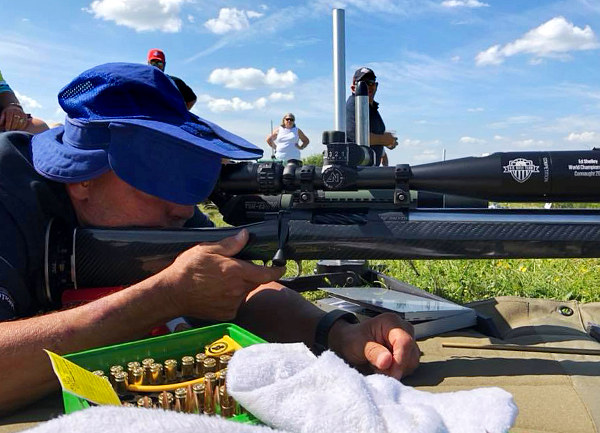
The day finished with a fun (and challenging) Clay Pigeon Shoot at roughly 1235 yards. Phil noted: “Ellis Berry, James Crofts and myself were one of only a handful to hit the 4.25″ clay target within 5 shots in these conditions.” Think you can do that? That 4.25″ clay bird represents a mere 0.338 MOA at 1200 Yards! Not easy folks…
Competitors in the Clay Pidgeon Shoot at 1200+ yards.
Posting on Facebook, Mias Nieuwoudt had an interesting observation about the challenge of 1200 yards: “On average it seems the old 308s ran out of steam compared to our F-Open rigs at 1200 yards. Maybe a 40° scope rail with the targets angled backwards at 30° so you can lob the points like mortars!”
Touring the Emerald Isle — Countryside and Castles
On June 5, Phil Kelley observed: “Another great group touring day. A morning stop at Donamass Castle ruins provided incredible Irish views, then on to the town of Kilkenny for the Smithwicks Brewery tour, visit to Kilkenny Castle and a walk on the Medieval Mile.”
Interior of Kilkenny Castle
Nancy Tompkins (left) and Michelle Gallagher (right) give a shout out to friends.
The American contingent — enjoying the good life in Ireland.
Facebook Photo Credits: Jenni Hausler, James Crofts, Phil Kelley, Pat Hunt, the Bramleys.
More than 200 shooters from around the country will make their annual pilgrimage to the home of the U.S. Army Marksmanship Unit this weekend as the week-long USA Shooting National Championships for Rifle and Pistol kick off Sunday in Fort Benning, Georgia. The National Championships start Sunday, June 10 and run through June 16. This event is free and open to the public.
This year’s National Championship will also be the first Nationals where the new ISSF shooting format will be in place, with men and women taking the same number of record shots in competition.
National titles and slots on the National/National Junior/National Paralympic Teams will be up for grabs as athletes compete in individual Olympic and Paralympic events in Rifle and Pistol disciplines, as well as Men’s and Women’s 50m Prone Rifle, Men’s 25m Center Fire and Standard Pistol and Men’s 50m Free Pistol. This match will also serve as the selection match for the 2018 International Shooting Sport Federation (ISSF) World Championships to be held August 31 – September 15 in Changwon, South Korea. Shooters who’ve already earned slots on the World Championship Team will be looking to Nationals as as a tune-up prior for the Worlds.
Among the notable Rifle athletes who will be competing in Fort Benning are three-time Olympic medalist Matt Emmons, 2016 Olympic gold medalist Ginny Thrasher, and two-time Olympian Michael McPhail of the USAMU. Emmons and Thrasher posted the top finishes for American Rifle athletes this year on the ISSF circuit. Emmons just missed the podium at the April 2018 World Cup in Changwon, finishing fourth in Men’s Three-Position Rifle. Thrasher finished fifth in Women’s Air Rifle at the World Cup in Fort Benning just three weeks ago.
Paralympic Competition Draws Shooters from Many Nations
In addition to the National Championships, this event is also a World Shooting Para Sport-sanctioned (WSPS, formerly IPC) match so Paralympic athletes from the U.S., Ireland, Canada, Ukraine and Columbia will also compete in this match across the Paralympic Rifle and Pistol events.
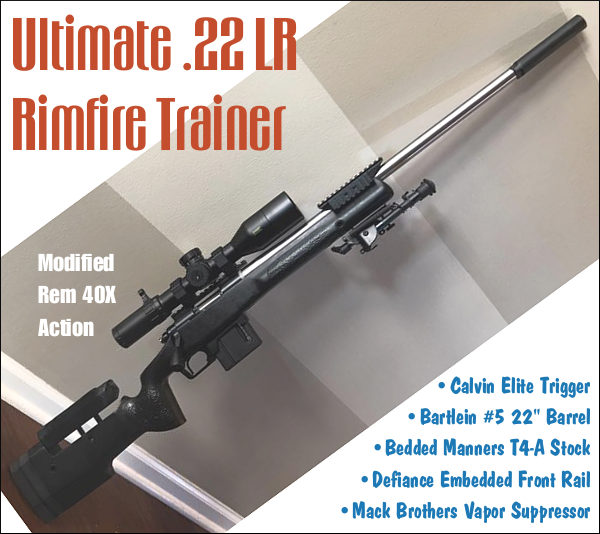
Brian, a gunsmith at GA Precision, built this rimfire rig with GAP colleague Anthony Soukup.
We’re seeing great interest in .22 LR rimfire tactical cross-training. With a rimfire rig, you can practice regularly for a fraction of the cost of centerfire training. That way you can build your skill set without breaking the bank. Decent rimfire ammo can be had for five cents a round. Compare that to fifty cents (or more) for handloads and maybe $1.00 per round for factory ammo.
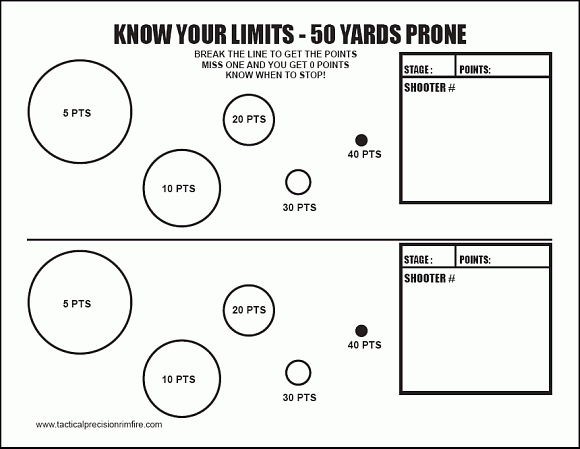
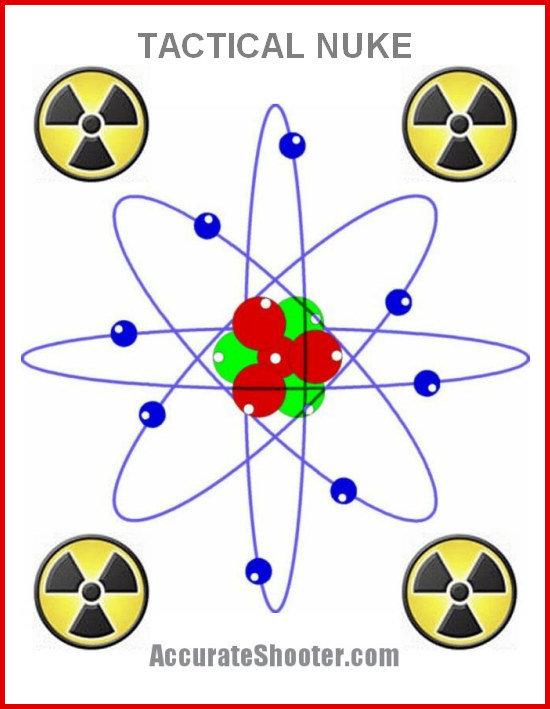
To help with rimfire cross-training, here are some of our favorite rimfire tactical targets, all in easy-to-print PDF format. Click each target image to download the FREE target. You’ll find more free targets for load development, precision practice, and fun shooting on our AccurateShooter FREE Targets Page
Aim Small, Miss Small
At 25 yards, this is a fun rimfire plinking target. At longer distances it can actually be a great training target for precision centerfire shooters.
Targets for Rimfire Training and Fun Matches
Here’s a rimfire training target with “big to small” target circles. Start with the largest circles, then move to the smaller ones in sequence. This systematic drill provides increasing challenge shot-by-shot. Novices often are quite surprised to see their accuracy improve as they move from bigger to smaller aiming points. That provides positive feedback — always a good thing.
Right Click and “Save as” to download printable PDF versions of target.
Rimfire Practice Targets
SPECIAL BONUS–Rimfire Tactical Precision Targets
These FREE targets by DesertFrog are offered in Adobe Acrobat format for easy printing. CLICK HERE to download all six targets as a .ZIP archive.
Vudoo V-22 State-of-the-Art Tactical Trainer
Some of the most talked-about .22 LR tactical trainers are being produced by Vudoo Gun Works. These rimfire rigs offer the size, weight and feel of real PRS rifles, though they shoot affordable .22 LR ammo. The 40X-style Vudoo V-22 action also feels and operates more like a full-size centerfire action than a typical skinny, rimfire receiver. This helps competitors translate rimfire practice to centerfire success.
The Vudoo Gun Works V-22 rimfire repeater action, arguably one of the best tactical rimfire actions available, owes its lineage to the respected Remington 40X action. Many rimfire matches have been won with 40X actions, so we understand why Vudoo chose that design for a starting point. Vudoo then added some important enhancements.
More Free Targets…
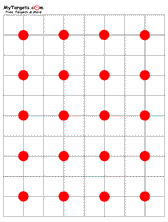
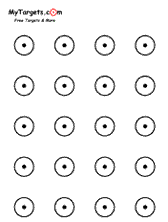
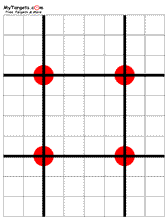
These and many other free targets are available at MyTargets.com.
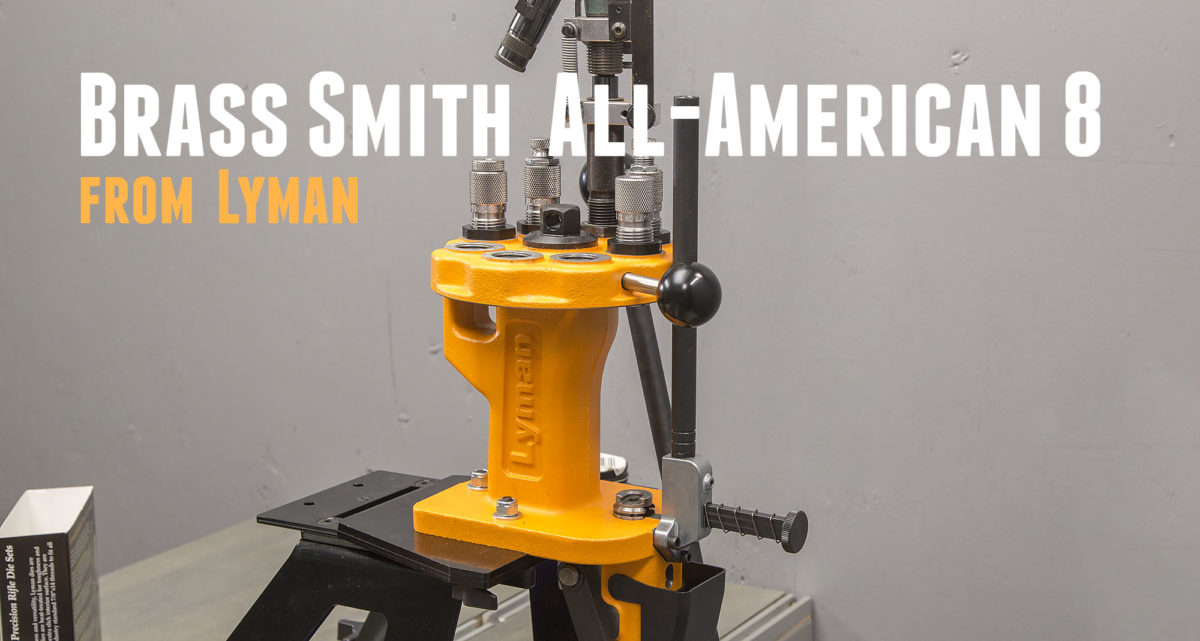
For 2018, Lyman has introduced a new 8-station turret press, the All American 8. There are two other new Brass Smith presses from Lyman — a compact C-Frame Ideal Press and a sturdy O-Frame Victory single-stage press that competes with the RCBS Rock Chucker. With its eight-station capacity, strong cast iron construction, we think the All American 8 will become popular. With a $195 street price, the 8-station Lyman is $100 cheaper than the 7-station Redding T-7. No question, that’s a significant price advantage, and we believe Lyman will take sales from Redding.
Our friend Gavin Gear of UltimateReloader.com got his hands on one of the new All American 8 presses, and he’s created an informative video showing press set-up and loading function. Gavin was excited to work with this beefy new turret press: “Why has this Lyman press been anticipated so highly since its announcement? A few reasons are: the 8-station capacity, cast iron construction, on-press priming system, ambidextrous design, and turret rear support for repeatable sizing and bullet seating. Plus, it’s made right here in the USA!” To learn more about the All American 8 turret press, watch Gavin’s video:
More Stations = More Reloading Options
Gavin said the press works well — he liked having 8 stations, because this offers more flexibility. With eight stations, you can have four two-die sets, or three two-die sets plus a dedicated decapping die and a powder measure. Gavin notes: “I’ve owned many reloading presses, including 3-station, 4-station, 5-station, and 7-station variants, but I’ve never owned an 8-station press until the Brass Smith All-American 8 came to the shop. I’ll have to say… you can’t get too many stations, especially on a manually-indexed turret. I love the idea that you can leave dies on the press, and load multiple calibers/chamberings using the same turret setup.”
Primer Function Works Well
Gaving also seated small and large primers using the on-press priming system. The Lyman All-American 8 turret press comes complete with all of the parts needed to seat both large primers and small primers. Gavin observed: “The All-American 8 loads quite well! Once I cleaned out the primer tube (always do that on a new press) the priming system worked perfectly, and I had no issues getting up to ‘full turret speed’ after getting into the groove.”
Why Use a Turret Press
This Editor has used a six-station RCBS Turret press for many years. I keep a dedicated decapping die on that press, as well as sizing and seating dies for pistol cartridges. My high-volume 9mm and .38 SPL reloading is done on a progressive press, but the RCBS turret allows me to have dies for two larger pistol chamberings — .44 Magnum and .45 ACP — at the ready. While we recommend single-stage presses for precision rifle reloading, the turret press offers great flexibility for handgun hand-loaders who shoot numerous cartridge types. And if having six die stations is good — having eight is even better. Advantage Lyman.
Do you enjoy working with computers? Have some experience designing and/or maintaining websites? Then here is an opportunity for you — the IBS needs a Webmaster. If you enjoy precision shooting, all the better. Through this part-time webmaster position, you’ll have a chance to work with one of the world’s top competitive shooting organizations, the International Benchrest Shooters (IBS).
The IBS organizes benchrest competition for short-range, mid-range, and long-range disciplines. Affialiated clubs are active through the nation. It’s an excellent organization, with a rich history, and a fine set of officers, lead by IBS President Jeff Stover.
IBS Webmaster Job Opening — Part-Time
The International Benchrest Shooters (IBS) is seeking a webmaster. This is a part-time position. Principal duties are to maintain the IBS website by posting submitted match reports, news items, match schedules, and other items. The IBS is launching a new site within 30 days built upon the PYRO CMS website management tool. The ideal candidate should have some experience maintaining websites. Knowledge of PYRO CMS or similar and html is a plus. Additionally, knowledge of IBS shooting disciplines is preferred. Salary is negotiable. Submit resumes to Jeff Stover, IBS President, at jstover33@comcast.net or call 570-660-6102.
Forum member Evan K. (aka “Katokoch”) has crafted a nice rimfire benchrest rig using a Suhl action fitted into a handsome home-built cedar and carbon fiber stock. This shows what a skilled hobbyist wood-worker can create in his garage. Evan tells us: “Here is my Suhl 150-1 with a factory 1:19″ twist barrel, Leupold 36X scope, Harrell tuner, and my handmade cedar/carbon fiber stock. I started working on the laminate blank a couple years ago and finally finished it earlier this year. I’ve been using it in my IR 50/50 matches this summer. I haven’t shot a 250 with it yet but I know the rifle is very capable — as usual, I am the weak link!”
We think Evan did a great job on his stock, though he has limited stock-building experience. Evan explained: “The stock is my first attempt at making a very lightweight laminate and also gluing both vertical and horizontal seams in a blank. The wood is Spanish and Red Cedar and I made the trigger guard and buttplate with carbon fiber too (great use for small scrap pieces). The finish is hand-rubbed spar urethane and the action is semi-glued-in with Devcon 10110 and stainless pillars.”
USRA-IR50/50 is a popular .22 rimfire benchrest discipline with three (3) classes: 13.5 lb., 10.5 lb., and 7.5 lb. (Sporter). The matches are shot at 50 yards and 50 meters.
GunsAmerica just released a detailed review of the recently-upgraded Kestrel 5700 Elite with LiNK, a software-enabled weather meter. If you compete in practical/tactical events (with targets at multiple distances), or campaign a wide selection of rifles, or shoot at Extreme Long Range, you may want to get this device. It offers unrivaled capabilities in a small package. This impressive handheld device combines weather-monitoring capabilities with a full-featured, very sophisticated ballistics solver that now calculates out to 5,500 yards. Using Bluetooth and LiNK technology it communicates with your mobile device as well as LiNK-enabled laser rangefinders.
Why You May Want to Buy the Kestrel 5700 Elite with LiNK:
— The Device can hold up to 30 different rifle/cartridge profiles, each with its own BC and muzzle velocity for ballistic calculations.
— The Device registers current windspeed, wind direction, air temp and pressure, and other variables, and then sends that info via Bluetooth to your smart-phone, updating the ballistic solution. It essentially updates your drop chart in real time.
— The Device “talks” to your smart-phone, providing a large, convenient display that can show both elevation clicks and wind corrections. The display essentially replaces your data card. The Smartphone integration also makes it easy to modify your different rifle/ammo profiles.
— The Device gives you come-ups and wind corrections for multiple targets (at various ranges). These can be displayed in a list, ordered by distance. This is a great feature, check it out:
Quick and Accurate Solutions for all Cartridge Types — Big and Small
The Kestrel 5700 Elite can work for everything from a .22 LR to a .50 BMG. In fact, GunsAmerica’s tester used the Kestrel 5700 for a 6.5 Creedmoor shooting out to 1070 yards, and then used the solver for a .22 LR match out to 300 yards. The data for the 6.5 CM was spot on, but even more remarkably, the holdover for the .22 LR was precise to 0.2 mils at 300 yards. The GunsAmerica Reviewer, Ian Kenney, was impressed:
“I think the best testament to the capabilities of the Kestrel 5700 Elite were on display at a recent range trip where I was getting my modified Ruger 10/22 ready for an upcoming precision rimfire match. I started out with a sort of hodgepodge of information, using an unconfirmed BC [for Eley Force ammo] that I’d heard from a friend along with a muzzle velocity that another friend had gotten with the same ammo. I created a new profile using this assortment of data and entered in target distances for 200 and 300 yards. Imagine the smile on my face then when I got hits at both distances with the elevation setting only being 0.2 mils off at the farthest target.
It’s impressive that the technology allowed me to only be 0.2 mils off with .22 LR ammunition at 300 yards, which is only about two inches, all the while starting out with imperfect data. If that’s not an exquisite demonstration of the versatility of this technology, to be able to toggle between such diverse calibers and get accurate data to long distances, I don’t know what is.”
Kestrel 5700 Elite Special Capabilities
The LiNK Ballistics App lets you set up multiple targets for single-screen viewing. The Kestrel 5700 Elite can also be wirelessly paired with LiNK-compatible laser rangefinders. Being able to instantly accees exact target range data allows a more rapid and and more precise ballistic solution.
In addition to the ballistics solver capabilities, the Kestrel 5700 Elite is a comprehensive weather meter that monitors all key variables including: wind speed and direction, temperature, humidity, heat index, pressure, and altitude. Your data log can be transferred to a iOS/Android device wirelessly with the LiNK wireless communication option and Kestrel LiNK app. The 5700 Elite now uses a single AA Battery housed separately from the circuit board.
More Features of the Kestrel 5700 Elite
The Kestrel 5700 elite has almost too many features to list. One notable capability allows you to quickly “tune” a profile by entering field-confirmed data. Kenney explains: “You can go into the gun profile and calibrate the muzzle velocity by telling it how much elevation you used to get a hit, effectively truing your dope in short order. This is ten times faster than logging it in your data book, going back to an online solver, and making adjustments[.]”
Ian Kenney’s Kestrel 5700 Elite Review is very thorough, and contains many more details and insights than we can cover here. For anyone considering purchase of a high-end Kestrel, we strongly recommend you read Kenney’s review. Ian concludes: “I’m not going to lie… with an MSRP of $699, I recognize [the Kestrel 5700 Elite] may not be for everyone. Considering how often I shoot long range and the number of rifles that I have, it makes sense for me[.] The Applied Ballistics solver also gives me the confidence that my dope is going to be accurate no matter what conditions I might find myself in. So for me… this Kestrel delivers the goods.”
Kestrel 5700 Elite Advanced Features (Partial List)
Kestrel LiNK Apps for iOS and Android
Wireless Bluetooth for Mobile Devices
Connects with LiNK Compatible Range Finders
Temperature Sensor (Patented External Isolated)
Integrated Applied Ballistics Calculator
Applied Ballistics G1/G7 Drag Model Profiles
Applied Ballistics Custom Drag Models
Average and Peak Wind Correction
Muzzle Velocity Calibration
Supports Mil, MOA Click Values
Create and store up to 30 Gun/Bullet Profiles
Create and store up to 10 Targets
Moving Target Lead Correction
Aerodynamic Jump Correction
High Angle Shot Correction
Target Range Estimator
Spin Drift Correction
MV-Temp Table
Digital Compass
Range Card
S&W Model 617 now has a 10-round cylinder, but early models were six-shooters.
While Accurateshooter.com concentrates on high-accuracy rifles, we know that many of our readers enjoy handguns. We are often asked “What is your favorite handgun — Glock? HK? SIG Sauer?” The answer to that question may be surprising. This Editor’s favorite handgun, at least the one that gets shot most often, is a rimfire revolver — that’s right, a wheelgun.
This Editor’s first really accurate handgun was a .22 LR Smith & Wesson Model 617 that could easily stack ten shots in a dime at 10 yards. It remains my favorite and most-used handgun. What can we say about the Model 617? The single-action trigger pull is superb, and the accuracy surpasses most any semi-auto rimfire pistol, except for a few, very expensive target pistols. We like the 6″ version for the longer site radius, but the 4″-barrel 617 is also very accurate, and it balances better.
We strongly recommend that new pistol shooters start off with a .22 LR rimfire handgun. The .22 LR cartridge is accurate but has very low recoil, less “bark” than a centerfire, and very little smoke and muzzle flash. New shooters won’t have to fight muzzle flip, and won’t develop a flinch from the sharp recoil and muzzle blast common to larger calibers. With the .22 LR, the trainee can focus on sight alignment, breathing, and trigger pull.
Smith & Wesson Model 617 Video Reviews
Here are three video reviews of the Smith & Wesson Model 617, both 4″-barrel and 6″-barrel versions. All three videos demonstrate the 617’s great accuracy. The reviewers concede that this handgun is pretty expensive, but all agree that the Model 617 will last a lifetime, and hold its value.
Hickok 45 Demos “Wonderful revolver”, a 4″ Model 617. See also Hickok 45 m617 Part 2:
Popular YouTube Host 22 Plinkster Tests Model 617 with 6″ Barrel:
22 Plinkster loves the Model 617, “one of his favorite revolvers in the whole entire world — a great choice”. He reports it “shoots straight [and] functions pretty much flawlessly” with nearly any .22 LR ammo. In this video, 22 Plinkster tests a wide variety of rimfire ammo types including CCI .22 LR Std Velocity, .22 Shorts, .22 LR Shotshells, .22 Stingers, .22 Super Colibri, and .22 LR tracers.
This Video Features the Smaller 4″-Barrel Model 617:
Other Rimfire Revolvers — from Ruger and S&W
If you’re considering a rimfire revolver but would like to see other options, read our Buyers Guide to Rimfire Revolvers. Along with the S&W Model 617, this covers the Ruger GP100 10-shot (5″ bbl), Ruger LCRx 8-shot (3″ bbl), Classic S&W Model 17 6-shot (blued 6″ bbl), and S&W Model 63 (3″ bbl).
TOP FIVE Reasons to Own a Rimfire Revolver:
1. Rimfire .22 LR Ammunition is once again plentiful and affordable. The revolver can shoot all kinds of rimfire ammo — even 22 Shorts.
2. A good, full-size .22 LR revolver will be MORE ACCURATE than the vast majority of semi-auto rimfire handguns. It will shoot all types of .22 rimfire ammo with no cycling issues. With no magazines to jam, a good wheelgun will also be more reliable than most self-loading rimfires.
3. A rimfire revolver can shoot tens of thousands of rounds, with just routine maintenance. The gun can last a lifetime and then be passed on to your kids.
4. On a S&W revolver, it is very easy to tune the pull weight. You can have a safe double-action pull with a very light, crisp single-action release.
5. It is easy to change grips and sights to suit your preference. You can also easily mount a scope on the top-strap.
Recommended .22 LR Revolver Training Targets
The .22 LR cartridge makes small bullet holes in paper. These can be hard to see if you’re shooting at large, black bulls-eyes, particularly at an indoor range. Also, when shooting rimfire, you’ll go through ammo quickly. For that reason we recommend targets with bright-colored, multiple aiming points.
The 19″x25″ Sight-Seer target (left) is great for pistol practice. It features eight red bulls on a 1″-square grid. Ultra bright fluorescent red inks, printed on heavy, 60-lb vellum paper, are highly visible, even indoors. You can use a classic Six O’Clock hold with this target, putting the bottom of each circle on top of your revolver’s front sight.
The smaller, 8.5″x11″ Sinclair Fluorescent Sight-In Target (right) also works well. It has four small diamonds surrounding a large center diamond overlaid on a 1-inch grid. Diamonds and grid are printed in fluorescent red/orange on white, heavy-grade paper so your shots print nice and clean.
Recommended .22 LR Ammo Box
When we go to the range with rimfire handguns or rifles we bring this handy $9.99 MTM ammo caddy. The compact carry case will hold boxed ammo, plus you can lay out your ammo in 10-round rows. This makes it easy to fill the 10-Rd cylinder on your Model 617. This ammo case is offered in both blue (as shown), or red.
The National Shooting Sports Foundation (NSSF) has published a Q & A Page about FFL transfers and other FFL-related matters. The NSSF’s experts provide answers to common questions to ensure that neither FFLs nor their customers get caught in regulatory traps. Here are some of the recent questions and answers:
1. Purchase of Firearm by Parent for Child.
Q: May a parent or guardian purchase firearms or ammunition as a gift for a juvenile (under 18 years of age)?
Yes. However, possession of handguns by juveniles (less than 18 years of age) is generally unlawful. Juveniles generally may only receive and possess handguns with the written permission of a parent or guardian for limited purposes (e.g., employment, ranching, farming, target practice or hunting), and that permission slip must be carried by the juvenile while possessing the handgun. [18 U.S.C. 922(x)]
2. May an FFL Transfer a Firearm by Way of a “House Call”?
Q: I have an elderly customer who cannot leave his home. I have a gun in my store that he wants to buy. Can I go to his house, have the Form 4473 completed, call for a background check and deliver the gun to him, providing that all the background checks clear?
A: Federal Firearms Licensees (FFLs) are required to conduct business from their licensed “business premises.” The Form 4473, Part 1, is for an over-the-counter transaction. The buyer must appear in person at the FFL premises. Licensees may not conduct firearms transactions from locations other than their licensed premises, with the exception of gun shows or other events dedicated to the sporting use of firearms and held in the state where the FFL’s premises is located. An FFL who locates purchasers by other means must complete the transaction and all required paperwork at the business premises indicated on the FFL’s license.
3. Can the Spouse of a Transferee (Buyer) Pick Up a Firearm?
Q: A customer filled out a Form 4473 on a shotgun. The NICS background check reply was delayed, but the following day NICS approved the purchase. The customer could not get back to my store during open hours, however, so he sent his wife to pick it up. May I transfer the shotgun to her?
A: The shotgun may not be transferred to the customer’s wife, as she is not the intended transferee. The customer must return to the store himself and complete the ATF Form 4473 to receive the firearm. He must recertify that his answers in section A are still true, correct and complete by signing and dating Section C on the ATF Form 4473.
4. What Is the Procedure for an Older Firearm with No Serial Number?
Q: I have received a firearm on trade. It was made before 1968 and has no serial number. I must note the physical markings on the firearm in my records. What do I do in this case?
A: Unfortunately, marking requirements that existed before 1968 did not apply to all firearms. Many of the firearms manufactured and imported prior to 1968 bear no serial numbers or other markings. Licensees who receive these firearms should note in each descriptive column in the acquisition record the physical markings that appear on the firearms. If no serial number was placed on the firearm, it should be specifically noted that “Firearm has no serial number” or recorded “NSN.” Remember, however, it is illegal to remove or alter a firearm’s serial number, and a licensee should report such a firearm to the nearest ATF office. Refer to the ATF P 3317.2, Safety and Security Information for Federal Firearms Licensees.
5. What Should Be Done if an FFL Finds a Firearm That Was Previously Reported Lost?
Q: I’ve reported a lost firearm. I’ve done all the necessary paperwork and notifications. Now, I’ve found the firearm. What is my course of action?
A: FFLs who report a firearm as missing and later discover its whereabouts should advise the ATF, as well as their local law enforcement agency, that the firearms have been located. The ATF can be contacted at 888-930-9275. In addition, once the firearms are located, they must be re-entered into the Acquisition and Disposition (A&D) record as an acquisition entry.
Sinclair International has created a series of helpful articles on rifle cartridge reloading. Today’s feature lists ten basic steps for precision hand-loading, with links to longer, detailed Sinclair Int’l technical articles providing more complete information. There’s a lot of helpful info here guys, if you click all the links to access the ten “long form” articles.
Tying It All Together: 10 Steps To Precision Handloads
Feature based on article by Roy Hill, Brownells/Sinclair Copywriter
Sinclair International offers a series of detailed articles on hand-loading precision rifle ammunition. The articles are included in Sinclair’s GunTech Articles Archive, but sorting through the index to find each article takes time. To help you access all these articles quickly, here’s a handy summary of ten key topics, with links to longer articles covering each subject in detail.
Part 1: The first step in making high-quality handloads is to carefully choose the best brass for your application. You need to know how to identify the different types of brass and how to choose the best kind for the ammo you want to load. CLICK HERE for Part 1.
Part 2: Even high-quality brass can have burrs around the flash hole that can interfere with the primer flame and cause inconsistent ignition – which can lead to shot groups opening up. Flash hole deburring is a critical step in making sure primers ignite powder consistently. CLICK HERE for Part 2.
Part 3: The next step is to make sure the primer pockets are square and uniform. Like flash hole deburring, primer pocket uniforming may reduce variations in primer ignition by ensuring more consistent primer seating. CLICK HERE for Part 3.
Part 4: Making sure all your cases are precisely the same length is crucial, especially when you use cases that have been fired before. Case trimming is the way to get there. CLICK HERE for Part 4.
Part 5: After trimming, cases still have to be resized. In order for them to work through the resizing die, they have to be lubricated. The case lube method you choose is crucial to making precision handloads. CLICK HERE for Part 5.
Part 6: Now it’s time to choose the dies that will resize your cases. There are several important options to consider in selecting the right sizing dies. CLICK HERE for Part 6.
Part 7: Wait! You’re not quite ready to start sizing yet. There’s yet more to consider before you start cranking cases through the press. Learn more about setting up and adjusting your sizing dies. CLICK HERE for Part 7.
Part 8: Once the cases are completely prepped, it’s time to start putting fresh components back into them. We start off by seating primers. CLICK HERE for Part 8.
Part 9: After the primers are seated, it’s time to drop in the powder. There are several tools that will help you handle powder for precision handloads. CLICK HERE for Part 9.
Part 10: The final step in the process is carefully seating the bullet to just the right depth. And then… you’re ready to try your loads at the range. CLICK HERE for Part 10.














 The
The 


