Here is some serious Sunday “gun glamour” from the folks at Star Shooter Precision, a bipod-builder and stock-maker based in Montreal, Canada. This stunning .308 Win F-TR rifle features a carbon-wrapped Star Shooter stock, angle-adjustable tubular bag-rider, star-shaped escutcheons, and a Kelbly Panda action. Up front is Star Shooter’s signature lightweight bipod.
Click Each Image for Large, Full-Screen Version
About the Rifle Builders Star Shooter Precision is a company located on the south shore of Montreal, Quebec, Canada. Fred Harvey is the designer. Fred says: “Our goal is to perfect the art of competition shooting the best we can with our custom bipods. The Star Shooter bipod is designed for shooters in F-Class competition, varmint hunting, load testing, tactical shooting and sighting in rifles.”
Looking for authentic U.S. Military Specification Standards (MIL-STD) for gun parts, safety products, or other hardware? Log on to EverySpec.com. This website provides FREE access to the complete archive of U.S. Government spec sheets and technical manuals. You can quickly access and download thousands of public domain U.S. Government documents. For example, we searched for “Picatinny” and came up with MIL-STD-1913 “Dimensioning of Accessory Mounting Rail for Small Arms Weapons”. With one click we downloaded the file as a PDF. Then a search for “M118″ yielded the engineering drawing for 7.62×51 M118 LR Match ammo. Pretty cool.
Using EverySpec.com is fast and easy. And everything you find and save is FREE. Search as often as you like — there are no limits on search requests or downloads. You can either search by keyword, or Federal Supply Class Code (FSC). CLICK HERE for a complete list of FSCs for all products.
Here are FSCs for a few common product types. Keep in mind that there are hundreds of other FSCs — for everything from Office Supplies (FSC 7510) to Nuclear Projectiles (FSC 1110).
1095 — Miscellaneous Weapons (incl. Knives) 1240 — Optical Sighting and Ranging Equipment 1395 — Miscellaneous Ammunition (incl. Small Arms) 3455 — Cutting Tools for Machine Tools 6140 — Batteries, Rechargeable 6230 — Electric Portable Lighting Equipment 7640 — Maps, Atlases, Charts and Globes 8340 — Tents and Tarpaulins 8405 — Outerwear, Mens
Credit Gunsmith Thomas ‘Speedy’ Gonzales for finding this resource. Thanks Speedy!
“A big congratulations to Bob Mead (1582-68X), who utterly destroyed the competition in tricky wind conditions to take the Gold.” — Jay Christopherson, 2017 F-Open Nationals Second Place.
In this 15-minute video, Team Lapua’s Erik Cortina interviews Robert Mead, the 2017 LR F-Open Champion. Robert (Bob) discusses his wind reading techniques with Erik, and the newly-crowned F-Open Champ explains how to set up a reliable wind zero. Bob also discusses cartridge choices in F-Open. He admits the straight .284 may be the tightest grouping 7mm cartridge, but he has used the 7mm RSAUM for a decade now. He believes the RSAUM may the best cartridge for 1,000 yards in 7mm, all things considered (grouping ability, ballistics): “To me it’s a light magnum, it’s capable of high speed, yet burns less powder than your regular magnums. [But] it’s a finicky cartridge — you’ve got to do a fair amount of load development.”
Every serious F-Class competitor should watch this video start to finish:
Credit Erik Cortina for video and the photo of Robert Mead with trophy above.
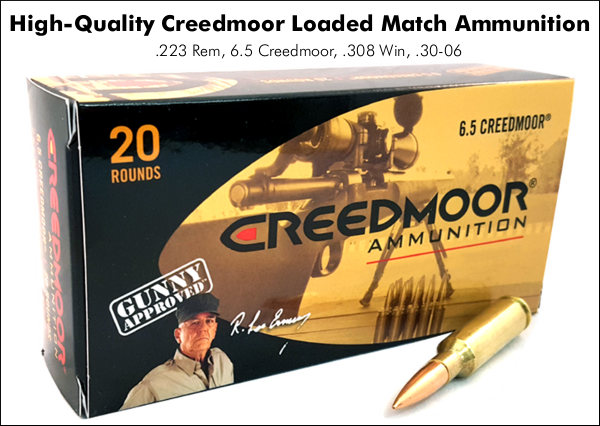
You may not know this, but Creedmoor Sports sells very high-quality loaded ammunition crafted with top-quality bullets and premium-grade Lapua brass for .308 Win and .30-06. We have friends who have shot some of this ammo in .223 Rem and .308 Win, and it is very impressive. The 6.5 Creedmoor ammo is capable of winning PRS matches outright. Creedmoor’s rifle cartridge match ammunition includes:
.223 Rem: (55gr FMJ, 68gr HPBT, 69gr TMK, 75gr HPBT, 77gr TMK) 6.5 Creedmoor: (140gr HPBT Hornady, 140gr HPBT Nosler, 142gr Sierra — all Hornady brass) .308 Win: (155gr, 167gr, 168gr Sierra, 175gr all in Lapua Brass; also precision hunting in other brass) .30-06 Springfield: (167gr Lapua Scenar HPBT in Lapua Brass)
Use Coupon Code CS929 to receive Free Ground Shipping on orders over $99!
Oh, the beauty of it — all that Lapua brass. From Finland with love….
What does 13,005 pounds (6.5 tons) of powder look like? That would last most reloaders a few seasons. Hoarders, eat your hearts out….
Sometime it’s fun to take a break from competition and just go out plinking with family members. During plinking sessions, you can try out a variety of non-standard targets — these “fun targets” create more interest, especially with youngsters. Here are six FREE fun targets from the NSSF. These (and other examples) can be downloaded as PDF files for easy, scalable printing. Shown are six fun targets: Alien, Goofy Gopher, Orange Clays, Fish in a Barrel, Cans on Fence, or Bacon Xs. To download any of the targets, right click and “Save Link As”. You can also click on the six targets and they should open up in most browsers if you have the PDF reader installed. Have Fun! MORE Targets HERE.
Orange Clays
Fish in a Barrel
Cans on Fence
Bacon Xs
Download FREE Bullseye Targets Too
The NSSF also offers conventional bullseye-style targets on the NSSF Targets page. Here are two, high-contrast printable targets. With five (5) bullseyes per sheet, these are good for load development. They also work well at short range for pistol shooting.
British Lee-Enfield Model SHT’22/IV Rifle, courtesy www.iCollector.com.
Our friend Dennis Santiago was a technical advisor for History Channel’s Top SHOT TV show. One of the notable Top Shot episodes involved the “Mad Minute”, a marksmanship drill practiced by the British Army in the decades preceding World War I. Dennis observed that the Top Shot competitors didn’t fare too well in their “Mad Minute” attempts, not scoring many hits in the alloted one-minute time period. That prompted Dennis to give it a try himself — seeing how many hits he could score in one minute with an authentic Lee-Enfield rifle. So, a while back, Dennis ran the drill at a range in California.
Dennis, an active high power rifle competitor and instructor, enjoyed his “Mad Minute” exercise, though he assures us that this takes practice to perfect. Dennis tells us: “Here is a ‘Mad Minute’ drill, done using a period correct Lee-Enfield (SMLE) No.1 Mk III rifle and Mk VII ammo. I got to the Queen’s Regulations (15 hits in one minute) on the second run and put a good group on the target at 200 yards. This is ‘jolly good fun’ to do every once in a while. This is ‘living history’ — experiencing a skill from a time when the sun never set on the British Empire.”
“Mad Minute” was a pre-World War I term used by British Army riflemen during training at the Hythe School of Musketry to describe scoring a minimum of 15 hits onto a 12″ round target at 300 yards within one minute using a bolt-action rifle (usually a Lee-Enfield or Lee-Metford rifle). It was not uncommon during the First World War for riflemen to greatly exceed this score. The record, set in 1914 by Sergeant Instructor Alfred Snoxall, was 38 hits. (From WikiPedia.)
Want to See More “Mad Minute” Action with a Modern Tubegun?
In 2012, Gary Eliseo ran a “Mad Minute” exercise using a modern, .308 Win Eliseo RTM Tubegun of his own making. Gary ended up with 24 hits on a bull target set at 300 yards. (Gary actually had 25 hits in 25 rounds fired, but the last round hit just after the 60-second time period expired.) Note how Gary pulls the trigger with the middle finger of his right hand. This allows him to work the bolt faster, using his thumb and index finger. CLICK HERE for Eliseo Tubegun Mad Minute story.
Watch Gary Elesio Shoot the ‘Mad Minute’ (Starts at 4:47 on Video)
NOTE: In an interesting coincidence, Dennis Santiago was actually in the pits pulling targets for Gary during Eliseo’s 2012 “Mad Minute” exercise.
History of the Mad Minute Commentary by Laurie Holland
The original military requirement of the “Mad Minute” saw the soldier ready to fire with a round in the chamber, nine in the magazine, safety on. This course of fire is still followed by the GB Historic Breechloading Arms Association and other bodies in their recreated “Mad Minute” competitions.
The first 10 would go quickly, but reloads were critical, this not done by a magazine change as Gary did with the RTM or in a modern tactical or semi-auto rifle, but through slick use of ‘chargers’. It is this aspect which fouls so many of my colleagues up as it is very easy to cause a jam and a large part of 60 seconds can go in sorting it out!
Charger clips were selected for those that just held the rounds firmly enough to stop then falling out, were sand-papered and polished with a stove / fireplace polish called ‘Zebrite’ so that the rimmed rounds would slip through the clips like corn through a goose.
If you’re unfamiliar with the cock-on-closing Enfield action, it seems clumsy. With intensive practice it is very smooth and can be operated incredibly quickly. The trick is to whip the bolt back onto its stop and initiate a rebound movement that takes it and the cartridge well into the chamber thereby reducing the effort required to close the bolt and chamber the round.
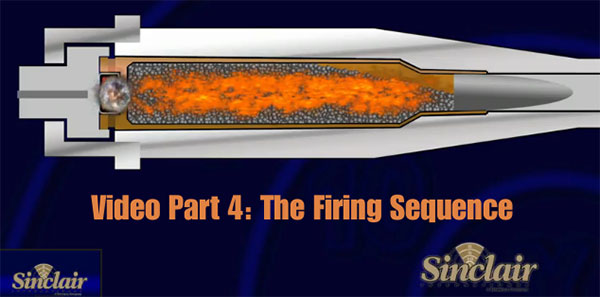
Sinclair International has produced an eight-part video series on metallic cartridge reloading, hosted by Sinclair’s former President Bill Gravatt. The entire series can be viewed (for free) via Sinclair’s YouTube Channel. While this set of videos starts with the basics, it covers many more advanced aspects of reloading as well. Accordingly, both novice and experienced reloaders can benefit from watching the eight videos. We think everyone should watch Video No. 2. Introduction to Reloading Safety, which provides guidelines for safe reloading practices.
Watch Firing Sequence Video
We also strongly recommend Video No. 4 to readers who are getting started in reloading. This “How Things Work” segment covers the sequence of events inside the chamber (and barrel) when the cartridge is fired. The video includes helpful graphics that show what happens to the primer, powder, cartridge, and bullet when the round is fired. The video also illustrates “headspace” and explains how this can change after firing. We think this video answers many common questions and will help reloaders understand the forces at work on their brass during the firing process.
Do you really know (and understand) the gun laws in your home state? Do you know when the use of deadly force is allowed? Do you know if the “Castle Doctrine” applies in your state or whether your state has a “Stand Your Ground” law in effect? If you ever carry a firearm for self-protection, you should know the answer to these and other important questions. Thankfully there are some excellent, up-to-date resources that explain the gun laws in five key states: Colorado, Florida, Oklahoma, Pennsylvania, and Texas. These gun law treatises, published by U.S. Law Shield, provide the text of important gun laws, along with expert commentary from experienced attorneys. The books provide clear explanations of gun laws in easy-to-understand language.
Gun Law Seminar Programs in Eleven States
In addition to its Gun Law books (offered for five states), U.S. Law Shield conducts legal seminars in 16 states across the country: AR, CO, FL, GA, KS, MD, MO, NC, NJ, OH, OK, PA, SC, TN, TX, and VA. At these Gun Law Seminars, you can ask questions and get state-specific answers from Law Shield Independent Program Attorneys in each jurisdiction. CLICK HERE to find a seminar in your state.
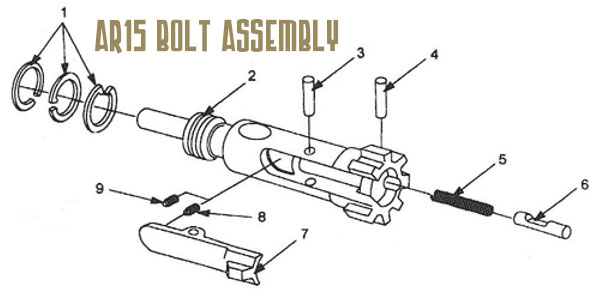
We call them “black rifles”, but that shouldn’t refer to all the carbon and gunk on the inside. AR-platform rifles can be maintenance-intensive beasts. But some AR owners make the situation worse by not regularly cleaning important small parts, or by using too much oily/greasy lubricants in the wrong places. A properly maintained and lubricated AR15 can shoot hundreds of rounds (between cleanings) without a problem. If you learn where (and where not) to apply lubricant, you’ll find that your AR will run more reliably and the task of cleaning the bolt and bolt carrier will be less of a burden.
Here is a good video that explains AR-15 Cleaning and Maintenance. In this 30-minute NSSF video, Gunsite Academy instructor and gunsmith Cory Trapp discusses the proper way to clean and maintain the AR-15 carbine. Very knowledgeable, Trapp provides rock-solid advice for AR owners. Along with cleaning producedures, this video explains how to inspect key components and how to function-test your AR before each shooting session.
2017 IBS 1000-Yard Benchrest Nationals Report By Boyd Allen
On September 1-4, the IBS held its 2017 1000-yard Benchrest Nationals at the Whitehorse Shooting Center in Peeltree, West Virginia. There was a great turn-out this year, with 118 entries in Light Gun Class (17-lb limit, 5 shots per target) class and 107 shooters in Heavy Gun Class (Unlimited weight, 10 shots per target). The conditions this year were challenging to say the least, with rain storms, spiraling winds, and fog. In fact, rain and fog on Saturday (with cancelled relays) caused the Nationals to be extended by one day through Monday, September 4th. What’s more, of the 107 shooters listed in the Two-Gun Overall results who actually shot both guns, there were dozens of DQs. (Yes, the wind was a bit tricky at this year’s Nationals.)
Sam Hall, past IBS Shooter of the Year, provided this image and most of the photos in this report.
Congratulations to the “top guns” at the Nationals: Edward Kenzakoski (Two-Gun Overall Champion), Mike Gaizauskas (Light Gun Overall, plus LG Score Agg), and Mike Brennan (Heavy Gun Overall, plus HG Score Agg). Group Agg winners were Richard Schatz for LG, and Charlie Lentz for Heavy. Two ladies also deserve mention. Sally Bauer shot the smallest group of the match, a 1.923″ 5-shot group in LG — that’s 0.184 MOA! Ruth Edwards drilled a 2.104″, also mighty impressive. Nice shootin’ ladies…
White Horse Wind and Weather Factors — and Topography
The firing line for the 1000-yard range has a covered structure with 14 well-spaced masonry benches with block bases and cast concrete tops. Facing southwest, the firing line is above the land between it and the target butts, which are at the head of a canyon. There is a low area with trees on the left with an elevated flat area on the right.
This topography create unpredictable wind patterns that can change rapidly with no warning. Those changes can wreak havoc with competitors’ groups and scores. The wind direction at the targets can be opposite that at the firing line, with the result that a let-off down range not only carries the penalty of making a hold-off incorrect, but because the wind at the firing line can continue, adding the additional penalty of a reversal. This was the common cause of disqualifications, which were numerous at this year’s Nationals.
Light Gun and Heavy Gun Equipment Lists (Partial Sample):
Barrel-Block Heavy Gun with a handsome wood stock. Wide fore-ends enhance stability.
Delay Caused by Fog and Rain
On Saturday, rain and fog delays, caused the match to be extended through Monday. The rules dictate that if a full match cannot be finished because of weather, then all of the day’s results are discarded. This meant that even those shooters who completed their relays on Saturday had to shoot them over — hence another day was added to the event. Because of the prospect of worsening conditions on Saturday afternoon, even though there was daylight left, the decision was made to extend the match through Monday.
Profile of 2017 IBS 1000-Yard National Champion Edward Kenzakoski
Commenting on his performance at the Nationals, Ed said modestly:
“I didn’t shoot really good. I just shot better than them other guys.”
Winning Hardware (with a 110-lb Heavy Gun)
Notably, Ed does all of his own gunsmithing, and he built his Championship-winning rifles. Both guns featured 1:11″-twist, 30″ Krieger barrels. (LG: 1.250″ shank and .950 muzzle; HG: 2″ contour untapered). Ed’s Light Gun has a BAT action, no barrel block, Jewell trigger, and McMillan Tooley MBR stock. His Heavy Gun boasts a 10″-long BAT action in a two-piece aluminum stock with barrel block. That HG beast weighs 110 pounds! Both of Ed’s rifles (light and heavy) wore Nightforce 12-42x56mm BR scopes.
Winning Numbers
To win the Two Gun Overall, Ed posted 137 LG Score, 262 HG Score, and 399 Two-Gun Score Agg. His Group numbers were: LG Group 5.659, HG Group 7.483, Two-Gun Agg: 6.571.
Winning Loads and Reloading Methods
Both rifles are chambered in 300 WSM. Ed shoots 210gr Berger VLDs (sorted every way possible), with Norma brass, Hodgdon H4350 powder, and CCI BR2 primers. For the two guns he used very different seating depths — barely touching for the HG, 0.100″ jump for the LG. He said that it takes him a full four days to load the ammunition for both rifles for a match. Yes, he weighs primers, and he even passes his bullets through a .309 bushing.
No Dark Horse at White Horse — Kenzakoski is a Proven Winner
One shouldn’t be surprised at Edward Kenzakoski’s success. Ed really cleaned up at Williamsport this year, winning one 6-match Aggregate and two 10-match score and group Aggregates. He also established a new Williamsport club Light Gun record of 3.2″.
Last year’s winner Tom Mousel sitting at the bench on Sunday. Tom finished third overall this year.
Record-Setting Asymmetry
In 2016 Michael Gaizauskas set the current 1000-yard IBS Heavy Gun (10 shot) group and score records. He set those records with the rifle on the left (below), then chambered in 6.5×47 Lapua. In this match, Mike won LG Group and LG Overall with the rifle on the right as chambered in his own 7mm short magnum wildcat. Mike designed and built both these distinctive assymetric stocks.
Prizes and Gift Certificates Galore at White Horse
The prize table at the IBS 1000-yard Nationals was impressive, with many scopes and stocks as prizes, plus a treasure trove of gift certificates:
White Horse Shooting Center Facilities, Organization, and Location
The 1000-yard range used at the IBS 2017 Nationals is part of a large shooting facility run by Whitehorse Firearms Outdoor Education Center in cooperation with the West Virginia Division of Natural Resources. White Horse is located off of Route 20 near the small community of Peeltree, WV. The nearest town of any size, ten miles to the south, is Buckhannon, WV, which has about 5600 residents.
White Horse Geography and Climate
The White Horse range is set in wooded hill country, with lots of creeks and some smaller rivers all kept green and running by an annual rainfall of about 48 inches and about the same for snowfall. To my eyes it is beautiful county, pleasingly rural and lush, in marked contrast to where I live where every plant must be served by some sort of irrigation.


 About the Rifle Builders






 Lee-Enfield No. 4 Rifle (1943), courtesy