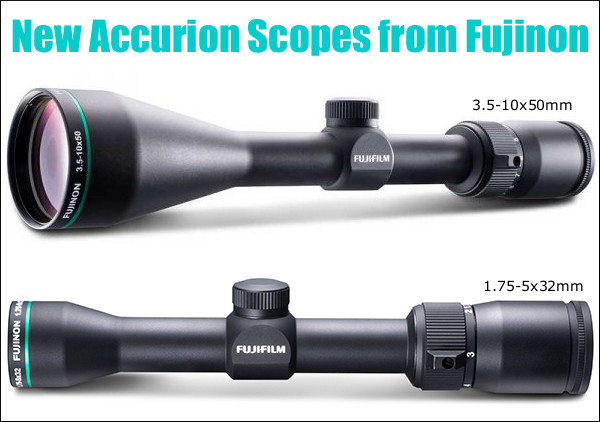
Fujinon (a division of FujiFilm) is already a major producer of binoculars, broadcast/cinema lenses, and customized precision optics. Parent FujiFilm is also a world leader in the digital camera market. Now the technical expertise of FujiFilm and Fujinon will be applied to a series of lightweight, affordable riflescopes — the new line of Accurion Sport Riflescopes by Fujinon.
We think it’s good that Fujinon is jumping into the rifle optics market. The more competition the merrier. FujiFilm has very high design and engineering capabilities, and we expect the entry of Fujinon into the sport optics market will encourage other scope makers to offer more attractive pricing. The first series of Accurion scopes will be extremely affordable — the highest magnification option, a 4-12x40mm scope, retails for just $189.99. Watch out Burris, Bushnell, Leupold, Nikon, and Weaver.
There are four new Accurion scopes, all featuring 1″ main tubes, 1/4-MOA click values, and multi-coated optics with 95% light transmission. The notable quality of all Accurion scopes is light weight — they weigh up to 10% less than other leading brands. That’s good news for hunters. Two reticle types will be offered initially: Standard Plex or BDC (bullet drop compensation). All Accurion scopes are backed by FujiFilm’s Limited Lifetime Warranty. CLICK HERE for detailed Specifications.
Fujinon Accurion Sport Riflescopes:
• 1.75-5x32mm Plex ($169.99) or BDC ($179.99)
• 3-9x40mm Plex ($179.99) or BDC ($189.99)
• 3.5-10x50mm Plex ($219.99) or BDC ($229.99)
• 4-12x40mm Plex ($189.99) or BDC ($199.99)
Hall of Fame Class of 2017 — Ed Etzel (top left, WVU photo); David Kimes (top right, USAMU photo); Don Haldeman (bottom left, NRA photo); Martin Gunnarsson (bottom right, USAMU photo).
USA Shooting Hall of Fame Inductions
Four outstanding American marksmen will be inducted into the U.S. International Shooting Hall of Fame on August 26th in Colorado Springs, CO. Ed Etzel, David Kimes, Martin Gunnarsson and Don Haldeman will be the largest group of inductees since the first distinguished class in 1991. Each of these four shooters served in the U.S. Army and shot with the USAMU. The Hall of Fame Induction Ceremony will coincide with the USA Shooting alumni reunion and Biennial Coach Conference.
ED ETZEL
Etzel won the Gold Medal at the 1984 Olympics in Los Angeles in the Men’s English Match Rifle event and was a gold medalist in the 1978 World Championships and 1979 Pan American Games. He was 11-time National Champion and set numerous national rifle records as a member of the U.S. Shooting Team. Later, Etzel coached the WVU Rifle team from 1976-89, with a 101-3 career coaching record. He coached over 30 WVU All-Americans and guided his teams to four NCAA National Championships during the 1980s. He was an active duty officer in the U.S. Army Medical Service Corps for nearly three years during the Vietnam War and subsequently for 10 years in the U.S. Army Reserves.
DAVID KIMES
Kimes earned 14 World Championship medals (team & individual) during his career. A five-time World Team member from 1966 to 1986, Kimes is the only U.S. shooter to win an individual World Championship (1974) while setting a World Record and then repeating the same feat in the next World Championships (1978). He was selected as a 1980 Olympian but was unable to compete due to the U.S. boycott of the Games in the USSR. Reflecting on his induction, Kimes quoted Thoreau: “Our truest life is when we are in our dreams awake.” He reflected back on his last shot of the 1974 World Championships in Switzerland, the cheering of over a thousand Swiss fans as he connected on his final shot for a perfect string of 100, resulting in a world record and title of world champion. MARTIN GUNNARSSON
Gunnarsson won the bronze medal at the 1968 Olympic Games in the 300m Three-Position Rifle event and was a Pan American and World Championships medalist during his distinguished career. His Pan American medals were both gold and were won in team events at the 1959 and 1963 Pan Am Games 00 in the English match and free rifle event, respectively. At the 1966 World Championships, he also won a gold medal in the free rifle team event. In addition, both free rifle team performances (in 1963 and 1966) earned him a share of the world record.
DON HALDEMAN
A two-time Olympian who competed in the 1972 and 1976 Olympic Games, Haldeman earned an Olympic gold medal in 1976 in Men’s Trap. Haldeman was a member of the gold-medal winning 1973-74 U.S. World Championship Team. He was also a member of the 1975 U.S. Pan American Games Team, winning individual silver along with a team gold medal. He remains the last U.S. team member to earn Olympic gold in Men’s Trap.
About the USA Shooting Hall of Fame
The U.S. International Shooting Hall of Fame was established in 1991 by the NRA International Competitions Committee. Selection is focused on marksmen who excelled in international competition over an extended period of time, and who have been retired from active international shooting at least five years. Living USA Shooting Hall of Fame members and USA Shooting Board of Directors nominate candidates and then join with USA Shooting alumni in voting on the final nominees.
Helpful “How-To” Maintenance Videos from BAT
BAT Machine’s website features an extensive Video Archive with a selection of helpful videos for custom action owners. Among BAT’s collection of videos, you’ll find informative clips covering about bolts, ejectors, action maintenance, and other technical matters. Here are two examples:
How to Grease and Maintain Your BAT Action and Bolt:
”
How to Remove (and Re-Install) Firing Pin Assembly:
More Helpful Information on the New BAT Website
One thing that people might easily miss is the large spreadsheet that details the specs of all BAT Machine actions. To download that .xlsx spreadsheet to your hard drive, Right Click (and “Save As”) this link: ACTION CONFIGURATION PART LIST. After opening the spreadsheet, on the “ACTION” worksheet, you’ll find action model, body shape, weight, bolt faces available, and tenon spec among several other items. Note that there are two worksheet tabs (look down at the bottom left). Use these spreadsheet tabs to switch between “Action” and “Accessories”.
Also, on the BAT website FAQ page, you’ll find prints for barrel tenon machining, firing pin sizes, torque specs, and tons of other very helpful info. This is well worth a look. — ELR Researcher.
Story Tip from Boyd Allen and EdLongrange. We welcome reader submissions.
“Science tells us that exposure to continuous noise of 85 dB for eight hours is enough to cause permanent hearing loss, and worse, spikes of 130 dB and more can result in permanent hearing damage instantly.” Source: NRA Blog.
The Risk of Hearing Loss
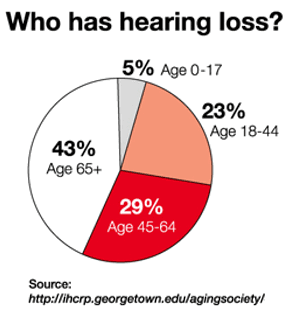
Hearing loss can be progressive and irreversible. If you are a shooter, this is serious business. As the NRA Blog cautions: “You may not even realize you’re harming your hearing. Hearing loss occurs gradually, and can go effectively unnoticed until symptoms become severe. By then, the damage is done.”
Nobody wants to go deaf. But we often see shooters without effective hearing protection when they are walking around a few yards behind the firing line. That’s bad — even if you are away from the firing line, gunshot noises can damage your hearing. You MUST use effective hearing protection every time you go to the range. Good foam earplugs costs mere pennies but they can prevent deafness in your later years. Many folks also wear muffs over plugs.
Sound Levels for Common Noises:
9mm Luger pistol: 160 dB
Jet aircraft engine (near): 140 dB
.22 LR pistol: 134 dB
Normal human pain threshold: 120 dB
Noisy Nightclub: 110 db
Riding Motorcycle at 65 mph: 103 db
Power Lawnmower: 95 dB
Hearing damage possible: 85 dB (sustained for 8+ hours)
Ringing Telephone: 80 dB
Normal conversation: 60 dB
The Myth of the “Quiet” .22 LR
The NRA Blog notes that “many rimfire shooters, particularly those using the beloved .22 Long Rifle cartridge, argue that the small .22 LR caliber doesn’t produce enough sound to damage your hearing”. So, is that really true … or is it a myth?
In fact, a .22 LR can be much louder than you think — a .22 LR pistol can produce sound levels of 134 dB. That’s well above the normal human pain threshhold.
Highest Protection NRR 34dB-Rated Ear Muffs
For under $20.00 you can buy quality ANSI-approved muffs with a 34dB Noise Reduction Rating — the best you can get. Chose the Bright Yellow TR Industrial Muffs at $13.48, or the dark green Walker EXT Range Muffs for $13.99. Both products have padded head-bands which retract. If you prefer “basic black”, consider the $14.85 ClearArmor Muffs, Amazon’s #1 Best Seller among safety earmuffs.
Howard Leight MAX NRR33 Earplugs, Just $7.39 for 50 Pairs.
20 Pairs
50 Pairs
These Howard Leight NRR33 Max plugs are your Editor’s favorite foam earplugs. Between shooting, motorcycling and mowing lawns, I probably have Max plugs in my ears 2-3 days a week. This is a very good price for a bulk pack of 50 pairs. And if you act soon, you can get free shipping to boot.
The movie “The Patriot” gave us the phrase “Aim small, miss small”. While that’s a good mantra, aiming strategies for long-range competition are a bit more complicated, as this article explains…
The The F-Class World Championships (FCWC) in Canada are just one week away. This August 11-17, the world’s top F-Class shooters will gather at the Connaught Ranges outside Ottawa, Ontario. Here are some tips that can help F-TR and F-Open shooters aim more precisely, and achieve higher scores. F-Class ace Monte Milanuk reviews reticle choices and strategies for holding off.
In our Shooters Forum, one newcomer wanted some advice on selecting a reticle for F-Class optics. He wondered about the advantage of Front (first) Focal Plane (FFP) vs. Second Focal Plane scopes and also wondered if one type of reticle was better for “holding off” than others.
In responding to this question, Forum regular Monte Milanuk provided an excellent summary of aiming methods used in F-Class. For anyone shooting score targets, Monte’s post is worth reading:
Aiming Methods for F-Class (and Long-Range) Shooting — by Monte Milanuk
F-Class is a known-distance event, with targets of known dimensions that have markings (rings) of known sizes. Any ‘holding off’ can be done using the target face itself. Most ‘benefits’ of Front (first) focal plain (FFP) optics are null and void here — they work great on two-way ranges where ‘minute of man’ is the defining criteria — but how many FFP scopes do you know of in the 30-40X magnification range? Very, very few, because what people who buy high-magnification scopes want is something that allows them to hold finer on the target, and see more detail of the target, not something where the reticle covers the same amount of real estate and appears ‘coarser’ in view against the target, while getting almost too fine to see at lower powers.
Whether a person clicks or holds off is largely personal preference. Some people might decline to adjust their scope as long as they can hold off somewhere on the target. Some of that may stem from the unfortunate effect of scopes being mechanical objects which sometimes don’t work entirely as advertised (i.e. one or two clicks being more or less than anticipated). Me personally, if I get outside 1-1.5 MOA from center, I usually correct accordingly. I also shoot on a range where wind corrections are often in revolutions, not clicks or minutes, between shots.
Some shooters do a modified form of ‘chase the spotter’ — i.e. Take a swag at the wind, dial it on, aim center and shoot. Spotter comes up mid-ring 10 at 4 o’clock… so for the next shot aim mid-ring 10 at 10 o’clock and shoot. This should come up a center X (in theory). Adjust process as necessary to take into account for varying wind speeds and direction.
Others use a plot sheet that is a scaled representation of the target face, complete with a grid overlaid on it that matches the increments of their optics — usually in MOA. Take your Swag at the wind, dial it on, hold center and shoot. Shot comes up a 10 o’clock ‘8’… plot the shot on the sheet, look at the grid and take your corrections from that and dial the scope accordingly. This process should put you in the center (or pretty close), assuming that you didn’t completely ignore the wind in the mean time. Once in the center, hold off and shoot and plot, and if you see a ‘group’ forming (say low right in the 10 ring) either continue to hold high and left or apply the needed corrections to bring your group into the x-ring.
Just holding is generally faster, and allows the shooter to shoot fast and (hopefully) stay ahead of the wind. Plotting is more methodical and may save your bacon if the wind completely changes on you… plotting provides a good reference for dialing back the other way while staying in the middle of the target. — YMMV, Monte
It’s good to see an ammo-maker step up to help the shooting sports. ELEY Ltd. has recently made significant investments in .22LR rimfire benchrest and competition segments within the USA. ELEY has partnered with the American Rimfire Association (ARA) and Professional Shooting League (PSL) to help promote and expand rimfire benchrest shooting, one of the fastest growing .22 LR rimfire competition disciplines worldwide. The ARA and PSL competitions are leading rimfire benchrest organizations within the United States. ELEY’s financial and logistical support will help the ARA and PSL grow the ranks of rimfire benchrest shooters.
Here’s a record-setting rimfire benchrest rifle owned by our friend Joe Friedrich who competes in ARA matches, primarily using ELEY .22 LR Tenex ammo.
ARA was started in April 1998 by a group of .22 LR shooters who wanted an organization for competitive .22 LR benchrest competition. In 2010, ARA started to transition to what it has become today, with the unique goal of continuing the vision of the ARA founders by providing an honest competitive organization that is true to .22LR shooting.
PSL was founded as a benchrest organization for the true precision shooting professional. With the growth of rimfire benchrest, there was a need to have a professional organization to which shooters would be compensated for their hard work, training and competition success.
Image from National Rimfire Benchrest Association of Ireland (NRBAI)
Among .22 LR rimfire disciplines, benchrest shooting represents the “pinnacle of precision” — the very highest level of accuracy is needed to succeed. As such, ELEY has identified the need to help expand this growing sport. “This support by ELEY will help us bring .22 LR benchrest to the forefront of shooting competitions,” says Dan Killough, Director of ARA & PSL. “The expansion of [rimfire] benchrest … gives shooters a platform to enjoy and participate in rimfire competition that previously may not have been available to them,” stated Mike Corkish, ELEY Director of North America Sales.
Here’s a cool (but expensive) new product that can benefit both recreational and competitive shooters who need to haul a lot of gear to the range. The NRA’s new Tactical Rolling Range Bag is an all-in-one transportation and storage solution. Fitted with a half-dozen pistol cradles, the range bag can also be adapted to hold rifle accessories such as spotting scopes, ear muffs, rear bag, MagnetoSpeed chronograph, ammo boxes, magazines, cleaning kit, and more. There are special sections for ammo and it even has a special velcro-attached target holder.
The NRA tells us: “This mobile armory travels effortlessly from your home, to your car and to the range, thanks to its 3.5″-diameter wheels and reinforced carry handle. The exterior boasts a dedicated compartment for eight pistol magazines, and there’s a pocket (with two cups) for collecting spent brass. The patented Visual ID Storage System features easily identifiable pockets for eye and ear protection, targets, stapler, tape and binoculars.” Color: Coyote. Dimensions: 23” W x 15” D x 17” H.
• Integrated, six handgun rigid foam rack
• Thick, padded top flap holds firearms securely
• Heavy-duty YKK zippers with cord pulls
• Rigid, internal frame
• Oversized, 3½” diameter ATV wheels
• Three position telescoping handle
Priced at $229.95, this fancy Rolling Range Bag ain’t cheap, but when you consider your investment in guns and accessories, this may be a smart solution for many shooters.
2017 USA Smallbore Silhouette Champion | 2017 USA High Power Silhouette Champion
2017 Canada Smallbore Silhouette Champion
We don’t know if there is an official “Lady Rifle Shooter of the Year”, but we would nominate Silhouette shooter Cathy Winstead-Severin, based on her amazing shooting so far this summer. Cathy has delivered some truly dominant performances recently. In mid-July, competing at the Ridgway Rifle Club in PA, Team Lapua’s Cathy Winstead-Severin won the 2017 Hunter Rifle NRA Smallbore Silhouette Championship. Cathy scored 110/120 to win her 20th NRA National Silhouette title. Then Cathy went on to win both the Standard and Hunter High Power Rifle Silhouette National Championships.
With those victories, Cathy completed a clean sweep of Smallbore (Rimfire) AND High Power (Centerfire) awards — a stunning achievement. Cathy was using Lapua cases, VihtaVuori powder, and a combination of Lapua and Berger bullets to win her 21st and 22nd National Silhouette Titles.
More Glory Across the Border — Cathy Wins in Canada Too!
Less than three weeks after her wins at the USA National Silhouette Championships, Team Lapua’s Cathy Winstead-Severin ventured north and won the Canadian NFA National Smallbore Silhouette Championship. After the match she also hosted a very informative clinic for other shooters. Congratulations Cathy Winstead-Severin. You have our vote for Lady Shooter of the Year. We also thank Team Lapua for providing support for major Silhouette Championship events.
Creedmoor Sports has released a series of helpful “how-to” videos in its new InfoZone web page. In the latest InfoZone video Bill Gravatt shows how to seat bullets using L.E. Wilson Hand Dies and an Arbor Press. The basic process is simple, particularly with a micrometer-top seating die. That makes it easy to adjust and set seating depth. Before you start seating bullets, you want to adjust the height of the arbor so the stroke is appropriate to the height of your die.
Bill Gravatt Shows How to Use Hand Seating Dies — Creedmoor INFOZONE
ARBOR PRESS TECHNIQUE: When using an arbor press, smooth is good. You don’t want to slam the handle down quickly. Try to repeat the same motion each time. You can also experiment by seating the bullet part way, then rotate the cartridge (in the die) and do the final seating with a second stroke. If your arbor press has a force gauge, note both the max value of the gauge needle and how it moves as you seat the bullet. If the needle spikes too rapidly, or bounces back and forth irregularly, set that cartridge aside and/or mark it. You could have neck tension issue with that case or some other fault. You might even have a bad bullet. That’s rare, but can happen. The key to success is moving the press arm in a smooth motion every time, maintaining the same down-pressure with each cartridge.
Here Bill Gravatt Offers a Simple Tip for Adjusting Wilson Seating Dies
One of our Forum readers asked “How can I get a custom in-line seater for my new rifle?”. First, we would say that, if you are not shooting an unusual Wildcat, check first to see if L.E. Wilson makes a stainless Micrometer Seater Die for your rifle. These dies are a joy to use, and we’ve found the fit to be exceptionally good with many calibers. Typically priced from $90-$100, Wilson stainless micrometer-top seaters are available for dozens of cartridge types: .204 Ruger, 20 BR, .222 Rem, .223 Rem, 22 PPC, 22 BR, .22-250, .223 WSSM, 6 PPC, 6mmBR, 6XC, 243 Win, .243 WSSM, 25 WSSM, 6.5×47 Lapua, 6.5 Creedmoor, 6.5-284, 26 Nosler, .270 WSM, 7mm-08, .284 Win, 28 Nosler, 7mm RUM, 30 BR, 30 IHMSA, .308 Win, .300 WinMag, .338 Edge (and MORE).
If you do want a custom seater die, the process is relatively simple. Purchase a die blank from Wilson and have your gunsmith run the chambering reamer in. Forum member Gunamonth explains: “I start with a Wilson seating die blank. They’re available from Sinclair and other vendors. Just run the reamer in. For some of my rifles, where I wanted the stainless die with the micrometer adjustment, I bought a smaller die and had the smith ream it with the chamber reamer. That’s how I had my 6 Dasher and 6mm AI seaters made. With the Dasher I stared with a 6mmBR Micrometer die.”
SEATER STEM TIP: If, on your seated bullets, you are seeing a sharp line around the jacket near the ogive, you may want to smooth out the leading edge of the Wilson seater stem (see above left). Do this by putting a little lapping compound on one bullet and manually spin this around in the stem. Without much effort you’ll have a smooth bullet/stem interface.
Micrometer Top Add-on
We really like micrometer tops on a seating die. But what if Wilson doesn’t make a micrometer top seater for your chambering? Don’t despair, Sinclair Int’l sells a $39.99 micrometer top that can be added to Wilson standard seaters or to a custom seater die made from a Wilson die blank.
The F-Class World Championships (FCWC) in Canada are just one week away. This August 11-17, the world’s top F-Class shooters will gather at the Connaught Ranges outside Ottawa, Ontario. The vast majority of F-Open shooters will be running some kind of 7mm (.284 Caliber) cartridge, with the .284 Winchester, .284 Win Improveds, and 7mm RSAUMs being popular.
For those of you who plan to compete but who haven’t loaded your ammo yet, you may want to consider a very good 7mm match bullet from Sierra, 183 grain MatchKing (item #1983). We have found the 183gr MK, which comes “pointed” from the factory, to be very consistent in weight and base-to ogive measurement. Top F-Open shooters have told us that these bullets shoot exceptionally well, with minimal vertical dispersion at 1000. “Holding waterline” at long range is a reliable indicator that the BC is very uniform from bullet to bullet.
Sierra’s popular 7mm 183 grain MatchKing boasts an impressive 0.707 G1 Ballistic Coefficient (BC) at 2300+ fps. These bullets also have very consistent bullet-to-bullet BC, thanks to very uniform jackets and the tips being “pointed” at the factory. Sierra explains: “A final meplat-reducing operation (pointing) provides an increased ballistic coefficient for optimal wind resistance and velocity retention.”
Insight Into Sierra’s New 7mm MatchKing® by Sierra Product Development Manager Mark Walker
In late 2015, Sierra introduced a new 7mm MatchKing® bullet with a different type of ogive. As part of the introduction, I had the opportunity to use them at the F-Class Nationals held in Phoenix with very good results. While at the match, several people had questions about what exactly was different about the ogive on this bullet as opposed to our tried and true blended tangent ogive. So with that in mind, hopefully this blog will answer those questions.
In the past, Sierra has typically used a tangent radius ogive design on our MatchKing® bullets. This is one of the most forgiving ogive designs due to its ability to shoot extremely accurately when jumped, as well as, jammed into the rifling. On rare occasions, some of our MatchKing® bullets have used a secant ogive due to design constraints. However, this ogive is much more sensitive to changes in seating depth than the tangent ogive so we tend to shy away from it. When we decided to work on this new bullet, we wanted to see if we could improve on the accuracy of even our best shooting tangent ogive bullets.
One of the main factors of what makes an accurate shooting bullet is how it aligns itself with the bore when fired. If a bullet is slightly crooked when entering the bore, it will cause inaccuracy on the target. We set out trying to think of ways to make sure that the bullet has no choice but to align itself with the bore perfectly.
The first part of the barrel to encounter the bullet is the leade in the chamber. The leade is an angle that is cut into the leading edge of the rifling which helps to guide the bullet into the bore. To illustrate how current bullets fit into the leade, picture a cone (leade) with a ball (bullet) sitting inside it. The ball can be rotated in all directions and the cone cannot force the ball to orientate itself in any particular direction. When a bullet with a radius encounters the leade, it behaves in a similar way. Now this of course is a very simple example and of course advanced shooters use tight necks and brass that is perfectly formed to the chamber to make sure the bullet is aligned as perfect as possible. However, there is always a small element of misalignment that is possible even with all this precise preparation.
This brings us to the ogive on the new 7mm MatchKing®. We thought instead of using the typical ogive radius that can allow slight misalignment, why not use the same straight angle that is used in the chamber leade on the bullet ogive to force itself to always align with the bore? Imagine the same cone as above (leade) with an identical cone (bullet) sitting inside of it. The cone inside has no choice but to align itself perfectly with the cone that it is sitting in every time. With that in mind, we designed the area of the bullet which contacts the leade in front of the bearing surface using a straight 1 1/2 degree angle instead of the typical radius. Once past that area, we use a traditional high caliber ogive radius to provide a very sleek, high BC bullet.
I hope that explains our thought process behind this new bullet. In our testing, it is one of the most forgiving high-BC bullets we have ever made.




 The Risk of Hearing Loss


 F-Class is a known-distance event, with targets of known dimensions that have markings (rings) of known sizes. Any ‘holding off’ can be done using the target face itself. Most ‘benefits’ of Front (first) focal plain (FFP) optics are null and void here — they work great on two-way ranges where ‘minute of man’ is the defining criteria — but how many FFP scopes do you know of in the 30-40X magnification range? Very, very few, because what people who buy high-magnification scopes want is something that allows them to hold finer on the target, and see more detail of the target, not something where the reticle covers the same amount of real estate and appears ‘coarser’ in view against the target, while getting almost too fine to see at lower powers.
 Others use a
 It’s good to see an ammo-maker step up to help the shooting sports.


 One of our Forum readers asked “How can I get a custom in-line seater for my new rifle?”. First, we would say that, if you are not shooting an unusual Wildcat, check first to see if


