Otis has released a new line of advanced, American-made chemicals designed to bring next-generation protection to any kind of firearm. Featuring a broad variety of cleaners, lubricants, protectants and CLPs, the Otis Smart Chemical product line offers formulas for any kind of shooter — from 3-Gun competitors to hunters and tactical professionals to gun collectors.
Video Covers All Otis Smart Chemicals — Cleaners, Lubricants, Protectants:
Formulated to the exact specification of Otis engineers and designed with intelligent application in mind, most Otis Smart Chemicals are biodegradable and available in liquid or aerosol form (as well as in grease and CLP wipes). A precision applicator pack is compatible with all liquid formulas to deliver a greater level of precision during the application process. Visit www.otistec.com/cleansmart to explore the full line or buy your Otis Smart Chemicals online.
For cleaning tasks, Otis offers a specific series of dedicated cleaning products. These combine excellent cleaning capabilities with biodegradable chemistry.
The nation’s top pistoleros are headed to Missouri this month to compete in the 2017 NRA Bianchi Cup, the most prestigious action pistol match of the year. The 2017 Bianchi Cup event, also known as the National Action Pistol Championship, will be held May 24-27, 2017 in Columbia, Missouri at the Green Valley Rifle & Pistol Club.
The format will be changed slightly for the 2017 NRA Bianchi Cup. The Multi-Gun Aggregate has been reinstated on Tuesday, May 23; signup for the Aggregate will be online only, capped at 44 competitors. The Championship consists of a “Match X” and the “Championship Final”. Each round is the aggregate of the four (4) following fired events: Practical, Barricade, Falling Plate and Moving Target Events. Match X will be conducted over 3 days, Wednesday, 24 May through Friday, 26 May 2017. CLICK HERE for official Program Guide. Send questions to bianchicup@nrahq.org or call 703-267-1452 for the NRA Bianchi Cup Coordinator.
Check out this “Sizzle Reel” from the 2013 NRA Bianchi Cup:
About the Bianchi Cup
The Bianchi Cup is the NRA National Action Pistol Championship, a major tournament held every May in Columbia, Missouri. The premier action pistol championship, the Bianchi Cup boasts the largest purse of any tournament on the action pistol calendar. The Bianchi Cup is the only major shooting tournament that has retained its original Course of Fire since its inception. The Course of Fire consists of four separate matches:
The Practical Event: From the appropriate shooting line, the shooter fires at distances from 10 yards to 50 yards under varying time limits.
The Barricade Event: From within shooting boxes and behind barricades, a shooter fires at targets on either side of the barricade at different distances and under varying time limits.
The Falling Plate Event: From the appropriate shooting line, the shooter fires at 8 inch round steel plates arranged in banks of six at distances from 10 to 25 yards under varying time limits.
The Moving Target Event: From within shooting boxes at distances ranging from 10 to 25 yards, the shooter fires at a target moving from left to right with the target being exposed for only 6 seconds.
Due to the high accuracy required in each stage of the Bianchi Cup, the tournament is widely considered one of the most difficult handgun championships on the planet.
Report by Kristina Holden
Even with a bit of snow left on the ground, some great long range shooting took place up in Montana recently. March 25th, 2017 was opening day for the first 1000-yard IBS match of the year at Montana’s Deep Creek Shooting Range, just outside of Missoula, Montana. With temperatures during both matches at a consistent low to mid 40s and winds blowing at a slight 2-4 mph from the south, the weekend was sure to produce some excellent results.
Framed by forested hills, the Deep Creek Range is a beautiful place to shoot.
Fifteen (15) shooters braved the cool Montana spring weather for what would turn out to be a very competitive match. On Saturday, both Richard Schatz and David Torgerson made the first Light Gun (LG) shoot-off, posting two-inch groups, with Richard taking the win (check out his targets above). David and Richard made it into the Heavy Gun (HG) shoot-off as well, this time with David taking the win. Leo Anderson took the LG score crown with a 47, while Shawn Williams took the HG title with a perfect 100.
Here Scott Stanko sets up his Light Gun. Scott won Sunday’s LG shoot-off.
Sunday’s conditions were even better and the shooters took advantage of them. Once again, some truly excellent groups were shot by Tom Mousel and Scott Stanko, both making the LG shoot-off with 2 inch groups. Scott, shown above, prevailed in the shoot-off. Richard Schatz, once again, made his way into the shoot-offs and took the HG win from Tom Mousel with a 4.889″. Jeff Reed took the HG score win over Leo Anderson with a 96. In the LG Score shoot-off, Jim Williams nailed a real stunner of a group, taking the Score win with a 2.018” – 49. Check out the group below. That sure would have helped his Aggs if it happened in the relay!
Jim Williams with his 2.018″- 49 group. That works out to 0.19 MOA — amazing accuracy at 1000 yards.
New Cartridge Debuts — the 6mmBR Ackley Improved (6mm BRA)
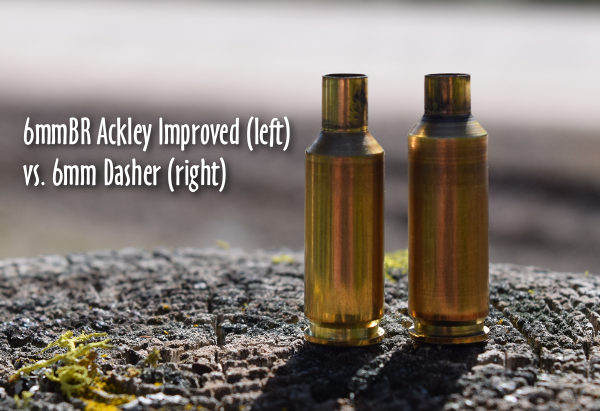
The 2017 season has brought some new gear/cartridge developments and many shooters were able to put them to good use in the first match of the year at Deep Creek. Leo Anderson and Tom Mousel were both shooting the new 6mm BRA (6mmBR AI), a 6mmBR Norma with a reduced body taper and a 40 degree (40°) shoulder. Fire-forming is as simple as turning the necks and shooting, as the factory 6mmBR case will headspace in the AI chamber. Sizing with a 6mm Dasher die with .080″ turned off the bottom is the ticket. Tom Mousel, reigning IBS 1K Champ, “believes this case to have a little wider tune window and far less throat wear”. That means this case might be easier on barrels. For Tom’s 6mm BRA with 28” Krieger barrel, the accuracy node is about 2980-2990 fps, so this gives up only 30-50 fps compared to typical Dasher velocities. Both of Tom’s HG groups held in the 3s for vertical, proving the 6mmBR Ackley’s accuracy potential.
Vapor Trail Bullets and Deep Creek Tracker Stock
Tom Jacobs at Vapor Trail Bullets has been working with a new die for his excellent 6mm 103gr Vapor Trail bullet. Four of the weekend’s competitors were shooting bullets off the new Vapor Trail die. The new die seems to be producing a bullet every bit as good as the old die, maybe even better. Several groups in the 2s (two inch) were shot this weekend. As well as Richard Shatz’s impressive 3.671″ 10-shot group in Heavy Gun (see top of this article).
Finally, the new Deep Creek Tracker 4″-wide stock is becoming a favored option, with half of the competitors at the match shooting these stocks from Wheeler Accuracy. That extra inch in the stock’s fore-end seems to be provide more stability and less rocking on the front rest when opening and closing the bolt. Also, the adjustable tracking rudder makes for perfectly parallel tracking surfaces, an absolute “must have”.
The weekend ended with the sun finally breaking through the clouds. Competitors enjoyed some great grilled Polish dogs with all the fixings prepared by Mark and Angie Candau; who also shot in the match. There were plenty of smiling shooters with awards/prizes for their efforts. It was a great opening match of the season!
Here are the Top Guns at the match: Dave Torgeson, Jim Williams, Jeff Read, Shawn Williams, Richard Schatz, Leo Anderson, Lonnie Anderson, and Tom Mousel.
Deep Creek is one of America’s best 1000-yard shooting centers — many records have been set here.
We have always liked Tikka actions, and now there is a great re-barreling option for Tikka T3 owners. Criterion Barrels Inc. (CBI), makers of “pre-fit” barrels for Savage, Remington, and Rem-clone actions, will soon be offering Tikka pre-fits. These pre-chambered barrels for Tikka T3 actions will be headspaced with a barrel nut, just like a Savage.
Click image for full-screen version
The new Tikka T3 pre-fit barrels will be sold through Solid Accuracy, a respected Texas-based outfit that sells high-end scopes, stocks, barrels and other rifle components. Criterion tells us: “The Solid Accuracy barrel nut and wrench design has been finalized, the prototype barrels tested and the barrel nuts are now going through production (with an expected ETA of 2-3 weeks). All orders for these pre-fits barrels are currently heading out to the shop floor for production. Orders placed this week can expect a conservative estimated lead time of 14-16 weeks.”
The accuracy has been impressive with Solid Accuracy’s test rifle, which features a Tikka T3 action mounted in a KRG X-Ray chassis. This prototype rifle is chambered in 6.5 Creedmoor. The group below was shot with a stout load of H4350 and Sierra 140 grain MatchKings seated .009″ in the lands.
The folks at Criterion are excited about the Tikka pre-fit project: “We’re looking forward to getting these barrels out the door and on to some custom rifle builds.” One of Criterion’s staffers was so impressed with the initial test results that he is building his own T3 project, with a Criterion pre-fit of course…
In recent years, Forster Co-Ax® presses have been somewhat hard to find, as demand has out-stripped supply. However, right now Grafs.com has Co-Ax presses in stock, at just $299.99 — that’s six percent off the regular price. This sale price includes a set of jaws, and includes ground shipping (in the lower 48), after a single $7.95 (per order) handling fee. If you’ve been hankering for a Co-Ax press, now is definitely a good time to buy.
If you are not yet familiar with the many unique features of the Forster Co-Ax, we recommend you watch the video embedded below. This shows how the press operates and highlights the design elements which set the Co-Ax apart from every other reloading press on the market.
Video Shows Special Features of Forster Co-Ax Reloading Press
Forster Co-Ax Press Video Review
This is a very thorough review of the Forster Co-Ax done by Rex Roach. This 14-minute video shows the key Co-Ax features, explaining how the floating case-holder jaws work (3:30 time-mark), how the dies are held in place (4:40 time-mark), how spent primers are captured (6:10 time-mark), and how to set the primer seating depth (10:00 time-mark). We’ve used a Co-Ax for years and we still learned a few new things by watching this detailed video. If you are considering purchasing a Co-Ax, definitely watch this video start to finish.
The Co-Ax case-holder features spring-loaded, floating jaws. These jaws have two sets of openings, small and large. This allows the system to adapt to various rim diameters. The jaw plates can simply be reversed to switch from small jaw to large jaw. In the photo above, the Co-Ax is configured with the large jaw openings in the center.
Seating primers is kind of a “dark art”. Many top shooters prefer to seat “by feel” using a hand tool. Others prefer bench-mounted tools that offer higher work-flow rates — with a good bench tool you can prime more cases in a given amount of time, plus it’s easier on the hands.
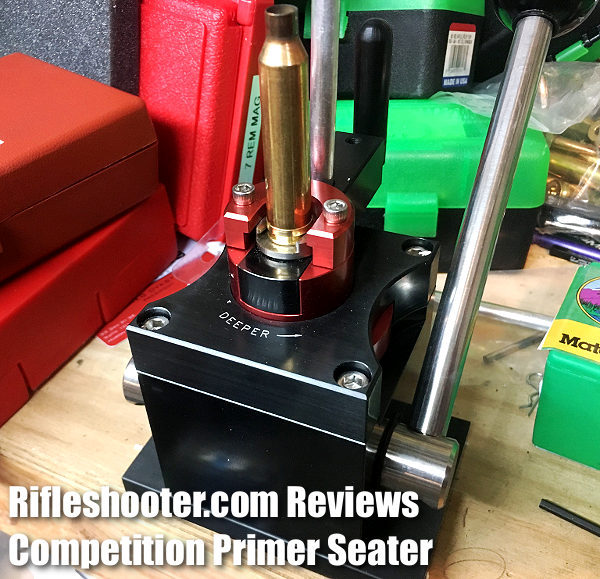
There have been many bench-mounted priming options — Forster has a tool, as does RCBS, and Lee. But there is a new player in the game — Primal Rights of South Dakota. And Primal Rights’ new Competition Primer Seater (CPS) may be the most precise bench priming tool yet offered to the public. It is certainly the most expensive. This patented tool costs $600.00! But the CPS delivers something special — superb, repeatable depth control, along with the ability to prime 1000 cases per hour. For some reloaders, that precision + productivity will justify the high price.
The Primal Rights CPS is built like a Swiss watch — the machining is beautiful. It also uses some unique internal engineering to achieve a superb “feel” when priming. Unlike some other tools, it is also very easy to adjust — simply turn a wheel to adjust seating depth. You can see this in the photos — the word “Deeper” with the directional arrow.
Operation of Competition Primer System Shown in Video:
Key Features of the Primal Rights CPS, as stated by the manufacturer:
Speed with Precision: Some priming tools are very fast. Others are very precise. The CPS is the only priming tool to combine both features into a single unit. You can achieve seating depths accurate to within a thousandth of an inch, all while priming at a comfortable rate of over 20 cases per minute. At that pace you can easily prime over a thousand cases per hour.
Precision Primer Seating Depth Control: The CPS has a revolutionary adjustable shell holder system which allows you to raise and lower your case in relation to the priming rod. You can seat the primer deeper or shallower in .001″ increments. The adjustment mechanism has tactile and audible clicks to ensure you stay on your desired seating depth. One click = One thousandth of an inch adjustment.
Integrated Shuttle Feeding System: The CPS uses a manually-operated shuttle system to slide primers from the primer tube into position over the primer rod. This ensures that any jams or misaligned primers are easily and safely discovered by the operator.
Check Out Competition Primer Seater Gear Review on Rifleshooter.com
Our friend Bill at RifleShooter.com has just released a detailed review of Primal Rights’ bench-mounted priming tool. He was very impressed with the Primal Rights CPS, finding that it was fast to use yet very precise, with great feel: “The CPS uses a rotational drive system to seat primers. Unlike the lever systems you’ll normally encounter, this allows you better feel as the primer seats. The CPS is expensive. However, it is a solid tool. Amortize it over the time you’ll be reloading and it’ll be worth every cent. If you load a lot of precision ammunition and have the budget to support it, take a look at the CPS. I found it is a game changer. I wish I had one twenty years ago!” READ REVIEW.
Say Hallelujah. These are pallets of Hodgdon H4350, something that’s been very hard to find recently. Check with Bruno’s, Graf’s, Midsouth and Powder Valley very soon.
Hodgdon H4350 has been the Holy Grail of reloading powders — highly desired but near impossible to find. For many popular cartridges such as 6XC, 6.5×47, 6.5 Creedmoor, and .260 Remington, H4350 has been the powder to beat — the “gold standard” for accuracy, low ES/SD, and temp stability. Unfortunately, H4350 has been in very short supply for the last couple of years. Major vendors such as Grafs.com, Midsouth and Powder Valley have been back-ordered for a long, long time.
But now that may change. Hodgdon has received a very large supply of H4350, and has started shipping pallets of the popular powder this week. The photo above was taken May 9, 2017. Hodgdon announced: “We have a lot of powder going out the door most days, but we have some special powder going out again this week. This should be on your local reloading shops’ shelves in the next couple weeks. Reloaders, rejoice!” If you’re in need of H4350, we recommend you contact your favorite shooting shop or online distributors soon. And guys — buy what you need, but don’t horde. Leave some for other shooters.
The new Sig Kilo 2400 ABS RangeFinder raises the bar among compact LRFs on the market. This unit offers class-leading ranging ability, combined with an Applied Ballistics solver, handy mobile App, and even a plug-in windmeter. If you are considering getting a new Laser Rangefinder (LRF), you should definitely consider the new Kilo 2400 ABS. With a $1499.00 price, this unit is not inexpensive. However, you’ll be hard-pressed to find any other compact LRF that offers better performance (or more sophisticated features) for the money. Here are highlights of a field test by Andy Backus of Longrangehunting.com. READ FULL FIELD TEST HERE.
— Claimed Ranging ability: Deer (1400 Yds), Trees (1800 Yds), Reflective Steel (2000 Yds).
— Syncs with iOS and Android smartphones via Mobile App (Bluetooth Compatible).
— Embedded Applied Ballistics Elite calculator with bullet database.
— Onboard temperature, air pressure, and humidity sensors.
— Display shows hold-over, wind direction/speed, density altitude, and shot angle.
— Scan mode refreshes at ultra-fast 4 times per second.
— Lumatic™ OLED display automatically calibrates brightness to changing light conditions.
— Lightweight magnesium housing with binoculars-style eyecup and diopter adjustment.
by Andy Backus, Longrangehunting.com
The Kilo’s scan mode is outstanding and is an important reason that it outperforms other rangefinders. I can’t think of any reason not to always use it on scan mode. The results are instant. The fact that the Kilo’s laser seems to be perfectly lined up with its reticle is another reason for its outstanding ranging performance. I think the size of the circular reticle and corresponding beam divergence of the laser is just about perfect. Because of the outstanding scan mode, the fact that the beam is smaller than some other rangefinders does not mean that you can’t do a good job of ranging freehand. And the relatively small beam means that the max range outperforms most other rangefinders.
Cycling through the menu and making changes to the settings on the KILO 2400 rangefinder is fast, simple and intuitive. The options are easy to read and understand.
One other slight negative I noticed is that it is hard to feel the RANGE button being depressed when wearing gloves. I would prefer a more noticeable click when depressing it.
Using the Mobile App with Ballistic Solver
The Sig Kilo 2400 ABS comes complete with a mobile App featuring the Applied Ballistics solver. This allows you to create profiles for various rifles and loads. Once you create the profiles and provide ambient altitude, temperature, and wind values, the Kilo 2400 will give you a ballistics solution via its onboard display. To range a target and get a ballistic solution you simply push the RANGE button. The first number that appears in the rangefinder is line of sight distance followed two seconds later by your elevation holdover and two seconds later by your wind hold (in MOA or MIL). The KILO 2400 will continue to cycle through the three numbers every two seconds for 30 seconds.
Great Features for Hunter in the Field
The array of on-board sensors along with the built-in Applied Ballistics solver mean that the KILO 2400 is capable of providing an instant and very accurate ballistic solution including wind hold with the push of a single button out to very long range. As a long range hunter this is exactly what I want.
The automatic brightness adjustment on the KILO 2400 seems to work flawlessly. No matter the lighting conditions on the day I tested, the KILO’s display was perfectly visible.
You hold the RANGE button down to take advantage of the KILO 2400’s outstanding scan mode and its precise circular reticle displays at just the right brightness level for the lighting conditions. The first number you see displayed on the KILO 2400 is 637 yards and it climbs as the scan mode follows the buck walking away from you. You let go as he stops at 642 yards and the KILO 2400 instantly tells you to dial your scope turret to 11.2 MOA. It also tells you that for a 10 MPH, 90 degree cross-wind you should hold 2.4 minutes. You estimate the full wind value to be about 5 MPH so you’ll hold 1 1/4 minutes.
Syncing Features and Remote Laser Activation
When synced to the KILO 2400 via Bluetooth, the Mobile App displays real-time information from the rangefinder including the line-of-sight range, elevation hold-over, and wind correction. It also displays temperature, pressure, density altitude, energy at target, and velocity at target. You can also enter a specific wind speed on this screen and quickly sync it to the KILO 2400.
One other cool feature on this screen is the opportunity to remotely fire the rangefinder. I played around with this a little bit when I had the KILO 2400 mounted on a tripod and I was trying to get the absolute farthest range I could. By firing the rangefinder remotely there was absolutely no wiggle from pressing the RANGE button on the rangefinder.
Complete Kit with Key Accessories
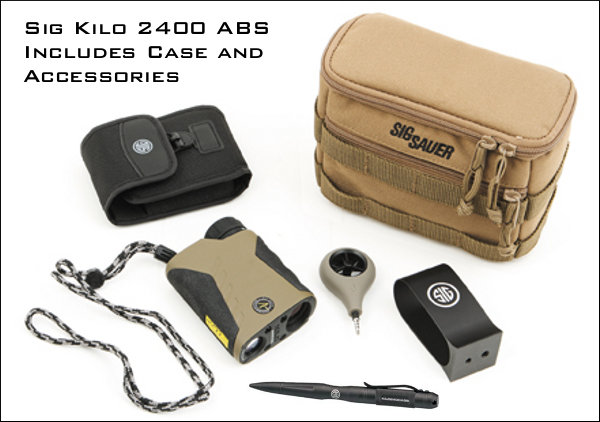
The Sig Kilo 2400 ABS comes complete with a a nice carry case, tripod mount, and even wind-meter that plugs into your mobile device. You get all this…
- Padded Ballistic Nylon Case
– TYR Water Resistant Molle Gear Bag
– Lanyard (Neck-strap)
- Wind Meter (plug-in for mobile device)
– One-Piece Machined Tripod Mount
– Sig Sauer Tactical Pen/Stylus
On Ammoland.com, there’s an interesting article about the NSSF’s recent 3-Gun Fantasy Camp in Las Vegas. Author Duncan Johnson attended the Camp last month and wrote an “after action report”. He said the Camp was a great experience, and his shooting improved greatly with the expert tutoring from top pros: “If you have ever wanted to try a 3-Gun competition, just go do it, you will quickly find out why this is the fastest-growing shooting sport today. If you are new to shooting and or just getting started in 3-Gun, I 100% recommend you attend the NSSF Fantasy Camp.”
Here are Four Tips/Observations Duncan learned during the 3-Gun Fantasy Camp:
1. Use a Zoom Rifle Optic – “The LWRC 3-Gun ready rifle [provided for the Camp] was topped with a Leupold Mark 6 1-6x20mm riflescope, which made distance shooting much easier than the AimPoint optic [on my own AR]. 3-Gun competitions have rifle stages that can involve distance shooting out to ranges of 500 yards or more. For that reason, most shooters in the 3-Gun TacOps and Practical divisions use magnified riflescopes like the Leupold Mark 6 or the Vortex Strike Eagle.”
2. Use Your Quads and Core Muscles — “There are also a lot of little things that the pros teach you… For instance, some shooters instinctively bend their knees to enter their stance, but once they start firing they tend to follow the recoil with their shoulders and end up leaning back. In order to avoid that, use your quad muscles in your legs to get a solid stance that will absorb more recoil. Also use your core muscles to maintain a strong stance, especially in shotgun stages. The combination of strong quad and core muscles will contribute to controlling muzzle flip and moving onto your next target more easily.”
3. Vision-Based Target Transitions — “Another pro tip from Randi Rodgers on transitioning from target to target with a pistol was using your eyes rather than your sights to switch targets. So imagine it as pull the trigger, the slide starts to come back, using your eyes find the next target, then point with the front sight, find the sight picture, fire, and repeat.”
Editor’s Note: A few seasons back, I attended an action shooting seminar taught by Randi, and she explained the “move your eyes” technique. For multi-target stages, this really works. Move your eyes from target to target, and you’ll find your arms automatically “pull” the handgun into position. You still need to get the sights on target, but this method yields create smoother, faster stage runs.
4. Trigger Control and Use of Support Hand — If you don’t have good trigger control and pull straight back, you can move your sights during the shot. This is a common problem with novice pistol shooters. The solution is lots of dry fire training. Duncan found out he needed work: “In my case, the biggest area where I need improvement was shooting my pistol. There were two different things I was doing that will guarantee a missed shot every time with a handgun. When I pull/squeeze/depress my trigger I have a tendency to also pull the gun off target, resulting in a miss to the low left of a target. I [also] over-apply pressure with my shooting hand. According to the pros, pistol grip should be 40% shooting hand, and 60% supporting hand.”
This article originally appears on Ammoland.com, reprinted here under Creative Commons License.
Some custom barrel makers are now honing barrels (after drilling) to improve bore diameter uniformity, smooth the interior finish, and reduce barrel lapping times. For years, large-scale manufacturers of hammer-forged barrels have employed honing. Now the process is being used by smaller, “boutique” barrel-makers. This article explains how and why barrel honing is done. Take the time to watch the video. For anyone with an interest in barrel-making, this video is an eye-opener…
Barrel Honing Process Demonstrated (Worth Watching!):
For custom barrel makers, honing is a time-saver and cost cutter. A few minutes on a honing machine can cut lapping times in half, leaving a cross-hatched surface finish in single or low double-digit Ra. Honing is the same process used to make diesel fuel injectors with bore roundness and straightness controlled to fractions of a micron (<0.000040″), with surface finish Ra ≤0.15 µm (6 µin).
A key manufacturing process used for hammer-forged barrels is now getting attention from the makers of custom button-rifled barrels. This process is precision bore-honing. Honing produces a high-quality bore surface fast, which is critical to hammer forging. (Why is honing so important with hammer forging? Surface finish is the one feature of the barrel that cannot be controlled in hammer forging. Surface imperfections in a barrel blank tend to be amplified as the blank is formed on the rifling mandrel. And if the bore is chromed afterwards, imperfections in the surface finish become even more obvious.)
Honing dramatically improves bore diameter size uniformity and accuracy, surface finish and roundness throughout the length of the barrel. It can certainly be used in place of a pre-rifling lap. The chief difference between a lapped and honed bore is the direction of the finish lines in the bore. Honing leaves fine spiraling crosshatch lines, while a lap leaves lines going longitudinally in the bore. After rifling the manufacturer can remove the crosshatch finish with a quick lap if desired. Honing is fast, accurate, and can be automated. Its surface quality and geometry can duplicate lapping, except for the longitudinal lines of the lapped finish.
Frank Green of Bartlein Barrels told us: “We worked with Sunnen and we did all the initial testing on the prototype machine for them. The machine works great! We ordered and received last year a new manufactured machine with the changes we wanted on it and we just ordered a second one a month or so ago. Should be here next month.”