If you want smoother bullet seating, inside neck lube can help. Forum member Ackleyman II likes to add a little Mica powder inside his case necks before seating bullets. This is easily done with the Forster three-brush neck lube kit. Ackleyman tells us: “Many loads that I have will not shoot well with a dry neck compared to a neck that is cleaned and lubed with this [Forster Dry Lubricator] — the best [$17] you have ever spent.”
The Forster Case Neck Lubricator features three brushes attached to a tough, impact-resistant case with holes for bench mounting. The brushes accommodate all calibers from 22 to 35 caliber. The kit includes enough “motor mica” to process 2000 to 3000 cases and has a cover to keep dust and grit from contaminating the mica. By moving the case neck up and down on the correct mica-covered brush, the neck can be cleaned and lubricated at the same time.
Function: Lubricate case necks for easier resizing
Contents: Kit with base, lid, and three nylon brushes
Lubricant: Includes 1/10 oz. of Motor Mica, enough to process 2000-3000 cases
Neck Lubrication After Ultrasonic Cleaning or Wet Tumbling with Pins
If you wet-tumble your cases with stainless media and solvents or ultrasonically clean your brass, you may find that the inside of the case necks get too “squeaky clean”. The inside surface of the neck looses lubricity. In this situation, applying a dry lube can definitely be beneficial. CLICK HERE to see story about ultrasonic cleaning.
Are you curious about bullet stabilization? Do you understand why bullets can tumble or become unstable if the velocity gets too low or if the twist rate is inadequate. Here is an excellent video from Gunwerks that explains Bullet Stabilization.
This animated video starts by showing the design/shape differences between an older-style rifle bullet and a newer VLD-style bullet with higher BCs (Ballistic Coefficients). Generally speaking, the longer a bullet gets relative to diameter, the more RPM is required for stability. And to achieve that higher RPM you need more barrel twist and/or more RPM. The video illustrates where the Center of Gravity and the Center of Pressure are located. These are farther apart (in relative terms) for a VLD or Hybrid-style, long-nose bullet.
When the bullet is in flight there is an angle of attack. This is exaggerated in the animation for illustration purposes, but it is important to understand the the attack angle affect stability. The rotation rate (Revolutions Per Minute) is a function of bullet velocity as it leaves the muzzle and the twist rate of the barrel. Since long VLD-style bullets need more stability, the barrel twist rate needs to be higher than with shorter, fatter bullets. This is pretty much try for all calibers.
The importance of adequate barrel twist rates for bullet stabilization is further discussed in this next video featuring Bryan Litz of Applied Ballistics:
Bullet Stability and Twist Rates
In this video, Bryan Litz talks about bullet in-flight stability and how to calculate barrel twist-rate requirements for long-range bullets. Bryan explains that bullet stability (for conventional projectiles) is basically provided by the spinning of the bullet. But this spin rate is a function of BOTH the nominal twist rate of the barrel AND the velocity of the projectile. Thus, when shooting the same bullet, a very high-speed cartridge may work with a slower barrel twist rate than is required for a lower-speed (less powerful) cartridge. For match bullets, shot at ranges to 1000 yards and beyond, Bryan recommends a twist rate that offers good stability.
The official first day of spring (the Vernal equinox) is just six days away. That means the spring shooting season will commence soon in most parts of the country. Before you head to the range for the first time, we recommend you do some basic tasks with your firearms. Here’s some good advice on readying your rifles for the 2025 shooting season.
by Ron Dague, Sinclair International I give my rifles a pre-season check before the shooting season starts. This starts with a general inspection starting with the butt-plate or recoil pad and making sure that all the screws and adjustable parts (on an adjustable butt-plate) move freely up or down and side to side. If you got caught in rain some of these screws and adjustable parts may not move when needed. I disassemble parts as needed and put rust preventative or a light oil and/or grease on threads and sliding parts. On rifles with recoil pads and fixed butt-plates, make sure the screws are tight and that holes in the stock aren’t stripped out. Make sure there are no cracks in the stock and around the butt-plate. If the recoil pad is glued-on, just make sure it hasn’t come loose.
Next I take the action out of the stock and check for cracks and wear marks. I look at the bedding to make sure that oils and cleaning solvents have not damaged the bedding. While the action is out of the stock, I look for any surface rust or dirt/dust in the recoil lug area and magazine well. Clean as needed and repair or re-bed if needed.
Trigger Assembly and Action With the barreled action out of the stock, it is a good time to spray out the trigger with cleaner. I use Ronson oil or lighter fluid. [Editor’s Note: Some trigger-makers advise against using any kind of lubricant, grease or oil — so plain lighter fluid is preferred.] After the trigger is cleaned you may want to check the trigger pull weight. If you don’t feel comfortable doing this, take it to a gun smith and have it checked. It is worth every penny to not have a trigger issue and/or a safety malfunction. I also take the bolt apart and clean the firing pin spring and bolt housing with Gun Scrubber or automotive brake cleaner. Then lube the firing pin-spring and firing pin with light oil. I use Kel Lube and/or Butch’s gun oil. Put a small dab of gun grease on the [bolt locking lugs] and cocking ramp.
I will also spray the outside of the action and barrel and give that a light coating of oil for rust prevention. I clean the action with Sinclair’s action cleaning tool. Don’t forget to clean the bore. Even though you didn’t fire the rifle, this makes sure nothing obstructs your barrel.
Checking Metal Fixtures and Fasteners Next I look at the trigger guard and hinged floor plate and make sure it works as designed. Make sure there are no cracks in the trigger guard from an accidental drop. Check guard screws and /or action screws for tightness and tighten to proper spec. There are torque specs for this, but on wood stocks the wood can crush and this should be checked throughout the year as weather change can affect this. My entire collection of rifles are bedded and I just tighten them just snug with screw driver or Allen wrench. The rimfire rifles have a spec of 55 to 74 inch/lbs and I think would carry over to center fire as well. I would caution you about torque wrenches as you need a good quality wrench, and read the directions on how to use it. You can over torque if not careful. Check the swivel studs and bipod to make sure there tight as well. You may want to take scope off and check the base screws and check the rings.
Test Fire the Rifle After Maintenance
After all cleaning and is done and everything is reassembled, take a few rounds out to the range and test fire to make sure everything works as it should. Don’t forget to run 3-5 rounds through the magazine at least two times for function. I look at this as preventive maintenance on the rifle. If you give it a look over you shouldn’t have any trouble during the rifle matches or hunting trip.
Ron Dague
Certified Reloading Instructor
Certified Range Safety Officer
This Article Originally Appeared in Sinclair International’s The Reloading Press.
Can you guess what your next barrel will weigh? In many competition disciplines, “making weight” is a serious concern when putting together a new match rifle. A Light Varmint short-range Benchrest rifle cannot exceed 10.5 pounds including scope. An F-TR rifle is limited to 18 pounds, 2 oz. (8.25 kg) with bipod.
One of the heaviest items on most rifles is the barrel. If your barrel comes in much heavier than expected, it can boost the overall weight of the gun significantly. Then you may have to resort to cutting the barrel, or worse yet, re-barreling, to make weight for your class. In some cases, you can remove material from the stock to save weight, but if that’s not practical, the barrel will need to go on a diet. (As a last resort, you can try fitting a lighter scope.)
Is there a reliable way to predict, in advance, how much a finished barrel will weigh? The answer is “yes”. PAC-NOR Barreling of Brookings, Oregon has created a handy, web-based Barrel Weight Calculator. Just log on to Pac-Nor’s website and the calculator is free to use. Pac-Nor’s Barrel Weight Calculator is pretty sophisticated, with separate data fields for Shank Diameter, Barrel Length, Bore Diameter — even length and number of flutes. Punch in your numbers, and the Barrel Weight Calculator then automatically generates the weight for 16 different “standard” contours.
Calculator Handles Custom Contours
What about custom contours? Well the Pac-Nor Barrel Weight Calculator can handle those as well. The program allows input of eight different dimensional measurements taken along the barrel’s finished length, from breech to muzzle. You can use this “custom contour” feature when calculating the weight of another manufacturer’s barrel that doesn’t match any of Pac-Nor’s “standard” contours.
Caution: Same-Name Contours from Different Makers May Not be Exactly the Same
One key thing to remember when using the Barrel Weight Calculator is that not all “standard” contours are exactly the same, as sold by different barrel-makers. A Medium Palma contour from Pac-Nor may be slightly different dimensionally from a Krieger Medium Palma barrel. When using the Pac-Nor Barrel Weight Calculator to find the weight of a barrel from a different manufacturer, we recommend you get the exact dimensions from your barrel-maker. If these are different that Pac-Nor’s default dimensions, use the “custom contour” calculator fields to enter the true dimensions for your brand of barrel.
Smart Advice — Give Yourself Some Leeway
While Pac-Nor’s Barrel Weight Calculator is very precise (because barrel steel is quite uniform by volume), you will see some small variances in finished weight based on the final chambering process. The length of the threaded section (tenon) will vary from one action type to another. In addition, the size and shape of the chamber can make a difference in barrel weight, even with two barrels of the same nominal caliber. Even the type of crown can make a slight difference in overall weight. This means that the barrel your smith puts on your gun may end up slightly heavier or lighter than the Pac-Nor calculation. That’s not a fault of the program — it’s simply because the program isn’t set up to account for chamber volume or tenon length.
What does this mean? In practical terms — you should give yourself some “wiggle room” in your planned rifle build. Unless you’re able to shave weight from your stock, do NOT spec your gun at one or two ounces under max based on the Pac-Nor calculator output. That said, the Pac-Nor Barrel Weight Calculator is still a very helpful, important tool. When laying out the specs for a rifle in any weight-restricted class, you should always “run the numbers” through a weight calculator such as the one provided by Pac-Nor. This can avoid costly and frustrating problems down the road.
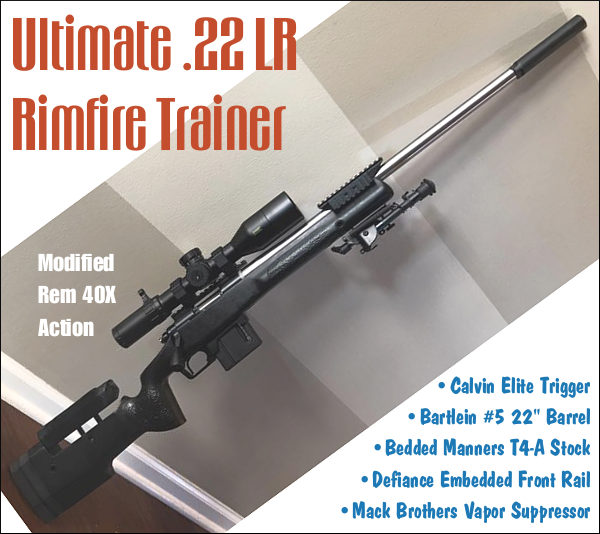
Brian, a gunsmith at GA Precision, built this rimfire rig with GAP colleague Anthony Soukup.
On his Facebook page, Tactical competitor Bryan Sikes posted a photo of a rimfire rig we really liked. Brian works at GA Precision. He and fellow GAP gunsmith Anthony Soukup built this rifle. With a modified Rem 40X action, Manners stock, Bartlein barrel, and Mack Brothers suppressor, this rig has top-quality components stem to stern. And Bryan tells us this rifle performs as good as it looks: “This is the baddest little .22 LR trainer ever. I’m stoked about it. With the barrel length and can, it’s the exact length of my regular comp rigs.” With length, balance, and ergonomics near identical to Bryan’s centerfire competition rifles, this 40X is a superb training tool.
Many readers wanted to know about the bottom metal and the detachable box magazine. Bryan Sike reveals: “The magazine setup is designed specifically to replicate my actual competition rifles. The bottom metal is for use with AI magazines and uses a standard M5 type inlet just like any centerfire completion rifle. In this case with the .22LR, Mike Bush designed a high reliability rimfire magazine using the same outside dimensions as an AI magazine. This rifle was built no different from any other. The action was modified and trued, barreled, fully bedded, etc. using ALL components common to centerfire match rifles.” The Rem 40X action was modified by Modacam Custom Rifles to work as a repeater with box mags.
Bryan adds that a new rimfire action is in the works: “My preference is modified Remington 40X actions and the [Vudoo Gunworks V-22 Action]. Both of which are TRUE repeaters and don’t feed from a Savage magazine. This rifle feels nothing like a .22 LR and that was the whole point.”
Why You Need a .22 LR Tactical Cross-Trainer
Many guys who shoot long-range tactical matches practice with .22 LR rifles of similar configuration. Rimfire ammo is way more affordable than centerfire, you do not need a big range facility, and shooting rimfire saves wear and tear on your centerfire rifle. Further, for learning how to read the wind, there really is no better training tool than a .22 LR, even as close as 50 yards.
Our Friend “DesertFrog”, who shoots tactical matches in Southern California, explains: “I used to shoot an average of 200 rounds of .308 Match ammo a month for training (50 per weekend). These days I shoot maybe an average of 50 rounds of .308 Win per month and probably around 600 rounds of .22 LR. Using mainly the .22 LR for practice did NOT hurt my standings in actual competitions. I shot my .308 just as well in matches, but saved the cost of hundreds of rounds of .308. If I didn’t reload and was still buying boxes of Federal Gold Medal Match .308 Win [at $1.75/round], this would be a savings of [$262.50 per month on the centerfire ammo (150 rounds).]” Money saved is money earned.
Targets for Rimfire Cross-Training
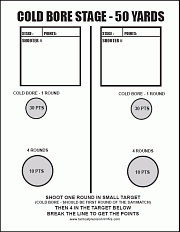
SPECIAL BONUS–Rimfire Tactical Precision Targets
These FREE targets by DesertFrog are offered in Adobe Acrobat format for easy printing. CLICK HERE to download all six targets as a .ZIP archive.
Here’s a smart tip from Bryan Litz, explaining how damage to a bullet jacket can harm the projectile’s Ballistic Coefficient (BC). This tip is posted on Bryan’s new Bryan Litz Ballistics Facebook page. We recommend you subscribe to that page to access Bryan’s latest informative posts.
Bryan notes: “If the case mouth scratches the bullet when you seat it, the damage can cause the BC to be inconsistent, which shows up as vertical dispersion at long range.”
We see this sometimes when running Doppler Radar for competitors at Applied Ballistics Mobile Lab events. If someone is shooting a bullet that typically has a very consistent BC (1% or less) but they’re seeing a higher BC variation, it can be due to the bullets being damaged in the loading process.”
The lead photo above shows the badly-scratched jacket of a bullet seated in a rough-mouthed case. To prevent such jacket damage, one should chamfer, deburr, and smooth case mouths after trimming.
Below is a recorded Doppler radar result showing excessive BC variation. Such variation can increase vertical dispersion at long range. This can result in larger group sizes and lower scores.
The Lapua Monarch Cup, one of the most prestigious smallbore rifle silhouette competitions in North America, has officially announced its 2025 schedule. Now in its fourth year, the Cup features a two-part series of smallbore standard rifle silhouette matches contested in the United States and Canada. For registration details and complete information on the Lapua Monarch Cup, visit Lapuamonarchcup.com.
The Lapua Monarch Cup includes the annual U.S. Smallbore Rifle Silhouette National Championships, along with a second host country event, this year in Canada. The 2025 competition schedule is as follows:
1st Match – Canadian National Smallbore Silhouette Championships
Cranbrook, British Columbia, Canada
June 20 – July 1, 2025*
2nd Match – NRA National Smallbore Silhouette Championships
Raton, New Mexico, USA
July 20-22, 2025
Competitors earn scores from each match within their respective classifications (Master, AAA, AA, & A), allowing participants to compete for a share of $25,000 in cash prizes across the two events.
“We are excited to continue the tradition of the Lapua Monarch Cup and provide competitors with an unparalleled competition experience,” said Adam Braverman, Lapua’s Vice President of Sales and Marketing and an advisor to the Cup. “This event not only showcases top-tier marksmanship but also fosters camaraderie among shooters across North America.” The Lapua Monarch Cup Board consists of esteemed members of the shooting community, including Erich Mietenkorte, Daniel Salazar, Jason Marsh, Jose (Pepe) Valdes, and Chris Cawthorne, with Adam Braverman serving as an advisor.
Basics of Smallbore Silhouette Competition
Smallbore Silhouette shooting is a fun and challenging shooting discipline that has competitors taking aim at a variety of steel chickens, pigs, turkeys, and rams. Shooters, standing and unsupported, take aim at four banks of silhouettes at increasing distances, shooting 40 targets in all. For every silhouette knocked down, the competitor earns one point. Smallbore Silhouette competitors typically shoot at distances of 40, 60, 77, and 100 meters at metric matches.
For more info on the North American Silhouette Shooting Association (NASSA), visit NASSAsilhouette.org.
*NOTE: The official Monarch Cup webpage lists June 20 as the Canada event start date. However the official graphic states the event runs June 29 through July 1, 2025.
The 17th Edition of the Cartridges of the World was released in June, 2022, so it is still quite current. This massive 704-page reference contains illustrations and load data for over 1500 cartridge types. That makes it a unique, very valuable resource. If you shoot a wide variety of cartridges, or are a cartridge collector, this book is a “must-have” resource. The latest 17th Edition includes 30+ new cartridge types and 1500+ photos. The print version costs $26.69 at Amazon.com (with possible free shipping on orders over $35.00). Or you can get the print book from Amazon 3rd party sellers starting at $26.35 delivered. The Kindle eBook version costs $16.21.
CLICK HERE for a large FREE Content Sample from the Kindle eBook version.
On the page that loads, click on the “Read Sample” button.
Updated 17th Edition with Feature Articles
The 17th Edition of Cartridges of the World includes cartridge specs, plus tech articles on Cartridge identification, SAAMI guidelines, wildcatting, and new cartridge design trends. Cartridges of the World, the most complete cartridge reference guide in print, includes a full-color section with feature articles such Cartridges of the AR-15, Creedmoor Cartridge Family, .404 Jeffrey, .30 Carbine, plus “Cartridges and Cans” (suppressors).
View Free Book Sample Content
FREE STUFF for You: If you want to see what you are getting, there is a very large sample section of the 17th Edition available online with over 100 pages of content and dozens of photos and illustrations. To access all this FREE INFO, CLICK HERE, then click on the cover photo where it says “Look Inside” or “Read Sample”. It may take a few moments to fully load the sample pages.
NOTE: This is content from the 16th Edition, but most is the same in the 17th Edition.
Cartridges of the World 17th Ed. CHAPTERS:
Chapter 1: Current American Sporting Cartridges
Chapter 2: Obsolete American Rifle Cartridges
Chapter 3: Wildcat Cartridges
Chapter 4: Proprietary Cartridges
Chapter 5: Handgun Cartridges of the World
Chapter 6: Military Rifle Cartridges of the World
Chapter 7: British Sporting Rifle Cartridges
Chapter 8: European Sporting Rifle Cartridges
Chapter 9: American Rimfire Cartridges
Chapter 10: Shotgun Shells
Chapter 11: U.S. Military Ammunition
Chapter 12: Cartridge ID by Measurement
Can you form a wildcat cartridge such as the 6 Dasher without expending primer, powders, and bullets? Absolutely. Using the hydro-forming method you can form improved cases in your workshop with no firing whatsoever, so there is no wear on your precious barrel. Watch this video to see how it’s done:
6 Dasher Case Hydro-Forming Demonstration:
Forum member Wes J. (aka P1ZombieKiller) has produced a helpful video showing how to form Dasher cases use the Hornady Hydraulic forming die kit. This includes a two-part die (body and piston), and a special shell holder. To form the case, you insert a primer in your virgin brass, top the case off with with a fluid (water or alcohol), then run the case up into the Hydro-forming die. A few stout whacks with a hammer and your case is 95% formed.
This same procedure can be accomplished with a Whidden Gunworks 6mm Dasher hydraulic form die. We like the Whidden hydro-forming die for its production quality and consistent results. This Whidden system works great according to our Forum members.
Hydro-Forming Procedure Step-by-Step:
1. Insert spent primer in new 6mmBR brass case.
2. Fill with water or alcohol (Wes prefers alcohol).
3. Wipe excess fluid off case.
4. Place case in special Hornady shell-holder (no primer hole).
5. Run case up into Hydraulic forming die.
6. Smack top piston of forming die 3-4 times with rubber mallet or dead-blow hammer.
7. Inspect case, re-fill and repeat if necessary.
8. Drain alcohol (or water) into container.
9. Remove primer (and save for re-use).
10. Blow-dry formed case. Inspect and measure formed case.
Wes achieves very uniform cartridge OALs with this method. He measured ten (10) hydro-formed 6 Dasher cases and got these results: two @ 1.536″; 2 @ 1.537″; and 6 @ 1.538″.
Three or Four Whacks Produces a 95%-Formed Case
With a Whidden or Hornady hydro-forming die, hydraulic pressure does the job of blowing out the shoulders of your improved case. The process is relatively simple. Place a spent primer in the bottom of a new piece of brass. Fill the case with water, and then slip it into a special Hornady shell-holder with no hole in the middle. Then you run the case up into the forming die. Now comes the fun part. You gently insert a plunger (hydraulic ram) from the top, and give it three or four stiff whacks with a mallet (or better yet, a dead-blow hammer). Remove the plunger and you have a 95% formed case, ready to load.
Special Shell-Holder
Hornady supplies a shell holder made specifically for the hydro die; there’s no hole in the bottom of it. Just insert a spent primer into the primer pocket and you’re ready to go. The spent primer, combined with the solid shell holder, keeps the water from seeping out of the primer pocket. The primer pushes out a little bit during this process, but it’s impossible for it to come out because of the way the shell holder is designed. The shell holder has a grove which allows the case to slide out of the shell holder even when the primer protrudes a bit.
Good Guide for PRS/NRL Competitors
Currently, PRS/NRL tactical competition is the fastest growing rifle shooting discipline with both centerfire and rimfire matches around the country. Are you thinking of getting started in the Practical/Tactical shooting game? Looking for ways to be more stable when shooting from unconventional positions? Then you may want to read Marcus Blanchard’s Practical Shooter’s Guide (A How-To Approach for Unconventional Firing Positions and Training).
Unlike almost every “how to shoot” book on the market, Blanchard’s work focuses on the shooting skills and positions you need to succeed in PRS and NRL matches and similar tactical competitions.
Blanchard provides clear advice on shooting from barricades, from roof-tops, from steep angles. Blanchard says you need to train for these types of challenges: “I believe the largest factor in the improvement of the average shooter isn’t necessarily the gear; it’s the way the shooter approaches obstacles and how they properly train for them.”
Blanchard also offers good tips on shooting fundamentals. Here’s an example:
Blanchard on Trigger Control
“There will always be some amount of wobble when shooting in positions other than prone, and timing the shot to go off when the reticle is within the target is difficult to accomplish when poor trigger techniques are employed. The most common [mistake] I have seen is ‘slapping’ the trigger. The finger is usually hovering off the trigger, and when the shooter determines that NOW is the time to fire, they quickly pull their finger to the rear and ‘slap’ the trigger. The finger never pulls the trigger in the same place and often provokes a sympathetic contraction of the rest of the muscles in the hand, which results in unwanted movement before the bullet exits the muzzle.”
Author Marcus Blanchard has the credentials. A Marine Corps veteran, Blanchard is a regular Top 10 finisher in Precision Rifle Series events. In 2015 Blanchard was ranked 8th overall (nationwide) in the PRS series at year’s end. In 2016 Blanchard won the New Mexico Precision Rifleman’s Championship.
Check out the Table of Contents to see the Topics Covered:
Click image above to view larger Table of Contents.
6.5 Guys Recommend Practical Shooter’s Guide
The 6.5 Guys have reviewed Blanchard’s book and they recommend it highly: “What’s a good book for the beginning shooter who wants to get into long range precision rifle or the intermediate shooter who wants to improve his scores? [The Practical Shooter’s Guide] is particularly useful because it explores firing from various positions and props that are encountered in long range precision rifle [events]. This knowledge is completely missing from more traditional books where the shooter is usually slung up and shooting at a paper target. Marcus… goes into considerable detail about shooting from rooftops, reverse rooftops, side slopes, tank traps, barricades etc. This is the type of information that is very difficult to find. We consider ourselves reasonably knowledgeable shooters and this book provided us with new and useful information.” CLICK HERE for 6.5 Guys REVIEW.
6.5 Guys Review Marcus Blanchard’s Practical Shooter’s Guide
Former USMC scout-sniper Frank Galli explains that there is no voodoo when it comes to precision rifle marksmanship, but there ARE techniques that, when practiced, make the difference between good marksmanship and great marksmanship. Understanding the reasons that a bullet hits or doesn’t hit its intended target at ultra-long distances is a crucial element to learning.
Galli’s explanations of how to understand and compensate for wind speed and direction are excellent. In this book, Galli offers great wind-reading advice.
Published in 2020, Galli’s treatise is four years newer than Blanchard’s book, so it includes more of the latest gear and equipment. Galli’s book covers the fundamentals of precision marksmanship with easy-to-understand methodology. The book follow the same instruction process Galli uses in his live marksmanship classes (CLASS REPORT HERE).
This well-illustrated, 272-page book (2020 ed.) covers the latest equipment (scopes, LRFs, chassis systems, magazines, bags, bipods, tripods) favored by tactical competitors in PRS/NRL type matches.


 I give my rifles a pre-season check before the shooting season starts. This starts with a general inspection starting with the butt-plate or recoil pad and making sure that all the screws and adjustable parts (on an adjustable butt-plate) move freely up or down and side to side. If you got caught in rain some of these screws and adjustable parts may not move when needed. I disassemble parts as needed and put rust preventative or a light oil and/or grease on threads and sliding parts. On rifles with recoil pads and fixed butt-plates, make sure the screws are tight and that holes in the stock aren’t stripped out. Make sure there are no cracks in the stock and around the butt-plate. If the recoil pad is glued-on, just make sure it hasn’t come loose.
 With the barreled action out of the stock, it is a good time to spray out the trigger with cleaner. I use Ronson oil or lighter fluid. [Editor’s Note: Some trigger-makers advise against using any kind of lubricant, grease or oil — so plain lighter fluid is preferred.] After the trigger is cleaned you may want to check the trigger pull weight. If you don’t feel comfortable doing this, take it to a gun smith and have it checked. It is worth every penny to not have a trigger issue and/or a safety malfunction. I also take the bolt apart and clean the firing pin spring and bolt housing with Gun Scrubber or automotive brake cleaner. Then lube the firing pin-spring and firing pin with light oil. I use Kel Lube and/or Butch’s gun oil. Put a small dab of gun grease on the [bolt locking lugs] and cocking ramp.
 Next I look at the trigger guard and hinged floor plate and make sure it works as designed. Make sure there are no cracks in the trigger guard from an accidental drop. Check guard screws and /or action screws for tightness and tighten to proper spec. There are torque specs for this, but on wood stocks the wood can crush and this should be checked throughout the year as weather change can affect this. My entire collection of rifles are bedded and I just tighten them just snug with screw driver or Allen wrench. The rimfire rifles have a spec of 55 to 74 inch/lbs and I think would carry over to center fire as well. I would caution you about torque wrenches as you need a good quality wrench, and read the directions on how to use it. You can over torque if not careful. Check the swivel studs and bipod to make sure there tight as well. You may want to take scope off and check the base screws and check the rings.

 Can you guess what your next barrel will weigh? In many competition disciplines, “making weight” is a serious concern when putting together a new match rifle. A Light Varmint short-range Benchrest rifle cannot exceed 10.5 pounds including scope. An F-TR rifle is limited to 18 pounds, 2 oz. (8.25 kg) with bipod.




 Hydro-Forming Procedure Step-by-Step:
 Special Shell-Holder


