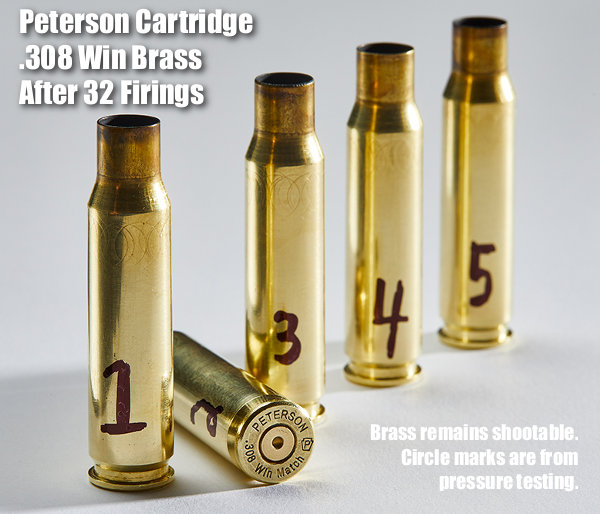
Here are five Peterson .308 Win casings after 32 loading/firing cycles (31 at SAAMI max). The brass remained intact, with no cracks. The circles below the shoulders are markings from pressure testing.
Recently Peterson’s ballistician had some extra time in his schedule, and asked what he should work on next. He was told, “Just for the heck of it, see how many times you can fire our .308s before you experience failure.” So that’s what he set out to do.
He took five casings out of inventory and loaded them at SAAMI max pressure, which is the pressure we use for all of our longevity testing. It is a hot load, and he did the firing out of Peterson’s Universal Receiver. This way he could measure pressures and velocities each shot. He shot all five, 20 times. (It takes a long time to do that. Load five casings. Shoot five times. Back into the lab to reload, back into the indoor range to shoot, back into the lab, and so forth.)
After 20 firings with no sign of case deterioration, Peterson’s tester asked if he should keep going. “Sure, let’s see how long these can go”, was the reply. So he shot them five more times. Same result. All casings still in good shape. We told him to keep going. He shot each of them six more times. At this point each of the five casings had been fired 31 times. After several days of this the casings were still in good shape but “ballistician fatigue” was setting in. Finally he said, “Let me take these cases to an outdoor range and see how they do for accuracy.” The Peterson team agreed.
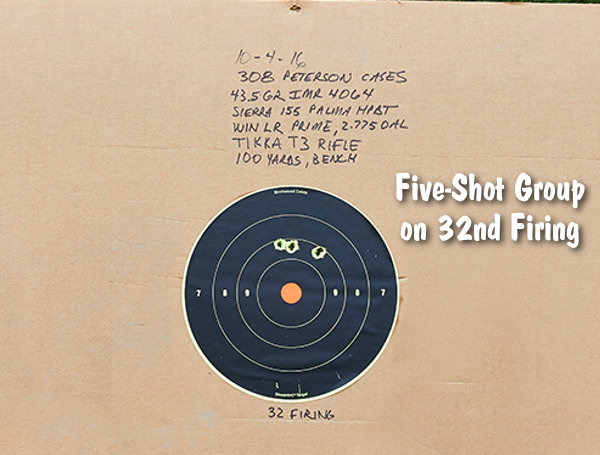
Five Shots at 100 Yards after 32 Load Cycles:
For the 32nd firing, the cases were loaded with a somewhat lighter load, and then tested for accuracy. The test rifle was a Tikka T-3 bolt action, with a 20 inch, 1:11″-twist barrel. After 32 firings the primer pockets had opened about 0.002″ (two-thousandths) but were still tight enough for further use. There were no cracks or signs of head separation. The tester put five shots in three holes at 100 yards. The group was 1.5 inches for the five shots, on a somewhat windy day.
Story Tip by EdLongrange. We welcome reader submissions.
At the request of our readers, we provide select “Deals of the Week”. Every Monday morning we offer our Best Bargain selections. Here are some of the best deals on firearms, hardware, reloading components, and shooting accessories. Be aware that sale prices are subject to change, and once clearance inventory is sold, it’s gone for good. You snooze you lose.
1. Amazon.com — Rock Chucker Supreme Reloading Kit, $279.99
Everything you see above can be yours for just $229.99, after manufacturer’s rebate. Right now, Amazon is selling the Rock Chucker Supreme Master Reloading Kit for $279.99. That’s a great deal considering all the hardware you get. Heck, the Rock Chucker press alone is worth $150.00+. But here’s the real incentive — this Rock Chucker Supreme Kit qualifies for a Buck$ or Bullets Rebate — choose either $50 or 500 Speer bullets. If you take the fifty bucks ($50), that reduces your net cost to just $229.00 for the entire RCBS Reloading Kit. That’s a total steal. NOTE: Cabelas.com also sells this RCBS Kit for the same $279.99 (before rebate).
Graf & Sons is now offering various Burris scopes with Close-Out Pricing– up to $40% off. If you are looking for a budget-priced, medium-range zoom scope for your hunting or varmint rifle, check out these deals. For example, the Burris Predator Quest 4.5-14x42mm (Side Focus) Scope is now just $199.99 — that a 38% savings. In addition to these optics close-outs, Grafs.com is offering FREE Shipping for a limited time. You can get FREE Shipping with orders totalling $100.00 or more. This shipping deal is valid through 4/18/17 at 11:59 PM.
3. PT&G — Howa Barreled Actions with Trigger, $350.00
Howa makes excellent, smooth-running actions, and the Howa HACT 2-stage trigger is WAY better than most domestic factory triggers. Right now you can save big bucks on Howa barreled actions, complete with HACT trigger and trigger-guard. Pacific Tool & Gauge (PT&G) sourced a truckload of Howa barreled actions, which are now on sale. Available at $350.00 are: .204 Ruger, .223 Rem, .22-250, .243 Win, 7mm-08, and .308 Win. Choose from light- or heavy-barrel contours. For $390.00 you can get .375 Ruger, 7mm Rem Mag. These barreled actions would be great for custom hunting/varmint rifle projects — many have factory camo finishes. Howa barrels typically deliver easy sub-MOA accuracy (and often much better). Some of these barreled actions may carry Weatherby or Nosler markings, but they were all made at the Howa factory in Japan.
Headed out for a varmint safari soon? Need inexpensive bullets for your .223 Rem or 22-250? Then check out this deal on from Midsouth Shooters Supply. Get 250 BTHP 62gr .224-Caliber bullets for just $24.99. That’s just $9.94 per hundred. At that price, it doesn’t hurt so much when you shoot 1000+ rounds over a weekend. With good expansion, these bullets work great on prairie dogs and other small critters. Note: These sale bullets ship in a bag. Midsouth also offers bulk pricing on 500-bullet and 1000-bullet quantities.
5. Stocky’s Stocks — Composite Stock with Bedding Block, $179.99
Here’s a killer deal on a versatile Stocky’s Long Range Stock with aluminum V-block bedding system. For just $179.99, order this for Rem/Rem Clone long actions or short actions, with either narrow or wide (varmint/tactical) barrel channel. This would be a good choice for a varmint rifle. This is also offered with a matte black, tan, or olive baked-on textured finish for $199.99.
6. Cabela’s — Mossburg Shotgun in Waterproof Case, $469.99
Here’s the perfect weapon to repel boarders or fight zombies! OK, you may not really NEED a pistol-grip shotgun, but this thing is just so cool. The Mossburg 500 Mariner shotgun has a durable Marinecoat finish and comes in a Int’l Orange storage case that floats. Keep this pump-gun on your boat, in your truck, or make it part of your “bug-out kit”. The floating tube’s heavy-duty synthetic seal is factory-tested to be airtight and waterproof to 40 feet. With a 6-round capacity, this Mossberg shotgun features an 18.5″ cylinder-bore barrel with bead front sight. It even ships with a knife and a multi-tool. There is also a matte black version with a green tube for just $349.99.
7. Amazon — Motorola Walkie Talkies, $48.99 per Pair
Walkie-Talkies are “must-have” items for long-range shooting. They let you reset targets and talk to back to the firing line. These are also very handy on hunts. The Motorola MH230R Two-Way Radio is Amazon’s #1 Best Seller in FRS/GMRS Handheld Radios. This under-$50.00 set offers 22 channels with a claimed range up to 23 miles (We’ve used them and they worked at 3 miles line of sight). The kit includes: 2 radios, 2 belt clips, 1 dual drop-in charger, 1 charging adapter, 2 NiMH rechargeable battery packs. Run-time is about 10 hours — plenty for a full day of shooting. There is also a newer version, the Motorola T260 for $58.99.
We like reactive targets. It’s fun to “ring steel” and see a target move instantly when hit. For just twenty bucks (including shipping), it’s hard to go wrong with this 8″ AR500 Steel Gong. The 8″-diameter size is big enough for zeroing at 200 yards, yet offers a nice challenge at 500 yards and beyond. There is also a 6″-diameter model for just $14.00.
Forum member Rick from Louisiana (aka RMulhern) has rigged up a fantastic target for long-range shooting. Rick, a long-time competitive Palma shooter, had a large 72″x72″ steel target fabricated with two separate center rings that are equivalent to the official paper Palma/Creedmoor target. He says he’s “shot a lot of Palma on that target, as well as lots of Black Powder Cartridge (BPCR) rounds”. The big steel target works great when Rick shoots his Sharps 45/110 BPCR at 800 to 1000 yards. The large steel background (painted white) helps Rick see and hear his hits. If you understand the high-arching trajectory of 500+ grain projectiles shot from a 45/110, you know it can take a few rounds to get Point of Impact dialed in.
Rick reports: “These are two of my favorite rifles to shoot: a M1874 Shiloh Sharps in caliber 45/110 (2 7/8) made in Big Timber, Montana by Kirk Bryan and family. The other is a 6.5×47 Lapua on a blue-printed M700 action with 1:8.5″-twist Krieger barrel and F5 McMillan Tactical stock. Many of the shooters that take up BPCR have a tendency to get away from their smokeless powder rifles in favor of the blackpowder game. Frankly I have the best of both worlds as I enjoy shooting both (smokeless and BPCR), although I must admit that I probably spend the majority of my time on the range with the Sharps rifles these days.” (Rick’s pretty good with his Sharps by the way — he recently shot a 95, 96, and 100 (clean) for 3×10 shots at 800 yards.)
Gongzilla: $1000 Worth of Steel with Three Plate Layers
Rick tells us: “Here’s the deal — everything is steel! The large plate is 72″x72″ and the black bull is 44″ diameter. The 20″-diameter central white bull is made from 1/2″-thick AR400 bull-dozer plating. That’s the same size as the regulation Palma/Creedmoor paper target. The white square and black bull are 3/8″-thick mild steel. Plates are off-set 2″ from each other. I welded a 2″ length of square tubing to the back of both plates and the bolt slides through and is attached to the large plate. I used 2 3/8″ upset tubing (oil field pipe) for the holder framing.” Rick says he invested about $1000.00 in metal for the target, but that was 15 years ago. Today the steel would be much more expensive.
Rick says the AR400 armor plate in the center bull is very strong: “You can shoot a .338 Lapua Magnum at 200 yards and it won’t damage the center bull”. The mild steel works well for the cast bullets Rick uses with his Sharps 45/110. Also, Rick says the mild steel is rugged enough for 6.5mm and .308 hollowpoint match bullets, if you’re at least 500 yards away. However, Rick told us, “If I would make [the target] again, I would make the black bull AR400 as well. [That way] you would never have to worry about big dents or beating the plate up at any distance. The AR400 is very tough steel. You can shoot a Sierra or Lapua HP bullet and they will just splatter.”
Rick told us: “I built this target with off-set clanger plates. The white clanger is AR400. Bullets just splatter!” Does he worry about hitting the bolt head? Not at all. Rick says: “When I hit the bolt head, I break my arm patting myself on the back!”.
A.P. Lane’s Gold Medal-Winning Colt Revolver
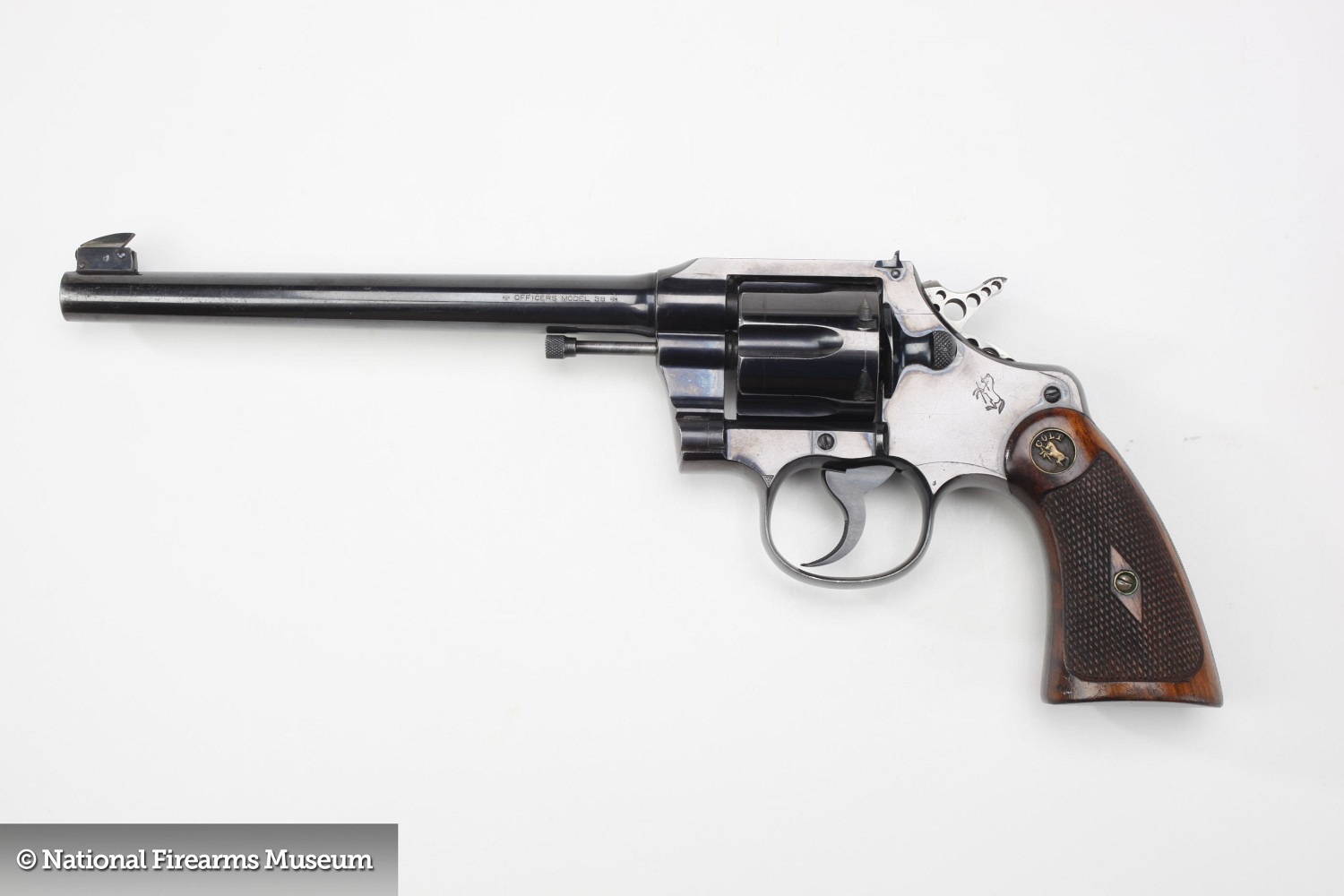
This Colt Officer’s Model revolver, factory-fitted with a skeletonized hammer, belonged to legendary Olympic shooter A. P. Lane, who was known as the “Pistol Wizard”. Lane used this Colt Revolver to win FIVE Olympic Gold Medals — three in 1912 and two in 1920.
A.P. Lane was one of the greatest pistol shooters of his generation. He shot scores that were typically 25-50 points higher than those of his competitors. And he exhibited true Corinthian spirit. At the 1912 Olympics, Lane shared his match ammunition with another competitor who used that ammo to capture the Silver Medal (Lane won the Gold).
This revolver, factory-fitted with a skeletonized hammer, was used by American A.P. Lane in winning five Olympic Gold Medals in the 1912 and 1920 Olympic Games. It’s a .38 caliber, Officer’s Model centerfire revolver from the early 20th century. Olympian A.P. Lane’s Gun can be found in Gallery 13, Firearm Traditions for Today, at the NRA National Firearms Museum in Fairfax, Virginia. The Museum exhibit includes a panoply of Lane pieces – his revolver, his five Gold Medals, and the five Olympic certificates that went along with them.
Folks have asked if there is a tool that can remove obstructions from a Lapua small, BR-sized flash hole without opening the hole size. The Lapua PPC/BR flash hole is spec’d at 1.5mm, which works out to 0.059055″. Most of the PPC/BR flash-hole uniforming tools on the market use a 1/16″ bit which is nominally 0.0625″, but these often run oversize — up to 0.066″.
If you want to just clear out any obstructions in the flash hole, without increasing the flash hole diameter, you can use an inexpensive “pin vise” with an appropriate drill bit. For $1.00, eHobbyTools.com sells a 1.5mm pin vise bit, item 79186, that matches the Lapua flash hole exactly. Other vendors offer a #53 pin vise bit that measures .0595″ or .060″ (depending or source). An 0.0595″ bit is close enough. You can find pin vises and bits at hobby stores.
The CMP has approved a new event for Glock pistols at the 2017 National Matches at Camp Perry. Plastic Pistols at Perry? Traditionalists may scoff, but this is certainly a way to get more (and younger) pistol competitors involved. The first-ever GLOCK Sport Shooting Foundation (GSSF) Match will be held on July 1, 2017 as part of the CMP’s 2017 National Matches. The inaugural Glock Match will be open to both adults and juniors, with two different categories: Stock and Unlimited.
The big news are the prizes — six Glock pistols will be awarded to top Class winners. The Glock Match will be shot on NRA D1 paper targets, with ten (10) rounds each at 5, 7, 10, 15 and 25 yards. NOTE: This is NOT a slow-fire match. According to the CMP press release, competitors will have just 15 seconds for each 10-round string. We hope that’s a misprint — ten shots in 15 seconds makes this a “mag-dump” contest, not a precision match, in our opinion. To compete at the match, shooters must have an active GSSF membership (you can join during match registration at check-in).
There will be two pistol classes, Stock and Unlimited. The Stock Class is for GLOCK firearms with components that are or ever have been available from GLOCK, Inc., though some modifications are permitted. NOTE: Fiber-optic and express sights are approved.
The Unlimited Class is for firearms with major modifications such as aftermarket barrels, mag funnels, recoil springs, and firing pins. Unlimited Class pistols can use “any non-post and notch sights including but not limited to, ghost ring or laser, electronic or optical sights.”
“This match was suggested by Bob Schanen, a valued, long-time GLOCK employee and Camp Perry rifle competitor for 30+ years,” said Brandie Collins, GLOCK public relations and communication manager. “The partnership with CMP in bringing this match to Camp Perry meets our common goals of promoting safe gun handling, marksmanship and introducing people to competitive shooting. Shooters of all skill levels will enjoy shooting this match.”
Many of our readers travel far and wide during summer months, both on family vacations and to participate in shooting matches. When transporting firearms across state lines, it is vital to understand the laws and regulations that apply in each jurisdiction. Moreover, all of us need to stay informed about gun laws in our home states, since new laws are passed every year.
Indiana attorney Brian Ciyou has created an outstanding resource, Gun Laws by State (2017 Ed.) (GLBS), that explains firearms laws in all 50 states. Ciyou’s gun law treatise, available in both book and online (web) formats, covers state laws as well as key federal laws that apply in federal buildings, airports, National Parks, and school zones. There is a handy Reciprocity Map showing which states recognize concealed weapon permits issued in other jurisdictions. Moreover, GLBS covers Reciprocal Carry for all 50 states, Constitutional Law, Federal Statutory Law, Use of Force, Criminal Provisions, Civil and Criminal Liability, Preemption, Federal Property Rules, and Interstate Transportation. The web version of Gun Laws by State is updated regularly, and Ciyou even provides a GLBS Gun Laws Blog with current topics on gun regulations nationwide.
FREE Access to Many Database Features
Access key state and Federal legal information for FREE on the GLBS website. Simply click on an interactive map to quickly review gun laws in any state (See Texas example at right). Other Navigation links provide quick access to particular topics, such as rules for Airline Travel, Amtrak, National Parks, and Federal properties.
We recommend that readers bookmark the GLBS website. Though much free info is available, you should definitely consider buying the book if you frequently travel with firearms outside your home state. The printed book version costs $20.00, while a digital eBook is $10.00 (or get both for $25.00). CLICK HERE to purchase Gun Law Books and/or eBooks.
The big NRA Convention is just two weeks away. The 146th National Rifle Association (NRA) Annual Meetings and Exhibits will be held at the Georgia World Congress Center in Atlanta, Georgia from April 27-30, 2017. This 4-day event will feature 800+ exhibitors, and include dozens of seminars, workshops, and special events. Over 80,000 NRA members and guests are expected to attend. In and around the Convention Hall there will be 15 acres of firearms, shooting and hunting gear, and other exhibits. There will also be an on-site airgun range. For more info, visit www.nraam.org.
There will be nearly 800+ Exhibitors displaying products at the 2017 NRA Annual Meetings and Exhibits. You can see products from big name companies such as Berger Bullets, Leupold, Lyman, Nightforce, Nosler, Redding, Remington, Ruger, Savage, Smith & Wesson, and Winchester. You can also meet with top hunting guides and outfitters.
The National NRA Foundation Banquet will be held April 27th in the Thomas Murphy Ballroom, Georgia World Congress Center Building ‘B’. The NRA-ILA Leadership Forum is slated for April 28th in Hall A3, Georgia World Congress Center. With the recent changes in the American national leadership, the ILA Forum should be popular this year.
Hank Williams Concert
Lifetime NRA member and multi-Platinum hit-maker and outdoor enthusiast Hank Williams Jr. will take the stage at the 2017 NRA Annual Meetings and Exhibits Saturday, April 29th! This is always a sell out event, so don’t wait to buy your tickets.
Location of NRA Annual Meetings in Atlanta:
Firearms Policy for the 2017 NRA Annual Meetings
During the 2017 NRA Annual Meetings & Exhibits, lawfully carried firearms will be permitted in the Georgia World Congress Center and the Omni Atlanta Hotel at CNN Center in accordance with Georgia law. However, firearms are not allowed in the remainder of the CNN Center, including the food court and shops. When carrying your firearm, remember to follow all federal, state and local laws.
A few years back our friend Danny Reever acquired the PMA Action Cleaning tool. He’s now used it for many seasons and it’s still working great. If you shoot a precision rifle, it deserves to have a clean action and lug recess area. This handy tool speeds up the cleaning process, letting you do a more thorough job in less time.
PMA Action Cleaning Tool Kit Review by Danny Reever
I’ve been using the PMA Action Cleaning Tool Kit for quite some time. Previously, I used one of the old style (round knob) Sinclair action-cleaning tools with cylindrical cotton rolls. With the Sinclair tool, I was pretty satisfied that I was getting my actions reasonably clean. But, as I explain below, I think the newer PMA Action Cleaning Tool Kit is easier to use, and possibly achieves better results.
PMA Tool Kit Extensively Tested with Many Action Types
PMA tried a variety of options before finalizing the PMA Action Cleaning Tool Kit. PMA explains that several shooters did a lot of testing “with various sizes of die-cut foam, patches, felts and cotton rolls with various bolt action types (BAT two- and three-Lug, Kelblys, Halls, Remingtons, Winchesters and Savages). [Testers all agreed] that the foam disc is far superior to felts and cotton rolls [and] we decided to include two different sizes of foam discs.”
The PMA Action-Cleaning Tool uses round foam discs in two included sizes: 1″ diameter and 1.25″ diameter. Both size discs can be used alone, or with a 3″ patch wrapped around them. The handles of the tools are CNC-machined blue-anodized aluminum with a silicone sleeve for grip. The PMA tool handles are a bit longer than those of my old Sinclair action-cleaning tool. I like the added handle length, and I find the design of the handle easier to use compared to the old-style round knobs.
The PMA tools are quality items. They are an improvement over my older Sinclair action-cleaning set-up. But do the PMA tools they actually clean the action better or easier than the old style cotton rolls? Well, based on my experience, the answer is a definite “maybe”.
Comparison Testing — Cotton Rolls vs. PMA Foam Discs (with and without patches)
Starting with the old-style cotton roll system, I cleaned my actions to a level I considered “clean” in the past. I then tried the included PMA foam discs. I found that, for my Remington-style actions, the larger 1.25″-diameter disc seemed to work better than the smaller 1″-diameter disc. Wrapping the larger disc with a 3″ patch definitely brought out more crud from my previously cleaned actions than the old style cotton rolls. Well, you might ask, what if you wrap the old-style cotton roll with a patch? Yes that will remove more crud too, but perhaps not as much as the PMA system. Moreover you would have to buy both cotton rolls AND 3″ patches. Not many places sell the cotton rolls.
Is it worth plunking down the $49.95 for the complete PMA system? Well, if you want to upgrade to a quality-made tool with better handles the answer is yes. Is getting that last bit of crud out of your action every time you clean it that important to you? You have to decide that for yourself. From my own perspective, I was due for an upgrade so the answer was easy. I like the PMA system, especially the new improved handles. Also, with the PMA system I don’t have to fool around with a tiny Allen screw to secure the cotton rolls — that was annoying. So my final take on the PMA Action Cleaning Tool Kit is that it is a good product with some real advantages over other action-cleaning systems.
PMA Tool charges $49.95 for the complete Action Cleaning Tool Kit that includes a chamber cleaning handle and cotton swab. PMA offers the lug recess action cleaning tool by itself with four foam cleaning discs and five 3″ patches. Cleaning discs are also available separately in your choice of 1″- and 1.25″-diameter in a five pack.
This story involves a match held last fall, but we know many of our readers compete in the Mid-Range (600-Yard) Benchrest discipline and follow developments in this sport. Accordingly we’re offering this report on the 2016 IBS Nationals held at the Big Piney Sportsman’s Club in Houston, Missouri.
The 600-Yard Nationals at Big Piney last September was a great event that drew 82 shooters from 14 different states. Competitors traveled from as far away as Florida, Idaho, and North Dakota to compete in the 2016 600-Yard International Benchrest Shooters National Championship. The weather was great and so was the food. A good time was had by all, and shooters praised the facility and the efficient way the match was run. The IBS offers a big “thank you” to everyone involved in running this excellent match. Their hard work and dedication deserves recognition.
On the forearm of this Heavy Gun was painted: “Give Me Liberty or Give Me Death”
Here are the Class Winners at the 2016 IBS 600-yard Nationals in Missouri
The opening morning for Light Gun class proved to be challenging, as the start time was pushed back one hour due to the fog settling in the firing line. By the second half of the eight targets to be shot, shooters began to settle in and take control of the conditions. The Missouri shooters stayed on top with Ben Peters winning light gun score with a 385. Jason Walker took the group win with a 2.008” through 8 targets. With Tom Jacobs, Darrel Dacus, Jim Bauer, and Carrol Lance rounding out the top 5 in Light Gun overall it was going to be a hard fight to the finish.
Click Image to View Larger Equipment List Look at the Caliber Column — Every Top 10 shooter in Light Gun Class shot either a 6mm BR Norma or a 6mm Dasher, an “Improved” version of the 6mm BR. In Heavy Gun it was 9 of 10 (with one unidentified 6.5mm). Hard to beat the 6mm BR and the Dasher for pure accuracy at 600 yards.
This competitor shot the match with a Labradar chronograph on his bench.
On Sunday the Heavy Gun class started right on time with the clouds keeping Saturday’s fog in check. Relay 3 started the day off strong, putting it on top shelf for everyone to follow. The conditions seemed to stay pretty steady and helped create opportunities for competitors to shoot some amazing groups. Tom Jacobs came through with a 1.685 Heavy Gun group Aggregate. Rookie shooters Jim Kowske and TJ Stroop put on great Heavy Gun performances. Jim was second in Heavy gun group with 1.996” and TJ shot his way to second in score with a 384. Jason Walker hung on winning Heavy Gun score with a 389. This set up Jason as the Heavy Gun overall winner.
The Big Piney Range is a pretty facility surrounded by trees.
Jason dominated the weekend landing himself a 2-Gun Overall Championship. The top Rookie honors went to T.J. Stroop. Sally Bauer won the Overall top female. Rory Jacobs was able to seal the top Junior spot. The Big Piney crew would like to thank everyone for being great friends and great competitors! We could not have done it without everyone!
The match organizers provided tasty BBQ banquets for hungry shooters.
Here competitors relax between relays at the Big Piney facility.




 Forum member Rick from Louisiana (aka RMulhern) has rigged up a fantastic target for long-range shooting. Rick, a long-time competitive Palma shooter, had a large 72″x72″ steel target fabricated with two separate center rings that are equivalent to the official paper Palma/Creedmoor target. He says he’s “shot a lot of Palma on that target, as well as lots of Black Powder Cartridge (BPCR) rounds”. The big steel target works great when Rick shoots his Sharps 45/110 BPCR at 800 to 1000 yards. The large steel background (painted white) helps Rick see and hear his hits. If you understand the high-arching trajectory of 500+ grain projectiles shot from a 45/110, you know it can take a few rounds to get Point of Impact dialed in.

 A.P. Lane’s Gold Medal-Winning Colt Revolver