|
|
April 22nd, 2017

This stunning flame-painted PPC belongs to Chris from Australia. This rifle features a Stiller Viper action, Speedy (Robertson) BRX stock, and Maddco (Australian) 14-twist barrel chambered in 6PPC.
In our Shooters’ Forum you’ll find a thread in which readers can post photos of their “pride and joy” — their favorite rifle. You’ll find a wide range of guns, from “big boomers” to .17-caliber varminters. Here are some of our favorite entries in the “Pride and Joy” Gallery.
The Bear’s Barbed-Wire Barnard

BarryO, aka ‘the Blue-eyed Bear’, posted his beautiful 6mm Dasher, with its unique barbed wire 3D finish. (There’s a story behind that design.) This rifle was smithed by John King in Montana, with stock bedding work by Leo Anderson. The gun features a Barnard ‘P’ action (with trigger), and 28″ Broughton 5C fluted barrel with VAIS muzzle brake. The Barnard sits in a Tom Manners carbon fiber BR stock decorated with amazing graphics by Mad Shadow Custom Paint.
Sebastian’s Radical Swallowtail 6PPC

Sebastian Lambang is the designer and builder of SEB Coaxial Rests. He’s a smart, creative guy, so you knew when he designed a short-range benchrest stock it would be something special. It needed to be lightweight, yet very rigid. Using “out of the box” thinking, Seb employs a truss-style structure to provide great strength with minimal weight. The rear section is equally radical. There are two splayed “keels” in the rear, forming what this Editor calls a “swallowtail” rear design. Others have called it a “catamaran buttstock.” Below is a side-view of the prototype SEB stock before painting.

Brad’s 6CM Long-Range Match Rifle

Chambered in the 6mm Competition match cartridge, this handsome rig features a Surgeon RSR Action, Bartlein Barrel, and LRB stock. Barrel work was done by Chad Dixon at LongRifles, Inc. and paint by AT Custom Painting.
Varmint Special with Figured Walnut Stock

Here’s a handsome varminter with a beautifully-figured walnut stock. This is one of three rifles Forum Member Dan Hall posted in the Pride and Joy thread.
A Trio of Pealescent Bench Guns

DixiePPC served up not one but THREE pretty bench rigs, all with pearlescent paint jobs. We’d be proud to own three eye-catching rifles like that. Click the image to see a full-screen version.
Zebra-Skinned Match Rifle
And here is Mark Walker’s amazing Zebra-skin BR rifle. With that wild-looking paint job, this rifle turns heads whenever Mark brings it to the range…

April 20th, 2017
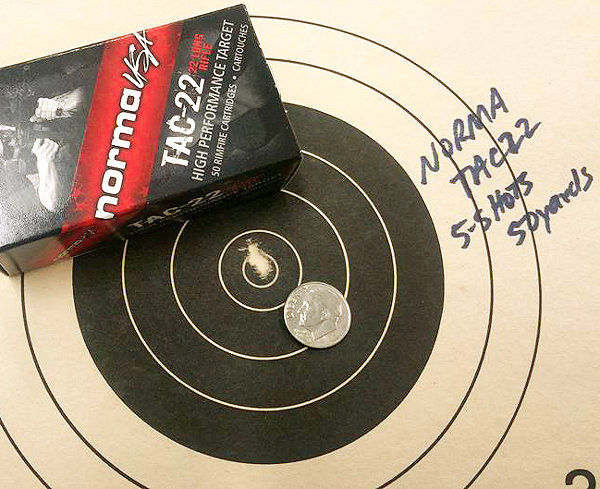
Photo from Champion Shooters Supply. Groups shot with Anschutz 1913 match rifle at 50 yards.
Check out that group. That’s impressive accuracy at 50 yards. You’d expect to pay $10.00 or more per box for rimfire ammo that can shoot this well. But get this — you can now get the Norma Tac-22 for just $3.99 per box. That’s right, this is some of the lowest-priced “Big Name” rimfire ammo you can buy, yet it offers top-tier accuracy. Low cost with high performance — that’s hard to beat.

The target photos above come from Champion Shooters Supply, which may have gotten an exceptional lot. This vendor tells us: “We have found this to run very well in Ruger rifles, handguns, and target pistols. These are 5-shot groups at 50 yards with an Anschutz 1913 rifle. This is an incredible value.”
We agree. We just ordered some Norma Tac-22 ourselves. Grab it while you can at these rock-bottom prices. The best deal we found on Norma Tac-22 ammo was $3.99 per box at Midsouth (Click below).

Other vendors with this Norma Tac-22 .22 LR rimfire ammo:
Bullets.com, $5.25/box | Champion Shooters Supply, $4.80/box | Grafs.com, $6.29/box
April 20th, 2017

You may not realize it… but to get the optimum BC from your bullets (i.e. the lowest aerodynamic drag), you must spin the bullets fast enough. Bullet drag increases (as expressed by lower BC) if the bullet spins too slowly. Bryan Litz of Applied Ballistics explains how BC changes with twist rates…
More Spin, Less Drag
In this article, we look at how twist rate and stability affect the Ballistic Coefficient (BC) of a bullet. Again, this topic is covered in detail in the Modern Advancements book. Through our testing, we’ve learned that adequate spin-stabilization is important to achieving the best BC (and lowest drag). In other words, if you don’t spin your bullets fast enough (with sufficient twist rate), the BC of your bullets may be less than optimal. That means, in practical terms, that your bullets drop more quickly and deflect more in the wind (other factors being equal). Spin your bullets faster, and you can optimize your BC for best performance.
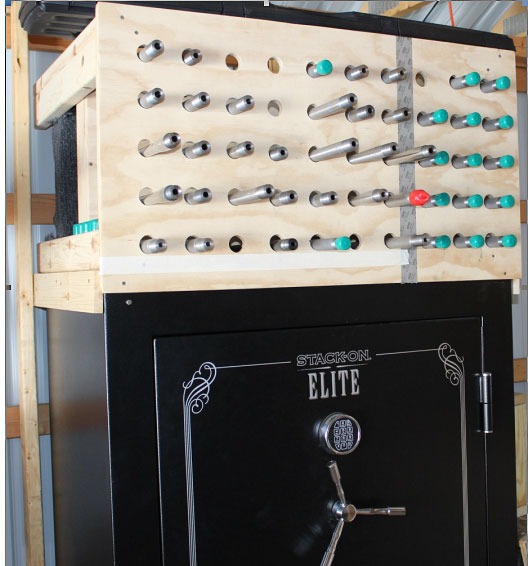
Any test that’s designed to study BC effects has to be carefully controlled in the sense that the variables are isolated. To this end, barrels were ordered from a single barrel smith, chambered and headspaced to the same rifle, with the only difference being the twist rate of the barrels. In this test, 3 pairs of barrels were used. In .224 caliber, 1:9” and 1:7” twist. In .243 caliber it was 1:10” and 1:8”, and in .30 caliber it was 1:12” and 1:10”. Other than the twist rates, each pair of barrels was identical in length, contour, and had similar round counts. Here is a barrel rack at the Applied Ballistics Lab:
Applied Ballistics used multiple barrels to study how twist rate affects BC.
“The Modern Advancements series is basically a journal of the ongoing R&D efforts of the Applied Ballistics Laboratory. The goal of the series is to share what we’re learning about ballistics so others can benefit.” –Bryan Litz
Barrel twist rate along with velocity, atmospherics, and bullet design all combine to result in a Gyroscopic Stability Factor (SG). It’s the SG that actually correlates to BC. The testing revealed that if you get SG above 1.5, the BC may improve slightly with faster twist (higher SG), but it’s very difficult to see. However, BC drops off very quickly for SGs below 1.5. This can be seen in the figure below from Modern Advancements in Long Range Shooting.
The chart shows that when the Gyroscopic Stability Factor (SG) is above 1.5, BC is mostly constant. But if SG falls below 1.5, BC drops off dramatically.
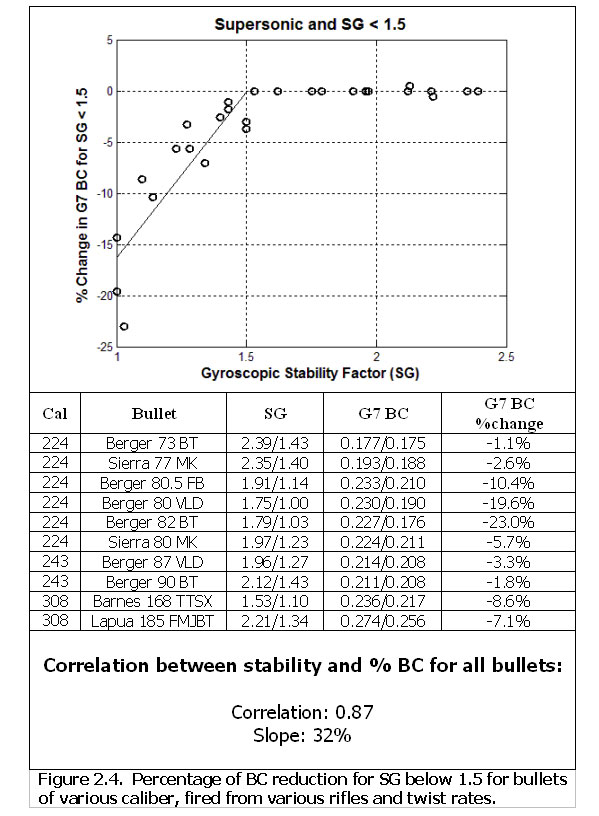
Note that the BC drops by about 3% for every 0.1 that SG falls below 1.5. The data supports a correlation coefficient of 0.87 for this relationship. That means the 3% per 0.1 unit of SG is an accurate trend, but isn’t necessarily exact for every scenario.
It’s a common assumption that if a shooter is seeing great groups and round holes, that he’s seeing the full potential BC of the bullets. These tests did not support that assumption. It’s quite common to shoot very tight groups and have round bullet holes while your BC is compromised by as much as 10% or more. This is probably the most practical and important take-away from this test.
To calculate the SG of your bullets in your rifle, visit the Berger Bullets online stability calculator. This FREE calculator will show you the SG of your bullets, as well as indicate if your BC will be compromised (and by how much) if the SG is below 1.5. With the stated twist rate of your barrel, if your selected bullet shows an SG of 1.5 (or less), the calculator will suggest alternate bullets that will fully stabilize in your rifle. This valuable online resource is based directly on live fire testing. You can use the SG Calculator for free on the web — you don’t need to download software.
Learn More About SG and BC
 This article is just a brief overview of the interrelated subjects of twist rate, Gyroscopic Stability, and BC. The coverage of twist rates in Modern Advancements in Long-Range Shooting is more detailed, with multiple live fire tests. This article is just a brief overview of the interrelated subjects of twist rate, Gyroscopic Stability, and BC. The coverage of twist rates in Modern Advancements in Long-Range Shooting is more detailed, with multiple live fire tests.
Other chapters in the book’s twist rate section include:
· Stability and Drag – Supersonic
· Stability and Drag – Transonic
· Spin Rate Decay
· Effect of Twist rate on Precision
Other sections of the book include: Modern Rifles, Scopes, and Bullets as well as Advancements in Predictive Modeling. This book is sold through the Applied Ballistics online store. Modern Advancements in Long Range Shooting is also available in eBook format in the Amazon Kindle store.
April 20th, 2017

We have used NO-LEAD Cleaner in rimfire benchrest rifles similar to this modified Suhl 150-1. It helped restore accuracy with minimal brushing.
 Made by the same folks that created Wipe-Out™, and Carb-Out™, the NO-LEAD Brushless Lead Remover™ really works. Honest. If you are an active rimfire shooter, or if you shoot cast lead-alloy bullets in centerfire rifles and pistols, you should try this product. We now use NO-LEAD in our rimfire benchrest rifles, and in some centerfire guns that receive a steady diet of soft-alloy cast bullets (90%+ lead). (With rimfire guns, you don’t need to use NO-LEAD very often — maybe every 300-400 rounds unless you have a real fouler of a barrel.) Made by the same folks that created Wipe-Out™, and Carb-Out™, the NO-LEAD Brushless Lead Remover™ really works. Honest. If you are an active rimfire shooter, or if you shoot cast lead-alloy bullets in centerfire rifles and pistols, you should try this product. We now use NO-LEAD in our rimfire benchrest rifles, and in some centerfire guns that receive a steady diet of soft-alloy cast bullets (90%+ lead). (With rimfire guns, you don’t need to use NO-LEAD very often — maybe every 300-400 rounds unless you have a real fouler of a barrel.)
If you’ve got stubborn lead fouling in a rimfire barrel, or on a pistol’s muzzle brake/compensator, you should definitely give this stuff a try. We don’t know how but it does soften lead deposits. The manufacturer says you don’t need brushes, but we found that a bit of brushing (after NO-LEAD application) can help remove more serious lead build-up.
Frankly we were surprised to find a lead solvent that really works. We have tried a half-dozen or more other lead “cleaners” that promise to dissolve lead and most of them, we discovered, are nearly useless. There’s a reason for that, as the lead alloys used in bullets don’t react to typical petrochemical-based solvents. It took the Wipe-Out chemists over five years to perfect a new water-based solution that really does dissolve lead.
NO-LEAD Cleaning Procedure — Read Carefully
NO-LEAD Lead Remover is a clear, red gel that is easy to apply. Just swab it in your bore (or on muzzle brakes) with wet patches or bore mop and let it sit for a few minutes. (The manufacturer says you can leave the NO-LEAD for up to 20 minutes, but that long of a dwell time does not seem necessary with our rimfire barrels.) When it contacts lead it will start to foam and you’ll see that the NO-LEAD solvent turns a pastel pink when it dissolves lead. The pink comes from the formation of lead oxide. After the recommended dwell time, simply patch out the dissolved lead deposits (you can also use a nylon brush for stubborn lead build-up).
NOTE: After cleaning, it is very important that you get all the NO-LEAD out of your barrel, and neutralize it. We recommend following the application of NO-Lead with Wipe-out or Patch-Out to neutralize the NO-LEAD, clear the bore, and remove residual carbon and copper fouling. If you don’t have Wipe-Out or Patch-out, flush the barrel thoroughly with Rubbing Alcohol or even a solution of Dawn dish detergent — then re-oil the bore.
Be Sure to Neutralize NO-LEAD After Use
Remember that N0-LEAD is a strong, slightly acidic chemical that needs to be neutralized after use. If you leave it on a nice, blued barrel for too long, it can harm the bluing. NO-LEAD will remove all the surface oils from the barrel bore. For this reason it is recommended that you neutralize NO-LEAD with Wipe-Out, or Patch-Out, which both contain effective corrosion inhibitors. If you don’t have those products, once you’ve flushed the NO-LEAD with something like rubbing alcohol, then follow with a gun oil. Caution: A petroleum-based gun oil will NOT, by itself, neutralize NO-LEAD. You need to neutralize first, then apply the corrosion inhibitor (or do it all in one step with Wipe-Out or Patch-Out).
 Where to Buy NO-LEAD Lead Remover Where to Buy NO-LEAD Lead Remover
NO-LEAD Lead Remover costs $15.99 for an 8 oz. squeeze bottle with a flip-top spout. This product is sold directly by Sharp Shoot R Precision Products, www.Sharpshootr.com, or you can purchase NO-LEAD through many other online vendors. For more information, send an email via the Sharp Shoot-R Contact Form or or contact Sharp Shoot-R at (785) 883-4444. You can ask for Terry Paul, Sharp Shoot-R’s owner and the master chemist who developed the NO-LEAD formula.
April 19th, 2017

This photo is one of Nightforce’s series of picturesque “Gunscapes”. SEE MORE HERE.
This story is not (directly) about firearms, or reloading gear, or any of the little details of our sport. It, instead, is about life… and, sadly, about death. The recent passing of a friend (and fellow shooter) got me to thinking, “I’m sixty — what if I only had ten more years to live — how would I want to live my life? What really counts the most? What things would I do differently? What dreams would I pursue?”
From the demographics of this website, I know we have thousands of readers in their 50s, 60s, and 70s. Hopefully we will all live long, happy, and fruitful lives. But it’s not a bad idea to consider that we are all mortal, and the clock is ticking. Consider this — in the United States, the average male life expectancy is 77 years*. Using that number as a benchmark, I personally may have just 15 more years to enjoy life and to do the things I love — shooting, traveling, sailing, camping, listening to music, being with friends and family. Breaking that down into months, I have 180 more months to do fun and rewarding stuff. Just 180 months — that’s a real number my brain can comprehend all too well. If I live an average lifespan, that means I also only have 780 more weekends to do all that I want to do. With less than 800 weekends remaining, I don’t want to waste a single one.
Living a Life with More Good Times, and Fewer Regrets
Recently, a group of men, very near the end of their lives, were surveyed. They were asked if they would do things differently if they could live their lives over again. The vast majority of these men gave surprisingly similar responses, which fit into five “Life Lessons”. These “Top 5 Regrets of the Dying” were reported in a story by Bronnie Ware, writing for the AARP online magazine. Ware writes: “When questioned about any regrets they had or anything they would do differently, common themes surfaced.” Here are the five regrets most often mentioned by older men:
1. I wish I’d had the courage to live a life true to myself, not the life others expected of me.
“This was the most common regret of all. When people realize that their life is almost over and look back clearly on it, it is easy to see how many dreams have gone unfulfilled. ”
Lesson: Don’t wait to follow your dreams. Be true to yourself.
2. I wish I didn’t work so hard.
“This came from every male patient [surveyed]. All of the men… deeply regretted spending so much of their lives on the treadmill of a work existence.”
Lesson: Don’t let your work crowd out other important aspects of life.
3. I wish I’d had the courage to express my feelings.
“Many people suppressed their feelings in order to keep peace with others. As a result, they settled for a mediocre existence and never became who they were truly capable of becoming.”
Lesson: Express yourself truthfully. Don’t suppress your feelings for decades.
4. I wish I had stayed in touch with my friends.
“There were many deep regrets about not giving friendships the time and effort they deserved. Many [were] so caught up in their own lives that they had let golden friendships slip by over the years.”
Lesson: Take an interest your friends’ lives; keep bonds of friendship strong.
5. I wish that I had let myself be happier.
“This is a surprisingly common [regret]. Many did not realize until the end that happiness is a choice.”
Lesson: Affirmatively pursue the things that bring you happiness. Don’t just stick to old habits.
Turn Off the Computer, and Do Something Memorable with Your Friends Today
How does this all apply to our shooting hobby? Well, if (like me) you are middle-aged (or older), go have some fun this weekend! Load up your rifle and get to the range. Don’t put off doing the things that make you happy. Call those old buddies you may not have seen in a long time. Renew friendships. Get out into nature. And start figuring out how you can live your dreams. As the saying goes, “Time waits for no man”.
*One of our readers pointed out that the numbers actually work out better than this, because once a man survives to later life, men of his surviving age cohort enjoy a projected lifespan longer than the average projected lifespan from birth. For example, using actuarial tables, a man born exactly 60 years ago (still alive today), has a calculated life expectancy of 23.4 years… meaning he would live to age 83.4 years, on average. CLICK HERE to see actuarial-predicted longevity based on your birthdate.

Practicing What I Preach…
As you read this, your Editor will NOT be sitting in front of a computer. Instead he will be on a boat, taking him 30 miles offshore to this beautiful spot. Three days with no internet, no TV, no Schedule Cs, and no traffic. Just good friends and unspoiled nature. Living like a kid again.

April 19th, 2017

The “Holy Grail” of prairie dog shooting is dispatching a dog at ultra-long-range — the farther the better. Here we recount the quest of Forum member VolDoc to nail a Prairie Dog at 1000+ yards with a Savage .20-caliber rifle. If you’re a fan of the “Terrific 20s”, or have an interest in ultra-long-range varminting, you’ll enjoy this story. VolDoc, a dentist by trade, is a seasoned Prairie Dog Hunter who has made many trips to the P-Dog fields in Colorado with his hunting buddies. But until recently he had never managed to nail a P-Dog at 1000 yards with a .20-caliber rifle. Nor, as far as we can determine, had any one else. But VolDoc did it — accomplishing a verified Prairie Dog kill at 1032 yards, possibly the longest recorded with a .20-Caliber rifle.
READ .20-Cal 1000-Yard Prairie Dog Quest FULL STORY
Modified Hart-Barreled 20BR Savage Does the Job
Shooting Prairie Dogs at extreme long range takes highly specialized equipment. To make his 1032-yard kill shot, VolDoc used a modified Dual-Port Savage chambered in 20 BR. The stock was geometrically-uniformed and pillar-bedded by smith Kevin Rayhill, who fitted a 28″ Hart barrel with a Rayhill muzzle brake. VolDoc loaded his 20BR with 55gr Berger BT LR Varmint bullets (0.381 G1 BC) pushed by a stout charge of Hodgdon Varget.

It took good conditions, and patience to make the successful 1000+ yard shot. Voldoc explains:
“We were out on the Colorado prairie at daylight and the conditions were perfect. The sunrise was at my back and we had about a 10 mph tailwind. I looked through my Leica Geovid Rangefinder Binos and the Prairie Dogs were out for breakfast. I quickly ranged the targets and found a group at about 1,050 yards.
My first shot was very, very close. I added about four clicks up and a couple of clicks left for windage and let another go. That shot threw dirt all over, but the dog didn’t even flinch. On the fourth shot, I saw the dog go belly up and kick its final throws. My quest for the 20-Caliber 1,000-yard Prairie Dog had become a reality. We confirmed the distance with our lasers at 1,032 yards.”

Voldoc’s Accurate Arsenal
In our report on VolDoc’s successful 1K Prairie Dog quest, we spotlighted two of VolDoc’s other accurate varmint guns. First, fans of fine wood will love VolDoc’s switch-barrel, drop-port Stiller Diamondback rifle. The wood on this gun is stunning. The custom stock was crafted from 40-year-old English Walnut to match the profile of a Shehane ST-1000. The rifle has three barrels with three different chamberings: 6BR Brux 1:8″-twist HV; 6BRX Krieger 1:8″-twist HV, and 6mm Dasher Krieger 1:8.5″-twist fluted straight contour (no taper). The scope is a Nightforce 12-42x56mm, with 2DD reticle.
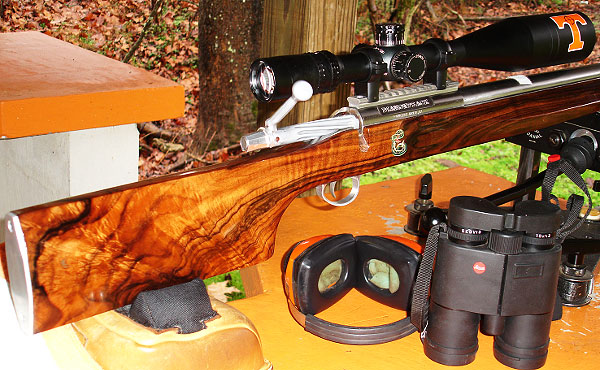
VolDoc’s “Go-To” Prairie Dog Rifle — Big Orange Crush Dasher
Next, check out VolDoc’s “Big Orange Crush” rifle. This features a stainless Nesika ‘J’ action in a painted fiberglass Shehane ST-1000 stock. Originally a 6BR, the gun is now chambered as a 6mm Dasher with a .271″ no-turn neck. The barrel is a 1:12″-twist Krieger fited with Vais muzzle brake. Big Orange Crush shoots 87gr V-Maxs into bugholes at 3,400 fps, according to VolDoc. He tells us that “The barrel now has more than 3,000 rounds down the tube and exhibits little throat fire-cracking and no loss of accuracy. I can’t explain why, it just hasn’t deteriorated yet. This rifle is my best-ever ‘go-to’ Prairie Dog rifle.”

April 18th, 2017

Most of us assume that if we weigh our powder carefully (down to the tenth of a grain or less) we can achieve a uniform powder fill from case to case in our handloads. Weighing does ensure that the weight of the propellant in each case is the same, but is the column of powder the same by volume each time? “Not necessarily” is the answer. An interesting experiment by our friend Boyd Allen demonstrates that the manner in which you place kernels in the case can make a significant difference in the height of the powder column within the brass case.
Using a Gempro 250 scale, Boyd measured exactly 30.6 grains of Vihtavuori N-133 powder. He then inserted this powder in the same cartridge case multiple times. (The case has a fired primer in place.) But here is the key — Boyd used various filling techniques. He did a slow fill, and a fast fill, and he also experimented with tapping and drop tubes. What Boyd discovered was that you can start with the exact same weight of powder (in fact the very same set of kernels), yet end up with vary different fill heights, depending on how you drop the kernels into the case. Look at the photos. Despite variations in lighting, the photos show the same 30.6 grains of powder, placed in the same cartridge, with four different methods.
Using funnels with long drop tubes packs kernels more tightly, creating a shorter powder column. That allows you to get more propellant (by weight) into the case.

Boyd Explains the Procedure Used for his Experiment.
EDITOR’s NOTE: So there is no misunderstanding, Boyd started with a weighed 30.6 grain charge. This identical charge was used for ALL four fills. After a fill the powder was dumped from the case into a pan which was then used for the next fill technique to be tried. So, the powder weight was constant. Indeed the exact same kernels (of constant weight and number) were used for each fill.
Boyd writes: “I used the same powder for all fills, 30.6 gr. on a GemPro 250 checked more than once. All fills employed the same RCBS green transparent plastic funnel. The fast drop with the funnel only overflowed when it was removed from the case neck, and 15 granules of powder fell on the white paper that the case was sitting on. The fast-funnel-only drop with tapping, was done with the funnel in place and the case and funnel in one hand, while tapping the case body with the index finger hard, many times (about 20 fast double taps). My idea here was to “max out” the potential of this tapping technique.
The slow drop with the funnel and 10″-long .22 cal. Harrell’s Precision drop tube, was done by holding the scale pan over the funnel and tapping the spout of the pan repeatedly on the inside of the funnel about 1/3 down from the top, with the scale pan tilted just enough so that the powder will just flow. Many taps were involved, again, to max out the technique.
Again, to be clear, after each case filling, the powder was poured from the case back into the scale pan carefully. You may notice the similarity between the fast drop with the drop tube, and the funnel only with tapping. Although I did not photograph it, fast tube drop and tapping (combined) improved on tapping alone, but only to about half as far down the neck as the slow with drop tube. Due to the endless possible permutations, I picked four and left it at that.
I believe that I can make the rough judgment that the scale pan funnel and drop tube technique, which involved a longer drop period, and probably less velocity at the top of the tube, left more room in the top of the case neck than the slow drop from the measure with the same drop tube. You have both pictures, so you can make the comparison.” — Boyd
Does Powder Column Height Variance Make a Difference?
Boyd’s experiment proves pretty conclusively that the method of dropping a given weight of powder can affect the height of the powder column in the case and the degree of powder compression (when a bullet is seated). He showed this to be true even when the exact same set of kernels (of constant weight) was used in repetitive loadings. This raises some interesting questions:
1. Will subsequent cartridge transport and handling cause the powder to settle so the variances in powder column height are diminished?
2. If significant inconsistencies in powder column height remain at time of firing, will the difference in fill level hurt accuracy, or result in a higher extreme spread in velocity?
3. Is there any advantage (beyond increased effective case capacity) for a tight (low level) fill vs. a loose (high level) fill?
We don’t know the answer to these follow up questions. This Editor guesses that, if we tested low-fill-height rounds vs. high-fill-height rounds (all with same true fill quantity by weight), we might see meaningful differences in average velocity. I would also guess that if you fired 10 rounds that exhibited quite a difference in powder column heights, you might see a higher ES/SD than if you shot 10 rounds loaded with a very consistent powder column height (either high or low). But further testing is needed to determine if these predictions are true.
April 18th, 2017
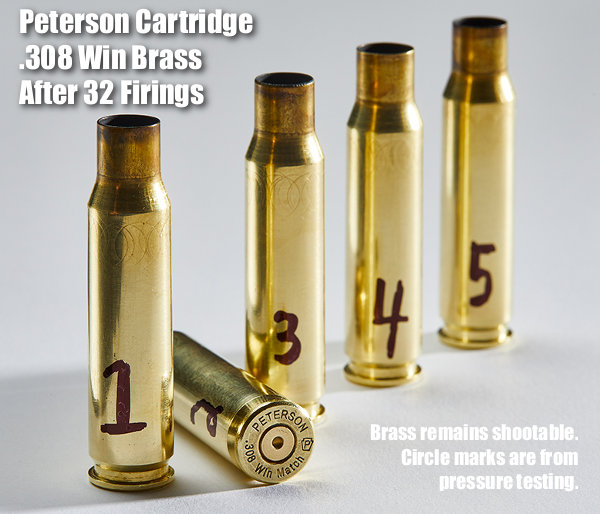
Here are five Peterson .308 Win casings after 32 loading/firing cycles (31 at SAAMI max). The brass remained intact, with no cracks. The circles below the shoulders are markings from pressure testing.
This story comes from the Peterson Cartridge website.
Torture Testing Peterson .308 Win Brass — 32 Load Cycles
Recently Peterson’s ballistician had some extra time in his schedule, and asked what he should work on next. He was told, “Just for the heck of it, see how many times you can fire our .308s before you experience failure.” So that’s what he set out to do.
He took five casings out of inventory and loaded them at SAAMI max pressure, which is the pressure we use for all of our longevity testing. It is a hot load, and he did the firing out of Peterson’s Universal Receiver. This way he could measure pressures and velocities each shot. He shot all five, 20 times. (It takes a long time to do that. Load five casings. Shoot five times. Back into the lab to reload, back into the indoor range to shoot, back into the lab, and so forth.)
After 20 firings with no sign of case deterioration, Peterson’s tester asked if he should keep going. “Sure, let’s see how long these can go”, was the reply. So he shot them five more times. Same result. All casings still in good shape. We told him to keep going. He shot each of them six more times. At this point each of the five casings had been fired 31 times. After several days of this the casings were still in good shape but “ballistician fatigue” was setting in. Finally he said, “Let me take these cases to an outdoor range and see how they do for accuracy.” The Peterson team agreed.
Five Shots at 100 Yards after 32 Load Cycles:
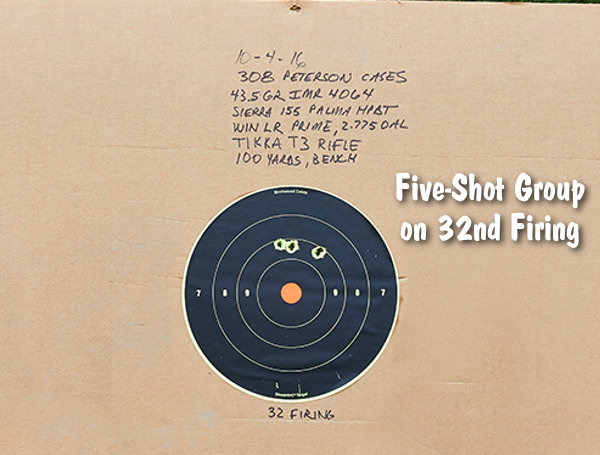
For the 32nd firing, the cases were loaded with a somewhat lighter load, and then tested for accuracy. The test rifle was a Tikka T-3 bolt action, with a 20 inch, 1:11″-twist barrel. After 32 firings the primer pockets had opened about 0.002″ (two-thousandths) but were still tight enough for further use. There were no cracks or signs of head separation. The tester put five shots in three holes at 100 yards. The group was 1.5 inches for the five shots, on a somewhat windy day.
Story Tip by EdLongrange. We welcome reader submissions.
April 17th, 2017

At the request of our readers, we provide select “Deals of the Week”. Every Monday morning we offer our Best Bargain selections. Here are some of the best deals on firearms, hardware, reloading components, and shooting accessories. Be aware that sale prices are subject to change, and once clearance inventory is sold, it’s gone for good. You snooze you lose.
1. Amazon.com — Rock Chucker Supreme Reloading Kit, $279.99

Everything you see above can be yours for just $229.99, after manufacturer’s rebate. Right now, Amazon is selling the Rock Chucker Supreme Master Reloading Kit for $279.99. That’s a great deal considering all the hardware you get. Heck, the Rock Chucker press alone is worth $150.00+. But here’s the real incentive — this Rock Chucker Supreme Kit qualifies for a Buck$ or Bullets Rebate — choose either $50 or 500 Speer bullets. If you take the fifty bucks ($50), that reduces your net cost to just $229.00 for the entire RCBS Reloading Kit. That’s a total steal. NOTE: Cabelas.com also sells this RCBS Kit for the same $279.99 (before rebate).
2. Grafs.com — Burris Scope Close-Outs, Huge Savings

Graf & Sons is now offering various Burris scopes with Close-Out Pricing– up to $40% off. If you are looking for a budget-priced, medium-range zoom scope for your hunting or varmint rifle, check out these deals. For example, the Burris Predator Quest 4.5-14x42mm (Side Focus) Scope is now just $199.99 — that a 38% savings. In addition to these optics close-outs, Grafs.com is offering FREE Shipping for a limited time. You can get FREE Shipping with orders totalling $100.00 or more. This shipping deal is valid through 4/18/17 at 11:59 PM.
3. PT&G — Howa Barreled Actions with Trigger, $350.00

Howa makes excellent, smooth-running actions, and the Howa HACT 2-stage trigger is WAY better than most domestic factory triggers. Right now you can save big bucks on Howa barreled actions, complete with HACT trigger and trigger-guard. Pacific Tool & Gauge (PT&G) sourced a truckload of Howa barreled actions, which are now on sale. Available at $350.00 are: .204 Ruger, .223 Rem, .22-250, .243 Win, 7mm-08, and .308 Win. Choose from light- or heavy-barrel contours. For $390.00 you can get .375 Ruger, 7mm Rem Mag. These barreled actions would be great for custom hunting/varmint rifle projects — many have factory camo finishes. Howa barrels typically deliver easy sub-MOA accuracy (and often much better). Some of these barreled actions may carry Weatherby or Nosler markings, but they were all made at the Howa factory in Japan.
4. Midsouth — .224-Cal 62 Grain BTHP Bullets, $24.86 for 250

Headed out for a varmint safari soon? Need inexpensive bullets for your .223 Rem or 22-250? Then check out this deal on from Midsouth Shooters Supply. Get 250 BTHP 62gr .224-Caliber bullets for just $24.99. That’s just $9.94 per hundred. At that price, it doesn’t hurt so much when you shoot 1000+ rounds over a weekend. With good expansion, these bullets work great on prairie dogs and other small critters. Note: These sale bullets ship in a bag. Midsouth also offers bulk pricing on 500-bullet and 1000-bullet quantities.
5. Stocky’s Stocks — Composite Stock with Bedding Block, $179.99

Here’s a killer deal on a versatile Stocky’s Long Range Stock with aluminum V-block bedding system. For just $179.99, order this for Rem/Rem Clone long actions or short actions, with either narrow or wide (varmint/tactical) barrel channel. This would be a good choice for a varmint rifle. This is also offered with a matte black, tan, or olive baked-on textured finish for $199.99.
6. Cabela’s — Mossburg Shotgun in Waterproof Case, $469.99

Here’s the perfect weapon to repel boarders or fight zombies! OK, you may not really NEED a pistol-grip shotgun, but this thing is just so cool. The Mossburg 500 Mariner shotgun has a durable Marinecoat finish and comes in a Int’l Orange storage case that floats. Keep this pump-gun on your boat, in your truck, or make it part of your “bug-out kit”. The floating tube’s heavy-duty synthetic seal is factory-tested to be airtight and waterproof to 40 feet. With a 6-round capacity, this Mossberg shotgun features an 18.5″ cylinder-bore barrel with bead front sight. It even ships with a knife and a multi-tool. There is also a matte black version with a green tube for just $349.99.
7. Amazon — Motorola Walkie Talkies, $48.99 per Pair

Walkie-Talkies are “must-have” items for long-range shooting. They let you reset targets and talk to back to the firing line. These are also very handy on hunts. The Motorola MH230R Two-Way Radio is Amazon’s #1 Best Seller in FRS/GMRS Handheld Radios. This under-$50.00 set offers 22 channels with a claimed range up to 23 miles (We’ve used them and they worked at 3 miles line of sight). The kit includes: 2 radios, 2 belt clips, 1 dual drop-in charger, 1 charging adapter, 2 NiMH rechargeable battery packs. Run-time is about 10 hours — plenty for a full day of shooting. There is also a newer version, the Motorola T260 for $58.99.
8. Amazon — AR500 Steel 8″-Diameter Gong, $19.95 Delivered

We like reactive targets. It’s fun to “ring steel” and see a target move instantly when hit. For just twenty bucks (including shipping), it’s hard to go wrong with this 8″ AR500 Steel Gong. The 8″-diameter size is big enough for zeroing at 200 yards, yet offers a nice challenge at 500 yards and beyond. There is also a 6″-diameter model for just $14.00.
April 17th, 2017

 Forum member Rick from Louisiana (aka RMulhern) has rigged up a fantastic target for long-range shooting. Rick, a long-time competitive Palma shooter, had a large 72″x72″ steel target fabricated with two separate center rings that are equivalent to the official paper Palma/Creedmoor target. He says he’s “shot a lot of Palma on that target, as well as lots of Black Powder Cartridge (BPCR) rounds”. The big steel target works great when Rick shoots his Sharps 45/110 BPCR at 800 to 1000 yards. The large steel background (painted white) helps Rick see and hear his hits. If you understand the high-arching trajectory of 500+ grain projectiles shot from a 45/110, you know it can take a few rounds to get Point of Impact dialed in. Forum member Rick from Louisiana (aka RMulhern) has rigged up a fantastic target for long-range shooting. Rick, a long-time competitive Palma shooter, had a large 72″x72″ steel target fabricated with two separate center rings that are equivalent to the official paper Palma/Creedmoor target. He says he’s “shot a lot of Palma on that target, as well as lots of Black Powder Cartridge (BPCR) rounds”. The big steel target works great when Rick shoots his Sharps 45/110 BPCR at 800 to 1000 yards. The large steel background (painted white) helps Rick see and hear his hits. If you understand the high-arching trajectory of 500+ grain projectiles shot from a 45/110, you know it can take a few rounds to get Point of Impact dialed in.
Rick reports: “These are two of my favorite rifles to shoot: a M1874 Shiloh Sharps in caliber 45/110 (2 7/8) made in Big Timber, Montana by Kirk Bryan and family. The other is a 6.5×47 Lapua on a blue-printed M700 action with 1:8.5″-twist Krieger barrel and F5 McMillan Tactical stock. Many of the shooters that take up BPCR have a tendency to get away from their smokeless powder rifles in favor of the blackpowder game. Frankly I have the best of both worlds as I enjoy shooting both (smokeless and BPCR), although I must admit that I probably spend the majority of my time on the range with the Sharps rifles these days.” (Rick’s pretty good with his Sharps by the way — he recently shot a 95, 96, and 100 (clean) for 3×10 shots at 800 yards.)
Gongzilla: $1000 Worth of Steel with Three Plate Layers
Rick tells us: “Here’s the deal — everything is steel! The large plate is 72″x72″ and the black bull is 44″ diameter. The 20″-diameter central white bull is made from 1/2″-thick AR400 bull-dozer plating. That’s the same size as the regulation Palma/Creedmoor paper target. The white square and black bull are 3/8″-thick mild steel. Plates are off-set 2″ from each other. I welded a 2″ length of square tubing to the back of both plates and the bolt slides through and is attached to the large plate. I used 2 3/8″ upset tubing (oil field pipe) for the holder framing.” Rick says he invested about $1000.00 in metal for the target, but that was 15 years ago. Today the steel would be much more expensive.

Rick says the AR400 armor plate in the center bull is very strong: “You can shoot a .338 Lapua Magnum at 200 yards and it won’t damage the center bull”. The mild steel works well for the cast bullets Rick uses with his Sharps 45/110. Also, Rick says the mild steel is rugged enough for 6.5mm and .308 hollowpoint match bullets, if you’re at least 500 yards away. However, Rick told us, “If I would make [the target] again, I would make the black bull AR400 as well. [That way] you would never have to worry about big dents or beating the plate up at any distance. The AR400 is very tough steel. You can shoot a Sierra or Lapua HP bullet and they will just splatter.”
Rick told us: “I built this target with off-set clanger plates. The white clanger is AR400. Bullets just splatter!” Does he worry about hitting the bolt head? Not at all. Rick says: “When I hit the bolt head, I break my arm patting myself on the back!”.
|


