At the request of our readers, we provide select “Deals of the Week”. Every Monday morning we offer our Bargain selections. Here are some of the best deals on firearms, hardware, reloading components, and shooting accessories. Be aware that sale prices are subject to change, and once clearance inventory is sold, it’s gone for good. You snooze you lose.
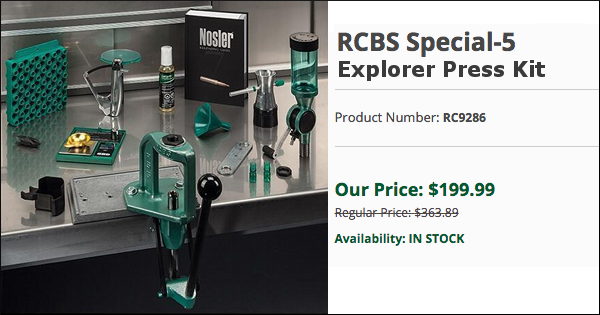
1. Natchez — Special 5 Reloading Press Kit, $199.99
This is an excellent entry-level reloading kit, which is on sale for $199.99 at Natchez Shooters Supplies. We like the relatively compact Special 5 press for most reloading duties. Eventually you may want to add an additional, large heavy press, but this will get the job done. This kit includes an RCBS Powder Measure, Digital Scale, Powder Trickler, Hand Priming Tool, Load Manual, Loading Tray, and more. It’s hard to beat this combination of tools for under $200.00.
Walker’s new Razor-X and Razor-XV operate like electronic muffs — allowing you to hear commands and conversations while still blocking loud noises. The Razor-X combines a collar unit (containing the electronics) with retractable, foam-tipped ear buds. Unlike conventional earmuffs, the Razor-X system doesn’t interfere with your cheek weld. The patent-pending earbuds provide an impressive 31dB of noise reduction, with the ability to hear commands. To ensure a good fit (for best noise reduction), the Razor-X and Razor-VX come with two styles of noise-reducing foam tips. An AC wall adapter with USB port and a one-meter micro USB cord is provided. READ Razor-X User Reviews.
We like reactive targets. It’s fun to “ring steel” and see a target move instantly when hit. For just twenty bucks (including shipping), it’s hard to go wrong with this 8″ AR500 Steel Gong. The 8″-diameter size is big enough for zeroing at 200 yards, yet offers a nice challenge at 500 yards and beyond. There is also a 6″-diameter model for $16.00.
4. Cabelas — Big Ammo Sale Plus FREE Shipping
Right now, Cabela’s is running a big sale on all types of ammunition from major manufacturers. Save as much as 20% off regular pricing. For example, Winchester 9mm pistol ammo is marked down from $13.99 to $11.99 for 50 rounds. And PMC X-Tac 5.56×45 ammo is reduced from $9.99 to $8.49 for 20 rounds. Plus, you can get FREE SHIPPING on all orders of $99.00 or more. Use Code 86BUY during checkout (code valid through 8/31/2016).
5. Kelbly.com — 15% Off Discount on All Products
Looking for a Panda or Atlas Action, or a complete match rifle? Here’s a great promotion from our friends at Kelbly’s. Now through Tuesday, August 23, 2016 you can get 15% of ANYthing on the Kelblys.com website. That includes rifles, actions, stocks, barrels, scope rings, muzzle brakes, Berger bullets, accessories and more. To save big, use code 15ALL at checkout. Don’t delay — this offer expires at 11:59 pm on September 1, 2016.
6. Midsouth — Complete Case Tumbling Kit, $73.70
This brass tumbling system contains everything you need to clean your cartridge brass: Vibratory Case Tumbler, Rotary Media Separator, 6 lbs. of Corn Cob Media, and 8 oz. of Brass Polish. Right now this whole system is on sale at Midsouth for just $73.70. The case tumbler, which holds 450 .223 Rem cases or 1000 9mm cases, has a three-year motor warranty. This is a good deal for the package. You could pay $65.00 for a good vibratory Tumbler by itself.
7. Natchez Shooters Supply — 325 Rounds .22 LR Ammo, $22.99
This Federal .22 LR ammo is just 7 cents per round — the kind of pricing on bulk rimfire ammo we used to see in the “good old days”. Act quickly, this $22.99 Federal .22 LR Ammo deal won’t last long. Each box contains 325 rounds — enough ammo for many sessions at the range. The bullets are 40 grains, solid lead.
8. CDNN — Browning A-Bolt with Nikon Scope, $639.99 w/Rebate
Right now you can get a nice, wood-stocked Browning A-Bolt III Hunting rifle in .308 Winchester for just $689.99. And, to sweeten that deal, the current “Browning Benjamins” Rebate program knocks $50.00 off, so the price (with rebate) is just $639.99. This package includes a Nikon Buckmaster II 4-12x40mm BDC scope. This same Browning/Nikon special is available in many other chamberings for the same price: .243 Win, .270 Win, .270 WSM, 7mm-08, .30-06 Spr, .300 Win Mag.
9. Browning — Save Up to $100 on Browning Firearms (Rebates)
Now through the end of September, 2016, Browning is offering substantial cash rebates on rifles, pistols, and shotguns. Save $100.00 on a shotgun, $50.00 on a rifle, or $25.00 with this rebate offer, good on firearms purchases made by September 30th. Browning makes some pretty darn good firearms. This Editor owns a Browning Citori Shotgun and it’s a gem. CLICK HERE for details and Rebate Form.
McMillan Fiberglass Stocks is introducing a new F-Class Open Division stock. This offers a low profile fore-end and parallel geometry for improved tracking. This is similar to McMillan’s previous F-Open stock, but with important enhancements. Here is Kelly McMillan’s report:
“Our new Kestro is … made specifically for F-Class Open competition. Notice we have kept the low profile fore-end while increasing the mass and rigidity. The fore-end is not only ‘dead nuts’ in line with the butt stock, but it is also on an exactly parallel plane so when it recoils there is no rise or lateral shift in the cross hairs.
This model comes with an integral adjustable cheek-piece and can have our standard buttplate or our lightweight 3-way adjustable butt plate. My estimation is that this stock will weigh as light as 4.5 pounds fully dressed, or as much as 8 pounds depending on what you need.
We are currently working on the cheek-piece free model for those of you who don’t put your face on the stock. One more thing, this color combination we call a Tiger Stripe Maple.” Editor’s NOTE: Though “maple” is in the stock color name, this is a reinforced fiberglass stock, not wood.
The Remington 700 is the most popular bolt-action rifle in America, at least according to Gunbroker.com sales figures for new and “previously-owned” rifles. So, chances are that you (or a close family member) may have a Rem 700 of some vintage sitting in the gunsafe. But do you have a copy of the official Remington 700 product manual in digital PDF format? Probably not.
To get you squared away, CLICK HERE for a PDF version of the latest Remington 700 Owner’s Manual (also covers models Seven, and 673).
Here are links for other Remington Manuals (Right lick and “Save As” to Download):
Everybody knows that powerful spotting scopes work best when mounted to a stable tripod or otherwise secured to a steady mount. Yet when most folks use binoculars, they never even think of using a tripod, despite the fact that tripod adapters are available for many premium binoculars. A serious hunter should learn how to glass with tripod support. With binoculars offering more that 8X magnification, you can really benefit from a steady mount. In this article, Mark Boardman of Vortex Optics, an experienced hunter, explains the benefits of using a tripod with high-magnification binoculars.
John Whidden of Whidden Gunworks used the .243 Winchester cartridge to win the 2016 NRA Long Range Championship, his fourth LR title at Camp Perry. John selected the .243 Win because it offers excellent ballistics with manageable recoil. John says that, at least for a sling shooter, the .243 Win is hard to beat at long range. Yes, John says, you can get somewhat better ballistics with a .284 Win or .300 WSM, but you’ll pay a heavy price in increased recoil.
.243 Winchester — The Forgotten 6mm Cartridge for Long Range
by John Whidden, 2016 National Long Range Champion
My experience with the .243 cartridge for use as a Long Range High Power cartridge dates back about 10 years or so. After building a .300 WSM, I realized that the recoil was hurting the quality of my shots. The WSM shot great, but I couldn’t always execute good shots when shooting it. From here I built a 6.5-284, and it shot well. I also had a very accurate 6mmBR at the time, and my logic in going to the .243 Win was to get wind performance equal to the 6.5-284 with recoil similar to the 6mmBR. The experiment has worked out well indeed!
Championship-Winning Load: Berger Bullets, Lapua Brass, and Vihtavuori N160
For a load, currently I’m shooting Lapua brass, PMC primers (Russian, similar to Wolf), VihtaVuori N160 single-base powder, and Berger 105 grain Hybrid bullets. I switched to the Hybrid bullets fairly recently at the beginning of the 2015 season. Previously I shot the 105gr Berger hunting VLDs, and in testing I found that the Hybrids were just as accurate without having to seat the bullet into the lands. The velocity of this combination when shot through the excellent Bartlein 5R barrels (32” length) is around 3275 FPS.
For my match ammo, I seat the Berger 105 Hybrids well off the lands — my bullets are “jumping” from .035″-.060″. I only use one seating depth for ammunition for multiple guns (I know some benchrest shooters will stop reading right here!) and the bullets jump further in the worn barrels than in the fresh barrels. The bullets are pointed up in our Bullet Pointing Die System and are moly-coated. The moly (molybdenum disulfide) does extend the cleaning interval a little bit, probably 20% or so. The Lapua .243 Win brass is all neck-turned to .0125″ thickness.
Whidden’s .243 Win Ammo is Loaded on a Dillon
My loading process is different than many people expect. I load my ammo on a Dillon 650 progressive press using our own Whidden Gunworks dies. However powder charges are individually weighed with a stand-alone automated scale/trickler system from AutoTrickler.com (see below). Employing a high-end force restoration scale, this micro-processor controlled system offers single-kernel precision. The weighed charges are then dropped into the cases with a funnel mounted to the Dillon head.
The Lapua .243 Win brass is full-length sized every time, and I run one of our custom-sized expanders in my sizer die. The expander measures .243″ which yields the desired .001″ neck tension. In my experience, the best way to get consistent neck tension is to run an expander in the case neck at some point. When sizing the case neck by a minimal amount such as is the case here, I don’t find any negative points in using an expander in the sizer die.
In my experience, the keys to accurate long range ammo are top quality bullets and the most consistent neck tension you can produce. From these starting points, the use of quality components and accurate powder measurement will finish out the magic.
Great Ballistics with 6mm 105s at 3275 FPS
Running at an impressive 3275 FPS, Berger 6mm 105 grain Hybrids deliver ballistics that are hard to beat, according to John Whidden:
“My .243 Win shoots inside a 6.5-284 with 142-grainers. Nothing out there is really ahead of [the .243], in 1000-yard ballistics unless you get into the short magnums or .284s and those carry a very significant recoil penalty. In the past I did shoot the 6.5-284. I went to the .243 Win because it had similar ballistics but had much less recoil. It doesn’t beat me up as much and is not as fatiguing.
With the .243 Win, there’s no tensing-up, no anticipating. With the reduced recoil (compared to a 7mm or big .308), I can break and shoot very good quality shots. I find I just shoot better shots with the .243 than I ever did with the 6.5-284.”
If you ever shoot factory ammo, you should consider getting Ammo & Ballistics 5. This resource book lists over 2,600 different loads for 190 cartridge types from 17 Mach 2 up to .700 Nitro Express, including the most popular centerfire and rimfire cartridges (both rifle and handgun). There are over 1,400 tables with ballistics data for nearly all commercially-loaded hunting ammunition sold in the United States (as of 2013, the publication date). Tables include velocity, energy, wind drift, bullet drop, and ballistic coefficient.
This book can be helpful when choosing ammo for a hunt. You can quickly compare the velocity and knock-down power of various types of commercial ammo. In addition, this book can help you choose a caliber/chambering for your next hunting rig, as you can compare factory load options.
Book Purchaser Reviews
“The data contained in this book is invaluable. If you don’t understand momentum vs. energy, MER and MEPBR, this book will help you gain an understanding. If you don’t know what the Taylor Knock Out (KO) Index is, this book will enlighten and inform.” — Daryl ID
“Great heaps of data! This volume has pages and pages of new data for .22LR like the hot Velocitor, and also on the .22 WMR from 30 grains up into the 50s. Most importantly there is lots of range data, drop, windage, kinetic energy, etc. — Terrific reference guide….” — E. Svanoe
With suicide accounting for nearly two-thirds of all firearm fatalities annually, the topic of suicide prevention deserves our attention. In recent years NSSF has worked with the Veterans Administration, the State of Utah, and mental health agencies to help educate gun owners and the public on how to keep firearms safely out of reach of those who, during a period of despair, decide to do themselves harm.
According to Centers for Disease Control and Prevention (CDC) Data:
1. Nearly half of all suicides were by firearm in 2014.
2. Suicide accounted for almost two-thirds of gun deaths in 2014.
3. 90 percent of suicide attempts with a firearm are fatal.
The NSSF has committed to broaden its efforts, in partnership with the American Foundation for Suicide Prevention (AFSP). Recently, NSSF and AFSP announced a partnership to embark on a first-of-its-kind national plan to build and implement public education resources for firearms retailers, shooting ranges, and the firearms-owning community about suicide prevention and firearms.
Experts say that suicide results from the culmination of several health and life factors, with the decision to act often being made in minutes. Keeping firearms securely stored puts space between the period of risk and the means to act, and sometimes that … can help save a life.
AFSP has commenced a four-state pilot program that will involve firearms retailers and shooting ranges. This pilot program employs AFSP/NSSF jointly-developed strategies and resources to inform firearm owners about warning signs, prevention resources and secure firearms storage options. The NSSF also supports AFSP’s Project 2025, an initiative to reduce the annual suicide rate 20 percent by 2025. You will be hearing more about AFSP and NSSF efforts in this area.
Summer is almost over. That’s means hunting season is coming soon. To help you prepare for your fall hunts, NRABlog.com has created a set of color practice hunting targets. You can hone your skills on a trio of bucks, three gobblers, or three wild hogs.
Each target features three red bullseyes, centered on the animals. You can print the targets in black and white, but they look best in color. Click on each image below to download a FREE printable PDF file.
As the NRA Blog says: “Print out the turkey target, grab your shotgun, and head to the outdoor range. Or, try your hand at deer and hog while zeroing your rifle.”
RIght-Click Each Image to Download Printable PDF File:
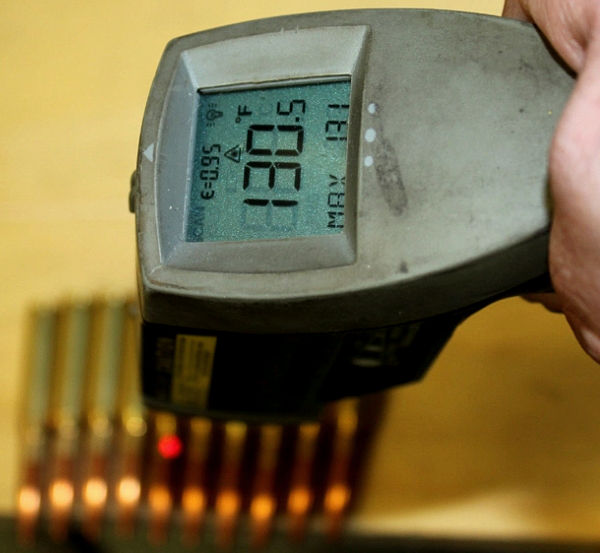
In this .308 Win test, 70° F ammo shot 96 FPS slower than ammo heated to 130.5° F. And the 130.5° ammo was 145 fps faster than ammo right out of the freezer (at 25.5° F). That’s a huge difference…
EDITOR’s NOTE: The Sierra tester does not reveal the brand of powder tested here. Some powders are much more temp sensitive than others. Accordingly, you cannot extrapolate test results from one propellant to another. Nonetheless, it is interesting to see the actual recorded velocity shift with ammo temperature variations in a .308 Win.
Written by Sierra Chief Ballistician Tommy Todd This story originally appeared in theSierra Bullets Blog
A few weeks ago I was attending the Missouri State F-Class Match. This was a two-day event during the summer and temperatures were hot one day and hotter the next. I shot next to a gentleman who was relatively new to the sport. He was shooting a basically factory rifle and was enjoying himself with the exception that his scores were not as good as he hoped they would be and he was experiencing pressure issues with his ammunition. I noticed that he was having to force the bolt open on a couple of rounds. During a break, I visited with him and offered a couple of suggestions which helped his situation somewhat and he was able to finish the match without major issues.
He was shooting factory ammunition, which is normally loaded to upper levels of allowable pressures. While this ammunition showed no problems during “normal” testing, it was definitely showing issues during a 20-round string of fire in the temperatures we were competing in. My first suggestion was that he keep his ammunition out of the direct sun and shade it as much as possible. My second suggestion was to not close the bolt on a cartridge until he was ready to fire. He had his ammo in the direct sunlight and was chambering a round while waiting on the target to be pulled and scored which can take from a few seconds to almost a minute sometimes.
This time frame allowed the bullet and powder to absorb chamber [heat] and build pressure/velocity above normal conditions. Making my recommended changes lowered the pressures enough for the rifle and cartridge to function normally.
Testing Effects of Ammunition Temperature on Velocity and POI
After thinking about this situation, I decided to perform a test in the Sierra Bullets underground range to see what temperature changes will do to a rifle/cartridge combination. I acquired thirty consecutive .30 caliber 175 grain MatchKing bullets #2275 right off one of our bullet assembly presses and loaded them into .308 Winchester ammunition. I utilized an unnamed powder manufacturer’s product that is appropriate for the .308 Winchester cartridge. This load is not at the maximum for this cartridge, but it gives consistent velocities and accuracy for testing.
I took ten of the cartridges and placed them in a freezer to condition.
I set ten of them on my loading bench, and since it was cool and cloudy the day I performed this test I utilized a floodlight and stand to simulate ammunition being heated in the sun.
I kept track of the temperatures of the three ammunition samples with a non-contact laser thermometer.
The rifle was fired at room temperature (70 degrees) with all three sets of ammunition. I fired this test at 200 yards out of a return-to-battery machine rest. The aiming point was a leveled line drawn on a sheet of paper. I fired one group with the scope aimed at the line and then moved the aiming point across the paper from left to right for the subsequent groups.
NOTE that the velocity increased as the temperature of the ammunition did.
The ammunition from the freezer shot at 2451 fps.
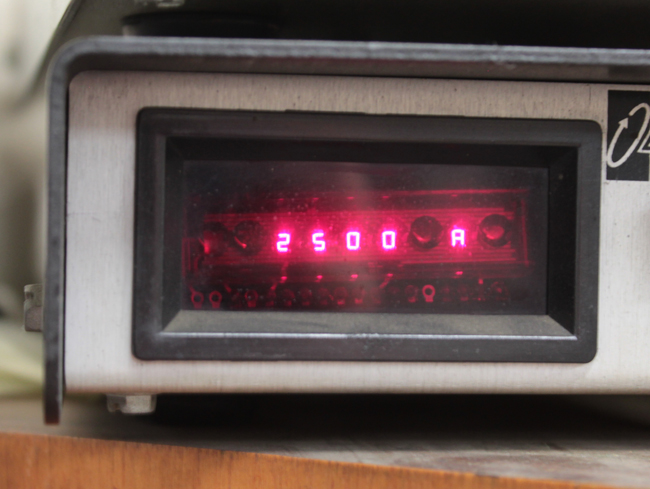
The room temperature ammunition shot at 2500 fps.
The heated ammunition shot at 2596 fps.
The tune window of the particular rifle is fairly wide as is shown by the accuracy of the three pressure/velocity levels and good accuracy was achieved across the board. However, notice the point of impact shift with the third group? There is enough shift at 200 yards to cause a miss if you were shooting a target or animal at longer ranges. While the pressure and velocities changed this load was far enough from maximum that perceived over pressure issues such as flattened primer, ejector marks on the case head, or sticky extraction did not appear. If you load to maximum and then subject your ammunition to this test your results will probably be magnified in comparison.
This test showed that pressures, velocities, and point-of-impact can be affected by temperatures of your ammunition at the time of firing. It’s really not a bad idea to test in the conditions that you plan on utilizing the ammo/firearm in if at all possible. It wouldn’t be a bad idea to also test to see what condition changes do to your particular gun and ammunition combination so that you can make allowances as needed. Any personal testing along these lines should be done with caution as some powder and cartridge combination could become unsafe with relatively small changes in conditions.
This week, American Rifleman TV looks at the history and heritage of Remington, which celebrates its 200th Anniversary this year. Founded in 1816, Remington is the oldest continuously-operating gun manufacturer in the United States, and it still sells more sporting rifles and shotguns than any other American company. Remington has also developed more cartridges than any other U.S. company. If you want to learn more about this important arms-maker, watch tonight’s episode, which you can preview below.
Two Hundred Years of Gun-Making Remington Arms Company celebrates its 200th year in business in 2016. The Remington enterprise was founded in 1816 by Eliphalet Remington in Ilion, New York, as E. Remington and Sons. Remington is America’s oldest gun maker and is still the largest U.S. producer of shotguns and rifles. And it is the only American Company that sells firearms and ammunition under its own name. CLICK HERE for 200 facts about the 200-year-old company.
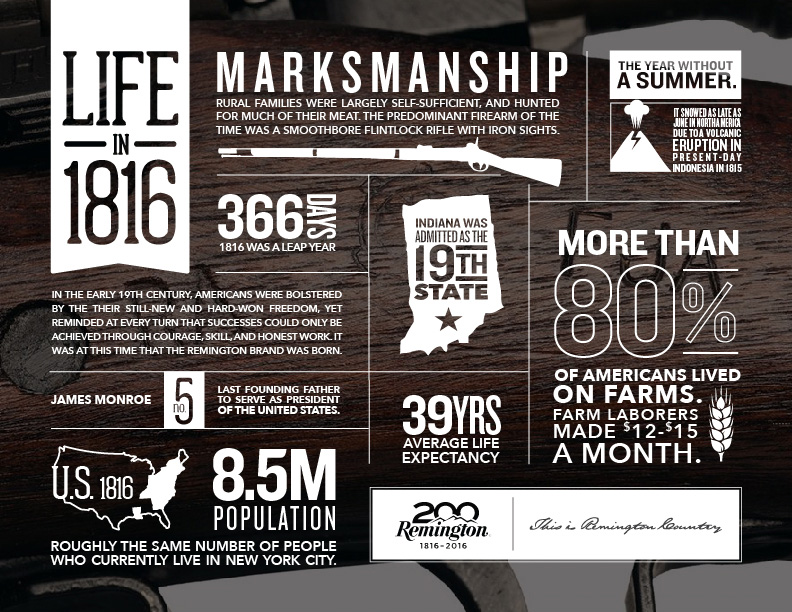
American Life in 1816
What was life like in America in 1816, two hundred years ago? This infographic offers some interesting facts. For example, average life expectancy was only 39 years, and a farm laborer earned just $12-$15 per month. Still want to go back to the “good old days”?