Will you be traveling (with firearms) to other states this year? Are you concerned about the laws that might apply when you are transporting guns across state lines? Or are you puzzled about the requirements for obtaining a carry permit in your own state? If you have any of these questions, you should definitely get expert guidance on State statutes and regulations controlling firearms. To do that, you can purchase Attorney Scott Kappas’s Traveler’s Guide to the Firearms Laws of the 50 States (2025) for just $16.95 from the publisher or $19.95 on Amazon. You can also get an eBook version for $15.95 (or $23.90 for eBook/Print combo). The latest 2025 edition includes 100+ updates since last year.
This very popular resource has sold over 2,000,000 copies since it was first released in 1996. The 2025 Edition just started shipping on 2/10/2025 — so this book is up to date. The print book is just $16.95 with FREE Shipping, or $20.95 with first-class shipping for quicker delivery.
Free State Law Summaries Online
If you don’t want to spend the money on the book, there is a FREE alternative. There’s a very helpful set of State Law Summaries on the web, presented by PewPewTactical.com. Despite the silly name, the PewPewTactical website has an abundance of information that is particularly beneficial for pistol shooters and CCW holders.
One of the best features of PewPewTactical.com is the Gun Laws by State online reference guide. We looked through four of these State Law Summaries and were impressed by the depth of the coverage. But we caution — if you have specific legal questions, particularly with recently-enacted statutes, you should consult a licensed attorney for your state (or the state to which you will travel). In addition, many of the State Law Summaries have not been updated for 3-5 YEARS! But they are still a good place to start. Below are links to state law articles from PewPewTactical.com. To access any State summary, simply click the State name below:
Above is a sectioned barrel showing an 80gr Sierra that was fired in a .223 bolt action with a cleaning rod in the bore. Both the bullet and the rod are still in the bore.
A Negligent Shooter Gets Lucky
“Here we have a story so filled with negligent acts that I can only marvel that the shooter survived the experience. The photo and narrative were provided by the gunsmith who took in the repair job, my comments are in italics. It’s worth reading, we can’t get enough safety warnings in our hobby.” — GS Arizona, Rifleman’s Journal
Description of Incident (with Commentary)
The shooter had a stuck case in his .223 chamber. The stuck case was actually a loaded round that didn’t fire. It wouldn’t extract because it was a .222 case that got mixed in with his .223 brass. [He had loaded the wrong brass.] I saw the loaded round with an 80gr bullet in it and a light primer strike. Negligent Act #1: Wrong brass was mixed in with the brass being reloaded.
The shooter removed the stuck case with a 3-piece aluminum rod. Negligent Act #2: Hammering out a loaded round with a cleaning rod. People have been killed doing this as the round can fire and drive the cleaning rod right into you. I remember one such incident about 5 years ago, the shooter was pounding out a stuck round, the cleaning rod went right through him, he didn’t survive.
The shooter didn’t notice only two segments of the cleaning rod came out when he removed it. Negligent Act #3: If you put anything at all down the barrel of a rifle you’d better make darn sure you got it all out before doing anything else!
He then chambered another round and fired it. Negligent act #4: If you’ve had a barrel obstruction of any kind, and if you’ve put something in the barrel, look through the barrel before proceeding! Within the past two years I know of an incident in which a benchrest shooter was killed in exactly this manner. The pressure built up and the rifle bolt came out of the receiver and into his chest.
The shooter is ‘OK’, but did not escape unscathed. He said there was a huge explosion and after regaining his senses found he was bleeding heavily from his forehead. The blood was thick enough that it ran in his eyes and he couldn’t see. In his words “I thought I was going to die”.
He has what looks like a pretty deep cut about an inch long on the side of his head, right in line with his right eye starting where the eye socket turns out to the side of the skull. And no telling what he’s got in the way of brass particles embedded in his forehead.
He was shooting on private property, and was alone when this happened. Negligent Act #5: Don’t shoot alone! Accidents happen, this is just one more example. If we could predict accidents, we wouldn’t have them. Always shoot with at least one other person.
He managed to get the bleeding stopped, or at least under control, packed his car and drove himself home without seeking immediate medical attention. Negligent Act #6: This one could have cost him his life after being lucky enough to survive the incident. There’s no way to know what’s happened just after an incident like this. He should have been at a hospital getting checked for shrapnel in the head.
The rod and slug could not be driven out. Since the barrel had a high round count there was no point in trying to salvage it. Note that the aluminum rod is expanded to a tight fit in the bore for the first couple inches. The base of the bullet is a little over 2″ from the mouth of the chamber.
What we’ve seen here is negligence and an absolute indifference to the established rules of safe reloading and gun handling, from start to finish, capped off with the shooter’s foolish avoidance of medical treatment. This shooter is lucky to be alive, but he’s surely used up all his luck. Don’t assume you’ll be so fortunate.
This article originally appeared in the Rifleman’s Journal website, which is no longer available. The Rifleman’s Journal site was created by German Salazar, who, sadly, has passed. He was a great shooter who helped this website in many ways. RIP German.
A good riflescope is essential for many types of competition, and the vast majority of hunters have scoped rifles. Some F-Class and benchrest competitors are now using optics with up to 60X magnification. Over the past 30 years, scopes have continued to evolve with improved glass, more reticle types, vastly increased elevation travel, bigger main tubes, FFP and SFP options, and even built-in electronics.
When shopping for a riflescope, it’s useful to understand how scopes work — how the internal mechanisms control windage and elevation, how parallax controls work, and how magnification levels are controlled.
Basics of How Riflescopes Work
This Burris video (above) covers the key aspects of scope function: zoom magnification, windage control, elevation control, parallax control (front or side mount), and ocular lens focus. There are some tips on getting a new scope running smoothly — it’s wise to rotate the power control a few times as well as both windage and elevation knobs. The video below also explains how to set ocular focus controls optimally.
Scope Break-In Methods and Diagnosing Issues — Great Video
We recommend that all serious shooters watch this video start to finish. A very knowledgeable scope engineer, Leupold’s Mike Baccellieri, explains the fine details of scope operation — with very useful recommendations on how to ready a new scope for use (See 36:50 time-mark). With a new optic he advises to run the controls multiple times to full travel. Also, take your time to get the diopter control just right (See 26:40 time-mark).
The video also explains why, with a new scope or one that hasn’t been used much, it is sometimes effective to rotate the elevation PAST the desired setting then come back a click (See 35:40 time-mark). In addition, near the end of the video, the expert explains how you can use a mirror to determine if the scope mount (base and/or rings) is NOT aligned with the bore axis, forcing excess travel to get on target (See 42:00 time-mark). We have seen this caused by scope rails attached slightly off axis.
Large diameter turrets make windage and elevation markings easier to see, and the click “feel” may be more noticeable given the greater diametrical travel between clicks.
First Focal Plane (FFP) vs. Second Focal Plane (SFP)
The main visual difference between First Focal Plane (FFP) and Second Focal Plane (SFP) scopes is the appearance of the reticle (and its hash marks) at different magnification levels. With a FFP scope, the reticle increases in visible size (and line thickness) with increased magnification. This is so the angular hash marks remain constant (in Mils or MOA angular span) at all magnification levels. So, on a 10-30X FFP scope, a 0.1 Mil hash mark represents the SAME angular measurement at 10X, 20X, or 30X (or any magnification). The downside of the FFP system is that the reticle lines can appear very thick at high magnification. But for a PRS/NRL match, with targets at multiple distances, it is important that the hash marks represent the same angular measurement at all power settings.
On a Second Focal Plane (SFP) scope, by contrast, the reticle lines (and hash marks) appear visually (in thickness) the same at all magnification levels. This means the hash mark divisions will only be precise at one magnification level, as designed by the manufacturer. For example, you could have exact 1 MOA Hash marks at 10X. But zoom the scope to 20X and the same reticle hash mark would then cover 2 MOA. SFP scopes are popular with competition shooters who shoot at specific known distances. Not having thick reticle lines at 25X to 50X is an advantage when aiming at precise benchrest and F-Class targets.
ZEISS now makes excellent FFP Scopes with both MOA and Milrad options
Minute of Angle (MOA) vs. Milliradian (MILRAD or MIL)
This video also explains MOA vs. MRAD (Milliradian) controls. A Minute of Angle (MOA) is an angular measurement that represents 1.047″ at 100 yards. Modern MOA scopes are typically configured with 1/4 MOA or 1/8 MOA clicks. A Milliradian (MRAD) is another angular measurement defined as one-thousandth of a radian. Milrad scopes are commonly configured with 0.1 Milrad clicks. How much is a 0.1 mil at 100 yards? One mil equals 3.6 inches at 100 yards; therefore, 1/10th of that, 0.1 Mil, equals 0.36” – roughly a third of an inch – at 100 yards. That’s pretty close to the common quarter-inch (1/4 MOA) increment found on MOA riflescopes.
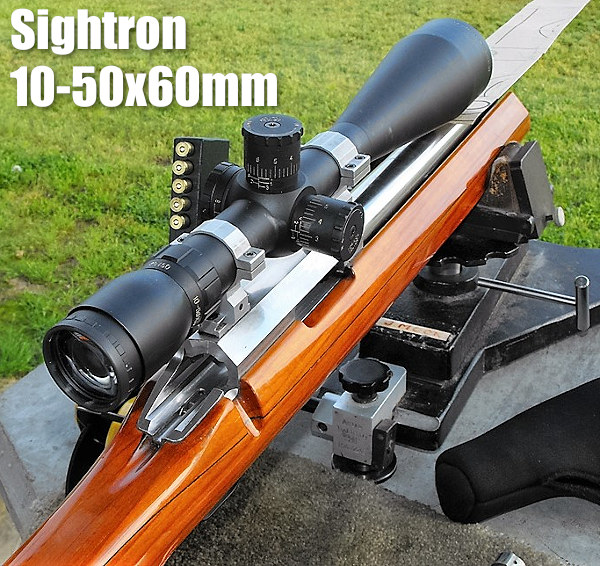
Sightron makes excellent high-magnification SFP zoom scopes favored by many competitors. These have proven quite reliable and offer very good performance for the price.
Scope Mounting Method and Alignment
When mounting a scope, you want to make sure the scope is aligned properly, so that vertical travel is precisely up and down, not offset. Begin by supporting the rifle with a good front and rear rest. Use a portable level to ensure the rifle is not tilting slightly left or right around the barrel bore axis. Then you want to align your scope’s vertical axis. For this, we recommend setting up a plumb bob — a weighted line that hangs straight down. This can be set up indoors or outdoors. Align your reticle’s vertical axis precisely with the plumb bob line, making sure not to move the rifle.
One caution — we have seen some riflescopes that are internally off-axis by up to 4 degrees. In this case, you can align the reticle’s vertical axis with the plumb bob line but then find that your turrets are slightly titled. That is a scope manufacturing fault that will result in some error when you input a large click value (e.g. 10+ MOA up or down).
When mounting your scope, a key factor to consider is the eye relief — the distance of the rear “ocular” lens to your eye. When mounting the scope, put your head in the position at which you normally shoot. NOTE: As your optimal head position may be quite a bit different when shooting prone vs. shooting from a bench, you may want to adjust the scope placement for different shooting positions. This Editor had to move his comp rifle scope about an inch rearward when local club matches changed from prone to bench.
Editor: Many new barrels will deliver higher velocities with the same load after 100-150 rounds through the bore. The exact reasons for this speed-up are not 100% certain, and velocity increases (if any) will vary from one barrel to the next. But this “speeding up” phenomenon is common, so be prepared if this happens with your next barrel. If you do experience a significant velocity increase you should probably re-tune your load AFTER the velocity stabilizes at the higher level.
From the Sierra Bullets Newsletter Article by Mark Walker, Sierra New Product Development Director
In a previous post, I discussed a couple of methods to tune a load to your barrel to help achieve the best accuracy possible. People most often work on load tuning if they get a new rifle or have a different barrel installed. In both instances, the barrel is new and has not been fired very much. According to most competitive shooters, this is the most accurate your barrel will ever be, so getting it tuned and shooting accurately is a priority.
The Speed Up Phenomenon After 100-150 Rounds
Even though after you work up a load and your new barrel is shooting great, a lot of shooters notice that at around 100 to 150 rounds their rifle may stop shooting as accurately. I had this happen to a rifle and I was confused as to why something that worked so well to begin with would all of a sudden quit shooting. I decided to break out the chronograph to do another load work up to see what was going on. To my surprise, the velocity had increased around 80 fps over the original velocity! After performing another ladder test and adjusting the seating depth, the rifle was once again shooting well.
There are several thoughts on why this may happen, however, you can rest assured that it does happen. One thought is that as the barrel breaks in, the tooling marks in the throat of the chamber smooth out and allow less resistance to the bullet as it exits the bore thereby increasing speed. Another idea is that the throat area starts to get a little rough which in turn causes more resistance which increases pressure and therefore more velocity. I’m sure there are some out there who have a better understanding as to why this happens, but it can definitely affect the accuracy of your rifle. So be aware and never be afraid to rework a load to keep your rifle in tune.
Experts Confirm That Barrel Speed-Up Is Common Two respected shooters have observed an increase in velocity with new barrels, typically after 100 rounds. Gunsmith and Hall-of-Fame benchrest shooter Thomas “Speedy” Gonzalez has documented barrel speed-up with testing. Moreover, Speedy’s bore-scope barrel inspections revealed a smoothing of the barrel lands. Jim See, a top PRS competitor, has encountered barrel speed-up many times. Accordingly, he re-tunes his load at 150 rounds.
“Alex Lipworth and I documented this phenomenon about four years ago and I have told all my customers about this. My son Mikee would shoot 100 rounds through all new barrels we planned on shooting before we would begin to do load development. We had a shooting snail that caught all the bullets set up in front of an indoor bench. We called it a wear-in process because upon careful examination of the bore when the ‘Speed Up’ takes place the cut-rifled bore resembles that more of a button-rifled barrels with the lands taking on more the softer look of a buttoned bore.” — Speedy Gonzalez
“Seen it [barrel velocity increase] too many times to count. All my match barrels get a ‘generic round’ loaded for them, which has worked well in barrels historically. After I hit 150 rounds I fine-tune the load and never look back, until the tube starts to slow down at it’s life end.” — Jim See
The Burris Eliminator 6 Rangefinder scope has been selected as the “2025 American Rifleman Optic of the Year” as part of the NRA Media Golden Bullseye Awards. This award is presented by NRA Media for notable new products, which are selected based on their technical performance, field reliability, innovation, and value.
Even at $3000.00 MSRP, this is a pretty amazing optic. It incorporates a laser rangefinder plus a set of environmental sensors. Plus it communicates, via BlueTooth, with the Burris Connect App which holds ballistics data for multiple loads. Basically, just range your target, and the Eliminator 6 does the rest — the digital DOPE card works with the scope’s illuminated X177 reticle to display the precise holdover aiming point for the ranged distance.
The new Burris Eliminator 6 combines precise rangefinding out to 2,000 yards with onboard ballistic compensation, environmental monitoring, and a comprehensive Heads-Up Display user interface to provide precise aiming solutions at the touch of a button. The Eliminator 6 represents an entirely new design from previous-generation Eliminator models. The Eliminator 6 is more compact and follows a more conventional riflescope profile for improved ergonomics and simplified operation. “The Eliminator 6 is, indeed, a game-changer for western game hunters and anyone who demands fast and accurate firing solutions,” said Burris Mktg. Director, Jordan Egli.
NEW Burris Eliminator 6 Laser Rangefinder Riflescope
The new, compact 4-20x52mm Burris Eliminator 6 combines a powerful laser rangefinder with multiple environmental sensors. It has easy-to-use turret controls and sharp ED glass. Compared to the previous model Burris Eliminators, the advanced new Eliminator 6 is smaller, and lighter. To minimize chromatic aberration, Burris uses extra-low dispersion (ED) glass. Other features include 4-20X magnification, +2.0 to -3.0 diopter adjustment range, and side focus/parallax adjustment from 25 yards to infinity.
How does it work? Using the Eliminator 6, simply range your target, hold the illuminated aiming point on your target, and hold wind if necessary using the hold-off points in the reticle. You don’t have to carry around a separate Laser Rangefinder, or dial elevation with knobs.
See how the parallax and illumination adjustments are now conveniently located on a conventional turret-style knob that also contains the range activation and brightness button array.
Burris states that the “Eliminator 6 [has] the most comprehensive and advanced integrated technology ever delivered in a hunting riflescope.” Remarkably, this new Eliminator 6 includes multiple sensors, along with the laser rangefinder. The Eliminator 6 features a built-in thermometer, barometer, and inclinometer, and it automatically measures density altitude (which can also be manually selected). This allows the Eliminator 6 to provide extremely accurate ballistics solutions. The key features are:
• Integrated laser rangefinder capable of ranging out to 2,000 yards (reflective)
• BurrisConnect App compatible for quick programing and precise ballistics
• X177 Reticle with 177 1/5 MOA illuminated aiming points
• Angle Sensor informs ballistics calculator
• Built-In Environmental Sensors
• HUD with 11 data zones
• Shotcall Marker
Team Lapua’s Keith Trapp Makes History at the 2025 Southwest Nationals
Keith Trapp, talented member of Team Lapua, has etched his name in history by claiming his third Southwest Nationals F-Class Target Rifle (F-TR) LR Championship with a Grand Aggregate score of 1237-72X. It was a great performance. Keith finished 3 points ahead of second-place Oleg Savelyev (1234-48X), but with 24 more Xs! (The next highest X-count was fourth-place Alen Tempke with 1223-54X.)
Trapp competed with a .308-Win chambered rifle, utilizing Lapua .308 Winchester Palma brass, Vihtavuori N150 powder, and Berger 200.20X Hybrid Target bullets.
The 2025 Southwest Nationals took place from February 12-16 at the Ben Avery Shooting Facility in Phoenix, Arizona. Hosted by the Desert Sharpshooters Rifle Club, this prestigious annual event attracted over 350 competitors across Sling, F-Open, and F-TR categories. CLICK HERE for full F-TR individual results.
Trapp not only earned him the championship title but he also coached the USA F-TR Vortex team to a strong second-place finish with a score of 2556-106X, which tied first-place Berger F-TR team (1556-125X) on points. Led by team captain Ian Klemm, the F-TR Vortex squad featured Drew Rutherford, Brad Sauve, Tracy Hogg, Mike Francis, Luke Ramsey, and Trapp himself.
2025 Southwest Nationals F-TR Individual and Team Top Five
F-TR Long Range Top 5 Individual
KEITH TRAPP 1237-72X *MW*
OLEG SAVELYEV 1234-48X
NIKLAS MONTIN 1227-49X
ALLEN TAMPKE 1223-54X
BRAD SAUVE 1223-47X HiSr
F-TR Long Range Top Five Teams
USA F-TR BERGER 2556-125X
USA F-TR VORTEX 2556-106X
GUN RUNNERS 2551-117X
TEAM USA VIHTAVUORI 2543-114X
SPIN DRIFTERS 2526-102X
“We congratulate Keith on this momentous achievement,” said Morgan Joy-Twenter, Capstone’s Director of Communications. “This past weekend, he made history as the only shooter to ever win the F-T/R Championship at the Southwest Nationals three times!” Watch the interview below to hear Keith talk about the 2025 SWN event:
Modern F-TR rifle looking down-range at Ben Avery Shooting Facility.
The F-Class Target Rifle (F-TR) category has strict regulations, requiring a rifle to weigh no more than 18 pounds with bipod. See an example above. Additionally, chambers must remain unmodified and use a standard .308 Win /7.62 NATO or .223 Rem/5.56 NATO cartridge.
2025 SWN F-TR champ Keith Trapp has won the Southwest Nationals LR match three times. Here he is shown after his impressive 2022 victory. That year Keith scored 1233-62X, winning by five points with high X-count among all F-TR shooters.
About Lapua Lapua produces superb-quality brass, cartridges, and components for civilian and professional use. In the USA, Lapua products are exclusively imported by Capstone Precision Group, the official distributor for Berger, Lapua, Vihtavuori, and SK-Rimfire products.
With the increase in crime in major cities, home security is more important than ever. A large, heavy conventional safe is still the best way to store your full firearms collection. However, when seconds count, a rapid-access system may be a smart option. Using RFiD technology, and a spring-loaded door, this kind of rapid-access vault lets you instantly get your hands on your primary defensive rifle or shotgun.
For home use, we like this RAPiD Safe AR Gunlocker from Hornady. The spring-loaded door opens instantly when activated by the owner’s personal RFID devices. The AR Gunlocker ($389.99 on Amazon) also has a keypad so you can enter a combination if your RFID “key” is not around. Or you can use the supplied manual barrel-style metal key. Watch the video to see how the system works:
The RAPiD Safe AR Gunlocker RFID safe secures long guns in a steel-walled vault that can be stored in a closet, under a bed, or even in your vehicle. This will hold an AR and a shotgun with foam inserts. There are several options for entry: 1) Radio Frequency IDentification (RFID) tag system; 2) KeyPad; 3) Manual barrel-style metal key.
Provided Access Devices
For the AR Gunlocker, Hornady provides one RFID Wristband, one RFID Key Fob, and two RFID “stickers”. As a secondary entry method, you can program a four- to six-digit security code. Finally, you can use a manual lock if all power fails.
RAPiD Safe AR Gunlocker Specifications:
Exterior: 42″ Wide x 15.25″ Deep x 6.75″ High
Interior: 40.5″ Wide x 13.5″ Deep x 5.5″ High
Weight: 55 pounds
Power: 12-volt DC (with transformer from AC wall outlet) or four (4) AA batteries.
Brownells hosts the 4th Annual 2A Day (Second Amendment Day) on February 22, 2025, a nationwide event dedicated to celebrating Second Amendment rights, advocating for their preservation, and strengthening the firearms community. On 2A Day, you can visit a participating range and take advantage of free firearm rental or limited free ammo. There are participating ranges in Scottsdale, Arizona; Johnston, Iowa; Ballwin, Missouri; Omaha, Nebraska; and Auburn, Virginia. And some other local ranges may offer free firearm rentals or limited free ammo. Or head to the range of your choice and shoot for fun.
With support from sponsors including CCI, Federal, Fiocchi, Henry, Hornady, Leupold, Magpul, Remington, Smith & Wesson, and Volquartsen, 2A Day provides multiple ways for firearm enthusiasts to participate:
CELEBRATE — Brownells is partnering with shooting ranges across the country to offer free range time and limited complimentary ammunition for participants.
ADVOCATE — Brownells encourages gun owners to actively support the Second Amendment by engaging with lawmakers at both the state and federal levels. The Brownells 2A Day webpage provides links to help individuals contact their elected representatives.
JOIN — Gun owners are encouraged to join national and state organizations committed to protecting gun rights, such as the 2nd Amendment Foundation (SAF) and the Gun Owners of America (GOA). Brownells will donate 4% of all sales from February 18-23 to 2A advocacy groups.
Second Amendment Day Official Target (Download for FREE)
“February 22nd is a day we, as a nation, can recognize, celebrate and do our part to secure one of the most important rights guaranteed by our Constitution – the right to keep and bear arms,” said Pete Brownell, Chairman of the Board at Brownells. “I hope Americans from all walks of life visit the range on this one day – 2/22 … and safely exercise their Second Amendment right, which is the underpinning of safety and security in America.”
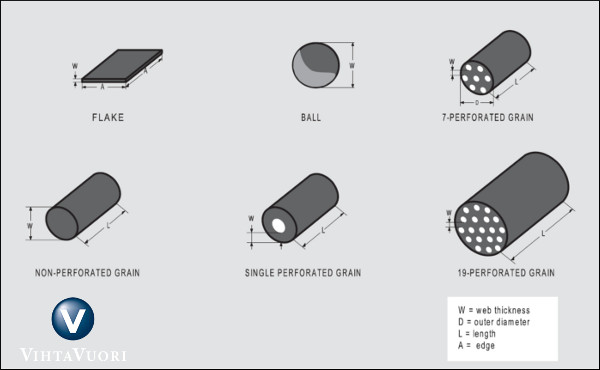
The shape of powder grains has a profound effect on the performance of the powder charge, as it concerns both pressure and velocity. There are multiple powder shapes including flake, ball, and extruded or “stick” (both solid and perforated).
So how does powder grain shape affect pressure and muzzle velocity?
In general, it can be said that powder that burns progressively achieves a desired muzzle velocity at lower maximum pressure than a powder that burns neutrally, not to mention a degressive powder. As grain size increases, the maximum pressure moves towards the muzzle, also increasing muzzle blast. Muzzle velocity and pressure can be adjusted by means of the amount of powder or loading density, i.e. the relationship between the powder mass and the volume available to it. As the loading density increases, maximum pressure grows.
All Vihtavuori reloading powders are of the cylindrical, single-perforated extruded stick type. The differences in burning rate between the powders depend on the size of the grain, the wall thickness of the cylinder, the surface coating and the composition. Cylindrical extruded powders can also have multi-perforated grains. The most common types are the 7- and 19-perforated varieties. A multi-perforated powder grain is naturally of a much larger size than one with a single perforation, and is typically used for large caliber ammunition.
Other types of powder grain shapes include sphere or ball, and flake. The ball grains are typically used in automatic firearms but also in rifles and handguns. The ball grain is less costly to produce, as it is not pressed into shape like cylindrical grains. Flake shaped grains are typically used in shotgun loadings.
Web thickness in gunpowder terminology means the minimum distance that the combustion zones can travel within the powder grain without encountering each other. In spherical powders, this distance is the diameter of the “ball”; in flake powder it is the thickness of the flake; and in multi-perforated extruded powders it is the minimum distance (i.e. wall thickness) between the perforations.
The burning rate of powder composed of grains without any perforations or surface treatment is related to the surface area of the grain available for burning at any given pressure level. The change in the surface area that is burning during combustion is described by a so-called form function. If the surface area increases, the form function does likewise and its behavior is termed progressive. If the form function decreases, its behavior is said to be degressive. If the flame area remains constant throughout the combustion process, we describe it as “neutral” behavior.
The cylindrical, perforated powders are progressive; the burning rate increases as the surface area increases, and the pressure builds up slower, increasing until it reaches its peak and then collapses. Flake and ball grains are degressive; the total powder surface area and pressure are at their peak at ignition, decreasing as the combustion progresses.
Shooting USA TV will broadcast a great show today, 2/19/2025. Shooting USA’s Wednesday Night episode features the NRA World Shooting Championship held last year at Camp Atterbury. This unique competition features multiple disciplines shot with firearms supplied by sponsors. All of the guns were provided and when the match finished the stage firearms become prizes. There were also cash prize awards for the top Pro Class competitors. SEE NRA World Championship Program.
Shooting USA SHOW TIMES: This Shooting USA Episode airs Wednesday, February 19, 2025 at 9:00 PM Eastern and Pacific; 8:00 PM Central. If you miss the regular broadcast, you can stream the show online at any time on Vimeo for $0.99 per episode.
The NRA World Shooting Championship was held April 3-6, 2024 at Camp Atterbury, Edinburgh, Indiana. Presented by Walther, this challenging event involved rifle, pistol, and shotgun shooting with a dozen disciplines — from short-range action pistol to long-range rifle. Topping the field among lady shooters was the talented Lanny Barnes, a 3-Time Olympic biathlete and professional 3-Gun competitor. We congratulate Lanny for her great 2024 performance at the NRA Championship, which earned Lanny the title of NRA World Shooting Lady Champion!
The NRA World Shooting Championship
This championship is designed to test individuals through multiple different disciplines over a period of three days of shooting. Competitors compete in Professional and Amateur categories for cash and prizes of over $250,000. Walther and other sponsors supplied ALL firearms equipment and ammunition required for the 12 stages of competition.
To do well, competitors must be highly proficient in all shooting skills — rifle, pistol, shotgun, both rapid fire and precision. The stages were: Sporting Clays, Precision Standing Air Gun, NRA Americas Rifle Challenge, NRA Precision Pistol, FITASC, 3-Gun, Mid-Range AR-Tactical, Biathlon, SASS (Cowboy Action), PRS, Scholastic Action Shooting, and USPSA.
There were also seven (7) side matches with different disciplines including falling plates.




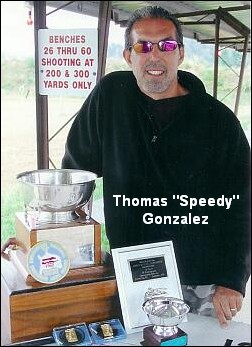 Two respected shooters have observed an increase in velocity with new barrels, typically after 100 rounds. Gunsmith and Hall-of-Fame benchrest shooter Thomas “Speedy” Gonzalez has documented barrel speed-up with testing. Moreover, Speedy’s bore-scope barrel inspections revealed a smoothing of the barrel lands. Jim See, a top PRS competitor, has encountered barrel speed-up many times. Accordingly, he re-tunes his load at 150 rounds.

 The
The