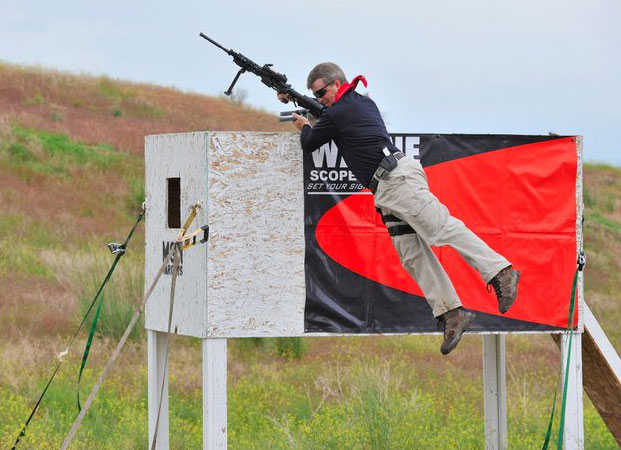
The 20th Annual MGM Ironman Match was held in Parma, Idaho earlier this month. Over 250 shooters vied for honors at this ultra-challenging event. The “OLHOT” (Open, Limited, Heavy Optics, and Trooper) classes competed June 5-7, while a Scoped Tactical Match followed June 9-11. Present were top pros, privateers, juniors, ladies, plus elite military and LEO teams. This very demanding 3-Gun event features ten tough, high-round count stages, including a signature zip-line descent from a tower. Without question, the MGM Ironman is one of the toughest shooting matches on the planet.
Watch POV view of the Zipline Stage at 2016 MGM Ironman:
Father and Son Duo Dominates 2016 Event
This year’s OLHOT match was definitely a “family affair” for the Gibson clan. In the Trooper Division, 17-year-old Wyatt Gibson won convincingly, finishing 138 points ahead of the next-best shooter. Meanwhile Wyatt’s father Travis Gibson won the Open Division. In true ‘Like father, like son’ fashion, Travis dominated the Open field, finishing 121 points ahead of his closest Open-class competitor.
This year’s aptly-named Ironman was particularly tough with triple-digit temps and strong winds. Over the course of three grueling days, competitors completed ten tough stages, shooting in excess of 1100 rounds per shooter over the course of the match. EVERY stage required the use of ALL three guns with 100 or more rounds. The average time spent shooting on each stage was about seven minutes. The Ironman is long, intense, and you shoot till you drop! Mike Gibson, the founder of MGM Targets, and the “inventor” of the Ironman, has said: “This match isn’t for weenies or crybabies”.
The week-long Ironman event is broken into two, 3-day sessions, with five different divisions. The OLHOT (Open, Limited, Heavy Optics, and Trooper) sessions ran June 5-7. During the second segment, held June 9-11, 120 Scoped Tactical shooters took on the same demanding course.
MGM Ironman Has Unique Stage Designs
The MGM Ironman is an intense test of both shooter and equipment. Participants shoot a variety of classes and various scenarios including shooting from the back of a moving vehicle, from a 20-foot tower, while driving a golf cart, and while carrying a dummy.
Of course there are plenty of MGM-made reactive targets (photo right). The MGM Ironman regularly offers unique and demanding stages including firing a pistol from a zip line, and plunging down a steep slide from a 30 foot tower, rifle in hand. One stage involves carrying an 80-lb dummy over 100 feet and lifting it to the top of a six-foot platform before climbing it to engage rifle targets at distance. With creative and challenging stage designs and high round counts, he Ironman is truly a unique match.
Here is a video from the 2010 MGM Ironman. It shows many of the multi-gun stages, including the Zipline stage, filmed from multiple camera angles.
Each Wednesday, the U.S. Army Marksmanship Unit publishes a reloading “how-to” article on the USAMU Facebook page. Recently the USAMU’s reloading gurus looked at the subject of case lubrication. Tasked with producing thousands of rounds of ammo for team members, the USAMU’s reloading staff has developed very efficient procedures for lubricating large quantities of cases. This article reveals the USAMU’s clever “big-batch” lube methods. For other hand-loading tips, visit the USAMU Facebook page next Wednesday for the next installment.
Rapid, High-Volume Case Lubrication
Today’s topic covers methods for quickly applying spray lube to cartridge cases prior to sizing. A typical order for this shop may be 25,000 rounds, so [speeding up] the lubrication process can be a real time-saver. While your ammunition lots probably aren’t this large, the efficient methods discussed here may help save a considerable amount of time over your handloading career. Our case lubrication rates range from 1500-1600 cases per hour, to 2400-2500 cases per hour, depending on caliber.
This shop uses virgin brass, whereas most home handloaders use fired brass, which necessitates some small changes at times. These will be discussed as they arise. Begin with fired brass that has been tumbled clean.
Ensure as much tumbling media as possible is removed from the brass, as when it gets into a size die, it can dent cases significantly. This is a good time to round out dents in the case mouths using a tapered tool to prevent damage from the decapping stem.
First, dump the clean cases into a large box or reloading bin. Shake the bin back and forth so that many cases are oriented with the mouths up. Next, pick up as many cases as is convenient with the mouths “up”, from natural clusters of correctly-oriented cases. With 7.62mm-size cases, this is usually 3-4, and with 5.56mm cases, this can be up to 8-10. Place the cases into the rack slots, mouth-up. Doing this in groups rather than singly saves considerable time. Once these clusters have been depleted, it will be time to re-shake the bin to orient more cases “up.”.
This photo shows a case lubrication rack made by a USAMU staffer.
Naturally, adjust the spacing to best fit the calibers you reload. We have found this size … convenient for handling through the various phases of case lubrication/transfer to progressive case feeders for processing. Note that the 1/2-inch angle does not cover much of the critical case area at the base, just forward of the extractor groove, where most re-sizing force will be exerted. As the USAMU uses virgin brass, less lubrication is required for our brass than would be needed for Full Length (FL) sizing of previously-fired brass.
NOTE: The amount applied using our rack is easily enough for our purpose. If using fired brass, be sure to adequately lube this base area to avoid having cases stick in the full-length sizing die.
Using a spray lube, coat the cases adequately, but not excessively, from all sides. Be sure to get some lube into the case mouths/necks, in order to reduce expander ball drag and case stretching/headspace changes. The spray lube this shop uses does not harm primers or powder, and does not require tumbling to remove after lubing.*
Take a close look at the photo above. The USAMU shop uses a common kitchen turntable, which allows the rack to be rotated easily. We place this in a custom-made box which prevents over-spray on to floors and walls.
Angled Box Method for Smaller Cases to be Neck-Sized
A refinement of the above method which especially speeds processing of 5.56x45mm cases is as follows. A small cardboard box which holds about 100 cases is fitted with an angled “floor” secured by tape. With the smaller 5.56mm cases, usually about 8-10 cases per handful can be picked up, already correctly-oriented, and placed into the box together. This prevents having to place them into the rack slots, saving time.
HOWEVER, note that this does not allow nearly as much lube access to the case bodies as does the rack. For our purposes — neck-sizing and setting neck tension on new brass, this works well. If using this procedure with fired brass, take steps to ensure adequate lube to prevent stuck cases.
As always, we hope this will help our fellow handloaders. Good luck, and good shooting!
*A two-part test performed here involved spraying primed cases heavily, while getting more lube into the case mouth/body than even a careless handloader would likely apply. The second part of the test involved literally spraying considerable quantities of the lube directly into the cases, drenching the primers. After a several-day wait to allow the lube to penetrate the primers, they were then fired in a test barrel. All fired normally; no unusual reports were noted. This bolstered confidence that normal amounts of the lube would not adversely affect our ammunition, and we have been pleased with the results over several years.
A Kestrel Wind Meter will record wind speed with its impeller wheel. However, to get the most accurate wind velocity reading, you need to have your Kestrel properly aligned with the wind direction. To find wind direction, first orient the Kestrel so that the impeller runs at minimal speed (or stops), and only then turn the BACK of the Kestrel into the wind direction. Do NOT simply rotate the Kestrel’s back panel looking for the highest wind speed reading — that’s not the correct method for finding wind direction. Rotate the side of the Kestrel into the wind first, aiming for minimal impeller movement. The correct procedure is explained below by the experts at Applied Ballistics.
How to Find the Wind Direction with a Kestrel Wind Meter
Here is the correct way to determine wind direction with a Kestrel wind meter when you have no environmental aids — no other tools than a Kestrel. (NOTE: To determine wind direction, a mounted Wind Vane is the most effective tool, but you can also look at flags, blowing grass, or even the lanyard on your Kestrel).
Step 1: Find the wind’s general direction.
Step 2: Rotate the Wind Meter 90 degrees, so that the wind is impacting the side (and not the back) of the wind meter, while still being able to see the impeller.
Step 3: Fine-tune the direction until the impeller drastically slows, or comes to a complete stop (a complete stop is preferred). If the impeller won’t come to a complete stop, find the direction which has the lowest impact on the impeller.
Step 4: Turn the BACK of the Kestrel towards the direction from which the wind is blowing. Then press the capture button, and record your wind speed.
Do NOT simply point the Kestrel’s back into the wind until you get the highest wind speed — that’s not the correct method.
Report based on story by Kyle Jillson for NRA Blog
Summer is the time of year to get outside and have fun with family and friends. A great way to enjoy shooting with friends and family members is to attend a Brownells/NRA Day. These fun events will be held throughout the summer, at locations across the USA. These events are designed for all ages — from youngsters to senior citizens. The activities appeal to all skill levels, from first-time shooters to seasoned competitors.
Brownells/NRA Day events are fun affairs, where participants can try out a variety of different shooting disciplines. Events are always a big hit and you won’t find people as friendly and helping anywhere else. Below is a complete list of upcoming July events. There are a variety of events, including Basic Firearms Training, Youth “SportsFest”, 3-Gun Experience, Hunter’s Event, Competition, and Shotgun. For more information on any scheduled event, visit the Brownells/NRA Day website.
Father’s Day is Sunday, June 19, 2016, less than a week away. If your father enjoys the shooting sports, here are some recommended items that our staff owns or uses. All selections cost less than $100.00. It’s not too late to order. If you have an Amazon Prime membership, you can get two-day shipping in most areas of the country. For non-Prime members, most items will ship in 3-4 days. That’s enough time to get the gift to “Pops” by next Sunday.
TEN Great Father’s Day Gifts for Dad Under $100.00
The light-weight, compact RCBS Partner Press is ideal for loading at the range. It can easily be mounted to a bench with C-Clamps.
This is an excellent shooting mat — it is very well made with good padding/insulation. On gravel, concrete, or hard-packed ground this is way more comfortable than typical mats. It is wide enough and easy to fold. Any Dad who shoots would love this.
We’ve used Bog-Pod shooting supports on varmint hunts. They’re great for down-angle shots from a ridge or kneeling shots to get above terrain obstacles. Bog-Pods adjust from 17″ to 39″.
This battery pack can charge your cellphone, tablet, or even a chronograph. Our IT manager uses this battery pack to run his LabRadar Chrono. He also uses it as an emergency charger when camping and traveling. It has three outputs, allowing multi-device recharging.
Walkie-Talkies are “must-have” items for long-range shooting. The 22-CH Motorola MH230R Two-Way Radio is Amazon’s #1 Best Seller in FRS/GMRS Handheld Radios.
Plano’s AirGlide case is a unique, top-loading rifle case. Ideal for benchrest guns with wide forearms, the AirGlide case puts no side-pressure on scopes. We like the ease of loading. This fits rifles up to about 27-28″ barrels.
The versatile MTM Range Box includes cradles so you can do gun maintenance while at the range. A lift-out tray holds small items such as patches and jags. This is a durable product that can hold ammo and other gear.
Your Editor owns this watch and wears it for all special occasions. It is a very handsome quartz dress watch crafted by Orient, a division of Seiko. The hands and case are rose-gold color. At just under 8mm, the watch is very thin and comfortable to wear. The 40.5mm case features an elegant retro-styled domed crystal. This watch is also available with a silver-tone case and white face for around $130.00.
This cleverly-designed Shotshell thermos will make Dad smile. Styled just like a 12ga shotgun shell, the Stansport thermal bottle holds 25 oz. of hot or cold liquids.
This rugged 4-pistol case will hold your handguns and magazines securely. Airline-approved for checked luggage, this lockable case has a lifetime warranty. An 0-ring seal makes the case 100% waterproof and dustproof.
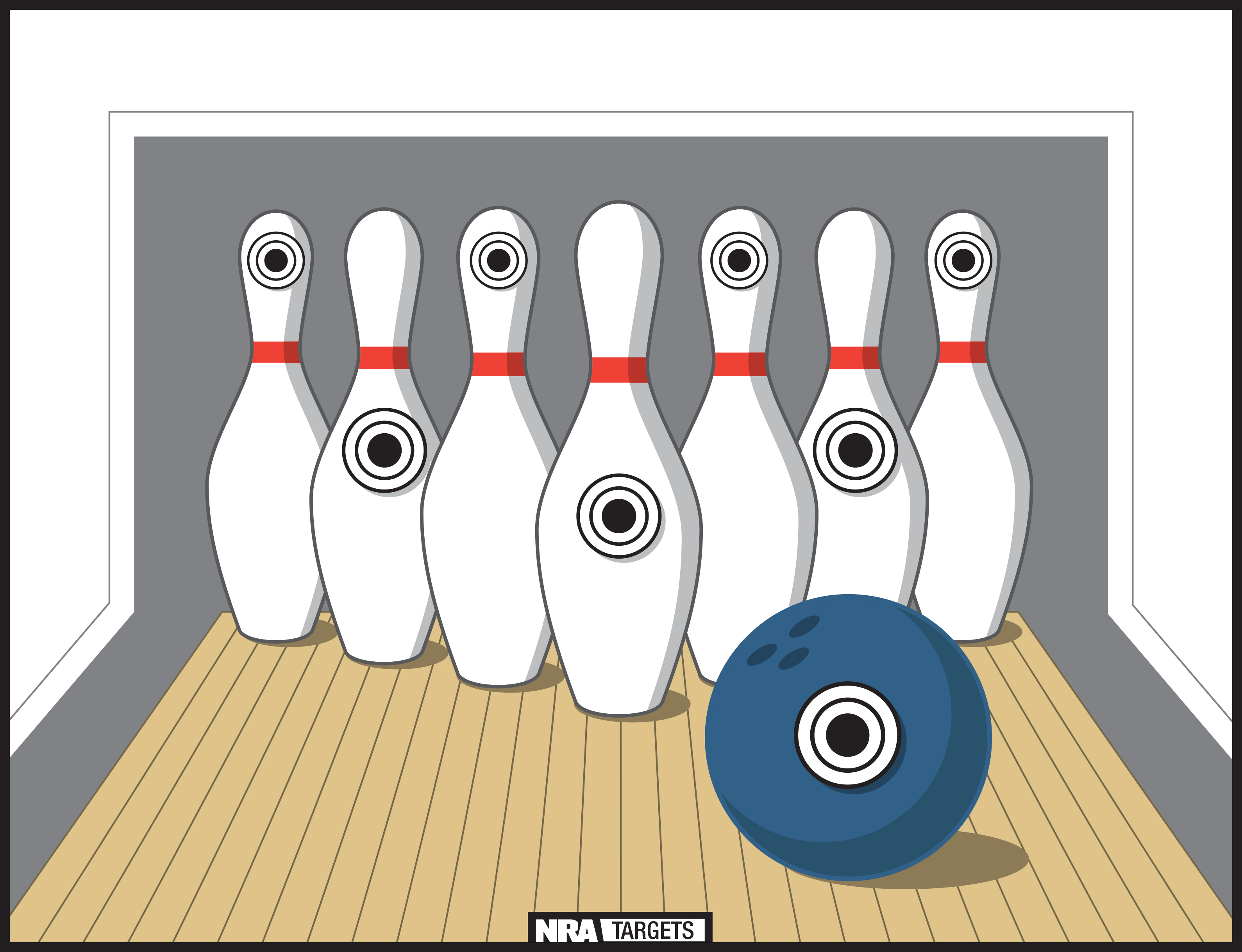
Summer is here, so it’s time to focus on fun and games. Here are three speciality targets with game themes: Dartboard, Billiards Table, and Bowling Alley. Each target features multiple bullseyes. Shoot the dartboard like a regular game or make up your own sequence. For the billiards target you can shoot the bulls, or the balls, or both. Click any target to load FREE higher-resolution PDF files which you can download. Then print the targets and take them to the range for a fun shooting session. A big thanks to our friends at NRABlog.com for creating these colorful “fun & games” targets. Enjoy!
In this article, Gun Watch Editor Dean Weingarten interviews SilencerCo Founder/CEO Josh Waldron. Started in 2008, SilencerCo is an amazing success story. The company now sells 18,000 silencers a month. To put that in perspective, a decade ago, the entire domestic suppressor industry was selling 18,000 suppressors a YEAR. SilencerCo now controls 65% of the suppressor market in the USA, and its business is growing 100% a year.
This growth is remarkable considering that suppressors remain highly regulated and costly to acquire. The National Firearms Act (NFA), passed in 1934, imposes significant restrictions and requires a $200 tax to be paid on each silencer sold.
At the NRA Annual Meeting in Louisville, Kentucky, I was able to talk to Josh Waldron, CEO of SilencerCo. Josh is more than a visionary. He is a man who acted on his vision, and is changing the gun culture and the national culture.
I [visited] the SilencerCo booth during the NRA Annual Meeting. I was told that SilencerCo produces about 65% of the silencers in the United States. The company is growing so fast that it was hard to keep up with the number of employees, currently about 330 and rising quickly. There is no doubt that SilencerCo holds a dominant market share and is growing at an exceptionally fast rate. I asked Josh about the future of silencers and silencer legislation.
Q: Do you have a plan, and can you tell me about it?
“It starts as education. Ever since we started the company in 2008, we have had a focus on education and advocacy. When I first started the company… only 18,000 silencers were sold in the United States each year, and that was every manufacturer.”
“From the time we have started until now, there were 18,000 then, we are now selling about 18,000 silencers every month, just SilencerCo.”
“In the last five years, this has been the fastest growing segment of the firearms industry.”
When I first started the company… only 18,000 silencers were sold in the United States each YEAR [from] every manufacturer. We are now selling about 18,000 silencers every MONTH, just SilencerCo. — Josh Waldron
“People are just starting to understand. This is not a ‘cool accessory’ as much as it is a personal protection/personal safety device, just as you would consider any other device that keeps you safe while you shoot, such as safety glasses. It is really the only true way to hunt while you protect your hearing. As we continue to educate the market, it grows exponentially. A guy will get one who has never had one before, he brings it home, he shows his friends, and they say ‘Oh my gosh, I want to buy one!’ Every time we get suppressors out there, the snowball continues to grow and get bigger and bigger.”
Q: Your market share is dominant. Your sales growth is exponential, isn’t it?
“Yes … pretty amazing. We are growing 100% every year.”
WATCH X-Ray View of Shots Through Silencer (28,000 frames per second, 22 Sparrow)
Q: Do you fear that removal of suppressors from the NFA (National Firearms Act) will cut into your profit margin?
“I don’t think so. We don’t get to take full benefit of the economies of scale. We have to order materials on a small-batch basis. As we increase the number of suppressors going out the door we decrease the amount that it costs us. We haven’t pushed it to the level where are seeing those economies of scale.”
“We are always going to be a top-shelf brand. We are never going to discount our brand. We will be a leader in the industry, continually. I do believe there will be a lot of new entrants to the industry. I do not think that will hurt our brand or hurt our market.”
Q: I saw the Maxim 9, SilencerCo’s integrally-suppressed pistol, at the SHOT Show in Las Vegas. Is the Maxim 9 in production yet?
“It is not in production yet. Projects of this size take a lot of research and development. They take a lot of torture testing. We have to put it through a lot of standard testing. We use outside firms that come in and test and evaluate, so that we can hold our heads up high and say ‘This is a duty grade weapon’. We are not going to release it until it is.”
“I do not want to be marketing to our men and women in uniform, and saying this is a safe way to shoot until we can say this is a perfect firearm for them. The amount of testing is extremely rigorous. We are on schedule. We will release it, probably in December.”
Q: Is the Maxim 9 your entry into a future market of integrally-suppressed firearms?
“Yes. Our intention with the Maxim brand is to have integrally-suppressed firearms in that brand. We are talking everything from shotguns to rifles to pistols. The pistol is a good place to start because it is the holy grail of integrally suppressed guns that everyone has wanted. It is extremely difficult to do. People have tried it and failed, years and years, for decades, and this is the first time it has actually been viable and real. We are very excited about that, and very proud of that. We are going to move into new calibers as soon as this one starts shipping. We are very excited to expand that line.”
“Do I think the gun companies will compete? They can try. Number one, our IQ is amazing around this product. We spent a lot of time researching every firearm, every handgun that you can think of. How the mechanisms worked, and why. We had to be thorough. Which is why we designed the gun from the ground up. We went into every single style of this type of firearm, and other types of handguns as well, and really, truly understand how it needed to be designed. We had to take every mechanism, the guide rods, the springs, the things that are in front of the chamber in a conventional handgun, and move them behind the chamber. That was our biggest challenge. Do I think that some of those guys will start competing and get around our IQ? It will be a lot harder for them than for us. Because we are the ones who figured it out in the first place, and we have a lot of patents around that.”
Q: Rifles have had a lot of [suppressor] solutions … for a long time.
“We will get into those lines, the rifle lines. The difference is that we will design the gun, just the same way as we did for the Maxim 9. We will design the gun for the suppressor instead of putting on a suppressor designed for the gun, so our guns will be better.”
“There are about 400 million firearms in the U.S. right now. Most of those were not designed with a suppressor in mind. There is a huge market for retrofitted suppressors.”
“Which is what we have been doing for the last eight years, it is what we have done as a company which is providing solutions for firearms that already exist. The field is ready to harvest as far as creating a new platform. A new platform that has never been done before this, that was designed from the ground up with the intention of being suppressed, integrally suppressed.”
Q: You say you are going to stay on the high end. I looked at some of the markets. There is a lot of low end potential out there.
“There is. It is something that I am just not interested in. Number one, I do not know how to make something that is not the best.”
“It is impossible to know what the percentage of the market the high end will be. It is important to me to make the best product in the world. I am a brand guy. My brand is very important to me to so if I am making things that are less than the best, that is not ever something that I want. I always want to be top shelf.”
Q: Are you exporting much?
“We export, yes. We can’t export to the commercial market. Only to the military and law enforcement. It is a State Department thing.
“We have a bill right now, it is called the Suppressor Export Act. Congressman Jeff Stewart is the one that is sponsoring that bill for us. It would ensure that the State Department would have to allow us to take part in the world market, that is available, that we are not able to take part in right now. We can only export to law enforcement and military, but not to the commercial market. But with this bill, we would be able to export to everybody. If there is a country where it is legal to have suppressors, we would be allowed to export to them.”
“There are suppressor manufacturers all over the world, and they sell all over the world. The United States is the only place where they are this regulated. It is just crazy. You can go to the UK, where it is really hard to own a gun, and you can buy a suppressor over the counter, without a background check.”
“We are behind the curve when it comes to the rest of the world.”
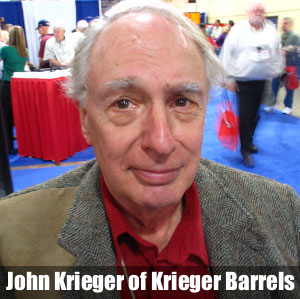
At SHOT Show 2013 we had the chance to chat with legendary barrel-maker John Kreiger of Krieger Barrels. In this wide-ranging interview, John addressed a number of questions our readers often pose…. What is better for a 6mm, 0.236″ land or 0.237″ land? What are the pros/cons of various barrel types: 3-groove, 4-groove, 6-groove, 8-groove, and 5R? What types of land/groove configurations clean up more easily? (John says the 5R might be the winner there).
John also discusses barrel cleaning and he explains why it’s unwise to pull a dirty brush back across your delicate crown: “The problem comes from the fact that abrasive materials — powder and primer residues in particular — get embedded in the brush. Essentially that is how a lap works.”
When we suggested that Krieger Barrels might want to offer three-groove barrels in the future, John surprised us by revealing that he has been considering putting a 3-groove design into production. John says that, in theory at least, a canted-land 3-groove holds a lot of promise. John hopes to build some prototype 3-grooves to test. Krieger Barrels has a 300-yard underground tunnel where barrels with various land/groove configurations and calibers can be tested using a return-to-battery fixture. John admits that tunnel testing of barrels is “on the back burner” as his company focuses on filling orders. But he says that he has a strong personal interest in testing different land/groove configurations, different amounts of choke, and different internal dimensions. We hope we’ll be able to share some results from the Krieger Barrels test tunnel in the near future.
The Ruger Precision Rifle (RPR) has been a hot seller since it was first released. All versions (.243 Win, 6.5 Creedmoor, and .308 Win) have been in high demand, with the 6.5 Creedmoor probably being the hardest to find. The RPR represents a solid value, and it is the logical “default” choice for the new Production Class in the Precision Rifle Series. (NOTE: If you spend around $1400 for the RPR, then add a $950.00 6-24x50mm Viper PST, you’re still well under the $3000.00 Production Class price limit for rifle and optic combined.)
In this video, Gavin Gear of UltimateReloader.com, along with Ed and Steve of 6.5Guys.com, review the Ruger Precision Rifle (RPR) in 6.5 Creedmoor. This particular rifle was fitted with the Vortex Viper PST 6-24x50mm scope. Together, Gavin and the 6.5 Guys give their opinions on the rifle, the 6.5mm chambering, and the Vortex optic. They provide candid evaluations (of rifle and optic) based on field tests with targets from 100 to 1000 yards.
Gavin tells us: “The Ruger Precision Rifle is a great rifle platform. I’ve had some great groups right out of the box, and have had no problems staying on target at ranges of 1000 yards and beyond. To me, the Ruger Precision Rifle is an ‘easy buy’ for the new competitive shooter or practical field shooter. But what about optics? It can be very confusing and overwhelming when shopping for ‘just the right scope’. There are so many great scopes on the market it can be staggering to take in all of the options. We wanted to give you some hands-on impressions of one of the most popular picks for optics for the Ruger Precision Rifle and similar rifles in the ~$1000 price range: the Vortex Viper PST 6-24×50 riflescope.”
Gavin was very pleased with the Vortex Viper PST: “Having used this scope in a variety of scenarios, ranges, and over the course of more than 1/2 of a year, I’m confident with not only the scope itself, but the entire package: Rifle + Scope + Mount (rings).”
Barrel-maker Dan Lilja’s website has an excellent FAQ page that contains a wealth of useful information. On the Lilja FAQ Page as you’ll find informed answers to many commonly-asked questions. For example, Dan’s FAQ addresses the question of barrel life. Dan looks at factors that affect barrel longevity, and provides some predictions for barrel life, based on caliber, chambering, and intended use.
Dan cautions that “Predicting barrel life is a complicated, highly variable subject — there is not a simple answer. Signs of accurate barrel life on the wane are increased copper fouling, lengthened throat depth, and decreased accuracy.” Dan also notes that barrels can wear prematurely from heat: “Any fast varmint-type cartridge can burn out a barrel in just a few hundred rounds if those rounds are shot one after another without letting the barrel cool between groups.”
Q. What Barrel Life, in number of rounds fired, can I expect from my new barrel?
A: That is a good question, asked often by our customers. But again there is not a simple answer. In my opinion there are two distinct types of barrel life. Accurate barrel life is probably the type most of us are referencing when we ask the question. But there is also absolute barrel life too. That is the point where a barrel will no longer stabilize a bullet and accuracy is wild. The benchrest shooter and to a lesser extent other target shooters are looking at accurate barrel life only when asking this question. To a benchrest shooter firing in matches where group size is the only measure of precision, accuracy is everything. But to a score shooter firing at a target, or bull, that is larger than the potential group size of the rifle, it is less important. And to the varmint hunter shooting prairie dog-size animals, the difference between a .25 MOA rifle or one that has dropped in accuracy to .5 MOA may not be noticeable in the field.
The big enemy to barrel life is heat. A barrel looses most of its accuracy due to erosion of the throat area of the barrel. Although wear on the crown from cleaning can cause problems too. The throat erosion is accelerated by heat. Any fast varmint-type cartridge can burn out a barrel in just a few hundred rounds if those rounds are shot one after another without letting the barrel cool between groups. A cartridge burning less powder will last longer or increasing the bore size for a given powder volume helps too. For example a .243 Winchester and a .308 Winchester both are based on the same case but the .308 will last longer because it has a larger bore.
And stainless steel barrels will last longer than chrome-moly barrels. This is due to the ability of stainless steel to resist heat erosion better than the chrome-moly steel.
Barrel Life Guidelines by Caliber and Cartridge Type
As a very rough rule of thumb I would say that with cartridges of .222 Remington size you could expect an accurate barrel life of 3000-4000 rounds. And varmint-type accuracy should be quite a bit longer than this.
For medium-size cartridges, such as the .308 Winchester, 7×57 and even the 25-06, 2000-3000 rounds of accurate life is reasonable.
Hot .224 caliber-type cartridges will not do as well, and 1000-2500 rounds is to be expected.
Bigger magnum hunting-type rounds will shoot from 1500-3000 accurate rounds. But the bigger 30-378 Weatherby types won’t do as well, being closer to the 1500-round figure.
These numbers are based on the use of stainless steel barrels. For chrome-moly barrels I would reduce these by roughly 20%.
The .17 and .50 calibers are rules unto themselves and I’m pressed to predict a figure.
The best life can be expected from the 22 long rifle (.22 LR) barrels with 5000-10,000 accurate rounds to be expected. We have in our shop one our drop-in Anschutz barrels that has 200,000 rounds through it and the shooter, a competitive small-bore shooter reported that it had just quit shooting.
Remember that predicting barrel life is a complicated, highly variable subject. You are the best judge of this with your particular barrel. Signs of accurate barrel life on the wane are increased copper fouling, lengthened throat depth, and decreased accuracy.
Benchrest Barrel Life — You May Be Surprised
I thought it might be interesting to point out a few exceptional Aggregates that I’ve fired with 6PPC benchrest rifles with barrels that had thousands of rounds through them. I know benchrest shooters that would never fire barrels with over 1500 shots fired in them in registered benchrest matches.
I fired my smallest 100-yard 5-shot Aggregate ever in 1992 at a registered benchrest match in Lewiston, Idaho. It was a .1558″ aggregate fired in the Heavy Varmint class. And that barrel had about 2100 rounds through it at the time.
Another good aggregate was fired at the 1997 NBRSA Nationals in Phoenix, Arizona during the 200-yard Light Varmint event. I placed second at this yardage with a 6PPC barrel that had over 2700 rounds through it at the time. I retired this barrel after that match because it had started to copper-foul quite a bit. But accuracy was still good.




 MGM Ironman Has Unique Stage Designs






 At SHOT Show 2013 we had the chance to chat with legendary barrel-maker John Kreiger of


