In this article, Gun Watch Editor Dean Weingarten interviews SilencerCo Founder/CEO Josh Waldron. Started in 2008, SilencerCo is an amazing success story. The company now sells 18,000 silencers a month. To put that in perspective, a decade ago, the entire domestic suppressor industry was selling 18,000 suppressors a YEAR. SilencerCo now controls 65% of the suppressor market in the USA, and its business is growing 100% a year.
This growth is remarkable considering that suppressors remain highly regulated and costly to acquire. The National Firearms Act (NFA), passed in 1934, imposes significant restrictions and requires a $200 tax to be paid on each silencer sold.
At the NRA Annual Meeting in Louisville, Kentucky, I was able to talk to Josh Waldron, CEO of SilencerCo. Josh is more than a visionary. He is a man who acted on his vision, and is changing the gun culture and the national culture.
I [visited] the SilencerCo booth during the NRA Annual Meeting. I was told that SilencerCo produces about 65% of the silencers in the United States. The company is growing so fast that it was hard to keep up with the number of employees, currently about 330 and rising quickly. There is no doubt that SilencerCo holds a dominant market share and is growing at an exceptionally fast rate. I asked Josh about the future of silencers and silencer legislation.
Q: Do you have a plan, and can you tell me about it?
“It starts as education. Ever since we started the company in 2008, we have had a focus on education and advocacy. When I first started the company… only 18,000 silencers were sold in the United States each year, and that was every manufacturer.”
“From the time we have started until now, there were 18,000 then, we are now selling about 18,000 silencers every month, just SilencerCo.”
“In the last five years, this has been the fastest growing segment of the firearms industry.”
When I first started the company… only 18,000 silencers were sold in the United States each YEAR [from] every manufacturer. We are now selling about 18,000 silencers every MONTH, just SilencerCo. — Josh Waldron
“People are just starting to understand. This is not a ‘cool accessory’ as much as it is a personal protection/personal safety device, just as you would consider any other device that keeps you safe while you shoot, such as safety glasses. It is really the only true way to hunt while you protect your hearing. As we continue to educate the market, it grows exponentially. A guy will get one who has never had one before, he brings it home, he shows his friends, and they say ‘Oh my gosh, I want to buy one!’ Every time we get suppressors out there, the snowball continues to grow and get bigger and bigger.”
Q: Your market share is dominant. Your sales growth is exponential, isn’t it?
“Yes … pretty amazing. We are growing 100% every year.”
WATCH X-Ray View of Shots Through Silencer (28,000 frames per second, 22 Sparrow)
Q: Do you fear that removal of suppressors from the NFA (National Firearms Act) will cut into your profit margin?
“I don’t think so. We don’t get to take full benefit of the economies of scale. We have to order materials on a small-batch basis. As we increase the number of suppressors going out the door we decrease the amount that it costs us. We haven’t pushed it to the level where are seeing those economies of scale.”
“We are always going to be a top-shelf brand. We are never going to discount our brand. We will be a leader in the industry, continually. I do believe there will be a lot of new entrants to the industry. I do not think that will hurt our brand or hurt our market.”
Q: I saw the Maxim 9, SilencerCo’s integrally-suppressed pistol, at the SHOT Show in Las Vegas. Is the Maxim 9 in production yet?
“It is not in production yet. Projects of this size take a lot of research and development. They take a lot of torture testing. We have to put it through a lot of standard testing. We use outside firms that come in and test and evaluate, so that we can hold our heads up high and say ‘This is a duty grade weapon’. We are not going to release it until it is.”
“I do not want to be marketing to our men and women in uniform, and saying this is a safe way to shoot until we can say this is a perfect firearm for them. The amount of testing is extremely rigorous. We are on schedule. We will release it, probably in December.”
Q: Is the Maxim 9 your entry into a future market of integrally-suppressed firearms?
“Yes. Our intention with the Maxim brand is to have integrally-suppressed firearms in that brand. We are talking everything from shotguns to rifles to pistols. The pistol is a good place to start because it is the holy grail of integrally suppressed guns that everyone has wanted. It is extremely difficult to do. People have tried it and failed, years and years, for decades, and this is the first time it has actually been viable and real. We are very excited about that, and very proud of that. We are going to move into new calibers as soon as this one starts shipping. We are very excited to expand that line.”
“Do I think the gun companies will compete? They can try. Number one, our IQ is amazing around this product. We spent a lot of time researching every firearm, every handgun that you can think of. How the mechanisms worked, and why. We had to be thorough. Which is why we designed the gun from the ground up. We went into every single style of this type of firearm, and other types of handguns as well, and really, truly understand how it needed to be designed. We had to take every mechanism, the guide rods, the springs, the things that are in front of the chamber in a conventional handgun, and move them behind the chamber. That was our biggest challenge. Do I think that some of those guys will start competing and get around our IQ? It will be a lot harder for them than for us. Because we are the ones who figured it out in the first place, and we have a lot of patents around that.”
Q: Rifles have had a lot of [suppressor] solutions … for a long time.
“We will get into those lines, the rifle lines. The difference is that we will design the gun, just the same way as we did for the Maxim 9. We will design the gun for the suppressor instead of putting on a suppressor designed for the gun, so our guns will be better.”
“There are about 400 million firearms in the U.S. right now. Most of those were not designed with a suppressor in mind. There is a huge market for retrofitted suppressors.”
“Which is what we have been doing for the last eight years, it is what we have done as a company which is providing solutions for firearms that already exist. The field is ready to harvest as far as creating a new platform. A new platform that has never been done before this, that was designed from the ground up with the intention of being suppressed, integrally suppressed.”
Q: You say you are going to stay on the high end. I looked at some of the markets. There is a lot of low end potential out there.
“There is. It is something that I am just not interested in. Number one, I do not know how to make something that is not the best.”
“It is impossible to know what the percentage of the market the high end will be. It is important to me to make the best product in the world. I am a brand guy. My brand is very important to me to so if I am making things that are less than the best, that is not ever something that I want. I always want to be top shelf.”
Q: Are you exporting much?
“We export, yes. We can’t export to the commercial market. Only to the military and law enforcement. It is a State Department thing.
“We have a bill right now, it is called the Suppressor Export Act. Congressman Jeff Stewart is the one that is sponsoring that bill for us. It would ensure that the State Department would have to allow us to take part in the world market, that is available, that we are not able to take part in right now. We can only export to law enforcement and military, but not to the commercial market. But with this bill, we would be able to export to everybody. If there is a country where it is legal to have suppressors, we would be allowed to export to them.”
“There are suppressor manufacturers all over the world, and they sell all over the world. The United States is the only place where they are this regulated. It is just crazy. You can go to the UK, where it is really hard to own a gun, and you can buy a suppressor over the counter, without a background check.”
“We are behind the curve when it comes to the rest of the world.”
At SHOT Show 2013 we had the chance to chat with legendary barrel-maker John Kreiger of Krieger Barrels. In this wide-ranging interview, John addressed a number of questions our readers often pose…. What is better for a 6mm, 0.236″ land or 0.237″ land? What are the pros/cons of various barrel types: 3-groove, 4-groove, 6-groove, 8-groove, and 5R? What types of land/groove configurations clean up more easily? (John says the 5R might be the winner there).
John also discusses barrel cleaning and he explains why it’s unwise to pull a dirty brush back across your delicate crown: “The problem comes from the fact that abrasive materials — powder and primer residues in particular — get embedded in the brush. Essentially that is how a lap works.”
When we suggested that Krieger Barrels might want to offer three-groove barrels in the future, John surprised us by revealing that he has been considering putting a 3-groove design into production. John says that, in theory at least, a canted-land 3-groove holds a lot of promise. John hopes to build some prototype 3-grooves to test. Krieger Barrels has a 300-yard underground tunnel where barrels with various land/groove configurations and calibers can be tested using a return-to-battery fixture. John admits that tunnel testing of barrels is “on the back burner” as his company focuses on filling orders. But he says that he has a strong personal interest in testing different land/groove configurations, different amounts of choke, and different internal dimensions. We hope we’ll be able to share some results from the Krieger Barrels test tunnel in the near future.
The Ruger Precision Rifle (RPR) has been a hot seller since it was first released. All versions (.243 Win, 6.5 Creedmoor, and .308 Win) have been in high demand, with the 6.5 Creedmoor probably being the hardest to find. The RPR represents a solid value, and it is the logical “default” choice for the new Production Class in the Precision Rifle Series. (NOTE: If you spend around $1400 for the RPR, then add a $950.00 6-24x50mm Viper PST, you’re still well under the $3000.00 Production Class price limit for rifle and optic combined.)
In this video, Gavin Gear of UltimateReloader.com, along with Ed and Steve of 6.5Guys.com, review the Ruger Precision Rifle (RPR) in 6.5 Creedmoor. This particular rifle was fitted with the Vortex Viper PST 6-24x50mm scope. Together, Gavin and the 6.5 Guys give their opinions on the rifle, the 6.5mm chambering, and the Vortex optic. They provide candid evaluations (of rifle and optic) based on field tests with targets from 100 to 1000 yards.
Gavin tells us: “The Ruger Precision Rifle is a great rifle platform. I’ve had some great groups right out of the box, and have had no problems staying on target at ranges of 1000 yards and beyond. To me, the Ruger Precision Rifle is an ‘easy buy’ for the new competitive shooter or practical field shooter. But what about optics? It can be very confusing and overwhelming when shopping for ‘just the right scope’. There are so many great scopes on the market it can be staggering to take in all of the options. We wanted to give you some hands-on impressions of one of the most popular picks for optics for the Ruger Precision Rifle and similar rifles in the ~$1000 price range: the Vortex Viper PST 6-24×50 riflescope.”
Gavin was very pleased with the Vortex Viper PST: “Having used this scope in a variety of scenarios, ranges, and over the course of more than 1/2 of a year, I’m confident with not only the scope itself, but the entire package: Rifle + Scope + Mount (rings).”
Barrel-maker Dan Lilja’s website has an excellent FAQ page that contains a wealth of useful information. On the Lilja FAQ Page as you’ll find informed answers to many commonly-asked questions. For example, Dan’s FAQ addresses the question of barrel life. Dan looks at factors that affect barrel longevity, and provides some predictions for barrel life, based on caliber, chambering, and intended use.
Dan cautions that “Predicting barrel life is a complicated, highly variable subject — there is not a simple answer. Signs of accurate barrel life on the wane are increased copper fouling, lengthened throat depth, and decreased accuracy.” Dan also notes that barrels can wear prematurely from heat: “Any fast varmint-type cartridge can burn out a barrel in just a few hundred rounds if those rounds are shot one after another without letting the barrel cool between groups.”
Q. What Barrel Life, in number of rounds fired, can I expect from my new barrel?
A: That is a good question, asked often by our customers. But again there is not a simple answer. In my opinion there are two distinct types of barrel life. Accurate barrel life is probably the type most of us are referencing when we ask the question. But there is also absolute barrel life too. That is the point where a barrel will no longer stabilize a bullet and accuracy is wild. The benchrest shooter and to a lesser extent other target shooters are looking at accurate barrel life only when asking this question. To a benchrest shooter firing in matches where group size is the only measure of precision, accuracy is everything. But to a score shooter firing at a target, or bull, that is larger than the potential group size of the rifle, it is less important. And to the varmint hunter shooting prairie dog-size animals, the difference between a .25 MOA rifle or one that has dropped in accuracy to .5 MOA may not be noticeable in the field.
The big enemy to barrel life is heat. A barrel looses most of its accuracy due to erosion of the throat area of the barrel. Although wear on the crown from cleaning can cause problems too. The throat erosion is accelerated by heat. Any fast varmint-type cartridge can burn out a barrel in just a few hundred rounds if those rounds are shot one after another without letting the barrel cool between groups. A cartridge burning less powder will last longer or increasing the bore size for a given powder volume helps too. For example a .243 Winchester and a .308 Winchester both are based on the same case but the .308 will last longer because it has a larger bore.
And stainless steel barrels will last longer than chrome-moly barrels. This is due to the ability of stainless steel to resist heat erosion better than the chrome-moly steel.
Barrel Life Guidelines by Caliber and Cartridge Type
As a very rough rule of thumb I would say that with cartridges of .222 Remington size you could expect an accurate barrel life of 3000-4000 rounds. And varmint-type accuracy should be quite a bit longer than this.
For medium-size cartridges, such as the .308 Winchester, 7×57 and even the 25-06, 2000-3000 rounds of accurate life is reasonable.
Hot .224 caliber-type cartridges will not do as well, and 1000-2500 rounds is to be expected.
Bigger magnum hunting-type rounds will shoot from 1500-3000 accurate rounds. But the bigger 30-378 Weatherby types won’t do as well, being closer to the 1500-round figure.
These numbers are based on the use of stainless steel barrels. For chrome-moly barrels I would reduce these by roughly 20%.
The .17 and .50 calibers are rules unto themselves and I’m pressed to predict a figure.
The best life can be expected from the 22 long rifle (.22 LR) barrels with 5000-10,000 accurate rounds to be expected. We have in our shop one our drop-in Anschutz barrels that has 200,000 rounds through it and the shooter, a competitive small-bore shooter reported that it had just quit shooting.
Remember that predicting barrel life is a complicated, highly variable subject. You are the best judge of this with your particular barrel. Signs of accurate barrel life on the wane are increased copper fouling, lengthened throat depth, and decreased accuracy.
Benchrest Barrel Life — You May Be Surprised
I thought it might be interesting to point out a few exceptional Aggregates that I’ve fired with 6PPC benchrest rifles with barrels that had thousands of rounds through them. I know benchrest shooters that would never fire barrels with over 1500 shots fired in them in registered benchrest matches.
I fired my smallest 100-yard 5-shot Aggregate ever in 1992 at a registered benchrest match in Lewiston, Idaho. It was a .1558″ aggregate fired in the Heavy Varmint class. And that barrel had about 2100 rounds through it at the time.
Another good aggregate was fired at the 1997 NBRSA Nationals in Phoenix, Arizona during the 200-yard Light Varmint event. I placed second at this yardage with a 6PPC barrel that had over 2700 rounds through it at the time. I retired this barrel after that match because it had started to copper-foul quite a bit. But accuracy was still good.
Until now, if you wanted good hearing protection with the ability to hear conversations and range commands, you’d employ a pair of electronic muffs with sound-cut-out circuitry*. Those electronic muffs worked but they were bulky, hot, and could interfere with your cheek weld. Now there’s a new alternative — an “Earbud Headset” that offers NRR 31-rated hearing protection along with the ability to hear conversations.
The innovative, patent-pending Razor-X Earbud Headset from Walker’s® could be a “game changer” in the hearing protection field. The noise-activated, sound protection hardware is contained in a padded collar that fits comfortably around your neck. Small earbuds with foam tips fit in your ear providing 31 dB of noise protection. The microphones in the headset allow you to hear normal conversations and range commands. Two versions of the Razor headset will be offered: Basic Razor-X ($119.00 MSRP) and the deluxe Razor-XV ($159.99 MSRP) with Bluetooth capability.
Razor-X Features:
• Retractable Digital Ear buds
• 31 dB NRR (Noise Reduction Rating)
• Sound-Activated Compression (SAC)
• Rechargeable 250mAH battery with 10 HR run-time.
• Hi Gain omnidirectional microphones.
• HD speakers in the ear buds for good audio quality.
• Includes 3 pairs of 12mm foam tips (S/M/L) and two pairs of 16mm coated foam tips (M/L)
• Auto-Shut Off (low power mode) after 4 to 6 hours.
• Integrated Micro USB port with charging cord.
• AC wall adapter with USB port for charging.
• Patent Pending Technology
• MSRP: $119.99
Walker’s product information states:
The Razor-X incorporates a neck-worn device featuring comfortable, retractable ear buds. The “behind the neck” design allows for ZERO interference with you or your weapon, allowing you to focus on your target. These … patent-pending buds allow the user to be in loud environments without damaging their hearing, providing an impressive 31 dB of noise reduction.
The Hi Gain omni-directional microphones provide clear sound enhancement for enjoyable conversations on the range or to hear firearm instructors’ directions while training. The Razor-X HD digital speakers provide a wide range audio quality that enhances the users experience. The kit includes two different styles of noise-reducing foam tips in a variety of sizes to ensure a proper fit for maximum noise reduction. The Razor-X is equipped with an auto-shut off (low power mode) after 4 to 6 hours. The timer will reset and the unit will wake up after any button is pressed. An AC wall adapter with USB port and a one-meter micro USB cord is provided for convenient charging.
*There are some high-tech “in-ear” electronic systems with noise-activated protection, but these are typically quite expensive and not commonly used by shooters.
The Second Annual D-Day Match in Talladega was a big success. On the weekend of June 4-5, over 250 eager competitors arrived at the Civilian Marksmanship Program’s (CMP) Talladega Marksmanship Park for the D-Day Match commemorating the 72nd Anniversary of the Allied Forces’ landing at Normandy. This was a major match, attracting rifle and pistol shooters from throughout the country.
The Talladega range complex is an impressive, modern facility equipped with a computerized, high-tech Kongsberg electronic target system that plots shot locations and displays scores on monitors at each shooting station. For many competitors, this D-Day match was their first experience with electronic scoring. None complained about being freed from pit duties (the Kongsberg system eliminates the need to raise and lower targets or mark shots).
The John C. Garand Match has become hugely popular…
Georgia boys dominated the popular John C. Garand Match. Winning gold was SSG Jonathan O’Neal of Marietta, GA, who fired a score of 291-13X. Larry Sollars (Cumming, GA) followed closely behind, one point back with a score of 290-9X. Keith Schachle of Brooks, GA, shot a 288-7X for third.
Vintage Sniper Rifle Matches at Talladega
New this year, the D-Day Matches featured the inclusion of one of the CMP’s most popular competitions, the Vintage Sniper Match. During the event, a team of two uses a scoped Korean War, World War II or earlier “as-issued” military rifle to fire at distances of 300 and 600 yards. All shots are taken from the prone position with sand bag rests permitted. Each partner takes a turn as both shooter and spotter.
Over 60 shooters registered for the event’s first showing at the D-Day Matches. CMP Competitions Department manager Shannon Hand said, “The addition of the Sniper Match was very well-received by the competitors! It was a great event!”
Winning the Manual (bolt-action) Vintage Sniper Match were Bobby Robinson and Daniel Henk. In the Semi-Automatic Sniper Match, the team of Franklin Hines III and CMP North general manager Steve Cooper fired the winning overall score of 368-7X.
In pistol action, SSgt. Chad Ranton, 29, of Beaufort, SC, was the overall competitor in the .22 Rimfire Pistol EIC Match with a score of 276-5X. Notably, 15-year-old Katelyn Abeln proved she came to win after recording a score of 254-3X to earn Junior Division gold in the EIC Pistol Match. Katelyn was also the High Non-Distinguished pistol shooter of the match.
All persons are welcome to visit the Talladega Marksmanship Park, which is open to the public all year long. More information on the Talladega Marksmanship Park, including a facility map and description of facilities, can be found at the CMP’s Talladega Webpage.
The Grand Opening of the new Brownells retail gun store (in Grinnell, IA) will take place on Saturday, June 11, 2016, from 9:00 am to 6:00 pm. At 8:45 am Iowa Governor Terry Branstad, Lt. Governor Kim Reynolds, and Grinnell Mayor Gordon Canfield will deliver comments before company owners Frank and Pete Brownell cut the ceremonial ribbon.
The new store is located at 3006 Brownells Parkway, just off I-80 exit 182, in Grinnell, Iowa. To learn more about Brownells’ new retail store call 641-236-0001 or visit www.Brownells.com/retail.
“We’re very excited for our grand opening celebration,” said Pete Brownell, CEO of Brownells. “There will be lots of great deals, prizes and things to do for the entire family”. There will also be a food truck on-site selling BBQ and other treats.
Retail Store Linked to Brownells Warehouse
The new retail location will showcase 1,200 new and used firearms, plus a large selection of ammunition, optics, parts and accessories. The new 7,000 square-foot retail store is attached to the 245,000 square-foot Brownells Distribution Center. Brownells promises that any of the nearly 100,000 firearms-related items will be delivered from warehouse to store in minutes.
Factory Reps Will Answer Product Questions
An impressive “brain trust” of gun industry experts will be on hand at the Saturday Grand Opening. Answering customer questions will be representatives from many leading manufacturers: Benelli, Beretta, H&K, Hornady, Leupold,Streamlight, Surefire, Trijicon and more.
Prizes, Swag, and Great Deals
To celebrate the Grand Opening, Brownells will offer valuable give-aways. Prizes up for grabs include a $2,500 Daniel Defense AR-platform rifle, a $450 Glock 43 pistol, and a $200 Brownells Gift Card.
Customers will enjoy special sale pricing on firearms from Ruger, Weatherby, Smith & Wesson, Glock, and Bushmaster. Sale-priced ammunition will be offered from Wolf, Federal and Remington, including limited-quantity .22 LR ammo priced at just $74.99 for an ammo box with 1,300 rounds. That works out to just $5.76 per hundred rounds — a great deal by any measure.
IMR® Legendary Powders now offers four (4) Enduron powders: IMR 4166, IMR 4451, IMR 4955, and IMR 7977. Shooters looking for readily-available alternatives to hard-to-find extruded powders should definitely check out the Enduron line-up. Precision shooters will find an Enduron option well-suited to most of the popular precision cartridge types. For example, IMR 4166 is a good replacement for Hodgdon Varget (commonly used in the .223 Rem, 6mmBR and .308 Win), while IMR 4955 is a fine substitute for H4831 (favored by F-Open shooters for the .284 Win and 7mm WSM cartridges).
Modern Powder Technology for Enhanced Performance
The technology in IMR’s Enduron line of powders provides four very important qualities that enhance both in-gun and downrange performance.
Copper fouling reduction – these powders contain an additive that drastically reduces copper fouling in the gun barrel. Copper fouling should be minimal, allowing shooters to spend more time shooting and less time cleaning a rifle to retain accuracy.
Temperature change stability – the Enduron line is insensitive to temperature changes. Whether a rifle is sighted in during the heat of summer, hunted in a November snowstorm or hunting multiple locations with drastic temperature swings, point of impact with ammunition loaded with Enduron technology will be very consistent.
Optimal load density - Enduron powders provide optimal load density, assisting in maintaining low standard deviations in velocity and pressure, a key feature for top accuracy.
Environmentally friendly - Enduron technology is environmentally friendly, crafted using raw materials that are not harmful to the environment.
The Enduron Line-Up of Four Powders
IMR now offers four Enduron powders that cover a broad range of burn rates. They are suitable for a wide variety of cartridges, from small varmint cartridges all the way up to the .338 Lapua Magnum.
IMR 4166 possesses the fastest burn rate in the Enduron lineup. It is the perfect burn speed for cartridges such as .308 Win, 7.62mm NATO, 22-250 Rem and 257 Roberts. A versatile, match-grade propellant, IMR 4166 is comparable to Hodgdon® Varget.
IMR 4451 is a mid-range burn speed powder, ideally suited for cartridges such as .270 Winchester, .30-06 and 300 Winchester Short Magnum. This powder is comparable to Hodgdon H4350.
IMR 4955 is a medium burn speed powder, falling in between IMR 4451 and IMR 7977 in burn speed. It provides top performance in big game cartridges such as 25-06, 280 Remington and 300 Winchester Magnum. This powder is comparable to Hodgdon H4831.
IMR 7977 has the slowest burn rate among the Enduron Technology powders. Its loading density is perfect for magnum cartridges and contributes to superb uniformity, yielding outstanding performance in 300 Winchester Magnum, 7MM Remington Magnum and .338 Lapua Magnum. IMR 7977 is comparable to Hodgdon H1000.
The Enduron Technology powders are available in one-pound (1 lb) and eight-pound (8-lb) containers from quality reloading retailers. Learn more about Enduron powders at www.enduronimr.com. For info on other IMR powders, visit www.imrpowder.com.
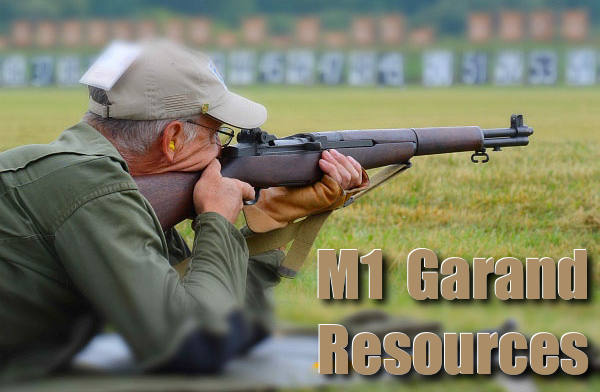
Take a look at that unusual target below. We bet you’ve never seen one of these before. It’s a 50-Yard Sighting Target for the M1 Garand. It’s designed to allow a rifleman to confirm his zeros for multiple yardages all the way out to 1000 yards. But importantly, he can establish those zeros at a very “short” shooting facility, since the target is positioned at a mere 50 yards.
Here’s how it works. The target is placed at fifty (50) yards. You start at the bottom, aiming at the black circle. Then check your come-up table and work your way up, clicking step-by-step to the various horizontal lines set for 200, 300, 500, 600 and 1000 yards. This is NOT “spray and pray” — you need to have a pretty good idea of the clicks you need, based on your ammo’s ballistics. This target is calibrated for the U.S. Military M72 Ball Ammo. The targets are available from Champion’s Choice ($0.75 each) or from Creedmoor Sports (12 for $5.95).
Lapua’s Kevin Thomas used this target to get zeroed for the recent D-Day Anniversary Match at the Talladega Marksmanship Park. Kevin used the target for both his M1 Garand as well as his M1903A1 Springfield, both chambered for the .30-06 Springfield cartridge.
Zeroing at a Short Distance — How to Use the 50-Yard Sighting Target, by Kevin Thomas
As part of my preparation for the Garand Match at the CMP’s Talladega Marksmanship Park, I needed to zero my new M1 Garand, but I was crunched for time. I didn’t have time to get to my normal range and confirm zeros at actual yardages. But a 50-yard zero target came to the rescue. Made for M1s using the M72 National Match ammo, the target allows the shooter to establish fairly good zeros at 200, 300, 500, 600 and 1,000 yards if you’ve got access to a 50-yard range.
I have no idea when these 50-yard Sighting Targets were first developed, but they’ve been around for at least as long as I’ve been involved in this game (longer than I care to admit). It consists of a tall target, with a smallish black bullseye located at the bottom center. The bullseye is an aiming point only. Extending through the top of the target is a vertical line that runs directly up the center, to nearly the top of the paper. Across this, there are intersecting horizontal lines that are marked 200, 300, 500, 600 and 1,000.
The target was designed for the M1 rifle using then-issued M72 National Match ammunition. This ammo launched a 173gr FMJBT bullet at approximately 2,640 fps. It was a good load in its day, supersonic out to the 1,000-yard line. While that ammo is fairly scarce these days, this isn’t a problem for the handloader. My standard match load for the M1 Garand utilizes the 175gr Lapua Scenar HPBT, and delivers remarkably similar ballistic performance. Thus my normal Garand load translates nicely to this 50-yard target. Yes, this is by design. No point in reinventing the wheel when Lake City has already established what works!
In use, the shooter sets the target up at a measured 50 yards, and (this is critical) checks the vertical line with a plumb bob or a carpenter’s level, to ensure that it is absolutely vertical. Once the target is set, the rifle is fired and the group noted. From there, it is a simple matter of zeroing it normally to bring the groups into alignment with the vertical line, at the elevation needed for a particular range. Once your group is hammering the intersection of the vertical line and the horizontal line marked “200”, you have established your 200-yard zero for that rifle. Record the number of clicks, and you’re good to go. Raise the impacts up to coincide with the line marked “300” and you now have a 300-yard zero as well. And so on, right up the target. Record those settings in your data book, and you’re ready to go to the range at the full distances. If done carefully, you may be in the X-Ring, but at the very least, you’ll be well-centered and ready to get some hard dope recorded for future shoots.
The same target can also be used with an M14/M1A, at least at the shorter distances. The ballistics of the M118 and the current M118LR are similar enough that this will get you on target at the full distances, probably requiring just a half MOA or so change from the 50 yard zero you recorded. Same bullets, moving at a slightly more sedate 2,550 fps, you’ll be in the ballpark at least.
Bryan Litz has recently popularized the short-range zeroing methods once again, reintroducing it to a new generation of shooters that may not have been aware of the old M72 short-range zero target. The same principles apply, and with the advent of the myriad computer ballistics programs and chronographs on the market today, any shooter can rapidly develop his own zero targets to accomplish the same result. But in the meantime, especially with the M1’s resurgent popularity, it’s nice to know that there’s an easy way to do things without a trip to a full-length range. The modestly-priced 50-Yard Sighting Targets can be ordered through Champion’s Choice or Creedmoor Sports.
Oh, and when I arrived in Talladega, yes, my zeros were good! All’s well that ends well. Safe Shooting! — Kevin Thomas
Are you looking for some summertime reading material? Do you enjoy classic hunting adventures from around the globe? Then log on to the NitroExpress.com Forum. There you’ll find links for literally hundreds of vintage hunting stories, and even complete books, such as Teddy Roosevelt’s classic African Game Trails and Good Hunting, plus the wonderful book African Campfires by Stewart E. White, one of Roosevelt’s close friends and hunting companions.
Among the downloadable titles are The Man-Eating Lions of Tsavo (leaflet edition) by Lt.Col. J. H. Patterson, the true tale that inspired the Hollywood movie, The Ghost and the Darkness, staring Michael Douglas and Val Kilmer. The online version of the Man-Eaters of Tsavo book (right) is a shorter, 140-page edition created for Chicago’s Field Museum, which purchased the skins of the lions from Patterson and put them on display.


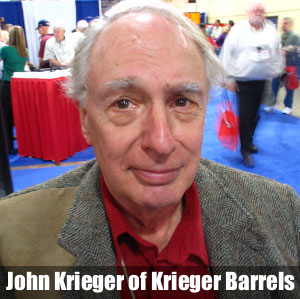 At SHOT Show 2013 we had the chance to chat with legendary barrel-maker John Kreiger of


 The Second Annual D-Day Match in Talladega was a big success. On the weekend of June 4-5, over 250 eager competitors arrived at the Civilian Marksmanship Program’s (CMP) Talladega Marksmanship Park for the D-Day Match commemorating the 72nd Anniversary of the Allied Forces’ landing at Normandy. This was a major match, attracting rifle and pistol shooters from throughout the country.




 Among the downloadable titles are


