|
|
April 1st, 2016

The biggest Berger bullet ever is on its way. In early summer, Berger Bullets will unveil its first-ever .50-Caliber projectile and its first-ever solid. This new 750gr bullet, called the TItan (for Titanium), features heat-resistant CNC-machined Titanium bullet tips with threaded shafts. TItan bullet bodies are precisely tapped (with a fine pitch) to accept the threaded tips. This allows for ultra-precise tip alignment and perfect concentricity. Another benefit of this threaded attachment system is that hand-loaders can change out tips, selecting a particular tip profile for different applications. Initially three tip types will be offered: Hunting (for increased expansion), Match (for maximum BC), and Tactical (for military/LEO applications). The Match Tip gives the new TItan a spectacular 1.25 G1 BC.
The field-tested G7 BC is still “top-secret” but Bryan Litz reports: “The number we’ve seen with the prototype TItans is a game-changer… nothing will touch it.” How impressive is the new TItan? Bryan told us: “Look, I don’t want to let the cat out of the bag, but I’m building a new .50 just to shoot this thing, and we’re looking to go sub-MOA at 2500 yards.”

The Titanium bullet tips set the new Berger TItan apart from all other projectiles on the market. Berger Ballistician Bryan Litz noted: “We wanted the ability to adapt bullet performance to particular applications. With interchangeable bullet tips you can increase BC or increase terminal performance. In addition, with the Titanium material, we have the most heat-resistant bullet tips in the business. Compare the heat resistance of Titanium with any thing else — red, green, or otherwise.” Recently, Hornady rolled out a line of ELD™ match bullets with heat-resistant red plastic tips. Berger’s Titanium tips can withstand much higher temperatures than ANY polymer tips. “Our Titanium tips are essentially heat-proof. The amount of heat required to compromise the tips would melt your barrel first”, said a Berger production engineer.
Berger Bullets President Eric Stecker said the company considered other monikers for its super-sized .50 Caliber projectile before finalizing on the name “TItan”: “For the new .50 we needed something to top the ‘Juggernaut’ name we use for our big 30s. We thought about ‘Super-Solid’ and even considered calling the big .50 the ‘Berger King Whopper’, but that didn’t work for obvious reasons. We finally settled on ‘TItan’ because it means ‘big’ and has the Titanium connection, and we can trademark that. But Bryan and some of the production guys in the shop still call this big .50 the ‘Whopper'”.
April 1st, 2016

At its upcoming Annual Meeting in Louisville, Kentucky, the National Rifle Association (NRA) will launch a new activities program for Millennials — young Americans in their 20s and early 30s. The new MRA (Millennial Rifle Activities) program will include a series of special events for Millennials held throughout the nation. These MRA “gatherings” will be unique among NRA competition disciplines. First, all participants in MRA events will receive a participation badge or trophy for showing up. Second, though shooting at targets will be encouraged, no actual gun-handling is required. Millennial participants can choose to watch instead. Finally, for those who do choose to shoot at MRA events, scoring will optional. Actual scores will be kept confidential, and there will be no published rankings. “At MRA events”, promises an NRA news release, “all participants will be winners.”
 The NRA’s new MRA activities program targets “Millennials” — the young Americans raised on video games and the internet. If you’re not familiar with the term “Millennials”, this refers to Americans born between 1980 and 2000. They represent “the first generation that grew up with the internet and the first to have truly incorporated technology into their daily lives.” READ More. The NRA’s new MRA activities program targets “Millennials” — the young Americans raised on video games and the internet. If you’re not familiar with the term “Millennials”, this refers to Americans born between 1980 and 2000. They represent “the first generation that grew up with the internet and the first to have truly incorporated technology into their daily lives.” READ More.
Scoring Optional at Millennials Matches
Creating a competition program for Millennials has been challenging. With short attention spans, Millennials are easily distracted and they lack motivation to prepare or practice. Very self-absorbed, Millennials were raised on “instant gratification” and see themselves as entitled. These personality traits seem to run contrary to the focus, self-discipline, and mindset required for serious competition. Accordingly, the NRA has taken a whole new approach to MRA matches — scores won’t count and the focus will be on participation. Said one member of the NRA Competition Committee: “These were the kids who got ‘participation trophies’ for playing soccer. We are offering the same kinds of rewards. At our Millennial Matches you’ll be acknowledged just for showing up. Scoring will be optional. The emphasis is not on winning, but on participating.”

An NRA spokesman told us: “We’ve done a lot of research into the Millennial group. This demographic is very different than older generations. They expect to be rewarded for participation and they don’t want to be judged by objective standards, such as numeric scores. We’ve also learned that they like to do activities on the spur of the moment and without preparation. That’s why actual shooting will be optional at MRA events. We expect that many participants will arrive completely unprepared — without a gun or ammo. But they can still participate, and be acknowledged… and that’s what it’s all about. We want to get more Millennials involved, whether they actually shoot or not.”
NRA Millennials Outreach Follows Success of NRA Programs for Women
The NRA’s outreach programs have enabled the organization to grow its membership base successfully. For example, in recent years the NRA has significantly expanded the ranks of female members. The NRA now offers a wide variety of programs expressly for women, including self-defense training and women’s wilderness retreats. The NRA also maintains a media channel for women, NRAwomen.tv. This broadcast/web channel promotes women’s activities and recognizes top female shooters.

Millennials Create Unique Challenges for Match Directors
Dennis Santiago is a seasoned match director with decades of experience running NRA matches. He said that finding a formula for the new Millennials Match “gatherings” has been a challenge: “Designing a competitive course of fire for the new MRA Millennials discipline is not as easy as you would think. Millennials have short attention spans and it is difficult to draw them away from their digital devices. You have to come up with range commands that can attract their attention. We are thinking of sending commands via Twitter, or possibly streaming match instructions over Spotify.”
Dennis also noted that a shooting competition with “optional scoring” is something new and different for the NRA. “The concept of recording and reporting scores was hotly debated. Ultimately we decided to make scoring optional. We concluded that mandatory scoring would probably discourage participation by Millennials. To a generation that has been rewarded for simply showing up, we wanted to create a ‘safe space’ and a non-threatening environment for this new class of competitor.”
April 1st, 2016

A new statute passed in California will bar state employees (as well as teachers, police personnel, and health care workers) from using a variety of firearms terms in official communications. California Assembly Bill 2243, authored by Assemblyman Tony Fulenzo (D. Los Angeles), defines over 30 gun-related words as “hate speech”. Under existing California law, any words/phrases defined as “hate speech” are proscribed (forbidden) in official publications, school textbooks, and all public-sector communications (including email). By effect of AB 2243 then, dozens of gun-related nouns, verbs, and adjectives will be banned, and “shall no longer be uttered or used in the State of California by any public agent or employee”.
Assemblyman Fulenzo said his intent in sponsoring AB 2243 was to alter public attitudes toward firearms, and in particular, to convince school children that firearms are bad. “We want to prevent young kids from perceiving firearms as ‘cool’ or ‘exciting’. The best way to do that is to bury the subject altogether. We need to dismantle the ‘gun culture’. That begins with banning the words themselves.”
 Fulenzo said AB 2243 was inspired by existing bans on racist “hate speech”: “We don’t want children to read about guns or talk about guns. The first step, therefore, is to remove firearms-related words from textbooks, classroom presentations, and state documents. This is not something new. California has done the same thing with hateful words directed at minority groups. In California, by law, we have banned the use of the ‘N’ word (and other racist terms) in official state publications and school textbooks. Now we are just following that practice and banning the ‘G’ word (i.e. ‘gun’) and similar firearms-related hate speech”. Fulenzo said AB 2243 was inspired by existing bans on racist “hate speech”: “We don’t want children to read about guns or talk about guns. The first step, therefore, is to remove firearms-related words from textbooks, classroom presentations, and state documents. This is not something new. California has done the same thing with hateful words directed at minority groups. In California, by law, we have banned the use of the ‘N’ word (and other racist terms) in official state publications and school textbooks. Now we are just following that practice and banning the ‘G’ word (i.e. ‘gun’) and similar firearms-related hate speech”.
Ban on Gun Words in Arizona Next?
Meanwhile, in neighboring Arizona, anti-gun groups have called for the passage of similar legislation banning the use of firearms-related terminology.

Permitted Word Equivalencies for Banned Firearm Terms
When enacted into law, AB 2243 will ban more than 30 firearm-related words, including “gun”, “pistol”, “rifle”, “bullet” and other commonly-used words. Where it is necessary to reference a firearm, as in a police report, AB 2243 provides for substitute words or phrases. AB 2243 recognizes that, in some instances, it will be necessary to mention firearms-related facts in official documents. By using these officially-designated substitute words, firearms-related facts can be logged without resort to banned “hate speech”.
| Gun = “Gunk”
Pistol = “Piddle”
Rifle = “Ripple”
Shoot = “Suit”
Bullet = “Mullet”
Cartridge = “Partridge” |
How to Use CA-Approved Substitute Words:
Under AB 2243, if an official report requires description of a hate speech item, then the approved replacement words shall be used instead of the prohibited terms. For example, if a state-funded hospital treats a pistol wound, this shall be listed as a “piddle wound” in the medical report. Likewise the recovery of cartridges at a crime scene by police shall be recorded as a “partridge recovery” in the incident report.
|
New Law Does Not Restrict Speech by Non-Governmental Entities
This new law only applies to “public sector” entities (schools, police/sheriff agencies, hospitals/health clinics, state and municipal agencies). Private businesses, including newspapers and web sites, will still be allowed to use firearms-related words without the threat of prosecution. Likewise, private citizens will still be allowed to say “gun”, “pistol”, or “rifle” etc. in their own private communications. However internet posting of hate speech involving forbidden firearm words will be monitored by a new California State Agency. This new Agency, the California Office of Firearms Hate Speech (COFHS) will be funded by a new 5% sales tax on firearms ammunition and components.
March 31st, 2016

Report based on story by Ashley Brugnone, CMP Writer
Registration for the 2016 National Trophy Pistol and Rifle Matches will open April 1, 2016. The National Matches will take place at Camp Perry, Ohio, six miles west of Port Clinton, during the months of July and August. Starting April 1st, you can register on the Civilian Marksmanship Program (CMP) website to claim your spot at this year’s event.
For more information on the National Trophy Pistol and Rifle Matches, to view event schedules, or to REGISTER for the matches, visit: www.TheCMP.org/competitions/cmp-national-matches.
2016 National Match Schedule Includes Legacy Series
The 2016 Match Schedule will be different from the 2014-2015 National Matches, returning to the original schedule of years past. Events featured will include the John C. Garand, President’s Rifle, Hearst Doubles, Vintage Sniper, as well as a multitude of prestigious pistol events. New this year, the CMP will introduce its Legacy Series — an extra week with competitions featuring both vintage and modern military rifles. Each event has been named to honor the memories of important figures in marksmanship history, as well as to commemorate the spirit of past and present National Matches.
Shooting Clinics at Camp Perry This Summer
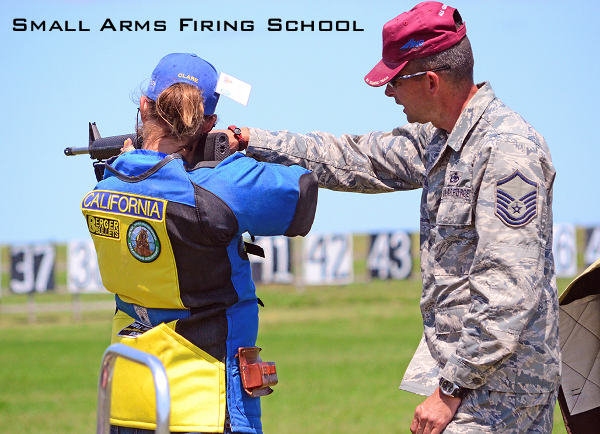
The Small Arms Firing School (SAFS) will also be held for rifle and pistol enthusiasts this summer. Participants will be taught firearms handling and competition skills by some of the top military shooters in the country. The SAFS courses have been a staple in the National Matches at Camp Perry since 1918. Many other clinics and learning opportunities, taught by qualified professionals, will also be available during the National Matches.
Spectators Are Welcome at the National Matches
Events are open to the public, and spectators are welcome to observe firing on the Camp Perry ranges at any time. Guests are encouraged to visit Camp Perry and watch the many events held during Match season. The photo below shows spectators watching Pistol events at the 1956 National Matches. That was quite a crowd…

The Civilian Marksmanship Program (CMP) is a federally chartered 501 (c) (3) non-profit corporation. It is dedicated to firearm safety and marksmanship training and to the promotion of marksmanship competition for citizens of the United States. For more information about the CMP and its programs, log onto www.TheCMP.org.
March 31st, 2016
What’s a “wallet group”? It’s a singularly spectacular proof target that entitles its bearer to bragging rights. The wallet group may or may not have been shot in competition, and, by definition, it may not be repeatable. But it exists as incontrovertible proof that, at least once, the stars aligned, and the wind gods smiled on the shooter.
 Five Shots in 0.178 MOA at 1000 Yards Five Shots in 0.178 MOA at 1000 Yards
A few years ago, Forum member and F-Class shooter Gary Wood was testing his 6.5-284 rifle at the 1000-yard range in Coalinga, California, getting ready for an upcoming long range match. In practice, Gary nailed a witnessed 1.859″ five-shot group, with four of the five shots well under an inch. Use this as proof to win those club-house arguments about whether it is possible to shoot “in the ones” at 1000 yards. Gary’s group worked out to 0.178 MOA!
Gary reports: “I was load testing with 5-shot groups. Each group was shot on a new F-Class center and pulled by Ret. Master Chief Jerry Pullens and spotted by an other long-range shooter. The second 5-shot load group looked really small … by our reckoning four out of five shots measured under an inch. I was amazed. What’s more, when I shot the group, the 4th shot blew the spindle out of the 3rd shot. My spotter saw that in his scope and Jerry Pullens told me about it afterwards”.
As measured with the OnTarget Software, using a scan of the target, Gary plotted the group size at 1.859″ total for five shots, or 0.178 MOA. Gary noted: “I had everyone sign the target which I saved and photographed.” Yes, Gary, this may be the wallet group to end all wallet groups. You should have that target framed.

Gary’s Load and 6.5-284 Rifle Specs
Gary was running a stout load of Hodgdon H4350 and CCI BR-2 primers, pushing moly-coated 142gr Sierra MKs, in Lapua 6.5-284 brass. The rifle features an F-Class, single-shot Surgeon action with a Bartlein 5R barrel chambered with a no-turn neck. Gary says “The barrel only has 70 rounds through it… yep, I think it will shoot.” Gary did all of the gunsmithing and barrel work himself.
Did Gary have any special reloading tricks? Apparently not: “Other than weighing the cases and the powder very carefully, there really were no magical reloading secrets used. The Sierra 142s were moly-coated straight from the box of 500, but they were not weighed or checked for bearing surface. The powder was dropped with a RCBS ChargeMaster then checked with an Acculab scale (to under a tenth). The Lapua cases were not neck-turned, but I did weight-sort them. The five cases for the small group weighed: 195.05, 195.03, 195.03, 195.03, 195.01.”
March 30th, 2016

Are you a fan of 6.5mm rifle cartridges? Then you should visit TargetShooter Magazine and read Laurie Holland’s latest “magnum opus”. Laurie recounts the development of 6.5mm rifle cartridges and examines a host of “six-fives” including the well-known 6.5×55 Swede and more esoteric cartridges such as the 6.5×58 Vergueiro. Laurie looks at a variety of military 6.5mm cartridges, including Japan’s 6.5×50 Arisaka, as well as some big 6.5mm Magnums. This Editor shot a .260 Remington (essentially a necked down .308 Win) for quite a while. I was pleased to see that Laurie discusses the .260 Rem, along with its bigger brother, the 6.5-06.
Part One of a four-part series, this is a LONG article, which runs over 4000 words. There are more than a dozen photographs, showing both cartridge types and bullet types. In addition, cartridge specs are presented in two detailed tables. Here is a list of the notable 6.5mm cartridges Laurie references (and we may have missed a few):
6.5×47 Lapua
.260 Remington (6.5-08)
6.5×50 (Arisaka)
6.5×52 Carcano
6.5x53R Mannlicher
6.5×54 Mannlicher-Schoenauer
6.5×55 Swedish |
6.5×57 Mauser
6.5×58 Vergueiro
6.5×68 RWS
6.5-284 Norma
6.5-06 (6.5/.30-06)
6.5mm Remington Magnum
.264 Winchester Magnum |

In early 20th century the 6.5x54mm Mannlicher-Schoenauer was a highly-regarded hunting cartridge.
Here is a sample from Laurie’s 6.5mm Cartridge History:
The 6.5×55 Swedish Mauser and Other Early Designs
Thanks to the 6.5X55mm and its common name of ‘Swedish Mauser’ (it was a joint Swedish / Norwegian military development truth to tell), not forgetting first rate Lapua, Norma, and Sako ammunition and components, many associate the 6.5s with Scandinavian countries. However, the two Nordic nations weren’t alone in adopting 6.5mm designs during the back end of the 19th century, moreover Germany and Austria did as much to popularize the caliber. The Netherlands, Italy, Japan, Romania, Portugal and Greece took the small caliber military route too, although some later decided to convert at least partially to larger bores.
However, once armies started to adopt lighter, pointed bullets at improved velocities in the .30-class designs starting with the German 7.92mm 153gr bulleted S-Patrone of 1905 which produced the then astonishing MV of 2900 fps in the G98 rifle, the 6.5s lost out as contemporary propellants couldn’t handle smaller calibers as efficiently. It’s significant that while some early users moved to larger caliber service rifles, no country [other than Japan] has adopted 6.5mm in the last 110 years although there have been some unsuccessful initiatives recently.
Prior to WW2, there had only been a single American attempt to produce a 6.5, the brilliant cartridge designer and riflemaker Charles Newton with his eponymous 256 design of 1913 which used a shortened and necked-down 30-06 case. The Western Cartridge Company loaded ammunition for Newton, a 129gr expanding bullet at a claimed 2760 fps MV and obtained in a longer barrel than those fitted to production rifles.

RWS introduced the powerful 6.5X68mm in 1939 and it is still in use in Europe.
March 30th, 2016

Ever find yourself sitting in an airport, bored out of your gourd? Well here’s how to make good use of your time — listen to a gun-centric Podcast. There are a number of interesting Podcasts for shooters and firearms fans. A Podcast is like an old-fashioned radio show, but delivered over the internet. You can listen “live” or save the Podcast file for later review. That’s great when you’re on an airplane and don’t have a web connection. Download some Podcasts to your smartphone before you get to the airport and then you can play them back during your flight.
Our friends at the NRA Blog have researched Podcasts for fans of the shooting sports. It turns out that Podcasts are more popular than ever: “The Great Podcast Renaissance is upon us! Podcasts have been around for about 10 years now. It’s easier now than ever for anyone and everyone to make their own podcast, which is why the number of podcasts and variety of show topics have greatly increased.”
Here are some Podcasts we like:
1. Gun Girl Radio

Photo courtesy NRAFamily.org.
The Gun Girl Radio Podcast is hosted by our friends Julie Golob and Randi Rogers, both top action shooting competitors. Julie served with the U.S. Army before embarking on her professional shooting career. Randi has been a champion in various shooting disciplines including Cowboy Action and 3-Gun.
2. The Firearms Radio Network

With more than a dozen different podcasts, the Firearms Radio Network (FRN) offers a large range of audio programming. Whether you’re a tactical shooter, or a handgunner, or a hunter, you’ll find something of interest. This network also offers a regular podcast dedicated to hand-loading. Here are some of our favorite FRN podcasts:

3. Tom Gresham’s GunTalk

Tom Gresham’s GunTalk is the only nationally-syndicated radio talk show about firearms, shooting and gun rights. It is available as a live radio broadcast as well as recorded podcasts. Each week Tom host notable guests from the firearms industry and shooting sports.
4. Hunt Talk Radio

Randy Newberg’s Hunt Talk Radio covers hunting politics, access to public lands, and conservation topics. Expert hunters and guides join Randy each week, sharing their field skills and stalking tips.
March 30th, 2016

Got Ammo? If you need bulk .223 Rem ammo for 3-Gun practice or a varmint safari, or if you want to stock up on pistol ammo, now’s a great time to shop. Cabelas.com is running a promotion this week with great prices on a wide variety of ammo. There are nearly 60 ammo varieties on sale. Some of the best deals are shown below. The 9mm Luger prices are low enough that it’s hard to justify hand-loading if you value your time at all.
Along with the savings on ammo prices, you can save on shipping costs. Through 4/1/2016, you can get $5.00 Shipping on orders of $99.00 or more. Use code 36SPRING during checkout. This $5.00 shipping offer will cover ammunition.
Federal American Eagle .223 Rem Rifle Ammo (55gr FMJ)
with Cabela’s Dry-Storage Box, 300 Rounds $124.99.

|
| CCI Blazer Brass 9mm Luger FMJ Ammo, $10.99 for 50 Rounds.

|
| Winchester .45 ACP FMJ Ammo, 200 Rounds in Wood Box, $89.99.

|
| CCI Herters .40 SW TNJ Ammo (Nylon-coated Lead) $13.99 for 50 Rounds.

This TNJ (total nylon jacket) ammo features aluminum cases and lead bullets that are fully sheathed with a blue polymer (nylon) coating |
March 29th, 2016

Click to view full-screen size image.
The Cactus Classic is a prestigious benchrest competition held every year in Phoenix, Arizona. On March 16-20, many of the nation’s top short-range benchresters came to Ben Avery to vie for glory and prizes. There were some impressive performances at this year’s Cactus Classic, hosted by the Arizona Benchrest Shooters. Top Gun was Larry Costa who won the Two-Gun Grand Aggregate as well as the Light Varmint (LV) 200-yard Agg. Lou Murdica (shown below) won the Heavy Varmint (HV) 200-yard Aggregate. At the shorter range, Larry Baggett won the Heavy Varmint 100-yard Aggregate and Gary Bristow won the Light Varmint 100-yard Agg. For full results, click the link below. To see hundreds of high-rez photos from the match, visit the Berger Bullets Flickr Photo Gallery.
CLICK HERE for Complete Cactus Classic Match Results.
HV 200-yard Aggregate winner Lou Murdica.
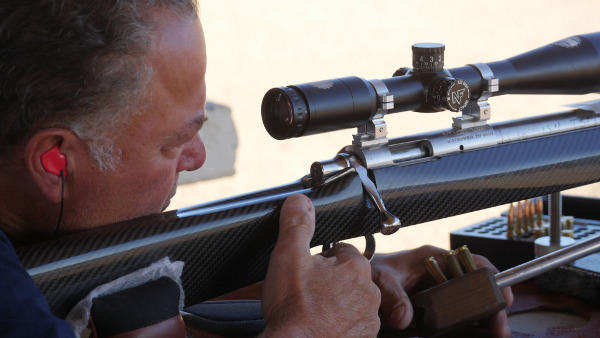


Most short-range benchrest shooters load at the range.

Now in his late 80s, Berger Bullets founder Walt Berger is still competing…

Impressive hardware was on display at the Cactus Classic.

Cleaning is part of the routine in the short-range benchrest game.

March 29th, 2016

This week’s episode of Shooting USA TV features the 2015 Palma World Championships. The World Fullbore Championships and ICFRA World Long Range Palma Team Championship were held at Camp Perry this past summer. The last time the USA hosted the Palma Championship was 1992 in Raton, New Mexico. The event won’t return to the USA for another 28 years. If you want to see the world’s best sling shooters in action, tune in to this episode of Shooting USA on the Outdoor Channel.
This Team Championship is a prestigious match at 800, 900 and 1,000 yards with national squads competing for the prized Palma Trophy (see below). The 2015 Team Championship was secured by the talented United Kingdom squad.

Palma Team World Championships
The Team Palma match is the oldest, continuously-running rifle match in the world. This event was first held in 1876 in Creedmoor, New York as a challenge match to mark America’s Centennial. British Commonwealth nations were invited and the American team won the first title. The Palma World Championships currently take place every four years. This summer the event was held in the USA, with the top eight teams in the world competing at Camp Perry in Ohio. The next Palma Team World Championships will be held in New Zealand in 2019.
 “It’s fantastic. It is the greatest honor you could ever get to represent your country. We wouldn’t give it up for anything,” says Australia Palma Team Member, Ben Emms. The match itself takes place over two days, with each team shooting at 800, 900 and 1,000 yards. Competitors shoot a modern target rifle with iron (aperture) sights. All rifles are chambered for the .308 Win (7.62×51) with 155-grain bullets. Wind calls are made by each team’s Wind Coach. “His job is very complex. He’s up there, he’s watching the mirage, the wind flags, and paying attention to the other targets down range,” says American Team Member Amanda Elsenboss. “It’s fantastic. It is the greatest honor you could ever get to represent your country. We wouldn’t give it up for anything,” says Australia Palma Team Member, Ben Emms. The match itself takes place over two days, with each team shooting at 800, 900 and 1,000 yards. Competitors shoot a modern target rifle with iron (aperture) sights. All rifles are chambered for the .308 Win (7.62×51) with 155-grain bullets. Wind calls are made by each team’s Wind Coach. “His job is very complex. He’s up there, he’s watching the mirage, the wind flags, and paying attention to the other targets down range,” says American Team Member Amanda Elsenboss.
The top individual shooter in the 2015 Team match was Great Britain’s Toby Raincock, who dropped only one point over two days to finish with 449-55V, a new record individual score that will be very hard to surpass. The next best individual score was the 447-49V by fellow Brit Jon Underwood. The top American shooter was John Whidden, who finished with a 445-45V.
 The Palma Team Trophy The Palma Team Trophy
Originally named the Centennial Trophy, in honor of the Centennial celebration of the independence of the United States of America, the Palma Trophy was commissioned from Tiffany’s at a cost of $1,500. The trophy was a full-sized replica of a Roman Legion standard, executed in bronze with silver and gold inlay. On the banner of the standard was the legend, “In the name of the United States of America to the Riflemen of the world”. Above the banner was an eagle, bearing in its talons a wreath of palm leaves and a plaque on which was the single word, “PALMA”, the Latin word for palm tree, which was used by the Romans to signify victory, or the ultimate in excellence.
Because the word Palma was so easily seen, the trophy soon became known as the “Palma Trophy”, and by 1878 was referred to officially by that name. The sriginal seven and one-half foot trophy is now lost, having not been seen since at least 1954. Serving in its place is a copy which was commissioned by Dr. Herbert M. Aitken of Eau Claire, WI. The copy was made from the original Tiffany blue-prints at a cost of $32,500. Dr. Aitken has given this copy of the Palma Trophy to the NRA for use in the Palma Match. The trophy is retained by the winning team until the next Palma Match.
In 2008, the Palma Trophy was returned to the NRA, and it was decided that the trophy, once refurbished, will travel to the host nation for the match every four years, then returned to the NRA for safekeeping.
The first competition for the Palma Team was a challenge match for which the British Commonwealth nations were invited. The match was fired in 1876 at the old Creedmoor Range on Long Island as part of the Centennial celebration of the United States. Teams representing Scotland, Ireland, Canada, Australia, and the United States took part. The match is currently fired on a four-year interval.
|


