SHOT Show 2025 kicks off on Monday, January 20, 2025 with Industry Day at the Range. We’ll have friends there at the Boulder City Range testing new rifles and pistols, and checking out new optics and accessories. Then on Tuesday, January 22nd, the doors open at the Venetian Expo and Caesars Forum. Over 2700 companies will be exhibiting products this year, with booths and displays covering over 800,000 square feet of floor space. Show organizers expect over 50,000 attendees.
SHOT Show is restricted to industry professionals — manufacturer personnel, buyers/sellers of products, and media representatives. But thankfully, there will be lots of coverage from the event. We’ll be providing regular updates through our Daily Bulletin. In addition, we’ll be following SHOT Show coverage from leading gun-related YouTube Channels, including BackFire, Guns America Digest, The Firearm Blog (TFB-TV), RECOIL Magazine, and Ultimate Reloader. And below are official pages from the show website:
This video shows six interesting firearms that will be featured at SHOT Show 2025. Items include Aero Precision M4E1 Pro ambi-AR rifle, Langdon Tactical 301 Blackout shotgun, KelTec PR57 pistol, Smith & Wesson Model 1854 Stealth Hunter rifle, HM Defense HM50B2 Gen2 rifle, Patriot Ordnance LMR Base rifle.
Here’s a selection of five notable handguns and rifles set for unveiling at SHOT Show 2025. Featured guns include: Bergara BMR-X rimfire rifle, Shadow Systems CR920X pistol, Jacob Grey TWC Black pistol, Bushmaster V-Radicator AR rifle, Wilson Combat Div77 Project 1 pistol.
Here are two good videos from 2024. The first is a great intro to SHOT Show, and the second covers Range Day, which is being held today at the Boulder Rifle & Pistol Club outside Las Vegas.
In addition, NRA Publications’ Shooting Illustrated will provide extensive coverage of SHOT Show — from pre-show private events to Media Day At The Range to updates from the Venetian Expo and Caesars Forum in Las Vegas. Shooting Illustrated staffers will be at SHOT Show to find notable new firearms, gear, and accessories, which will be covered via regular updates on the internet. Check out ShootingIllustrated.com for daily show recaps, as well as exclusive, live content from Las Vegas on Instagram, Twitter, Facebook and YouTube.
Shooting Illustrated is the NRA’s official journal covering personal defense, concealed carry, and tactical firearms, training and gear. Shooting Illustrated reaches over one MILLION users through its print magazine, digital publications, and social media. Visit ShootingIllustrated.com for more information.
Sebastian (“Seb”) Lambang, the brilliant creator of SEB rests, joystick bipods, and rear bags, visited the USA two years ago to compete at the 2023 NRA F-Class National Championships at the Ben Avery shooting facility in Phoenix, Arizona. For that Fall 2023 event, Seb commissioned a very handsome, state-of-the-art F-Open rifle built by Blake Barrel and Rifle. Above is Seb’s F-Open rifle on the firing line at Ben Avery.
Seb Lambang’s impressive 7 FCP rig is chambered for the 7 FCP cartridge, an “improved” 6.5 PRC necked up to 7mm. This handsome rifle was crafted by Blake Barrel and Rifle using a 7mm, 1:8.5″-twist Blake barrel chambered in 7 FCP fitted to a Borden Accuracy BRMXD action. Mated to the Borden action is a Bix’N Andy Competition Benchrest trigger. On top is a March 10-60x56mm HM scope.
The handsome laminated wood XR stock is made by Cerus Rifleworks. The XR stock boasts a R.A.D. recoil reduction system in the rear, and a metal bag-rider system at the forward end of the stock. The rig employs an adjustable F-Class Products F-Open Barrel Tuner.
Seb Lambang is a talented shooter as well as a great craftsman. On the side of his March X scope it states: “Sebastian Lambang, QRA Queens 2022, F-Open Winner”.
Sebastian Lambang — Founder and Chief Designer of SEB Rests
When he is not competing, Seb works hard producing SEB Front Rests, SEB Neo-X Rests, SEB Mini-X tripod rests, and the class-leading SEB JoyPod-X joystick bipod, favored by F-TR shooters worldwide. Here are products at Seb’s warehouse, getting ready to be shipped out.
About the 7 FCP — New 7mm Cartridge Derived from 6.5 PRC
The 7 FCP was a cartridge designed from the ground up by F-Class Products out of Phoenix, Arizona in the fall of 2022. The developers believe it is the “ultimate cartridge” for the F-Class Open Division competition. F-Class Products notes: “We wanted a cartridge that [had] an efficient case capacity [matching] the 7mm Remington Short Action Ultra Magnum. The 7 RSAUM has proven to be the most winning cartridge in world F-Class competitions and many nationals and finale events. The problem with the RSAUM is brass availability. Remington stopped making brass for the RSAUM years ago and recently Norma has also stopped producing brass for it. The only option now is ADG. While the ADG brand of brass is good, it is quite expensive and also is only run in short runs and is hardly ever available.”
So the 7 FCP was developed from the 6.5 PRC, which has high-quality Lapua brass available. The 7 FCP was designed to shoot the 180 grain Berger Hybrid bullet at 2960 FPS out of a 30″ barrel without excessive pressure. SEE: 7 FCP Cartridge INFO FAQ Page.
7 FCP Cartridge — Wildcat Based on 6.5 PRC Necked up to 7mm
How Does the 7 FCP’s Case Capacity Compare?
F-Class Products states: “The parent case of the 7 FCP is a 6.5 PRC. The 6.5 PRC is a magnum case that has a head diameter of 0.532″ and has a overall length of 2.020″. It is the same overall length as the 7 RSAUM but with a smaller diameter body. Hence, without improving it, you will get not get the case capacity of a 7 RSAUM case, and therefore you will not get the velocities that the 7 RSAUM produces either.” F-Class Products has compared the capacity of cases commonly used in F-Open competition:
.284 Winchester = 63 grains of water capacity
.284 Shehane = 66.5 grains of water capacity
6.5 PRC = 65 grains of water capacity
7-6.5 PRC = 66.5 grains of water capacity
As you can see by the data above, the 6.5 PRC that is simply necked up to a 7mm does not provide more case capacity than the .284 Shehane. That is why the PRC has the shoulder moved forward.
What Powders Work Well in the 7mm FCP?
F-Class Products has tested many powders with the 7 FCP: “Any powders that work well in a .284 Win, a .284 variant or a 7 RSAUM and/or variant, can work well in the 7 FCP. We have tested many different powders and many show to work excellent. Here is a list of the powders we have tested that work well in our testing and in our customers’ testing:
Hodgdon H4350
Hodgdon H4831
Hodgdon H4831 SC
Alliant Reloder 16
Alliant Reloder 23
Vihtavuori N160
Vihtavuori N550
Vihtavuori N555
This is just a short list of what we believe are the core powders that will burn and work efficiently in the 7 FCP. There are plenty of other powders that also can work, yet they may be temperature sensitive and or not burn efficiently in the case.”
What Velocities Are Optimal?
F-Class products observes: “With the 180 grain Berger bullet we see accuracy from 2920-2980 FPS muzzle velocity. With the 190 grain Hornady A-Tip bullet we see accuracy from 2860-2900 FPS.”
What Twist Rates Do You Recommmend?
F-Class Products recommends a 1:8.5″-twist barrel. An 8-twist can work, yet the accuracy nodes may be narrower than the 8.5 twist. A 9-twist barrel can also work if you are shooting a 184 grain bullet or less. These twist rates are recommended for lead cored bullets. If you are planning on shooting a solid copper bullet, consult the bullet manufacture for recommended twist rates for that particular bullet.
What Is the Parent Case?
The parent case of the 7 FCP is a 6.5 PRC. The 6.5 PRC is a magnum case that has a head diameter of 0.532″ and has a overall length of 2.020″. It is the same overall length as the 7 RSAUM but with a smaller diameter body, hence without improving it, you will get not get the case capacity of a 7 RSAUM case, and therefore you will not get the velocities that the 7 RSAUM produces either.
SHOT Show 2025, the biggest gun industry trade show, kicks off Tuesday, January 22nd, in Las Vegas. Over 2700 exhibitors will showcase thousands of new products at the Venetian Expo and Caesars Forum which together provide more than 800,000 net square feet of displays. The official SHOT Show Product Planner offers a “sneak peak” at 340 new-for-2025 products for hunters and shooters. Here are 6 cool new items in the SHOT Show New Product showcase (product profiles are based on descriptions provided by the manufacturers). That’s followed by six more interesting products featured in Shooting Industry Magazine.
Kestrel 5700X WEZ Ballistics Weather Meter
Company: Kestrel Ballistics
Advanced Kestrel 5700X Ballistic Weather Meter with AB Elite ballistics solver and WEZ analysis. This unit operates seamlessly without additional electronics and can calcualte P-HIT probability. Price: $999.00.
Vision Pro Chassis
Company: GCP Rifle Co.
The Vision Pro chassis is a Precision Rifle chassis with high-grade components. List $1599.00.
TAPCO Tactical Henry Model X Rifle Handguard & Stock Package
Company: TAPCO
The Henry Model X stock/handguard package is a stock upgrade with modern tactical/precision features including an adjustable cheek plate and universal 6-round ammo quiver. You can fit M-LOK accessories on the tactical Henry handguard. Price is $449.98.
Pelican Reset Case Interior System
Company: Pelican Products Inc.
The Pelican Reset interior system has customizable foam pegs in a grid frame that can be raised or lowered to create cavities for guns and gear. A middle panel can be removed for extra space. Reset foam works with 1700, 1720 and 1750 Protector cases.
SPACE Smart Safes
Company: SPACE Smart Safes
Advanced smart safe with cameras and smartphone App.
Shooting Industry Magazine 2025 New Product Showcase
See more cool new products in the Shooting Industry Magazine 2025 New Product Showcase. You can view all editions in the Monthly Issue Archives
Savage Arms Model 334 bolt-action rifle will be available a Mossy Oak Terra Gila camo stock and two new calibers: .30-06 Springfield and .270 Win (along with 8 other chambering types). The Model 334 has a 3-position safety, a 60-degree bolt lift, and three locking lugs.
Bolt Action AR-type Rifle
Bear Creek Arsenal BC-15 Bolt Action Style Complete Upper and Rifle in .350 Legend and .450 Bushmaster. The BC-15 Bolt Action Style Upper fits any standard AR-15 lower.
Rise Triggers — Match and Hunting
RISE now offers Reliant triggers for Rem 700 and Rem 700 clone rifles. The Reliant Hunter Trigger has a preset pull weight of 3.5 lbs. For Precision shooters, the Reliant Pro Trigger has a lighter preset pull weight of 2 lbs., with pull-weight adjustment from about 1 lb. to over 3 lbs. maximum. The Reliant Hunter is available in a curved blade only, while the Reliant Pro has flat and curved blade options. Additional features include unibody cassette-style installation, NoWay take-up for a clean break and NiB-coated steel key components.
The new MDT CRBN Rifle Stock is a lightweight carbon fiber stock with an internal mini-chassis weighing 27 ounces. Crafted from foam-filled carbon fiber, the MDT CRBN Rifle Stock features an ARCA rail, adjustable comb, adjustable length-of-pull, M-LOK slots, QD attachment points, and a 20-degree grip angle.
Silencer Central
Meat-Eater Suppressor
Silencer Central has worked with Banish to develop a new 30-caliber “Meat Eater” suppressor for cartridges up to .300 RUM. The maker claims this suppressor can reduce sound levels by 32 decibels and reduce recoil by up to 40% via its integrated “anchor brake”. This light-weight suppressor weighs 10.3 oz., and measures 5.85″ long. It employs an industry-standard hub mount.
Vudoo Gun Works
Precision Rifle Bag
The impressive Vudoo Precision Rifle Bag has thick foam padding on all sides, 3 Zippered mesh pockets, removable scope cover, muzzle cover with bungee, Velcro interior walls, and cleaning rod sleeve. The fully customizable compartments keep gear organized, while thick, high-density padding shields your firearm from the toughest conditions. This case costs $225.00.
CLICK HERE to read the full monthly digital editions of Shooting Industry Magazine online. Access to ALL articles is free via these Online Editions.
Have you recently purchased a new scope? Then you should verify the actual click value of the turrets before you use the optic in competition (or on a long-range hunt). While a scope may have listed click values of 1/4-MOA, 1/8-MOA or 0.1 Mils, the reality may be slightly different. Many scopes have actual click values that are slightly higher or lower than the value claimed by the manufacturer. The small variance adds up when you click through a wide range of elevation.
In this video, Bryan Litz of Applied Ballistics shows how to verify your true click values using a “Tall Target Test”. The idea is to start at the bottom end of a vertical line, and then click up 30 MOA or so. Multiply the number of clicked MOA by 1.047 to get the claimed value in inches. For example, at 100 yards, 30 MOA is exactly 31.41 inches. Then measure the difference in your actual point of impact. If, for example, your point of impact is 33 inches, then you are getting more than the stated MOA with each click (assuming the target is positioned at exactly 100 yards).
How to Perform the Tall Target Test
The objective of the tall target test is to insure that your scope is giving you the proper amount of adjustment. For example, when you dial 30 MOA, are you really getting 30 MOA, or are you getting 28.5 or 31.2 MOA? The only way to be sure is to verify, don’t take it for granted! Knowing your scopes true click values insures that you can accurately apply a ballistic solution. In fact, many perceived inaccuracies of long range ballistics solutions are actually caused by the scopes not applying the intended adjustment. In order to verify your scope’s true movement and calculate a correction factor, follow the steps in the Tall Target Worksheet. This worksheet takes you thru the ‘calibration process’ including measuring true range to target and actual POI shift for a given scope adjustment. The goal is to calculate a correction factor that you can apply to a ballistic solution which accounts for the tracking error of your scope. For example, if you find your scope moves 7% more than it should, then you have to apply 7% less than the ballistic solution calls for to hit your target.
NOTE: When doing this test, don’t go for the maximum possible elevation. You don’t want to max out the elevation knob, running it to the top stop. Bryan Litz explains: “It’s good to avoid the extremes of adjustment when doing the tall target test.I don’t know how much different the clicks would be at the edges, but they’re not the same.”
Should You Perform a WIDE Target Test Too?
What about testing your windage clicks the same way, with a WIDE target test? Bryan Litz says that’s not really necessary: “The wide target test isn’t as important for a couple reasons. First, you typically don’t dial nearly as much wind as you do elevation. Second, your dialed windage is a guess to begin with; a moving average that’s different for every shot. Whereas you stand to gain a lot by nailing vertical down to the click, the same is not true of windage. If there’s a 5% error in your scope’s windage tracking, you’d never know it.”
Verifying Scope Level With Tall Target Test
Bryan says: “While setting up your Tall Target Test, you should also verify that your scope level is mounted and aligned properly. This is critical to insuring that you’ll have a long range horizontal zero when you dial on a bunch of elevation for long range shots. This is a requirement for all kinds of long range shooting. Without a properly-mounted scope level (verified on a Tall Target), you really can’t guarantee your horizontal zero at long range.”
NOTE: For ‘known-distance’ competition, this is the only mandatory part of the tall target test, since slight variations in elevation click-values are not that important once you’re centered “on target” at a known distance.
Every Saturday we present interesting, informative videos for our Daily Bulletin readers. Here we feature five YouTube videos that offer a ton of useful information for serious shooters. We start with a great video about setting up rifle, rest, and bag on the bench. Then Hall-of-Fame benchrest shooter Speedy Gonzalez shows smart methods for cleaning barrels. Next F-Class Ace Keith Glasscock explains how to optimize your rifle after travel. In the fourth video, AutoTrickler inventor Adam MacDonald shows how to optimize the AutoTrickler V4. Next the truly outstanding 21st Century Power Neck-Turning lathe is showcased.
How to Set Up Your Rifle, Rest, and Bag on the Bench
To get the best results in benchrest shooting, you need to set up all the gear on your bench properly. That includes front rest placement, rear bag position, spotting scope set-up, and placement of cartridge holder/caddy, and possibly an elbow/forearm rest. When setting up the hardware, you need to align the front rest and rear bag properly to get optimal tracking. In addition you want to make sure the rear bag doesn’t slide or rotate a bit from shot to shot. And you also want to set your seat height/location so the shooter’s position is optimal and comfortable. This helpful video shows how to set up your rifle and gear for a benchrest match or load development/practice at the range. Credit to Boyd Allen for finding video.
Cleaning Barrels with Speedy — Smart Techniques
There are many effective methods to clean barrels. But some are more efficient that others and can help you do the job more quickly, with less effort. Here respected gunsmith and Hall-of-Fame benchrest shooter Speedy Gonzalez shows his procedures for cleaning competition barrels. He uses Sharpshoot-R Liquid Patch-Out and Wipe-Out Accelerator as primary solvents. Watch carefully — Speedy has some clever techniques for starting a patch in the rifling, and he is also careful about exiting the muzzle when brushing. Speedy also explains the importance of keeping your rods clean. And he prefers nylon brushes because, as the barrel starts to get wear in the throat, “the bronze bristles will actually start eating into that and you’ll see little grooves if you have a good borescope.” (See video 00:38-01:35)
Loading for PRS vs. F-Class — Keith Glasscock
Keith Glasscock is one of America’s top F-Class shooters, having finished second at the National Championships multiple times. He also now shoots PRS/NRL Precision Rifle matches. Keith, who has an engineering background, runs the popular Winning in the Wind YouTube channel. There you’ll find great advice on wind reading, load tuning, precision reloading and many other topics. In this video, Keith offers very smart advice on how to optimize a PRS load compared to a F-Class load. Accuracy counts for both disciplines, but the key objectives can be different.
Adjusting AutoTrickler V4 with its Inventor, Adam MacDonald
Adam MacDonald is the brilliant Canadian engineer who created the AutoTrickler series of automated powder dispensing systems. These work with advanced scales to dispense powder rapidly, but with a precise final trickle accurate to a single kernel. In this video, Adam explains how best to adjust and calibrate the AutoTrickler V4 when using powders that flow at different rates.
21st Century Power Neck-Turning Lathe — Great Tool
Turning case-necks can be tedious and tough on older hands if you’re using hand-held tools. Quite a few years ago 21st Century released a great compact, neck-turning lathe that delivers superb, consistent results. This Editor uses that original lathe with hand crank and I can affirm that it works great. It is easy to use, fast, and the turned necks come out smooth with consistent rim thickness. But you still had to turn a crank. Well, in 2018, 21st Century created an upgraded Power Neck-Turning Lathe with an electric motor and lever to advance the cases to the cutter. The power head glides on stainless steel guide rails. Power is controlled with a red button in the feed handle.
This advanced, powered mini-lathe is absolutely superb. It works brilliantly and makes the task of turning case-necks fast and VERY easy. And there is even a 3-Way trimmer upgrade that will trim cases to length at the same time as the necks are turned.
BONUS — How to Spot Fake Online Sellers of Components
With the shortage of premium reloading components, particularly powder and primers, many handloaders are desperate to find components when even big companies such as Midsouth and MidwayUSA are completely sold out. Enter the scammers. There are criminals, many based overseas, who have created entire websites designed to steal your money. You might find such a site when searching for “Varget powder in stock” or “CCI BR4 primers”. These sites look like regular business webstores, with product photos and modern shopping cart systems. But it’s all a scam.
Key giveaways are: 1) The site does NOT take Visa, Mastercard, or Discover but requires payment with Zelle, Venmo, Bitcoin, or AppleCash only; and 2) The site has hard-to-find powders, such as H4895 and H4198, that nobody else has, and you can put thousands of pounds in the shopping cart.
Bottom line here — if the site allows you to order vast amounts of powder and/or primers, and does not take ANY major Credit Card types, it is almost surely a scam. If you see links to pay with Crypto-Currency (such as Bitcoin) run away!
Creedmoor Sports has released a series of helpful “how-to” videos in its InfoZone web page. In one InfoZone video Bill Gravatt shows how to seat bullets using L.E. Wilson Hand Dies and an Arbor Press. The basic process is simple, particularly with a micrometer-top seating die. That makes it easy to adjust and set seating depth. Before you start seating bullets, you want to adjust the height of the arbor so the stroke is appropriate to the height of your die.
Bill Gravatt Shows How to Use Hand Seating Dies — Creedmoor INFOZONE
ARBOR PRESS TECHNIQUE: When using an arbor press, smooth is good. You don’t want to slam the handle down quickly. Try to repeat the same motion each time. You can also experiment by seating the bullet part way, then rotate the cartridge (in the die) and do the final seating with a second stroke. If your arbor press has a force gauge, note both the max value of the gauge needle and how it moves as you seat the bullet. If the needle spikes too rapidly, or bounces back and forth irregularly, set that cartridge aside and/or mark it. You could have neck tension issue with that case or some other fault. You might even have a bad bullet. That’s rare, but can happen. The key to success is moving the press arm in a smooth motion every time, maintaining the same down-pressure with each cartridge.
Here Bill Gravatt Offers a Simple Tip for Adjusting Wilson Seating Dies
One of our Forum readers asked “How can I get a custom in-line seater for my new rifle?”. First, we would say that, if you are not shooting an unusual Wildcat, check first to see if L.E. Wilson makes a stainless Micrometer Seater Die for your rifle. These dies are a joy to use, and we’ve found the fit to be exceptionally good with many calibers. Typically priced from $95-$120, Wilson stainless micrometer-top seaters are available for dozens of cartridge types: .204 Ruger, 20 BR, .222 Rem, .223 Rem, 22 PPC, 22 BR, .22-250, .223 WSSM, 6 PPC, 6mmBR, 6XC, 243 Win, .243 WSSM, 25 WSSM, 6.5×47 Lapua, 6.5 Creedmoor, 6.5-284, 26 Nosler, .270 WSM, 7mm-08, .284 Win, 28 Nosler, 7mm RUM, 30 BR, .308 Win, .300 WinMag, .338 Edge (and MORE).
If you do want a custom seater die, the process is relatively simple. Purchase a die blank from Wilson and have your gunsmith run the chambering reamer in. Forum member Gunamonth explains: “I start with a Wilson seating die blank. They’re available from Sinclair and other vendors. Just run the reamer in. For some of my rifles, where I wanted the stainless die with the micrometer adjustment, I bought a smaller die and had the smith ream it with the chamber reamer. That’s how I had my 6 Dasher and 6mm AI seaters made. With the Dasher I stared with a 6mmBR Micrometer die.”
SEATER STEM TIP: If, on your seated bullets, you are seeing a sharp line around the jacket near the ogive, you may want to smooth out the leading edge of the Wilson seater stem (see above left). Do this by putting a little lapping compound on one bullet and manually spin this around in the stem. Without much effort you’ll have a smooth bullet/stem interface.
Micrometer Top Add-on
We really like micrometer tops on a seating die. But what if Wilson doesn’t make a micrometer top seater for your chambering? Don’t despair, Brownells sells a $39.99 Sinclair Micrometer Top that can be added to Wilson standard seaters or to a custom seater die made from a Wilson die blank.
The NRA Blog ran an feature on Silhouette shooting by NRA Silhouette Program Coordinator Jonathan Leighton. Here are selections from Leighton’s story:
NRA Silhouette Shooting
The loud crack from the bullet exiting the muzzle followed by an even louder ‘clang’ as you watch your target fly off the railing is really a true addiction for most Silhouette shooters. There is nothing better than shooting a game where you actually get to see your target react to the bullet. In my opinion, this is truly what makes this game so much fun.
Metallic Silhouette — A Mexican Import
Silhouette shooting came to this country from Mexico in the 1960s. It is speculated that sport had its origins in shooting contests between Pancho Villa’s men around 1914. After the Mexican Revolution the sport spread quickly throughout Mexico. ‘Siluetas Metalicas’ uses steel silhouettes shaped like game animals. Chickens up front followed by rows of pigs, turkeys, and furthest away, rams. Being that ‘Siluetas Metalicas’ was originally a Mexican sport, it is common to hear the targets referred to by their Spanish names Gallina (chicken), Javelina (pig), Guajalote (turkey) and Borrego (ram). Depending on the discipline one is shooting, these animals are set at different distances from the firing line, but always in the same order.
Before Steel There Was… Barbeque
In the very beginnings of the sport, live farm animals were used as targets, and afterwards, the shooters would have a barbeque with all the livestock and/or game that was shot during the match. The first Silhouette match that used steel targets instead of livestock was conducted in 1948 in Mexico City, Mexico by Don Gonzalo Aguilar. [Some matches hosted by wealthy Mexicans included high-ranking politicians and military leaders].
As the sport spread and gained popularity during the 1950s, shooters from the Southwestern USA started crossing the Mexican border to compete. Silhouette shooting came into the US in 1968 at the Tucson Rifle Club in Arizona. The rules have stayed pretty much the same since the sport has been shot in the US. NRA officially recognized Silhouette as a shooting discipline in 1972, and conducted its first NRA Silhouette Nationals in November of 1972.
Great Video of Silhouette Shooting in Canada with Drone Footage
Now There Are Multiple Disciplines
The actual sport of Silhouette is broken into several different disciplines. High Power Rifle, Smallbore Rifle, Cowboy Lever Action Rifle, Black Powder Cartridge Rifle, Air Rifle, Air Pistol, and Hunter’s Pistol are the basic disciplines. Cowboy Lever Action is broken into three sub-categories to include Smallbore Cowboy Rifle, Pistol Cartridge Cowboy Lever Action, and regular Cowboy Lever Action. Black Powder Cartridge Rifle also has a ‘Scope’ class, and Hunter’s Pistol is broken into four sub-categories. Some clubs also offer Military Rifle Silhouette comps.
Where to Shoot Silhouette
NRA-Sanctioned matches are found at gun clubs nation-wide. There are also many State, Regional, and National matches across the country as well. You can find match listings on the Shooting Sports USA website or contact the NRA Silhouette Department at (703) 267-1465. For more info, visit SteelChickens.com, the #1 website dedicated to Silhouette shooting sports.
A Virginia Congressman has introduced legislation which will take suppressors (aka “silencers”) off the NFA list and make them much easier to purchase. That’s a good idea because a quality suppressor can reduce firearm sound levels by 30 decibels (dB) or more. U.S. Rep. Ben Cline’s Hearing Protection Act (H.R. 404) would remove firearm suppressors from the list of restricted items under the 1934 National Firearms Act (NFA). That would reduce costly licensing ($200 per suppressor) and burdensome background checks. Instead, suppressors would be regulated under the 1968 Gun Control Act (GCA) with the same type of background check done with retail firearm purchases. The legislation would also amend statutory suppressor definitions.
Under current law, an individual purchasing a suppressor must locate a regulated NFA Class III retailer, complete a Bureau of Alcohol, Tobacco, Firearms and Explosives (ATF) Form 4 with the model and serial number of the suppressor, and obtain two passport photos and fingerprint cards from a local police department. The local chief law enforcement official must receive a completed copy of the application. Then the form, photographs, and fingerprints must be sent to ATF along with a check to pay the $200 tax. The customer can obtain the suppressor from the NFA Class III retailer upon an additional background check through FBI’s National Instant Criminal Background Check System (NICS).
Congressman Cline’s legislation would eliminate those requirements and make suppressors available with the same type of paperwork and background check required for a firearm. H.R. 404 would also clarify the definition of suppressors, ensuring that components like mounts, baffles and end caps are not erroneously classified as standalone suppressors or “silencers”.
“Congressman Cline’s Hearing Protection Act will have the federal government recognize firearm suppressors for what they are. These are accessories to a firearm that make recreational shooting and hunting a safer experience”, said Lawrence G. Keane, NSSF Senior V.P. and General Counsel. “These safety devices reduce the report of a firearm to a level that won’t cause instant and permanent hearing damage.” There are currently 2.6 million legally owned suppressors in the United States.
See Through Suppressor in Super Slow Motion (110,000 fps) — Click Arrow to Watch:
Suppressors, On Average, Reduce Noise Levels about 30 Decibels
In an article for Ammoland, gunwriter Sam Hoober says that you can expect about 30 decibels (dB) of noise reduction from the average suppressor: “Looking at a few different products, SilencerCo attests their suppressors reduce the sound pressure of a 9mm gunshot to anywhere from 125.7 dB to 131.5 dB, depending on the model. Advanced Armament Co, another popular supplier, attests a 23 dB to 33 dB reduction or down to 127 dB. Liberty Suppressors, another manufacturer, attests a reduction of 24 dB to 38 dB, depending on model and other factors. In short, we can presume something on the order of 30 dB of attenuation as an average.”
Using that 30 dB number you can quickly discern that you’ll still need hearing protection — good hearing protection — when shooting any suppressed firearm (even a .22 LR). “Spikes of 130 dB and more can result in permanent hearing damage instantly”. Source: NRA Blog.
Firearm suppressors (aka “silencers”) reduce the report of a firearm from a level roughly equal to that of a jet taking off which causes instant and permanent hearing loss to one that is safe, but still equal to a jackhammer. That decibel level will not permanently damage hearing. Suppressors work similar to a car’s muffler, redirecting exhaust gases.
Shooting can be a frustrating sport at times, prompting shooters to say some funny things in the heat of the moment. Here’s a collection of humorous range ripostes, supplied by Shooters’ Forum members (who are listed after each quote). Enjoy.
“I paid to use all of the target and I’m getting value for money on all of the real estate!” (Macropod)
“At 65 years of age, 1000-yard benchrest is better than sex, because a relay lasts 10 minutes!” (The Viper)
“How did I do?” “Well the gun went off and nobody got hurt, we can build on that….” (Mr. Majestic)
“Treat that trigger likes it’s your first date, not like you’ve been married to it for 20 years.” (Jet)
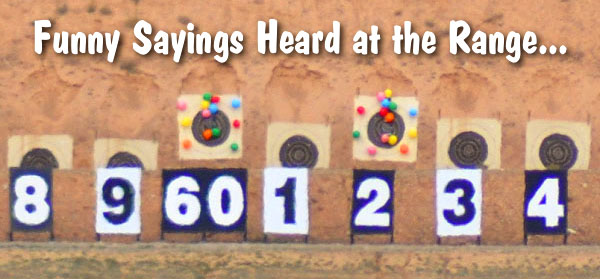
“It’s a good thing broad sides of barns aren’t at many shooting ranges.” (Rocky F.)
Target photo by Forum member RyanJay11.
“It was an 0.2″ group! Well, err, except for that flyer….” (Dsandfort)
“It’s not the arrow, it’s the Indian.” (Rocky F.)
“I can’t understand it. That load worked good in my other barrel”. (Hogpatrol)
“You bakin a biscuit?” Said to me as I was sitting at the bench ready to shoot with a cartridge in the chamber of a hot gun, taking longer than necessary. (Ebb)
“Shooting groups is easy. Just put the last three between the first two.” (Uthink)
Shooter 1: “Hey you cross-fired on my target!”
Shooter 2: “Well you cross-fired on mine first!”
Shooter 1: “Yeah but you could have at least shot an X like I did on yours.” (At Raton — Rocky F.)
“I had a bughole going and my second shot dropped straight down!” (JDMock)
“The nut came loose on the end of my stock.” (TXDan)
“That’s a pretty eight.” (REastman quoting James Crofts)
“I almost shot a record.” (Jay Christopherson)
This article is Copyright 2023 AccurateShooter.com. No reproduction on any other website is allowed.
SHOT Show 2025 kicks off in Las Vegas, Nevada in less than three weeks, starting with Industry Day at the Range on 1/20/25 where new guns can be tested at the Boulder City Rifle & Pistol Club range.
SHOT Show draws visitors from around the world. At SHOT Show 2024, exhibitors, buyers, media, and industry professionals hailed from 50 states and over 115 countries. The 2025 SHOT Show will have more than 2,700 exhibitors on the show floor, including the Suppliers Showcase. Total exhibit space for the 2024 show in these two venues is estimated to be more than 830,000 net square feet –equivalent to more than 18 acres or enough space to park 547 F-16 fighter jets. The SHOT Show boasts 13.9 miles of aisles — a distance more than half a marathon.
Firearms and ammunition are an $8.9 billion industry. The total economic impact of the sporting arms and ammunition industry is more than $90.1 billion, which supports more than 384,000 jobs.
More than 55,400 professionals in the shooting, hunting, outdoor and law enforcement industry attended SHOT Show in 2024. There could be even more this year. The SHOT Show’s website is SHOTShow.org and you’ll find daily reports on the SHOT Show Blog. You can also follow SHOT Show on Twitter @NSSFSHOTShow, on Facebook, LinkedIn, YouTube, and @shotshow on Instagram.


 How Does the 7 FCP’s Case Capacity Compare?


 Rise Triggers — Match and Hunting


 Verifying Scope Level With Tall Target Test

 One of our Forum readers asked “How can I get a custom in-line seater for my new rifle?”. First, we would say that, if you are not shooting an unusual Wildcat, check first to see if


 The
The 
 Metallic Silhouette — A Mexican Import
 Before Steel There Was… Barbeque




 SHOT Show 2025 kicks off in Las Vegas, Nevada in less than three weeks, starting with


