Here’s a handy training option for F-Class shooters. Forum member SleepyGator is an F-Class competitor, but it’s not convenient for him to shoot at long ranges close to home. Accordingly, he wanted some “reduced-distance” targets he could use at 300 yards for practice. There is an official reduced-distanced standard for 300-yard F-Class matches. This utilizes the NRA No. MR-63FC – F-Class Target Center which is pasted over the MR-63 target. It provides a 1.42″ X-Ring, 2.85″ 10-Ring, and 5.85″ Nine-Ring. (The dimensions of F-Class targets are found in the NRA High Power Rules, Sec. 22, part 4, page 70 — see sample below.)
To duplicate the 300-yard target, SleepyGator has prepared a printable version of the MR-63FC Target Center, along with a pair of training targets with two bulls and five bulls. The two-bull and five-bull targets mirror the scoring rings on the MR-63FC, but they display only the innermost three rings and two rings respectively. All three targets are Adobe Acrobat (PDF) files that can be easily printed. You may need to adjust the scale (sizing) on your printer to get the dimensions exactly correct. As noted above, when printed, the 10-Ring on all three targets should measure 2.85″. This should provide some handy practice targets you can use between matches. Thanks to SleepyGator for providing these targets. You can download all three as a .Zip archive. After downloading the .Zip file, just click on the .Zip archive to extract the individual targets.
This important video shows what really happens when loaded ammunition burns. You will probably be surprised. Contrary to Hollywood notions, the ammo doesn’t ignite in a massive explosion. Far from it… basically the rounds “cook off” one by one, and the bullets release at relatively low velocity. We’ve featured this SAAMI research project before, but it is worth reprising for those who have not yet seen the burn tests.
A couple years back, SAAMI released an important video concerning ammo and fire. With professional fire-fighters standing by, over 400,000 rounds of ammo were incinerated in a series of eye-opening tests. If you haven’t had the chance to view this video yet, you should take the time to watch it now
The Sporting Arms and Ammunition Manufacturers’ Institute (SAAMI) has produced an amazing 25-minute video that shows what actually happens to sporting ammunition involved in a fire. This video shows the results of serious tests conducted with the assistance of professional fire crews. We strongly recommend you watch this video, all the way through. It dispels many myths, while demonstrating what really happens when ammunition is burned, dropped, or crushed.
Watch SAAMI Ammunition Testing Video
Video Timeline
2:10 Impact Test (ignited outside firearm)
3:40 65-foot Drop Test
5:08 Bullet Impact (.308 Win firing)
7:55 Blasting Cap Attacks
9:55 Bulldozer and Forklift Tests
12:20 Boxed Ammo Bonfire
15:37 Bonfire without Packaging
17:21 Retail Store Simulation Burn
20:55 Truck Trailer Burn
Over 400,000 rounds of ammunition were used in the tests. Some of the footage is quite remarkable. Testers built a bonfire with 28,000 rounds of boxed ammo soaked in diesel fuel. Then the testers loaded five pallets of ammo (250,000 rounds) in the back of a semi-truck, and torched it all using wood and paper fire-starting materials doused with diesel fuel.
The video shows that, when ammo boxes are set on fire, and ammunition does discharge, the bullet normally exits at low speed and low pressure. SAAMI states: “Smokeless powders must be confined to propel a projectile at high velocity. When not in a firearm, projectile velocities are extremely low.” At distances of 10 meters, bullets launched from “cooked-off” ammo would not penetrate the normal “turn-out gear” worn by fire-fighters.
We are not suggesting you disregard the risks of ammo “cooking off” in a fire, but you will learn the realities of the situation by watching the video. There are some amazing demonstrations — including a simulated retail store fire with 115,000 rounds of ammo in boxes. As cartridges cook off, it sounds like a battery of machine-guns, but projectiles did not penetrate the “store” walls, or even two layers of sheet-rock. The fire crew puts out the “store fire” easily in under 20 seconds, just using water.
Additional Testing: Drop Test, Projectile Test, Crush Test, Blasting Cap Test
Drop Test
The video also offers interesting ammo-handling tests. Boxes of ammo were dropped from a height of 65 feet. Only a tiny fraction of the cartridges discharged, and there was no chain-fire. SAAMI concludes: “When dropped from extreme heights (65 feet), sporting ammunition is unlikely to ignite. If a cartridge ignites, it does not propagate.”
Rifle Fire Test
SAAMI’s testers even tried to blow up boxes of ammunition with rifle fire. Boxes of loaded ammo were shot with .308 Win rounds from 65 yards. The video includes fascinating slow-motion footage showing rounds penetrating boxes of rifle cartridges, pistol ammo, and shotgun shells. Individual cartridges that were penetrated were destroyed, but adjacent cartridges suffered little damage, other than some powder leakage. SAAMI observed: “Most of the ammunition did not ignite. When a cartridge did ignite, there was no chain reaction.”
Bulldozer Crush Test
The test team also did an amazing “crush-test” using a Bulldozer. First boxes of loaded ammo, then loose piles of ammo, were crushed under the treads of a Bulldozer. A handful of rounds fired off, but again there was no chain-fire, and no large explosion. SAAMI observed: “Even in the most extreme conditions of compression and friction, sporting ammunition is unlikely to ignite. [If it does ignite when crushed] it does not propagate.”
Blasting Cap Test
Perhaps most amazingly, the testers were not able to get ammunition to chain-fire (detonate all at once), even when using blasting caps affixed directly to live primers. In the SAAMI test, a blasting cap was placed on the primer of a round housed in a large box of ammo. One cartridge ignited but the rest of the boxed ammo was relatively undamaged and there was no propagation.
You can now purchase an exact reprint of Howell’s classic book for $59.98. This 600-page hardcover (8 1/2″ x 11″) resource features 450 pages of diagrams, all drawn to the same 1.5x scale. The collection of cartridge diagrams includes many “cartridge blueprints” available nowhere else, including many obscure wildcats. Howell’s book includes sections on: case specs, use of forming dies, fire forming, cartridge annealing, case capacity variables, chamber pressure variables, and powder selection. CLICK to ORDER.
Here are reviews from two book purchasers:
“This is an absolutely incredible [book] for wildcatters, ballistic students and serious cartridge handloaders. It provides the critical dimensions (imperial and metric as well as displacement) for about 1840 cartridges[.] The first 100 pages explain the mechanics of cartridge forming. The cartridge drawings are in B&W, very legible and easy to copy or scan[.] Especially on the metric side there are a few notable cartridge ommissions… but it does not detract from the overall importance of this magnificent work, which I consider the best of the genre. A great buy for serious cartridge students at any price.” — Pierre Van W.
“This book has earned the reputation of being THE authority in the field of reliable dimensions for small arms cartridges. The author [lists] which cases are useful in making other cases which may not be available. This is the bedrock technical book for this subject area and is a necessity for any hardcore reloader. It is worth more than the price asked.” — Gene C.
Editor’s Note: A couple of guys who had the original edition of this book said they found a few errors in dimensions when comparing Howell’s diagrams with SAAMI specs. Before you spec a reamer or invest in dies, you may want to double-check dimensions found in this book.
Book tip from EdLongrange. We welcome reader submissions.
Happy New Year to all our readers worldwide, and especially the nearly 30,000 members of our AccurateShooter Forum. We hope 2016 brings you happiness in your lives and success in your endeavors. And we wish for small groups, good scores, and successful hunts in the New Year.
We have upgraded our site for 2016, making our Forum mobile-friendly with new faster, more modern software. We hope you’ll continue to enjoy our feature articles, our Daily Bulletin, our match reports, and our Free Forum Classifieds. The formula seems to be working — our audience is bigger than ever and it just keeps growing, with over 550,000+ unique users visiting the site every month.
Forum Membership Grows 12% in 2015
Our Shooters’ Forum grew significantly in 2015. Membership grew by 12% as Forum ranks swelled to nearly 30,000 members! More people are successfully buying and selling in our FREE Forum Classifieds section than ever before. Remember, user donations help make our Free Classifieds possible.
Check Out Our Recently Upgraded Shooters’ Forum
Now Fully Responsive and Mobile-Friendly!
We need your support. For over 12 years the site has relied largely on volunteer efforts by dedicated shooters. But as the site grows, serving a larger audience, we need the assistance of freelance writers and video producers, plus help from expert computer and software techs. Those guys don’t work for glory alone.
Consider this — what do you pay for a movie ticket these days? Probably nine bucks for 90 minutes of escapism. For a buck a month ($12 a year) you can help this site provide a YEAR’s worth of info, tests, and shooting news that you won’t find anywhere else.
In the past quarter about 140 site users have donated. We thank all those who have generously contributed. But that still leaves tens of thousands of users who access the site regularly without contributing. With more donations we can deliver more premium content and offer more services to our members.
Here’s our proposal. First, if you have used our FREE Classifieds to successfully sell your rifles or shooting gear, consider sending in $10.00 from your sale proceeds. Second, for those who use the site regularly, consider donating One Dollar a Month. That’s less than the price of a cup of coffee.
How to Contribute
Making a donation to the site is simple and easy. Just click on the orange “Donate” button at right. If you have a credit card, you don’t need a Paypal account to contribute. Any sum is welcome — donations need not be large.
Help Support this Site by Making a Secure Donation.
If you don’t like Paypal, you can send a check. Make the check payable to our “Answerman” Jeff Williams. Please list your Forum Log-In Name (if any), and mail the check to:
Jeff Williams
P.O. Box 240
Solon Springs, WI 54873
Sharpshooter (and competitive smallbore shooter) Kirsten Joy Weiss tried a special New Year’s trick shot for 2015. In keeping with the festive New Year’s spirit, Kirsten attempted to shoot the cork off a champagne bottle. After a few unsuccessful tries, she managed to hit the cork with at least two shots. But alas the cork did not fly. She actually hit the cork, but it did not release. That was surprising…
Undaunted, Kirsten changed her strategy, aiming for the neck of the bottle. This duplicates the process of “sabering” a champagne bottle — a method of liberating the bubbly by slashing off the end of the neck with a blade. Aiming for the neck of the bottle, Kirsten successfully blew off the top of the bottle. (Apparently, when “sabering” it is actually the pressure within the champagne bottle which does most of the work).
You knew it was just a matter of time until modern Bluetooth wireless technology was harnessed for precision shooting. Now weather data from a Kestrel and range info from a Vectronix rangefinder can be shared to a remote PDA with GPS capability. The system works via the common Bluetooth networking protocol used for smartphone accessories and computer peripherals. Ballistic solutions are calculated using Field Firing Solutions software. Composed of weathermeter, rangefinder, and hand-held processor (PDA), this three-part TALON Wireless Ballistic Targeting System was developed for Ashbury Precision Ordnance (APO). The Talon System will be introduced by APO at SHOT Show 2015 where pricing and availability will be announced.
Here’s how it works — dual Bluetooth feeds (from Kestrel and rangefinder) communicate with a Trimble T41 Juno or NOMAD PDA. The dongle is set up for any Vectronix Laser Rangefinder equipped with a RS232 data port. The enabling technology, a nicely packaged Bluetooth dongle, was developed by a team of U.S. SpecOps personnel. Their goal was enhance operational capabilities by getting rid of wires and cables. They succeeded.
Story based on report in the Midsouth Shot Report Blog, MSSBlog.com.
Ruger (aka Sturm, Ruger & Co.) has just announced the new, full-size Ruger American Pistol (RAP), available in 9mm Luger and .45 ACP. The new RAP handgun is an well-thought-out, ergonomic design with many advanced features. Yet this new handgun is very affordable — both 9mm and .45 ACP models list for $579.00 MSRP. (Guns should be available at retailers very soon, with “street price” around $530.)
The new Ruger American Pistol features a pre-tensioned striker system, which allows for a short takeup trigger with positive reset.
The Ruger American Pistol is built on a one-piece, stainless-steel chassis with integral frame rails. It features a stainless slide with black-nitrided finish, Novak LoMount Carry three-dot sights, and a one-piece, glass-filled nylon grip frame with interchangeable backstraps. Up front is a mil-standard 1913 rail. Controls are fully ambidextrous. Importantly, unlike the Glock, you can field strip the Ruger American Pistol without pulling the trigger.
“The Ruger American Pistol is the most advanced semi-auto pistol we have ever produced,” noted Ruger CEO Mike Fifer. See other comments from Ruger’s CEO in this NRA-produced Video:
Ruger CEO Demonstrates New Ruger American Pistol:
The 9mm weighs in at 30 ounces with a 4.2-inch barrel and the .45 weighs in at 31.5 ounces with a 4.50-inch barrel. Both ship in a hard case with replaceable grip modules and two, nickel-Teflon plated steel magazines. Capacities are 17+1 rounds for 9mm and 10+1 rounds for .45 Auto. (There is also a 10-round version of the 9mm for states which restrict magazine capacity).
While developing RAP prototypes, Ruger polled law enforcement and military trainers throughout the country. Based on feedback from these LEO/military trainers, Ruger’s engineers worked to tame perceived recoil and reduce muzzle flip. The new pistol employs a barrel cam to spread recoil over time, a low-mass slide, and a low bore axis. All these elements work together to control muzzle rise and lessen felt recoil. The trigger is pretty smooth reports one early tester, who measured pull weight at just under six (6) pounds.
Ruger American Pistol Quick Review
One of the nice features of the Ruger American Pistol is the modular grip system. Three interchangeable wrap-around backstraps allow the RAP to fit a wide range of hand sizes.
SFC Michael McPhail, shown above, is currently ranked #1 in the world in the smallbore 50m prone rifle discipline. He’s one of the favorites to win Gold in 2016.
As the 2015 international shooting season comes to a close, the USAMU shooting teams are preparing for the 2016 Olympic trials and a chance to compete in the Olympic Games in Rio de Janeiro next summer. One USAMU marksman who has already secured a berth for the 2016 Olympics is SFC Michael McPhail of Darlington, Wisconsin.
SFC Michael McPhail, ranked number one in the world in men’s 50-meter rifle prone, already won his spot on the U.S. Olympic team by virtue of his performances in 2015 ISSF World Cup events. McPhail, of Darlington, Wisconsin, won the ISSF World Cup Finals in Munich this September. McPhail also won back-to-back gold medals at the ISSF World Cup events at Fort Benning, GA and Munich, Germany, held in May and early June of 2015.
Michael McPhail Secures Olympic Team Nomination with World Cup Finals Triumph
McPhail said for anyone who wants to participate in the Olympics, the Army provides superior coaching, training, equipment and ammunition. “For a kid who shoots and their goal is to make the Olympics, the Army Marksmanship Unit is the place to go,” McPhail said.
SFC Jason Parker, International Rifle and Pistol Teams coach noted that: “Sergeant First Class McPhail has had a fantastic year. He has a great potential for medaling in the Olympic Games.”
With one seat already taken by McPhail for men’s 50-meter rifle prone, two other USAMU Soldiers are Parker’s top picks for the second and final seat. They are SFC Eric Uptagrafft and SSG George Norton. “Sergeant First Class Uptagrafft is another top contender for making the United States Olympic Team,” Parker said. “In the past, he has won multiple world class medals, he has been to two Olympics already, and he is one of our top shooters. He will be trying to get that last spot in the prone, and I wouldn’t count him out of anything.”
For more information on the U.S. Army Marksmanship Unit, visit www.USAMU.com.
.009″ — The Record That Stood for 40 Years.
In 1973 Mac McMillan shot an amazing 100-yard, .009″ five-shot group in a benchrest match. The .009″ group was measured with a 60x microscope for verification. Mac McMillan shot the group using a handbuilt prototype McMillan rifle with an early McMillan stock.
Mac’s .009″ group was the “Holy Grail” of rifle accuracy. This .009″ record was considered by many to be unbreakable, a record that would “stand for all time”. Well, it took 40 years, but someone finally broke Mac’s record with an even smaller group. In 2013, Mike Stinnett shot a .0077″ five-shot group using a 30 Stewart, a .30 caliber wildcat based on the 6.5 Grendel. Stinnett’s .0077″ group now stands as the smallest 100-yard group ever shot in registered benchrest competition.* Read About .0077″ group HERE.
Stinnett’s success doesn’t diminish the significance of Mac McMillan’s .009″ group in the history of benchrest competition. For four decades Mac’s group stood as the ultimate standard of rifle accuracy*. For those of you who have never seen Mac McMillan’s .009″ group, here it is, along with the NBRSA World Record certificate. The target now hangs in the McMillan Family Museum.
*Somebody else might claim a smaller group, but unless moving backers or electronic targets were used, it cannot be verified. Moving target backers are used at registered benchrest matches to ensure that five (5) shots are actually fired in each group. That eliminates any doubt.
SHOT Show 2016 kicks off in two weeks in Las Vegas. While at SHOT Show next month, we plan to get the “inside scoop” on new bullet designs from Berger, Hornady, Lapua, Nosler and Sierra.
A while back, at SHOT Show 2012 we chatted with Berger Ballistician Bryan Litz about Berger’s popular line of Hybrid bullets. Berger now offers a wide range of Hybrids in multiple calibers and weights. In fact, for .30-Caliber shooters, Berger now offers seven different Hybrid match bullets, with weights from 155 grains up to 230 grains. Two .338-caliber OTM Tactical Hybrids were introduced in 2012 (a 250-grainer and a 300-grainer).
Bryan tells us: “The hybrid design is Berger’s solution to the age old problem of precision vs. ease of use. This design is making life easier for handloaders as well as providing opportunities for commercial ammo loaders who need to offer a high performance round that also shoots precisely in many rifles with various chamber/throat configurations.”
For those not familiar with Hybrid bullets, the Hybrid design blends two common bullet nose shapes on the front section of the bullet (from the tip to the start of the bearing surface). Most of the curved section of the bullet has a Secant (VLD-style) ogive for low drag. This then blends in a Tangent-style ogive curve further back, where the bullet first contacts the rifling. The Tangent section makes seating depth less critical to accuracy, so the Hybrid bullet can shoot well through a range of seating depths, even though it has a very high Ballistic Coefficient (BC).
In the video we asked Bryan for recommended seating depths for 7mm and .30-Caliber Hybrid bullets. Bryan advises that, as a starting point, Hybrid bullets be seated .015″ (fifteen thousandths) off the lands in most barrels. Watch the video for more tips how to optimize your loads with Hybrid bullets.


 The Sporting Arms and Ammunition Manufacturers’ Institute (
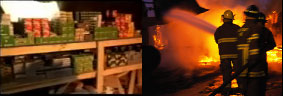 We are not suggesting you disregard the risks of ammo “cooking off” in a fire, but you will learn the realities of the situation by watching the video. There are some amazing demonstrations — including a simulated retail store fire with 115,000 rounds of ammo in boxes. As cartridges cook off, it sounds like a battery of machine-guns, but projectiles did not penetrate the “store” walls, or even two layers of sheet-rock. The fire crew puts out the “store fire” easily in under 20 seconds, just using water.


 In the past quarter about 140 site users have donated. We thank all those who have generously contributed. But that still leaves tens of thousands of users who access the site regularly without contributing. With more donations we can deliver more premium content and offer more services to our members.
 Sharpshooter (and competitive smallbore shooter) Kirsten Joy Weiss tried a special New Year’s trick shot for 2015. In keeping with the festive New Year’s spirit, Kirsten attempted to shoot the cork off a champagne bottle. After a few unsuccessful tries, she managed to hit the cork with at least two shots. But alas the cork did not fly. She actually hit the cork, but it did not release. That was surprising…


 As the 2015 international shooting season comes to a close, the USAMU shooting teams are preparing for the 2016 Olympic trials and a chance to compete in the Olympic Games in Rio de Janeiro next summer. One USAMU marksman who has already secured a berth for the 2016 Olympics is SFC Michael McPhail of Darlington, Wisconsin.
 .009″ — The Record That Stood for 40 Years.


