Halloween is less than a week away. Our friend, trick-shot ace Kirsten Joy Weiss, did something special for this week, “carving” a pumpkin using her semi-auto Volquartsen .22 LR rifle. Kirsten had to send a lot of rimfire rounds into her orange friend. It turns out the little .22-caliber bullets worked better on exit than entry — Mr. Pumpkin’s posterior side was more impressive than his front. But overall, the effort turned out very well indeed, as you can see. Nice job, Kirsten.
On inspection, Kirsten found that the most impressive Jack ‘O Lantern face appeared on the reverse side of her pumpkin. The “exit wounds” were better than the entry holes.
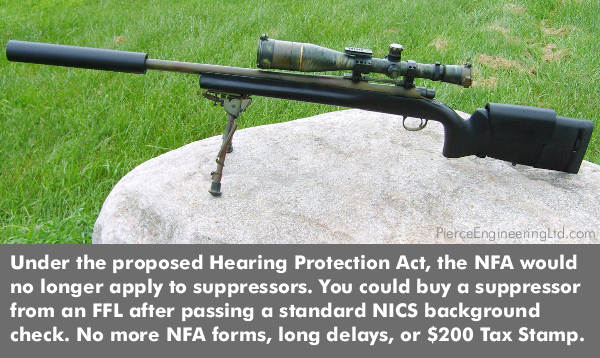
New legislation by Congressman Matt Salmon* (R-AZ) would make it much easier to purchase a suppressor (aka “silencer” or “sound moderator”) for use with firearms. The new Hearing Protection Act (HPA), H.R. 3799, will remove suppressors from the purview of the National Firearms Act (NFA), replacing the current burdensome federal transfer process with a standard NICS background check. Under the proposed law, acquiring a suppressor would be like purchasing a firearm — you would obtain the suppressor from an FFL dealer after passing a background check. There would still be a background check, but suppressor purchasers would no longer be required to fill out extensive paperwork, be fingerprinted, and pay for a $200.00 tax stamp. The HPA also includes a provision to refund the $200 transfer tax to applicants who purchase a suppressor after October 22, 2015.
Many older hunters and sport shooters suffer from hearing loss. Greater access to suppressors would help prevent that health problem. “Suppressors significantly reduce the chance of hearing loss for anyone who enjoys the shooting sports,” said Chris Cox, executive director of NRA’s Institute for Legislative Action. On average, suppressors reduce the noise of a gunshot by 20 – 35 decibels (dB), roughly the same sound reduction as earplugs or earmuffs. In addition to hearing protection, suppressors also mitigate noise complaints from those who live near shooting ranges and hunting lands.
Because suppressors safeguard hearing and reduce “noise pollution”, suppressors are widely used in many countries, including the United Kingdom. In most parts of Europe, suppressors are readily available at reasonable cost. According to the NRA-ILA, “Many European nations place no regulations on [suppressor] acquisition or use.” In the “enlightened” European view, sound moderators are considered a “good thing”. Is it time for the USA to change its laws?
It’s Time to Remove Unnecessary Burdens to Suppressor Ownership
Suppressors have been federally regulated since the passage of the National Firearms Act of 1934. The NFA regulates the transfer and possession of certain types of firearms and devices, including suppressors. Currently, prospective buyers must send in a Form 4 application to the ATF, pay a $200 transfer tax per suppressor, undergo the same background check that is required to purchase a machine gun, get a “CLEO Signoff”, and wait months for the ATF to process and approve the paperwork.
The American Suppressor Association (ASA) states that: “[The] Hearing Protection Act will fix the flawed federal treatment of suppressors, making it easier for hunters and sportsmen to protect their hearing in the 41 states where private suppressor ownership is currently legal, and the 37 states where hunting with a suppressor is legal. This legislation will remove suppressors from the onerous requirements of the NFA, and instead require purchasers to pass an instant NICS check, the same background check that is used during the sale of long guns.”
There has been a huge growth in the number of registered suppressors in the USA. From 2014 to 2015, the number of NFA-registered suppressors rose from 571,150 to 792,282. That’s a 39% increase in just one year! It’s remarkable that there are nearly 800,000 suppressors now registered in the USA. These stats are based on data published in the latest Bureau of Alcohol, Tobacco, Firearms, and Explosives (BATFE) Firearms Commerce Report.
*Joining Rep. Matt Salmon as co-sponsors of H.R. 3799, the Hearing Protection Act (HPA), are ten other U.S. Representatives: Frank Guinta (R-NH), John Carter (R-TX), Mike Kelly (R-PA), Chris Collins (R-NY), Glenn Thompson (R-PA), Tim Huelskamp (R-KS), Trent Franks (R-AZ), Mia Love (R-UT), Doug LaMalfa (R-CA), and Chris Stewart (R-UT).
At the recent IBS 600-Yard Nationals, the 6mm Dasher cartridge was the most popular chambering for both Light Guns and Heavy Guns. The Dasher, a 40° improved version of the 6mmBR Norma case, can definitely shoot — no question about that. But the Dasher has one less-than-ideal feature — its very short neck. This makes it more problematic to shoot a wide variety of bullet types — short bullets as well as long. In addition, the short neck makes it harder to “chase the lands” over time.
For those folks who like the performance of the 6mm Dasher, but prefer a longer neck, there is an excellent alternative — the 6mm BRDX. This wildcat shares the 40° shoulder of the Dasher and has nearly the same capacity. Like the Dasher, the 6 BRDX can drive 100-107gr bullets to the same 3000-3050 FPS accuracy node. But the 6 BRDX has a longer neck than the Dasher. Depending on your “blow length”, the 6 BRDX will typically give you about .030″ to .035″ more usable neck length. That may not sound like much, but it is very useful if you have a longish (.110″+) freebore and you still want to shoot shorter bullets in the lands for some applications.
Your editor has a 6mm BRDX and I really like it. The neck is long enough to let me shoot 90-grainers loaded into the lands as well as 105-grainers. Fire-forming is pretty easy. I just load very long (so there is a firm jam) and shoot with 30.0 grains of Varget and a 100+ grain bullet. With a Brux barrel, my BRDX easily shoots quarter-MOA, with some 100-yard groups in the ones in calm conditions. This is with a Stiller Viper Action, and Shehane ST-1000 stock bedded by Tom Meredith.
6mm BRDX Reamer, Dies, and Hydro-Forming Service
It’s not difficult to set up a rifle to run the 6 BRDX. Dave Kiff’s Pacific Tool & Gauge has the reamer (just tell him the freebore you want). Whidden Gunworks offers excellent BRDX sizing and seating dies. And if you don’t like fire-forming, give Darrell Jones of DJsbrass.com a call. Darrell can hydro-form 6 BRDX brass and even turn the necks to your specs. Darrell’s hydro-forming service saves you time and preserves precious barrel life.
The CMP has just released proposed 2016 Competition Rules. There are a number of important proposed changes, some quite controversial. Topping the list are rule changes that would allow optics for service rifles and “modern military rifles” (MMR). If these changes are adopted, Service Rifle shooters and modern military rifle shooters will be able to use scopes up to 4.5X power. Rifle weight limits will be increased slightly to allow for the optics and the definition of “Service Rifle” will be liberalized to allow more AR variants. In addition, collapsible or adjustable-length stocks will be allowed.
We want to stress that these new rules have NOT been set in stone — not yet at least. The CMP issued its notice of Proposed 2016 Rule Changes to inform competitors and invite feedback. The CMP asks that comments/questions be sent to competitions @ thecmp.org, not later than November 13, 2015.
Major Proposed Rule Changes
1. Optical Sights For Service Rifles
The CMP states: “For several years, the CMP has recognized that optical sights are the wave of the future for Service Rifle shooting. Military recruits today do all of their training with optical sighted rifles. Service Rifle rules have traditionally tried to keep abreast of military rifle and training developments so opening Service Rifle shooting to optical sights became an inevitable change.” The 2016 rules will, for the first time, permit M16/AR15-type rifles to have optical sights (fixed power or zoom) with a maximum magnification of 4.5X and an objective lens no larger than 34 mm. There will not be a separate class for scope-sighted rifles. Instead, competitors will have a choice of using either a scope-sighted rifle that weighs no more than 11.5 pounds or a metallic-sighted rifle that will continue to have no weight limit.
2. More Options For M16/AR15-Type Rifles
Since accurized Service Rifles first came into popular use in the 1950s and 1960s, those rifles, whether M1s, M14s, or M16s and their commercial equivalents, have been rigidly defined. Legal M16-type service rifles had to retain the external profile of an M16A2 or M16A4 rifle and could only have modifications that were explicitly permitted in the rules. All this will change in 2016. The CMP plans to liberalize the Service Rifle rules to encourage greater participation. A wider variety of commercial AR-platform rifles will be allowed so long as they meet basic requirements, such as 20″ max barrel length, 5.56x45mm (.223 Rem) chambering, and a trigger pull of at least 4.5 pounds. Notably, the rifles can have either a gas-impingement system or a piston-operated gas system. Collapsible stocks will be allowed. However butt-plates and cheek-pieces may not be adjustable. (See all Requirements HERE).
3. Optical Sights for Modern Military Rifles (CMP Games)
One of the fastest growing rifle competition categories is for Modern Military Rifles. There are two classes, one for M16/AR15 platform rifles and one for a broad range of other military rifles. Competitors who compete in Modern Military Rifle Matches will now have the option of using optical sights with a maximum magnification of 4.5X. To make allowance for the increased weight of telescopes, the weight limit for AR-type rifles was increased to 8.5 pounds and for M-14/M1A rifles to 10.0 pounds. (This is a CMP Games limit — a different Rule than the Service Rifle Rule).
4. Stocks for Modern Military Rifles
Butt-stocks on these rifles may vary in length and collapsible or adjustable-length stocks will be allowed. Butt-stocks, however, may not have butt-plates or cheek-pieces that adjust up or down.
No Changes for Pistol, Vintage Sniper, or Rimfire Sporter Competitions
While big changes are slated for the Service Rifle and MMR disciplines, the CMP is not making significant rule changes for other popular CMP shooting sports.
Pistol Rules Are Unchanged
Except for permitting service pistols to have a Picatinny rail below the barrel, the Service Pistol and 22 Rimfire Pistol rules adopted in 2015 are unchanged.
Vintage Sniper Rifle Team Match Rules Are Unchanged
According to the CMP, Vintage Sniper Rifle Match rules “have stabilized nicely in the last two years” so there will be no 2016 rule changes for the Vintage Sniper two-man team event.
Rimfire Sporter Rifle Rules Are Unchanged
The most popular rimfire rifle match in the country continues to attract impressive numbers to its matches. Like the Vintage Sniper Rifle Team Match, these rules have now stabilized so that there are also no 2016 rule changes in Rimfire Sporter.
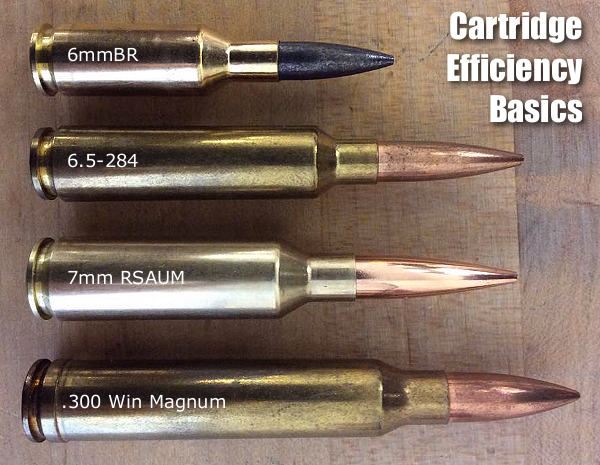
Efficient cartridges make excellent use of their available powder and case/bore capacity. They yield good ballistic performance with relatively little recoil and throat erosion.
Cartridge Efficiency: A Primer (pun intended!)by USAMU Staff
Each week, the U.S. Army Marksmanship Unit (USAMU) publishes a reloading article on its Facebook Page. In this week’s article, the USAMU discusses cartridge case efficiency and its benefits. While this is oriented primarily toward NRA High Power Rifle and Long Range (1000-yard) competition, these factors also apply to medium/big game hunters. Assuming one’s rifle and ammunition are accurate, key considerations include ballistic performance (i.e., resistance to wind effects, plus trajectory), recoil, and throat erosion/barrel life.
Efficient cartridges make excellent use of their available powder and case/bore capacity. They yield good ballistic performance with relatively little recoil and throat erosion. A classic example in the author’s experience involved a featherweight 7x57mm hunting/silhouette rifle. When loaded to modern-rifle pressures, just 43-44 grains of powder pushed a 139gr bullet at 2900 fps from its 22” barrel. Recoil in this light rifle was mild; it was very easy to shoot well, and its performance was superb.
An acquaintance chose a “do everything” 7mm Remington Magnum for use on medium game at short ranges. A larger, heavier rifle, it used ~65 grains of powder to achieve ~3200 fps with similar bullets — from its 26″ barrel. Recoil was higher, and he was sensitive to it, which hampered his shooting ability.
Similarly efficient calibers include the 6mm BR [Norma], and others. Today’s highly-efficient calibers, such as 6mm BR and a host of newer developments might use 28-30 grains of powder to launch a 105-107gr match bullet at speeds approaching the .243 Winchester. The .243 Win needs 40-45 grain charges at the same velocity.
Champion-level Long Range shooters need every ballistic edge feasible. They compete at a level where 1″ more or less drift in a wind change could make the difference between winning and losing. Shooters recognized this early on — the then-new .300 H&H Magnum quickly supplanted the .30-06 at the Wimbledon winner’s circle in the early days.
The .300 Winchester Magnum became popular, but its 190-220gr bullets had their work cut out for them once the 6.5-284 and its streamlined 140-142gr bullets arrived on the scene. The 6.5-284 gives superb accuracy and wind performance with about half the recoil of the big .30 magnums – albeit it is a known barrel-burner.
Currently, the 7mm Remington Short Action Ultra-Magnum (aka 7mm RSAUM), is giving stellar accuracy with cutting-edge, ~180 grain bullets, powder charges in the mid-50 grain range and velocities about 2800+ fps in long barrels. Beyond pure efficiency, the RSAUM’s modern, “short and fat” design helps ensure fine accuracy relative to older, longer cartridge designs of similar performance.
Recent design advances are yielding bullets with here-to-fore unheard-of ballistic efficiency; depending on the cartridge, they can make or break ones decision. Ballistic coefficients (“BC” — a numerical expression of a bullet’s ballistic efficiency) are soaring to new heights, and there are many exciting new avenues to explore.
The ideal choice [involves a careful] balancing act between bullet BCs, case capacity, velocity, barrel life, and recoil. But, as with new-car decisions, choosing can be half the fun!
Factors to Consider When Evaluating Cartridges
For competitive shooters… pristine accuracy and ballistic performance in the wind are critical. Flat trajectory benefits the hunter who may shoot at long, unknown distances (nowadays, range-finders help). However, this is of much less importance to competitors firing at known distances.
Recoil is an issue, particularly when one fires long strings during competition, and/or multiple strings in a day. Its effects are cumulative; cartridges with medium/heavy recoil can lead to shooter fatigue, disturbance of the shooting position and lower scores.
For hunters, who may only fire a few shots a year, recoil that does not induce flinching during sight-in, practice and hunting is a deciding factor. Depending on their game and ranges, etc., they may accept more recoil than the high-volume High Power or Long Range competitor.
Likewise, throat erosion/barrel life is important to competitive shooters, who fire thousands of rounds in practice and matches, vs. the medium/big game hunter. A cartridge that performs well ballistically with great accuracy, has long barrel life and low recoil is the competitive shooter’s ideal. For the hunter, other factors may weigh more heavily.
Cartridge Efficiency and Energy — Another Perspective
Lapua staffer Kevin Thomas explains that efficiency can be evaluated in terms of energy:
“Cartridge efficiency is pretty straight forward — energy in vs. energy out. Most modern single-based propellants run around 178-215 ft/lbs of energy per grain. These figures give the energy potential that you’re loading into the rifle. The resulting kinetic energy transferred to the bullet will give you the efficiency of the round. Most cases operate at around 20-25% efficiency. This is just another way to evaluate the potential of a given cartridge. There’s a big difference between this and simply looking at max velocities produced by various cartridges.”
Hunting season is here in many parts of the country. If you need a good, yet affordable scope for your hunting rig, look no further. Midsouth Shooters Supply is running a super sale right now on Vortex scopes. You can get a 4-12x44mm Crossfire II Vortex scope for just $169.99 with free shipping. Or, if you want something lighter and smaller, consider the 3-9x40mm Crossfire II. It’s a mere $149.99, again with free shipping.
If you’re concerned about the durability/longevity of these bargain-priced optics, consider this — these Crossfire scopes, like all Vortex optics products, are backed by the Vortex lifetime “VIP” warranty:
IBS Match Report by Tom Jacobs and Jim Bauer
“What a wonderful match” — those words were heard often during this year’s IBS 600-yard National Championship match. Tom and Sara Jacobs hosted the 600-yard Nationals September 26-27 at their Vapor Trail Valley Range in Spickard, Missouri. Attendance was strong, with 78 competitors from 14 different states. The Vapor Trail Valley range holds both 600-yard and 1000-yard yard matches throughout the year. Located in northwest Missouri, Vapor Trail Valley sits in the middle of crop ground and cattle country. The terrain is a mixture of tree lines and green pastures.
It seemed every aspect of the match came off flawlessly, thanks to the hard work of the organizers. Even the weather cooperated, with 80 degree days and 60 degree mornings. The wind was mild but twitchy, providing a challenge for the competitors. Overall though, conditions were generally good and some very impressive results were recorded. Despite the twitchy winds, over the course of the weekend, some eighty perfect 50-point targets were shot. That’s darn good shooting overall.
Interesting Factoids from Vapor Trail:
1. Competition is VERY tight now. The difference between 1st place and 20th place in Light Gun Group Aggregate was .478″, less than half an inch. The difference between 1st and 20th place in Heavy Gun Group aggregate was .480″, again less than half an inch.
2. 6mm cartridges, particularly the 6mmBR and Dasher, now dominate the 600-yard Benchrest game.
All but one Light Gun was chambered as a 6mm, mostly 6BRs or Dashers. Even in the Heavy Gun division, 6mms ruled — 58 out of 61 Heavy Guns were chambered for 6mm cartridges, mostly Dashers.
3. These rigs are capable of extreme accuracy. The ten best Light Gun groups were all under 1.250″ (FYI, at 600 yards, one-quarter-MOA is 1.570″). And, as you can see at right, the three smallest Light Gun Groups were all under 0.9″. Think about that — a one-inch group used to be considered darn good at 300 yards.
This photo shows the winners in the front row, kneeling. Left to right are: Bud Larson (HG Score), Richard Schatz (2 Gun Overall, HG Group) , and Jim Bauer (HG Overall).
After Friday practice, the match began with the Light Gun relays on Saturday. Both Light and Heavy Guns shoot 8-target Aggregates. At the end of the day Saturday, Tim Gonnerman was the Light Gun Group winner with a 2.236 Agg , edging runner-up Jason Walker by a mere .003″. That’s about as close as it gets. Dan Hullinger won Light Gun Score with a 382 (Danny Wake also had a 382 but placed second on the tie-breaker). Richard Schatz, “Mr. Consistent”, placed 4th for score and 5th for group to take the Light Gun Overall title. Last year’s two gun Champion Ryan Hunt finished in second place.
Equipment Choices of Two Gun Top 20
If you review the equipment list for the Top 20 Two Gun competitors, you’ll find that Nightforce scopes were used by 19 shooters, while BAT actions were used by 15 shooters. Remarkably, 17 out of the top 20 used rifles chambered in 6 Dasher. Hodgdon Varget was the most commonly-used powder followed by Alliant Reloder 15. In the barrel department, Brux enjoyed a slight edge over Krieger, with ten shooters using Brux Barrels vs. seven using Kriegers.
Note the large, extended-width base-plate under the forearm. This spreads the load and provides more stability when used with super-wide SEB MAX front rest.
The Heavy Guns came out on Sunday. Early morning relays saw a dead-flat wind condition that constantly changed as the day progressed. Scores settled a little and groups opened up, creating a little room between competitors. In the end, Bud Larson won the Heavy Gun Score title with a 385 total. This year’s Shooter of the Year leader Andy Ferguson was close behind with a 384. The Heavy Gun group champion is Richard Schatz with a 2.003 Agg, followed by Jim Bauer with a 2.017. The Heavy Gun overall went to Jim Bauer followed by “Andy Who?” Ferguson (see photo below).
The 2015 IBS 600-yard Two Gun Champion is Richard Schatz with 18 rank points. If you look at the new 600-yard traveling trophies, you’ll see Mr. Schatz’s name multiple times — this victory marks the third time Richard has won the 600-yard, Two Gun IBS National Championship in the past decade. Richard Schatz is certainly a great ambassador for our sport and a true gentleman. Second Place in the Two Gun overall went to Jim Bauer, not far behind with 20 rank points. Taking third was Andy Ferguson with 28 rank points.
Left to right are Two Gun Overall winner Richard Schatz, along with top female Shooter, Sally Bauer and Tom Jacobs, Vapor Trail Valley range owner.
The top lady shooter was Sally Bauer. A past IBS 1000-yard Shooter of the Year, Sally is a 7-time female National Champion in 600-yard or 1000-yard benchrest. Rory Jacobs was the Junior “Top Gun” this year, winning the Junior division and finishing 10th Overall among ALL shooters (of any age) in the Two-Gun Agg. Rory is a four-time Junior National Champion and three-time Junior shooter of the year. The top Rookie shooter was Carroll Lance.
As with many of the matches that we attend, the range owner’s family and friends make up the help for scoring and target crews, the lunch attendants and general maintenance of the ongoing match. This match is no different. Tom and Sara’s families took care of all the required chores and it all came together like a well-oiled machine. Give credit to Tom Jacobs for working with the sponsors to put together a great prize table — every shooter in attendance got a sponsored prize. Please take the time to let our sponsors know that you appreciate their generous support.
There was an excellent prize table, as this young fellow demonstrates
“Andy Who?” — Ferguson is Front-Runner in 600-Yard Shooter of the Year Race
Here’s the “Andy Who?” story. Andy Ferguson, a good friend and neighbor of the Vapor Trail Valley range owners, is currently leading the 600-yard Shooter of the Year (SOY) point competition. Given his hot shooting and top ranking in the SOY chase, some of Andy’s friends/fellow competitors thought Andy might be getting a “big head” (i.e. oversize ego). To bring him down to earth, as a joke, Andy’s friends printed up the “Andy Who?” T shirts. A good laugh was had by all.
Berger has released two important informational updates for its line-up of bullets. First, the Ballistics Coefficients (BCs) have been updated for the vast majority of bullets Berger sells. In addition, G7 model BCs are being provided for most of the bullets. You will want to use the updated BC data, which is based on actual testing of recent production lots of bullets.
Second, Berger is now providing a dual twist-rate recommendation for most bullets. Berger is now lists a “minimum” barrel twist rate as well as an “optimal” twist rate. To get maximum long-range performance from your bullets, use a barrel with the “optimal” rate of twist.
CLICK HERE for the latest Berger Quick Reference Sheets with updated BCs and new Optimal Twist Rates. Eric Stecker, Berger President says: “We have tested every lot of bullets produced in the last several years to bring you these updated numbers for all of our bullets.”
Ballistic Coeffificent (BC) Updates with G7 Data
Berger notes: “We have updated all of our Ballistic Coefficients to be even more accurate.
Prior to 2008, all of Berger Bullets’ BCs were calculated using a computer prediction. Early in 2009, we began measuring BCs with live-fire testing. As a result, Berger’s BCs were updated and G7 BCs were also made available. This represented a dramatic improvement in the accuracy of performance data at that time. Since 2009, the BCs assessed for Berger Bullets have not been updated. As part of our ongoing effort to provide shooters with the best information possible, Berger has been testing every lot of bullets produced for the last several years. The result is updated and highly accurate running averages of BCs for recent production lots.
Here are some of the Updated BC Values for popular Berger Target (Match) Bullets:
G7 Form Factor Addition
Berger also added the G7 form factor to the Ballistics Quick Reference Sheet. The analysis of form factors can be very useful when considering a bullet’s long range performance potential. Going by BC alone can be deceptive since BC includes the weight and caliber of the bullet. Form factor indicates how much drag the bullet has, which is a very important consideration for all bullets of all calibers.
NEW Dual Twist-Rate Recommendations
Recommended twist rates for bullets are commonly listed as a single value, such as 1:12” (one rotation in 12″ of barrel travel). This may be overly simplistic. There is a big gray area of marginal stability in which bullets can fly with good accuracy, but with a reduced (i.e. sub-optimal) Ballistic Coefficient. Recognizing this reality, Berger is now listing two twist rates for each bullet it makes. The first is the minimum twist needed for good accuracy, which Berger has always recommended. The second is the new optimal twist rate, which is the twist that will stabilize the bullet to a level which achieves its full performance (BC) potential. CLICK HERE For more information.
Redding Reloading is now providing Advanced Handloader’s Data Sheets in printable PDF format. This FREE form allows hand-loaders to document their tool settings, bushing size, powder charge, load specs (COAL etc.), and case prep status. In addition, the form allows you to enter your load testing information, complete with chronograph data, group size, zero range, and wind/temp conditions. With this single, handy form you can document all the vital information for a particular cartridge and load.
We’ve seen various reloading log templates, but this Redding form (shown below) is better than most because it combines both reloading data AND range-test data in one place. You can see all key details of the reloading process (tool settings etc.) plus the end results — how the load actually performed over the chronograph and on paper. This form allows the user to capture a large amount of information for later use, while accurately track load development. Go to Download Page.
FREE Ammunition Box Label Template Redding Reloading has also developed a printable template for your ammo boxes (see photo at top of article). This lets you put all vital load info on your ammo boxes. There are fields for: Date, Cartridge, Powder, Grains, Bullet, Weight, Primer, Case type. Designed for Avery 5260 (or similar) label sheets, this template allows you to print 30 labels at one time. You can purchase the Avery 5260 peel-off printable label sheets at any office supply store.
The late Bill Myers was recognized as one of greatest rimfire smiths who ever lived. Myers crafted many match-winning, record-setting rimfire benchrest rigs. Here we feature one of Bill’s most interesting creations — a clamping action that allows a rimfire barrel to be indexed (rotated) around the bore axis.
Bill was a creative thinker, and his own exhaustive testing has convinced him that barrel indexing can enhance accuracy in rimfire benchrest guns. Myers did acknowledge that, particularly with a very good barrel, the advantages of indexing may be subtle, and extensive testing may be required. Nonetheless, Myers believed that indexing could improve rimfire accuracy.
Indexing with the Myers’ Clamping Action
To index the barrel, Myers simply loosens the three clamping-bolts and rotates the barrel in the action. Because there is no thread to pull the barrel in or out, the headspace stays the same no matter how much the barrel is rotated. In other words you can rotate the barrel to any position on the clockface and the headspace remains unchanged.
The Challenge of Barrel Indexing With a conventional barrel installation, employing a shoulder with a threaded tenon, it is difficult to index the barrel. Even with a cone breech (photo right) that eliminates the problem of extractor cuts, you’d have to use shims to alter the barrel index position, or otherwise re-set the shoulder each time you screwed the barrel in further.
Clamping Action Allows Barrel to Be Rotated to Any Position
Bill has come up with a masterful solution to barrel indexing. He designed and built his own prototype custom action that clamps the barrel rather than holding it with threads. The front section of the action is sliced lengthways, and then clamped down with three bolts. A special bushing (the gold-color piece in photos) fits between the barrel and the action. By using bushings of different inside diameters, Bill can fit any barrel up to an inch or so diameter, so long as it has a straight contour at the breech end. To mount the barrel, Bill simply places the fitted bushing over the barrel end-shank, then slips the “sleeved” barrel into the front end of the action. Tighten three bolts, and the barrel is secure.







 All but one Light Gun was chambered as a 6mm, mostly 6BRs or Dashers. Even in the Heavy Gun division, 6mms ruled — 58 out of 61 Heavy Guns were chambered for 6mm cartridges, mostly Dashers.


 Redding Reloading has also developed a


 With a conventional barrel installation, employing a shoulder with a threaded tenon, it is difficult to index the barrel. Even with a cone breech (photo right) that eliminates the problem of extractor cuts, you’d have to use shims to alter the barrel index position, or otherwise re-set the shoulder each time you screwed the barrel in further.


