The 2016 Summer Olympic Games will be held in Rio de Janeiro, Brazil. Marksmanship will be an important part of the Rio Olympics. Nearly 400 top shooters from around the world will compete in rifle, pistol, and shotgun events. The shooting competitions will take place in a large, modern sports complex originally created for the 2007 Pan-American Games at a cost of $53.5 million. This complex, located within the Deodoro Olympic Park in Rio, offers roughly 30,000 square meters of improved areas on the 125,000 square meter site. Brazil’s Olympic Shooting Center (also known as the National Shooting Center) is an impressive facility. In size, scale, cost, and capabilities, Rio’s Shooting Center is without rival in the Southern Hemisphere.
Video Showcases Brazil’s Modern Olympic Shooting Center:
ISSF World Cup Underway at Shooting Center Now
If you want to learn more about the Olympic Shooting Center in Rio, there is an good article on the Shooting Sports USA website. This covers the history of Brazil’s Olympic shooting teams, and explains what competitors can expect this summer. Right now the Olympic Shooting Center is being used for the ISSF World Cup.
2016 Olympic Dress Rehearsal
“The 2016 Olympic Games this August will be one of the largest sporting events ever held. There will be another contest this year in the wonderful city of Rio de Janeiro that will function as a ‘dress rehearsal’ for the big show. On April 14-25, the Olympic Shooting Center will host the International Shooting Sport Federation (ISSF) World Cup. During the 11-day competition, 700 athletes from dozens of countries will showcase their skills at the biggest shooting sport event in Brazil before the Olympics.” — Read more at Shooting Sports USA
The 10th Annual Eastern CMP Games and Creedmoor Cup Matches will be held at Camp Butner, North Carolina, April 29 through May 8, 2015. The Eastern CMP Games run April 29 through May 3, while the Creedmoor Cup Matches will follow the Eastern Games, May 4-8. Events will include a 4-Man Team Match, Creedmoor Cup Match and EIC Match. All interested shooters are invited to participate in this popular event, which includes: Rimfire Sporter Match, M16 Match, M1 Garand Match, Springfield Match, M1-Carbine Match, Vintage Military Match, Modern Military Match, Vintage Sniper Match, Pistol Matches and more.
There will also be skills training seesions throughout the week, including a High Power Shooting Clinic, Pistol Clinic, and GSM New Shooter Clinic. The free Team Remington High Power Shooting Clinic will offer instruction by some of the nation’s top High Power service rifle competitors. This will feature lectures, dry fire training, plus lots of hands-on coaching with a large squad of instructors. The Eastern CMP Games will also conduct a Small Arms Firing School (SAFS). The SAFS instruction is geared toward new shooters, so no previous firearm experience is required.
The Vintage Sniper Match is a two-person team match, utilizing scoped rifles from the Korean War, World War II or earlier, upon sandbags. Teammates take turns as both shooter and spotter.
Garand-Springfield-Military New Shooter Clinic
The Garand-Springfield-Military (GSM) New Shooter Clinic is recommended for all new shooters to the CMP Games, as well as those who may not be firing, but simply would like to learn more about the events. The clinic includes classroom instruction, demonstrations and dry-fire position practice – all led by CMP GSM Master Instructors.
Great Place to Get Started in Competitive Shooting
The CMP Games matches are ideal events for shooters who have not participated in previous competitions. Shooters are permitted to coach or assist each other in these matches. Experienced shooters are encouraged to assist new shooters with positions, slings, loading and the rules.
To learn more about the Eastern CMP Games, email croguski [at] thecmp.org or call (888) 267-0796, extension 714. If you have questions about the Creedmoor Cup contact Dennis DeMille, demille [at] creedmoorsports.com or call (800) 273-3366 M-F, 9:00 am – 6:00 pm Central Time.
The NRA Annual Meetings and Exhibits extravaganza is just over one month away. This year, the NRA will hold its annual gathering May 19-22 at the Kentucky Exposition Center in Louisville. This is a huge event with over 750 exhibitors in a 500,000 square-foot facility. The Exhibit Hall opens at 9:00 am on May 20th (Friday Morning).
You can Pre-Register now so your entry badge will be ready when you arrive.
This year’s NRA convention will feature a variety of special events, starting with the NRA Foundation Banquet on Thursday night, May 19th. The ever-popular NRA Country Jam kicks off at 6:00 pm on Friday, May 20th at Louisville’s Belvedere at Waterfront Park. The official NRA Members Meeting will be held Saturday morning at 10:00 in Freedom Hall at the Exposition Center. NRA leaders Wayne LaPierre, Chris W. Cox, and Allan Cors with address the membership. Many other seminars will be hosted over the course of the weekend. Purchase Event Tickets.
Rifles are manufactured in virtually every state in the country. Some states have only small “boutique” operations which produce a few dozen rifles annually. In other states, such as New York, where larger factories are located, hundreds of thousands of firearms are manufactured every year. The federal Bureau of Alcohol, Tobacco, Firearms and Explosive (BATFE) keeps track of gun manufacturing nationwide, cataloging production figures from all 50 states. State by state rifle production figures are listed in BATFE’s Annual Firearms Manufacturing and Export Report. Shown below, in alphabetical order by state, are the top producing rifle-makers for each state.
We were surprised to find that in California, the nation’s most populous state (with 38 million residents), the leading gunmaker, Weatherby, only made 3563 rifles. Compare that with tiny New Hampshire where Ruger produced 636,073 rifles! Credit the American Rifleman for finding this state-specific list in the BATFE 2014 Annual Report. After the state is the number of rifles made by the top producer, followed by that company’s name.
Most shooters know Carl Bernosky as a 10-time National High Power Rifle champion. But you may not realize that Carl is also a very talented stock-maker and rifle-builder. Carl crafts a wide variety of wood and wood laminate stocks for competition as well as hunting. He also crafts many stocks for Alex Sitman of Master Class Stocks.
Master Class Low-Profile F-Open Stock
Here is a new Master Class Low-Profile F-Open Stock crafted by Carl Bernosky. It is made from a Cherry/Maple wood laminate. This design features a railed fore-end along with a flat, parallel toe for improved tracking and stability on the bags. The front section of the fore-arm has a low profile. This allows the barrel bore axis to ride lower. That helps reduce hop and helps the gun recoil straight back. For more information on this low-profile F-Open stock design, visit Carl Bernosky’s Facebook Page and MasterClassStocks.com.
Note that the stock maintains full depth under the action and quite a few inches forward of the action. This smart design feature is very important. We have seen other low-profile stock designs that can flex or “hinge” forward of the action because there’s not enough wood material there. In fact, the only part of the stock that needs a cut-down profile is the front 10″ or so, where the stock actually rides the front bag.
This particular stock features a “pop-off” magnetic cheekpiece, as well as a buttplate that adjusts for Length of Pull (LOP) via spacers. The action is by Pierce Engineering. This and other Master Class Stock designs can be customized with other features on request.
Many of our readers have concealed carry permits. When carrying a handgun concealed, holster choice is key. A good holster will carry more comfortably, “print” less, and be 100% secure while still allowing rapid access. Our systems admin Jay C. recently acquired a Walther PPS M2 as a carry gun. Jay has a CCW permit, and he sometimes chooses to carry a concealed handgun, particularly on trips.
After looking at many options, Jay chose a Kydex Clinger ATom Holster. These are very affordable, yet they have many great features. The most important design feature of the $19.99 Clinger Atom is the location of the belt clip. This is placed over the trigger guard area, not the slide. This pulls the grip in closer than if the clip was mounted over the slide as on other holsters. This smart design feature really works, improving concealment and comfort. Jay says: “the Atom works great with my little Walther — it’s very stable and comfortable.”
The $19.99 Clinger Atom also offers adjustable “ride height”. This is accomplished by moving the belt clip up or down. Holster retention (the clamping tightness) is easily adjusted with a simple hex screw.
Along with its popular Atom holster, Clinger offers two other holsters: 1) the $29.99 Stingray model (with choice of 0°, 15°, or 30° cant); and 2) the dual-clip, ultra-thin No-Print Wonder Holster priced at $59.99. The latter is a good choice for carrying a heavier pistol for long periods. All three holsters (Atom, Stingray, No Print Wonder) are shown in the video above.
Clinger offers a Zero-Risk Guarantee. Try any Clinger holster for two weeks. If you don’t like it, you can return it for a full refund. There is also a “Bumper-To-Bumper Lifetime Warranty”. If anything on your Clinger Holster ever needs repair the manufacturer will repair it or replace it for free.
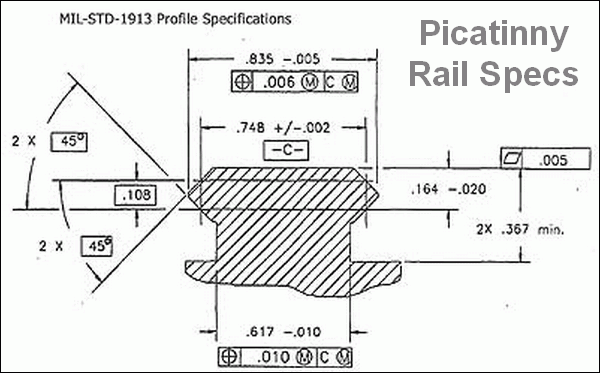
Readers often ask “What’s the difference between a Weaver scope rail and a Picatinny Rail?” The answer is not as simple as it seems. The dimensions of a Picatinny Rail should be consistent (from one rail-maker to another), since there IS a government spec. Conversely, there is some variance in “Weaver-style” rails. The width of the groove is the most important difference between Picatinny Rails and weaver rails. “Mil-spec” Picatinny rails will have a grove width of 0.206″ while Weaver rails typically have a narrower, 0.180″ groove width.
Brownell’s has a helpful GunTech™ Article that discusses the Picatinny Rail vs. Weaver Rail. That article explains:
“What are the differences between the ‘Picatinny’ and the ‘Weaver’ systems? The profile of the two systems is virtually identical. Depending on the quality of the machining done by the manufacturer, the two systems should be indistinguishable from the profile. The key difference lies in the placement of the recoil grooves and with width of the grooves. MIL-STD-1913 (Picatinny) grooves are .206″ wide and have a center-to-center width of .394”. The placement of these grooves has to be consistent in order for it to be a true ‘Picatinny’MIL-STD system. Weaver systems have a .180” width of recoil groove and are not necessarily consistent in a center-to-center measurement from one groove to the next.
In many instances, a Weaver system has a specific application that it is machined for, so interchangeability is not necessarily an issue. A MIL-STD-1913 system must adhere to the specifications listed above in order for it to be considered MIL-STD, since the military desires uniformity in the recoil grooves to allow for different systems to be mounted on the weapon with no concern for compatibility.
Now, what does this mean to you? Boiled down, it means that accessories designed for a Weaver system will, in most cases, fit on a ‘Picatinny’ system. The reverse, however, is probably not the case. Due to the larger recoil groove, ‘Picatinny’ accessories will not fit a Weaver system. There are, of course, exceptions to every rule, but for a good rule-of-thumb, [full-width] ‘Picatinny’ won’t fit Weaver, but Weaver will fit ‘Picatinny’.”
In case you haven’t heard, Sierra has a great new 7mm match bullet, the 183 grain MatchKing (item #1983). This bullet boasts an impressive 0.707 G1 Ballistic Coefficient (BC) at 2300+ fps. These bullets also have very consistent bullet-to-bullet BC, thanks to the tips being “pointed” at the factory. Sierra explains: “A final meplat-reducing operation (pointing) provides an increased ballistic coefficient for optimal wind resistance and velocity retention.” Top F-Open shooters have told us that these bullets shoot exceptionally well, with minimal vertical dispersion at 1000. “Holding waterline” at long range is a reliable indicator that the BC is very uniform from bullet to bullet.
The design of this bullet represents a radical departure for Sierra. The 7mm 183gr MK employs a new bullet shape with a special geometry: “To ensure precise bullet-to-bore alignment, a unique bearing surface to ogive junction uses the same 1.5 degree angle commonly found in match rifle chamber throats.” Mark Walker, Sierra Product Manager, explains: “We thought instead of using the typical ogive radius that can allow slight misalignment, why not use the same straight angle that is used in the chamber leade on the bullet ogive to force itself to always align with the bore? Once past that area, we use a traditional high caliber ogive radius[.]”.
Insight Into Sierra’s New 7mm MatchKing® by Sierra Product Development Manager Mark Walker
In late 2015, Sierra introduced a new 7mm MatchKing® bullet with a different type of ogive. As part of the introduction, I had the opportunity to use them at the F-Class Nationals held in Phoenix with very good results. While at the match, several people had questions about what exactly was different about the ogive on this bullet as opposed to our tried and true blended tangent ogive. So with that in mind, hopefully this blog will answer those questions.
In the past, Sierra has typically used a tangent radius ogive design on our MatchKing® bullets. This is one of the most forgiving ogive designs due to its ability to shoot extremely accurately when jumped, as well as, jammed into the rifling. On rare occasions, some of our MatchKing® bullets have used a secant ogive due to design constraints. However, this ogive is much more sensitive to changes in seating depth than the tangent ogive so we tend to shy away from it. When we decided to work on this new bullet, we wanted to see if we could improve on the accuracy of even our best shooting tangent ogive bullets.
One of the main factors of what makes an accurate shooting bullet is how it aligns itself with the bore when fired. If a bullet is slightly crooked when entering the bore, it will cause inaccuracy on the target. We set out trying to think of ways to make sure that the bullet has no choice but to align itself with the bore perfectly.
The first part of the barrel to encounter the bullet is the leade in the chamber. The leade is an angle that is cut into the leading edge of the rifling which helps to guide the bullet into the bore. To illustrate how current bullets fit into the leade, picture a cone (leade) with a ball (bullet) sitting inside it. The ball can be rotated in all directions and the cone cannot force the ball to orientate itself in any particular direction. When a bullet with a radius encounters the leade, it behaves in a similar way. Now this of course is a very simple example and of course advanced shooters use tight necks and brass that is perfectly formed to the chamber to make sure the bullet is aligned as perfect as possible. However, there is always a small element of misalignment that is possible even with all this precise preparation.
This brings us to the ogive on the new 7mm MatchKing®. We thought instead of using the typical ogive radius that can allow slight misalignment, why not use the same straight angle that is used in the chamber leade on the bullet ogive to force itself to always align with the bore? Imagine the same cone as above (leade) with an identical cone (bullet) sitting inside of it. The cone inside has no choice but to align itself perfectly with the cone that it is sitting in every time. With that in mind, we designed the area of the bullet which contacts the leade in front of the bearing surface using a straight 1 1/2 degree angle instead of the typical radius. Once past that area, we use a traditional high caliber ogive radius to provide a very sleek, high BC bullet.
I hope that explains our thought process behind this new bullet. In our testing, it is one of the most forgiving high-BC bullets we have ever made.
TV Shopping networks typically sell jewelry, housewares, and clothing items. Now there’s a new TV shopping network that will sell firearms and shooting accessories. GunTV recently launched with shows airing on cable and satellite networks (and streamed live on GunTV.tv on the web). This video unveils GunTV’s mission and explains how guns and shooting sports merchandise will be sold:
GunTV presentations combine studio sessions with range time. The hosts begin, in studio, talking about a gun’s features. Next the show may feature range footage demonstrating the firearm. Then it’s back to the studio for the sales pitch. Finally, viewers can bid on the featured item(s). Non-firearms items may ship directly to buyers. However, all actual firearms are sent to an FFL dealer, which performs background checks and handles the required paperwork.
30 Cal Gal on GunTV
One of GunTV’s hosts is our friend Anette Wachter, creator of the 30CalGal.com website. Anette, a top-level Palma and multi-gun competitor, will be testing and reviewing products, as well as selling her signature 30CalGal line of custom jewelry.
Safety is emphasized in GunTV broadcasts. The show’s creators state: “GunTV offers education, information and safety regarding firearms in America[.] GunTV is proud to offer its consumer audience an exciting mix of unique content, a wide range of firearms and related products and services, educational information, resources and entertainment, all delivered via live broadcasting on satellite and cable systems and streaming on the Internet.”
Promotional Opportunities for Manufacturers
GunTV makes money two ways. First it takes a share of sale proceeds from items sold. In addition, it gets promotional fees from product makers. If you have a shooting-related product you want to see featured, you can advertise on GunTV. You can apply online using the Product Submission Application form. GunTV charges fees for its airtime segments and advertising spots and advertising spot production services.
Guns are big money. In the past seven years, the dollars generated by the production and sales of guns and ammo have more than doubled. In fact, total economic impact of the firearms and ammunition industry in the United States increased from $19.1 billion in 2008 to $49.3 billion in 2015, a 158% increase. Meanwhile the total number of gun industry full-time jobs rose from approximately 166,000 to almost 288,000, a 73% increase in that period, according to a report released by the National Shooting Sports Foundation (NSSF), the industry’s trade association. Read NSSF Report HERE.
On a year-over-year basis, the industry’s economic impact rose from $43 billion in 2014 to $49.3 in 2015, a nearly 15 percent increase while total jobs increased from approximately 263,000 to almost 288,000, a 9 percent increase in the same period.
“Our industry is proud to be one of the truly bright spots in our economy as an unprecedented number of Americans have chosen to exercise their fundamental right to keep and bear arms and to safely enjoy the shooting sports,” said Stephen L. Sanetti, NSSF president and CEO. “We have increased our direct workforce by about 21,000 in the last two years alone, adding jobs that pay an average of more than $50,000 in wages and benefits.”
The Firearms and Ammunition Industry Economic Impact Report: 2016 provides a state-by-state breakdown of job numbers, wages and output covering direct, supplier and induced employment, as well as federal excise taxes paid. Access the full report here.


 2016 Olympic Dress Rehearsal