This Friday, July 17th, the CMP hosts the Vintage Sniper Rifle Match at Camp Perry. One of the most popular vintage rifle matches held each summer at Perry, this is a two-man team competition using scoped rifles of WWI and WWII Vintage. Many competitors use some version of the M1903 Springfield, but you’ll also see scoped M1 Garands, K31s, Mausers, and even a Lee-Enfield or two.
Two-person teams will fire 10 rounds in 20-second intervals from scoped vintage military rifles set on sand bags. One team marksman shoots from the prone position at 300 and 600 yards, while the other serves as a spotter to relay shot position. Marksman and spotter switch positions on the firing lines, allowing each teammate to play both roles. Scores are then combined for an Aggregate team total.
Two M1 Garands, fitted with scopes and lace-on cheekpads.
Who can identify this rifle, with its unusual scope mount?
Our friends at Criterion Barrels have written an interesting article about last year’s Vintage Sniper Rifle Match. It you want an “insider’s perspective” on the 2014 Match, plus Vintage Sniper gunsmithing tips, read this article. Here are some highlights:
About the Match and the Rifles
The Vintage Sniper Match was the brainchild of Hornady’s Dave Emary. The competition was inspired by his father, a World War II scout sniper, who carried a rifle similar to the 1903A4 rifle builds that can be found today on the Camp Perry firing line. Bob Schanen worked alongside Dave and the CMP staff in establishing the various competition rules prior to the first official Vintage Sniper Match in 2011. The match developers made a point to offer some level of flexibility in rifle configuration, allowing specific types of non-issue optics and rifle rebuilds. This helped make the match more inclusive.
Hornady’s Dave Emary and “Gunny” R. Lee Ermey (right):
Bob Shanen has two vintage sniper competition rifles. Both builds are based off of the USMC Model 1941 sniper rifle, a design similar to the M1903A1 National Match rifle. Bob’s rifles both carry 8x Lyman Junior Target Spotter scopes with a thin crosshair reticle. Bob attributes a large part of his rifle’s accuracy to the Criterion M1903 match-grade barrels installed on each rifle by Rick Humphreys, a Milwaukee area gunsmith. These tack-driving barrels are capable of half-MOA accuracy.
Camp Perry — The Venue
The hallowed grounds of Camp Perry have hosted some of the nation’s finest shooters each summer for more than a century. Some of the world’s greatest marksmen have accomplished remarkable feats on the ranges of this lakeside military outpost. Located on the coast of Lake Erie, Camp Perry is positioned just outside of the scenic town of Port Clinton, Ohio. It is our firm belief that every shooter should make the pilgrimage to the Camp Perry at least once in their lifetime. If not participating in an event, visitors should at least make an attempt to meet the competitors, witness the wide selection of firearms used by participants, and pay a visit to the various vendors on base.
Here’s a handy new item, particularly if you load large quantities of bulk ammo for a variety of firearms. Lyman’s new Ammo Checkers check the diameters of reloaded rounds and factory ammo, so you can quickly confirm that your ammo fits a standard chamber. Just drop your loaded rounds in the Ammo Checker, and if the round fits into the gauge, it will fit in the gun’s chamber.
Lyman Ammo Checkers are multi-caliber — each orange block checks six or eight different cartridge types, with each caliber/cartridge name engraved on the gauge. Ammo Checkers are machined to SAAMI minimum chamber dimensions from solid blocks of 6061 T6 aluminum. Ammo Checkers are available in three versions covering most common handgun and rifle calibers:
Why Use a Case Gauge?
We find that case gauges like the Lyman Ammo Checker are particularly useful for handgun reloaders using progressive presses. The chambers of many popular semi-auto pistols are partly unsupported. This allows the case to swell in the bottom quarter. The case may not be sized adequately by your sizing die, which can lead to misfeeds or malfunctions.
Additionally, if you have loaded a large quantity of ammo for a semi-auto rifle such as an AR15, it’s not a bad idea to check your cartridges before you load them into your magazines. All you need is one mis-sized round to cause a stoppage. That will ruin your day if you are competing in a Service Rifle match or 3-Gun event.
In a legislative victory for Empire State gun owners, background checks for ammunition purchases, a centerpiece in New York Gov. Andrew Cuomo’s 2013 SAFE Act, have been scrapped for now. An agreement announced late Friday signed by Republican Senate Majority Leader John Flanagan and Director of Operations Jim Malatras suspends this section of the SAFE Act. The document stipulates that no state money will be used to implement the database, which also means the ban on Internet sales of ammunition is shelved… for now. The New York State Police acknowledged that currently there is a “lack of technology” for supporting the database. The Buffalo News reports:
Never implemented since the SAFE Act’s passage in early 2013, a State Police database of all ammunition sales in New York will not go forward in the future, according to Senate Republicans. The arrangement, likewise, blocks implementation of a background check on ammunition purchases that also was never activated since the law’s passage.
The Cuomo administration’s director of state operations, James Malatras, has signed a memorandum of understanding with State Senate Majority Leader John Flanagan to undo certain aspects of the New York SAFE Act gun control law … that pertain to ammunition sales.
Another massive, data-driven field test has been completed by our friend, Cal Zant, over at PrecisionRifleBlog.com. The past few months, Cal has tested 20+ muzzle brakes designed for 6mm, 6.5mm, and .30-caliber precision rifles. Hundreds of hours have gone into this research, and it provides a lot of new insight and empirical data for several aspects of muzzle devices. Cal put a huge amount of labor/engineering into these tests and his findings deserve to be widely read.
Recoil Reduction
Cal created a system to directly measure the entire recoil force signature of each muzzle brake using high-speed sensors. Although the recoil cycle happens very quickly (around 1/100th of a second), his test equipment could record up to 1,000 force data points during a single recoil cycle! He fired over 1,000 rounds of match-grade ammo through four different rifles: 6XC, 6.5 Creedmoor, .308 Win, and the monster .300 Norma Magnum. He literally spent thousands of dollars on this part of the test, to ensure he got it right.
Cartridge Types Tested: 6XC, 6.5 Creedmoor, .308 Win, and .300 Norma Magnum
Ability To Stay On Target
David Tubb helped Cal develop this part of the test, because David believes this is the most important aspect of a muzzle brake. Using a laser and high-speed camera, Cal was able to objectively quantify how well each design helped you stay on target.
Noise Level
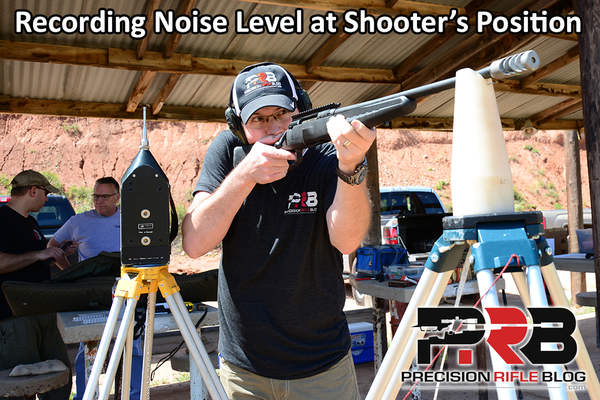
Muzzle brakes are loud, but some are louder than others … three to four times as loud. Cal enlisted the help of an expert from the suppressor industry to precisely measure how much louder each muzzle brake made a rifle. Each brake was tested in accordance with MIL-STD-1474D using calibrated military-approved equipment, and the noise level was also tested at the shooter’s position. This produced some interesting results.
Zant also includes high-res photos of each brake, and plans to publish other info about each model (including price, whether it requires gunsmithing, what calibers it is available in, etc.) to make it easy to compare them side-by-side.
Cal recently started publishing the results of these tests, and there is already a lot of interesting info. The data might surprise a few people and even dispel a few myths. Particularly interesting is Zant’s comparison of recoil reduction with a suppressor compared to muzzle brakes. How do you think the suppressor performed compared to the brakes? You may be surprised.
Howa now offers “Mini Action” rifles with actions that are nearly an inch shorter than typical “short actions”. With the Mini Action, the chamber and bolt are 12% shorter than regular short actions with shorter bolt throw for faster reloads. Weight is also reduced with a shorter bolt. The Howa Mini Action rifles come with ten-round, synthetic detachable box magazine and a reasonably light HACT 2-stage trigger. This makes for a nice, compact (and very shootable) varmint package. Nice enough, in fact, that we are looking seriously at the Mini-Action Howa as a donor for a .221 Fireball varmint gun project. We like the idea of a shorter action with a compact 10-round mag.
Howa Mini Action rifles chambered in .223 Rem are available now with 20″ lightweight, 22″ standard and 20″ heavy barrel options. Other chamberings, including the .204 Ruger, will be available soon. Synthetic stocks designed to fit this new Mini Action configuration are offered in black, OD green, and Kryptek Highlander camo colors.
Here’s an important announcement for Kestrel users. The new Kestrel Companion (Version 10) software has been released. Bryan Litz tells us this lastest version has many new features and enhancements. For example wind direction is now displayed with a clock-style graphic. Current environmental conditions are displayed on the screen and updated continuously. View the graphic below to see other important changes. This new software (for Android phones) is available now for FREE at the Google Play store.
NOTE: To use this software you must own a ballistics-enabled Kestrel Windmeter, either the Applied Ballistics Model or the Sportsman Model. These devices can be purchased through Amazon.com and other vendors.
To download the FREE Kestrel Companion Software for your Android Device, visit the Google Play Store.
Click Image for Full-Screen View of Features:
No Apple iOS Version
Kestrel Companion is a free companion application for the Applied Ballistics and Sportsman Kestrel units. The software runs only on Android devices. There is no version for iOS at this time, because the Kestrel devices cannot pair to an iOS Device.
Bench Barrels for Sound Attenuation
There’s something unusual about this range. Competitors are required to shoot through hoops. Vince Bottomley explains: “Competitors have to shoot with the rifle barrel inside a foam-lined plastic barrel, in an attempt to cut down on noise. This was a condition imposed by the local police but in practice, you don’t notice it as you are looking through a scope.” That looks pretty strange to us. Hopefully we won’t see these kind of restrictions imposed in the USA.
Here’s good news to report from the United Kingdom. The UK’s second 1000-yard benchrest facility just opened up in Scotland, near the town of Castle Douglas in the south of Scotland. Until now, Diggle was the only range running 1000-yard benchrest matches in all of the UK. With interest in long-range benchrest competition growing in the UK, it’s good to see a new 1K venue opening for business.
The new Ingleston Range in Castle Douglas is operated by the Galloway Small Arms Club. This club is affiliated with the United Kingdom Bench Rest Association (UKBRA), so any records established will be recognized by the UK governing body for benchrest shooting. Light Gun and Heavy Gun Classes are run according to American IBS rules. And, per UKBRA standards, there is also a third, Factory Rifle Class. Vince Bottomley reports: “The Range is located on a working farm and the GSAC members have worked tremendously hard to create a 1000-yard range from what is basically open countryside.”
Here’s the view looking downrange. What a beautiful place to shoot…
by Dennis Santiago
Tricked-out match guns are fun but, if you want to prove that you’ve got an eagle eye and steady hands, a true test of skill is the Civilian Marksmanship Program’s As-Issued Four Gun Aggregate.
The Four Gun Aggregate encompasses a series of CMP John C. Garand 30-shot matches (200-yard As-Issued Military Rifle Match Course A) on NRA SR targets at one of the CMP Regional Games or the Nationals officiated by the CMP. These are the only places you can earn the coveted neck-ribbon CMP achievement medals.
You will need four as-issued rifles. The first is the M-1 Garand. (The course of fire is named after this rifle’s inventor.) This remarkable battle rifle will test your prowess at slow prone, rapid prone, and offhand. The match winner will put almost all bullets into a saucer.
You do get to hear that classic “ping” when the en bloc clip ejects with this gun. It’s a good idea to write your firing point number on your hand for each match because you will move around over the course of the tournament.
Next comes the hyper-accurate 1903 Springfield. You can use either the WW I M1903 or the later WW II M1903A3 model with peep sights. A Springfield will typically shoot groups half the size of a Garand with the same ammunition. Think potential in terms of tea cups instead of saucers.
Here’s a smart new product that could save your life (or the life of a loved one). The EPIC-id bracelet stores your vital information on a shockproof, weatherproof USB flash drive that can be instantly accessed by an EMT or doctor. Your Editor just bought two of these med-info bracelets — one for himself and another for a diabetic family member. If you’re a shooter, or spend much time outdoors, you should have this device or some other kind of tag that provides your vital info (such as blood type and drug allergies) to first responders.
If you’re injured, first responders need to know if you have a medical condition, have drug allergies, or take any medications. With this bracelet, that vital info is available even if you can’t communicate. The EPIC-id Emergency Band stores medical data on a USB flash drive that can be “read” by any computer or mobile device with a USB port. Firefighters, EMTs, and medical professionals can instantly determine your name, emergency contacts, insurance, and medical information. (Read my experience below).
It’s easy to load your medical data on to the device. Standardized emergency info forms come pre-loaded — just insert the Epic-ID into any computer to fill out the forms. PC and Mac™ compatible, the waterproof EPIC-id features a durable stainless steel clasp and trim-to-fit silicone band.
Editor’s Story — Why This Is Important
Just this past Wednesday July 8th, at 2:00 am, a family member was rushed to the hospital after suffering a stroke. She was non-responsive and unable to communicate at all. This created problems for EMTs because they were unaware of her current medications, insulin needs, resusitation preferences, and some relevant past medical history. After that experience I decided to buy these bracelets for her and myself. The good new is that she survived… but it was close.
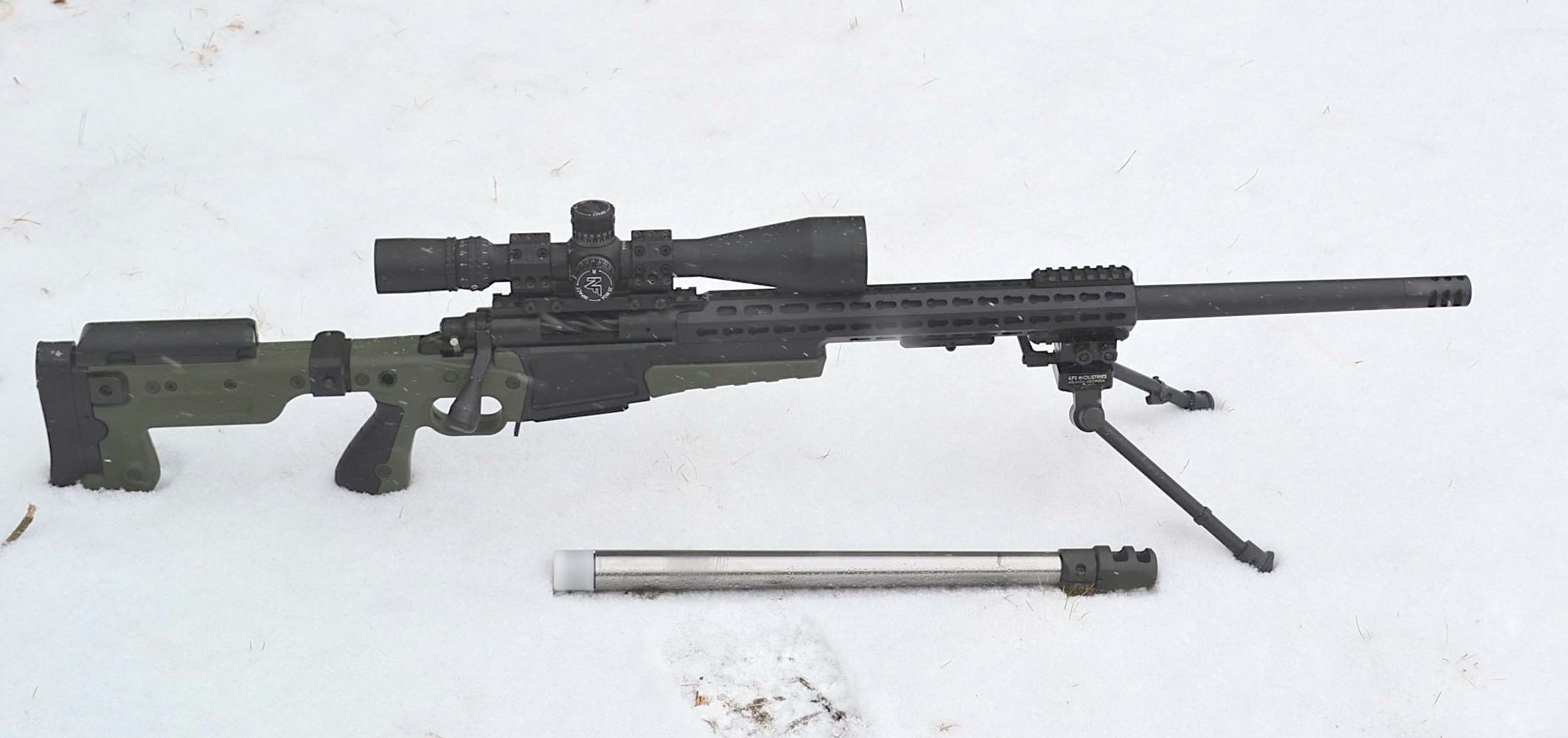
Initially drawn to the 6mmBR and 6mm Dasher, I realized these cartridges wouldn’t feed from an AICS magazine system without extensive modification. I took a look at the 6mm Creedmoor, 6XC, and 6mm-6.5×47 Lapua (aka 6×47 Lapua), all of which feed well from a detachable magazine. At right you can see the 6×47 Lapua in an AICS magazine. It has the “Goldilocks factor” — not too long, not too short.
The ability to simply convert 6.5×47 Lapua brass to 6×47 brass by running the parent 6.5mm brass through a full-length Forster sizing die in a single step was what made me choose the 6×47 Lapua over the 6mm Creedmoor and 6XC (both excellent cartridges in their own right). I also own a 6.5×47 Lapua rifle, so I had a supply of 6.5×47 brass ready to neck-down. Being able to create 6×47 brass easily (one pass and done) was very appealing.
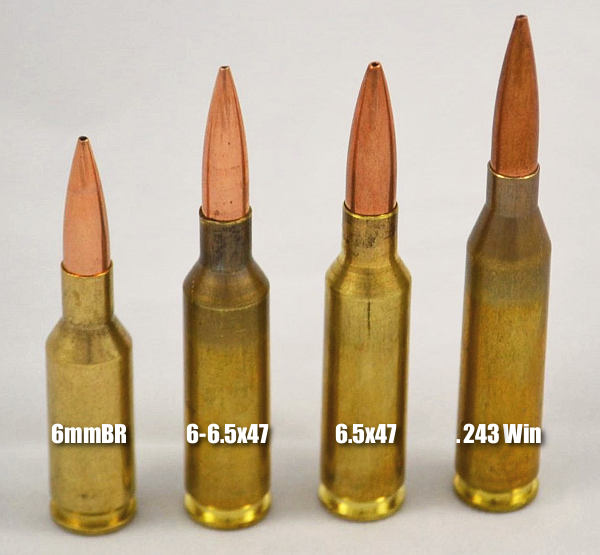
Left to right, below: 6mmBR, 6-6.5×47 Lapua, 6.5×47 Lapua, and .243 Winchester.
I cut the chamber end off my .243 Win barrel, threaded and chambered my rifle for the 6×47 Lapua cartridge. I have written a lengthy article on this cutting and re-chambering process. Home gunsmiths interested in this process can READ MORE HERE.
When the re-chambering was complete, I headed to the range and worked up a set of eight loads using Berger 108 BTHPs, H4350, Lapua brass, and CCI 450 primers.
Load development was a little trickier than with the 6.5×47 Lapua parent cartridge. The accuracy nodes were smaller. However, once I dialed in a load with Hodgdon H4350 and the 108-grain Berger BTHP, the rest was history. The 6×47 rig is now one of the most consistent rifles I own, holding just above 0.3 MOA for 5-round groups. Below is a 100-yard test target with 108-grain Berger BT in the 6×47 Lapua. Five-shot group sizes are (L to R): .369″, .289″, and .405″. The average size was .354″ or .338 MOA. [Editor: We think that is excellent accuracy for a tactical-type rifle shot from bipod.]
Learn More about this 6×47 Lapua Project
I’ve written more about this 6×47 rifle on my Rifleshooter.com website. To learn more about my experience with the 6×47 Lapua, click this link: 6-6.5X47 Lapua Review.
About the author: Bill has been a serious shooter for over 20 years. A former Marine Corps Sergeant, he’s competed and placed in High Power Rifle, ISPC, USPSA, IDPA, 3-Gun, F-Class, and precision rifle disciplines. In addition to being an NRA-certified firearms instructor and range officer, Bill has hunted big game in North America, South America, and Africa. Bill writes extensively about gunsmithing, precision rifles, and the shooting sports on his blog, Rifleshooter.com.




 The Four Gun Aggregate encompasses a series of CMP John C. Garand 30-shot matches (200-yard As-Issued Military Rifle Match Course A) on NRA SR targets at one of the CMP Regional Games or the Nationals officiated by the CMP. These are the only places you can earn the coveted neck-ribbon CMP achievement medals.