There are many products used successfully for case lubrication for case sizing. And for neck-turning a variety of lubricants are favored. The video above explains the basics of case lubrication with die wax, and spray lubricants. Below we mention three products that have proven very effective. For cases that have a close fit to your chamber via custom FL dies, Ballistol works well and is easy to apply and remove. For neck-turning, some of our Forum members have had great success with some automotive lubricants.
Three Good Lubricants You May Not Have Tried Before If you’re using a body die or a full-length sizing die, try using Ballistol (in the aerosol can) as a lube. It works GREAT without the tacky or gooey residue left by most case lubes. It will also clean off carbon residues on the neck as you lube the case. Just spray a little on a cotton patch (or your fingertips) and wipe each case before you run it up into the die. If you are using a steel neck bushing, be sure to wipe the neck as well. You can usually do a half-dozen BR-sized cases before you need to re-apply Ballistol on the patch. Ballistol is non-toxic, bio-degradeable, and will not harm your skin. It is very slippery, but can easily be removed with a rag or paper towel. Try it–you may retire your One-Shot. Ballistol can also be used to protect wood stocks.
Note, for heavy case-forming or necking up case necks, we still recommend a thicker lubricant, such as Imperial Die Wax. But for normal case sizing, after your neck has been expanded, Ballistol will do the job, and you won’t need to tumble the brass afterwards. All you need is a very thin layer of Ballistol, and this easily wipes off with a paper towel.
For Neck-Turning, Try STP Blend or Assembly Lube
For lubing the neck-turning tool mandrel while turning case necks, many folks use a blend of STP® Oil Treatment and Mobil 1 lube. Chuckw2 reports: “Try STP and Mobile 1 Synthetic oil in a 50/50 mixture. Very slick, you will need to tumble your cases after turning.” STP is a very thick lubricant, that flows and clings almost like honey. Jason reports the STP blend comes off easily in an ultra-sound bath, using a bit of detergent. At many retailers, STP is also available in a convenient 7-ounce tube, so you don’t have to buy a large bottle.
Another even cheaper option is assembly lubricant. For turning his case necks, RStreich uses assembly lube from an auto parts store. He notes: “The brand I have is reddish in color and kind of sticky like honey. It’s far better than the Imperial die wax I was using before.” There are a variety of types, both with and without moly additive, and you can select the viscosity you prefer if you sample a few brands. Be sure to clean out any lube residue from the inside of your necks when you have completed your neck-turning.
The USAMU has published a “how-to” article about bullet sorting. While many of us may sort bullets by base-to-ogive length (and/or weight), the USAMU story explores the “how and why” of sorting bullets by Overall Length (OAL). Read the article highlights below, and make your own decision as to whether OAL sorting is worth the time and effort. Bryan Litz of Applied Ballistics says that sorting by OAL is not a bad idea, but base-to-ogive bullet sorting probably represents a better investment of your time.
Bullet Sorting by Overall Length
We’d like to share a specialized handloading technique which we’ve long found beneficial to our long-range (600 yards and beyond) accuracy. Sorting of bullets for extreme long range (LR) accuracy is not difficult to do, but some background in theory is needed.
Here at USAMU’s Handloading Shop, we only sort individual bullets for the most demanding Long-Range applications and important competitions. Only the most accurate rifles and shooters can fully exploit the benefits of this technique. The basic sorting process involves measuring the Overall Length (OAL) of the bullets, and grouping them in 0.001″ increments. It’s not unusual to find lots of match bullets that vary as much as 0.015″-0.020″ in length throughout the lot, although lots with much less variation are seen as well. Even in bullet lots with 0.015″ OAL variation, the bullet base-to-ogive length will show much less variation. Hence, our basic sort is by bullet OAL. One obvious benefit of sorting is easily seen in the attached photo. The few bullets that are VERY different from the average are culled out, reducing probable fliers.
How does one know what OAL increments to use when sorting? The answer is simple. As each lot of bullets is unique in its OAL distribution, it’s best to sample your bullet lot and see how they are distributed. In the attached photo, you will see a set of loading trays with a strip of masking tape running along the bottom. Each vertical row of holes is numbered in 0.001″ increments corresponding to the bullets’ OAL. A digital caliper makes this task much easier. As each bullet is measured, it is placed in the line of holes for its’ OAL, and gradually, a roughly bell-shaped curve begins to form.
Note that near the center, bullets are much more plentiful than near the edges. At the extreme edges, there are a few that differ markedly from the average, and these make great chronograph or sighting-in fodder. We recommend using a sample of 200 bullets from your lot, and 300 is even better. Some bullet lots are very consistent, with a tall, narrow band of highly-uniform bullets clustered together over just a few thousandths spread. Other lots will show a long, relatively flat curve (less uniform), and you may also see curves with 2 or more “spikes” separated by several 0.001″ OAL increments.
Bullet Sorting — OAL vs. Base-to-Ogive vs. Weight
Expert advice from Bryan Litz, Applied Ballistics
I’m often asked what is a the best measure to sort bullets by, and the answer (to this and many other questions in ballistics) is: it depends.
Choosing to sort by overall length (OAL), base to ogive (BTO), bearing surface, weight, etc. can get overwhelming. Shooters typically look for something they can measure, which shows a variation and sort by that. It’s common for dimensional variations to correlate. For example, bullets which are longer in OAL are typically also shorter in BTO, and have longer noses. All these are symptoms of a bullet that was pushed a little further into the pointing die, or possibly had more than average lube while being swaged. So in essence, if you sort by BTO, you’re measuring one symptom which can indicate a pattern in the bullets shape.
So, the question still stands — what should you measure? You’ll always see more variation in OAL than BTO, so it’s easier to sort by OAL. But sometimes the bullet tips can be jagged and have small burrs which can be misleading. Measuring BTO will result in a lower spread, but is a more direct measure of bullet uniformity.
Then there’s the question of; how much variation is too much, or, how many bins should you sort into? Shooters who see 0.025” variation in BTO may choose to sort into 5 bins of 0.005”. But if you have only 0.005” variation in the box, you’ll still sort into 5 bins of 0.001”. What’s correct? You have to shoot to know. Live fire testing will answer more questions, and answer them more decisively than any amount of discussion on the subject. The test I recommend is to identify bullets on the extreme short end of the spectrum, and some on the extreme long end. Load at least 10 rounds of each, and take turns shooting 5-shot groups with them. If there is a difference, it will be evident. The results of the testing will answer your question of: should I sort based on X, Y, or Z?”
You can read more discussions on this and other similar subjects in our Accurateshooter.com Shooters’ Forum. Here’s a link to a thread discussing bullet sorting: Bullet Sorting Thread
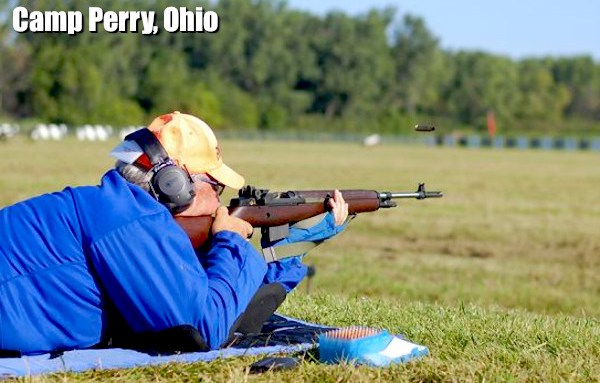
The CMP M14 Heritage Match was held Sunday, August 3, 2025 at the Viale Range at Camp Perry.
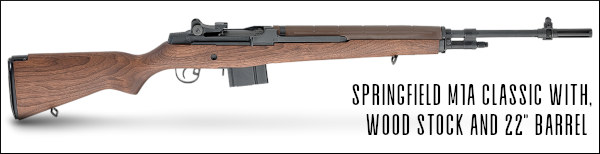
M1A rifles at M14 Heritage Match at Camp Perry Shooting USA TV has a good show this week featuring the M14 Heritage Match at Camp Perry, Ohio. One of most popular matches held during the CMP National Matches at Camp Perry, the Franklin Armory M14 Heritage match features M1A rifles, which are a modern, semi-auto version of the M14. The 2025 M14 Heritage Match was held Sunday, August 3, 2025, at the CMP 2025 National Rifle Matches.
Shooting USA SHOW TIMES: This Shooting USA Episode airs Wednesday, November 12, 2025 at 9:00 PM Eastern and Pacific; 8:00 PM Central. If you miss the regular broadcast, you can stream the show online at any time on Vimeo for $0.99 per episode.
History of the M14 Heritage Match and Springfield M1A Match
The Franklin Armory M14 Heritage Match, previously the Springfield Armory M1A match, began with one man’s concept. Springfield Armory’s Mike Doy witnessed the waning of classic M1 Garand and M1A rifles from the competitive High Power firing lines. “I really wanted to get those M1A rifles out of safes and closets and back out onto the field. So [in 2008] I promoted the idea of running an M1A-specific match at Camp Perry. That first year we had over 600 competitors and spectators.”
Take the time to WATCH this 3-minute video. It has great match footage of Camp Perry and interviews with M1A competitors. Well worth watching!
M1A Competition at Camp Perry National Matches
For many years, the semi-auto version of the M14 was “top dog” in iron sights Service Rifle competition. Now that discipline is dominated by .223 Rem (5.56×45) AR-type rifles, but the bigger .308-caliber rifle, now sold as the M1A, remains popular and is the star of the popular “M14 Heritage Match”.
Dick Jones reports that accurized M14/M1As could post remarkable scores: “The accuracy potential of the M14/M1A is unquestionable. During their reign as service rifles, they produced multiple perfect 200 scores at 600 and 1000 yards in the hands of top shooters. This is a difficult feat with a modern, scoped, magnum-caliber rifle and remarkable with an iron-sighted battle rifle. Good competition rifles can group 10 shots under one MOA, and the meticulously-massaged rifles used by the top shooters during my career would consistently put up 10 shots under an inch at 200 yards off a test cradle.”
M1A Match Equipment Rules and Course of Fire
Renewed interest in the M1A led to the first dedicated Camp Perry M1A match in 2008. That first-ever match drew over 500 shooters. Match equipment rules allow pretty much all types/grades of M1As. The one-day course of fire consists of 50 shots at 300 yards on the NRA MR-65F target, as follows: 5 sighters; 20 shots slow-fire prone; 10 shots rapid-fire prone; 10 shots rapid-fire, kneeling or sitting; and 10 shots slow-fire standing. Here are photos from the 2014 MIA match, courtesy NRA General Operations.
Thanksgiving is Thursday, November 27th this year. Looking for culinary inspiration for your holiday gatherings? The NRA Blog offers three special (and delicious) Wild Game Recipes for your family feasts:
Honey Mustard Planked Wild Turkey Breast
Mushroom-Stuffed Wild Boar Roast with Black Truffle Sauce
BBQ Brined Pigeon
These recipes come from some of the country’s best chefs, and they all seem mouth-watering. You’ll find a full list of ingredients plus step-by-step cooking tips.
One of the many advantages to hunting is the assortment of game you can gather that lasts for an extended period of time. Just because it’s Thanksgiving doesn’t mean you have to stick with a whole turkey from the store and a ham hock.
We have three unique spins on wild game recipes that will suit your dining table perfectly. Even if you’re one of those hunters who enjoys a quick hunt the morning of Thanksgiving, these recipes will make your holiday more delicious than ever. — NRABlog.com
And for those folks who hope to harvest their own gobbler for the Thanksgiving holiday, here is a special NRA Turkey target that can help you hone your turkey-hunting skills.
GetZone.com offers a turkey hunting video with expert guidance on Turkey hunting, specifically stalking and shot placement: “When it comes to shotgun hunting, you don’t want to get BBs in the meat, so the most common (and lethal) shot with a shotgun is a headshot.”
This photo is from GetZone.com, a website that provides information on shooting and hunting. CLICK HERE to watch a GetZone video on turkey hunting. Work Warning: When you click photo, a loud audio track may start immediately, so turn down the audio volume.
The NRA Foundation is providing new grant awards supporting school security initiatives through the NRA School Shield program. These grants were made possible in part by a generous estate gift. This gift enabled the Foundation to expand its commitment to helping schools strengthen their security infrastructure and create safer learning environments for students nationwide.
$304,447 in School Security Grants
This year the NRA Foundation awarded 30 School Shield grants totaling $304,447 to schools seeking to enhance their security through equipment upgrades, facility improvements, and training resources. In determining the grants, the NRA Foundation partnered with the NRA Law Enforcement Division. Staffers with extensive law enforcement experience and school safety knowledge reviewed each request to ensure grants can produce optimal security enhancement.
“The NRA Foundation is proud to help schools across the country strengthen their safety posture”, said Peter Churchbourne, Exec. Director of The NRA Foundation. “This year’s grant cycle demonstrates how philanthropy, in particular planned giving, can have a lasting impact on the well-being of communities. The estate gift dedicated to School Shield allowed us to expand our reach and help even more schools[.]”
The Foundation will again process School Shield grant applications in 2026, continuing to support schools seeking to implement comprehensive, security-focused solutions.
The NRA School Shield program provides schools with tools, assessments, and training to enhance campus safety, offering a multifaceted approach to help keep children safe where they learn. To learn more, visit NRASchoolShield.org.
“On that day, let us solemnly remember the sacrifices of all those who fought so valiantly, on the seas, in the air, and on foreign shores, to preserve our heritage of freedom, and let us reconsecrate ourselves to the task of promoting and enduring peace so that their efforts shall not have been in vain.”
– 1954, President Dwight D. Eisenhower, Veterans Day proclamation.
107 Years Later…
On the 11th hour, of the 11th day, of the 11th month of 1918, bugle calls signaled the ‘cease fire’ ending the First World War. (The official Armistice was signed earlier that morning.) To those who endured it, WWI was the “Great War”, “the War to End All Wars.” Tragically, an even greater conflict consumed the world just two decades later.
Today, 107 years after the end of WWI, Americans mark the anniversary of the WWI Armistice as “Veterans Day”. In Canada it is known as Remembrance Day. On this solemn occasion we honor all those who have served in the military in times of war and peace.
While more veterans pass away each year, there are still about 16.5 million veterans in the United States. Take time today to honor those soldiers, sailors, and airmen who have served their nation with pride. Today we remember that… “All gave some, and some gave all.” History of Veterans Day.
Former Secretary of Veterans Affairs Dr. James Peake asked Americans to recognize the nation’s 16.5 million living veterans and the generations before them who fought to protect freedom and democracy: “While our foremost thoughts are with those in distant war zones today, Veterans Day is an opportunity for Americans to pay their respects to all who answered the nation’s call to military service.”
On Veterans Day we especially need to remember the seriously wounded combat veterans. These men and women summon great courage every day to overcome the lasting injuries they suffered in battle. Some of these soldiers have lost limbs, yet volunteered to return to combat duty. That is dedication beyond measure — true patriotism.
National Veterans Day Ceremony
The Veterans Day National Ceremony is held each year on November 11th at Arlington National Cemetery. The ceremony commences precisely at 11:00 a.m. with a wreath laying at the Tomb of the Unknowns and continues inside the Memorial Amphitheater with a parade of colors by veterans’ organizations. The ceremony is intended to honor and thank all who served in the U.S. Armed Forces. Major regional ceremonies and events are also held throughout the country.
On this 11th day of the 11th month, MidwayUSA is running a major Veterans Day Sale. Hundreds of high-quality products are on sale, with discounts up to 60%. Here are ten notable deals — good products at great prices. Mind you, this is just a small sample of the huge collection of Veterans Day discounts. Visit the MidwayUSA Sale Page to see dozens of other great deals. As an added incentive, MidwayUSA is offering FREE Shipping with purchases over $100.00.
At the request of our readers, we provide select “Deals of the Week”. Every Sunday afternoon or Monday morning we offer our Best Bargain selections. Here are some of the best deals on firearms, hardware, reloading components, optics, and shooting accessories. Be aware that sale prices are subject to change, and once clearance inventory is sold, it’s gone for good. You snooze you lose.
NOTE: All listed products are for sale to persons 18 years of age or older. No products are intended for use by minors.
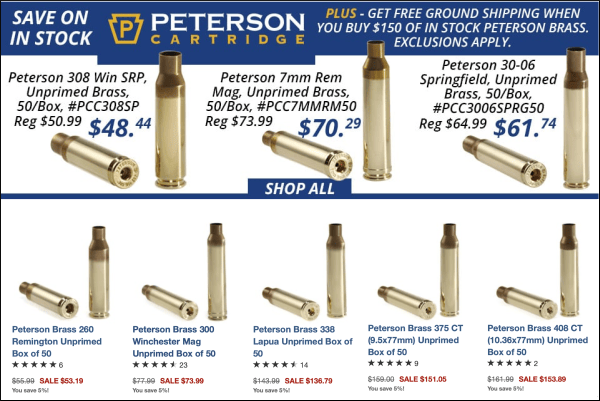
1. Graf & Sons — Peterson Brass Sale
⏺️ » High-quality American-made cartridge brass with discounts
Peterson Cartridge produces very high-quality, competition-ready brass. And Peterson offers dozens of cartridge types — one of the widest selections of cartridge brass available. We’ve found Peterson brass to deliver good accuracy with excellent brass life. NOTE: As a bonus this week, if you order more than $150 worth of in-stock Peterson brass at Grafs.com, you get FREE ground shipping.
2. EuroOptic — Major Multi-Brand Optics Sale
⏺️ » Fantastic Deals on major brand optics
EuroOptic.com is running a major clearance sale this week on big name optics. You can save hundreds on quality scopes from Vortex, Leupold, Burris, Althon, Schmidt & Bender, and many other brands. This Limited Time Sale at EuroOptic offers huge savings up to 60% with specials and close-out deals. Click these links for sale listings by manufacturers: Vortex | Leupold | Burris | Athlon | Schmidt & Bender | Pulsar.
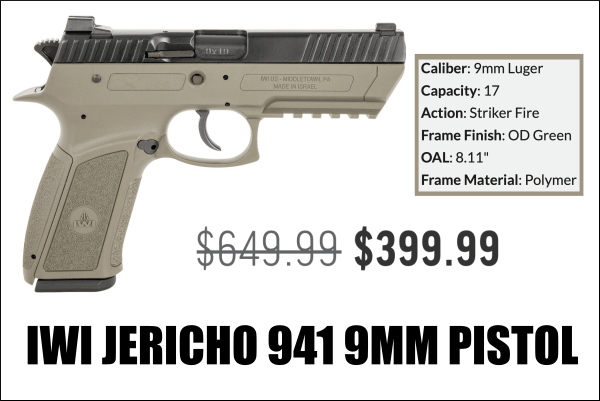
3. Palmetto State Armory — IWI Jericho 9mm Pistol, $399.99
⏺️ » High quality Israeli Weapons Industry (IWI) 9mm pistol
If you’re looking for a good, reliable 9mm handgun, consider the IWI Jericho 941 9mm pistol. This striker-fired pistol features a 4.4″ barrel and adjustable sights. The OD green polymer frame boasts interchangeable backstraps for good ergonomics. As part of PSA’s Veteran’s Day sale, this pistol is now just $399.99 — $250.00 off MSRP. The Jericho 941 combines notable CZ75-type features with IWI’s high standards for reliability, accuracy, and quality. User reviews have been very positive — 87% five-star.
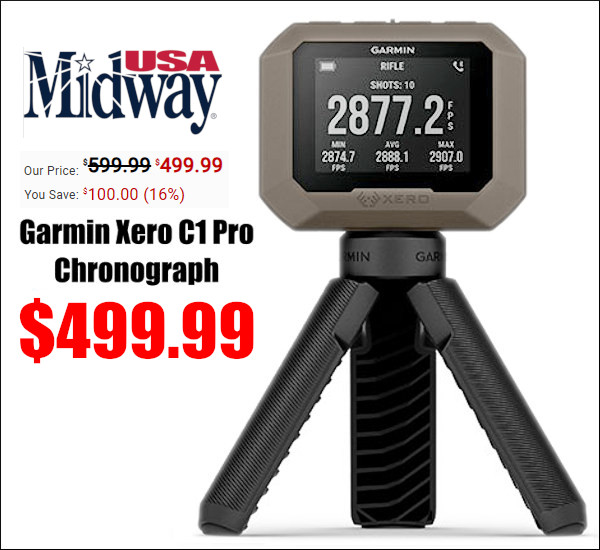
4. MidwayUSA — Garmin Xero C1 Pro Chronograph, $499.99
⏺️ » Superb, ultra-reliable compact radar chrono with $100 savings
Right now MidwayUSA has the excellent Garmin Xero C1 Pro Chronograph for $499.99, $100 off MSRP. These Garmin Radar chronos measure velocities from 100 to 5000 FPS, are easy to set up, and have up to 6 hours of battery life. In addition, if you want more savings, MidwayUSA has some newly overhauled (NOH) Garmin Xero C1 Pro Chronographs at $479.99, $120 off the normal price. All these Garmin Xero C1 Pro Chronos come boxed with all accessories, manuals, and a 1-Year Manufacturer Warranty.
5. Palmetto SA — Veterans Day Sale, UP to $500 off MSRP
⏺️ » Huge savings on wide variety of products including ARs and optics
This week Palmetto State Armory is running a major Veteran’s Day Sale through Friday. Popular products (with big discounts) include: Rifles, Pistols, Optics, Triggers, Ammunition, AR Uppers/Lowers, Magazines, Rifle Cases, knives and more. There are some incredible deals. For example the PSA PA-15 M4 Carbine is just $469.99 — that’s $480.00 off the regular price, a 50.5% discount.
6. Amazon — Frankford Arsenal Case Prep & Trim Center, $146.13
⏺️ » Versatile powered tool center with good user reviews
The Frankford Arsenal Case Prep and Trim Center (#ad) can trim, chamfer, and deburr cartridge brass as well as clean primer pockets. The Case Prep Center boasts four power stations with case holder, VLD chamfering tool, outside chamfer tool, and primer pocket uniformers. The case holder features Adjustable Collet System (with bushing) for cases from .17 Rem to .460 Weatherby. This indexes the case shoulder and can be set to precisely trim brass to an exact length. This Frankford Case Prep Center is crafted from aluminum with a strong steel frame.
7. Amazon — Hornady LNL Sonic Cleaner, $137.95
⏺️ » Good, reliable, efficient unit for cleaning brass
Unlike traditional vibratory tumblers, Hornady’s LNL Sonic Cleaner (#ad) uses ultrasonic waves (with a ceramic heater) to quickly clean the inside and outise of cartridge brass. This can also help clean primer pockets. The large, 2-liter stainless steel tank holds up to 300 .223 Rem cases or 150 .308 Win cases. This Hornady machine is reliable and has good user reviews. For best results, use with Hornady One Shot Sonic Clean Solution (not included). The machine can also remove carbon residue from small metal equipment.
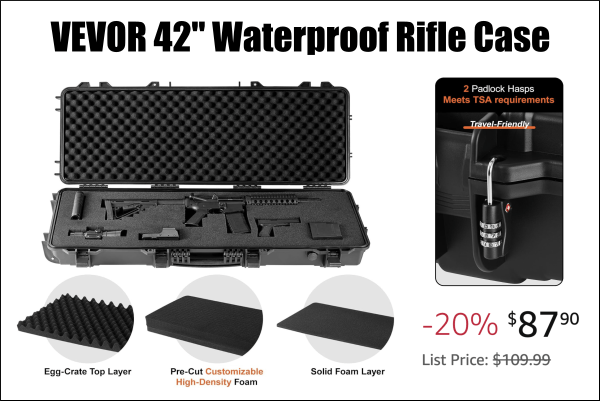
⏺️ » Major savings on rugged waterproof case; 50″ and 52″ models also
Protecting your firearms requires a good, tough transport case. The VEVOR 42″ Rifle Case (#ad) features three layers of protective foam, solid locking points, wheels, and a IP67 waterproof case. This VEVOR gun case meets TSA requirements, making it a good choice for rifle owners who travel by air. At just $87.90 this is a great deal — much cheaper than other wheeled rifle cases of similar size. NOTE: This design VEVOR case is available in larger sizes: 50″ long version for $108.99 and 52″ version for $132.99.
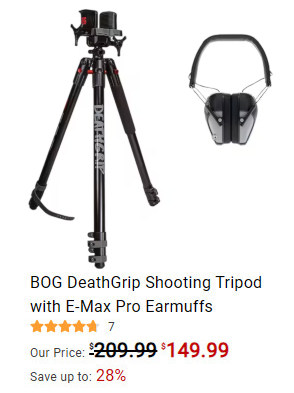
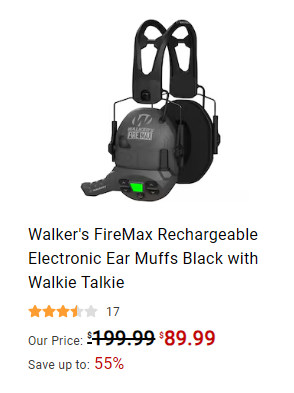
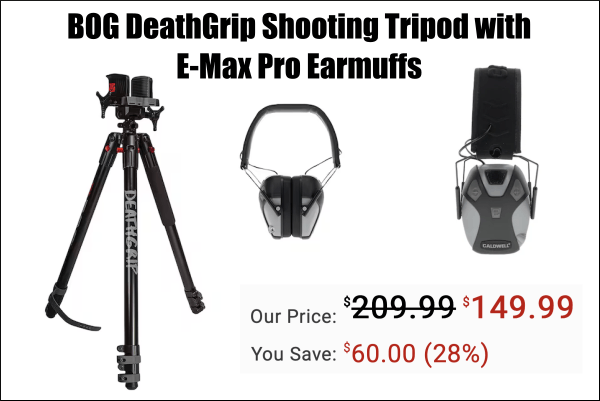
9. MidwayUSA — BOG Tripod Plus E-Max Pro Earmuffs, $149.99
⏺️ » Good combo set for Hunters and Varminters
Here’s a great combo for PRS/NRL shooters and/or hunters. You get the excellent BOG Deathgrip Tripod AND Caldwell E-Max Electronic Muffs for just $149.99 total at MidwayUSA (28% Off). And, for a few more days, this combo is just $129.99 at Palmetto SA during the PSA Veterans Day Sale. The BOG DeathGrip Tripod has rugged aluminum legs and a patented hands-free clamp that can quickly secure any rifle. The bipod head pans 360 degrees with cant adjustment. The 3-position leg angle lock allows bipod use in standing, kneeling, and prone positions. The comfortable, low-profile E-Max Pro electronic muffs have a 23dB noise reduction rating (NRR). NOTE: For a few days this week, this combo
10. Amazon — Lyman Case Prep Tool Kit, $70.69
⏺️ » Handy kit with 11 tools — all you need to prep cases
If you prefer to do your case prep by hand, we like the Lyman Universal Case Prep Accessory Set (#ad) which has ll good tools all in one handy case with fitted foam interior. The set includes both large and small primer pocket reamers, primer pocket cleaners, outside deburring tool, inside (VLD) chamfer tool and large and small primer pocket uniformer tools. All individual items have their own molded handle with rubber insert for sure grip. Includes custom zippered case for storage.
As an Amazon affiliate, this site can earn revenues through sales commissions.
You have probably watched one of the excellent shooting sports videos Ryan Cleckner has done for the NSSF. Ryan’s Understanding Minute of Angle (MOA) video (see below) has been viewed over 3.8 million times! Ryan, a former sniper instructor Ryan who is now an attorney, is noted for his ability to explain complex topics in an easy-to-comprehend manner.
Cleckner has also authored a great book, the Long Range Shooting Handbook, which expands on the topics covered in his popular video series. This book is the #1 Best Seller on Amazon in its category. You can view Sample Chapters from Ryan’s book — just click “Read Sample” on the Amazon product page.
As a long-range shooting expert, Ryan Cleckner has impressive credentials. Cleckner was a special operations sniper (1/75 Rgr) with multiple combat deployments, and he has served a U.S. Army sniper instructor. Currently he works as a firearms industry executive and attorney.
The Long Range Shooting Handbook is divided into three main categories: What It Is/How It Works, Fundamentals, and How to Use It. “What It Is/How It Works” covers equipment, terminology, and basic principles. “Fundamentals” covers the theory of long range shooting. “How to Use It” gives practical advice on implementing what you’ve learned, so you can progress as a skilled, long range shooter.
Ryan Cleckner’s best-selling Long Range Shooting Handbook is designed as an introduction to important fundamental concepts such as MOA vs. MILs, External Ballistics, and Environmental Effects. Included are personal tips and advice based on Cleckner’s years of experience as a sniper instructor.
Iain Harrison, editor of Recoil Magazine, said: “Whether you’re looking to dip a toe into the complex world of long range shooting, or you’re a seasoned shooter with years of trigger time, Ryan Cleckner’s book will prove to be excellent reference material. Well written and easy to understand, it covers all the essential topics that a well-rounded shooter needs to master.”
In this video, Ryan Cleckner reviews proper technique for rifle shooters. A stable platform, sight alignment, sight picture, and trigger control are key fundamentals to shooting properly.
Ask 10 shooters about barrel cleaning and you’ll get 10 different opinions. This reflects that fact that different fouling problems demand different solutions. For example, solvents that work well for copper may not be the best for hard carbon (and vice-versa). To come up with the right solution, first you must understand the nature of the fouling in your barrel.
John Krieger Interview with AccurateShooter at SHOT Show:
The debate about the proper care of a match barrel is a hot one, spiked with folklore and old wives’ tales, Lohman said. He and his staff set out to set the record straight: “We tried to interject some science into the discussion of cleaning a match barrel,” he explained. In his article, Lohman writes:
Why worry about a little barrel fouling when the throat is subjected to a brutal 5,600° F volcano at 55,000 PSI? To investigate these and other questions about taking care of a match barrel, we spoke with a dozen experts and share their knowledge in this first of a series of articles.
After listening to folks who shoot, build barrels or manufacture cleaning solvents for a living, we concluded that even the experts each have their own unique recommendations on how to care for a match barrel. But they all agree on one thing — the gun will tell you what it likes best. Because the life expectancy of a match barrel is about 1,500 to 2,500 rounds, the objectives of cleaning one should include: preserve accuracy, slow the erosion, and remove fouling — all without damaging the gun. This article doesn’t claim that one cleaning method is better than the next. Rather, we set out to interject a little science into the discussion and to share some lessons learned from experts in the field.
For more Shooting Sports USA articles, visit www.ssusa.org.


 If you’re using a body die or a full-length sizing die, try using Ballistol (in the aerosol can) as a lube. It works GREAT without the tacky or gooey residue left by most case lubes. It will also clean off carbon residues on the neck as you lube the case. Just spray a little on a cotton patch (or your fingertips) and wipe each case before you run it up into the die. If you are using a steel neck bushing, be sure to wipe the neck as well. You can usually do a half-dozen BR-sized cases before you need to re-apply Ballistol on the patch. Ballistol is non-toxic, bio-degradeable, and will not harm your skin. It is very slippery, but can easily be removed with a rag or paper towel. Try it–you may retire your One-Shot. Ballistol can also be used to protect wood stocks.
 For Neck-Turning, Try STP Blend or Assembly Lube
 Another even cheaper option is assembly lubricant. For turning his case necks, RStreich uses assembly lube from an auto parts store. He notes: “The brand I have is reddish in color and kind of sticky like honey. It’s far better than the Imperial die wax I was using before.” There are a variety of types, both with and without moly additive, and you can select the viscosity you prefer if you sample a few brands. Be sure to clean out any lube residue from the inside of your necks when you have completed your neck-turning.