Need .223 Rem ammo for your early summer varmint safari? Grafs.com has you covered. Over the past few months, Graf & Sons has acquired a large supply of .223 Rem ammo from a variety of manufacturers. Now Grafs.com has a great selection of .223 Rem ammo, with many items marked down on sale. You’ll find name-brand ammo for as little as $9.99 per 20-ct box (American Eagle 50gr JHP). If you prefer heavier bullets for longer-range shooting, check out the PRVI Partizan ammo loaded with 75gr HPBT match bullets — this is just $10.99 per per 20-ct box.
Forum member Eric has built an innovative specialty pistol for long-range benchrest. The gun is chambered in 6.5-284 and built for IBS 1000-yard shooting. Eric originally built the gun with a 3″-wide fore-end, then decided to go with a 6″-wide offset design since the IBS no longer restricts Light Gun Forearms to three inches. Eric explained: “After building the 3″-wide stock I looked at the IBS 1000-yard benchrest rules and found out that there was not a width limit and rails were allowed for a Light Gun stock. I set out to design a 6″ version. I was thinking it should be offset also to help control torque and track straighter. I had a new 6.5mm, 1:8.5″ twist, 1.250″ HV-contour Krieger barrel. I chambered the barrel for 6.5-284 and bedded the stock.”
Eric feeds his pistol Sierra 142gr MatchKings with a load of 51.0 grains of H4831sc. Estimated muzzle velocity with this load is 2900 fps — respectable speed from the short barrel. The gun tracks remarkably well, with very little torque effect, as you can see in the video below.
After initial testing, Eric added a muzzle brake to the barrel. This tamed the recoil considerably. To learn more about Eric’s long-range 6.5-284 pistol, visit our Shooters Forum and READ this POST. To see more videos of the pistol in action (with muzzle brake), visit Eric’s PhotoBucket Album.
USAMU Service Rifle shooter/instructor SSG Brandon Green set a new national record this past week, shooting a 500-33X in the individual Aggregate, National Match Course (NMC) with metallic sights. Green was near-perfect in the 200-yard Rapids, shooting an amazing 100-9X. Green was shooting a Tubb 2000 bolt-action rifle chambered in 6XC. He set the new record using Norma factory ammo. Yep, this was factory 6XC ammo, right out of the box.
National Record Score Card of SSG Brandon Green
SSG Green is the current NRA High Power National Champion and Interservice Rifle Champion. He and the rest of the USAMU rifle team have trained hard for the 2014 season. Yet Brandon joked about his record-setting performance, noting that the record was shot with his “back-up” gun. On his Facebook page, Brandon posted: “500-33X NMC. Not positive, possibly a record [Editor: Yes it was.] Not too bad for a #2 gun.” Not too bad indeed, Brandon. Congratulations on this achievement. This bodes well for Green’s goal to win a second straight National High Power Championship at Camp Perry this summer.
Note: After setting a National Record with 500-33X during the individual match with his Tubb 2000, SSG Green followed with a 498 the following day using a Service Rifle during the team match. Remarkable.
File photo of Green with Service Rifle (posed publicity photo).
Forum Member Roy B. has found a website with scores of well-researched articles about guns and shooting. The Firearms History, Technology & Development Blog features a wide variety of posts on myriad subjects, from early black powder firearms to modern match rifles. The latest entry is a fascinating story on the Richardson R5 gun, an ultra-simple shotgun modeled on home-made, slam-fire weapons used by Filipino guerrilla forces. (David Richardson was a PT-boat officer who fought with resistance forces in the Philippines for three years. Hollywood made a movie based on his wartime activities in the Philippines.)
Richardson R5 Philippine Guerrilla Gun
On the Firearms History Blog, you’ll find tons of information on gun design, barrel-making, action types, and firearms testing equipment. To access hundreds of articles, click on the Firearm History Blog Archive Menu on the left side.
Sisk Rifles had been granted U.S. patent # 8,720,099 for a “Multi-Axis Adjustable Buttstock”*. Several other patents are still pending. In the meantime, gunsmith/inventor Charlie Sisk is continuing to develop more applications for his modular, adaptive stock. The complete Tactical Adaptive Rifle (STAR®) rifle stock is now available for short or long action, left or right hand Remington 700s (and clones) for $1395. Complete rifles are available for $6495, built to order. Demos for law enforcement are available on request. To learn more about this stock and other innovative Sisk products, visit Siskguns.com.
Click Photo for full-screen version:
Charlie Sisk SISK RIFLES
400 County Road 2340
Dayton, TX 77535
(936) 258-4984
Email: charlie [at] siskguns.com
*The patent is set to issue May 13, 2014, so it may not yet appear in patent databases.
The 2014 Eastern CMP Games and Creedmoor Cup Matches are underway at Camp Butner, NC. This popular event, held May 2-11, offers a wide variety of shooting competitions, including: Rimfire Sporter Match, M16 Match, M1 Garand Match, Springfield Match, M1-Carbine Match, Vintage Military Match, Modern Military Match, Vintage Sniper Match, Pistol Matches and more. The Eastern CMP Games kicked off Friday, May 2nd. Set for the next two days are the Garand/Springfield/Vintage & Modern Military Match (two days), Carbine Match (Monday), and Vintage Sniper Team Match (Tuesday). The Creedmoor Cup Matches segment commences on May 7th with a Highpower Clinic and 4-man Team Match.
We recently wrote about a spectacular 2.6872″ ten-shot group shot at 1000 yards in Montana. Well Australian Peter Varley recently turned in another amazing group at 1000 yards — this time 2.010″ for FIVE shots. And he did it with a borrowed gun! That’s not the smallest 1K group ever shot on the planet*, but it’s still an Australian and (we believe) a Southern Hemisphere record. Varley shot the 2.010″ group with a borrowed 17-lb Light Gun at a Canberra Rifle Club match in March of this year. Congrats to Peter for his outstanding shooting. And “hats off” to fellow Queenslander John McQuire, who loaned Peter the rifle.
Shown below is Peter Varley with his target, plus a close-up. You’ll note that two of the five (5) shots go through a paster. You’ll find pasters all over these targets because the Canberra Club “recycles” these large 1K targets many times.
Peter reports: This was shot at a 1000-yard match on the Canberra Rifle Range on Sunday, March 9, 2014. I traveled 1300 kilometers (807 miles) from Nambour (Sunshine Coast) Queensland to Canberra in the Australian Capital Territory.
I had left my rifle case keys at the motel and resigned myself to target butts duty or a lazy day. A friend, John McQuire from Mackay (Central Queensland Coast) said: “Get my 6.5 x 47 out, clean up, and you’re in the first detail (relay)”. So it was a borrowed gun for the shoot. The match commenced around 9:00 am. Conditions were very good — winds were very light with no mirage to speak of. Everything fell into place.”
Gun Specifications: Lawton 7500 action with Jewell trigger, PacNor barrel chambered for 6.5×47 Lapua, home-made custom stock, March 10-60x scope
6.5x47L Load: Lapua 123gr Scenars, with CCI 450 primers and Varget (ADI 2208) powder.
*The current NBRSA Light Gun 1000 Yard 5-shot group record is 1.473″ by Bill Schrader in 2002. Tom Sarver is credited with an even smaller 5-shot IBS Light Gun record.
Berger Twist-Rate Stability Calculator
On the Berger Bullets website you’ll find a handy Twist-Rate Stability Calculator that predicts your gyroscopic stability factor (SG) based on mulitiple variables: velocity, bullet length, bullet weight, barrel twist rate, ambient temperature, and altitude. This very cool tool tells you if your chosen bullet will really stabilize in your barrel.
LIVE DEMO BELOW — Just enter values in the data boxes and click “Calculate SG”.
How to Use Berger’s Twist Rate Calculator
Using the Twist Rate Calculater is simple. Just enter the bullet DIAMETER (e.g. .264), bullet WEIGHT (in grains), and bullet overall LENGTH (in inches). On its website, Berger conveniently provides this info for all its bullet types. For other brands, we suggest you weigh three examples of your chosen bullet, and also measure the length on three samples. Then use the average weight and length of the three. To calculate bullet stability, simply enter your bullet data (along with observed Muzzle Velocity, outside Temperature, and Altitude) and click “Calculate SG”. Try different twist rate numbers (and recalculate) until you get an SG value of 1.4 (or higher).
Gyroscopic Stability (SG) and Twist Rate
Berger’s Twist Rate Calculator provides a predicted stability value called “SG” (for “Gyroscopic Stability”). This indicates the Gyroscopic Stability applied to the bullet by spin. This number is derived from the basic equation: SG = (rigidity of the spinning mass)/(overturning aerodynamic torque).
If you have an SG under 1.0, your bullet is predicted not to stabilize. If you have between 1.0 and 1.1 SG, your bullet may or may not stabilize. If you have an SG greater than 1.1, your bullet should stabilize under optimal conditions, but stabilization might not be adequate when temperature, altitude, or other variables are less-than-optimal. That’s why Berger normally recommends at least 1.5 SG to get out of the “Marginal Stability” zone.
In his book Applied Ballistics For Long-Range Shooting, Bryan Litz (Berger Ballistician) recommends at least a 1.4 SG rating when selecting a barrel twist for a particular bullet. This gives you a safety margin for shooting under various conditions, such as higher or lower altitudes or temperatures. Try changing the altitude and temperature in the calculator and you will see that the SG can increase or decrease when these environmental factors change. Under optimal circumstances you should aim for a 1.4, that way if you change circumstances you are still over 1.1.
Erik Dahlberg rifling illustration courtesy FireArmsID.com.
Story idea from EdLongrange. We welcome reader submissions.
Harrell’s Precision sells “semi-custom” full-length bushing dies for the PPC and 6BR chamberings. While the Harrell brothers do not cut the die to spec, they carry a large selection of dies made with slightly different internal dimensions. When you send in your fired brass, the Harrells choose a die from inventory with just the right amount of sizing (diameter reduction) at the top and bottom of the case. Given the quality, and precise fit, Harrell’s full-length dies are a good value at $75.00 plus shipping.
Bump Measuring Collar
The Harrell brothers provide a nice bonus item with each full-length die — a neat, little shoulder bump measuring device as shown in the photo at right. Hornady/Stoney Point sells a stand-alone tool that does the same job, but the Harrell’s bump collar is simpler and faster. To measure your shoulder bump, simply place the Harrell’s bump collar over the upper section of your deprimed case (before sizing) and measure the OAL with your calipers. The collar should seat on the shoulder without any wobble. After taking the measurement, then size the case in your full-length die, replace the collar and repeat the measurement. You want to set your die so the shoulder moves back about .001″ to .0015″ for most applications. (With semi-auto guns you may want more bump — .003″ or more.)
When measuring for shoulder bump, you need to remove the primers first. Our friend Boyd Allen explains: “Use a decapping tool or die to remove the fired primer before taking the initial measurement. When working to thousandths, even the raised edge of a crater or a slightly raised primer can throw you off by a significant amount.”
On German Salazar’s Rifleman’s Journal website, you’ll find an excellent 5-Part Series on barrel chambering. The Series, entitled The Voyeur’s Guide to Barrel Chambering, is not intended to be a “how-to” instructional treatise for gunsmiths. Instead, German’s 5-Part Guide is aimed at the end user — the shooter. German explains: “This Series isn’t intended for anyone who owns a lathe; instead it is for those of us who send an action off to get a new barrel installed. Those who have the equipment know what to do and how to do it and I have nothing to teach them. On the other hand, if you’ve ever wondered just what goes into barrel fitting, this is it.” PART I | PART II | PART III | PART IV | PART V
With well-written text and dozens of very high-quality images, German takes you through the chambering, threading, shoulder-fitting, and crowning processes from start to finish. The idea is to give the “barrel consumer” a clear idea of the processes involved when a barrel blank is converted into functional form, complete with chamber, threaded tenon, fitted breech, and crown.
We highly recommend German’s 5-Part Voyeur’s Guide to Barrel Chambering. German, with the aid of John Lowther (who ran the machines), did a great job. The series has already drawn much attention from our Forum members, along with praise. After reading the articles, John C. from Australia wrote: “Your Chambering articles… really are excellent [and] informative for those of us too scared to watch our gunsmith chamber one of our barrels lest we distract him at a crucial moment!”
We know you’ll learn something from reading through German’s 5-Part Series. And if you see a photo on German’s website that intrigues you, simply click on it to see a larger, higher-resolution version. All the images in the Voyeur Series on RiflemansJournal.com can be zoomed to larger formats.


 USAMU Service Rifle shooter/instructor SSG Brandon Green set a new national record this past week, shooting a 500-33X in the individual Aggregate, National Match Course (NMC) with metallic sights. Green was near-perfect in the 200-yard Rapids, shooting an amazing 100-9X. Green was shooting a Tubb 2000 bolt-action rifle chambered in 6XC. He set the new record using Norma factory ammo. Yep, this was factory 6XC ammo, right out of the box.


 If you have an SG under 1.0, your bullet is predicted not to stabilize. If you have between 1.0 and 1.1 SG, your bullet may or may not stabilize. If you have an SG greater than 1.1, your bullet should stabilize under optimal conditions, but stabilization might not be adequate when temperature, altitude, or other variables are less-than-optimal. That’s why Berger normally recommends at least 1.5 SG to get out of the “Marginal Stability” zone.
 Bump Measuring Collar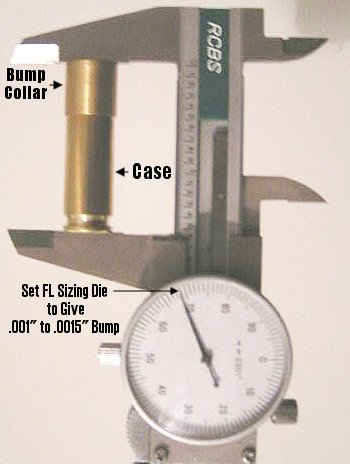
 On German Salazar’s


