|
|
April 5th, 2014
 On the Norma website, in the products area, you’ll find dozens of illustrated cartridge profiles. Many of these have been augmented with “Caliber Histories” providing background information, both historical and practical. These entries will benefit those interested in the origins and development of popular hunting and match cartridges. Many of the “Caliber Histories” also include information on bullets and twist rates. On the Norma website, in the products area, you’ll find dozens of illustrated cartridge profiles. Many of these have been augmented with “Caliber Histories” providing background information, both historical and practical. These entries will benefit those interested in the origins and development of popular hunting and match cartridges. Many of the “Caliber Histories” also include information on bullets and twist rates.
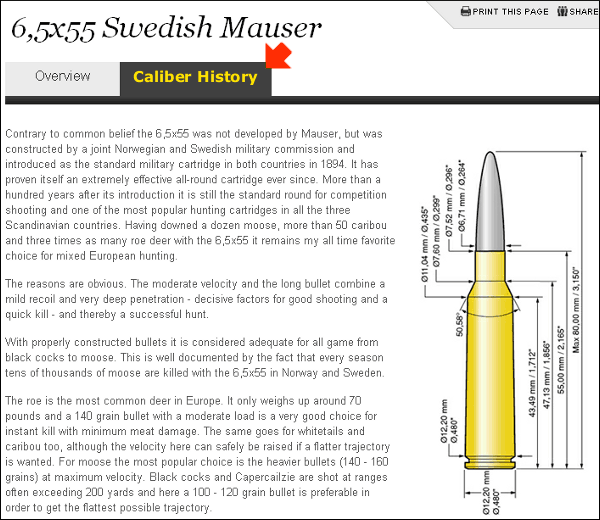
CLICK HERE to access the Hunting Products page on Norma’s website. There, on the left, you’ll see a vertical list of 58 different cartridges. Click on any cartridge name and you’ll see an illustrated “overview”. For most (but not all) listed cartridges, there is also a gray tab labeled “Caliber History”. Click that tab to see a cartridge diagram and a few paragraphs explaining the cartridge’s lineage and design features. For example, the .280 Remington Caliber History explains: “This cartridge was constructed in 1957 for Remington’s model 740 Autoloader. It is basically a .30-06 necked down to accept 7mm bullets, but the shoulder was moved forward a little in order to prevent the cartridge from being loaded into .270 Win. rifles by mistake.” Many of the Caliber History entries offer recommended bullet weights and barrel twist rates. Shown below is the 6.5×55 Swede’s Caliber History:

Article tip by EdLongrange. We welcome reader submissions.
April 4th, 2014
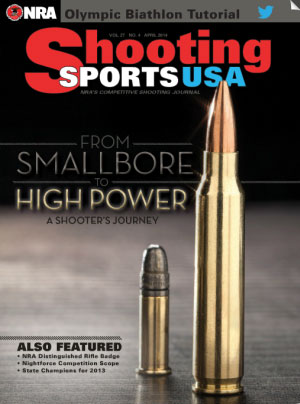 The April 2014 Digital Edition of Shooting Sports USA is now available online (for free). This month’s issue has many articles of interest to competitive shooters. The cover story From Smallbore to High Power, profiles Col. Denise Loring, an international smallbore competitor who recently made the transition to High Power shooting. This is an excellent article. The April 2014 Digital Edition of Shooting Sports USA is now available online (for free). This month’s issue has many articles of interest to competitive shooters. The cover story From Smallbore to High Power, profiles Col. Denise Loring, an international smallbore competitor who recently made the transition to High Power shooting. This is an excellent article.
Col. Loring “compares and contrasts” smallbore and High Power, providing fascinating insights into the differences between the disciplines: “I was very nervous about having only two sighters for NRA High Power matches. Then, I heard about the CMP style of HP where there are no sighters and could not believe you could shoot a match without them. We have unlimited sighters in smallbore and I took full advantage of that aspect. In NRA conventional smallbore you can even return to the sighter bull once you have begun shooting for record.”

Biathlon — Shooting at 180 Beats Per Minute
There is also an interesting feature on Biathlon shooting. This tutorial covers the basics of this challenging Olympic sport that combines Nordic skiing and smallbore position shooting. This in-depth article profiles the top athletes, explains the rules, and provides interesting details of the hardware: “Most athletes use a Fortner (straight-pul bolt) action, although traditional bolt-action guns are allowed. The rulebook regulates biathlon rifles by minimum width, trigger resistense, dimensions and shape[.] Magazines may be spot-checked before or after an event to ensure they contain only five rounds[.]”

The April issue of Shooting Sports USA also includes a complete round-up of 2013 State Champions for all NRA shooting disciplines, from BB Gun to Black Powder Cartridge Rifles.
April 4th, 2014
 Last year, to catch up with demand for its most popular products, Hornady temporarily halted production of a significant number of bullet types and ammunition products. Some shooters were upset because they were no longer able to get their favorite bullets. Well, here’s some good new guys — Hornady has resumed production of a number of bullet types, and four ammo varieties. Last year, to catch up with demand for its most popular products, Hornady temporarily halted production of a significant number of bullet types and ammunition products. Some shooters were upset because they were no longer able to get their favorite bullets. Well, here’s some good new guys — Hornady has resumed production of a number of bullet types, and four ammo varieties.
CLICK LINK to View Updated 2014 Production List.
Highlighted items have been removed from suspension.
http://www.hornady.com/assets/files/support/CurrentProductionList.pdf
We scanned over the updated production list (linked above), and we found these highlighted items, which should now be back in production. As Hornady may update the list with new items, we suggest you contact Hornady if your favorite projectile is not yet back in production.
|
Bullets Restored to 2014 Production
22492 22 CAL .224 52 GR A-MAX®
2250 22 CAL .224 53 GR HP MATCH
22281 22 CAL .224 60 GR V-MAX®
2278 22 CAL .224 68 GR BTHP MATCH
27352 270 CAL .277 140 GR SST®
27402 270 CAL .277 150 GR SST®
27200 270/6.8 .277 110 GR BTHP W/C
28402 7MM .284 162 GR A-MAX®
28405 7MM .284 162 GR BTHP MATCH
30311 30 CAL .308 140 GR MFX (308MX)
30310 30 CAL .308 140 GR MONOFLEX®
30370 30 CAL .308 150 GR GMX®
3072 30 CAL .308 180 GR BTSP
3560 9.3 CAL .366 286 GR SP-RP |
Ammo Restored to 2014 Production
8218 AMMO 300 WIN MAG 195 GR BTHP
8115 AMMO 30-06 SPRG 165 GR BTSP
4747 470 CAL .474 500 GR DGX®
82741 AMMO 45-70 GOVT 250 GR MFX LVR |
April 4th, 2014
Here’s a way you can support competitive shooting, while getting a tax deduction. Donations to the NRA Competitive Shooting & National Championships Endowment can be tax-deductible. Started in 2007 by then NRA President John Siegler, the Endowment provides direct funding for shooting programs, including the NRA National matches at Camp Perry. This is a permanent Endowment, with investment income channeled to shooting programs.
According to the NRABlog: “Donations go right into the fund and stay there. They are never touched. 85% of the earnings (or interest) generated by the fund are dispersed to the Competitive Shooting Division for their yearly budget. The other 15% goes back into the principal. By never touching the principal, and reinvesting a portion of the earnings, the endowment will always grow. Simple as that.”

You can contribute in one of two ways — as a gift or as a tax-deductible donation. No matter what path you choose, the money still goes towards the overall cost of running the competitions. To make a contribution to the fund, download the Competitive Shooting & National Championships Endowment flyer, fill out the form and send it to:
NRA Treasurer’s Officer
11250 Waples Mill Road
Fairfax, Virginia 22030
“Once [the Endowment] is big enough, it could pay for all of competitive shooting. That’s something every competitor would benefit from.” — Dennis Willing, NRA Competitive Shooting Director.
April 3rd, 2014
This week’s big story from the ISSF World Cup in Fort Benning involves a lanky Army Reserve Marksman from Montana, Nick Mowrer. The shooting world was shocked when this “pistol guy” (a 50m Free Pistol shooter for the 2012 USA Olympic Team) took a bronze medal in a World Cup rifle competition. Yes, we said “rifle”. And get this — in the process of earning that World Cup bronze medal, Nick racked up enough points to become a triple distinguished marksman (three disciplines).
In the highest level of ISSF competition, it is very unusual for a pistol shooter to even compete in a rifle match. It is unheard-of that a pistol shooter would actually earn a medal. That is like an Olympic 100m spinter also medaling in the Marathon. It just doesn’t happen.

 USAR Team shooter Nick Mowrer pulled off this remarkable accomplishment at the 2014 ISSF World Cup at Fort Benning. It’s not known whether a pistol specialist has ever earned a World Cup medal in rifle competition. In fact none of the experts from USA Shooting can recall another shooter who has even competed in both rifle and pistol categories at the same World Cup event. It appears Mowrer made history with his smallbore rifle Bronze medal. Competitive pistol shooters aren’t supposed to be good rifle shooters as well. Mowrer’s bronze-medal-winning performance has changed that view. USAR Team shooter Nick Mowrer pulled off this remarkable accomplishment at the 2014 ISSF World Cup at Fort Benning. It’s not known whether a pistol specialist has ever earned a World Cup medal in rifle competition. In fact none of the experts from USA Shooting can recall another shooter who has even competed in both rifle and pistol categories at the same World Cup event. It appears Mowrer made history with his smallbore rifle Bronze medal. Competitive pistol shooters aren’t supposed to be good rifle shooters as well. Mowrer’s bronze-medal-winning performance has changed that view.
Cross-Training Works Well Mowrer Says
Will we see more pistoleros “cross the aisle” and shoot rifle? Only time will tell. But Mowrer believes that “cross-training” with both rifle and pistol has improved his overall marksmanship skills: “I have used prone smallbore (rifle) as cross training for pistol for years now and I am very excited to have the unique opportunity to represent the USA not only in pistol but rifle as well. I shoot multiple events, not only prone, but the reason is just the same; I use other shooting disciplines to be able to compete in more matches and gain more experience that I am able to then use in my pistol shooting! It also keeps shooting fun and exciting.” Read related USAR story.
Mowrer’s medal at Fort Benning has caused a stir among top-level World Cup shooters. The reigning Olympic gold medalist in Women’s 3-P rifle, Jamie Gray, recently posted:
“Today is an amazing day…our Olympic Pistol Shooter Nick Mowrer broke into the medals in Men’s Prone [rifle event]! Couldn’t be more excited for him and obviously his amazing shooting abilities! Nick… [took] a Prone Rifle Bronze, nothing more to say than AWESOME!”
April 2nd, 2014
 Guns and ammo are big business in the United States — really big business. Guns and ammo now represent a $38 billion-dollar per year segment of the U.S. economy. Guns and ammo are big business in the United States — really big business. Guns and ammo now represent a $38 billion-dollar per year segment of the U.S. economy.
According to the NSSF, the total economic impact of the firearms and ammunition industries in the United States increased from $19.1 billion in 2008 to $37.7 billion in 2013, a 97% increase, while the total number of full-time equivalent jobs rose from more than 166,000 to more than 245,000, a 48% increase in that five-year period. These figures are based on a new report release today (April 2, 2014) by the National Shooting Sports Foundation (NSSF).
NSSF President/CEO Steve Sanetti states: “We have seen dramatic, unprecedented during peacetime growth in the firearms and ammunition industry that is the direct result of consumer demand for our products in the last five years. While our nation’s overall economic recovery has been slow since 2008, our industry has been a true bright spot, increasing our direct workforce by nearly half, adding jobs that pay an average of more than $47,700 in wages and benefits. Supplier and induced jobs* were also increased by about half since 2008, even as we increased federal tax payments by 93 percent, Pittman-Robertson excise taxes that support wildlife conservation by 83 percent and state business taxes by 77 percent.”

The Firearms and Ammunition Industry Economic Impact Report (2013) provides a state by state breakdown of job numbers, wages and output covering direct, supplier and induced employment, as well as federal excise taxes paid. Access the full report here.
* Induced jobs are those created by the economic impact made by the industry.
April 2nd, 2014
Maggie Reese, one of the nation’s top female 3-gun shooters, recently signed as a factory-sponsored Team Colt shooter. It seems that blue and white suits Maggie just fine. Maggie just won the Ladies Open Division title at the Superstition Mountain Mystery (SMM) 3-Gun match in Mesa, Arizona. This marked the third time Reese finished as “High Lady” at this competition. Maggie told us: “The SMM 3-Gun is a competition I’ve gone to since the start of my shooting career, and it’s always a pleasure to go back.”
Photo credit: Yamil Sued

Reese used a Colt LE6920 for the rifle portion of the SMM 3-Gun. “There was a lot of accuracy involved in this particular match,” said Reese. “Having a dependable rifle made all the difference in trusting my shot placement.”

 The stages also included distance targets up to 350 yards, along with some unique challenges. One stage had competitors strapped to a chair that was rotated to a 90-degree angle (See video below). “Shooting sideways was a fun experience,” said Reese. “Body placement was so important for this stage, along with being comfortable with your rifle. Up next for Reese is the 3-Gun Nation Pro Series Event in Tulsa, followed by the USPSA Multi-Gun Nationals on April 16 in Las Vegas. To follow Maggie Reese and other Team Colt members this season, visit Facebook.com/ColtFirearms. The stages also included distance targets up to 350 yards, along with some unique challenges. One stage had competitors strapped to a chair that was rotated to a 90-degree angle (See video below). “Shooting sideways was a fun experience,” said Reese. “Body placement was so important for this stage, along with being comfortable with your rifle. Up next for Reese is the 3-Gun Nation Pro Series Event in Tulsa, followed by the USPSA Multi-Gun Nationals on April 16 in Las Vegas. To follow Maggie Reese and other Team Colt members this season, visit Facebook.com/ColtFirearms.
Superstition Mountain Tilting-Chair Stage (Benny Hill style)
This video, by Brett Russo, features Jamie Franks, Taran Butler, Craig Outzen, Maggie Reese, Peter Jonasson, Chris Cheng, Jessica Hook, and others.
Here is Maggie with other shooters at SMM 3-Gun. Can you name the people in the picture?

April 2nd, 2014
 MGM Targets has released a new polymer version of its popular alloy Switchview Speed Lever for optics. The new Eagle Eye Switchview Lever functions just like the Gen 1 aluminum versions, but at less than half the price. The polymer SwitchView costs $24.99 vs. $59.95 for alloy. Both models allow rapid, positive adjustment of scope magnification. But the big advantage of the new polymer version is UNIVERSAL Fit. The polymer Eagle Eye SwitchView easily adjusts to fit virtually any variable-power scope. It simply and securely attaches around the scope magnification ring. MGM Targets has released a new polymer version of its popular alloy Switchview Speed Lever for optics. The new Eagle Eye Switchview Lever functions just like the Gen 1 aluminum versions, but at less than half the price. The polymer SwitchView costs $24.99 vs. $59.95 for alloy. Both models allow rapid, positive adjustment of scope magnification. But the big advantage of the new polymer version is UNIVERSAL Fit. The polymer Eagle Eye SwitchView easily adjusts to fit virtually any variable-power scope. It simply and securely attaches around the scope magnification ring.

The Eagle Eye Switchview is injection-molded from Zytel 66 (aka Nylon 66). This material is widely used in the firearms industry for Glock pistol frames and many other firearms components. The material was selected for its durability and temperature stability — it will not become brittle in cold or overly flexible in the heat. Nylon 66 is also resistant to breakdown due to chemical exposure.
Polymer Switchview Version Designed for General Use
Travis Gibson, MGM Vice President, tells us: “The Eagle Eye Switchview lever was specifically engineered to be a magnification adjustment lever for pistol, rifle, and spotting scope optics, and was extensively tested for just this purpose. It is not a re-purposed fishing reel holder, cable tie, or wine bottle opener. The polymer Eagle Eye Switchview lever was designed from customer feedback to be a bit less rigid than the aluminum alloy Switchview. When compared to the alloy models, on initial installation the lever may seem a little ‘springy’. This is by design, to allow for movement if the lever was to be accidentally bumped on a tree, or while being transitioned in and out of gun cases, vehicles, etc. and not transmit impact to the magnification ring and scope. While rigorous tests and evaluations in the field have proven it to be extremely reliable, the primary intent for the Eagle Eye Switchview is for use on hunting type rifles, and not necessarily ‘work guns’ or ‘hard use’ guns such as with military and law enforcement.”
As with all MGM Targets products, the Eagle Eye Switchview™ lever is made in USA. Every kit includes:
One MGM Eagle Eye Switchview lever, two universal fit clamp straps, connection screws, and wrench.

April 1st, 2014
 Here’s big (and small) news for reloaders — get ready for smaller powder containers. The U.S. Department of Transportation (DOT) recently approved new smaller containers for shipment of smokeless powder. The new containers are designed to hold 1000 grains, exactly one-seventh of a pound. That works out to 2.29 ounces of powder — quite a bit less than you are getting currently with one-pound (16 oz.) containers. Here’s big (and small) news for reloaders — get ready for smaller powder containers. The U.S. Department of Transportation (DOT) recently approved new smaller containers for shipment of smokeless powder. The new containers are designed to hold 1000 grains, exactly one-seventh of a pound. That works out to 2.29 ounces of powder — quite a bit less than you are getting currently with one-pound (16 oz.) containers.
Here how it works out:
7000 grains = 1 pound = 16 ounces
1000 grains = 0.143 pounds = 2.29 ounces
Many products — from cereal boxes to Snickers bars — have been down-sized in recent years. Now downsizing has come to the powder marketplace. The strategy behind the smaller containers is simple. In a market where demand vastly outstrips available supply, the smaller containers allow powder-makers to generate more revenue with a given amount of powder inventory. Will consumers accept the smaller powder containers? Probably so — 1000 grains is enough to load 20-22 rounds of .308 Winchester. In the current marketplace (with many powders virtually impossible to find), most consumers would probably prefer to get 2.3 ounces of their favorite powder, rather than nothing at all. (NOTE: The major powder suppliers will continue to offer popular powders in 1-lb, and 8-lb containers. The new 1000-grain containers will be phased-in over time, as an alternative to the larger containers).

Why the small bottles? One industry spokesman (who asked not to be named) explained: “We’ve had a severe shortage of smokeless powder for nearly two years. The powder production plants are running at full capacity, but there’s only so much finished product to go around. By moving to smaller containers, we can ensure that our customers at least get some powder, even if it’s not as much as they want.”
Why are the new containers 2.3 ounces rather than 8 ounces (half a pound) or 4 ounces (one-quarter pound)? One of the engineers who helped develop the new DOT-approved container explained: “We looked at various sizes. We knew we had to reduce the volume significantly to achieve our unit quantity sales goals. Some of our marketing guys liked the four-ounce option — the ‘Quarter-Pounder’. That had a nice ring to it, but ultimately we decided on the 1000 grain capacity. To the average consumer, one thousand grains sounds like a large amount of powder, even if it’s really only 2.3 ounces. This size also made it much easier to bundle the powder in six-packs. We think the six-packs will be a big hit. You get nearly a pound of powder, but you can mix and match with a variety of different propellants.”
Less Bang for Your Buck?
We’re told the new 2.3-ounce powder bottles will retail for around $8.50, i.e. about $3.70 per ounce. At that price, it may seem like you’re getting less bang for your buck. Currently, when you can find it, high-quality reloading powder typically sells for $25-$30 per pound (in 1-lb containers). At $30 per pound, you’re paying $1.88 per ounce. That means that the new mini-containers will be roughly twice as expensive, ounce-for-ounce, as current one-pounders ($3.70 per ounce vs. $1.88 per ounce).
 Why is the DOT getting involved in powder packaging? Well, powders are considered hazardous materials, subject to many rules and regulations. Before a powder manufacturer or distributor can ship any propellant, all the hazmat packaging has to be first approved by the DOT to ensure safe shipping. Why is the DOT getting involved in powder packaging? Well, powders are considered hazardous materials, subject to many rules and regulations. Before a powder manufacturer or distributor can ship any propellant, all the hazmat packaging has to be first approved by the DOT to ensure safe shipping.
Along with the 2.3-ounce containers, the DOT has approved “six-pack” consolidated delivery units that will hold six, 1000-grain containers. Some manufacturers plan to offer “variety packs” with a selection of various powders in the 1000-grain bottles. Wouldn’t it be cool to have a six-pack with H322, H4895, Varget, H4350, H4831sc, and Retumbo?
April 1st, 2014
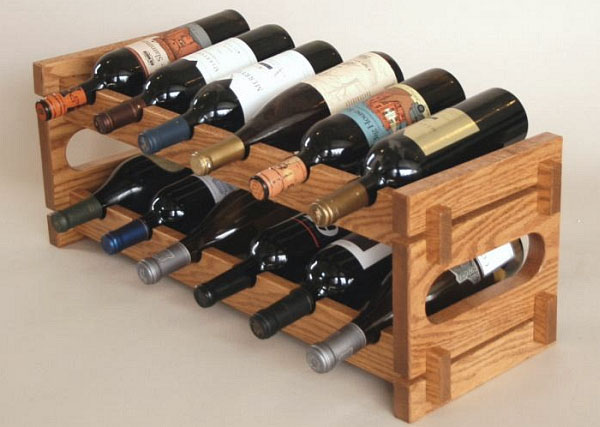
Ever wonder why fine wine is always stored on its side? That’s not just for looks, or easier access when the sommelier (wine steward) visits the wine cellar. Wine bottles are stored horizontally, at a slight angle, to prevent the wine from oxidizing:
“By intentionally storing a wine on its side, you will help keep the cork in constant contact with the wine. This will keep the cork moist, which should keep the cork from shrinking and allowing the enemy of wine, oxygen, to seep into the bottle. When oxygen comes into contact with wine the result is not good – the wine starts to oxidize and the aromas, flavors and color all begin to spoil“. — About.com
Ammunition Should Also Be Stored Horizontally
So what does wine have to do with shooting? Well, it may surprise you, but over time, our cartridges can spoil, just like wine can — though not for the same reason. We don’t have the issue of oxygen seeping past the bullet (the “cork” as it were). However, when ammunition is stored nose-up or nose down, problems can arise. In a nose-up or nose-down configuration, over a long period of time, the powder column will compress, and the powder kernels can actually break down. This can lead to erratic ignition and/or dangerous pressures.

To avoid the problems associated with powder column compression and kernel break-down during long-term storage, take the time to orient your cartridges like wine bottles, i.e. placed flat on their side. Of course, this really isn’t necessary if you burn through your ammo relatively quickly. But, if you are storing cartridges “for the long haul”, take the time to arrange them horizontally. That may require a little extra effort now, but you’ll reap the rewards down the road.
This tip courtesy Anette Wachter, www.30CalGal.com.
|


