|
|
March 26th, 2014
 Gun Digest will be producing a new quarterly print magazine, called Modern Shooter. It appears that the magazine focuses mostly on AR-platform rifles, AR accessories, and defensive shooting. The new magazine parallels the new Modern Shooter television show, which debuts on the Sportsman Channel next January. Look for Modern Shooter magazine on newsstands in April. The new magazine will also be available in digital format at www.gundigeststore.com. Gun Digest will be producing a new quarterly print magazine, called Modern Shooter. It appears that the magazine focuses mostly on AR-platform rifles, AR accessories, and defensive shooting. The new magazine parallels the new Modern Shooter television show, which debuts on the Sportsman Channel next January. Look for Modern Shooter magazine on newsstands in April. The new magazine will also be available in digital format at www.gundigeststore.com.
Each issue of Modern Shooter will focus on a popular firearms category. For example, the premier issue explains how to maintain an AR rifle, and how to “Defend Your Castle” with an AR. This first issue features Richard Mann’s 12 training drills for AR-platform rifles, plus reviews of AR accessories: optics, sights, rails, and adjustable stocks. The premiere edition of Modern Shooter profiles Colt manufacturing, discussing the history of the company. Colt’s new LE6920MP-USA and AR15A4 rifles will be reviewed.
March 25th, 2014
The “Old Warhorse” .30-06 Springfield cartridge is not dead. That’s the conclusion of Forum member Rick M., who recently compared the 1000-yard performance of his .30-06 rifle with that of a rig chambered for the more modern, mid-sized 6.4×47 Lapua cartridge. In 12-16 mph full-value winds, the “inefficient and antiquated” .30-06 ruled. Rick reports:
“I was shooting my .30-06 this past Sunday afternoon from 1000 yards. The wind was hitting 12-16 mph with a steady 9 O’clock (full value) wind direction. My shooting buddy Jeff was shooting his 6.5×47 Lapua with 123gr Scenar bullets pushed by Varget. Jeff needed 13 MOA left windage to keep his 6.5x47L rounds inside the Palma 10 Ring. By contrast I only needed 11.5 MOA left windage with my .30-06. I was shooting my ’06 using the 185gr Berger VLD target bullet with H4350. I managed the same POI yet the .30-caliber bullet only needed 11.5 MOA windage. That’s significant. From this experience I’ve concluded that the Old Warhorse ain’t quite dead yet!”


Rick likes his “outdated” .30-06 rifle. He says it can deliver surprisingly good performance at long range:
“To many of the younger generation, the Old Warhorse .30-06 is ‘outdated’ but I can guarantee that the .30-06 Springfield is a VERY ACCURATE cartridge for 1000-yard shooting (and even out further if need be). With some of the advanced powders that we have today, the .30-06 will surprise many shooters with what it’s capable of doing in a good rifle with the right rate of twist. My rifle has a 1:10″ twist rate and I had it short-throated so that, as the throat erodes with time, I could just seat the bullets out further and keep right on shooting. My recent load is Berger 185gr Target VLDs pushed by IMR 4350. This is a very accurate load that moves this bullet along at 2825 fps.”

March 25th, 2014
Forum member Stan from Northern California (aka BigBamBoo) has produced a cool video showing a 1000-yard shooting session with his Surgeon Rifles .243 Win. As he shot prone from bipod, Stan filmed with two cameras, one aimed at the shooter and the other zoomed way out at the target 1000 yards away. Using frame in frame editing, Stan combined the two camera viewpoints so you can watch his trigger-pulling and simultaneously see what’s happening downrange. Stan hits steel five times in a row.
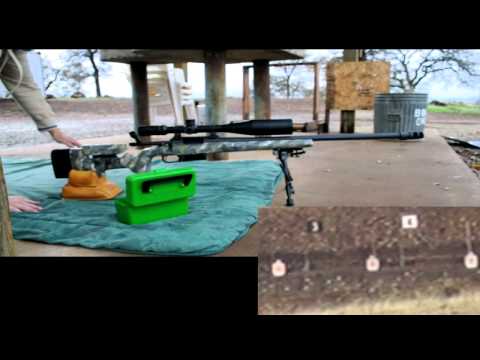
 If you listen carefully, you can hear the steel ring about three seconds after each shot (it takes that long for the sound to travel back). On a couple shots you’ll see dust kick up at the side of the target — but that’s not a miss. Remember his bullet is impacting on steel and what you’re seeing is dust kicked up on ricochet by a bullet fragment. If you listen carefully, you can hear the steel ring about three seconds after each shot (it takes that long for the sound to travel back). On a couple shots you’ll see dust kick up at the side of the target — but that’s not a miss. Remember his bullet is impacting on steel and what you’re seeing is dust kicked up on ricochet by a bullet fragment.
The main purpose of Stan’s shooting session was to evaluate a new Badger FTE muzzle brake. Watch the video and you can see that the big brake dramatically reduces both rearward movement and bipod hop. Stan was very happy with the brake’s effectiveness, as it allows him to keep his scope on target, and cycle quickly for the next shot. Stan reports: “Just keep an eye on the rifle. Watch the recoil — it’s greatly reduced with the muzzle brake. Makes spotting my shots very easy.”
LOAD: Lapua .243 Winchester brass, Sierra 107gr MatchKings, Wolf LR primers, 40.1 grains of H4350 powder.
Stan posts: “I recently sent my Surgeon Scalpel in .243 back to Surgeon to have a Badger FTE muzzle brake installed. Got a chance between rain storms to get to the range and do some shooting. As you can hear in the video…the wind was blowing pretty hard. But that just adds to the fun of shooting at long range. Turn up the volume and you should be able to hear the five hits on steel. If you set the playback resolution to 480p or better and go ‘full screen’, you should be able to see most of the hits.”
Why is the Sound of the Hit Delayed So Long?
The speed of sound at sea level, in dry 59° air, is 1116 fps. With the steel target 3000 feet (1000 yards) away, it takes 3000/1116 or 2.69 seconds for the sound of each hit to reach the shooter.
March 24th, 2014
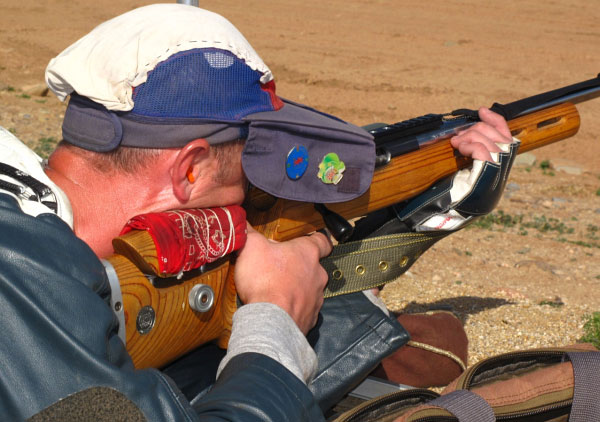
If you only know Bryan Litz from his Applied Ballistics Books and DVDs, you may not realize that this guy is a great marksman (along with being an actual rocket scientist). This guy can shoot. At the recent Berger Southwest Nationals (SWN), Bryan took top honors among all sling shooters — and he managed to do that while performing many other important match duties. The pay-off for Bryan was getting his name on a really cool “ghost dancer” perpetual trophy. Litz joked: “With what the wind gods can do at shooting matches, it makes sense to have a trophy that puts you in touch with the spirit world.”

This is actually the second time Litz has finished first in Sling class at the Southwest Nationals. After his impressive win, we asked Bryan if he had any advice for other long-range competitors. First Bryan provided three tips concerning Ballistics, his special area of expertise. Next Bryan offered three more general tips about long-range competition — how to analyze your shooting, how to choose your ‘wind strategy’, and how to avoid the most costly mistakes, i.e. how to avoid the “train-wrecks”.

Litz Ballistics Tips
Ballistics TIP ONE. If you’re having trouble getting your ballistic software to match actual drops, you need to look at a number of possible reasons. Here are some common issues that can cause problems.
Click Values Are Not Exact. Scopes and iron sights don’t always produce accurate adjustments. In other words, if your ballistics program predicts 30 MOA of drop, and you dial 30 MOA but hit low, it might be that your sight actually only moved 28 MOA (for example). To see if your sight is adjusting accurately, shoot a tall target at 100 yards and measure group separation when dialing your sight.
Barometric vs. Station Pressure. This is a commonly misunderstood input to ballistics programs. You can avoid this pitfall by remembering the following: station pressure is the actual measured pressure at your location, and you don’t need to tell the program your altitude when using station pressure. Barometric pressure is corrected for sea level. If you’re using barometric pressure, you also have to input your altitude.
Muzzle Velocity. Chronographs are not always as accurate as shooters think they are — your true MV may be off by 10-20 fps (or more). If your drop is different than predicted at long range, it might be because your muzzle velocity input is wrong.
Mixing Up BC (G1 vs. G7). Knowledgeable long range shooters know that the G7 standard is a more representative standard for modern LR bullets. However, using G7 BCs isn’t just a matter of clicking the ‘G7′ option in the program. The numeric value of the BC is different for G1 and G7. For example, the G1 BC of the Berger 155.5 grain Fullbore bullet is .464 but the G7 BC is .237. If you were to enter .464 but click on G7, the results would be way off.
Ballistics TIP TWO. A properly installed level is absolutely essential for long range shooting. Without a good level reference, your long range wind zero will be off due to minor canting of the rifle from side to side. You can verify that your level is installed correctly on a 100-yard ‘tall target’. Draw a plumb line straight up the target and verify that your groups track straight up this line as you go up in elevation.
Ballistics TIP THREE. If your long range ballistic predictions aren’t tracking, always come back and verify your 100-yard zero. Sometimes a simple zero shift can be misconstrued as errors in long range ballistics predictions.
Litz Competition Shooting Tips
Competition TIP ONE. Improving your scores in long range competition is a constant process of self-assessment. After each match, carefully analyze how you lost points and make a plan to improve. Beginning shooters will lose a lot of points to fundamental things like sight alignment and trigger control. Veteran shooters will lose far fewer points to a smaller list of mistakes. At every step along the way, always ask yourself why you’re losing points and address the issues. Sometimes the weak links that you need to work on aren’t your favorite thing to do, and success will take work in these areas as well.
Competition TIP TWO. Select your wind shooting strategy carefully. For beginners and veterans, most points are typically lost to wind. Successful shooters put a lot of thought into their approach to wind shooting. Sometimes it’s best to shoot fast and minimize the changes you’ll have to navigate. Other times it’s best to wait out a condition which may take several minutes. Develop a comfortable rest position so you have an easier time waiting when you should be waiting.
Competition TIP THREE. Actively avoid major train wrecks. Sounds obvious but it happens a lot. Select equipment that is reliable, get comfortable with it and have back-ups for important things. Don’t load on the verge of max pressure, don’t go to an important match with a barrel that’s near shot out, physically check tightness of all important screws prior to shooting each string. Observe what train wrecks you and others experience, and put measures in place to avoid them.

Photos by Steve Fiorenzo
March 24th, 2014
Brownells’ 8th Annual Gunsmith Career Fair will be held at the Des Moines Marriot Downtown in Des Moines, Iowa, April 1-2, 2014. The Brownells Gunsmith Conference & Career Fair is expected to draw hundreds of attendees along with representatives from three dozen potential employers. As in past years, the Career Fair will include gunsmithing seminars along with opportunities for individuals to interview for jobs with arms-makers and government agencies.
 Gunsmith CareerFair.com. Gunsmith CareerFair.com.
In addition to industry and government representatives, many trade schools and colleges offering gunsmithing programs will be exhibiting at the 2014 Gunsmith fair. Past exhibitors have included:
Story tip by EdLongrange. Reader Submissions are welcome.
March 24th, 2014
 The Bureau of Alcohol, Tobacco, Firearms and Explosives, (ATF) Enforcement Programs and Services (EPS) Division has posted a new chart for its form-processing times, and the latest information is not good. NFA Forms 1 and 4 are now taking 10 months to process. The Bureau of Alcohol, Tobacco, Firearms and Explosives, (ATF) Enforcement Programs and Services (EPS) Division has posted a new chart for its form-processing times, and the latest information is not good. NFA Forms 1 and 4 are now taking 10 months to process.
The ATF’s NFA Form 4, is one of the forms required to legally purchase a suppressor (sound moderator). The National Shooting Sports Foundation (NSSF) is working to get additional resources committed to EPS through the Congressional appropriations process. NSSF Senior VP and General Counsel Lawrence G. Keane stated: “The delays and lack of timely customer service, which grows worse every month, is significantly interfering with the ability of members of our industry to engage in the lawful commerce and grow their businesses[.] It also infringes on the ability of law-abiding citizens to exercise their Second Amendment rights in a timely manner, and a right delayed is a right denied.”
Related Resources:

March 23rd, 2014
Need a first-rate scope for you new rifle? How would you like to get a Nightforce for a great price? Well, you’re in luck. Lilja Precision Rifles (“Lilja”) has placed its entire inventory of late-model Nightforce scopes on sale. The reason is that Lilja has decided to stop selling scopes and focus on its primary barrel-making business. Dan Lilja says that: “We have been a Nightforce dealer since Nightforce’s first year in business. But we’ve made the decison to leave the scope-selling business… and concentrate on our barrels. That part of our business is excellent and taking all of our time.”

Show below are the scopes on sale with regular price and sale price. Quantities are limited and these scopes are being sold “First Come, First Serve”. Prices are limited to stock on hand and do not include shipping. Scopes are not returnable – all sales final.

Lilja explains that some of these prices are well below MAPP (Minimum Advertised Price Policy) because they are for discontinued products. From time to time, Nightforce changes reticle combinations (or other features) and an product number (sku) becomes obsolete. Lilja also has some optics accessories for sale, such as rings and bases, PC programs, torque wrenches and other small items. Call (406) 826-3084 for availability or visit Lilja Precision Rifles.
Sale tip from EdLongrange. We welcome reader submissions.
March 23rd, 2014
The International Shooting Sports Federation (ISSF) World Cup season kicks off right here in the USA, March 26 through April 3, 2014, in Fort Benning, Georgia. Many of the world’s best rifle and pistol shooters will be on hand — more than 400 competitors from 50 nations are expected to compete at the home of the U.S. Army Marksmanship Unit (USAMU).
ISSF World Cup (Fort Benning) 2013 50m Rifle Prone Winner Valerian Sauveplane of France.

At the last Rifle/Pistol World Cup USA back in May 2013, the USA earned two medals with Will Brown winning a gold medal in Men’s 10m Air Pistol and Dempster Christenson winning a silver medal in Men’s Air Rifle. Highlights from last year’s ISSF World Cup at Fort Benning are featured in the 24-minute video linked below. The video covers both rifle and pistol disciplines.
Here is last year’s women’s 50m 3P winner at the Fort Benning World Cup, Andrea Arsovic of Serbia.


Complete ISSF World Cup (Fort Benning) Match Schedule
If you want to watch the matches,or meet some of the shooters here is a schedule for the all the events, starting with training sessions on March 27th.
CLICK HERE for General Match INFO (PDF)
CLICK HERE for list of competitors, grouped by Nation (PDF).

Photos ©2014 ISSF | Competitor Photos: Marco Dalla Dea
March 22nd, 2014
Ever wondered how Hornady bullets and ammunition are made? You’ll see every stage of production in this interesting video from the Outdoor Channel. Starting with raw materials (lead, copper, and brass), this 9-minute “factory tour” video shows how bullet cores are produced, how jackets are crafted, and how cartridge cases are formed, headstamped, and inspected. If you watch carefully you’ll also see the massive, multi-stage cartridge loading machines. Now one of the most successful manufacturers of ammunition and reloading components in the world, Hornady Manufacturing has come a long way from its early days. In 1949, Founder Joyce Hornady started the company “making bullets… in a garage down on 4th street” in Grand Island, Nebraska.
Your browser does not support iframes./
Lead cylinders are pressed into lead wire used for bullet cores.

Spools of flat copper are fed into cupping machines. The punched cups become bullet jackets.

All cartridge cases and loaded rounds are hand-inspected.

Hornady Manufacturing — The Early Years
During World War II, Joyce Hornady served as a marksmanship instructor at the Cornhusker Army Ammunition Plant. Following the War, Joyce and his family stayed in Grand Island, Nebraska and opened a small sporting goods retail store that sold everything from basketballs to shooting supplies.
After WWII, shooters and hunters used surplus military ammunition. This surplus ammo however, did not offer the accuracy or performance needed for target shooting, big game, or varmint hunting. Recognizing the need for better bullets, Hornady and his original partner Vernon Speer built a machine that converted spent 22 rimfire cases into bullet jackets, and then into bullets. The business relationship between Hornady and Speer later faltered, and Vernon Speer moved to Lewiston, Idaho. Using a surplus bullet assembly press in a rented garage on 4th Street in Grand Island, Nebraska, Joyce Hornady began to produce his own .30-caliber bullet.
The first year of business, Hornady Bullets had total sales of $10,000 – a figure that increased three-fold the next year. Hornady added equipment and workers, confident that more growth lay ahead. During the Korean War, Hornady earned contracts to produce a variety of products not associated with bullets — aluminum hearts for bracelets, and condenser cans for the government. After the war, the can material and the technology developed to produce them was utilized to make ultra-thin copper jackets for varmint bullets.
In 1958, the company moved to its present location on the west edge of Grand Island. The new, larger facility featured an 8,000-square-foot plant. In 1960, Hornady added a 200-yard underground testing facility.
March 21st, 2014
 Mid-sized 6.5mm cartridges proved themselves at the recent Shoot for the Green match in northwest Oklahoma. Four out of the top five shooters ran a rifle chambered for the 6.5×47 Lapua, with the fifth shooting the slightly larger 6.5 Creedmoor cartridge. 53 shooters from as far away as California showed up to test their skills in the stiff March winds in NW Oklahoma. The course of fire was challenging, with improvised field shooting positions and targets set as far as 1300 yards out. And there were “Troop” stages that competitors have come to expect in Oklahoma. Match winner Rick Reeves stated, “I enjoyed the troop stages more than anything else, even though I didn’t shoot them the best.” Mid-sized 6.5mm cartridges proved themselves at the recent Shoot for the Green match in northwest Oklahoma. Four out of the top five shooters ran a rifle chambered for the 6.5×47 Lapua, with the fifth shooting the slightly larger 6.5 Creedmoor cartridge. 53 shooters from as far away as California showed up to test their skills in the stiff March winds in NW Oklahoma. The course of fire was challenging, with improvised field shooting positions and targets set as far as 1300 yards out. And there were “Troop” stages that competitors have come to expect in Oklahoma. Match winner Rick Reeves stated, “I enjoyed the troop stages more than anything else, even though I didn’t shoot them the best.”

Steve Elmenhorst shooting a Troop Stage.

Rich Emmons, who steered his 6.5x47L to fourth place, has written a match report for PrecisionRifleSeries.com. Day One saw temps around 70 degrees with only light, switchy winds. But Day Two was brutal, Emmons reports: “On Sunday… 40-50 mph winds hit NW Oklahoma hard and most competitors were woken up. To say that shooting in the 15-30 mph winds with temps in the high 30s [was really tough] is an understatement. All competitors struggled a bit and scores were understandably lower on Day Two. Conditions were brutal and both the ROs and the competitors deserve a gold star for toughing it out and finishing the match.” CLICK HERE for Complete Match Results
| Top 5 Shooters Equipment List
Rick Reeves
6.5×47 Lapua, 140 Berger Hybrid, Surgeon Action, McMillan A-5 Stock, Bartlein Barrel, Rem trigger, Vortex Razor scope, Built by DMFJ, Tab Sling & bag, Harris Bipod, AAC Suppressor.
Adam Roberts
6.5 Creedmoor, Desert Tech Armory (DTA), Benchmark Barrel, 123 Lapua Scenar, H4350 powder, Silencer Tech Suppressor, S&B PMII scope w/ H2CMR reticle.
Justin Shireman
6.5×47 Lapua, Surgeon/ Parry Custom Gun, Silencer Tech Suppresor, Benchmark Barrel, McMillan Stock, Harris Bipod, Swarovski binoculars.
Rich Emmons
6.5×47 Lapua, Surgeon Rifle, Bartlein Barrel, Mcmillan Stock, Berger 140 Hybrids, Harris Bipod, S&B PM II MSR, Vortex Binoculars, MGM Switchview, 5.11 gear, JEC brake.
John Sommers
6.5×47 Lapua, Surgeon Rifle, Bartlein Barrel, Mcmillan Stock, Lapua 139, Harris Bipod, S&B PM II MSR, Vortex Binoculars, AAC Suppressor. |
|


