Here’s an entertaining video from Fog Ammunition. Starting with boxes of bullets and bags of cartridge brass, this video shows how components are bulk-sorted, then .223 Rem ammunition is produced on a modern, linear multi-stage loading machine. In assembly-line fashion, cases are primed, powder is added, bullets are placed, final seating depth is set, and then the case is crimped.
If you’ve never seen an automated loader in action you should definitely watch this video. With this kind of machine, a new round is produced every second or so (see video 1:15 to 1:55). The .223 Remington ammunition featured in this video is loaded with Sierra BlitzKing bullets. Fog offers both rifle and pistol ammo loaded with quality components.
Video Shows Automated Loading Process Start to Finish (Worth Watching):
Displayed are results with Federal Gold Medal Match — quite impressive accuracy!
Criterion Barrels has published an interesting Ammo Comparison Test, shooting seven (7) different varieties of .223 Rem ammunition out of an AR15 fitted with Criterion Barrel. Each ammo type was chronographed (10-shot string), then five-shot groups were shot at 100 yards. Along with handloads (69gr Sierra MK + Varget), six (6) types of commercial ammo were tested:
PREMIUM Type Ammo:
Federal Gold Medal Match (69gr SMK)
Creedmoor 75gr HPBT
Prime 77gr OTM (Open Tip Match)
BULK Type Ammo:
Federal American Eagle XM193 (55gr FMJ)
Wolf Gold (55gr FMJ)
Wolf Polyformance Steel Case (55gr FMJ)
Here are the results for the four best commercial ammo types tested: Federal Gold Medal Match (GMM) with 69gr SMK, Prime 77gr OTM, Creedmoor 75gr HPBT, and American Eagle XM193 (55gr FMJ). The Gold Medal Match shot the best of all factory ammo tested. In fact, the GMM even shot slightly better than the handloads, which averaged 0.79″ for the three accurized groups.
The results are quite interesting. The Federal GMM actually shot the best, beating “untailored” handloads. Basic accurizing efforts and a much better rest set-up showed significant benefits with most ammo types (but not the bulk Wolf Ammo). As you would expect, the more expensive ammo shot best: “Chart 1.2 [below] showcases the average [after accurizing] five-round group sizes with each type of ammunition at 100 yards, while Chart 1.3 lists the price per round of each ammunition type. It becomes immediately evident by reviewing these two graphs that there is an inverse relationship between group size and factory ammunition price.”
Accurizing Improvements — Better Scope, Better Rests, Accu-Wedge
As you would expect, some basic accurizing efforts improved accuracy with the better ammo. The accurizing process included: 1) Swapping to a Vortex Viper PST Gen 1 6-24x50mm optic; 2) Adding an Accu-Wedge; 3) Improving fitment during reassembly, and 4) Switching from Harris bipod to a Sinclair Front Rest and Edgewood rear bag for added stability. The same 1:8″-twist Criterion barrel was used throughout the testing process.
If you shoot an AR15, or even shoot a .223 Rem bolt gun with factory ammo, you should probably read this test in full. Criterion put a lot of time into the testing, and experimented with a variety of AR options showcased in a series of YouTube videos. SEE: Accurizing the AR-15 Video Playlist.
Jeremy Rowland decided to put together an F-TR rifle for his eldest daughter, who enjoys competitive shooting. For his daughter, Rowland chose the .223 Rem option because it has less recoil and components are less costly than the .308 Win. Here is Rowland’s account of how he developed a .223 Rem load. For more details (with data charts), read Jeremy’s FULL STORY on Sierra Bullets Blog.
Journey to Find a .223 Rem F-Class Load
by Jeremy Rowland, Reloading Podcast
My oldest daughter has been to several matches with me, and has even competed in several, using her .243. I decided this coming season (2016), she would compete with a .223 Rem in FT/R. Looking for a good starter rifle, I settled on the Savage Axis Heavy Barrel since it has a 1:9″ twist. This would be a great little rifle for her to learn on. The rifle was shot unmodified, as it came from the factory. A Sinclair F-Class Bipod w/micro elevation adjustment was fitted to the front.
Next came finding the components I wanted to use for her match loads. After spending hours and hours running numbers on JBM stability calculator as well as in my iPhone Ballistic AE app, the 69 gr Sierra Tipped MatchKing® (TMK®) looked really good. So that’s what I decided to go with. I jumped in head first and ordered a bulk pack of the Sierra 69 gr TMKs. I had settled on Hodgdon CFE 223 since it shows good velocity. I decided to go with once-fired Lake City brass with CCI BR4 primers.
Next came the testing. I decided to run a ladder test (one shot per charge from min to max looking for the accuracy node). The ladder test ranged from 23.5 grains to 25.6 grains, in 0.3 grain increments.
Bullet: 69 gr Sierra Tipped MatchKing®
Case: Lake City (mixed years, sorted by case capacity)
Primer: CCI BR4
Powder: Hodgdon CFE 223 (one round each from 23.5 to 25.6 grains)
Cartridge OAL: 2.378″
Base to Ogive: 1.933″ (.020″ off lands)
After his ladder test, Rowland settled on a load of 25.2 grains of Hodgdon CFE 223. He then fine-tuned his load with different seating depths: “I loaded up 5 rounds each at .020″ off lands, .015″ off lands, .010″ off lands, and .005″ off the lands. Here are the results from the best group for OAL/Ogive fine tuning. As you can see, I think I’ve found a winner in these 69 gr Sierra Tipped MatchKings.”
The Tikka T3 rifle is very popular with hunters around the globe — for good reason. These rifles offer smooth-running actions, easy sub-MOA accuracy with good ammo, crisp triggers, and ultra-reliable detachable box magazines. The Tupperware stocks aren’t super-rigid, but they are comfortable and easy to handle. If you are looking for a hunting rifle, the Tikka T3 is a smart choice, offering good performance for the price (which starts at less than $580.00 for the T3 Lite version). The T3 series is offered in a wide selection of chamberings, from .204 Ruger up to the large magnums.
Here are two good Tikka T3 video reviews, the first from New Zealand, the second from Scotland. Both reviewers are experienced hunters who explain why the T3 is well-suited for hunting applications. In the first video, Mitch of BushBrothersNZ reviews a T3 with polymer stock and stainless barrel chambered for the .270 Win. Mitch focuses on the T3’s controls and functions, with particular attention to the operation of trigger, safety, and bolt.
In this second video, David, a hunter and wilderness skills teacher from Scotland, demonstrates the features (and remarkable accuracy) of a factory Tikka T3, chambered in .223 Remington. With David’s handloads, this rifle has grouped just over an inch at 250 yards, as shown near the end of the video.
David uses his rifle primarily for fox-hunting (often done at night). He employs a variable-power scope with an illuminated reticle to target his night-time prey. David offers many tips for predator hunters. He prefers an extra-high Harris bipod. With the bipod’s legs fully extended, he can assume a comfortable and solid sitting position. The rifle is supported on his shoulder and on the bipod, leaving both of his hands free. Being able to support the rifle without gripping it is a major advantage, David explains. This frees his hands to search for animals with binoculars or scan distances with his rangefinder.
Vihtavuori markets a full line of quality, European-made powders for rifles and pistols. Finland-based Vihtavuori is operated by the same parent company, Nammo, that owns Lapua and Berger Bullets. If you haven’t tried Vihtavuori powders yet, you may be pleasantly surprised. For loading .45 ACP, our favorite powder is VV N320 — it burns clean and is very accurate. Likewise, VV makes excellent powders for rifle applications — from small varmint cartridges to large magnums.
New Reloading Data Released Vihtavuori offers free reloading data on its website, and through a free Mobile App. And now those resources are even more complete…
Last week, Vihtavuori added new reloading data for ten different cartridge types, including some of the most popular pistol and rifle cartridges. You’ll find new pistol data for 9mm Luger and .45 ACP, and extensive new load data for .223 Rem, .260 Rem, .308 Win, and .30-06 Springfield (among others). Overall the 2018 data update features over 20 new bullets, with more than 140 new lines! All new data is also available in FREE Vihtavuori Reload App for iOS and Android. The updated online information supplements Vihtavuori’s Reloading Databases, which have dedicated sections for Rifle Cartridges, Pistol Cartridges, and Cowboy Action.
New Reloading Data is available for these TEN cartridge types:
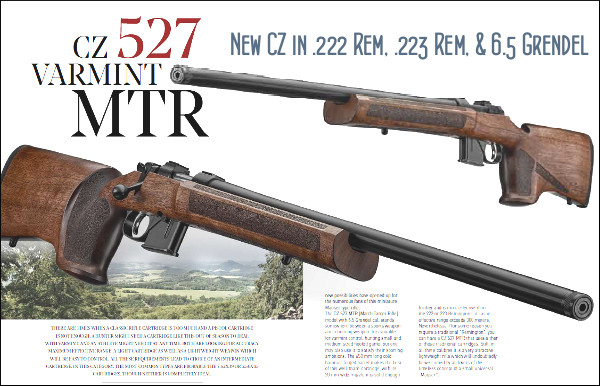
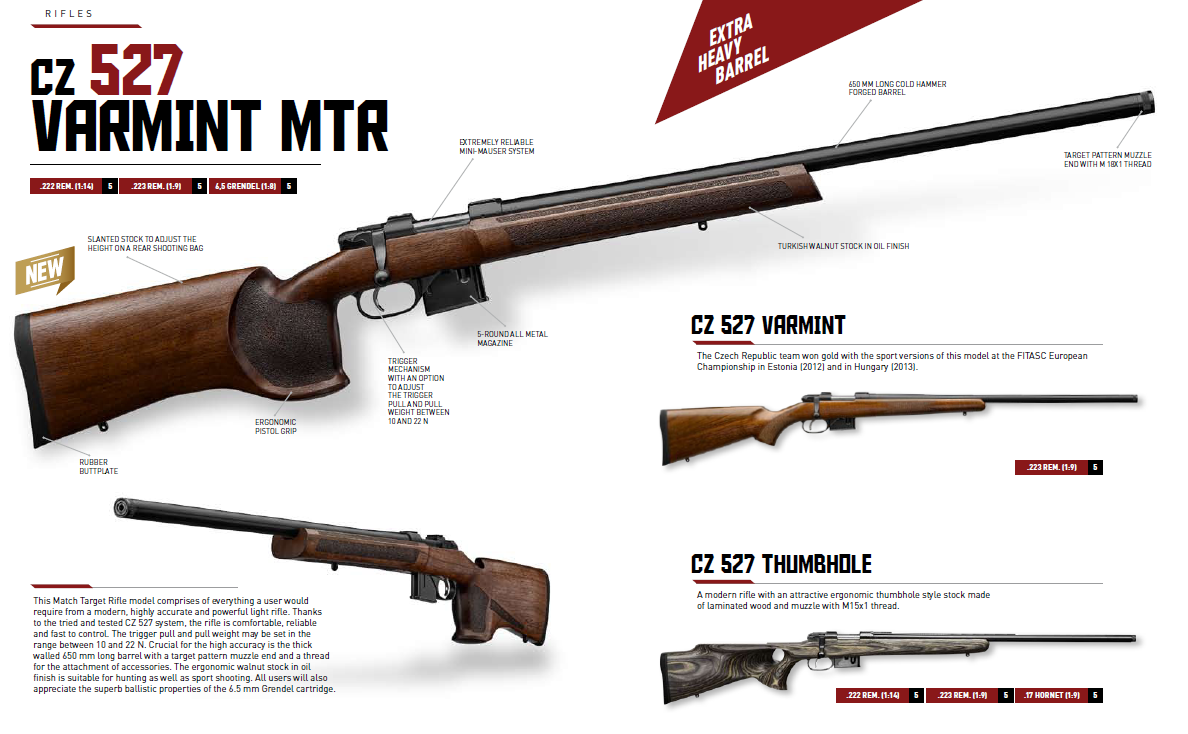
CZ has a new rifle that should appeal to varminters and target shooters. The new CZ 527 Varmint MTR (Match Target Rifle) is designed to provide enhanced accuracy with a heavy-profile barrel and stock that works well from bench or bipod. The MTR features a fast Mini-Mauser action with a trigger that adjusts from 2.25 to 4.95 lbs (10 to 22 N).
Click above photo for full-screen image with legible notations.
We wish we could tell you how the CZ 527 Varmint MTR shoots, but this rifle is so new that test samples haven’t made it to the USA yet. Based on experience with other CZ 527 models, we would expect about 1.2 MOA accuracy with decent factory ammo. With handloads you might get closer to 0.7 MOA for three shots. Sorry no USA price is available yet. However, the older CZ 527 Varmint, with a lesser-grade stock, has an MSRP of $725.00, so we expect the CZ 527 Varmint MTR to retail for around $875.00. We note that the latest model CZ 557 Varmint with similar, ergonomic Turkish Walnut stock has an $865.00 MSRP as listed in the 2018 CZ-USA Catalog.
CZ 527 Varmint MTR Features:
— Match-type stock design with wider, straight fore-end for good tracking on front rest.
— Slanted buttstock toe to adjust height in rear shooting bag
— Match-type ergonomic grip design with palm swell
— High-quality Turkish Walnut wood with oil finish
— Adjustable trigger pull from 2.25 to 4.95 lbs (10 to 22 N)
— Detachable 5-round all-metal magazine
— Heavy-contour 25.6″ (650 mm) hammer-forged barrel with threaded muzzle
Here is the manufacturer’s product description: “Thanks to the tried and tested CZ 527 system, the rifle is comfortable, reliable and fast to control. The trigger pull and pull weight may be set in the range between 10 and 22 N. Crucial for the high accuracy is the thick-walled 650 mm long barrel with a target pattern muzzle end and a thread for the attachment of accessories. The ergonomic walnut stock in oil finish is suitable for hunting as well as sport shooting. All users will also appreciate the superb ballistic properties of the 6.5 Grendel cartridge.”
Velocity vs. barrel length — How much speed will I sacrifice with a shorter barrel? Hunters and competition shooters often ask that. Today we DO have solid answers to that question for many cartridge types thanks to Rifleshooter.com.
Bill, Rifleshooter.com’s Editor, explained his test procedure:
“I gathered four different types of factory Federal 224 Valkyrie ammunition, the 90gr Sierra MatchKing (SMK), 90gr Fusion soft point (SP) (referred to a Fusion MSR), 75gr Total Metal Jacket (TMJ) and 60gr Nosler Ballistic Tip Varmint (NBT). After a brief barrel break in and zero, I fired 5 rounds of each cartridge at each barrel length (except the 75 TMJ, I fired 4 rounds at each barrel length due to limited resources). I recorded the average muzzle velocity and standard deviation for each ammunition and barrel length combination and cut the barrel back 1 inch and repeated the process. I recorded barrel lengths from 28″ to 16.5″ (I try to save these barrels as finished 16″ tubes so they don’t go to waste).”
The Heavy Bullet 90gr Ammo Lost about 21 FPS per Inch
How did the test turn out? You’ll find all the results summarized in helpful tables with inch-by-inch velocity and SD numbers. For the two, 90gr ammo samples, results were similar. The 90gr SMK ammo started at 2782 fps (28″), finishing at 2541 fps (16.5″). That’s a loss of 241 fps, or 20.96 fps average per inch of length. The ammo loaded with 90gr Fusion SPs started at 2797 fps (28″) and ended at 2561 fps (16.5″), a drop of 236 fps. That’s 20.5 fps loss per inch. NOTE: Ambient temperature during the test was 45° F. You could expect the overall velocities to be a bit higher during hotter summer months.
With a the smaller bullets, the effect was even more dramatic. As you’d expect they started out faster. The ammo with 60gr Nosler Ballistic Tips (NBT), a good choice for varminters, started at 3395 fps (28″), and declined to 3065 fps (16.5), a total velocity drop of 330 fps. Average velocity loss was 28.7 fps per inch of barrel length. Rifleshooter.com also tested Federal 75gr TMJ ammo.
About the .224 Valkyrie Cartridge
The new .224 Valkyrie was introduced late last year as a Hot Rod cartridge that will work in AR15s. Designed to rival the .22 Nosler while still running well in ARs, the new .224 Valkyrie offers excellent long-range performance when loaded with modern, high-BC bullets. We expect some bolt-action PRS shooters might adopt the .224 Valkyrie. Why? Reduced recoil. With the 90gr SMK, the .224 Valkyrie offers ballistics similar to the 6.5 Creedmoor but with significantly less felt recoil. Check out this chart from Federal showing comparative recoil levels:
.224 Valkyrie vs. .22-250 Remington
The Social Regressive explains: “There are two key reasons why the 224 Valkyrie is unique and desirable. First, it is specifically designed to fit the limitations of the AR-15 platform. It does so even when loaded with gigantic bullets, like the 90-grain SMK that Federal announced. .22-250 Rem is too long and too fat to work in the AR-15 platform; it needs an AR-10 bolt and magazine.”
The new .224 Valkyrie is basically a 6.8 SPC case necked down to .22-caliber. You can use your existing AR15 lower, but you will need a dedicated .224-Valkyrie upper, or at the minimum a new barrel, modified bolt with proper bolt face, and 6.8-compliant mags.
In recent months, Sierra has unveiled four very serious, ultra-high-BC MatchKing bullets in .224, .264 (6.5 mm), and .308 calibers. And just last week Sierra has released initial load data for these four new projectiles. CLICK HERE to get the latest official load data for these four new bullets.
High-BC MatchKings Tipped at Factory
Sierra recently released a new-for-2018, 95-grain .224 projectile, Sierra product #1396, with a claimed G1 BC of 0.600 — mighty impressive for a .22-caliber bullet. Next up is the new 6.5mm (.264 caliber) 150-grainer with an 0.713 G1 BC. This could be a game-changer for the 6.5-284 and new 6.5 PRC short magnum. There are also two new .308-caliber MatchKings, a 200-grainer with 0.715 G1 BC, and a new 230-grainer with a stunning 0.800 G1 BC. Many of these New Generation MatchKings now come “tipped” from the factory for more uniform BC.
Sierra Bullets has LOAD DATA for these four new bullets. If you handload for .223 Remington, 22-250, 6.5 x284 Norma, .308 Winchester, or .300 Winchester Magnum, check out this new reloading data.
If you’re looking for loaded ammunition at affordable prices, WikiArms.com can help you find a good deal. WikiArms constantly searches the listings of ammo vendors across the web. Then WikiArms ranks the offerings by cost per round, low to high. This way you can instantly compare prices from multiple vendors including Ammomen, Ammunition Depot, Brownells, Cheaper Than Dirt, Lucky Gunner, Natchez, Slickguns, SG Ammo, Sportsmans Guide, and Walmart. Search bots refresh pricing constantly so listed prices are normally current within five minutes. WikiArms even displays the amount of product currently in stock for each vendor.
Using WikiArms is easy. Just click your choice of caliber (such as .22 LR, 9mm, or .308 Win) on the navigation bar, or hit the Good Deals link (bottom left column) to see a variety of cartridge types all at one time. WikiArms is fast, and it is FREE to use. Check it out.
WikiArms also tracks prices on reloading components — bullets, brass, primers, and powders. From the WikiArms Home page, look at the left column under the “Reloading” header. From there you can select the type of components you want.
There are some great deals now on quality .223 Rem ammo. Brownells is selling 800 rounds of Norma .223 Rem for $218.70 shipped with code “JNS”. That’s just $0.27 per round for very good stuff.
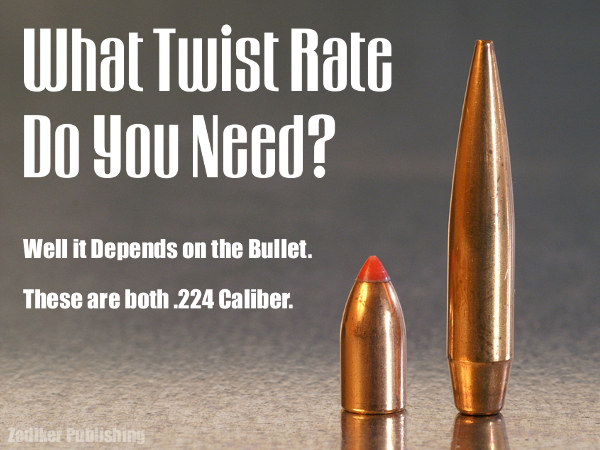
Here’s an extreme range of .224-Caliber bullets: 35gr varmint bullet and 90gr match bullet. Of course, along with bullet length/design, you need to consider MV when choosing twist rate.
Even with the same caliber (and same bullet weight), different bullet types may require different rates of spin to stabilize properly. The bullet’s initial spin rate (RPM) is a function of the bullet’s muzzle velocity and the spin imparted by the rifling in the barrel. You want to ensure your bullet is stable throughout flight. It is better to have too much spin than too little, according to many ballistics experts, including Bryan Litz of Applied Ballistics. Glen Zediker has some basic tips concerning barrel twist rates and bullet stability. These come from his latest book, Top Grade Ammo.
Choosing the Right Twist Rate
I’d always rather have a twist too fast than not fast enough. Generally… I recommend erring toward the faster side of a barrel twist decision. 1:8″ twist is becoming a “new standard” for .224 caliber, replacing 1:9″ in the process. The reason is that new bullets tend to be bigger rather than smaller. Don’t let a too-slow twist limit your capacity to [achieve] better long-range performance.
Base your next barrel twist rate decision on the longest, heaviest bullets you choose to use, and at the same time realize that the rate you choose will in turn limit your bullet choices. If the longest, heaviest bullet you’ll shoot (ever) is a 55-grain .224, then there’s honestly no reason not to use a 1:12″. Likewise true for .308-caliber: unless you’re going over 200-grain bullet weight, a 1:10″ will perform perfectly well.
Bullet Length is More Critical than Weight
Bullet length, not weight, [primarily] determines how much rotation is necessary for stability. Twist rate suggestions, though, are most usually given with respect to bullet weight, but that’s more of a generality for convenience’s sake, I think. The reason is that with the introduction of higher-ballistic-coefficient bullet designs, which are longer than conventional forms, it is easily possible to have two same-weight bullets that won’t both stabilize from the same twist rate.
Evidence of Instability
The tell-tale for an unstable (wobbling or tumbling) bullet is an oblong hole in the target paper, a “keyhole,” and that means the bullet contacted the target at some attitude other than nose-first.
Increasing Barrel Length Can Deliver More Velocity, But That May Still Not Provide Enough Stability if the Twist Rate Is Too Slow
Bullet speed and barrel length have an influence on bullet stability, and a higher muzzle velocity through a longer tube will bring on more effect from the twist, but it’s a little too edgy if a particular bullet stabilizes only when running maximum velocity.
My failed 90-grain .224 experiment is a good example of that: I could get them asleep in a 1:7″ twist, 25-inch barrel, which was chambered in .22 PPC, but could not get them stabilized in a 20-inch 1:7″ .223 Rem. The answer always is to get a twist that’s correct.
These tips were adapted from Glen’s newest book, Top-Grade Ammo, available at Midsouth. To learn more about this book and other Zediker titles, and read a host of downloadable articles, visit ZedikerPublishing.com.




 Velocity vs. barrel length — How much speed will I sacrifice with a shorter barrel? Hunters and competition shooters often ask that. Today we DO have solid answers to that question for many cartridge types thanks to


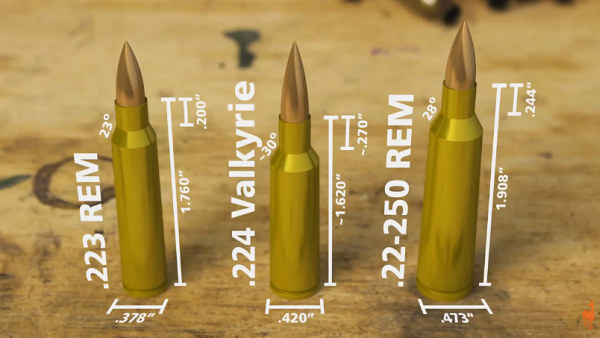 Image from Social Regressive


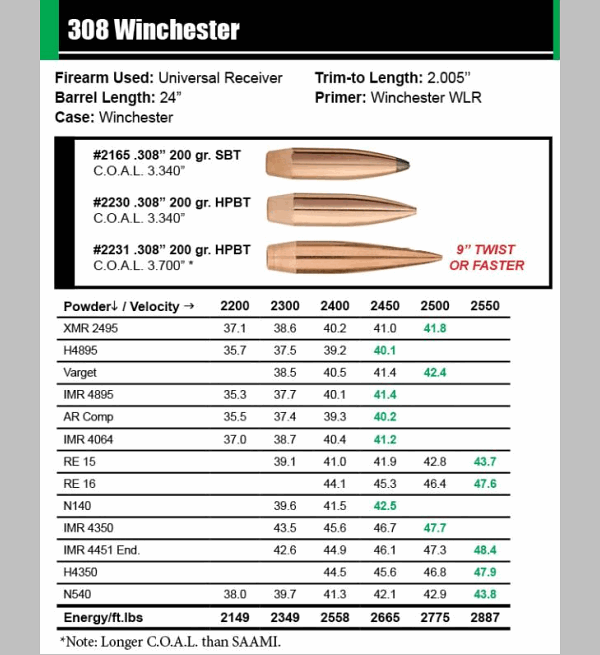


 If you’re looking for loaded ammunition at affordable prices,

 Increasing Barrel Length Can Deliver More Velocity, But That May Still Not Provide Enough Stability if the Twist Rate Is Too Slow


