A new Vortex video series, Cartridge Talks Comparisons, looks at multiple variables along with ballistics gel tests to determine the comparative performance of popular cartridge types. Each Month, Cartridge Talks will examine and test two popular cartridges, comparing their head to head performance. In Episode 1, Vortex Nation™ hosts Mark Boardman and Ryan Muckenhirn pit the 6.5 Creedmoor and .308 Winchester cartridges against each other, examining projectile performance. Mark and Ryan then make conclusions about the applications best suited to each cartridge type.
Cartridge Comparison 14-minute video, Highlighting Ballistic Gel Testing
This first Cartridge Talks Episode pits the 6.5 Creedmoor against the .308 Winchester in a head-to-head, ballistics gel-induced bullet battle. Ballistics (drop/drift), penetration ability, terminal performance and other variables are tested with a variety of tools and tests. Viewers are invited to check out Episode 1, and suggest future cartridge battles in the comments section.
Here is the full 67-minute 6.5 Creedmoor vs. .308 Win Cartridge comparison video:
““With the myriad of cartridges available to the big game hunter, picking which chambering is best for you and your application can be a daunting task”, says Muckenhirn. “In Cartridges Talks, we put our biases on the shelf and put as much scientific process to this as possible. From ‘shootability’ and accessibility, to terminal performance as observed in ballistics gel, Cartridge Talks wades through the numbers and figures with you, loads you up with the pertinent information, and helps you select the ideal cartridge for your next hunt!”
Our friend Dennis Santiago is a talented Service Rifle shooter, who regularly competes with an AR shooting the .223 Rem cartridge. A few seasons back, he decided to go over to the “dark side”, putting together a Palma (fullbore) rifle chambered for the .308 Winchester. Dennis selected a Competition Machine (Gary Eliseo) R1 Chassis for the project. Here’s Santiago’s account of his “true blue” Palma build.
Palma Rifle Report by Dennis Santiago
“This project was a .308 Win Palma rifle with an Eliseo R1 chassis, Rem 700 action (blue-printed with PT&G upgrades), Jewell trigger, Boots Obermeyer 1:11″-twist barrel, and Phoenix sights holding Gehmann apertures. Next comes chassis and sling set-up, initial mechanical zeroing, and load development. Yup, I have a bunch of Peterson small primer .308 brass, Sierra #2156 155gr MKs, and Varget to get started with. I’m told I can drive 155gr pills to stay supersonic to 1K. Should make for an interesting 2020. My goal was to be cozy with this blue beast by the time the Berger Southwest Nationals kicked off in February 2020.”
CLICK Imagefor full-screen photo with more detail.
Pinning the Picatinny — For a Super-Solid Mount
One of the key parts of the build, Dennis explains, is mounting the top rail with pins: “Once the rail is aligned using a spin-centered optic, it locks down with three 3/16″ roll pins. That way there is no reliance on screws that can come loose. Above is a photo of the top of the Eliseo tube chassis showing the three, 3/16″ roll pins that unitize the Picatinny rail. You can also see the four brass screws that just kiss the action to fully stabilize it in the tube. The recoil ring buttresses completely around the action with metal to metal contact. There are a million details hidden inside a Gary gun.”
Phoenix Sights Front and Rear
Rise of the Phoenix — Here are the sights for the Eliseo R1. There are very few manufacturers left making these kinds of ultra-precise and repeatable iron sights.
These Ray-Vin tools help set mechanical zero on the sights. Dennis notes: “Finally a reason to pull out the Ray-Vin calibration paraphernalia to set up a mechanical zero. This photo is for all of you who still remember that those barrel flats and screws in our sight towers actually had a purpose once upon a time.”
Sling ‘N Irons — Classic Palma Configuration Dennis plans to use an Eric Hollis sling with his new blue Palma rifle.
Peterson Small Primer .308 Win Brass for Santiago’s Rig
Dennis has used Peterson Cartridge Small Rifle primer .308 Win brass. Peterson offers a “Select” version weight-sorted and length-sorted at the factory. All Select casings (in a 50ct box) are guaranteed to be within 1 grain in weight and .001″ in OAL. Peterson Select brass is available for 20 different cartridge types, including .308 Win both small primer/small flash hole and large primer/large flash hole.
Now Adapted with a Scope
Currently (in 2025) Dennis has this rifle fitted with a high-magnification Nightforce zoom scope, and he competes with his blue prone rifle in the “Any-Any” division. He usually runs the scope at about 22X power. For an older guy with aging eyes, being able to run high-magnification optics is a big plus.
With the optics Dennis has found the rifle to be exceptionally accurate. Shooting 168gr bullets it has produced 5-round groups around 1/3-MOA during testing. And it can easily hold the X-Ring at 300 yards.
Getting the Blue Rifle Ready for the Berger SW Nationals
Dennis has campaigned his rifle at recent Berger Southwest Nationals (SWN) events. At the SWN a Palma shooter can shoot iron sights, or also fit a scope and shoot in the “Any Sights” category. The week-long Berger SWN is the biggest rifle match in the Western United States. Hundreds of shooters compete in both individual and team events. The SWN begins with the Mid-Range Nationals at 600 yards. Then the Long-Range matches are held, with targets out to 1000 yards. Watch the video to see the Ben Avery facility, home of the Berger SWN:
Chassis-maker Gary Elesio at the 2017 Berger SW Nationals. Gary shoots what he sells:
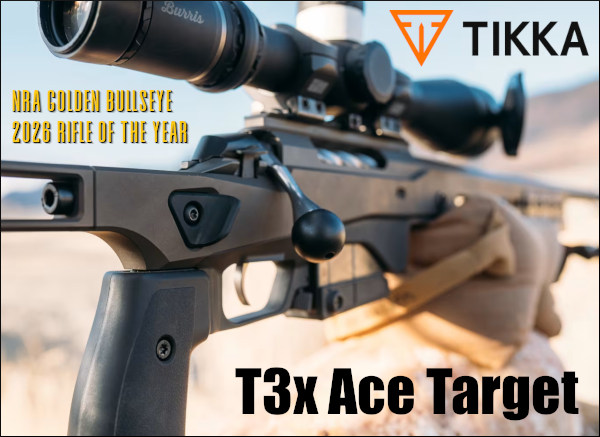
The Tikka T3x Ace Target was named the 2026 American Rifleman Golden Bullseye “Rifle of the Year”.
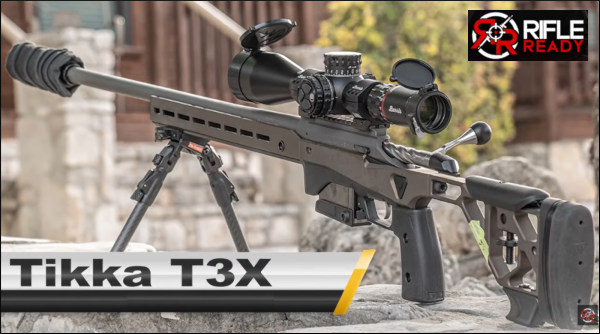
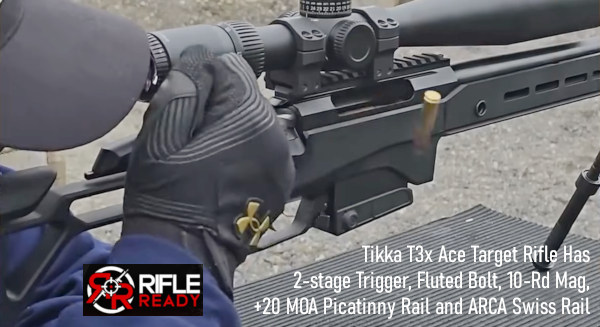
The Tikka T3x ACE Target rifle has been named the 2026 American Rifleman Golden Bullseye Rifle of the Year, a highly coveted award presented annually by NRA Media. This impressive factory rifle is a great choice for PRS/NRL competition. It boast a good chassis with full-length ARCA rail, modular magwell, and adjustable cheekpiece. The action is smooth with a nice fluted bolt and big bolt handle knob. On top of the action is a +20 MOA Picatinny rail which helps with long-range shooting. This rifle has shown very good accuracy with factory ammo, aided by an excellent 2-stage trigger that adjusts from 2 to 4 pounds.
Available chamberings are .223 Rem, 6.5 Creedmoor, and .308 Win with prices starting at $1799.00 at EuroOptic.com. The 6.5 Creedmoor with 26″ barrel would be our choice for PRS/NRL competition.
SPECIAL REPORT: NEW Tikka T3x Ace Target Rifle for PRS/NRL
Tikka is best known for its rugged and accurate hunting rifles. But recently Tikka has introduced an impressive new line of T3x Ace Target chassis rifles. These 10.6-lb rigs have impressive alloy chassis stocks, with modular M-LOK and Arca-Swiss compatible fore-ends, and interchangeable magwells. Optimized for PRS/NRL competition, the Tikka T3x Ace Target has a fine 2-stage adjustable trigger, plus a rear stock section with adjustable cheek-piece and nicely-designed attached lower bag rider. NOTE: Tikka also offers the rimfire .22 LR Tikka T1x Ace Target rifle for practice and competition. This is cool because NRL-22 Matches are now very popular.
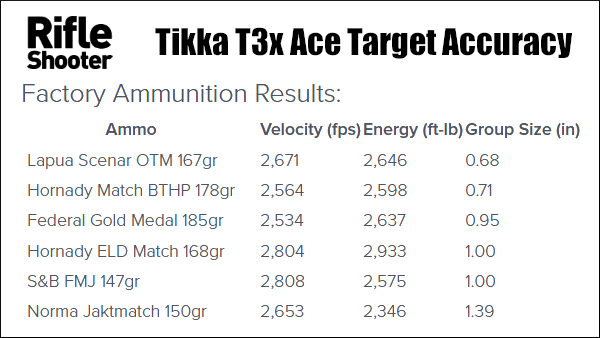
Accuracy Testing Results Rifle Shooter, a leading UK gun publication, did extensive accuracy testing of the Tikka T3X Ace Target. This testing is featured in the above video. Shooting from a bench with rear bag and front tripod, the test rifle delivered MOA (or better) accuracy with five out of six types of factory ammo. The best group, 0.68″ for 5 shots, was shot with Lapua ammunition with 167gr Scenar bullets. Here are the test results:
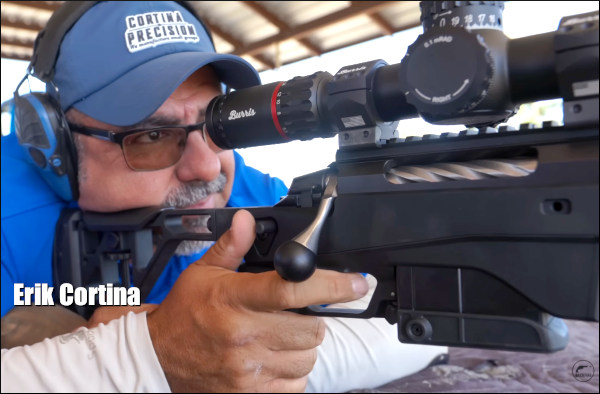
In another test of a Tikka T3X Ace Target, top F-Class shooter Erik Cortina achieved half-MOA or better groups with SAKO 6.5 Creedmoor ammo. Watch Erik shoot the Tikka T3x Ace Target in the video below, starting at 8:22 time-mark.
Tikka T3X ACE Target Rifle Features
2-Stage Adjustable Trigger (2-4 lbs)
Spiral-fluted Bolt with Coned Head
+20 MOA Picatinny Scope Rail
Free-floating Hammer-Forged Barrel
Adjustable Cheekpiece and Buttpad
10-shot steel CTR/Tac-style Magazines
23.6″ or 26″ Heavy Barrels with 5/8″-24 threaded muzzles
Full-length RRS ARCA Swiss Rail with barricade stop, M-Lok & QD Sling Mounts
Optional Factory External and Internal Weights
Two Colors: Black or Cerakote Midnight Bronze
Optional Cerakote coating
According to Rifle Ready: “The new Tikka T3X Ace lineup exploded out of SHOT Show 2025 and instantly became one of the most talked-about precision rifles of the year — and for good reason. With multiple testers recording sub-half MOA groups and even extended 15-shot strings under 1 MOA, the Ace is delivering near-custom accuracy right out of the box. Built on the legendary T3C action and paired with a full competition-ready chassis, the Ace Target and Ace Game rifles blend Finnish craftsmanship with modern modularity in a way Tikka fans have waited years for.”
Want to learn more? A Rifle Ready video released this month showcases Tikka T3X features. It covers real-world accuracy tests, reviewer impressions, and the differences between the Target and Game variants. This video does help explain why some shooters say the Ace “beats rifles triple its price”.
In promoting its rifle, Tikka posted: “The T3x Ace Target, crafted with Tikka’s legendary attention to detail, was developed for precision shooters seeking an out-of-the-box competition-ready platform. With its optimized barrel profile, enhanced ergonomics, and refined trigger system, the Ace Target embodies the advanced engineering and shooter-focused design Tikka is known for.” The video below features a test of the .223 Rem variant.
Many visitors to the site ask us, “I’ve got a .223 and .308. What will a 6mmBR Norma (6BR) give me that I’m not getting already?” Well first you will probably average consistently smaller groups than your current .223 or .308 rifle (assuming the 6BR has a quality barrel and trigger). A good .308 Winchester can be superbly accurate, no question about that, but the lesser recoil of the 6BR works in the shooter’s favor over a long string of fire. Even with a Rem 700 or Savage action factory action, a 6BR with a benchrest stock, premium barrel, and a high-quality chambering job should deliver 5-shot groups in the high twos to mid-threes, provided you do your job. We have one 6BR rifle that shoots Lapua factory-loaded 6BR ammunition in the low twos and high ones. That’s exceptional, we admit, but it still shows how the 6BR is an inherently accurate cartridge, even with factory loads.
Compared to a .223, the 6BR offers a much better selection of high-BC projectiles, and will deliver considerably more power on the target. So it’s a better choice for hunters and 600-yard benchrest shooters. Compared to the .308 Win shooting 168gr MatchKings, a 6BR shooting 105-107gr bullets offers better ballistics all the way out to 1000 yards. Plus, for most people, the 6BR is just easier to shoot than a .308 Win. Recoil is less than half of the .308 Win cartridge. Both the .308 and 6BR chamberings offer good barrel life, but the 6BR uses 15-18 grains less powder, saving you money. On the other hand the .308 Win is the designated cartridge for F-TR and Palma shooting, so it may be a more versatile chambering for Long-Range competition. So which would we choose between the 6BR and the .308? Actually we think you should have both. The 6BR is a favorite cartridge out to 500 yards, and we like the .308 Win for F-TR. The .308 Win has shown outstanding accuracy, as displayed last week at the NRA F-class Nationals in Arizona.
Hunting season kicks off this month in many parts of the USA. If you have a new hunting rifle or need to develop a load for your rig with a new choice of bullets and/or powder, this article can help. Ace shooter Keith Glasscock explains how to develop a good load for a hunting rifle or varmint rifle.
Keith is an outstanding competitive shooter, who has finished second at the F-Class National Championships (F-Open) multiple times. Keith is also a skilled wind coach who runs the popular Winning in the Wind YouTube Channel. Along with his interest in mid-range and long-range F-Class competition, Keith also enjoys game hunting and varmint adventures.
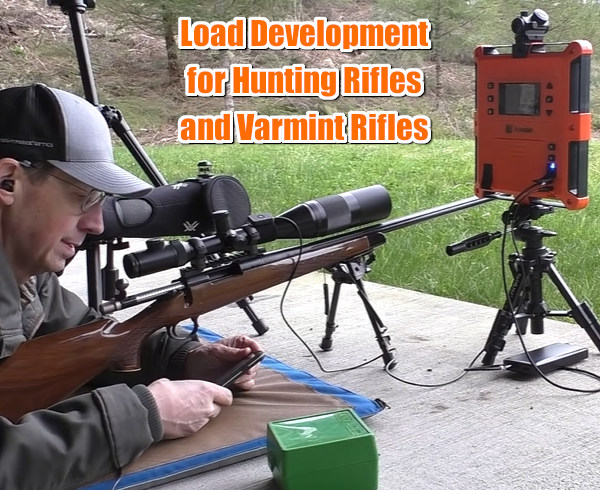
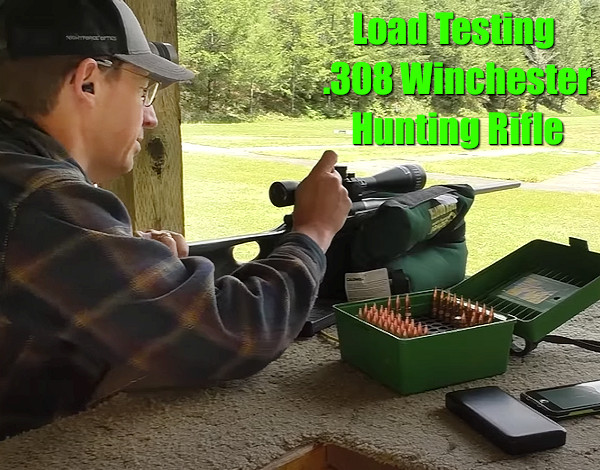
Developing accurate hand-loaded ammo for hunting and varmint rifles involves procedures that may be a bit different than load testing for a match rifle. You want to be efficient, and use the types of brass and bullets you’ll be using on the hunts. In two recent videos, Keith shows how he developed good, accurate loads for a .223 Rem varmint rifle and a .308 Win hunting rifle.
.223 Rem Load Development — Powder Charge and Seating Depth
In the first video, Keith covers the load development process for a Remington 700 bolt-action varmint rifle chambered in .223 Remington. Keith starts by full-length sizing the brass. Then he experimented with powder charge weights, and came up with a promising load of 24.7 grains of Alliant AR Comp with Hornady 50gr A-Max bullets.
Next Keith experimented with seating depths (see 5:30-6:100) and found that accuracy improved as he changed OAL length in .005 increments. Keith ended up with 2.270″ with a 3-shot group in the twos! This video shows the importance of testing your bullet choice at various seating depths. Keith shoots this rig prone off bipod, which is similar to the bipod shooting he does in the varmint fields. Keith explains key factors to consider when optimizing the .223 Rem cartridge in a varmint rig. Velocity readings are made with a LabRadar unit.
Load Development for .308 Win Hunting Rifle
In a second video, Keith shows the process for load development with a .308 Winchester hunting rifle. Here Keith uses a large X-type sandbag for a front support. Again, he was shooting a Remington 700 bolt-action rifle, this time with Barnes TSX solid copper bullets, PPU Brass, Federal 210m primers, and AR Comp powder. Keith said the Barnes bullets were excellent — he commented that these bullets were “match quality in terms of precision”. Keith achieved some very small three-shot groups with AR Comp and the TSX projectiles. Keith did note that point-of-impact shifted up significantly with increases in charge weight (see 6:20-7:10). With thinner-contour hunting barrels, this is not unexpected. But POI change should be observed carefully during load development, as you may need to adjust your zero after completing testing.
We are often asked “Can I get more velocity by switching primer types?” The answer is “maybe”. The important thing to know is that changing primer types can alter your load’s performance in many ways — velocity average, velocity variance (ES/SD), accuracy, and pressure. Because there are so many variables involved you can’t really predict whether one primer type is going to be better or worse than another. This will depend on your cartridge, your powder, your barrel, and even the mechanics of your firing pin system.
BE SAFE: Be cautious when changing primer types. Glen Zediker recommended decreasing your load ONE FULL GRAIN when changing to a different primer type, one that you haven’t used before.
Interestingly, however, a shooter on another forum did a test with his .308 Win semi-auto. Using Hodgdon Varget powder and Sierra 155gr MatchKing bullets, he found that Wolf Large Rifle primers gave slightly higher velocities than did CCI-BR2s. Interestingly, the amount of extra speed (provided by the Wolfs) increased as charge weight went up, though the middle value had the largest speed variance. The shooter observed: “The Wolf primers seemed to be obviously hotter and they had about the same or possibly better ES average.” See table:
Varget .308 load
45.5 grains
46.0 grains
46.5 grains
CCI BR2 Primers
2751 fps
2761 fps
2783 fps
Wolf LR Primers
2757 fps
2780 fps
2798 fps
Speed Delta
6 fps
19 fps
15 fps
You can’t extrapolate too much from the table above. This describes just one gun, one powder, and one bullet. Your Mileage May Vary (YMMV) as they say. However, this illustration does show that by substituting one component you may see significant changes. Provided it can be repeated in multiple chrono runs, an increase of 19 fps (with the 46.0 grain powder load) is meaningful. An extra 20 fps or so may yield a more optimal accuracy node or “sweet spot” that produces better groups. (Though faster is certainly NOT always better for accuracy — you have to test to find out.)
WARNING: When switching primers, you should exercise caution. More speed may be attractive, but you have to consider that the “speedier” primer choice may also produce more pressure. Therefore, you must carefully monitor pressure signs whenever changing ANY component in a load. In his books, the late Glen Zediker recommended decreasing your load ONE FULL GRAIN when changing to a different primer type, one that you haven’t used before.
First there was F-Class, and now there will be E-Class, the “E” standing for “Economy”. The NRA Competitive Shooting Division has just approved a new form of rifle competition starting in 2025: E-Class. Unlike F-Class, E-Class will have tight rifle and gear cost controls. This is a clear response to rising F-Class costs, which have spiraled out of control. The first major E-Class National event will be a preview match held this summer at Camp Atterbury in Indiana.
The NRA’s sanctioning of E-Class competition makes sense. Let’s face it, top-level F-Class competition, both F-TR and F-Open, has become just too expensive. A modern F-Open rifle capable of winning a championship can now cost $9000.00 or more, including rest, premium trigger, and optics. Under the NRA’s new E-Class Rules, rifles can cost no more than $2000.00 total, including optics and rest (E-Open) or bipod (E-TR). In addition, new E-Class rules will recognize a special division, called E-Factory, that is limited to factory rifles, such as the Savage Axis II and Howa rifles. The E-Factory Class will also be restricted to .223 Remington to keep ammo costs down.
COST COMPARISON — F-Open, E-Open, and E-TR Factory
E-TR Factory Division
Complete Rifle
Savage Axis II: $1079 MSRP
Barrel: Included
Stock: Included
Optics: $500
Trigger: Included
Bipod: $150
Rear Bag: $50 Total: $1779.00
Under the new E-Class rules, TOTAL Cost for an E-Open or E-TR Rifle is limited to $2000.00, including optics, front rest or bipod, and rear bag. There are specific gear limits. Scope maximum is $500.00. Front rest or bipod is limited to $300.00. In the chart above you see how an E-Open rifle could be built for $1900 with a $400 action and a $400 optic. In the third column we’ve priced out an E-Factory rifle, based on a Savage Axis II Rifle, at $1779.00.
A top-of-the-line F-Open set-up like this can cost more than $8000.00 with custom stock, high-end optic, and coax front rest. All new E-Class rifles must cost less than $2000 including rests and scope.
These E-Class rigs cost less than a quarter of the price of a Top-of-the-line $8750.00 F-Open Rig. That’s a huge savings, that will allow more shooters to enjoy competitive shooting. E-Class combines the fun challenge of the F-Class course of fire, with a vastly lower investment. With the rising costs of taxes, food, fuel, and everything else, it’s high time we get serious about the money we throw away on competition rifles. We know the wives will approve!
Keeping on Lid on Expenses
In the Wings — Controls on Ammo Costs as Well
Shooters know that the price of the rifle, optics, and rests is only part of the cost equation. The price of ammunition is also significant. Currently, in F-Open, competitors can easily pay $1.40 per round just for the expendables — bullets, powder, and primers. Add in the cost of premium cartridge brass and the cost per shot goes up significantly. One competitor lamented “Shooting a match these days really empties your wallet. I cringe every time I pull the trigger, knowing what it costs.”
Therefore, the NRA is considering E-Class ammo restrictions. Starting in 2026, E-Factory class competitors would be required to shoot recycled bulk brass and blem bullets. Bulk Lake City 5.56 brass will be offered by ARMorAlly.com, and blem bullets will be offered by Midsouth Shooters Supply. Purists may complain about using surplus brass, but it only costs $199.99 for 500 cases! That’s a huge savings.
The Final Step — Claiming Rules for E-Class
As in every competitive endeavor, there may be temptation to bend or even break the rules. Predictably, some E-Class competitors may try to substitute more expensive components, such as high-cost triggers, or modified actions. To prevent this, the NRA plans to impose claiming rules for E-Class matches. This means that any rifle that captures first or second place in a major match can be claimed by another competitor for the fee of $2000.00. This procedure may seem radical but it is used in other sports to ensure parity among the competitors. If a shooter wins with a “cheater” $5000.00 rifle, he can be forced to sell it to a competitor for $2000.00.
A new Vortex video series, Cartridge Talks Comparisons, looks at multiple variables along with ballistics gel tests to determine the comparative performance of popular cartridge types. Each Month, Cartridge Talks will examine and test two popular cartridges, comparing their head to head performance. In Episode 1, Vortex Nation™ hosts Mark Boardman and Ryan Muckenhirn pit the 6.5 Creedmoor and .308 Winchester cartridges against each other, examining projectile performance. Mark and Ryan then make conclusions about the applications best suited to each cartridge type.
Cartridge Comparison 14-minute video, Highlighting Ballistic Gel Testing
This first Cartridge Talks Episode pits the 6.5 Creedmoor against the .308 Winchester in a head-to-head, ballistics gel-induced bullet battle. Ballistics (drop/drift), penetration ability, terminal performance and other variables are tested with a variety of tools and tests. Viewers are invited to check out Episode 1, and suggest future cartridge battles in the comments section.
Here is the full 67-minute 6.5 Creedmoor vs. .308 Win Cartridge comparison video:
“With the myriad of cartridges available to the big game hunter, picking which chambering is best for you and your application can be a daunting task,” says Muckenhirn. “In Cartridges Talks, we put our biases on the shelf and put as much scientific process to this as possible. From ‘shootability’ and accessibility, to terminal performance as observed in ballistics gel, Cartridge Talks wades through the numbers and figures with you, loads you up with the pertinent information, and helps you select the ideal cartridge for your next hunt!”
Today is March 8, 2025, the eighth day of the third month — so it’s officially 3/08 today. That 3/08 date has inspired Creedmoor Sports to run a special on .308 Winchester dies for the next couple of days. You can save 10% on all .308 Win dies and die sets through 3/10/2015 at 11:59 pm CST. CLICK HERE to see the die deals.
Right now the 2025 Southwest Nationals 1000-yard individual competition is underway at the Ben Avery range outside Phoenix. Along with the F-Class matches (for F-TR and F-Open), there is a “hard-hold” division with competitors shooting rifles with sling in prone position. At the SWN this sling division has two sub-classes: “A” for “Any Rifle, Any Sight” and “P” for Palma rifles. These Palma rifles must shoot with iron sights, and they are limited to two chamberings: .223 Remington (5.56×45) and .308 Winchester (7.62×51). These Palma rifles typically feature long barrels for enhanced velocity, and a sophisticated stock that offers multiple adjustments.
Palma rifle division shooter at the Southwest Nationals a few seasons back.
Today’s Saturday showcase we features six videos showing key features of modern Palma rifles. In addition, we offer insight into loading the .308 Win cartridge for long-range accuracy. Even with iron sights, modern top-tier Palma rifles are capable of shooting exceptional scores at 600 to 1000 yards.
About Palma Rifle Competition
The Palma discipline is a prone Iron Sight competition that originated in 1876, making it the second oldest continuing rifle match in the world. Except for a hiatus in the late 1900s, there is a nearly 150-year history of Palma matches. The Palma Course of Fire includes stages at 800, 900, and 1000 yards. At each yard-line you get two (2) sighting shots followed by 15 shots for record, for a grand total of 51 shots.
Under U.S.A. Palma rules the gun must be a rifle with metallic sights chambered for .308 Win (7.62×51) or .223 Rem (5.56×45). Most of the rifles featured in these videos are chambered for .308 Winchester, but we do have a video of John Whidden shooting his .223 Rem Palma gun — you’ll notice the significantly reduced recoil. CLICK HERE for more information on Palma Rules.
Here is Bryan Litz, creator of Applied Ballistics software, with his .308 win Palma rig.
Components of Modern Palma Rifle and Palma Competition Basics
We definitely recommend you watch this video. Hosted by SSG Robert Germanelo of the U.S. Marine Corps Shooting Team, this video explains the basic rules of Palma competition and covers the key features of a modern, tubegun-style Palma rifle. The featured rifle has a Eliseo Competition Machine stock, Krieger 30″ 1:13″-twist barrel, Defiance Machine single-shot Rem 700-compatible action, Jewell trigger, Warner Tool Aperture Rear Sight, and Stallings Machine “Right Sight” in the front.
John Whidden Shoots His Modern .223 Rem Palma Rifle
With the latest bullets, long barrels, and strong Lapua brass, the .223 Rem CAN compete successfully in modern Palma competition. Here we feature a .223 Rem Palma rig belonging to 5-time NRA Long Range Champion John Whidden. Watch video at 00:25 and you’ll see the recoil of Whidden’s .223 Rem Palma rifle is significantly less than a .308 Win Palma rig. John joked: “With the .223 Rem there is just a pop and a wiggle after the shot.” CLICK HERE for full 1200-word report on this rifle with many more photos.
Modern .308 Win Palma Rifle with Custom Anschutz-style Stock
Here a Palma competitor showcases his modern .308 Win Palma rifle built with an custom-made, Anschutz 1913 model-style stock with the main frame crafted by the host’s father. This rig has a 30″ barrel chambered for 155gr bullets. The video explains how the components were chosen, why the barrel is so long, and how the stock adjusts in numerous ways to fit the shooter’s particular prone style. Below is a diagram of the sight picture. This is covered at 1:56 in the video.
Palma Rifles Shooting 1000 Yards at Bisley in the UK
This UK-produced video features Palma matches at the Stickledown Range at Bisley. This video showcases the Inter-Counties match, where competitors use iron-sighted Palma rifles on targets at 1000 yards. This video provides a good introduction to the Palma discipline as practiced in Great Britain.
Canadian Palma Fun — Nova Scotia Shooters at 900 Yards
In this video, filmed at a beautiful range in Nova Scotia, two Canadian shooters compete at 900 yards with their iron sighted .308 Win Palma rifles. The video combines three different views into one frame, so you can simultaneously see downrange, see the shooters, and see the shot impact on the electronic target display. The shooters fired .308 Win cartridges loaded with Vihtavuori N140 powder and 155gr Sierra #2156 PALMA bullets.
Ballistics Guru Shoots Palma at 800 Yards
The talented Bryan Litz, head honcho of Applied Ballistics LLC, demonstrates his shooting skills in this video. Watch Byran complete the 800-yard phase of the Palma course shot at Camp Atterbury, Indiana in the summer of 2008.
Palma Chambering and Bullet Weight Limits
There is, understandably, quite a bit of confusion concerning caliber limitations for Palma rifles and Palma competition. Some folks say you can shoot a .308 Winchester (or 7.62×51) with a bullet weight up to 156 grains. Others say you can shoot a .308 Win (or 7.62×51) with any bullet weight. Still others opine that you can shoot EITHER a .223 Rem (5.56×45) or a .308 Win (or 7.62 NATO).
So who is right? Well, all these viewpoints are correct in part. That’s because different rules apply in different venues. In most, but not all United States Palma competitions, you can shoot either a .223 Rem or .308 Win with no restriction on bullet weights. But in some U.S. Matches, most notably the Spirit of America, certain prizes are limited to .308s with 156gr max bullet weights OR .223s with 81gr max bullet weights. What’s the bottom line? In most USA Palma competitions you can shoot either a .308 or a .223 with no limit on bullet weight. In International Palma competitions you can shoot either a .308 or a .223 but the max bullet weight is limited.




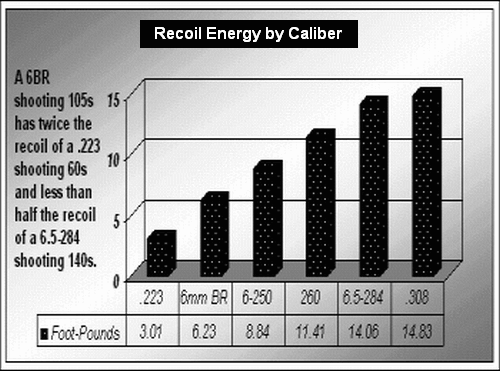
 Many visitors to the site ask us, “I’ve got a .223 and .308. What will a 6mmBR Norma (6BR) give me that I’m not getting already?” Well first you will probably average consistently smaller groups than your current .223 or .308 rifle (assuming the 6BR has a quality barrel and trigger). A good .308 Winchester can be superbly accurate, no question about that, but the lesser recoil of the 6BR works in the shooter’s favor over a long string of fire. Even with a Rem 700 or Savage action factory action, a 6BR with a benchrest stock, premium barrel, and a high-quality chambering job should deliver 5-shot groups in the high twos to mid-threes, provided you do your job. We have one 6BR rifle that shoots Lapua factory-loaded 6BR ammunition in the low twos and high ones. That’s exceptional, we admit, but it still shows how the 6BR is an inherently accurate cartridge, even with factory loads.