In our Shooters’ Forum, you’ll find a lengthy thread about accuracy problems with a Savage LRPV, chambered in 6mmBR. The gun would repeatedly split groups at 100 yards, and at 300 yards, the “flyers” would open up the groups to 1.5 MOA or larger. Interestingly, the factory test target (at right) showed a split group — not a good sign.
The gun’s owner, forum member LR_Shooter, tried a variety of tweaks: “I did this, done that… [changed] torque, tang floated, bedded action, recut chamber, and [adjusted firing pin]”. But nothing really helped. Frustrated, LR_Shooter asked his fellow Forum members for help. Much advice was proffered, including the novel idea of removing the middle action screw in the Savage 3-screw target action. Some of the advice proved helpful, but none of the suggested remedies produced a major improvement. This rifle, out of the box, tossed flyers and no amount of tweaking (or changes in shooting technique) really cured the basic problem. That is, until, the factory barrel got replaced…
New Criterion Pre-Fit Barrel Works Wonders
LR_Shooter acquired a Criterion pre-fit barrel from Jim Briggs at Northland Shooters Supply (NSS). These pre-fits are designed for easy installation with the standard Savage barrel nut. Wouldn’t you know it, with a new 30″ heavy-contour barrel on the LRPV, the gun started shooting way better. No more crazy fliers, no more split groups, no more excessive vertical. And the improvement came without any other major modifications. LR_Shooter reports: “I got a replacement barrel from Jim at NSS. It is a 30″ bull Criterion barrel. So far, without playing with torque screws and having my old setup… I’m very satisfied with the barrel I got. Now I have no problem getting [groups] under 0.25 MOA. Finally this thing can shoot!” The targets below, shot with the new Criterion barrel, speak for themselves. The left target was shot at 100 yards, while the target on the right was shot at 300 yards (very impressive).
Targets Shot with Savage LRPV Fitted with Criterion Barrel
Moral of the Story — Sometimes A New Barrel Really Is the Right Solution
All of us have struggled at times with a rifle that won’t live up to expectations. This Editor personally struggled for over a year with a .260 Rem Savage with a factory tube. The gun tended to split groups and the POI walked as the barrel heated. I tried one powder/primer combination after another, working through a variety of seating depths over many months. I was persistent. Out of stubbornness, I just believed that sooner or later I’d find the magic load.
Well folks, sometimes there’s really nothing you can do about a sub-par barrel. It is what it is. To really improve a gun’s accuracy (particularly a gun with a factory tube), you may need to open your wallet and get a quality aftermarket barrel. Spending months trying one recipe after another may simply be an overwhelming waste of powder, bullets, and your precious time.
Albert Einstein supposedly said: “Insanity is defined as doing the same thing over and over again, and expecting different results.” Well that sort of describes my efforts with my .260 Rem. Once I had enough evidence that my barrel split groups no matter what load combo (and seating depth) I tried, it was time to pony up for a new barrel. When I did finally screw on a nice PacNor 3-groove Supermatch, that Savage suddenly became a true tack-driver. As re-chambered in 6mmBR with the Pac-Nor, in calm conditions, my Savage will now consistently shoot in the twos with heavy bullets, and it can sometimes dip down into the ones with Berger 80gr flat-base bullets. The moral of the story here is simple — don’t waste weeks or months chasing your tail with a barrel that just won’t deliver (after a reasonable amount of testing). Save up for a custom barrel, get it chambered properly, and stop your cycle of frustration.
Contact Information for Northland Shooters Supply:
E-mail: briggs.j-b@q.com (that is Q.com not G.com)
Phone: (763) 682-4296
Fax: (763) 682-6098
Mailing address:
P.O. Box 333
Buffalo, MN 55313
When a rifle isn’t shooting up to it’s potential, we need to ask: “Is it the gun or the shooter?” Having multiple shooters test the same rifle in the same conditions with the same load can be very revealing…
When developing a load for a new rifle, one can easily get consumed by all the potential variables — charge weight, seating depth, neck tension, primer options, neck lube, and so on. When you’re fully focused on loading variables, and the results on the target are disappointing, you may quickly assume you need to change your load. But we learned that sometimes the load is just fine — the problem is the trigger puller, or the set-up on the bench.
Here’s an example. A while back we tested two new Savage F-Class rifles, both chambered in 6mmBR. Initial results were promising, but not great — one gun’s owner was getting round groups with shots distributed at 10 o’clock, 2 o’clock, 5 o’clock, 8 o’clock, and none were touching. We could have concluded that the load was no good. But then another shooter sat down behind the rifle and put the next two shots, identical load, through the same hole. Shooter #2 eventually produced a 6-shot group that was a vertical line, with 2 shots in each hole but at three different points of impact. OK, now we can conclude the load needs to be tuned to get rid of the vertical. Right? Wrong. Shooter #3 sat down behind the gun and produced a group that strung horizontally but had almost no vertical.
Hmmm… what gives?
Shooting Styles Created Vertical or Horizontal Dispersion
What was the problem? Well, each of the three shooters had a different way of holding the gun and adjusting the rear bag. Shooter #1, the gun’s owner, used a wrap-around hold with hand and cheek pressure, and he was squeezing the bag. All that contact was moving the shot up, down, left and right. The wrap-around hold produced erratic results.
Shooter #2 was using no cheek pressure, and very slight thumb pressure behind the tang, but he was experimenting with different amounts of bag “squeeze”. His hold eliminated the side push, but variances in squeeze technique and down pressure caused the vertical string. When he kept things constant, the gun put successive shots through the same hole.
Shooter #3 was using heavy cheek pressure. This settled the gun down vertically, but it also side-loaded the rifle. The result was almost no vertical, but this shooting style produced too much horizontal.
A “Second Opinion” Is Always Useful
Conclusion? Before you spend all day fiddling with a load, you might want to adjust your shooting style and see if that affects the group size and shape on the target. Additionally, it is nearly always useful to have another experienced shooter try your rifle. In our test session, each time we changed “drivers”, the way the shots grouped on the target changed significantly. We went from a big round group, to vertical string, to horizontal string.
Interestingly, all three shooters were able to diagnose problems in their shooting styles, and then refine their gun-handling. As a result, in a second session, we all shot that gun better, and the average group size dropped from 0.5-0.6 inches into the threes — with NO changes to the load.
That’s right, we cut group size in half, and we didn’t alter the load one bit. Switching shooters demonstrated that the load was good and the gun was good. The skill of the trigger-puller(s) proved to be the limiting factor in terms of group size.
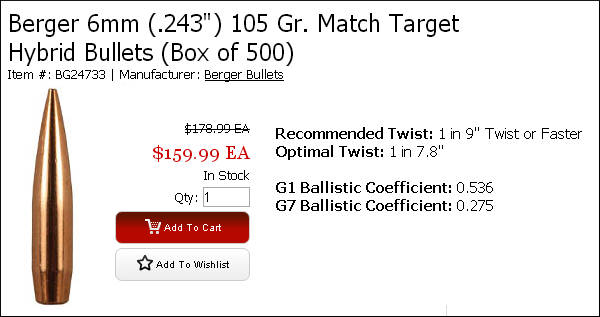
Need top-quality 6mm match bullets for your 6mmBR, 6mm Dasher, 6XC, 6mm Creedmoor, 6-6.5×47, or .243 Win? Then get out your checkbook, because this is a very good deal on hard-to-find Berger 6mm 105gr Hybrid Match Bullets.
Right now Precision Reloading offers big, 500-count boxes of 105gr 6mm Hybrids for just $159.99. That works out to just $31.99 per 100, a lot less than you’d pay normally. These .243-diameter premium bullets hold many records and have won many important shooting competitions. You may want to act quickly — supplies are limited. When Precision Reloading runs out of sale inventory, prices will go up. To order, visit PrecisionReloading.com
Estimating Actual Cost per Round by Caliber
This article comes from the USAMU, which provide shooting and reloading tips on its Facebook Page. This week’s USAMU TECH TIP outlines a ballpark-estimate method of calculating the actual cost per round of different calibers. Some applications, and some shooters, by virtue of their high level of competition, require the very best ballistic performance available — “Darn the cost, full speed ahead!
If you are in serious contention to win a major competition, then losing even a single point to inferior ballistic performance could cost you a national title or record. However, this “horsepower” does come at a cost! Some calibers are barrel-burners, and some offer much longer barrel life. Look at this comparison chart:
Estimated Cost Per Round by Cartridge Type
Below are some estimated total expense per round (practice and competition) based on component costs, type used, expected barrel life and a standard, chambered barrel cost of $520.00 across calibers.
5.56x45mm: $0.46/round (barrel life 6,000 rounds)*
6mmBR: $0.81/round (barrel life 2800 rounds)
6XC: $0.97/round (barrel life 2200 rounds)
.308 Win: $0.80/round (barrel life 4500 rounds)
6.5-284: $1.24/round (barrel life 1100 rounds)
*Note the high round count estimate for 5.56x45mm. This is a bit deceptive, as it assumes a period of “lesser accuracy” use. The USAMU says: “Much of the difference you see here between 5.56 and .308 is due to using the 5.56 barrel for 100-200 yard training with less-expensive, 55gr Varmint bullets after its long-range utility is spent”.
Moreover, while some applications require specialized, high-cost components, others do not. And, if the shooter is still relatively new to the sport and hasn’t refined his skill to within the top few percentile of marksmen, a more economical caliber choice can help stretch a limited budget. Translation: More skill per dollar!
In this post, the prices for all items mentioned here were taken from a major component supplier’s current advertisements, and all brass was of top quality, except in the case of 5.56mm. There, 200 top-quality, imported cases were reserved for 600-yard shooting, and the other brass used was once-fired Lake City surplus.
Cartridge cases were assumed to be loaded 10 times each. [Your mileage may vary…] Bullet prices assumed the use of less-expensive, but good-quality match bullets for the bulk of shooting as appropriate.
The cost of top-tier, highly-expensive match bullets was also calculated for a realistic percentage of the shots fired, based on ones’ application. Barrel life by caliber was taken from likely estimates based on experience and good barrel maintenance.
Brass Costs Based on 10 Loads Per Case
Often, handloaders may calculate ammunition cost per round by adding the individual costs of primers, powder charges and projectiles. Many don’t consider the cost of brass, as it is reloaded several times. Here, we’ll consider the cost of enough top-quality brass to wear out a barrel in our given caliber, at 10 loads per case, except as noted above.
Don’t Forget Amortized Barrel Costs
Few shooters factor in the full, true cost of barrel life. Depending on caliber, that can dramatically increase the cost per round. For example, consider a long-range rifle in 6.5/284 caliber. This cartridge performs amazingly well, but at a cost. Ballpark estimated barrel life [in a top-quality barrel] is 1100 rounds. Some wear out faster, some last longer, but this gives a rough idea of what to expect.
Accurate barrels are a joy to use, but they are an expendable resource!
A top-quality barrel plus installation was estimated at about $520.00. At 1100 rounds, barrel life adds $0.47 per round to our total cost. Thus, what had started out as an [components-only estimate, with brass cost] of $0.76/round now totals $1.24 per shot!
Cost Considerations When Choosing a Catridge Type
Some shooters might ask themselves if they could meet their present needs with a more economical caliber. If so, that equates to more practice and matches per available dollar, and more potential skill increase on the available budget.
Each shooter knows his skill level, practice needs, and shooting discipline’s requirements. Some might shoot NRA Service Rifle or Match Rifle using a 5.56mm with a long barrel life. Others might be Match Rifle shooters faced with choosing between, say, a 6mm BR vs. 6XC. A realistic assessment of ones needs, performance-wise, may help guide the shooter toward a caliber that’s most optimized to their needs at the moment.
Admittedly, the factors affecting cost for any individuals circumstances can vary significantly. However, hopefully this will provide one useful method of evaluating one’s training and competition choices, based on their skill, goals and needs.
Here’s something you don’t see very often — Lapua cartridge brass on sale. As part of its Back-to-Black promotion, Brownells has deeply discounted its inventories of Lapua Brass. For most cartridges/calibers, the price has been reduced at least $10.00 per 100-count box. Here are the sale prices, good through the end of the week:
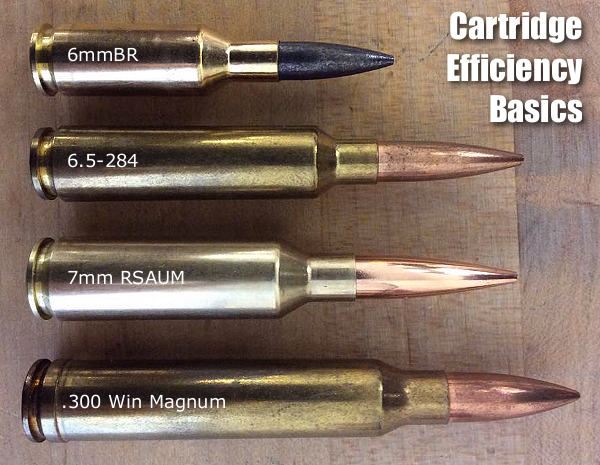
Efficient cartridges make excellent use of their available powder and case/bore capacity. They yield good ballistic performance with relatively little recoil and throat erosion.
Cartridge Efficiency: A Primer (pun intended!)by USAMU Staff
Each week, the U.S. Army Marksmanship Unit (USAMU) publishes a reloading article on its Facebook Page. In this week’s article, the USAMU discusses cartridge case efficiency and its benefits. While this is oriented primarily toward NRA High Power Rifle and Long Range (1000-yard) competition, these factors also apply to medium/big game hunters. Assuming one’s rifle and ammunition are accurate, key considerations include ballistic performance (i.e., resistance to wind effects, plus trajectory), recoil, and throat erosion/barrel life.
Efficient cartridges make excellent use of their available powder and case/bore capacity. They yield good ballistic performance with relatively little recoil and throat erosion. A classic example in the author’s experience involved a featherweight 7x57mm hunting/silhouette rifle. When loaded to modern-rifle pressures, just 43-44 grains of powder pushed a 139gr bullet at 2900 fps from its 22” barrel. Recoil in this light rifle was mild; it was very easy to shoot well, and its performance was superb.
An acquaintance chose a “do everything” 7mm Remington Magnum for use on medium game at short ranges. A larger, heavier rifle, it used ~65 grains of powder to achieve ~3200 fps with similar bullets — from its 26″ barrel. Recoil was higher, and he was sensitive to it, which hampered his shooting ability.
Similarly efficient calibers include the 6mm BR [Norma], and others. Today’s highly-efficient calibers, such as 6mm BR and a host of newer developments might use 28-30 grains of powder to launch a 105-107gr match bullet at speeds approaching the .243 Winchester. The .243 Win needs 40-45 grain charges at the same velocity.
Champion-level Long Range shooters need every ballistic edge feasible. They compete at a level where 1″ more or less drift in a wind change could make the difference between winning and losing. Shooters recognized this early on — the then-new .300 H&H Magnum quickly supplanted the .30-06 at the Wimbledon winner’s circle in the early days.
The .300 Winchester Magnum became popular, but its 190-220gr bullets had their work cut out for them once the 6.5-284 and its streamlined 140-142gr bullets arrived on the scene. The 6.5-284 gives superb accuracy and wind performance with about half the recoil of the big .30 magnums – albeit it is a known barrel-burner.
Currently, the 7mm Remington Short Action Ultra-Magnum (aka 7mm RSAUM), is giving stellar accuracy with cutting-edge, ~180 grain bullets, powder charges in the mid-50 grain range and velocities about 2800+ fps in long barrels. Beyond pure efficiency, the RSAUM’s modern, “short and fat” design helps ensure fine accuracy relative to older, longer cartridge designs of similar performance.
Recent design advances are yielding bullets with here-to-fore unheard-of ballistic efficiency; depending on the cartridge, they can make or break ones decision. Ballistic coefficients (“BC” — a numerical expression of a bullet’s ballistic efficiency) are soaring to new heights, and there are many exciting new avenues to explore.
The ideal choice [involves a careful] balancing act between bullet BCs, case capacity, velocity, barrel life, and recoil. But, as with new-car decisions, choosing can be half the fun!
Factors to Consider When Evaluating Cartridges
For competitive shooters… pristine accuracy and ballistic performance in the wind are critical. Flat trajectory benefits the hunter who may shoot at long, unknown distances (nowadays, range-finders help). However, this is of much less importance to competitors firing at known distances.
Recoil is an issue, particularly when one fires long strings during competition, and/or multiple strings in a day. Its effects are cumulative; cartridges with medium/heavy recoil can lead to shooter fatigue, disturbance of the shooting position and lower scores.
For hunters, who may only fire a few shots a year, recoil that does not induce flinching during sight-in, practice and hunting is a deciding factor. Depending on their game and ranges, etc., they may accept more recoil than the high-volume High Power or Long Range competitor.
Likewise, throat erosion/barrel life is important to competitive shooters, who fire thousands of rounds in practice and matches, vs. the medium/big game hunter. A cartridge that performs well ballistically with great accuracy, has long barrel life and low recoil is the competitive shooter’s ideal. For the hunter, other factors may weigh more heavily.
Cartridge Efficiency and Energy — Another Perspective
Lapua staffer Kevin Thomas explains that efficiency can be evaluated in terms of energy:
“Cartridge efficiency is pretty straight forward — energy in vs. energy out. Most modern single-based propellants run around 178-215 ft/lbs of energy per grain. These figures give the energy potential that you’re loading into the rifle. The resulting kinetic energy transferred to the bullet will give you the efficiency of the round. Most cases operate at around 20-25% efficiency. This is just another way to evaluate the potential of a given cartridge. There’s a big difference between this and simply looking at max velocities produced by various cartridges.”
Jonathan Ocab, a High Power shooter from California, had gunsmith Doan Trevor install a Sako-style extractor in the Rem 700 bolt in Ocab’s 6mmBR Eliseo R5 tubegun. Jonathan produced an excellent video showing how the Sako extractor improves the ejection of the short, fat 6mmBR cartridges in his rifle. Jonathan’s video demonstrates 6mmBR case ejection with an unmodified Rem 700 factory bolt versus a factory bolt fitted with a Sako-style extractor.
Johnathan explains: “Note how even when slowly operating the bolt, the bolt with the Sako extractor easily ‘kicks’ out the brass on ejection with minimal chance of operator error resulting in a failure to extract. While the unmodified bolt has issues ejecting brass on slow operation, it will eject if the operator pulls the bolt back quickly (fast and with some force).
While a Sako-style extractor isn’t an absolute necessity, this video shows the definite improvement this modification provides. For short cartridges like the 6mmBR, this is very useful. This modification is highly recommended for competition shooters, especially High Power competitors who seek improved function in rapid-fire stages. This modification is fairly inexpensive and any competent gunsmith should be able to perform the work (usually under $100 with parts and labor).”
EDITOR’s NOTE: In his video, Jonathan deliberately worked the unmodified Remington bolt slowly to show how the standard Rem extractor can struggle with short fat cases like the 6mmBR. In fact, when you work a standard, unmodified bolt more quickly, the extraction can be much more positive. Cycling the bolt with more “snap” provides more energy to eject the cases. We have run an R5 Tubegun chambered in 6mmBR with an unmodified Rem 700 bolt (no SAKO extractor), and the extraction was reliable, provided the bolt was worked quickly.
DJ’s Brass Service now offers custom case hydro-forming to your exact specs. Darrell Jones offers this service for a variety of popular cartridges: 6mm Dasher, 6mm BRX, 6mm BRDX, and 6mm Shehane. After hydro-forming your brass, Darrell can also neck-up or neck-down the cases to meet your needs. For example, if you shoot a 22 Dasher, Darrell can hydro-form the cases and then neck them down to .22 caliber. He can also turn the necks to your specs (for an additional charge).
Darrell is a hydro-forming wizard who has perfected the process over the last couple of years. He has learned a few special techniques along the way to ensure uniform case-forming. Without revealing any trade secrets, we can say the Darrell has very special dies and Darrell doesn’t use a mallet or hammer — he has a system that is much more consistent. Darrell tells us: “Many of my customers take this brass and load it ‘as is’ and go straight to a match and shoot some very nice groups.”
Hydro-forming by Darrell costs $0.60 (sixty cents) per case with a minimum order of $60. Neck-turning is an additional $0.50 (fifty cents) per case plus actual return shipping. The turnaround is usually less than five days.
With Darrell’s hydro-forming service you don’t have to buy any special dies or other equipment. Darrell says: “Simply send me the brass you need or have it dropped-shipped to me along with a fired case that has not been sized. If you need formed brass for a new build (gun not yet fired), let me know and I will size the brass to fit within .001 of a PT&G GO gauge.”
For more information, visit DJsBrass.com, or call Darrell at (205) 461-4680. IMPORTANT: Contact Darrell for shipping instructions BEFORE sending brass for processing. In a hurry, don’t have time? Just call Darrell and he’ll make something work for you.
Hydro-Forming Customer Reports
Here are testimonials from recent customers.
“Recently had Darrell Jones of DJ’s Brass Service hydro-form 6 BRX brass for me. The turn around time was very fast and the brass was to the exact specification I ask for. I actually shot the hydro-formed brass in a match [without further fire-forming]. It shot a 3.597″ — pretty amazing. Let DJ do the work for you!” — Mike Wilson (3 Time IBS Record Holder; 2013 and 2014 1000-yard IBS Shooter of the Year.)
“Darrell Jones of DJ’s Brass Service went far beyond the call of duty, to assist me in preparation to shoot for my first time in an IBS match. I have had an interest in 1000-yard competition for many years and finally got the opportunity to try it. After researching the winning competitors, rifles, and rounds I ordered a Panda action with Krieger barrel in 6mm Dasher from Kelby’s. It was one week before the match and I had a rifle and no rounds. I contacted Darrell to hydraulically form 6mm dasher from Lapua 6mm BR brass. He formed the brass and had it in the mail the next day[.] Since I have only reloaded for hunting or magazine fed rifles I was not familiar with proper seating to allow land engagement of the bullets for 1000-yard accuracy. Darrell took the time to advised me every step of the way to allow me to shoot a 3.158″ (5) shot group to win my first round of my first competitive match ever.” — Mike Youngblood
Roy Hunter’s Brace of Two 30 Dashers by Jeff Stover, IBS President
Short range benchrest at 100 and 200 yards is the domain of the 6PPC. Since 1978 that has been the case. Yes, an occasional 30BR, the King of Score Benchrest, will sometimes punch with the 6PPC in group competition. But a .30-caliber benchrest rifle will put you at a disadvantage in group shooting over the long haul — that’s certainly the conventional wisdom. Apparently, no one told Roy Hunter.
6PPC Group vs 30 Dasher Group at 200 yards — the “Fat Dasher” is definitely competitive.
Roy brought two rifles to the 2015 Group Nationals. Both were 30 Dashers. He did not even go with the milder 30 BR. The Dasher boasts more case capacity and, thus, more velocity. (The 30 Dasher is a 6mmBR improved with the neck expanded to .30 caliber and the shoulder blown forward). Speed comes at a price. That price is recoil, especially in a 10.5-pound rifle, such as Light Varmint and Sporter (same as LV but with at least a 6mm bore). Roy can handle the Dasher even in a 10.5-lb gun. The target above shows a sub-.300” group at 200 yards compared to a 6PPC group at the same distance. The larger cartridge and .308 bore CAN compete with a 6PPC – at least in the hands of a benchrest ace like Roy.
Roy’s 30 Dasher in 10.5-lb trim boasts a 1:17″-twist Pac-Nor barrel. Roy shoots Euber 116gr .30-Cal bullets over 38 grains of H4198. That load is good for nearly 3300 fps. This rifle, shown above, has a distinctive stained Butternut finish.
The stocks on Roy’s rifles are his own, made in his shop near Gettysburg, PA. Before Roy Hunter was a premier benchrest stockmaker he built museum-quality 18th Century-style furniture, following Chippendale patterns and the like. Now he just makes benchrest-style stocks (benchrest only — there’s no time to make hunting stocks). The fit and finish are as good as it gets. Roy’s stocks combine old world craftsmanship with high-tech construction. Roy uses Butternut wood, English Walnut, and other woods laminated with carbon fiber. His 10.5-lb rifle is Butternut, while his 13.5-lb rifle is Walnut — and they both shoot superbly! If you are interested in a Roy Hunter stock, the best way to reach Roy is by phone: 410-259-7944.
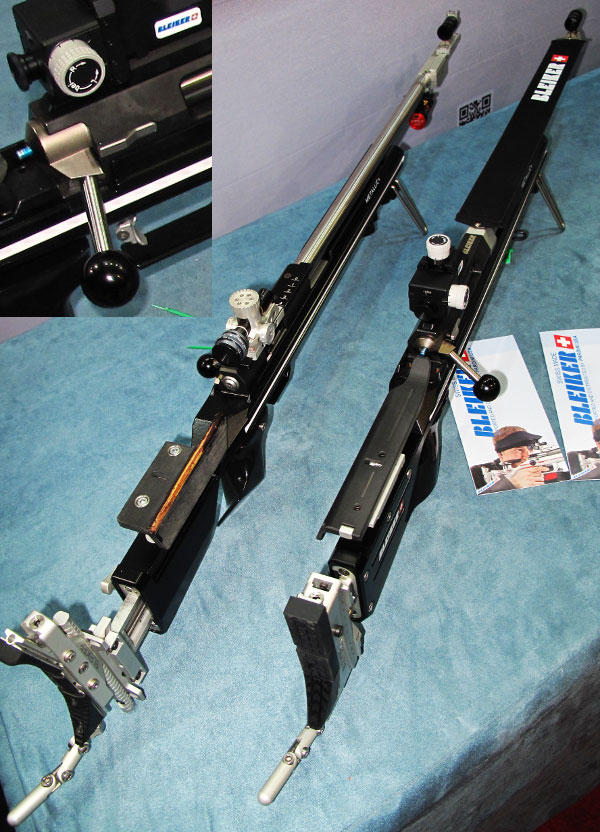
You don’t want to inquire about the price of a Bleiker competition rifle. As the expression goes, “If you have to ask, you can’t afford it”. At the Pardini USA booth at SHOT Show we saw a pair of black beauties — two “full-race” Bleikers, one a smallbore match rifle (.22 LR) and the other a 300m position rifle chambered in 6mmBR Norma. The combined price for the two rifles was a jaw-dropping $20,100.00. Yep, over $20K for the two. The 6mmBR rig was $10,200 while the smallbore rifle was $9,900.00.
Bleikers command such high prices because they win. At recent ISSF 300m and Smallbore Championships, Bleikers have been used by many of the medal winners. A gun is worth $10K if it can really put you on the podium or, better yet, deliver a world championship.
You are looking at $20,100 of Competition Rifles here. (Click Image for full-screen version.)
Take a look at this slick feature on the 300m gun. The adjustable cheek-pad automatically tilts up (for clearance) when you retract the bolt. That’s clever Swiss Engineering.


 In our Shooters’ Forum, you’ll find a lengthy thread about accuracy problems with a Savage LRPV, chambered in 6mmBR. The gun would repeatedly split groups at 100 yards, and at 300 yards, the “flyers” would open up the groups to 1.5 MOA or larger. Interestingly, the factory test target (at right) showed a split group — not a good sign.