|
|
October 1st, 2013
 The 6.5×47 Lapua necked down to 6mm is a popular wildcat. However, we’ve learned that, when necking down a 6.5×47 Lapua case to 6mm, simply running the brass into a 6-6.5×47 full-length sizer won’t give the best results. Reader “Fireball”, who has worked with both a 6-6.5×47 and a 22-6.5×47, offers this tip: “You don’t want to bring the 6.5mm case all the way down to 6mm in one step — it’s too big of a jump. First, to smooth entry, run a 6.5mm expander in the case mouth, and chamfer the outside of the case mouth — be sure to remove all burrs. Apply some lube to the neck. Then, if you have a .257 bushing, put that in a 6BR bushing neck die, and run the case up [for initial reduction].” Then, use your 6mm die for the final step. The 6.5×47 Lapua necked down to 6mm is a popular wildcat. However, we’ve learned that, when necking down a 6.5×47 Lapua case to 6mm, simply running the brass into a 6-6.5×47 full-length sizer won’t give the best results. Reader “Fireball”, who has worked with both a 6-6.5×47 and a 22-6.5×47, offers this tip: “You don’t want to bring the 6.5mm case all the way down to 6mm in one step — it’s too big of a jump. First, to smooth entry, run a 6.5mm expander in the case mouth, and chamfer the outside of the case mouth — be sure to remove all burrs. Apply some lube to the neck. Then, if you have a .257 bushing, put that in a 6BR bushing neck die, and run the case up [for initial reduction].” Then, use your 6mm die for the final step.
Alternatively, you can use a Redding 6BR body die initially. The body die will funnel the neck down about half way. Body dies are pretty inexpensive ($29.99 at Grafs.com, Item #RED75317). After running the brass through the 6BR body die, then you can run the case into the Forster 6-6.5×47 Full-length sizing die. The Forster die is excellent — it sizes a no-turn neck just about perfectly, so long as you do an intermediate step first.”
April 12th, 2013
We all know that reloading components are in very short supply these days — bullets, brass, powder — you name it. Every day we get calls and emails from guys trying to find these items. Here’s a tip for those of you who need high-quality brass: Midsouth Shooters Supply carries Norma Brass, and Midsouth has this brass for many popular cartridge types IN STOCK now. Here’s a partial list of unprimed Norma brass available for purchase at Midsouth as of April 12, 2013:
NORMA Brass IN-STOCK at Midsouth Shooters Supply (Partial List)
| 6MM PPC RIFLE BRASS 25ct |
Item: 013-10260105 |
Price: $22.72 |
| 6MM BR Norma RIFLE BRASS 25ct |
Item: 013-10260155 |
Price: $22.72 |
| 6MM XC RIFLE BRASS 25ct |
Item: 013-10260185 |
Price: $24.66 |
| 222 REM RIFLE BRASS 25ct |
Item: 013-20257115 |
Price: $15.13 |
| 22-250 REM RIFLE BRASS 25ct |
Item: 013-20257315 |
Price: $22.72 |
| .260 REM RIFLE BRASS 25ct |
Item: 013-20266025 |
Price: $28.42 |
| 6.5×55 REM RIFLE BRASS 25ct |
Item: 013-20265515 |
Price: $20.84 |
| 6.5-284 RIFLE BRASS 25ct |
Item: 013-20265285 |
Price: $31.79 |
| 270 Win RIFLE BRASS 25ct |
Item: 013-20269015 |
Price: $24.69 |
| 280 REM RIFLE BRASS 25ct |
Item: 013-20270505 |
Price: $27.82 |
| .30-06 Springfield BRASS 25ct |
Item: 013-20276405 |
Price: $25.46 |
| 300 WSM BRASS 25ct |
Item: 013-20276765 |
Price: $48.11 |

February 6th, 2013
 Many visitors to the site ask us, “I’ve got a .223 and .308. What will a 6mmBR Norma (6BR) give me that I’m not getting already?” Well first you will probably average consistently smaller groups than your current .223 or .308 rifle (assuming the 6BR has a quality barrel and trigger). A good .308 Winchester can be superbly accurate, no question about that, but the lesser recoil of the 6BR works in the shooter’s favor over a long string of fire. Even with a Rem 700 or Savage action factory action, a 6BR with a benchrest stock, premium barrel, and a high-quality chambering job should deliver 5-shot groups in the high twos to mid-threes, provided you do your job. We have one 6BR rifle that shoots Lapua factory-loaded 6BR ammunition in the low twos and high ones. That’s exceptional, we admit, but it still shows how the 6BR is an inherently accurate cartridge, even with factory loads. Many visitors to the site ask us, “I’ve got a .223 and .308. What will a 6mmBR Norma (6BR) give me that I’m not getting already?” Well first you will probably average consistently smaller groups than your current .223 or .308 rifle (assuming the 6BR has a quality barrel and trigger). A good .308 Winchester can be superbly accurate, no question about that, but the lesser recoil of the 6BR works in the shooter’s favor over a long string of fire. Even with a Rem 700 or Savage action factory action, a 6BR with a benchrest stock, premium barrel, and a high-quality chambering job should deliver 5-shot groups in the high twos to mid-threes, provided you do your job. We have one 6BR rifle that shoots Lapua factory-loaded 6BR ammunition in the low twos and high ones. That’s exceptional, we admit, but it still shows how the 6BR is an inherently accurate cartridge, even with factory loads.
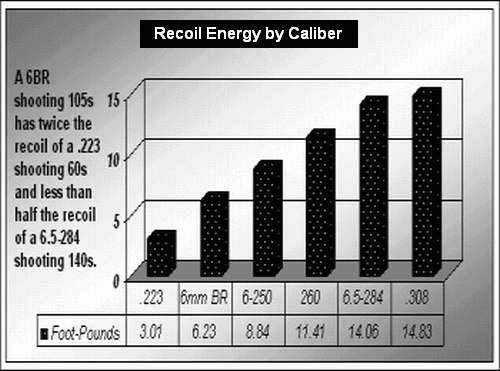
Compared to a .223, the 6BR offers a much better selection of high-BC projectiles, and will deliver considerably more power on the target. Compared to the .308 shooting 168gr MatchKings, a 6BR shooting 105-107gr bullets offers better ballistics all the way out to 1000 yards. Plus, for most people, the 6BR is just easier to shoot than a .308. Recoil is less than half of the .308 cartridge. Both the .308 and 6BR chamberings offer good barrel life, but the 6BR uses 15-18 grains less powder, saving you money. Here’s how the 6BR stacks up vs. a number of popular calibers:
February 1st, 2013
The .223 WSSM and 6mmBR Disaster
Report by Dr. Jim Clary
Under most circumstances, shooters don’t have to worry about chambering the wrong cartridge into the wrong rifle. After all, the cartridges are well marked and we all know which rifle we are shooting on any given day. In many cases, incorrect cartridges cannot be chambered — larger cases will not fit in smaller chambers, for example. No problem! That being said, I can tell you that even an experienced, careful and normally safe shooter can make a mistake.
The following is an account of just such a mistake that could have resulted in death or dismemberment. Fortunately, the shooter was not hurt, but the rifle was completely destroyed.
Last year, a friend purchased a Savage Precision right bolt, left port, single shot bolt action in 6mmBR Norma. It was an incredible prairie dog gun and he spent the summer burning powder and busting dogs. In October, he purchased a stainless steel Browning A-Bolt Varmint in .223 WSSM. The weather in the upper Midwest turned sour by the time he got the brass tuned up and he only got to fire it a few times before he was “socked in” for the winter. Thus, he spent his evenings loading ammo for the spring thaw.
During a break in the weather, he grabbed both rifles and a couple of bags of .223 WSSM and 6mmBR cartridges and headed to the range to check out his new loads. In case you are not familiar, the 6mmBR is smaller in diameter and a mite shorter than the .223 WSSM. Because of this, it will chamber in a .223 WSSM, but the .243 caliber (6mm) bullet is too big for the .22 caliber bore. That is what happened to my friend.
The rest is history — when he squeezed the trigger, all hell broke loose. The entire bottom of the rifle blew out, including the magazine assembly. The explosion actually cut the stock into two pieces. However, the bolt held and amazing as it may seem, the .243 bullet was “swaged” right out of the .223 barrel.

6mmBR (left) and .223 WSSM (right) cartridges above the remains of Browning A-Bolt rifle.
One Small Mistake Is All It Takes
Now, realize that my friend has been shooting all manner of firearms, safely, for over half a century. He is meticulous, thorough and conscientious in his approach to reloading and shooting. However, he made one mistake. He put some lose 6BR cartridges in a baggie as he packed up from a prairie dog hunt last summer, without noticing that the baggie was marked .223 WSSM in black marker. Then, when the break in his winter weather came, he grabbed the bag, believing it to be the WSSM cartridges and didn’t check the head stamp.
Couldn’t happen to you? How many times have we emptied our pockets of cartridges and dropped them into a plastic container on the shooting bench? How many times have we set down to a marathon reloading session, loading several calibers in a row? How many times have we put the wrong bullets, cases or primers into the incorrect container? My point is that even the safest of us can make a mistake. So, look at the picture above and take a bit more time when you reload your ammunition at home or chamber a round in the field. It might save your life.
Story and photo © Dr. Jim Clary, All Rights Reserved.
October 23rd, 2012
Put the same load in a variety of barrels (with the same length and chamberings) and you’ll see a wide variance in muzzle velocity. In fact, it’s not unusual to see up to 100 fps difference from one barrel to the next. We demonstrated this with a comparison test of Lapua factory ammo.
Chron Testing Lapua Factory Ammo
At our Southern California test range, we chronographed Lapua 105gr 6mmBR factory ammo in three different 8-twist barrels of similar length. The results were fascinating. Lapua specs this ammo at 2790 fps, based on Lapua’s testing with its own 26″ test barrel. We observed a speed variance of 67 fps based on tests with three aftermarket barrels.

Brand ‘S’ and Brand ‘PN’ were pre-fit barrels shot on Savage actions. Brand ‘K’ was fitted to a custom action. All test barrels were throated for the 100-108 grain bullets, though there may have been some slight variances in barrel freebore. With a COAL of 2.330″, the rounds were “jumping” to the rifling in all barrels. Among the four barrels, Brand ‘PN’ was the fastest at 2824 fps average — 67 fps faster than the slowest barrel. Roughly 10 fps can be attributed to the slightly longer length (27″ vs. 26″), but otherwise this particular barrel was simply faster than the rest. (Click Here for results of 6mmBR Barrel Length Velocity Test).
Results Are Barrel-Specific, Not Brand-Specific
These tests demonstrate that the exact same load can perform very differently in different barrels. We aren’t publishing the barrel-makers’ names, because it would be wrong to assume that ‘Brand X’ is always going to be faster than ‘Brand Y’ based on test results from a single barrel. In fact, velocities can vary up to 100 fps with two identical-spec barrels from the SAME manufacturer. That’s right, you can have two 8-twist, 26″ barrels, with the same land-groove configuration and contour, from the same manufacturer, and one can be much faster than another.
Don’t Demand More Than Your Barrel Can Deliver
We often hear guys lament, “I don’t get it… how can you guys get 2900 fps with your 6BRs and I can only get 2840?” The answer may simply be that the barrel is slower than average. If you have a slow barrel, you can try using more powder, but there is a good chance it may never run as fast as an inherently fast barrel. You shouldn’t knock yourself out (and over-stress your brass) trying to duplicate the velocities someone else may be getting. You need to work within the limits of your barrel.
Factory Ammo Provides a Benchmark
 If you have a .223 Rem, 6BR, .243 Win, 6.5×47 Lapua, 6.5×55, .308 Win, 30-06, or 300 WM Rifle, we recommend you buy a box of Lapua factory-loaded ammo. This stuff will shoot great (typically around half-MOA), and it can give you a baseline to determine how your barrel stacks up speedwise. When you complete a new 6BR rifle, it’s wise to get a box of the factory ammo and chronograph it. That will immediately give you a good idea whether you have a slow, average, or fast barrel. Then you can set your velocity goals accordingly. For example, if the factory 6BR ammo runs about 2780-2790 fps in your gun, it has an average barrel. If it runs 2820+ in a 26″ barrel (or 2835 fps in a 28″), you’ve got a fast tube. If you have a .223 Rem, 6BR, .243 Win, 6.5×47 Lapua, 6.5×55, .308 Win, 30-06, or 300 WM Rifle, we recommend you buy a box of Lapua factory-loaded ammo. This stuff will shoot great (typically around half-MOA), and it can give you a baseline to determine how your barrel stacks up speedwise. When you complete a new 6BR rifle, it’s wise to get a box of the factory ammo and chronograph it. That will immediately give you a good idea whether you have a slow, average, or fast barrel. Then you can set your velocity goals accordingly. For example, if the factory 6BR ammo runs about 2780-2790 fps in your gun, it has an average barrel. If it runs 2820+ in a 26″ barrel (or 2835 fps in a 28″), you’ve got a fast tube.

October 15th, 2012
One of our readers has been shooting his 6BR with considerable success in tactical/practical matches. Thus far he’s been using Lapua factory-loaded 105gr ammo. The factory ammo has delivered superb accuracy for him — under 1/4 MOA at 100 yards. Now, he is making the jump into reloading. He asked for some tips on working up a good load for an 8-twist 6BR with a no-turn neck, and selecting reloading tools. Since other readers may be 6BR novices as well, here are some helpful hints…
Accurate Reloading Tips for the 6mmBR Cartridge
 ▪ Brass Prep — You need to look at the flash-holes to make sure they’re not occluded. A few lots of Lapua brass came with a little sliver/flake of brass in the hole, sort of like a quarter moon. You can clean that up with an inexpensive pin vise. Otherwise, there is no need to ream flash holes or uniform primer pockets. ▪ Brass Prep — You need to look at the flash-holes to make sure they’re not occluded. A few lots of Lapua brass came with a little sliver/flake of brass in the hole, sort of like a quarter moon. You can clean that up with an inexpensive pin vise. Otherwise, there is no need to ream flash holes or uniform primer pockets.
▪ Neck Chamfering — You want to develop a good feel for neck chamfering. You don’t want/need to remove a lot of brass — just knock off the sharp edge. I use a Forster 45 deg “rocket” tool. It works fine. After a couple light turns, spin backwards to smooth the cut and then finish with a twist with a green scotch pad. If you use a deep-angle chamferer, be very careful not to overcut and remove too much brass.
▪ Neck Tension — On brand new, unfired Lapua 6BR brass, neck tension is excessive. You should run an expander mandrel down the case necks before the first firing. This will reduce the neck tension while it fixes necks that may be dented or out of round. After the first firing, we suggest sizing the necks so that, after they come out of your sizing die, the neck outside diameter (OD) is .002″ less than the neck diameter of a loaded round with bullet seated. If that doesn’t work, try the next size up bushing for .001″ tension. Many top shooters like low neck tension, but we’ve also seen heavy tension work. The .002″ under loaded OD is a good starting point with the 6BR. (But note — if you have thin-walled turned necks, you may need to use a smaller bushing, running your sized necks .003 or .0035 under the OD of a loaded round.)
▪ Primers — A lot of guys like the CCI 450 primers. They’re a lot cheaper than the Federal and CCI BR primers and may give a little more velocity. The cups are also hard, which lets you run faster loads with less concern about cratering. Wolf/Tula primers also have hard cups, but you must make sure to seat them deep enough.
▪ Load Development and Bullet Choice — With the 6BR and 100-108gr bullets, load development should be relatively easy. With Varget, Reloder 15, Norma 203B, or VV N150, between 30.0 and 30.7 grains should work as your final load. My match load is 30.3 Varget and that has shot under 2.0″ at 600 yards. Start at 29.0 grains and and work up in 0.2 grain increments, checking for pressure. DO weigh every load… twice. If possible, use a chronograph during your load work-up. 2880-2920 fps is a nice “sweet spot” for the 6BR, but slower can be very accurate too. (With custom actions, tight chambers, and long barrels, some guys are going even faster — but that’s hard on brass.)
If you have a barrel on the slow side, consider shooting the Berger 100gr ‘Match Target’ BTs. These bullets are very accurate, and we’ve found that you can drive them 75-100 fps faster than the Berger 108s or Sierra 107s at similar pressure levels. With the 100-grainers, you may find that you can hit a superior velocity/accuracy node, so they may shoot better overall than the 105-108 class bullets. Varget, RL15, and IMR 8208 all work great with this 100gr bullet.
For shooting from 300-500 yards, you should consider the lighter-weight bullets: Sierra 95gr MK, Lapua 90gr Scenar, Berger 95gr and 87gr VLD. The Sierra and Lapua bullets are very accurate and not sensitive to seating depth. In addition to the powders mentioned above, H4895 and IMR 8208 XBR work very well with the 90-grain-class bullets. One note about the smaller Berger VLDs — the Berger 95gr VLD and 87gr VLD both have very short bearing surfaces, so they work best in a chamber with a short-to-moderate Freebore. We had the best luck with the 95gr VLD about .010″ into the lands. We could achieve that with an 0.075″ Freebore chamber. But you won’t be able to hit the rifling with the 95s in a long-throated chamber. With this bullet we recommend sorting bullets by base to ogive.
 For guys with 10-twist barrels, try out the new Berger 87gr VLD. It was expressly designed to work great in the 1:10″ twist barrels. Forum member Mark Schronce reports that this bullet is extremely accurate and can be driven fast. It has an 0.412 G1 BC. Note: The new 87gr VLD, product #24524, is hard to find on the Berger website, but it IS available. Berger calls it a “hunting bullet”, but it works great on paper also. MidwayUSA has the 87-grainers in stock as item #77854. For guys with 10-twist barrels, try out the new Berger 87gr VLD. It was expressly designed to work great in the 1:10″ twist barrels. Forum member Mark Schronce reports that this bullet is extremely accurate and can be driven fast. It has an 0.412 G1 BC. Note: The new 87gr VLD, product #24524, is hard to find on the Berger website, but it IS available. Berger calls it a “hunting bullet”, but it works great on paper also. MidwayUSA has the 87-grainers in stock as item #77854.

▪ Pure Accuracy — If you are looking for bughole accuracy out of your 6BR, try the Berger 80gr FBHP ‘Match Varmint’ bullets (item #24321). Many folks have reported these bullets will shoot in the ones and low twos, even in 8-twist barrels. For 100- to 200-yard distances, these bullets are hard to beat for pure accuracy. Beyond those distances, you’ll want something with a higher BC. We’ve had good luck with the Berger 80s pushed by Vihtavuori N135, and IMR 8208 XBR.
▪ C.O.A.L. — Bullet seating depth is very important. You should get the Hornady (Stoney Point) O.A.L. Gauge (shown below). This will let you discern the OAL at which the bullets just contact the rifling. The trick is tapping gently on the stick. (Get a wood dowel as the bullet can get stuck if you tap a little too aggressively.) With some practice, measuring is quick and you can get repeatable measurements of your distance to lands within .001-.002″.

A good starting point for the Berger and Lapua 105s is about .010-.015 IN the lands and then work back. Each barrel is different, but about .010″ in the lands works for many folks. One guy I know started at .012″ in the lands with Berger 105s, adjusted his load up from 30.0 to 30.4 Varget, and within an hour he was done with load dev — the gun was shooting in the low 2s. He went out and won his first match with that load the next day! With the Sierra 107s you might want to start .020″ out of the lands.
▪ Seating Die — We recommend the Wilson Micrometer Seating Die. The adjustable top makes it really easy to play with seating depths. Keep in mind, however, that moving 5 hash marks on the die may not give you exactly .005″ seating depth change — it will be close, but you should measure and write down the actual base to ogive length. FYI, I measure base to ogive of every loaded round. Occasionally you’ll find a bullet that ends up seated a little long or short.
NOTE: The fit of the 6BR Wilson seating die is very tight. You may have difficulty getting a fired case into the die if you do not full-length size the case first. Even with FL-sized cases, there may be a vacuum fit that makes the loaded round a little hard to remove. If you can’t easily extract your loaded round, try lifting the entire micrometer head and attached stem. This can release the vacuum so the case can slide out easily (unless there is a really tight fit). If that doesn’t work, here’s another trick — use the end of a Popsicle stick placed under the cartridge rim to lever the case out. I’ve found that the “working” end of a metal spoon works well too, but be careful not to nick the bottom of the die.
September 15th, 2012
 300m Lapua European Cup Finals are currently underway in Zagreb, Croatia. The prone events have concluded — and Lapua ammo shooters dominated the field, with the little 6mmBR topping all other cartridge types in both the mens’ and womens’ divisions. There have been challengers to the 300m crown, including Norma’s 6XC and Lapua’s own 6.5×47, but it appears that the 6mmBR cartridge is still “King of the Hill” at 300 meters. We know that Lapua’s 6mmBR factory ammo is outstanding. This factory 6mmBR ammo shot well under quarter-MOA in one Eliseo Tubegun we tested (READ 6mmBR Tubegun Story). 300m Lapua European Cup Finals are currently underway in Zagreb, Croatia. The prone events have concluded — and Lapua ammo shooters dominated the field, with the little 6mmBR topping all other cartridge types in both the mens’ and womens’ divisions. There have been challengers to the 300m crown, including Norma’s 6XC and Lapua’s own 6.5×47, but it appears that the 6mmBR cartridge is still “King of the Hill” at 300 meters. We know that Lapua’s 6mmBR factory ammo is outstanding. This factory 6mmBR ammo shot well under quarter-MOA in one Eliseo Tubegun we tested (READ 6mmBR Tubegun Story).
The European Cup Finals continue today with mens’ 3×40 and ladies’ 3×20 matches. On Sunday, the last day of the competition, the Mens’ 3×20 Standard Rifle and Super Finals are slated. Here are results from Friday’s 300m Prone matches:
| Mens’ 300m Prone Results
1. Antti Puhakka, FIN 599-34X – 6mm BR
2. Juha Rutonen, FIN 598-42X – 6mm BR
3. Josselin Henry, FRA 597-32X – 6.5×47 Lapua
4. M. Ackermann, SUI 597-32X – 6.5×47 Lapua
5. Mikhael D’Halluin, FRA 596-39X – 6mm BR
All Top 5 male shooters used Lapua
factory-loaded ammunition. |
Women’s 300m Prone Results
1. Catherine Houlmont, FRA 599-39x – 6mm BR
2. Charlotte Jakobsen, DEN 598-38x – 6mm BR
3. Eva Friedel, GER 598-32x – 6mm BR
All Top 3 female shooters used Lapua factory-loaded 6mmBR ammunition.
L to R in photo below:
Jakobsen, Houlmont, Friedel |


CLICK HERE for Complete 300m European Cup Results from Zagreb.

September 4th, 2012
After our recent post on ammo boxes for benchrest-sized cartridges, Forum Member Dave Berg let us know that MTM Case-Gard has introduced a new series of R-50 Ammo Boxes with mechanical hinges. The new mechanical hinge on the improved MTM R-50 series box allows the box lid to open fully and lay flat, providing unimpeded access to your rounds. This is smart — no longer will shooters have to struggle with a box lid that wants to spring back over your ammo.

For some guys this makes the MTM R-50-series ammo boxes easier to use both on the bench and at the range. Dave notes: “The new and improved MTM RS-S-50… has a real mechanical hinge that just flops the lid back out of the way. The dimensions are virtually identical to the 512. [The RS-S-50 box is] tall enough that long-seated 6mm 108gr bullets will just fit and the walls between the compartments are high enough the empties can’t jump out.” The new MTM R-50 series are made from tough UV-resistant polypropylene that won’t crack. The mechanical hinge is warranteed for 25 years. The MTM CaseGuard R-50 series is offered in eight (8) sizes to fit everything from 17 Hornet all the way up to .375 Rem Ultra-Mag. For .204 Ruger, .223 Rem, and .223 Rem shooters, get the RS-50 box. For 22-250, 22BR, 6PPC, 6mmBR, 30BR, and 7.62×39, you should order the RS-S-50 box, shown below. For other rifle cartridge types, CLICK HERE for Chart showing the right-size MTM box.

Consumer NOTE: Some online vendors still may still have older-inventory MTM R-50 series Ammo Boxes with the older-style lid attachment. The newer, hinged version shares the same product names, for example RS-50 and RS-S-50, so you’ll need to ask for the newer versions when ordering. (NOTE: The two-tone boxes all have the new hinges.) When shopping online, you may see extended product codes, such as “RS50-24″, and “RS50-16T”. The suffixes are box color codes, “-24″ referring to blue, and “-16T” referring to green/black, with “T” for two-tone. The RS-50 series comes in four (4) color options, each with its own suffix.
August 26th, 2012
by Robert Whitley
 After Accurate Shooter published the July 31, 2010 Daily Bulletin feature on 6mm BRX Myth-Busting With Bob Crone, further research reveals that there’s more to tell about the BRX, its origins, and its original specifications. After Accurate Shooter published the July 31, 2010 Daily Bulletin feature on 6mm BRX Myth-Busting With Bob Crone, further research reveals that there’s more to tell about the BRX, its origins, and its original specifications.
6 BRX Myth-Busters Follow-Up Challenge
I wanted to obtain a print reflecting the true original dimensions of Bob Crone’s 6mm BRX reamer. I hoped to verify the head spacing of the reamer to be .100″ longer than a 6mm BR, and I also wanted to see how Bob’s original print compares to 6mm BRX match reamers currently considered to be the “standard in the industry”.
Recreating the Original 6mm BRX Reamer Print
Clymer Precision was contacted to obtain a print of Bob’s original reamer. Todd Wilms, the current owner of Clymer Precision (and a heck of a nice guy as well) went back in the Clymer archives and pulled the records of the dimensions of Bob Crone’s 6mm BRX reamer. Todd then entered them into Clymer’s current reamer drawing program and has generated a current drawing reflecting the original 6mm BRX reamer. The print (see below) confirms the head space of the 6mm BRX to be .100″ longer than a 6mm BR (i.e. 1.267″ min at a shoulder datum diameter of .350″).
Comments on Bob’s 1996 Clymer Reamer
In many ways, the print dimensions are very close to what is currently recognized as the “standard in the industry” for 6mm BRX reamers, however in other ways there have been some definite changes:
A. Body Diameter: A chamber body diameter of .470″ is still in wide use today with 6mm BRX reamers (that’s measured .200″ forward of the bolt face). The current Lapua 6mm BR brass has a web diameter very close to this diameter and one should be wary of trying to tighten this dimension. If anything, running a little looser (like the .4708″ dimension similar to that used with the 6mm Dasher) would not hurt the performance of the 6mm BRX cartridge a bit.
B. Shoulder Diameter: Bob’s original reamer had a shoulder diameter of .4609″ (the same as a 6mm BR Norma), however many current 6mm BRX reamers now use a .460″ shoulder diameter which helps avoid overworking the brass there if readily available commercial dies are used.
C. Max Chamber Length: Bob’s original print had a “max chamber length” of 1.570″ (the same as a 6mm BR Norma), however many of the current 6mm BRX reamers have shortened this up a little. This is because, when 6mm BR brass is fire-formed into 6mm BRX brass, typically the brass shortens. Indeed, this author’s 6mm BR brass shrinks in OAL from around 1.555″ to around 1.547″ when it is fire-formed to 6mm BRX brass. A max chamber length in the range of 1.560″ – 1.565″ is seen often with 6mm BRX reamers these days.
D. Neck Diameter: While Bob’s reamer has a .262″ neck, this has for the most part given way to either a .269″ (sometimes .268″) turned neck, or a .272″ (sometimes .271″) no-turn neck, with the neck diameter typically selected based on the actual dimensions of the brass to be used.
E. Throat Angle: Bob’s throat angle was one and a half degrees, which seems to be standard and in wide use today with the 6mm BRX.
F. Freebore: Bob’s freebore length was 0.00″ because his smith used a separate throater to set the throat length Bob wanted for specific bullets. These days, a built-in freebore in the range of .104″ – .125″ seems to be very common with 6mm BRX reamers. Freebore in that range is seen by many as a good choice for the readily available 105- to 108-grain 6mm bullets.

6mm BRX — Real World Specs
Here are measurements on Robert Whitley’s 6mm BRX brass, as fire-formed, full-length sized and ready to load in a no-turn chamber.
Base to shoulder = 1.170″
Base to neck/shoulder junction = 1.333″
Overall case length (fired 2x and re-sized 2x) = 1.547″
Shoulder diameter (resized) = .459″
Diameter .200″ forward of base (resized) = .470″
Neck diameter loaded = .269″
June 23rd, 2012
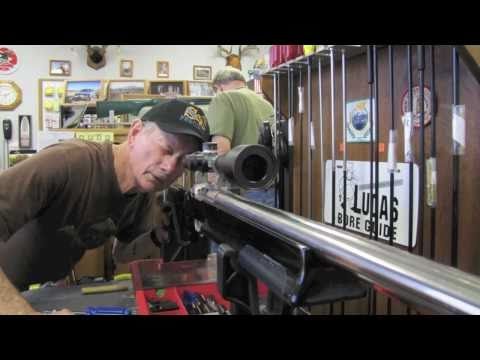
 A while back, we featured the East Texas Benchrest Shoot-out in Huntsville, TX. That match was co-sponsored by S&S Precision Rifles of Argyle, Texas. In the video below, the folks at S&S put together some tack-drivers for their customers. There are some nice glimpses of bedding work, and barrel finishing. Watch carefully — at the 40-second mark you’ll see a sub-1/4″, 10-shot group that S&S co-owner “Stick” Starks shot at 200 yards with his 6.5×47 Lapua rifle. That’s serious accuracy. Half-way through the video, Stick offers advice for shooters looking for a super-accurate fun gun for club shoots: “If you want to shoot [at] 100 and 200 yards, I’d get me a 6BR or a 30 BR. It would be the most fun gun you ever had… and the barrel will probably last three or four thousand rounds.” If you want a gun to shoot at primarily 500-600 yards, Stick recommends the 6.5×47 Lapua chambering. He told us: “Run it with the Berger 130s and Hodgdon H4350 powder. That H4350 works great with the 130 Bergers.” A while back, we featured the East Texas Benchrest Shoot-out in Huntsville, TX. That match was co-sponsored by S&S Precision Rifles of Argyle, Texas. In the video below, the folks at S&S put together some tack-drivers for their customers. There are some nice glimpses of bedding work, and barrel finishing. Watch carefully — at the 40-second mark you’ll see a sub-1/4″, 10-shot group that S&S co-owner “Stick” Starks shot at 200 yards with his 6.5×47 Lapua rifle. That’s serious accuracy. Half-way through the video, Stick offers advice for shooters looking for a super-accurate fun gun for club shoots: “If you want to shoot [at] 100 and 200 yards, I’d get me a 6BR or a 30 BR. It would be the most fun gun you ever had… and the barrel will probably last three or four thousand rounds.” If you want a gun to shoot at primarily 500-600 yards, Stick recommends the 6.5×47 Lapua chambering. He told us: “Run it with the Berger 130s and Hodgdon H4350 powder. That H4350 works great with the 130 Bergers.”
|


