February 13th, 2012
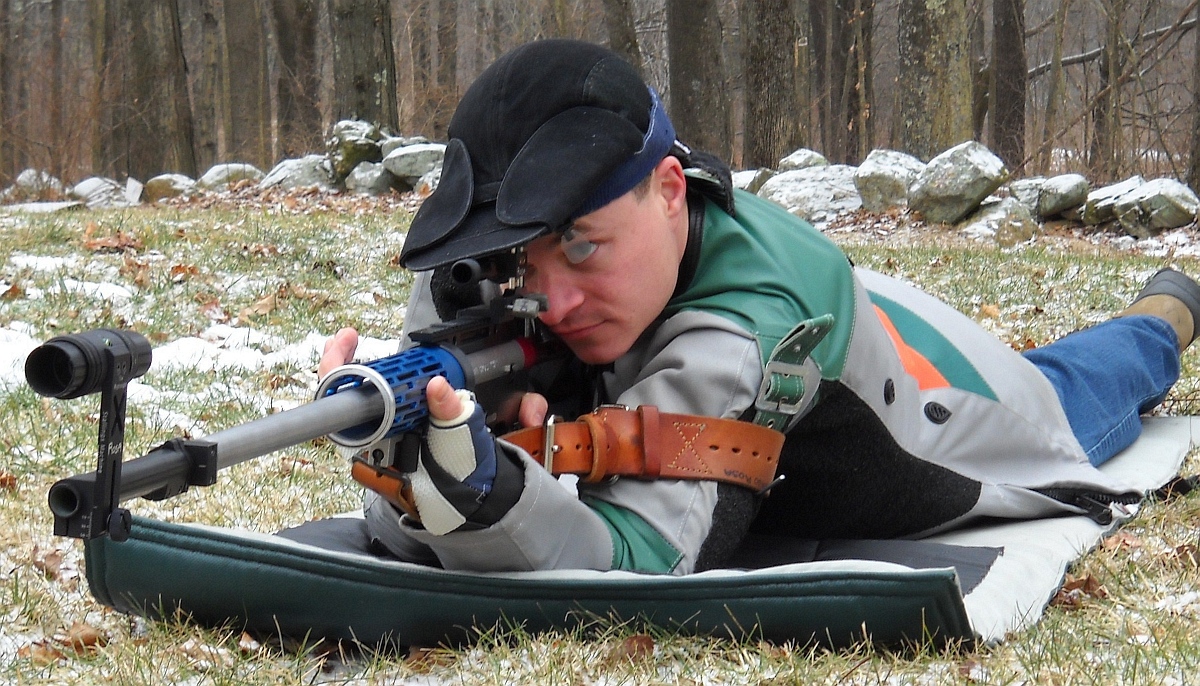
 Rodrigo Rosa is a rising star in the world of High Power shooting. Though he’s been shooting competitively for only four years, he is already a top contender at the national level. In 2011, the young marksman, who now lives and works in New Hampshire, was right up with the leaders at the NRA National High Power Championships. At Perry, Rodrigo finished second in the Across-the-Course phase and finished third in the Long Range National Championship. He was also on the winning 2d Amendment match team with Norm Houle. Over the last couple of years, Rodrigo has lead the field at New England High Power events. He was New Hampshire State Champ in 2010 and 2011, Massachusetts State Champ in 2011, and Mid-Range (and Across-The-Course) Vermont State Champion in 2009. Rosa is also a two-time NE Regional Across-the-Course Champion, winning titles in 2008 and 2011. That’s an impressive shooting resume for a young man who shot his first High Power match in 2008, and had to borrow money to get his first real match rifle.
Rodrigo tells us: “I had a good year in Camp Perry in 2011. My goal was only to perform well in the across-the-course event, so taking second place after Carl Bernosky by only 3 points and taking third place in the Long Range event was a real treat.”
What was the “secret” of Rosa’s meteoric rise from rookie shooter to podium performer at Camp Perry? Rodrigo replied: “Key factors? I would have to say dry-fire practice, and working on consistency and the ‘mental game’. I spent many hours dry-firing last winter, particularly working on my off-hand position. Despite such training my technique was still flawed at the beginning of the year. I could dry-fire very well but the results did not show on target. I believe that my ability to finally build a mental sequence that allows me to perform the same movements time-and-time again, on demand, made the greatest difference on my results.”
Interview with Rodrigo Rosa — Born to Shoot
We had the opportunity to chat with Rodrigo. He told us how he got started in competitive shooting. He then discussed his shooting techniques and his reloading methods. At our request, Rodrigo offers some tips for new sling-shooters. Rosa also revealed his preferences in hardware and shooting gear.


AccurateShooter: Rodrigo, tell us about your background. How did you get involved in shooting?
Rosa: I grew up on a farm in Brazil. When I was about 11 years old my mom bought me an air rifle, and I later inherited my grandpa’s Winchester .22LR. I hunted many rabbits and ducks with that rifle until I was 17 years old when my studies became more important. I traveled to the USA in late 2004 to finish my Veterinary clinical training at Cornell University, where I met my wife-to-be. We got married in 2005 and moved to California for internships. It wasn’t until early 2007 when I decided to buy a rifle and join a gun club. All I could afford was a simple .308 hunting rifle. With the .308, I tried (with limited success) to hit small metal silhouettes at 600 yards. Despite my limited success I decided to educate myself about the shooting sports, predominantly by reading books by David Tubb and Nancy Tompkins, as well as foreign publications.
My wife Kate and I moved to New Hampshire in 2007, when I decided to take a personal loan to buy a better rifle, suited for High Power competition. I joined the Nashua NH Fish and Game Association and started to work on my skills. In late 2010 I met Norm Houle who became a good friend and gave me extra motivation to stay in the game.
AccurateShooter: What are your strengths and what are the areas where you need improvement. What training methods do you use to improve those weak points?
Rosa: My strengths are my ability to concentrate, attention to detail and perseverance. The areas I tend to work on the most are my mental systems. I know I am able to shoot a perfect score in any yard line and shooting position, so I spend most of my time coming up with ways to make my shooting sequence as meticulous and repetitive as possible. I believe I still have a lot of work to do….
AccurateShooter: What are the best and worst things about competing at Perry?
Rosa: 2011 was my second year competing in Perry (I also started the match in 2009 but had to leave early for a family issue). I had one of the best weeks of my life! Perry is a wonderfully beautiful and challenging range, and the friends I had the pleasure to share my time with were the highlight of the trip. From previous experience, I would say that the heat and humidity are the worst things
about Perry, but 2011 gifted the competitors with amazingly pleasant weather.

AccurateShooter: Rodrigo, do you have any tips for novice High Power shooters?
Rosa: Start by investing in good equipment — buy quality and you will buy it only once. Seek the advice of successful shooters. All truly good shooters will be glad to share their “secrets”, for it is only worth winning when all competitors can shoot their best. Develop a safe, reasonably good load for your cartridge and quit messing with it! If you already have an accurate rifle your time is much better spent working on your hold than on developing loads. Be ready! Develop checklists, plans, mental sequences. The less you can worry about, and the more prepared you are for adverse situations at the firing line, the better your chances will be.
AccurateShooter: Speaking of load development, tell us what load you shoot, and what methods you use to create accurate ammo.
Rosa: I shoot the 6mmXC cartridge Across-the-Course and Long-Range (except for Palma, of course). I use Federal 210M primers, Norma brass, Hodgdon 4350 powder, Sierra 70gr bullets for 200 yards and DTAC 115gr bullets from 300 to 1000 yards. My loads are: 39.5 grains H4350 with the Sierra 70gr; 37.5 grains H4350 with DTAC 115gr for 300 yards; and lastly, for Mid-Range and Long-Range, I use a stout H4350 load with the DTAC 115s. (Editor: Start at 37.0 grains H4350 and work up with the 115s; Rodrigo’s long-range load is near max).
The most important steps of my reloading are accurate load weighing (I weigh ALL loads) and bullet selection. I select all the bullets I shoot from 600 to 1000 yards by bearing surface and length. I do not spend any time doing elaborate load testing (and re-testing). All I care about is having a reasonably accurate load that functions smoothly in my rifle.

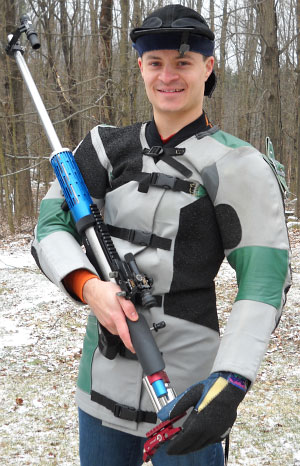 AccurateShooter: Tell us about your shooting coat and sling. Do you have any advice concerning coat fit and sling adjustment?
Rosa: I currently wear a Monard shooting coat. Proper fit is fundamental for anyone who wishes to be competitive in any category of position rifle shooting, and the folks at Monard certainly have got that down. My advice to anyone who is going to invest hard-earned money in a coat is to make sure that the maker uses at least 15 different measurements of his/her body. Anything less than that is not acceptable in my opinion. I also prefer the stiffness and coolness of canvas over leather. Leather tends to mold better to ones body but softens and shrinks when wet. Since High Power shooters must often shoot in the rain I believe that canvas is a more durable and stable material. For a sling I always used the Superior Shooting Systems Heart Breaker Sling. This is an extremely well-made sling crafted to last many decades. It is important to cut the new sling to fit one’s arm diameter so that the “hinge” is located between the arm and the hand. I did not know this important “trick” for the longest time until David Tubb called my attention to it at Perry last year.

AccurateShooter: You shoot a Tubb 2000 match rifle. Tell us the features of the T2K you really like, and explain how you set up the sights and buttstock for different positions.
Rosa: The Tubb 2000 rifle is the only rifle I have ever shot Across-the-Course. It is an extremely user-friendly gun that truly allows the shooter to extract all that a competitive target rifle can offer. I used to have only one buttstock and was therefore forced to make adjustments between shooting positions. Now I have three buttstocks individually set up for each position — a major asset in my opinion. My off-hand buttstock is probably the least orthodox of the three. It has a good deal of added weight to help balance the gun and a very narrow buttplate. I like the narrow buttplate because it fits my small shoulder better. This plate is, however, kept mostly flat (very shallow curvature) in order to comply with NRA rules (less than 1/2 inch depth).
Canting — I truly enjoy the ability to cant the T2K rifle to fit my body. Anyone who watches me shooting seated will notice that I use a great amount of canting in that seated position. Canting is a major asset and can greatly improve most shooter’s position by increasing comfort. The key thing with canting is you must be consistent with the amount of cant you use (hint: learn how to use a bubble level).
Forearm — I have shortened the tubular handguard/fore-end of my rifle in order to improve balance as well. People occasionally ask me: Didn’t you get nervous about cutting such an expensive rifle? (I had taken a loan to buy the rifle and it wasn’t even paid for yet). My answer was “Not at all!” My philosophy is that if something does not fit you or does not do the job for which it was intended, then you MUST act on it. It is pointless to have a rather costly piece of machinery if it does not lead to 10s and Xs.
Sights — I use a Warner #1 rear sight and a “Right Sight” in the front. I currently use the “Houle Tube” sight extension tube (bloop tube) made by Norm Houle. This bloop tube has been a major improvement. It lets me have a short, balanced gun for off-hand and a long gun for sling-supported positions. I must admit that I did not believe these extension devices would repeat zero until I tried one. The Houle Tubes are incredible. These extensions come in 2″, 4″ and 6″ lengths and repeat zero flawlessly every time.
Gunsmithing — Dick Beaudoin from Derry, NH has done most of the customization work on my rifle. I want to give him credit. His patience and attention to detail has made all the difference.
Editor’s Comment: We thank Forum member Rodrigo Rosa for taking the time to share his knowledge with our readers. He is a very talented, yet humble young shooter who works diligently on his game. We have no doubt that one day we will see Rodrigo standing on top of the podium at Camp Perry. Boa sorte Rodrigo, we wish you 10s and Xs and continued success…


 How to Shoot Standing
 5. Know your hold and shoot within it. The best part of my hold is about 4 inches. When I get things rolling, I recognize a still gun within my hold and execute the shot. I train to do this every shot. Close 10s are acceptable. Mid-ring 10s are not. If my hold was 8 inches I would train the same way. Shoot the shot when it is still within the hold, and accept the occasional 9. But don’t accept the shots out of the hold.