Team Applied Ballistics will soon release a new DVD on the science, skills, and strategy required for successful Extreme Long Range (ELR) shooting. The new DVD features a reality-style documentary following Team Applied Ballistics in the 2017 King Of 2 Mile (KO2M) competition. Team AB has now won this prestigious event two years in a row. Team shooter Mitchell Fitzpatrick won the KO2M title in 2016, followed by team-mate Derek Rodgers in 2017.
Bryan Litz tells us: “Applied Ballistics is proud to announce the release of our latest DVD: ELR Shooting With Applied Ballistics. With lessons learned from our successful 2016 KO2M campaign, you can see how the AB ELR team developed our equipment and approach through practice and careful analysis. Learn the essential elements of ELR competition from the top team in the sport.”
This documentary, filmed over the course of a year, shows Team Applied Ballistics preparing for, and competing in, the 2017 KO2M match. This presentation includes interviews from all Team AB members, along with tips on ELR shooting.Pre-Order the ELR DVD and Save $5.00 (Pre-Order Price $19.95)
2017 K02M Match-Winning Performance on Video
The video below shows Team Applied Ballistics shooter Derek Rodgers winning the 2017 King of 2 Miles event. This excellent video combines firing line and target-cam views. You can see the strings-of-fire at 2667 and 3028 yards. Then Watch Derek, after four misses, hit the last target with his fifth (and final) round! That plate was set at a mind-numbing 3368 yards (1.91 miles). Derek had Paul Phillips as a spotter and Emil Praslick as a wind coach — a very powerful team and it showed.
If you want to learn more about ELR shooting and how team Applied Ballistics achieves great results in ELR competition, we recommend an excellent article just released byShooting Sports USA. SSUSA’s Editor John Parker interviewed Team Applied Ballistics members Bryan Litz and Paul Phillips. Both men said that successful Extreme Long Range shooting requires solid team-work.
Bryan Litz (center) conferring with Team AB members Emil Praslick (L) and Doc Beech (R).
Paul Phillips explained: “ELR is very difficult. It requires a great shooter with 1/2-MOA accuracy, a really good wind coach and spotter to see impacts, trace and the ability to quickly negotiate and engage the targets. It’s one fluid team working together.”
Bryan Litz, Applied Ballistics founder, concurred: “Of all the various precision rifle disciplines, ELR shooting is particularly suited to a team approach. All aspects of ELR shooting are both highly challenging as well as critical to success. One individual is typically not able to stay on top of all the variables effectively enough to hit targets at extreme ranges all by themselves.”
Litz says superior wind-reading skills are vital in the ELR game: “One of the important challenges of hitting targets at long range is reading the wind. All the shooters on our team can read wind, but when we’re shooting a match, we put our strongest wind-reader in this position for all shooters. Emil Praslick is arguably the best in the world at putting a number on the wind. He’s got a well-rehearsed process that works in all scenarios. When Emil isn’t available, someone else on our team will apply his process and focus specifically on the wind.”
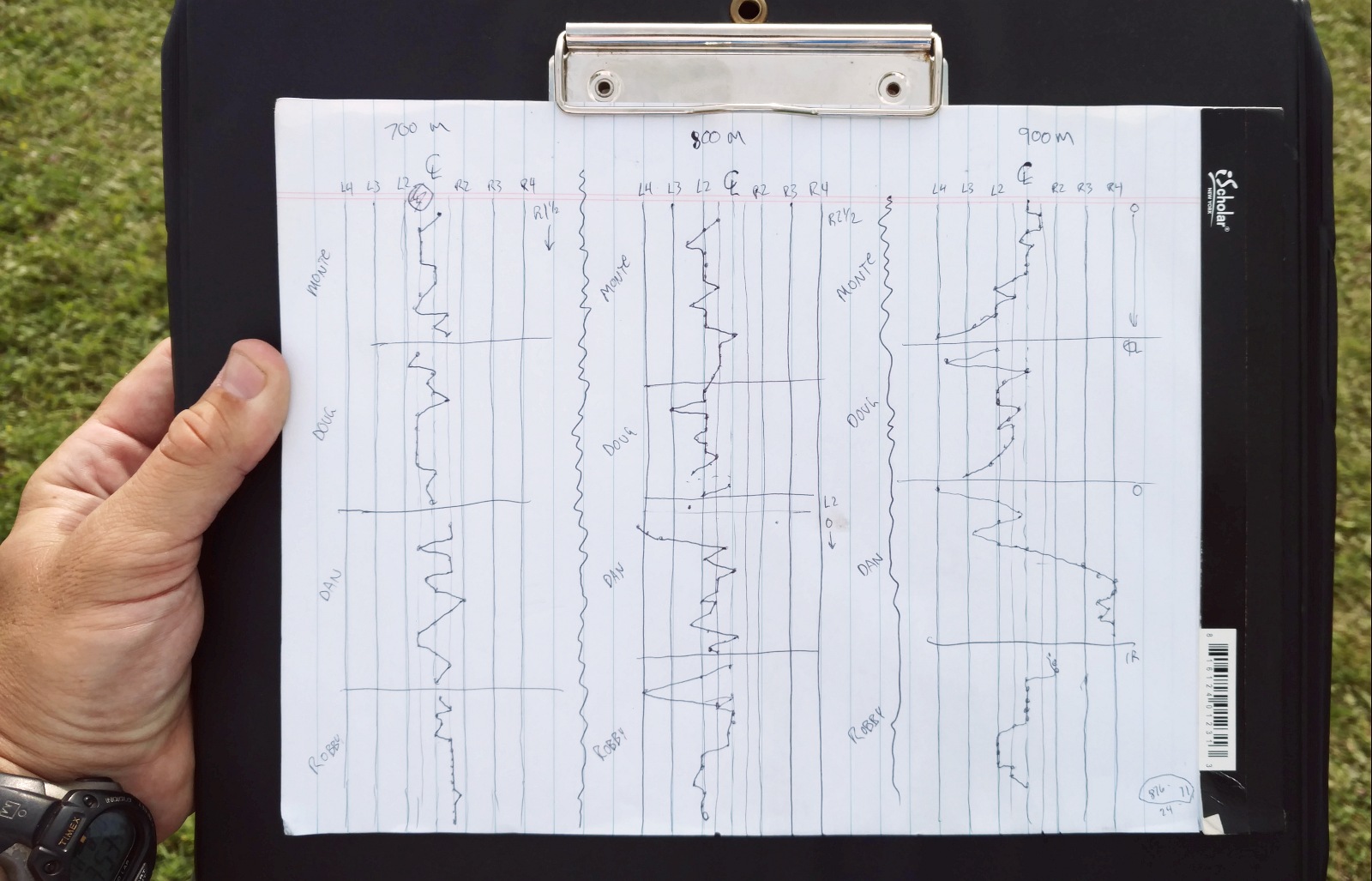
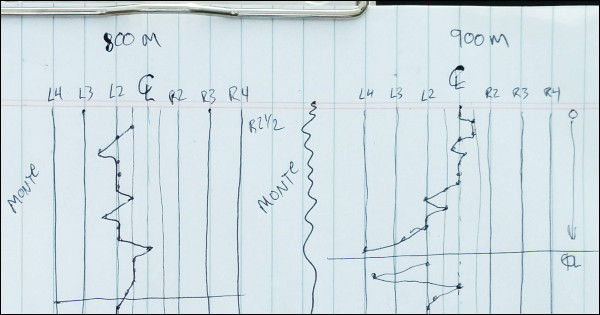
CLICK HERE to see full-screen version of Wind Plot.
The Battle of Nations begins. Today is Day 1 of international team competition at the 2017 F-Class World Championships (FCWC) in Ottawa, ON, Canada. Talented teams, in their nation’s colors, will be competing for glory and national pride.
Team shooting is very different than individual competition. Typically a team coach makes the wind calls for the shooters. In some cases (where the rules allow), the wind coach even dials elevation and windage changes for the active shooter. For the wind coach to do his job effectively, he must follow the changes in the wind and determine what the correct wind call should have been for each shot. (In other words — what was the “right call”)
Past F-TR USA Nat’l Champ Bryan Litz was wind coach for the winning 4-man LUM F-TR Team at the 2017 Canadian F-Class Championships, which preceded the FCWC Worlds. Here Bryan explains how he uses a Wind Plot to make better wind calls, helping his team-mates maximize their scores.
Wind Plot Methodology by Bryan Litz
The wind plot I use is a running history of what the correct wind call was for every shot fired. The more you shoot, the more history you have in a condition, and I find that very useful information. This kind of plot IS NOT showing where the bullet hit, and is NOT showing what you held. It’s showing what you should have held to center each shot. IMO, this is the most valuable information to have when guessing where to hold next for each shot. Here are some key points:
1. I always look for blocks of stable conditions to shoot in and wait out the rest.
2. If the wind plot shows drastic changes, either I’m not picking the right time to shoot or it’s just a really unstable wind condition.
3. When you see many shots using the same hold (e.g. Robby’s 700m and 900m strings on plot), it can indicate very fast shooting and fast pit service.
Q. What are the numbers and Markings on this Wind Plot?
Litz: The wind plot represents the rings on the target. Left 2 for example, is the 5 line on the international target, while Left 2 is the 10 line on the USA target. F-Class shooters and coaches talk about wind holds in relation to these rings. A Left 2 hold isn’t left 2 MOA or 2 MILS, it’s the second ring from center. The vertical lines on the plot represent the rings going out from center, 4 or 5 in each direction. A left or right 5 hold is edge of black on the int’l target.
Q: What Does this Specific Plot Reveal?
Litz: Looking at the plot, from left to right is 700m, 800m, and 900m that we shot progressively through the day. Top to bottom shows each shooter in sequence (shooters names are shown by their blocks). To the right I note what was on the gun for that shooter, and note when it changes. Often times we run the same wind on the gun for several shooters but if it changes, I note what the new windage is and continue on. For example if we’re settled into a condition where we’re shooting Vs with a right 3 hold, I might adjust the scope 1 MOA right because a right 3 hold is equal to 1 MOA. So we can move the scope and start shooting with a center hold.
Q. Are you Plotting Where the Bullet Hits?
Litz: Not exactly. This kind of plot IS NOT specifically showing where the bullet hit, and IS NOT showing what the shooter held. It’s showing what the shooter should have held to center each shot. IMO, this is the most valuable information to have when guessing where to hold next for each shot.
On each shot, the shooter or coach takes a guess about where to hold, and fires the shot. If the bullet hits the center, you plot the point right where you held because it was the correct hold. However, if you miss the call, you plot what hold was required to put that shot in the center. For example if you shoot a right 3 and hit where you held, the correct call would have been “center”. In this way, you’re building a history of what you should have done, which may or may not be what you actually did. This shows you the trends, and brackets which can be used to make future decisions.
Q: Is this Type of Wind Plot Something New?
Litz: I didn’t invent this method, it’s been around a long time. Vertical can be plotted the same way. In team matches, we have a plotter who is advising on elevation trends and suggesting corrections. But, as wind coach, my job is the horizontal so I only keep the wind plot. I have learned lots of strategies from my coaches Emil Praslick and Steve Hardin.
There are many ways to plot and many standard work sheets for this. They’re all tools and the key is to find something that works for you in different situations. I don’t keep a plot when I am personally behind the trigger string firing because I lose more points when I take the time to do it vs. just shooting fast. When pair firing or coaching, I can keep the wind plot without compromising the shooting.
Team Australia used plots and comms linking coaches to help win the 2013 F-Open Team World Championship. We expect other teams will follow suit in Canada in 2017.
Know Your Goal — Keep It Simple
Know your goal of plotting. The simplest plot is where you write the shot number where it hit on a target face. This kind of plotting is useful for evaluating shooter performance because it shows how big the group is (in particular the vertical dispersion). However keeping a plot like this does little to help you figure out the wind. It just shows you what shots you messed up on. It does nothing to help you find the center. [Editor: That’s a whole different matter with many variables.] The wind plot I use is a running history of what the correct wind call was for every shot fired. The more you shoot, the more history you have in a condition, and I find that very useful information.
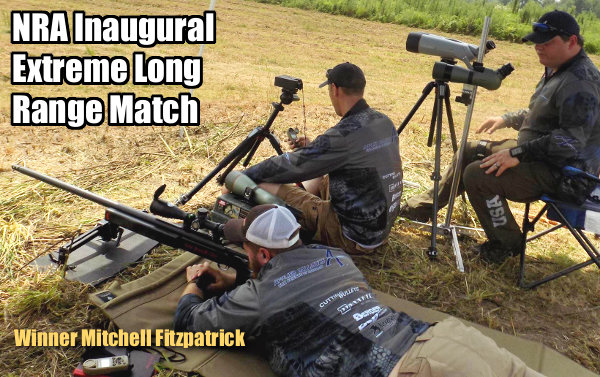
The first-ever NRA Extreme Long Range (ELR) Match took place this past week at Camp Atterbury in Indiana. Also labeled the “One-Mile Match”, this inaugural event ran as a side-match between the NRA’s Mid Range and Long Range Championships at Atterbury. The event drew many of the nation’s top marksmen, including multi-time National High Power and LR Champion David Tubb, recent F-TR National Champion Bryan Litz, and 2016 KO2M winner Mitchell Fitzpatrick.
It was a tightly-fought match. Showing exceptional skills (along with great rifles and ultra-accurate ammo), both Corbin Shell and Team Applied Ballistics’ Mitchell Fitzpatrick were perfect for 15 shots — making every shot at 1400, then 1575, and finally 1788 yards (1.016 miles). With the score tied, a 1000-yard target center (bullseye) was set on a target backer at 1988 yards (1.13 miles). Mitchell hit the target, but sadly Corbin had his first miss of the match. With that 1988-yard hit, Mitchell went down in the history books as the first-ever NRA ELR Champion. Winning at Extreme Long Range is nothing new for Mitchell, who was the winner of last year’s King of 2 Miles match in Raton, NM.
Mitchel posted: “We pulled off the win by shooting clean, never missing a shot! It was a great event and I look forward to competing in the coming years. They are trying to extend the facility to make it a 2400-yard match. With the NRA having such a rich competitive shooting history… I am beyond honored to have won the inaugural NRA ELR match. As ELR grows … it will be awesome to look back and know we were in at the ground level. Also, it should be noted that my extractor broke on the second shot at 1788 yards, and I ended up having to fire the last thre shots while extracting my cases with a cleaning rod from the muzzle end…”
Overall Standings NRA ELR One-Mile Match
1. Mitchell Fitzpatrick
2. Corbin Shell
3. Randy Pike
4. Paul Phillips
5. Dan Pohlabel
6. M. White
7. Rusty Phillips
8. Kent Reeve
9. Bryan Litz
10. David Tubb
Corbin’s Big Rig Built for Extreme Long Range
Runner-Up Corbin Shell was shooting his impressive .338 Lapua Magnum Improved barrel-block rifle, originally built for the KO2M event. It performed superbly in Indiana. This rifle was showcased here on AccurateShooter last month. READ Corbin Shell .338 LM Story.
ELR TECH — Confirming Hits at a Mile (and Beyond)
Confirming hits at extreme yardages is a challenge. With a conventional spotting scope you can see a target swinging but it is very difficult to see actual impact at extreme ranges. For this match, wireless remote TV cameras were placed near each of the targets down range. These fed video signals to monitors and tablet computers, allowing scorers to confirm hits on steel. In addition to the Targetvision target cam systems, GSL Technology had a drone to get aerial footage and augment streaming video coverage on Facebook. Sheri Judd, NRA ELR Match Manager, also captured some great still images of the event, including the images you see in this article.
Like Father, Like Son — Rusty and Paul Phillips
The NRA ELR match was a family affair for the Phillips clan. Paul Phillips shot with his father Rusty. The elder Phillips, at the ripe young age of 80, had multiple hits at one mile, earning his official “One Mile Club Certificate”. You can see Rusty shooting in the video below. Paul says: “I had a great day shooting with my dad at the inaugural NRA ELR match. My dad went four for five at 1 mile (1788 yards) on a 36″ plate and earned his One Mile Club membership. This was his first competitive match ever shot at 80 years old and he finished 7th overall! Bryan Litz and myself help keep him centered up.” Paul and his father Rusty used GSL .375 Lethal Mag Copperhead Suppressor and the .338 Lapua Copperhead.
Rusty Phillips, at 80 years, shot 4 for 5 at 1788 yards (1.016 miles) to earn his One Mile Club Certificate. Congratulations Rusty!
Photos by Stephen Fiorenzo, courtesy Applied Ballistics.
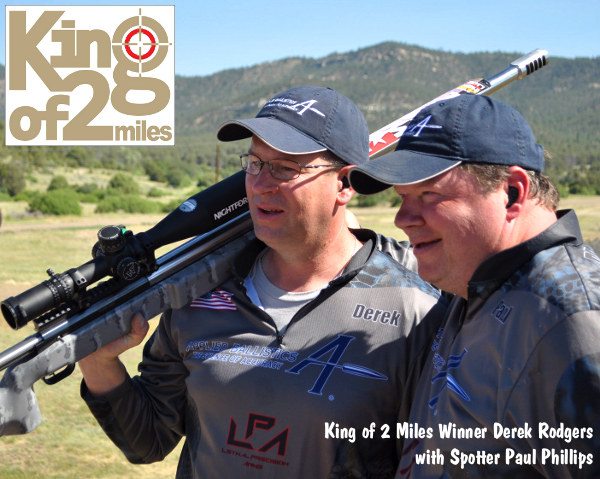
The 2017 King of 2 Miles match has concluded, and we have a new monarch. F-Class Ace Derek Rodgers is the new King of 2 Miles. Shooting with Team Applied Ballistics, Derek delivered a dominant performance, scoring nearly twice as many points as his nearest rival, Ronnie Wright. And Derek was the first KO2M marksman in history to hit the target at the maximum 3368-yard (1.91 mile) distance.
With his McMillan-stocked .375 CheyTac rifle, Derek shot brilliantly from the start. He was perfect — without a miss — at the first three yardages: 1543, 1722, and 1888. He had some misses at 1953 and 2667 yards, but then he out-shot all competitors at 3028 yards, going two for five. No other shooter managed a single hit at 3028 yards. Then it all came down to the big one — the last (and greatest) challenge, the target at 3368 yards (1.91 miles).
This would require superior shooting skills, a masterful wind call (by Emil Praslick), and nerves of steel. Derek tried four shots without success. It looked like the two-mile hit would continue to be an impossible goal. But then, on his fifth and very last shot, Derek did it — he hit the 3368-yard target.
After Derek made the (nearly) two-mile shot, cheers erupted on the firing line — what an achievement! Derek is the first (and only) shooter to make the 3368-yard shot at K02M. Watch him do it in this video:
Derek Rodgers Hits Target at 3368 Yards on his Final Shot:
Derek Rodgers K02M-Winning Hardware and Ammunition
Factory Rifle Finishes in Second Place
With so many full-custom rifles on the firing line, many were surprised to see a factory rifle finishing second overall. Ronnie Wright shot superbly with his stock Barrett M99 chambered in .416 Barrett. Ronnie’s impressive second-place performance proved the effectiveness of the .416 Barrett cartridge (and the build quality of the M99). For ammo, Ronnie used Cutting Edge 472gr MTAC projectiles loaded in Barrett-stamped .416 cases. The powder was Alliant Reloder 50 ignited by CCI #35 50 BMG primers. The rifle had a Barrett factory 32″ barrel fitted with an Accuracy 1st level.
INTERVIEW with DEREK RODGERS:
Q: What do you believe contributed to your success at this match?
Derek: This match was truly a team effort from the entire Applied Ballistics Team. Emil Praslick and Paul Phillips are world class wind-readers and spotters. They have the ability to make decisive decisions and trust that I (as the shooter) will put a bullet on target every time a command is given. We posses a dynamic team background with a lot of history and experience under our belt. Our positive team synergy is hard to find. The addition of vital tools played a huge role in our success. A few of the tools we used were the AB Kestrel and Garmin Foretrex 701 AB Elite to give absolutely crucial and accurate ballistic solutions. The new McMillan ELR Beast stock was stable and the NF ATACR scope is robust and clear. The Bartlein barrel used was top notch! However, one of the most important pieces of the ELR puzzle and the only thing that separates the target is — the bullet. We chose Cutting Edge (CE) bullets due to their high level of precision. These bullets proved to be invaluable in connecting every piece of steel at the KO2M competition. The CE 400gr Lazer Max bullet was selected and was tremendously accurate. This bullet transitioned into a sub-sonic velocity without any loss of precision at ELR distances. Our success would not be possible if the projectile did not fly correctly for 7+ seconds of flight time. CE has outstanding designs and several quality choices to choose from.
Q: How many hours would you say you practiced for this match?
Derek: It is hard to calculate practice time in hours. ELR is a program that we work on every chance we get — day and night for months prior to the event. We have an extremely strong background of team shooting and long range shooting. A lot of time has been invested on and off the range, but does not stop there. The combined range time from other disciplines really helped me to be successful in transitioning from long range to ELR. It really is a compilation of 10 years of trials and tribulations. Some would say, “the Devil is in the details”. Our team tries very hard to not overlook any small detail. Practice and training is always scrutinized for improvements. Our Applied Ballistics team has a love and passion that goes beyond measurable amounts of time. We were fortunate to get together for two days a month prior to the Ko2M event to review our program and practice as a team. Bryan Litz had a plan, and we discovered as a team we had flaws in our program. Each one of us contributed from years of experience on improving our technique until we had a winning solution.
Q: Why did you choose the .375 CheyTac cartridge?
Derek: When I was asked to join the AB Team, I needed to get an ELR rifle built in a short period of time. I was under a very tight time schedule to get the project complete. In an effort to eliminate variables, I decided to keep things standard and as simple as possible. I chose the .375 CheyTac for the ease of getting components. The larger rifles are more difficult to get components quickly and I felt like the .375 CheyTac had enough attributes to be competitive at ELR distances.
The Cutting Edge 400gr bullets are milled from solid copper bar stock on a CNC Swiss-style lathe.
New ELR Hardware and Software on Display at K02M
This marks the second straight year that Team Applied Ballistics has won the K02M event. Last year, Team AB shooter Mitchell Fitzpatrick won the coveted “King of 2 Miles” title (Fitzpatrick finished fourth this year, just off the podium). In the past year, there has been considerable evolution in Extreme Long Range hardware and software, and projectiles are constantly being improved.
Bryan Litz (center) conferring with Team AB members Emil Praslick (L) and Doc Beech (R).
We asked Bryan Litz, founder of Applied Ballistics, to summarize developments in the ELR game. Here are Bryan’s observations:
“Each year the KO2M sees advancements and shooters converging on those tools and processes that have proven effective in prior years. It’s rather apparent, for example, that spotting impacts is a crucial part of success in this match. This was improved by the match directors/organizers placing the targets in very good locations for spotting impacts. We’re seeing less set-ups with adjustable bases, and more with solid/fixed scope mounts. One of the exciting new pieces of equipment is the periscope device made by TACOMHQ (John Baker). This device provides an optical shift to the image which allows you to get more elevation for those long shots. Also, the refinement of fire control (ballistic) solutions has really played a role in getting shooters centered up for their first shots.”
“This tournament highly favors first-round impacts with the scoring system, so the approach of ‘walking the shots on’, isn’t a winning strategy. Those who employed accurate ballistics solvers were able to score more first round hits, and pile up the points. First and second place (at least) were using Applied Ballistics solvers to center their shots. We’re looking forward to even more advancements and making these ELR shots even out to two miles more commonplace in the future thru systematically applying the Science of Accuracy.”
In this video, Bryan Litz of Applied Ballistics focuses on training. Bryan says that training is key for success in Long Range shooting: “Training in the sense that you want to want to refine your fundamentals of marksmanship — your sight alignment, your trigger control. You should practice those things enough that they become second nature and you don’t have to think about them. Keep in mind, it’s not just good enough to train, you have to learn how to train. You need to learn how to practice effectively, to get the most out of everything you do.”
Bryan says that success in Long Range shooting is not just about the hardware. It’s what’s between your ears that really counts: “The most important element in Long Range shooting is your knowledge — your understanding and practice of fundamentals of marksmanship, as well as your understanding of ballistics. You have to be able to fire the rifle, execute good shots that will put your rounds on target, but you also need to make intelligent sight corrections that will accurately account for the effects of gravity drop, and wind deflection, to center your group on those targets”.
Litz Competition Shooting Tips
Competition TIP ONE. Improving your scores in long range competition is a constant process of self-assessment. After each match, carefully analyze how you lost points and make a plan to improve. Beginning shooters will lose a lot of points to fundamental things like sight alignment and trigger control. Veteran shooters will lose far fewer points to a smaller list of mistakes. At every step along the way, always ask yourself why you’re losing points and address the issues. Sometimes the weak links that you need to work on aren’t your favorite thing to do, and success will take work in these areas as well.
Competition TIP TWO. Select your wind shooting strategy carefully. For beginners and veterans, most points are typically lost to wind. Successful shooters put a lot of thought into their approach to wind shooting. Sometimes it’s best to shoot fast and minimize the changes you’ll have to navigate. Other times it’s best to wait out a condition which may take several minutes. Develop a comfortable rest position so you have an easier time waiting when you should be waiting.
Competition TIP THREE. Actively avoid major train wrecks. Sounds obvious but it happens a lot. Select equipment that is reliable, get comfortable with it and have back-ups for important things. Don’t load on the verge of max pressure, don’t go to an important match with a barrel that’s near shot out, physically check tightness of all important screws prior to shooting each string. Observe what train wrecks you and others experience, and put measures in place to avoid them.
We know many of our readers aren’t 100% clear on the difference between a secant ogive bullet and a tangent ogive bullet. Add the “blended” or “hybrid” ogive into the design equation and you add to the confusion. In this article, Berger Ballistician Bryan Litz, explains the characteristics of the three popular ogive types: tangent, secant, and hybrid.
In discussions of ballistics, you’ll see references to “tangent” and “secant” bullet shapes. For many readers, these terms can be confusing. To add to the confusion, bullet makers don’t always identify their projectiles as secant or tangent designs. This article provides a basic explanation of tangent and secant designs, to help you understand the characteristics of both bullet shapes.
Tangent vs. Secant vs. Hybrid
Most match bullets produced today use a tangent ogive profile, but the modern VLD-style bullets employ a secant profile. To further complicate matters, the latest generation of “Hybrid” projectiles from Berger Bullets feature a blended secant + tangent profile to combine the best qualities of both nose shapes. The secant section provides reduced drag, while the tangent section makes the bullet easier to tune, i.e. less sensitive to bullet seating depth position.
Berger Bullets ballistician Bryan Litz explains tangent and secant bullet ogive designs in a glossary section of his Applied Ballistics website, which we reprint below. Bryan then explains how tangent and secant profiles can be combined in a “hybrid” design.
How Bullet Ogive Curves are Defined
While the term “ogive” is often used to describe the particular point on the bullet where the curve reaches full bullet diameter, in fact the “ogive” properly refers to the entire curve of the bullet from the tip to the full-diameter straight section — the shank. Understanding then, that the ogive is a curve, how is that curve described?
LITZ: The ogive of a bullet is usually characterized by the length of its radius. This radius is often given in calibers instead of inches. For example, an 8 ogive 6mm bullet has an ogive that is a segment of a circular arc with a radius of 8*.243 = 1.952”. A .30-caliber bullet with an 8 ogive will be proportionally the same as the 8 ogive 6mm bullet, but the actual radius will be 2.464” for the .30 caliber bullet.
For a given nose length, if an ogive is perfectly tangent, it will have a very specific radius. Any radius longer than that will cause the ogive to be secant. Secant ogives can range from very mild (short radius) to very aggressive (long radius). The drag of a secant ogive is minimized when its radius is twice as long as a tangent ogive radius. In other words, if a tangent ogive has an 8 caliber radius, then the longest practical secant ogive radius is 16 calibers long for a given nose length.”
Ogive Metrics and Rt/R Ratio
LITZ: There is a number that’s used to quantify how secant an ogive is. The metric is known as the Rt/R ratio and it’s the ratio of the tangent ogive radius to the actual ogive radius for a given bullet. In the above example, the 16 caliber ogive would have an Rt/R ratio of 0.5. The number 0.5 is therefore the lowest practical value for the Rt/R ratio, and represents the minimum drag ogive for a given length. An ogive that’s perfectly tangent will have an Rt/R ratio of 1.0. Most ogives are in between an Rt/R of 1.0 and 0.5. The dimensioned drawings at the end of my Applied Ballistics book provide the bullets ogive radius in calibers, as well as the Rt/R ratio. In short, the Rt/R ratio is simply a measure of how secant an ogive is. 1.0 is not secant at all, 0.5 is as secant as it gets.
Hybrid Bullet Design — Best of Both Worlds?
Bryan Litz has developed a number of modern “Hybrid” design bullets for Berger. The objective of Bryan’s design work has been to achieve a very low drag design that is also “not finicky”. Normal (non-hybrid) secant designs, such as the Berger 105gr VLD, deliver very impressive BC values, but the bullets can be sensitive to seating depth. Montana’s Tom Mousel has set world records with the Berger 105gr VLD in his 6mm Dasher, but he tells us “seating depth is critical to the best accuracy”. Tom says a mere .003″ seating depth change “makes a difference”. In an effort to produce more forgiving high-BC bullets, Bryan Litz developed the hybrid tangent/secant bullet shape.
Bryan Litz Explains Hybrid Design and Optimal Hybrid Seating Depths
Any long range shooter knows that wind is our ultimate nemesis. The best ways of overcoming wind are to measure what we can and use computers to calculate deflection. The Applied Ballistics Kestrel is a great tool for this. As good as our tools may be, we don’t always have them at our fingertips, or they break, batteries go dead, and so on. In these cases, it’s nice to have a simple way of estimating wind based on known variables. There are numerous wind formulas of various complexity.
The Applied Ballistics (AB) Wind Hack is about the simplest way to get a rough wind solution. Here it is: You simply add 2 to the first digit of your G7 BC, and divide your drop by this number to get the 10 mph crosswind deflection. For example, suppose you’re shooting a .308 caliber 175-grain bullet with a G7 BC of 0.260 at 1000 yards, and your drop is 37 MOA. For a G7 BC of 0.260, your “wind number” is 2+2=4. So your 10 mph wind deflection is your drop (37 MOA) divided by your “wind number” (4) = 9.25 MOA. This is really close to the actual 9.37 MOA calculated by the ballistic software.
WIND HACK Formula
10 mph Cross Wind Deflection = Drop (in MOA) divided by (G7 BC 1st Digit + 2)
Give the AB wind hack a try to see how it works with your ballistics!
Some Caveats: Your drop number has to be from a 100-yard zero. This wind hack is most accurate for supersonic flight. Within supersonic range, accuracy is typically better than +/-6″. You can easily scale the 10 mph crosswind deflection by the actual wind speed. Wind direction has to be scaled by the cosine of the angle.
Getting started in long-range shooting? Need some pointers on gun set-up and hardware options? Bryan Litz of Applied Ballistics has created a helpful series of videos for the NSSF covering long range shooting. Bryan, a past F-TR Long-Range National Champion and Chief Ballistician for Berger Bullets, knows his stuff. His Applied Ballistics squad was the winning team at the 2016 King of 2 Miles event. Here are four (4) videos, each covering a topic of interest for long-range shooters. Running 3-4 minutes each, these videos can help you get started, and invest wisely when acquiring your next long-range rifle, scope, and accessories.
Long Range Precision — The Keys to Success
TIP for Plotting Long Range Trajectories: You want to know the true, actual ballistic coefficients of your loads. The BCs listed by manufacturers for their projectiles may be somewhat unreliable — the real BC could be higher or lower (and BC can change with velocity). That can result in problems at longer distances. Using sophisticated equipment, Applied Ballistics has measured true BCs for hundreds of projectiles. Plugging these verified numbers into your Ballistics App can improve your hit percentage at long range.
Tools of Choice — Purpose-Built Long Range Rifles
TIP for Choosing a Rifle: When you’re selecting a rifle for long range shooting, it’s important to understand your application and objectives. The applications for long-range shooting can be very refined. You have to select all the details of your application to select the correct rifle. Here are two examples — a semi-auto AR-platform rifle with scope and a bolt-action Fullbore (Palma) rifle with aperture sights. There are many other long range disciplines — F-TR for example. The F-TR rig uses a bipod and rear bag and a scope. To be competitive, a modern F-TR rig should shoot well under half-MOA.
Equipment Advice — Upgrading Your Hardware
TIP for Upgrading Your Rifle: At some point factory rifle owners will recognize weak links in the equipment chain. You can run that factory rifle for quite some time, but the barrel is eventually what’s going to hold you back. The twist-rate may not be high enough to stabilize the high-BC bullets. So the first thing you’re going to want to upgrade is the barrel. You want to get a fast twist-rate barrel with a chamber that is optimized for the bullet you’ll be shooting. A good-quality, custom barrel will be easier to clean, and it will improve the overall accuracy and precision of your shooting.
Big Boomers — Large-Caliber Rifles for Long Range
TIP for Shooting Hard-Recoiling Rifles: Bryan Litz defines “Large Caliber” as .338 caliber and bigger. These rifles can shoot heavy bullets with high BCs. However there are some trade-offs. It can be hard to maintain good fundamentals of marksmanship (trigger control, sight alignment) when you’re fighting heavy recoil and burning 100+ grains of powder. You’re dealing with the challenges that high energy brings. You want a muzzle brake with any cartridge .338 or above. Also, when considering lathe-turned solid bullets, remember that these typically have less sectional density compared to lead-cored bullets with similar profiles. This affects ballistics as well as recoil energy.
Applied Ballistics is running a big promotion this Memorial Day weekend, to honor those who served their country. There are significant savings on top-flight, category-leading products, such as the Sig Kilo 2400 LRF, and Kestrel Elite. Check out these deals…
Starting Saturday and ending Monday (72 Hours) Applied Ballistics offers these DEALS:
No coupon code is needed, discounts will automatically apply at checkout. Sale pricing while supplies last, NO back-orders.
The folks at Applied Ballistics also asked to note that military and LEO personnel qualify for discounts all the time: “Active Military Members and Law Enforcement (Including Allied Nations) get a 10% discount off MSRP with proof of current active service 365 Days a Year!”
FREE Hazmat Fees at Grafs.com
Now through Monday May 29 at 11:59 pm CST, you can order powder and primers from Grafs.com with no Hazmat fees. To qualify for FREE Hazmat, you must order at least sixteen (16) pounds of smokeless powder. You can add other items to the shipment — up to 50 pounds total of hazmat products. This deal will save you $20.00 if you order this weekend. NOTE: standard $7.95 fixed-rate handling fee applies, and this offer is good for in-stock items only (no back-orders).
FREE Shipping at Bruno Shooters Supply
Now through Tuesday, May 30th at 8:00 am PT, you can get FREE Shipping on all products in stock at Bruno Shooters Supply. This is a great offer because the free shipping applies to everything in stock — actions, stocks, barrels, optics, reloading components, tools and more. But there are some qualifications:
1. Free Shipping requires a minimum order of $150.00, or $299.00 for powder and primers.
2. The Free Shipping offer applies to in-stock items only — no back-orders. Also this does not cover gunsmithing or complete rifles.
3. Hazmat orders will still have a $32 hazmat fee.
Sale Tips from EdLongrange. We welcome reader submissions.
There’s a new home on the web for Extreme Long Range (ELR) shooters. Bryan Litz and Applied Ballistics recently launched ELR Central, a new website dedicated to ultra-long-range shooting*. This new site will offer a wide variety of information. Bryan Litz explains: “The most visible element of ELR Central will be a website which will serve to publish and promote all ELR shooting events going on across the country. Although owned and operated by Applied Ballistics, ELR Central will rely heavily on input from the community in order to best serve the sport as a whole.” Along with the ELR Central website, Applied Ballistics has launched a new ELR Central Facebook page.
Content Available on ELR Central
The ELR Central website will eventually offer a comprehensive library of information and activity reports. Bryan and his team plans to build out the website to include all the following:
1. Map of ELR ranges across the USA.
2. List of ELR events with links to the Match Directors’ pages.
3. Technical information and articles for the ELR community.
4. Match results/reports, including equipment lists where available.
5. Analysis of what equipment and shooters are doing well in ELR.
6. Links to other ELR shooting resources such as forums and websites.
On 5/13/17, the Applied Ballistics ELR Team had a successful practice at 3161 Yards (1.8 miles). Bryan Litz reports: “The main goal … was to test how the Berger and Cutting Edge bullets traveled through transonic and subsonic speeds. We all made several hits on target and several within 1 MOA of center.”
Standardized ELR Targets
Another goal of ELR Central is to develop standardized ELR targetry. Bryan explains: “In competitive rifle shooting, standardization of targetry is important. Applied Ballistics, through ELR Central, will provide steel targets to organizations wishing to run ELR matches and/or record-setting events. No one would be required to use these standard targets, we’re simply providing resources to help promote promote some consistency.” The initial standard target, produced by MGM Targets, will be a steel square, 3 feet (36″) per side.
ELR Central is Not A Rule-Making Entity
Bryan was quick to explain that ELR Central is not a governing body, but rather it was created to help advance the sport (and science) of shooting at very long distances, one mile and beyond: “The concept of ELR Central is a result of the ongoing discussions about standardizing ELR matches, records, targets, and more. Although ELR Central will not be enforcing these details, there is a measure of organization which we feel is appropriate, would benefit the sport, and that we are willing to provide. ELR Central is NOT a governing or sanctioning body. We do not have nor seek the authority to dictate how matches are run. For anyone who asks, we can advise on best practices, and what’s generally working, but we’re not here to tell anyone what to do nor how to do it.”
More Information on ELR Competition, per ELR Researcher:
(1) By consensus of the parties involved in the ELR meetings held at SHOT this year, and notwithstanding the names and descriptions of certain “ELR” web sub-forums, “ELR” has been defined as “beyond 1500 yards”.
(2) ELR Central-recognized “ELR” events require that more than one-half of targets must be beyond 1500 yards. Where all criteria are not met an event may be promoted as having “ELR components”.
(3) “ELR Central has published a set of guidelines and standards by which official world records can be established.” CLICK HERE for guidelines/standards.
Story tip from EdLongrange. We welcome reader submissions.








 We know many of our readers aren’t 100% clear on the difference between a secant ogive bullet and a tangent ogive bullet. Add the “blended” or “hybrid” ogive into the design equation and you add to the confusion. In this article, Berger Ballistician Bryan Litz, explains the characteristics of the three popular ogive types: tangent, secant, and hybrid.
 Hybrid Bullet Design — Best of Both Worlds?


 Standardized ELR Targets


