Federal Premium has a new online Ballistics Calculator. This free program can determine the trajectory for any rifle or handgun load, and even save your ballistics solutions for future reference. This is handy if you shoot Federal ammunition, because all Federal ammo types are included in the built-in database, with BCs and velocities. That makes it very easy to get a ballistics solution for Federal factory ammo — simply enter the caliber and bullet type/weight and the solver fills in the BC and velocity for you.
Federal’s Ballistics Calculator can also be used for handloaded ammo with non-Federal components. However, you can only use a G1 BC and Federal’s solver is not as sophisticated as some others. We still recommend JBM Ballistics or the new Applied Ballistics Online Solver. These both offer both G1 and G7 and extensive databases of field-derived BCs for hundreds of bullets. The Federal Ballistics Calculator only has BC numbers for factory-made Federal ammunition.
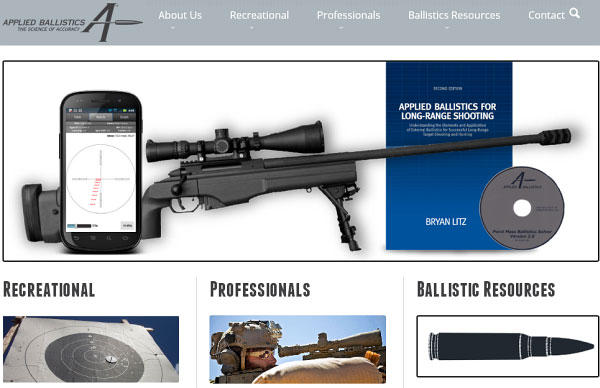
Applied Ballistics LLC has launched a completely updated website with many new features including an archive of FREE articles plus a full-featured online ballistics calculator. If you are interested in precision shooting, you should visit the “new and improved” Applied Ballistics website. Browse through the new content and try out the advanced Ballistics Calculator.
NEW Online Ballistics Calculator
There are many free online ballistics calculators, but the new Applied Ballistics web utility goes far beyond other web-based options. Bryan Litz states: “No ballistic solution can be more accurate than its inputs”. Accordingly, Applied Ballistics offers the most reliable BC data available — a built-in library of measured G1 and G7 BCs for over 200 bullets. The Online Ballistics Calculator also allows you to “offload” your results for use in the field in two ways. First, you can save a file for transfer to an Applied Ballistics Kestrel. (This process is supported with a ‘save profile’ option from the output page.) Alternatively, you can send the ballistics profile to Accuracy First DG to have a whiz wheel created.
The Online Ballistics Calculator has many “advanced” features. For example, you can enter sight scale factors to account for scopes which don’t track perfectly true, and also zero offsets which allows you to compensate for imperfect zeros. In addition, this is the first online ballistics program to provide dynamic WEZ (Weapon Employment Zone) analysis. This WEZ feature gives users the ability to calculate hit percentage on targets at a variety of ranges (and in various environments).
Bullet Data Files
The new website provides a number of detailed bullet data files. These data files include geometric dimensions, drag/BC data at multiple velocities, and detailed stability maps. The information is based on direct measurements and live fire testing conducted by Applied Ballistics.
Digital Media
The new Applied Ballistics website features a “digital library” of authoritative articles in PDF and eReader (Kindle, Nook) formats. You can download these FREE articles by clicking on the “Recreational” and “Professional” tabs at the top of Applied Ballistics Home Page, and then selecting “Recreational Articles” or “Professional Articles” from the pull-down menus.
Sample Ballistics Article Gyroscopic (Spin) Drift and Coriolis Effect
Most long range shooters are aware of the effects of gravity, air resistance (drag), and wind vectors on their bullets’ trajectory. Gravity, drag, and wind are the major forces acting on a bullet in flight, but they’re not the only forces. In this article, Bryan Litz explains some of the more subtle forces that influence a bullet’s flight.
Sample Professional Article 300 Winchester Magnum vs. 338 Lapua Magnum WEZ Analysis
The specific intent of this Weapon Employment Zone (WEZ) report is to compare the ballistic performance of the 300 Winchester Magnum to the 338 Lapua Magnum with several available ammunition types. Understanding how these weapons compare in terms of hit percentage is important in the context of modern military applications.
Special Projects
Applied Ballistics is involved in some advanced, special projects. The new website showcases some of these high end ballistics solutions. Bryan Litz notes: “We have an active ballistics laboratory, highly capable contractors and industry partners who all contribute to provide practical and accurate solutions for a range of recreational and professional applications.”
As you may know already, Bryan Litz of Applied Ballistics LLC has produced an excellent 3-Disc DVD set entitled Putting Rounds on Target. When one views the end result one can forget the hard work and tribulations that go into making such a production. Sometimes Mother Nature doesn’t cooperate when the crew is out at the range.
Bryan tells us:
“Filming for ‘Putting Rounds on Target’ proved to be a bit more challenging then we had expected. For this segment in the third disk, we packed up and set up everything over half a dozen times to keep the camera and shooting equipment dry as the sun played Peek-a-boo behind rain clouds. The chilled temperatures, required a lot of hot coffee, but the lack of restrooms made for a long day. In the end, it was totally worth it!
Watch Trailer Video of Putting Rounds on Target DVD Set
We want to say “Happy Birthday” to Bryan Litz of Applied Ballistics LLC. Bryan came to earth from Planet Krypton on August 7, 1979, making him a ripe old 34 years of age today. (One more year and he’s over the hill).
In an industry where many products are conceived and marketed by folks who spend more time on the golf course than the shooting range, it’s reassuring to know that there are still guys like Bryan who shoot what they sell, and who put in the trigger-time to acquire (and maintain) world-class shooting skills. Bryan, who actually worked as a rocket scientist before founding Applied Ballistics, is one of the nation’s leading long-range sling shooters — with the trophies to prove it. As well, the bullets Bryan designed for Berger bullets, particularly the Berger Hybrids, are helping competitive shooters around the world shoot higher scores and win more matches.
Palma Match from a Shooter’s Perspective
For those of you who haven’t seen it before, here is a “shooter’s POV” video of Bryan shooting an 800-yard Palma match. In the video Bryan shoots a 149-12X over a 15-shot string. NOTE: This video was speeded up in editing to keep it to a reasonable length.
On the Applied Ballistics Facebook page, Ballistician Bryan Litz regularly offers a “Tuesday Trivia” question about ballistics. Today’s brain-teaser is a true/false question about bullet stabilization. On shooting forums you often find heated arguments about “over-stabilization”. Bryan wants readers to consider the issue of over-stabilization and answer a challenge question…
Is This Statement TRUE or FALSE?
“The problem with ‘over-stabilizing’ a bullet (by shooting it from an excessively fast twist rate) is that the bullet will fly ‘nose high’ on a long range shot. The nose-high orientation induces extra drag and reduces the effective BC of the bullet.”
True or False, and WHY?
Click the “Post Comment” link below to post your reply (and explain your reasoning).
Bullet Movement in Flight — More Complicated Than You May Think
Bullets do not follow a laser beam-like, perfectly straight line to the target, nor does the nose of the bullet always point exactly at the point of aim. Multiple forces are in effect that may cause the bullet to yaw (rotate side to side around its axis), tilt nose-up (pitch), or precess (like a spinning top) in flight. These effects (in exaggerated form) are shown below:
Yaw refers to movement of the nose of the bullet away from the line of flight. Precession is a change in the orientation of the rotational axis of a rotating body. It can be defined as a change in direction of the rotation axis in which the second Euler angle (nutation) is constant. In physics, there are two types of precession: torque-free and torque-induced. Nutation refers to small circular movement at the bullet tip.
Bryan Litz, author of two leading books on practical rifle ballistics, has produced a 3-disc multi-media DVD: Putting Rounds on Target. We’ve previewed this new DVD set from Applied Ballistics. The DVDs are very thorough and very well-made. This is an important product release — there is nothing like it on the market. If you are a serious long-range shooter, put this DVD set on your wish list. Even if you own one or both of Bryan’s books, we know you can benefit from this product. The DVD format provides many graphic aids and video clips that illustrate key principles being covered. The three DVDs deliver as much information as a weekend shooting seminar… at a fraction of the cost.
The 3-disc DVD set costs just $39.95. That’s a bargain. Many shooting-related DVDs, with much less information, cost as much (or more) for a single disc. Putting Rounds on Target includes THREE discs, with a total run-time of 3 hours and 37 minutes. Plus, in addition, Bryan is tossing in a fourth, BONUS disc with 40 minutes of match coverage from the Berger SW Nationals. This documentary-style DVD highlights individual and team competition in Sling, F-Open and F-TR classes.
Watch Video Preview of Applied Ballistics 3-DVD Set
Interested? Pre-orders for Applied Ballistics’ new 3-disc instructional DVD set are now being accepted on the Applied Ballistics website for an expected ship date of August 15, 2013. CLICK HERE to Pre-Order.
Bryan tell us that his new DVD set was designed to give shooters the technical knowledge that will improve their scores on the target: “We explain the science involved in putting rounds on target at long range. After a classroom-type presentation (on video), we demonstrate the principles in live fire at the range with three different rifles (.308 Win, .284 Win, and .338 LM). In the end, DVD viewers will have the information and techniques required to master this technical subject matter. Follow along as the science is applied on the range to hit targets from 100 yards to a mile (1760 yards) with different rifles and ballistic solutions.”
Disc 1
Accuracy & Precision
Tall Target Test
Chronographs & Statistics
Ballistic Coefficient
Trajectory Terms
Run Time: 1 hour, 4 min
Disc 2
Primary Elevation Influences Wind
Secondary Effects
Using Ballistics Solvers
Short & Long Range Equipment
Run Time: 1 hour, 11 min
Disc 3
On The Range: .308 Win
On The Range: .284 Win
On The Range: .338 LM
Extended Range Shooting
Equipment for Extended Range Shooting
One Mile Shooting
Run Time: 1 hour, 22 min
FREE BONUS DISC
The Applied Ballistics instructional DVD set also includes a fourth BONUS disc: Long Range Competition: It’s Worth It. Filmed at the 2013 Berger SW Long Range Nationals, this 40-minute video DVD shows NRA long-range target shooting in Sling, F-TR, and F-Open divisions. Both individual and team competition are featured. If you like competitive shooting, you’ll enjoy this bonus disc.
About Bryan Litz
Champion shooter and Ballistician Bryan Litz explains and demonstrates the science of external ballistics for use in long range shooting. Bryan Litz is a well-known expert in the field of external ballistics. His books, Applied Ballistics for Long Range Shooting and Accuracy and Precision for Long Range Shooting are considered “required reading” for serious long range shooters — both recreational and professional.
Bryan Litz, author of Applied Ballistics for Long-Range Shooting, told us that Kestrel will unveil a new “Shooter’s Weather Meter” this week at SHOT Show. The brand-new Kestrel Shooter’s Weather Meter will feature Bryan’s sophisticated Applied Ballistics software inside. This allows shooters to calculate very accurate trajectories while measuring up to 15 environmental parameters. This is a big step forward, according to Bryan.
When can you get your hands on one? The new Shooter’s Weather Meter will be available for pre-order for spring 2013 production. [Bryan hosted a demonstration at the Kestrel SHOT Show Booth Thursday at 2:00 pm.]
With integrated Applied Ballistics software, Kestrel users are now able to select from either G1 or G7 ballistic coefficients (BC) when calculating a trajectory. The new Ballistics Kestrel also offers the very extensive “Litz”-measured BC library of over 225 bullets. In addition to these features, users can “train” the software to match a specific rifle based on observed impacts at long range with the ballistics calibration feature. With more accurate BC data, shooters are empowered to make more precise trajectory calculations.
Watch Video about Kestrel Shooters’ Weather Meter with Applied Ballistics Software
New Kestrel Can Communicate with Remote Wind Sensors
The new Kestrel Shooter’s Weather Meter can receive data from wind sensor arrays designed and sold by Applied Ballistics. The use of remote sensors allows actual wind data from various distances down-range to be factored into the ballistics solution. Kestrel says that no other handheld weather meter has offered this kid of multi-array “remote sensing” capability before. Like all Kestrels, the Shooter’s Weather Meter is IP67 waterproof and ruggedized to MIL-STD-810F standards.
Kestrel Weather & Environmental Meters are manufactured by Nielsen-Kellerman, which has produced advanced environmental instruments for more than 15 years. Every Kestrel meter is pocket-sized, rugged, accurate, waterproof, easy-to-use, and backed by an industry-leading five-year warranty.
As we reported a few weeks ago, Bryan Litz has written a new book, Accuracy and Precision for Long Range Shooting. We know many readers have pre-ordered Bryan’s latest book. Here’s the good news. Bryan reports that most pre-orders for the new book shipped yesterday, and the rest will go out today.
We asked Bryan to explain the differences between his original Applied Ballistics for Long Range Shooting resource book and the new Accuracy and Precision book. Here is Bryan’s explanation…
The first book, Applied Ballistics for Long-Range Shooting, covers the elements of long range shooting and explains how all the various mechanisms of external ballistics affect trajectories. It’s also the book that contains detailed drawings, BC and stability data for hundreds of bullets.
The new book, Accuracy and Precision for Long Range Shooting explains the impact of external ballistic effects in terms of “hit percentage”. For example, if you choose to ignore Coriolis Effect in your ballistic solution, how much will your hit percentage be reduced on a 10″ target at 1000 yards? How about a 5″ target at 500 yards? How much would your hit percentage be improved on a 15″ target at 1200 yards if you reduce wind uncertainty from +/-3 mph to +/-2 mph?
There are also numerous performance comparisons between different classes of cartridges. For example: how much higher is hit percentage for a .338 Lapua Magnum than a .308 Winchester for common environments and targets?
The new book identifies accuracy and precision effects and defines their effects separately. Did you ever wonder why it’s so easy to shoot a 10 inch GROUP at 1000 yards, but how difficult it is to HIT A 10″ TARGET at 1000 yards on the first shot? Shooting a 10 inch group is precision, but centering the group is a challenge of accuracy.
It’s quite common for long range shooters to focus 90% of their effort on the precision aspect, and only 10% on accuracy. To actually hit targets, you need a balance of accuracy and precision, with accuracy becoming increasingly more important as range is extended. — Bryan Litz
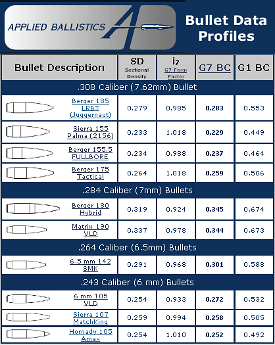
Along with showcasing his books, match ammo, and other products, Bryan Litz’s Applied Ballistics website offers detailed Bullet Data Profiles for popular match projectiles. These profiles provide accurate bullet dimensions, stability factors (based on barrel twist rates), plus sophisticated multi-value BC tables that provide field-tested BCs across a wide velocity spectrum. Using these tables, you can select a G1 or G7 BC that closely matches a bullet’s actual muzzle velocity fired from your gun. Choosing the right BC for a bullet’s known MV from your rifle provides a more accurate ballistics solution — which translates to more first-round hits on the target.
New 6mm Bullet Data Profiles
Bryan recently added two new 6mm Bullet Profiles to his website: Sierra’s 107gr MatchKing, and Hornady’s 105gr A-Max.
Sierra 107gr MatchKing, HPBT
Sierra’s 107gr MatchKing has been used reliably in many medium- to high-capacity 6mm chamberings for many years. At 107 grains, this bullet is heavy enough to have a respectably-high BC while not being excessively long. This bullet is the ‘middle brother’ in the heavy end of Sierra’s 6mm target bullet line-up. The 95gr and the 115gr bullets have essentially the same nose and tail, and almost identical form factors as a result. The only difference being the weight which is taken up in the bearing surface. This bullet is comfortably stable in a 1:8″ twist in all but the worse case conditions, and even then the stability factor is still 1.33 which would result in acceptably accurate flight.
Hornady 105gr A-Max, PTBT
The 105gr Hornady A-Max is a very well-designed bullet with good performance. The plastic tip (PT) promotes a little higher and more consist BC compared to standard match bullet meplats while the 2.71-caliber long tangent ogive produces a low drag profile and good accuracy over a wide range of seating depths. The experimentally determined average G1 BC of 0.492 varies from 0.515 at 3000 fps down to 0.454 at 1500 fps. The G7 BC is a much better match for this bullet. Application-wise, this bullet was designed to be a match bullet, but has found favor with hunters as well due to the relatively thin forward jacket promoting good expansion.
Bryan’s Ballistics Book Offers Hundreds of Bullet Data Profiles
Bryan currently offers ten (10) detailed bullet profiles on his website — you can access these for free. If you want information on scores of other projectiles, you’ll find 236 other Bullet Data Profiles in Bryan’s definitive book, Applied Ballistics for Long-Range Shooting.
Applied Ballistics LLC, Bryan Litz’s company, has started producing new .300 Winchester Magnum loaded ammunition, supplementing the ultra-accurate .308 Winchester ammo that Applied Ballistics rolled out in 2010. The new .300 Win Mag ammo is featured on Bryan’s new dedicated webpage for ammo sales.
The new .300 Win Mag ammo is loaded with Berger’s LRBT 185gr “Juggernaut” bullet. This high-BC bullet, combined with an impressive 3155 fps muzzle velocity (from 28″ barrel), gives the new Applied Ballistics ammo superior performance compared to other commercial .300 WM ammo offerings. Take a look at the chart below:
Exclusive AccurateShooter.com Offer — Get $5.00 Off Each Box of .300 WM Ammo
To promote the new .300 Win Mag ammo, Bryan is offering a special discount to AccurateShooter.com members. When shopping on Bryan’s Ammo website, if you order .300 Win Mag ammo, use Coupon Code ASDC on check-out. That Code will save purchasers $5.00 per box on any quantity of .300 Win Mag ammo. The Coupon Code, valid through November 30, 2011, is good for one purchase per customer.


 Federal Premium has a new online Ballistics Calculator. This free program can determine the trajectory for any rifle or handgun load, and even save your ballistics solutions for future reference. This is handy if you shoot Federal ammunition, because all Federal ammo types are included in the built-in database, with BCs and velocities. That makes it very easy to get a ballistics solution for Federal factory ammo — simply enter the caliber and bullet type/weight and the solver fills in the BC and velocity for you.



 As you may know already, Bryan Litz of

 We want to say “Happy Birthday” to Bryan Litz of
 On the


 Bryan Litz, author of Applied Ballistics for Long-Range Shooting, told us that Kestrel will unveil a new “Shooter’s Weather Meter” this week at SHOT Show. The brand-new Kestrel Shooter’s Weather Meter will feature Bryan’s sophisticated Applied Ballistics software inside. This allows shooters to calculate very accurate trajectories while measuring up to 15 environmental parameters. This is a big step forward, according to Bryan.
 The new book,