At the request of our readers, we provide select “Deals of the Week”. Every Monday morning we offer our Bargain selections. Here are some of the best deals on firearms, hardware, reloading components, and shooting accessories. Be aware that sale prices are subject to change, and once clearance inventory is sold, it’s gone for good. You snooze you lose.
The RCBS Rock Chucker remains a classic — a big, strong, versatile press that can handle most reloading chores with ease. And now you can get a genuine Rock Chucker Supreme for $126.99 — a very good deal. The Rock Chucker offers plenty of leverage for case-sizing and the “O” is tall enough for long cartridges. The Rock Chucker has a very strong base and should last a lifetime. We’re not fans of the Rock Chucker’s priming system but most serious reloaders use a separate priming tool.
2. Midsouth — 17 HMR V-Max Ammo, $10.45 for 50 rds
Need 17 HMR ammo for your varmint safaris? Then grab this Hornady V-Max ammo while you can at $10.45 for a 50-round box. This is a great price. Other vendors are selling the same Hornady ammo for as much as $15.00 per box. We’ve used this ammo and it was very accurate out of both semi-auto (Savage A17) and bolt-action (CZ 455) 17 HMR rifles.
3. Aero Precision — Upper and Lower Stripped Receivers, $189.99
If you want to build your own AR for varminting, self-defense, or competition, here is a great value for the basics. Right now Aero Precision is offering a combo set of AR15 Stripped Upper Receiver PLUS AR15 Gen 2 Stripped Lower Receiver all for $189.99 with free shipping. The upper and lower are both machined from from 7075-T6 aluminum forgings and have a tough, Cerakote finish. This upper/lower set features 0.250″ takedown pin holes and M4-style feedramps. Both upper and lower take standard AR15 components so you can choose from a wide selection of trigger groups.
The Jewell trigger is still probably the most commonly-used trigger in benchrest competition. Right now at Grafs.com you can get a Remington 700-compatible Jewell benchrest trigger for $179.99 — that’s $20.00 of the regular price. This single-stage trigger adjusts from 1 ounce to 3 ounces pull-weight, and has a crisp, precise release. This will fit Rem 700 actions as well as Rem-compatible custom actions. This trigger does NOT have a safety and it is NOT recommended for hunting applications. (Sale tip from EdLongrange.)
5. Cabelas — Howa 1500 Mini-Action in .223 Rem, $349.99
Here’s a good deal on a great little rifle. Right now at Cabela’s you can get the Howa 1500 Mini-Action in .223 Rem for just $349.99. That’s a bargain — other vendors are charging $500.00 or more for this rifle. The Howa 1500 Mini Action is nearly an inch shorter than a Rem 700 short action, making for a nice, compact carry-around varminter. Your Editor checked out the Howa Mini Action Rifle at SHOT Show. The bolt opens and closes VERY smoothly (way better than most mass-produced bolt guns). The two-stage HACT trigger is excellent — it’s plenty light, with a crisp release and no annoying spring-loaded blade in the middle.
If you shoot long range, you need a scope level. This Discovery scope level is fully CNC-machined to close tolerances for a good fit. It is available with three inner diameters to fit scopes with 1″, 30mm, or 34mm main tubes. The 1″ version is just $11.99 while the 30mm model is $13.95 and the large 34mm version is $15.95. You could easily pay $35.00 or more for a 30mm scope level. Purchasers have praised this product: 89% of verified buyers rated this five stars.
7. Eabco.com — Pillar-Bedded Laminated Stock for Savage
For a Savage-based general purpose rifle, this Laminated Thumbhole Savage Stock is a good choice, and a fine value at just $175.00 including installed pillars. (Most bargain-priced laminated stocks do NOT include pillars). This stock fits Savage actions with detachable magazines. There are four color options: Camo laminate (shown in photo), Brown Laminate, Gray Laminate, and walnut color.
8. RCBS — Buy Green, Get Green Rebate
RCBS is running a very attractive Rebate Program currently. If you spend $300.00 on qualifying products you get a $75.00 rebate. Spend $50 and get a $10.00 Rebate. This program is limited to one (1) rebate redemption per calendar year, with a maximum of $75.00. CLICK HERE for more information. NOTE: To qualify, you must supply completed RCBS rebate coupon, original UPC barcodes from package, and original cash register receipt and/or dated, itemized sales invoice.
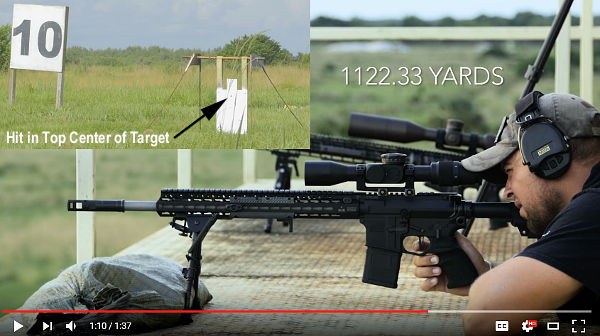
Many of our readers have never had a chance to shoot much past 600 yards. How far away does a 1000-yard+ target really seem to the naked eye? Well this short video answers that question. Gorilla Ammo, the video’s producers, used a camera-carrying aerial drone to fly downrange from the firing line all the way out to 1122 yards (and back again). Watch the drone footage at 0:00-0:07 and especially 0:48-1:03. The “bird’s-eye view” really gives you a sense of the distance. The “fly-back” at 0:48-1:03 time-mark is what makes this video worth watching.
The video features prone shooting at steel targets placed at 750 and 1122 yards. We do apologize for the lame, “oh so serious” voice-over which attempts to make this rather ordinary range session seem like some kind of life-changing experience. (Frankly, you may just want to turn the sound off — it’s that annoying.) It’s really not that big a deal to hit steel at 750 yards with a quality AR-15, chambered in .223 Rem, shooting Sierra 77 grain MatchKings.
Hitting Steel at 1122 Yards with 2540 FPS Ammo Can Be Challenging
The 1122-yard hits are a bit more impressive. Gorilla Ammo lists a relatively sedate 2540 fps Muzzle Velocity for its .223 Rem 77gr SMK ammunition. According to JBM Ballistics, at 1125 yards, that 2540 fps load has 68.3 MOA of drop from a 100-yard zero (firing at sea level and 80° F ambient). Morever the bullet goes trans-sonic around 750 yards (losing stability) and is traveling just 933 fps at impact. And the wind’s the killer — at 1125 yards, with this bullet/load, a mere 2 mph, full-value wind change can move the Point of Impact over three feet!
This summer, our friend Dennis Santiago made his first-ever pilgrimage to Camp Perry, Ohio to compete in the National Matches. He recounts his experience in a fascinating, informative, and often humorous story on his Dennis Talks Guns Blog. When you have a few moments to spare, you should definitely read Santiago’s account of his First Time at Camp Perry. This is much, much more than a match report. Dennis gives insights into the human side of the experience — and the little things that make Camp Perry so special. CLICK HERE to Read Full Camp Perry Story.
Dennis competed in a number of events during his two-week stay. Shooting “classic” service rifle and his new scoped, “modern AR” service rifle Dennis competed solo (in Presidents 100 and NTI matches among others) and also as a member of the California Adult Team in the 4-man NTT match.
Santiago’s First Time at Camp Perry report is a “must-read” for anyone contemplating a Camp Perry visit. Here are some highlights — but honestly folks, do read the entire story — it’s well worth it.
First Time at Camp Perry, by Dennis Santiago
Perry Ain’t Like Home
Iron Sights and “Perry-Vision”
This range is kicking me hard. I tell people about how hard I was pushing my eye into my aperture. They smile that “welcome to Camp Perry” smile again. They ask what sights I’m shooting on my A2 and I tell them I’ve got an 0.050″ front and 0.038″ rear to maximize depth of field. They smile more broadly and tell me my problem is that I’m from the Western provinces where the sun is bright and the ground is devoid of flora. Lots of light. It’s green here and we have clouds I’m told. Not nearly the same ambient lighting. You have the wrong sights my son. Where the green grass grows you want a big fat 0.072″ front the size of an aircraft carrier deck and a huge 0.046″ hole in the morning and maybe close it down to an 0.042″ rear aperture later if the sun comes out. But that desert glare sight system of yours will lose you about 5-8 points in these parts. Well there you go. Learn something every day.
Baptism at Camp Perry
One’s first visit to Camp Perry is a series of baptismal rites. I shall now enumerate them…
Walk the Base. Do not drive around. Get used to walking. Walk from your hut to everything. Walk to the administration buildings. Walk to the ranges. Walk to commercial row. Walk to the CMP North Store. Walk to the CMP or Army trailer to have the triggers of your rifles(s) weighed. Walk. This is your primary mode of transportation while on base for the next couple of weeks.
Go Shopping. It’s called Commercial Row. It is the best shopping mall for competitive shooters ever. The sale prices here are Black Friday quality. You stock up on supplies. You can buy elusive powders in quantity with the same lot number. Same with bullets and primers. Everything you need to keep making your pet loads. Oddly, not cases. This is a service rifle tournament. Pretty much everyone is using LC or WCC cases. I stocked up. Then I began politely watching my expected cubic feet and gross weight capacity for the drive home as other people asked if I could take stuff back for them instead of shipping their loot.
Learn about the Perils of Perry. One, evacuate the range. It rains at Camp Perry. Sometimes that rain comes with lightning. When that happens range controls issues an evacuation order. Depending on where you are and how much time you have, you either grab your stuff and make for a sheltered structure or leave your stuff under whatever rain cover you have and leave it there until the storm cell passes. This happened on squadded practice day. There was no squadded practice. There was learning to make a better rain cover for the next two weeks because it’d probably happened again. I was particularly proud of my final design which involved a very large tarp and many bungee cords. Modern art to be sure. I received many compliments.
Peril Two — Cease fire, boat in the impact area. One has not truly been to Camp Perry until your shooting string is put on hold while range control sends someone out to tell an errant yacht or jet ski that it’s not a good idea to go into that area with all the buoys with the signs on them that say, Danger. Live Fire. Keep Out.
Shooting Gear
I brought two rifles with me to Camp Perry. The first was my iron sights-configured AR-15. Being my very first trip to the Nationals, I wanted to check off a bucket list item to shoot irons at a National Match. The gun has a Geiselle trigger and an upper I assembled from White Oak Armament parts. The barrel is a Krieger that had 3,800 rounds arriving at Perry. The sights are pinned 1/4×1/4s. I run Sierra 77gr SMKs short line and 80gr SMKs seated .015″ off the lands Long Line with it.
The other rifle I brought was for NRA week. It’s a 2016 Rule Service Rifle, Optic. It has a collapsible UBR stock and a Geiselle Mk VII quad rail. The barrel is an older DPMS .223 that was cryo-treated back in the day. Round count on arrival at Nationals was around 1,800. Same ammunition combination [as the iron sights rifle]. The chamber on this barrel has a shorter throat so I brought a Lee Hand Press with an RCBS competition seater die to set the 80gr SMKs back to proper jump for NRA week. The sighting system for this gun was one of the very new Nightforce 4.5X Competition SR’s with the CMP R223 reticle. Parallax is set to 200 yards. It’s mounted using Nightforce’s superbly engineered AR-15 service rifle Unimount.
Members of the State of California Teams at Camp Perry. Dennis is front row left.
Coaching — When It All Comes Together, at Last
I coached one of the California teams in the NTIT Rattle Battle match. This was the day I finally began to be comfortable at Camp Perry. Walking up and down the field, first as a verifier and then as a coach, I felt back in the game. At team matches you get to confer with your teammates comparing wind calls and observing the effects of their calls as the shooting members of their squads send rounds downrange. You watch the traces of bullets arcing in the air going left or right of the bull’s center depending whether or not the call was right. This process was cathartic. I began to remember that I really can read a range once I get the hang of it.
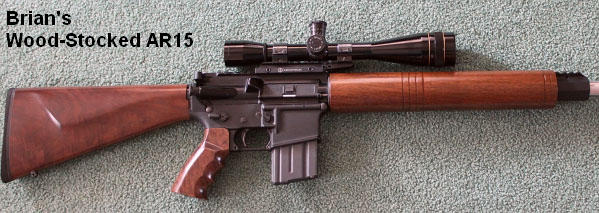
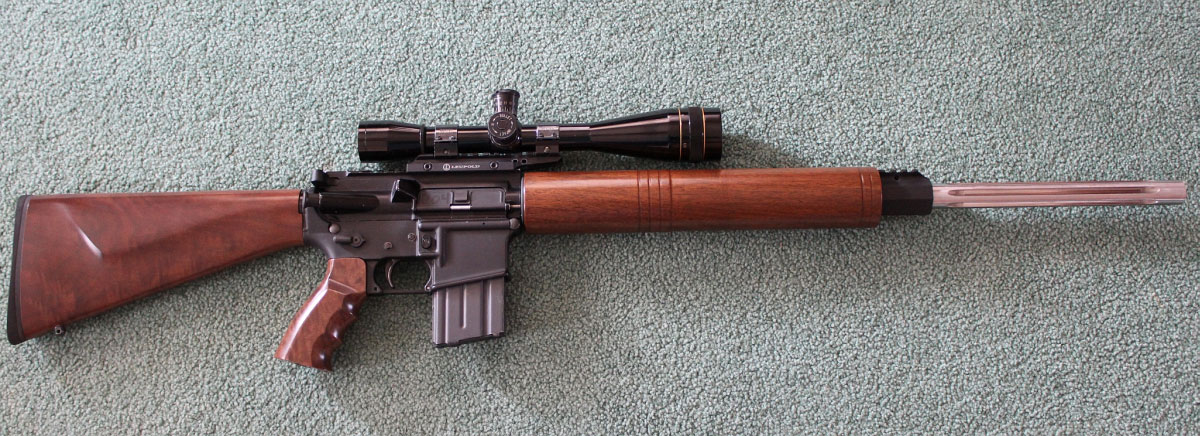
The rear stock and grip (shown above) come from the commercial LUCID AR Stock Kit. But Forum member Brian V. custom-made this one-piece walnut forearm.
Forum member Brian V. (aka “Carbide”) wanted a new look for his “modern sporting rifle”. He was tired of looking at black plastic (or FDE, OD green) and aluminum components on his AR15. So he decided to fit wood “furniture” on the rifle. He ordered a wood butt-stock and fore-arm set made by Lucid, but he didn’t like the two-piece fore-arm of the Lucid stock set. He decided he could build something better than the commercially-available, Lucid-made wood fore-arm.
Lathe-Turned Custom Walnut Sleeve in Front
So Brian took his existing AR tubular fore-arm and epoxied a walnut sleeve to it. With a lathe, Brian then turned the walnut sleeve to his desired dimensions: 2.250″ diameter in back and 2.200″ diameter in front, so there’s a little taper. Brian says “I could have gone a little thinner.” The wood fore-end was then sanded and stained to match the Lucid-made rear section. Brian says “the stain is not quite a perfect match, but but it looks a lot better.”
Does Brian like his new wood-stocked AR? Absolutely. He says the conversion makes the gun more user-friendly: “The wood is warmer to carry in winter and quieter.” He adds that the wood sleeve added about four ounces of weight to the fore-end, but that did not affect the handling.
We think this is a good “do-it-yourself” project that could be done by many of our readers. You can simply install the Lucid stock set or customize the front end like Brian did. Either way, you end up with a good-looking rifle that feels better in your hands.
Establishing zero at 300 yards. Dennis says: “Wow you can really drive that crosshair into the center of the bull with ease” with the 4.5X optic.
Dennis Santiago recently received the all-new Nightforce Competition SR Fixed 4.5x24mm Service Rifle scope. He will be using this at Camp Perry soon, so he needed to get zeros (and click values) for all his yardages. Off he headed to the Burbank Rifle and Revolver Club (BRRC) for a Zero Session.
After establishing a 100-yard, base-line zero from the bench, Dennis put on his sling and jacket to work out to 200, 300, and 600 yards. When shooting at 200, Dennis said: “The target is huge in that 4.5X scope. Fun to drive. Next stop NRA Week at Camp Perry!”
Above you can see Dennis working up two elevation zeroes for 600 yards. First he fired a center hold using the crosshair inside the circle to “pie” the bull. Next, he shot with a 12 o’clock hold using the lower leg of the crosshair to bisect the target. You can see the target at 600 yards in the top right of the photo.
Zeroing Task accomplished, Dennis is ready to take this rifle to Camp Perry for the National Championships. He says: “In the end, it’s always about your handy-dandy notebook.”
New 2016 CMP/NRA Rules Allow 4.5X Optics
Dennis Santiago explains the Service Rifle rule changes that now allow scopes up to 4.5X max magnification (and max 34mm objective):
“Per the 2016 Rulebooks of the CMP and NRA, today’s Service Rifle is now defined to include an M-16/AR-15 variant with an optical sighting system not to exceed 4.5X magnification. So, this optic-equipped rifle goes head-to-head with the match-tuned M-16A2/AR-15A2 iron sight guns in the same class. The rules were updated to take into account that some military branches no longer train service members to shoot iron sights as their primary marksmanship method and have switched to reliance combat optics. The rules were debated and tried in 2015 and codified at the beginning of this year. This will be the first Nationals where the old and new generation guns compete side-by-side.
Here is my personal prediction: There will be improved scores by Expert class shooters who figure out how to work with optics jumping into Master class. At the High Master level, there may be a slight rise in numerical scores but there will be a massive jump in X-Count. EICs will remain the all-out race they’ve always been; whoever makes the fewest mistakes wins the day.”
California Governor Jerry Brown just departed for a luxurious European vacation. But before he left the state, he savaged the Second Amendment rights of millions of California gun owners. Less than 24 hours after they arrived on his desk, Brown signed six anti-gun bills railroaded through the Democratic-controlled California Legislature. Among the bills signed by Brown was SB 1446 which will require Californians to forfeit, destroy, or ship out of the state ALL firearms magazines that can hold more than ten rounds. Owners of legally-obtained magazines, previously “grandfathered”, will receive no compensation though they must give up their property. Those who fail to comply will be fined and charged with an infraction, a low-level crime. This magazine restriction goes into effect July 1, 2017.
Gov. Brown also signed SB 1235 which will require background checks for the purchase of any and all ammunition. Ammo buyers’ names and personal information will be logged and tracked in a database.
Notice from NSSF RE California Legislation
The NSSF issued this statement: “The National Shooting Sports Foundation is extremely disappointed that Gov. Brown today chose to sign into law these highly restrictive and unneeded gun control measures, all of which will affect law-abiding Californians while doing nothing to stop the criminal misuse of firearms. By acting within 24 hours after being sent these bills, and not allowing the public to voice their opinions in order to depart for his European vacation, the governor compounded the miscarriage of legislative process and procedure while demonstrating disdain for Californians who now face laws that clearly infringe on their Constitutional rights.”
Gov. Brown SIGNED the following bills into law:
AB 1135 (Levine) and SB 880 (Hall) Firearms: Assault Weapons – Expands the definition of assault weapons based on whether a semiautomatic firearm has a detachable magazine, banning thousands of popular firearms.
SB 1235 (de Leon) Ammunition – Requires authorization to purchase ammunition and track what and how much ammunition each person buys, creating a database of ammunition purchasers.
SB 1446 (Hancock) Firearms: Magazine Capacity – Makes it illegal to possess magazines capable of holding more than 10 rounds no matter how long a person has owned them.
AB 1511 (Santiago) Firearms: Lending – Makes it illegal to loan a firearm to a person who is personally known to you (except for family members with restrictions).
AB 1695 (Bonta) Firearms: False Reports – Creates a 10-year prohibition on owning firearms for someone convicted of falsely reporting a lost or stolen firearm.
Gov. Brown VETOED the following bills:
SB 894 (Jackson) Firearms: Lost or Stolen: reports – Would have made it a crime not to report lost and stolen firearms to law enforcement within the arbitrary time limit.
AB 1673 (Gipson) Firearms: Unfinished frame or receiver – Would have expanded the definition of a firearm to include partially finished frames and receivers (no definition of what this means) and require their registration.
AB 1674 (Santiago) Firearms: Transfers – Would have made it illegal to buy or receive more than one firearm in any 30-day period.
If you wish to Contact Gov. Brown’s office to voice your concern about his signing of six anti-gun measures, here is the contact information:
Governor Jerry Brown
c/o State Capitol, Suite 1173
Sacramento, CA 95814
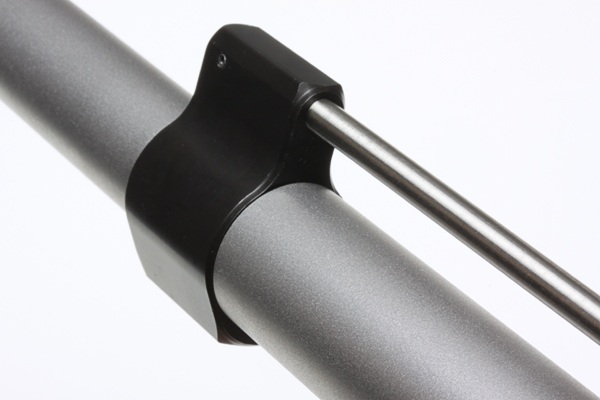
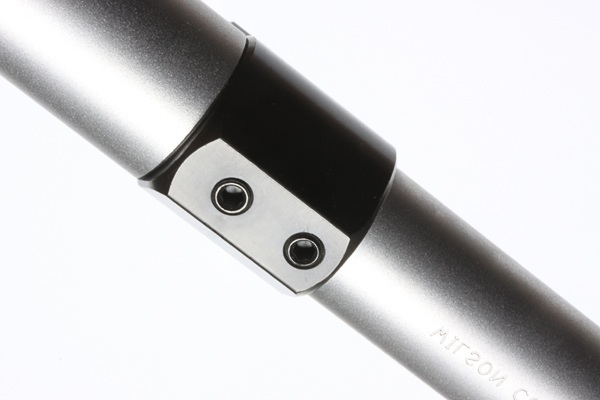
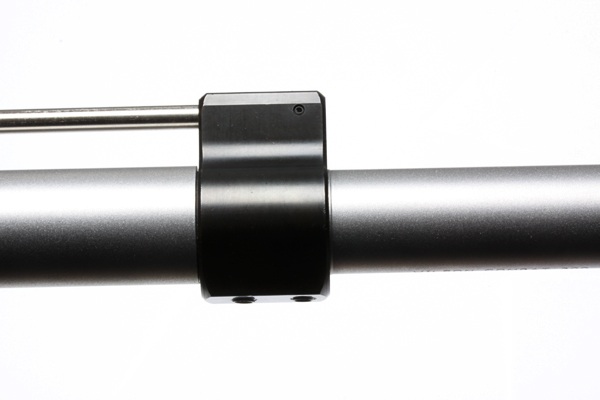
Wouldn’t it be cool if you could adjust the bolt cycling energy on your AR-platform rifle? Turn down the cycling rate for slow fire at the bench or varmint hunting. Crank up the energy for 3-Gun matches and rapid-fire disciplines. This IS possible with a handy accessory that fits on your barrel. Wilson Combat offers an Adjustable Lo-Profile AR Gas Block for direct gas impingement AR-type rifles. Wilson Combat’s adjustable gas block replaces a standard AR gas block and allows you to tune your AR’s gas system for smoother cycling and enhanced reliability. Wilson Combat explains: “Adjusting your rifle’s gas port will lower or increase your bolt’s cyclic rate. This tailors your rifle’s performance to your unique needs.”
A simple adjustment of the hex screw at the front of the block modulates the gas volume allowing you to tune your rifle’s function to your favorite loads. This is very handy when shooting non-standard AR calibers, unusual hand-loads, or suppressed rifles. Adjustable Gas Block systems are sold as complete kits starting at $61.07. Wilson Combat offers two diameters (.750″, .937″), so you can select the right dimensions for your rifle configuration and barrel diameter. The blocks are Chromoly steel with a Melonited finish.
Package Includes:
Adjustable Gas Block (Melonite Finish)
Adjustment Set Screw (Installed)
Straight Gas Tube (Installed, Gas Tube Pin Installed)
For sheer versatility, it is hard to beat the AR-15 platform. An AR can function in a multitude of roles — defending your home, hunting varmints, or competing in Service Rifle or High Power matches. If you’re planning a new AR project, it all starts with the lower. That’s the part that carries the serial number and is logged into the books of your FFL. Once you’ve got your lower, then the fun begins — you choose all the other components: trigger group, stock, handguards, and upper.
Right now, Brownells is running a great deal on stripped lower receivers. You can get an Aero Precision Stripped Lower for just $59.99. It’s hard to beat that price. Aero Precision is a good manufacturer that makes durable and dimensionally-correct lowers. And these lowers are backed by Brownells’ 100% Satisfaction Guarantee.
Aero Precision Lower Receiver Features
This small pin, mil-spec lower receiver is precision-machined from a 7075 T6 aluminum forging. This versatile lower can be the foundation for rifle builds on 5.56/.223, 6.5mm, 6.8mm, 300 AAC Blackout, 9mm Luger, or other chamberings. Holes, inletting and pin locations have been cut to final dimensions and accept standard AR-15 magazines and components. The safe/fire switch position indicators are stamped on the receiver. FFL required for purchase.
By Dennis Santiago
It’s called the “Rattle Battle” or more formally, the National Trophy Infantry Team Match (NTIT) at the U.S. National Matches at Camp Perry, Ohio. It requires practice. It takes teamwork. To optimize one’s Rattle Battle practice in California you need a pre-ban AR-15 properly CA DOJ registered [that’s California law] service rifle — something that civilians in California are now banned from acquiring (along with high-capacity magazines). Glad I have my 1989 Roberti-Roos era registered rifle because I do want to represent my state as well as I can at the Nationals. It’s legal to insert a 30-round magazine into this CA-registered rifle.
This is a practice drill shooting 29 rounds in 50 seconds. Hyperventilate, shoot multiple rounds per breath, put them all into the silhouette target. This was slow. I need to build speed to create time to make one or two sight corrections on command in the middle of the string. Practice makes perfect. As they say: “Improvise, Adapt, and Overcome.”
The CMP’s National Trophy Infantry Team Match (NTIT) has been a staple at the National Matches since 1922. Also known as the “Rattle Battle,” the event is one of the most unique in the competitive rifling world — scoring is based on how many hits six-person teams can score on a bank of targets during a series of 50-second firing periods at four yardages.
Teams begin the NTIT match with 384 rounds of ammunition, which they fire upon eight silhouette targets from 600, 500, 300, and 200 yards during successive 50-second periods. After each rapid-fire string, team members move forward (to the next-closest distance) carrying all equipment from firing line to firing line. The match emphasizes extremely fast, accurate fire and good communication among teammates. The Rattle Battle is always an exciting competition for spectators to watch.
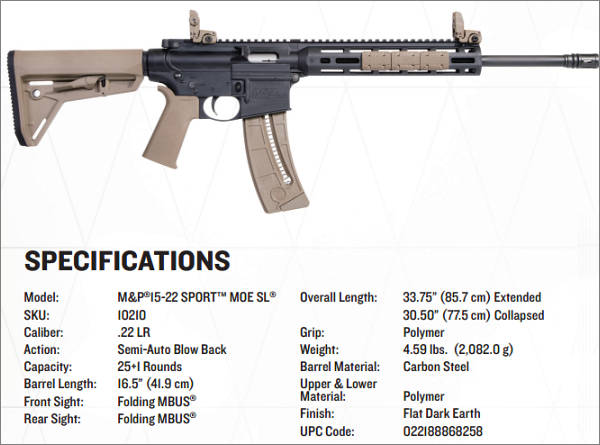
We like AR-style .22LR rigs for Rimfire Tactical Matches and 3-Gun cross-training. With an AR-style rimfire rifle you can train with low-cost ammunition while enjoying the same ergonomics, controls, and sighting systems found on your centerfire ARs.
Smith & Wesson has upgraded its M&P 15-22, a fun rifle that we’ve praised in the past. The new M&P 15-22 Sport MOE SL model (Magpul Original Equipment Slim Line) features a more comfortable handguard, an improved grip, and an adjustable Magpul buttstock. The dedicated .22 LR M&P rifle retains the look and features of the company’s popular M&P rifle line, with the enhanced ergonomics of Magpul furniture. Click HERE for Spec Sheet.