William “Tom” Collins earned the CMP’s Distinguished Rifleman Badge #2500 this July. Collins earned his final EIC points at the Washtenaw Sportsman’s Club in Michigan.
One of the highest honors in competitive shooting is earning the Distinguished Rifleman Badge. This Badge was created by the War Department in 1884 to recognize members of the U.S. Army for Excellence-in-Competition (EIC) with the Army’s service rifle. Other U.S. Armed Forces soon adopted a similar program and in 1926 civilians were authorized to participate. This story is about William “Tom” Collins, 50, of Maumee, Ohio, who earned his badge in July 2020. His achievement was a landmark — Civilian Distinguished Rifleman Badge number 2500.
Collins Earns Distinguished Rifleman Badge Number 2500
Story based on Report by Ashley Brugnone, CMP Staff Writer
For over 20 years, the Civilian Marksmanship Program (CMP) has issued Distinguished Badges to competitors who collect at least 30 Excellence-In-Competition (EIC) “leg” points — earned by placing in the top 10% of an EIC match. This story is about Ohio shooter William “Tom” Collins, who recently earned Distinguished Rifleman Badge number 2500. [Editor: To learn more about the history of the Distinguished Rifleman Badge and what is takes to earn it, read Distinguished Rifleman — the Chase for Excellence by Jonathan Ocab.]
For Collins, this fulfilled a dream to join generations of elite marksmen before him. “The Distinguished Rifleman Badge has been a goal of mine since I learned about it,” Collins said. “I like to think back on the history of the badge … It makes me proud to be a part of that.”
Collins earned Distinguished Rifleman Badge #2500 in July. “Shooting is almost like meditation to me”, Collins said. “You really can’t think about anything other than the current shot. It’s very relaxing.”
He gives simple advice to other competitors hoping to one day earn a Distinguished Badge of their own: “Anyone working on it – quit thinking about it. Just shoot.”
Collins is congratulated by his friend Jamie Root after “going Distinguished”.
Collins has been shooting most of his life. Growing up in rural Ohio, he received his first BB gun around seven years old and his first .22 at age 11. It wasn’t until he joined the Army Reserves in 1987 that he received any formal marksmanship training. After he left the Reserves nine years later, he started looking toward organized shooting sports.
One day, back in 2014, he picked up his rifle and took the 45-minute drive to Fremont, Ohio, to fire in his first GSM (Garand-Springfield-Modern/Vintage Military) Match at the Sandusky County Sportsmen’s Club. It was there that he met Jesse Bragg, who was running the event.
Jesse Bragg, a retired staff sergeant from the Marine Corps Reserve Rifle Team, took Collins under his wing and showed him the ropes. Collins says Bragg seemed to want to teach more than run the match. In fact, Bragg was the one who introduced Collins to the idea of pursuing a Distinguished Badge. Collins admits that he had no clue what “going distinguished” meant. Bragg went over the terms – legging out, finishing “first leather” and other related expressions.
In 2015, Collins went to the National Matches at nearby Camp Perry, Ohio, and fired in his first President’s Rifle Match. Watching the elite shooters take their final shots inspired Collins: “Learning about the Distinguished Badge, learning about the President’s Match — I just knew that I had to get this Distinguished Badge on my way to, hopefully, getting into the President’s 100 or even the Top 20.” So Collins began traveling to GSMM competitions with his match rifle in tow, just to get in a little extra practice. It became his main focus. In June 2019, he earned his first set of six leg points at the CMP Viale Range 800 Aggregate and EIC Service Rifle Match at Camp Perry. It was a breakthrough.
When I first started, I was shooting the Garand and the M1A. [But] once I realized I wanted to get my Distinguished Badge, I said, “None of the wood guns. It’s all my match rifle until I go Distinguished”.
He went on to earn eight points at his next match in July, followed by eight more in August. With one more match left in 2019 and only seven points away from the required 30 to earn a badge, his goal was within sight. But it wasn’t until the EIC match at the Washtenaw Sportsman’s Club in Ypsilanti, Michigan, in July 2020 that he was able to conquer his nerves and earn his final points: “The most rewarding thing – it’s when you get there. When you finally earn it, everybody knows it. Everybody at the range celebrates with you. All of your friends are there with you. It’s just rewarding in itself. You’re part of that tradition that spans three centuries.”
Friendships Made on the Road to Distinguished
More so than the time, effort, and skill it took to earn the badge, the journey to become Distinguished was almost as rewarding as the badge itself for Collins, given the relationships he’s made along the way:
“These guys I’ve met and hung out with — we’ve given jobs to each other, we celebrate each other’s birthdays, we know each other’s families. It’s just been a great group of guys. You always are rooting for your friends, regardless of how well you’re doing. If you’re doing bad, you root for them even more.”
Distinguished Badge-Earning Marksmen Will Be Honored in 2021 at Camp Perry
Part of the tradition of earning a Distinguished Badge is walking across the stage at Camp Perry during the National Matches award ceremony. There, badge winners are formally pinned by their peers on a stage that has felt the footsteps of prominent marksmen for over a century.
“Last year, when I got the first points, I told myself, ‘I’m going to walk this stage at Perry next year'”. Collins and all others who earned a Distinguished Badge in 2019 or 2020 will still have the opportunity to take the stage next year at the 2021 National Matches — and that’s just what Collins plans to do.
With the 2020 Presidential election just 65 days away, and more riots in the streets, it may be time to think about getting that AR-platform rifle. Getting it while you still can. Democratic Party nominee Joe Biden and his VP candidate Kamala Harris both support banning of AR-type rifles. And Biden and Harris have praised Canada’s sweeping semi-auto gun ban carried out by Prime Minister Trudeau through dictatorial executive action (without parliamentary approval). The official Democratic Party Platform includes these provisions:
— Banning the manufacture and sale of ARs and modern sporting rifles
— Halting and criminalizing online firearm and ammunition sales
— Forcing states to require licenses for owning any firearms
— Instituting delay processes for background checks
— Criminalizing private firearm transfers
And during her Presidential campaign (before she was selected as Biden’s VP), Kamala Harris declared: “Upon being elected … I will give the United States Congress 100 days to get their [sic] act together and have the courage to pass reasonable gun safety laws. And if they fail to do it, then I will take Executive Action”. That’s a chilling threat…
Got the message? The Dems want your guns. And the first guns they want to take away are the “evil” black rifles. As Robert “Beto” O’Rourke said famously: “Hell yes we’re going to take your AR15″.
AR Purchase Option — Lower Receiver
The restricted part of an AR15 is the lower receiver. This is the section that must be purchased through an FFL, with a background check. You can later add an upper (or multiple uppers), which can be purchased directly from a supplier. But the lower is what you need. If you’re short on cash, but want to get an AR, grab a lower and then add a complete upper receiver later.
One leading vendor of AR lowers is Palmetto State Armory (PSA). PSA has plenty of stripped lowers and complete lower receivers in stock right now at attractive prices. Here are two offers on 8/29/2020:
Complete AR15 Lower Receiver — $209.99
This complete Palmetto State Armory lower receiver is fully assembled and ready for your complete Upper. This unit is machined from 7075-T6 Aluminum Forgings, hardcoat anodized. The lower comes with M4 Stock and Standard Carbine Buffer. The bolt and carrier fit .223 Rem/5.56×45 case heads.
Stripped AR15 Lower Receiver — $74.99
This PSA Stripped Lower Receiver is machined from 7075-T6 Aluminum Forgings, hardcoat anodized. It does NOT include trigger group and pins for operation. You must purchase those items separately. This is just the bare lower receiver.
Do you use factory ammo in your hunting rifles? Perhaps you buy bulk centerfire ammo for your AR15 or varmint rifle. Then this book is for you.
If you ever shoot factory ammo, you should consider getting Ammo & Ballistics 6. This resource book lists over 2,600 different loads for 200+ cartridge types from .17 Mach 2 up to .700 Nitro Express, including the most popular centerfire and rimfire cartridges (both rifle and handgun). In this updated-for-2020 Sixth Edition, there are over 3,000 tables covering virtually every caliber and every load for all commercially-loaded hunting ammunition sold in the USA. Tables include velocity, energy, wind drift, bullet drop, and ballistic coefficients up to 1,000 yards.
Ammo & Ballistics 6 helps you select ammo for a hunt — quickly compare the velocity and knock-down power of various commercial ammo. This book can help you choose a caliber/chambering for your next hunting rig.
Verified Book Purchaser Reviews
“Outstanding reference guide for shooters and ballistic enthusiasts alike. Has data on velocity, energy delivered, Taylor KO index, windage and elevation on numerous loadings for hundreds of [cartridge types]. Each cartridge has all dimensions labeled (i.e rim, case length, neck, etc.), and has an informative description of the cartridges history/relevance.” — S. Step, 2017
“Great heaps of data! This volume has pages and pages of new data for .22LR like the hot Velocitor, and also on the .22 WMR from 30 grains up into the 50s. Most importantly there is lots of range data, drop, windage, kinetic energy, etc. — Terrific reference guide….” — E. Svanoe
Ammo & Ballistics 6 contains data and illustrations on virtually every sporting cartridge sold in the USA. This 2020 Edition covers 200-plus cartridge types from .17 Mach 2 up to .700 Nitro Express.
What happens when a round goes off unsafely in an AR? Watch this video and see. At about the 00:40 time-mark the shooter has a malfunction (click no bang), with a round. He then removes the magazine, and clears the chamber (we think). On the next round, at 00:53 you hear a “Bang” and see a big puff of smoke coming out of the upper receiver (see photo at right). This has been called a “detonation” by the video-maker, but we’re not 100% sure what happened. What do you guys think? Watch the video carefully, and state your conclusions in the comment section if you wish.
What Caused this Malfunction? Watch Video…
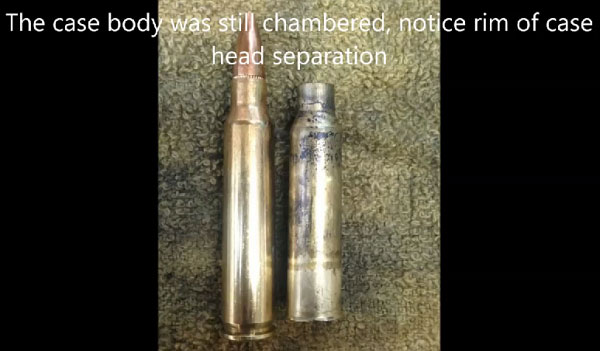
In any event, the shooter is fortunate his upper did not completely fracture, launching shrapnel into his face or other body parts. This could have turned out much worse. Here are screen-shots from the video, showing details of the gun after the accident, along with the recovered brass case, which separated near the case-head.
Never had a chance to hunt prairie dogs in the American west? Then check out this video. Dan Eigen, host of the We Love It Outdoors Television series, ventured to South Dakota for some varmint hunting. Dan teamed up with Varmint Hunter Association President Jeff Rheborg to patrol some South Dakota Dogtowns where things get serious. In the video, you’ll see p-dog hits at distances from 70 yards to roughly 450 yards. The hunters were shooting from portable, wood-topped swivel rests, using AR-platform rifles on X-type sandbag rest. (Rifle zeroing session is shown at the 5:30+ mark.)
Multiple cameras were employed so you can see both the shooter’s POV and close-ups of the prairie dogs downrange. Watch the shooters having fun with a prairie dog cut-out and some Tannerite at the 9:00-minute mark. This guys are having a grand old time sending critters to Prairie Dog Heaven — we think you’ll enjoy the video.
Prairie Dog Hunting Starts at 2:20 Time-Mark in Video:
NOTE: This video actually covers three sequences: 1) Three-gun training; 2) Prairie Dog Hunting; and 3) Coyote Hunting. The Prairie Dog segment runs from 2:20 to 15:15. If you wish, you can slide the controls forward or back to watch the other segments.
Video found by EdLongrange. We welcome reader submissions.
In an unprecedented move, the central government of Canada, without parliamentary vote or debate, has banned a vast number of rifles, including most modern mag-fed, semi-auto rifles currently for sale. This action banning the firearms was done by Prime Minister Justin Trudeau via “Order-in-Council”, with no political debate and no vote of elected representatives. It was essentially an Executive action, rule by fiat, like a decree issued by a dictator.
Starting now, around 1,500 models of long-arms have become illegal to sell, transport, import or use in the Canada, according to CBC News.
“The government implemented the ban immediately, and without the need for legislation in Parliament, by reclassifying about 1,500 firearm models as prohibited. In the meantime, a two-year amnesty is now in effect for Canadians who own the banned firearms and government officials said gun owners will also have the option to be ‘grandfathered’ in with weapons they currently own, although no details were available for that program yet”. Source: NationalPost.com
Nova Scotia Killer Posed as Police Officer
This action came in response to the Nova Scotia killings by a madman, Gabriel Wortman, who dressed in a police uniform and used vehicles with law enforcement markings and lightbars. Wortman was NOT licensed to possess his weapons and had obtained his firearms illegally. According to Global News: “During the shooting, the gunman was traveling in a replica police vehicle and wearing an authentic police uniform.”
Canadian Investigators said Gabriel Wortman had several semi-automatic handguns and at least two semi-auto rifles, which may have been AR-type rifles, but we are not certain about the exact configurations of Wortman’s long guns. Notably, most if not all of Wortman’s guns were already ILLEGAL for Wortman to own under existing Canadian laws. The crazed shooter had violated multiple firearms laws already on the books, and did NOT possess his weapons legally (it is believed he sourced them from outside Canada). AR-type rifles required a special permit in Canada. And of course he violated multiple laws in impersonating a law enforcement officer.
Trudeau Exploits Nova Scotia Shooting to Ban Guns without Normal Legislation
Prime Minister Trudeau used the Nova Scotia mass killing as the impetus to fulfill his campaign promises to ban so-called “assault-type” weapons. Seven months ago, Trudeau pledged to ban modern semi-auto rifles, which he called “assault rifles”. Trudeau opportunistically leveraged the mass shooting to execute his plan with no public debate and no vote by elected officials.
Trudeau’s actions were criticized by many in Canada. Conservative Leader Andrew Scheer declared: “Taking firearms away from law-abiding citizens does nothing to stop dangerous criminals who obtain their guns illegally”. Alberta Premier Jason Kenney stated: “Today’s order does little to target criminals … instead, Ottawa is singling out law-abiding gun Canadians who purchased their property legally”. And Alison de Groot, Director of the Canadian Sporting Arms and Ammunition Association, said Trudeau’s gun ban “will strand somewhere between $200 to $300 million worth of pre-paid merchandise in stores”. READ MORE.
Q: Would a Ban on Semi-Auto Rifles Have Prevented the Nova Scotia Tragedy?
A: No. The killer Gabriel Wortman also used pistols, and could have been just as deadly with a pump shotgun. And nine of the 22 killed “died in house fires” set by Wortman. (Source: RCMP per Reuters.) Remember that fact — 40% of the victims were burned to death: “Of the 22 people killed, 13 were shot and nine died in house fires.” Source: CNN.com.
The real reason for the high kill count was that Gabriel Wortman was an insane maniac wearing a police uniform and driving a police car. The important questions to ask are how did he get the uniform and why were vehicles sold complete with police markings?
Terms of Canada’s Broad New Gun Ban
Under the Canadian gun ban, owners of prohibited firearms now have two years to turn in their rifles. According to CTV News: “Owners will also have the ability to be compensated through a buyback program, though the details of these options have yet to be outlined. Gun owners must be in compliance with the law by April 2022. Those who have not disposed of any banned firearms by that time may face sanctions under the Criminal Code.”
Was Trudeau’s massive gun ban necessary? Consider this comment from a Canadian gun owner: “Handguns and AR15s in Canada [were] highly regulated already. To get the license you go through a 2-day course. There was a 3- to 6-month wait for your application. Spouse must sign. No history of metal disorders. [Authorities conduct] phone interviews with credible people who know you. When you get your licence you must join a shooting club[.] Now you have your restricted license … and a government issued travel licence.”
Here is a list of all the firearms that have been banned (without Parliamentary vote) by Trudeau’s government. This includes AR15-platform rifle, AR10 rifles, Ruger Mini-14s, Semi-Auto M14-type rifles, and many other varients. Some big bolt-action guns will banned as well. ELR Researcher notes: “Read down to section 96: ‘Any firearm capable of discharging a projectile with a muzzle energy greater than 10,000 joules[.]’. Well 10,000 joules is 7375 foot-pounds, meaning [this would ban] ALL firearms chambered for most commercially-available .408 CheyTac, .416 Barrett, and .50 BMG ammo.”
Use the scoll bar (on right) to move through the list of prohibited firearms.
As folks are stuck at home with the Pandemic lock-downs, many guys are thinking about projects involving their AR-15s sitting in their safes. We’ve seen some threads in our Forum asking about the .224 Valkyrie, an AR-centric cartridge that offers significantly better long-range performance than the .223 Remington (5.56×45). If you own a .224 Valkyrie, or are thinking about adding a .224 Valkyrie upper to your MSR (Modern Sporting Rifle) arsensal, here is load information from industry leaders Hodgdon and Sierra.
With the 90gr SMK (or similar High-BC projectiles), the .224 Valkyrie offers ballistics similar to the 6.5 Creedmoor but with significantly less felt recoil.
Hodgdon has reloading data for the .224 Valkyrie, a popular new cartridge optimized for the AR15 platform. “At Hodgdon, we’ve been researching this cartridge since before its introduction and are excited to release load data for the Valkyrie featuring powders like Hodgdon CFE 223, IMR 8208 XBR, and Hodgdon Varget” reports Ron Reiber, Hodgdon product manager/ballistician. Access the .224 Valkyrie Data via Hodgdon’s Reloading Data Center.
While new load data will continue to be updated, there is currently data for 80 different loads with bullet weights ranging from 50 to 90 grains. NOTE: The load data covers Hodgdon, IMR, and Winchester brand powders only. See Sierra Data for other powder brands. Bullet brands included are: Federal, Hornady, Nosler, Sierra and Swift.
About the .224 Valkyrie Cartridge
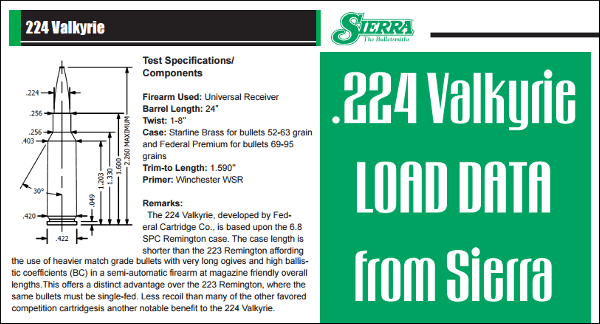
Basically a 6.8 SPC necked down to .22, the Valkyrie has a shorter case than the .223 Remington (and 5.56×45 NATO). This allows you to load the longest, heaviest .224-caliber bullets and still feed reliably from an AR15-type magazine. Designed to rival the .22 Nosler while still running well in ARs, the .224 Valkyrie offers excellent long-range performance when loaded with modern, high-BC bullets. We expect some bolt-action PRS shooters might adopt the .224 Valkyrie. Why? Reduced recoil. With the 90gr SMK, the .224 Valkyrie offers ballistics similar to the 6.5 Creedmoor but with significantly less felt recoil.
The new .224 Valkyrie has already developed a loyal following: “Shooting heavier bullets in an AR-platform rifle that maintain supersonic speeds beyond 1,300 yards has captured the interest of shooters and handloaders everywhere” — Hodgdon Powders
Our friend Gavin Gear of Ultimate Reloader.com found a superbly accurate load with Berger 80.5gr bullets.
IMPORTANT: Check Out Sierra’s .224 Valkyrie DATA
Sierra Bullets has also published extensive load data for the .224 Valkyrie. This covers over a dozen powder types — many more than the Hodgdon database. Sierra’s .224 Valkyrie load data covers projectiles from 50 grain all the way up to 95 grains. With the 90 to 95 grain bullets, the little Valkyrie can give 6mm match cartridges a real run for their money — offering similar ballistics with less recoil. When selecting a barrel for the long .224-cal bullets, specify a fast enough twist rate: “Sierra recommends a 1:6.5″-twist barrel for the #9290 22 cal 90 gr HPBT bullet. However, for cartridges like the Valkyrie, that can push them over 2650 fps muzzle velocity, a 1:7″-twist barrel will stabilize the bullet correctly.”
Here’s a radical new rifle. Instead of a vertical trigger that moves rearward when pulled by the index finger, this Blackwater T.O.R. A1 rifle has a lever INSIDE the lower receiver. That lever is moved by the operator’s THUMB, causing the rifle to fire. The claimed benefits of the “thumb-gun” are: 1) Improved Ergonomics (thumb stays in alignment with point of aim); 2) Better Mechanics (thumb is strongest digit and can manipulate lever easily); 3) Enhanced Safety (trigger blade/lever is not exposed).
This AR-type rifle was developed by Iron Horse, now partnered with Blackwater Worldwide. The new T.O.R. (aka “Thumb Operated Receiver”) A1 is the industry’s first AR-platform rifle incorporating patent-pending, lever-driven fire technology.
Iron Horse A1 Precision Rifle
The manufacturer has made some interesting claims about this new thumb-lever system. Blackwater/Iron Horse claims that “Multiple samples of users show a shorter learning curve and reduced shot group size”, and that the design “lends to greater accuracy in precision shooting… with its inherent natural ergonomics.” One claim we do believe, is that the thumb lever may help disabled shooters. Additionally the manufacturer notes that because the “trigger guard completely encases the trigger” there is less chance of snagging the trigger in brush or vegetation.
How the Lever Trigger Works
The operator’s thumb goes into a port in the top of the polymer grip (see grip photo above). This allows ambidextrous firing by right- or left-handed shooters. The thumb points forward, in line with the barrel. The lever itself is contained INSIDE the lower. Watch this video to see how it works:
Is the Thumb Lever a Game-Changer?
“Ironhorse’s revolutionary trigger system has the potential to be a game changer” states Eric Prince, Founder of Blackwater Worldwide. “Our in-house testing has shown a significant decrease in shot group size when compared to a traditional AR-15 trigger set. We think this technology … could replace traditional triggers altogether at some point.” The manufacturer states that the thumb-operated trigger “has been shown to greatly enhance the experience of a large portion of the shooting community and makes shooting possible for those who have limited mobility or severely injured fingers.”
About Iron Horse and Blackwater Worldwide Iron Horse Firearms, based in Salt Lake City, Utah, was founded by a former U.S. Marine Ryan McDonald. The Patent-Pending Thumb-Operated Receiver was first developed in August of 2016 and became a fully operational system in the fall of 2018. Moving forward, Iron Horse Firearms will be doing business as part of Blackwater Worldwide.
In 2019, Blackwater Worldwide re-entered the firearms and ammunition market in the United States. In its first year of operation, it has acquired or developed multiple firearms lines and a proprietary ammunition line. The company is headquartered in Concord, NC.
Due to the COVID-19 Pandemic, many of our readers are dusting off their AR-platform rifles. Because ARs have a somewhat unique (and dirty) semi-auto operating system, we think all AR owners should learn how their rifles operate — from the inside out. This Sunday GunDay feature provides an “inside look” at the AR, with X-Ray and Cutaway views created through advanced 3D computer modeling.
AR15 Functions Revealed with 3D Computer Animation
Ever wondered how the parts inside an AR15 work together? Just exactly how does the reciprocating bolt carrier feed rounds from the magazine? How do the elements in the trigger group work and reset after each shot? How does the gas system bleed gas from the barrel and operate the bolt carrier? These and other questions are answered in this eye-opening video from 45Snipers. Using “cutaway” 3D computer animation, this 5-minute video shows all features of an AR15 inside and out. This fascinating firearms animation allows the viewer to look inside the upper and lower receivers, into the bolt carrier, chamber, barrel, and magazine.
This video starts off slow and has annoying background music, but it is well worth watching if you own or shoot any AR-platform rifle. It illustrates all the key operations during the charging, loading, firing, and ejection processes. The cutaway animation shows how rounds are stripped from the magazine and then chambered. It then shows how every part of the trigger group works, and how the firing pin strikes the primer. You can even watch the bullet move down the barrel before the empty shell casing is removed from the chamber and tossed out the ejection port. Here are sample frames from the video:
How AR-Platform Rifles Work — General Introduction
To help reader understand the general operation of AR-type rifles, this video shows the control functions of an AR and how the upper and lower sections work together.
Cutaway 3D Animation of AR15/M16 Action — Watch Video
Here is an excellent “cutaway” animation by Thomas Schwenke that shows how an AR-15 functions — how the entire loading cycle works from start to finish.
AR platform rifles are semi-automatics version of the M16. These feature distinctive upper and lower receivers which can be readily separated via front and rear pins. The upper includes the barrel, handguard, forward gas tube, and bolt assembly, while the lower contains grip, trigger group, fire selector, and mag well. In addition the lower is attached to the stock which encloses the buffer assembly.
The original ArmaLite AR-15 was a select-fire, air-cooled, gas-operated, magazine-fed rifle designed by American gun manufacturer ArmaLite in 1956. It was based on Armalite’s AR-10 rifle chambered for the 7.62×51 NATO (.308 Win). In 1959, ArmaLite sold its rights to the AR-10 and AR-15 to Colt. Some key modifications were made — most notably, the charging handle was re-located from under the carrying handle to the rear of the receiver. The redesigned rifle was adopted by the U.S. military as the M16 carbine, which went into production in March 1964.
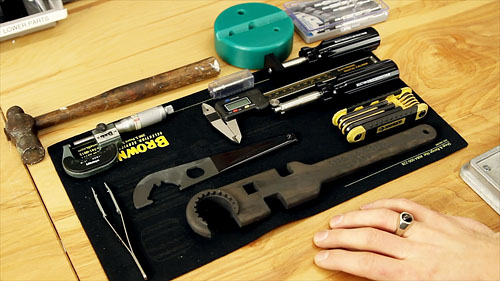
Here are the main tools you’ll need to assemble an AR-platform rifle
In these challenging times, many Americans are buying an AR-type rifle, or starting an AR project — assembling the rifle from available uppers, lowers, and parts kits.
If you are planning to put together an AR-platform rifle or upgrade your AR with a new barrel, stock, or trigger group, here’s a tip. Check out the AR-15 Rifle Build DVD from our friends at UltimateReloader.com. This DVD covers all the details of a custom build, using high-resolution video sequences, and helpful supporting graphics.
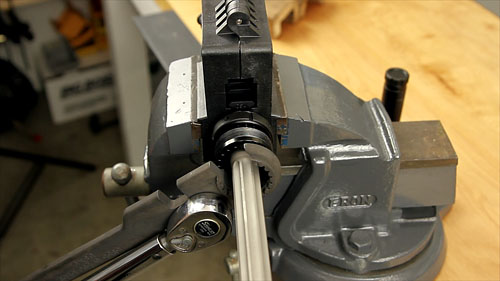
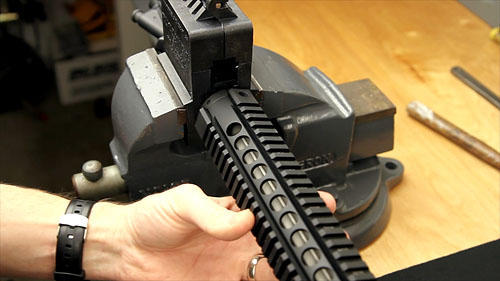
In this DVD, Gavin Gear guides you through the entire process including selecting components, acquiring and using the necessary tools, assembly steps and details for each component, and even mounting a scope. Building an AR-15 can be overwhelming, but with the right guidance and help it’s not difficult and can be very rewarding. With this DVD you’ll be able to build your AR-15 with confidence.
Upper: Barrel / Gas Block / Gas Tube
Upper: Handguard Installation
UltimateReloader.com’s AR-15 Build DVD is available just $9.90 (plus $3.80 shipping/handling). This DVD can pay for itself many times over by showing you how to do your own gunsmithing (and get quality AR components at attractive prices).







 Never had a chance to hunt prairie dogs in the American west? Then check out this video. Dan Eigen, host of the



 Here’s a radical new rifle. Instead of a vertical trigger that moves rearward when pulled by the index finger, this Blackwater