Smart shooters know the importance of using a quality cleaning rod bore guide when cleaning barrels. The rod guide helps center the rod in the bore, preventing uneven wear on the rifling. Good bore guides also seal off the chamber to prevent solvents and gunk from flowing back into the bolt raceway and trigger housing. While most bore guides are “better than nothing”, the best designs are custom-sized to the chamber and also have a very tight clearance around the rod shaft. This prevents the rod from bowing and from dragging on the critical throat area of your rifle. We use Lucas Rod Guides for many of our rifles. The Lucas two-part design, with a caliber-specific insert, provides a tight fit for the rod.
T.K. Nollan’s Barrel Saver System
While many readers may have seen or used Lucas Rod Guides, T.K. Nollan makes another very high-quality cleaning rod guide that is favored by top benchrest shooters such as Tony Boyer, Dwight Scott, and Dick Wright. If, like many short-range Benchresters, you do a lot of barrel brushing, it may be worth investing in the $135.00 Barrel Saver.
T.K. Nollan’s patent-pending Barrel Saver is a precision-machined system designed to provide maximum protection during barrel cleaning. The Barrel Saver features a double O-ring “fail-safe” seal, and a stainless steel outer tube with straightness held to within .001″. To help ensure optimal alignment, a bushing, custom-sized for your action, precisely centers the outer tube in your action. Models are offered for Hall, Stolle, Grizzly, Farley, Remington, RFD, Nesika Bay, Borden, BAT, Viper and similar 2-lug actions.
Each Nollan Barrel Saver comes with two (2) metal guide tubes, one for brushes and the other for jags. As you can see in the slide show below, these brush/jag tubes run INSIDE the larger diameter guide which slides into the action and chamber. This “tube-within-tube” design, combined with the 0-ring for the chamber, ensures that the cleaning rod stays precisely centered, even if you brush fairly aggressively. While we strongly advocate bore-brushing only in the outward direction, we know some shooters prefer to brush back and forth. If you are a “back and forth” cleaner, you NEED a product like the T.K. Nollan Barrel Saver.
T.K. Nollan Barrel Savers start at $135.00 plus $9.00 shipping for PPC-type chamberings. Custom sizes cost $150.00 plus $9.00 shipping. Each Barrel Saver kit comes complete with two Rod Guide Tubes and spare O-rings. For more info, visit the Barrel Saver website, or contact T.K. Nollan at this address:
TK Tool Co. – Precision Benchrest Tools
tknemail [at] gmail.com
401 South Cimarron St.
Catoosa, OK 74015
(918) 633-2966 (Call before 9:00 PM CST)
German Salazar has found some innovative and smartly-engineered new cleaning accessories that can benefit any shooter who wants to maintain the accuracy of his precious (and expensive) barrels. Here’s German’s report on the new Bore Rider Jags and Bore Rider Brush Guides.
Good Stuff: Bore Rider Barrel Care Productsby German Salazar
We see new bore cleaning solvents introduced with some regularity, but cleaning hardware evolves more slowly. I’ve been using some new jags from Don Leidich’s Bore Rider Barrel Care Products for a few months and am satisfied that they are a genuine improvement over anything else I’ve used. Don began making these items for the black powder cartridge shooters as their cleaning needs are serious and frequent. He has now expanded the line to include popular bore sizes for modern centerfire barrels.
Modern Jags and Brush Guides Made from Acetron Polymer
Don’s Bore Rider enterprise makes jags as well as companion Brush Guides for use with bore brushes. These are all made from Acetron® GP, an acetal polymer material similar to Delrin, but with greater lubricity. Bore Rider Jags and Brush Guides minimize any damage that might occur to the crown when the jag or brush exits the bore. With conventional jags and brushes, when brushing or patching your barrel, the cleaning rod shaft falls to the bottom of the bore as the patch or brush exits. Over time, that can result in excessive wear at the lower edge of the bore (6 O’Clock position) in the last few millimeters on the muzzle end. In extreme cases you can even wear a slight groove in the lip of the crown (i.e. the very end of the rifling at the muzzle). Another advantage of Bore Rider Jags over conventional brass jags is that you don’t get “false positive” green/blue patch colorations from solvent reactions with the metal jag itself (as opposed to actual copper fouling in the barrel).
The Bore Rider Jag has an extra-long shank so that when the patch exits, the Acetron (polymer) shank is the only thing that makes contact with the crown. This way you don’t have a metal rod tip riding over the delicate crown. The Bore Rider Jag shank diameter is also a close fit to the bore to avoid uneven wear. The Brush Guide is an Acetron extension that fits between your brush and the end of the cleaning rod. This extension protects the crown when you brush, allowing you to push the brush completely out of the barrel without dragging metal connections over the edge of the crown. [Editor’s Tip: While the polymer material used in the Bore Rider Jag and Brush Guide is “kinder” to crowns, be sure keep the Acetron shanks clean from small particles and debris. These particles can embed themselves in the polymer. Wipe off the Jags and Brush Guides regularly.]
If protecting your barrel’s crown was all that these items did, that would be enough to merit their use. However, what’s more interesting about the jags is that they are made for a very tight fit in the bore and as a result, they truly get the patch working to scavenge the grooves of all the residue possible. The fit is so tight that Don was concerned that not all patches might work properly, as some extra thick ones might not enter the bore at all on this jag. I’ve used the jags with patches from Sinclair, Bruno’s Pro-Shot and a couple of no-name bags and all have worked flawlessly. Also, the jags are designed so that the segments that hold the patch material can never come in contact with the crown while pulling it back into the barrel. My borescope examination of the barrels shows that the job is getting done right.
Source for Bore Rider Jags and Brush Guides
The .223, .243, .264 and .308-caliber jags sell for $15.00 and the Brush Guides sell for $13.00. Other caliber jags start at $22.00 for jags and $18.00 for Brush Guides. These are threaded and chamfered to fit appropriate Dewey rods. The opposite ends on the brush guides have 8-32 female threads. Customers can buy adapters (from other vendors) to fit other brands of cleaning rods. Don can also customize Jags to fit a customer’s rod specifications if you don’t want to deal with an adapter. Don’s custom made Jags and Brush Guides cost $25 and $18 respectively.
Monitor Barrel Heat with Pocket InfraRed Gauges
You never want to run the barrel of a precision rifle too hot. Excessive barrel heat kills accuracy, increases copper fouling, and can cause rapid barrel throat wear. Over the years people have devised various means to cool their barrels — from electric fans to dunking in tubs of ice water.
But how do you know if your barrel is too hot? Consider a “non-contact” thermometer that reads your barrel’s “infrared signature”. The Kintrex or Actron pocket-sized, non-contact IR thermometers are ideal for shooters at the range or in the prairie dog fields. Both are handy and inexpensive — costing about twenty bucks (on sale).
Pen-Sized Kintrex
Just 3.2″ long, and weighing a mere 1.3 ounces, the waterproof Kintrex IRT0401 (IP67) is small enough to carry in your pocket, and will easily stow in any range bag/box. The unit measures from -67 to 428 °F (-55 to 220 °C). Kintrex is a respected manufacturer that also makes larger hand-held IR thermometers for industrial and shop applications. Priced at just $21.11 on Amazon.com, the tiny Kintrex is one gadget that every serious shooter should have. Given the cost of replacing barrels these days, can you afford NOT to have a temp gauge for your match or varmint barrel?
Actron PocketTherm for just $18.22
The compact Actron CP7875 PocketTherm Infrared Thermometer is on sale right now on Amazon.com for just $18.22. Roughly 4″ x 1.5″ in size, it is slightly larger than the Kintrex, but still small enough to carry in a pocket. It features an angled head and may be easier to hold than the Kintrex for some users. It works instantly with intuitive one-button operation, measuring temp ranges from -27º to 428º F (-33º to 220º C). Rated battery life is 20-25 hours. The backlit display is easy to read. However, you need to place the Actron PocketTherm close to the “target”. Most larger “industrial” spot thermometers (both laser and infrared), have beam ratios from 6:1 to 10:1, allowing them to measure a 1″ circle at 6″-10″. The CP7875 has a 1:1 ratio, so it measures a 10″ circle at 10″ distance. To get an accurate temp on a barrel, you must hold the thermometer within an inch or so. That’s not a big deal when measuring barrel heat, but the beam ratio may limit the usefulness of the PocketTherm for other tasks.
Many shooters expend considerable time and effort to coat their bullets with friction-reducing compounds such as Boron Nitride (HBN), Molybdenum Disulfide (Moly), and Tungsten Disulfide (WS2 or ‘Danzac’). Many of these same shooters believe that coated bullets permit longer strings of fire between barrel cleanings. Also, there is some evidence that coated bullets may extend barrel life (though this remains controversial).
What if you could enjoy all the benefits of coated bullets without the effort? When you think about it, why not apply the anti-friction coating to the barrel itself, rather than the bullets? That is the thinking behind salt-bath nitriding of barrels. This nitriding process creates a very slick, very hard surface coating on the steel in the bore. The coating is only 10-20 microns thick (so it doesn’t cause pressure problems). But that coating is enough to reduce friction, and just possibly, extend useful barrel life.
John Whidden, Camp Perry Long-Range National Champion in 2007, 2008, and 2010, recently had one of his Broughton 6mm match barrels nitrided by Joel Kendrick. Joel does the salt-bath nitriding for MMI TruTec. Whidden reports he “is happy as he can be with the barrel” after the nitriding process. After nitriding, the stainless Broughton 5C barrel was “every bit as accurate as before, and noticeably easier to clean”, according to John. Also, John reports that he did NOT have to change his load after the barrel was nitrided (which left it with a handsome black, semigloss finish). Whidden says, “after cleaning, the barrel takes about 3-4 rounds to settle in… that’s the same as before.” This barrel shot very well before nitriding, and after nitriding, John used it successfully at Camp Perry in the 2009 Wimbleton Cup competition.
Overall, John tells us “Everything looks good. No accuracy loss, and easier cleaning.” He is pleased enough that he has sent more barrels to Joel Kendrick for nitride processing. John also said that he’s heard that nitrided barrels in some of the big caliber rifles, such as the .338 Lapua Magnum, are showing “significantly enhanced” barrel life.
To learn more about salt-bath nitriding for barrels, or to place a processing order with MMI-TruTec, email joelkndrck [at] aol.com, or call Joel at (704) 616-6442. Joel, a past 600-yard Shooter of the Year, is very knowledgeable about both shooting and the nitriding process. He can give you well-informed answers to your questions. Price for nitriding depends on quantity — call Joel for pricing details.
Thanks to Savage’s signature barrel nut system, it’s easy for Savage rifle owners to swap barrels without gunsmith assistance. With a pre-fit barrel from Pac-Nor or Shilen you can easily re-barrel your rifle and set the headspace with go/no-go gauges. In addition to a barrel vise, you’ll need a specialized barrel nut wrench to swap Savage barrels. Now through 5/31/2010, MidwayUSA has the Wheeler Engineering Savage Barrel Nut Wrench on sale for just $22.99, marked down from $38.49 (a $15.50 savings — roughly 40%). For comparison, Brownell’s charges $47.90 for the Sharp Shooter Supply Savage barrel nut wrench.
The double-ended Wheeler Savage Barrel Nut Wrench (item #288765) allows easy removal of the barrel nut on Savage model 10, model 110, and model 12 series rifles. Made from 3/16″ steel, the Wheeler tool features two 1/2″ square drive holes for a swing bar or torque wrench.
Many of our readers know Joel Kendrick, one of America’s top mid-range shooters. Joel is a two-time IBS 600-yard Shooter of the Year, and we have featured Joel’s match-winning 6×44 as one of our Guns of the Week. Joel now works with MMi-Trutec, specializing in the salt-bath nitriding process. This is a surface-hardening procedure for steel that creates a super-hard, low friction layer for the top 10-20 microns of the metal. Barrels treated with salt-bath-nitriding show much improved wear resistance and reduced friction.
For match rifles, varmint rifles, and hunting rifles, the most significant benefits of salt-bath nitriding are enhanced barrel life, and easier cleaning. Joel’s own F-Class rifle has a nitrided stainless barrel with over 5000 rounds — and it still holds 1/4 MOA at 100 yards. Other well-known shooters, such as John Whidden, have observed that nitrided barrels can shoot longer strings of fire between cleanings, with no reduction of accuracy. What is the cost of nitriding? As Joel explains in the video below, nitriding a single barrel costs $60.00, but there is a minimum first-time lot charge of $200.00. If you submit multiple barrels at the same time, the price per barrel can be reduced significantly. For more info, visit the MMI-Trutec website or contact Joel Kendrick by phone (704) 616-6442, or via email: joelkndrck [at] aol.com .
Is there a downside to nitriding? First, the nitriding process results in a BLACK matte or satin finish. If you like the natural silver finish of stainless steel, you shouldn’t nitride your barrel. Second, and most importantly, the salt-bath-nitriding process creates a surface so hard that you can NOT re-cut the chamber with normal reaming tools. Therefore, before nitriding, the barrel must be finished chambered. Basically the barrel should be fully finished, crowned, chambered and headspaced before nitriding. NOTE: MMi Trutec CAN mask the crown during nitriding so that the barrel can be re-crowned at a later time.
Chip Lohman, Managing Editor of Shooting Sports USA Magazine, has authored an excellent article on barrel maintenance and cleaning. Chip’s article, Let the BARREL Tell You — Match Barrel Care, Part I, appears in the January 2010 edition of Shooting Sports USA, which is FREE online, in a digital e-zine format.
Chip Lohman is a talented writer, an NRA-Certified Instructor, and an active shooter. Like most writers, he maintains a healthy sense of curiosity. The debate about the proper care of a match barrel is a hot one, spiked with folklore and old wives’ tales, Lohman said. He and his staff set out to set the record straight: “We tried to interject some science into the discussion of cleaning a match barrel,” he explained. In his article, Lohman writes:
Why worry about a little barrel fouling when the throat is subjected to a brutal 5,600° F volcano at 55,000 PSI? To investigate these and other questions about taking care of a match barrel, we spoke with a dozen experts and share their knowledge in this first of a series of articles.
After listening to folks who shoot, build barrels or manufacture cleaning solvents for a living, we concluded that even the experts each have their own unique recommendations on how to care for a match barrel. But they all agree on one thing— the gun will tell you what it likes best. Because the life expectancy of a match barrel is about 1,500 to 2,500 rounds, the objectives of cleaning one should include: preserve accuracy, slow the erosion and remove fouling—all without damaging the gun. This article doesn’t claim that one cleaning method is better than the next. Rather, we set out to interject a little science into the discussion and to share some lessons learned from experts in the field.
You never want to run the barrel of a precision rifle too hot. Excessive barrel heat kills accuracy, increases copper fouling, and can cause rapid barrel throat wear. Over the years people have devised various means to cool their barrels — from electric fans to dunking in tubs of ice water.
But how do you know if your barrel is too hot? Consider a “non-contact” thermometer that reads your barrel’s “infrared signature”. The $20.00 Kintrex pocket-sized, non-contact IR thermometer is ideal for shooters at the range or in the prairie dog fields.
Just 3.2″ long, and weighing a mere 1.3 ounces, the waterproof Kintrex IRT0401 (IP67) is small enough to carry in your pocket, and will easily stow in any range bag/box. The unit measures from -67 to 428 °F (-55 to 220 °C). Given the low cost and compact size, we highly recommend you get one of these units.
Kintrex is a respected manufacturer that also makes larger hand-held IR thermometers for industrial and shop applications. Priced at just $19.95 on Amazon.com, the tiny Kintrex is one new gadget that every serious shooter should have. Given the cost of replacing barrels these days, can you afford NOT to have a good temp gauge for your match or varmint barrel?
If you have more room in your range kit, and want a larger unit with longer battery life for daily shop duty, we recommend the Kintrex IRT0421. A top-selling tool, this $47.08 unit has a full-sized pistol grip and features laser targeting for ultra-precise temp-gauging. It records temps from -76 °F all the way up to 932 °F (-60 to 500 °C). Black & Decker also offers the versatile TLD100 IR thermometer, which can be used for thermal leak detection in the home as well.
Bruno Shooters Supply is running a holiday sale on Krieger 6mm Gain Twist (GT) barrels. Short-range GT barrels cost $249.95 while long-range GT barrels are $269.00. Gain twist barrels have performed very well in recent short-range benchrest matches and long-range shooters have started to experiment with them in faster twists for the longer bullets.
Many Gain-Twist Options Offered
For short-range benchrest rigs, Heavy Varmint, Light Varmint, or Medium contour 6mm slow-twist GT barrels are offered in 15-14.2 twist, 14.6-13.8 twist, or 14.2-13.4 twist, all with a 27″ length, and a $249.95 price. For tactical, 600-yard, or long-range, Krieger 6mm GT barrels are offered in 8.75-8.3 twist rate for $269.00. Available contours are: #14, 15, 16 Palma; Heavy Varmint (1.250″ x .900″); and 1.250″ straight. Length is 31″ on the fast-twist 6mm barrels. Bruno’s also offers 29″-long, 1.450″ straight-diameter gain twist Krieger barrels for rail guns. These cost $315.00. For more info, visit Brunoshooters.com or call Bruno’s at (623) 587-7641.
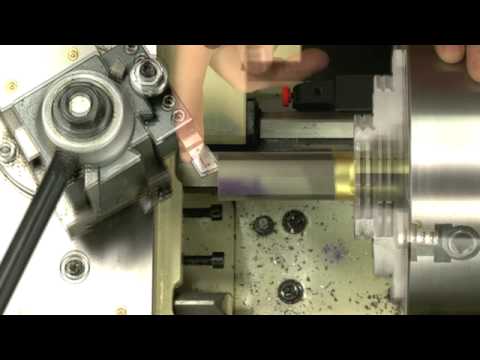
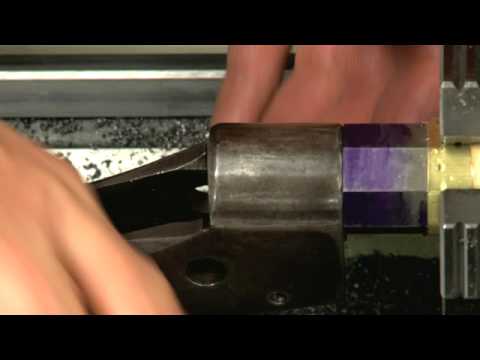
Larry Potterfield, owner and founder of MidwayUSA, has created some basic gunsmithing videos that are worth watching. These show some key aspects of rifle metal-working, such as crowning a barrel. Be aware that these videos are really just teasers — they don’t illustrate most of the critical preparatory steps a skilled gunsmith will do, such as leveling his lathe precisely, and indicating the barrel very, very carefully. Nonetheless, there are some good, basic tips in the videos, which should be informative for all shooters, whether they do their own smithing or not. Please note that benchrest smiths may employ more advanced methods.
VIDEO One: Cutting and Crowning a Barrel (Radiused Crown)
VIDEO Two: Threading and Chambering an Octagon Barrel


 The Bore Rider Jag has an extra-long shank so that when the patch exits, the Acetron (polymer) shank is the only thing that makes contact with the crown. This way you don’t have a metal rod tip riding over the delicate crown. The Bore Rider Jag shank diameter is also a close fit to the bore to avoid uneven wear. The Brush Guide is an Acetron extension that fits between your brush and the end of the cleaning rod. This extension protects the crown when you brush, allowing you to push the brush completely out of the barrel without dragging metal connections over the edge of the crown. [Editor’s Tip: While the polymer material used in the Bore Rider Jag and Brush Guide is “kinder” to crowns, be sure keep the Acetron shanks clean from small particles and debris. These particles can embed themselves in the polymer. Wipe off the Jags and Brush Guides regularly.]
 Source for Bore Rider Jags and Brush Guides
 But how do you know if your barrel is too hot? Consider a “non-contact” thermometer that reads your barrel’s “infrared signature”. The Kintrex or Actron pocket-sized, non-contact IR thermometers are ideal for shooters at the range or in the prairie dog fields. Both are handy and inexpensive — costing about twenty bucks (on sale).


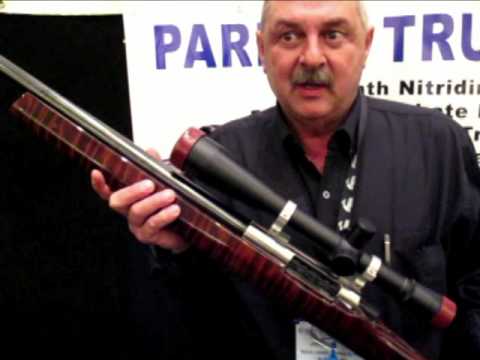

 Chip Lohman, Managing Editor of Shooting Sports USA Magazine, has authored an excellent article on barrel maintenance and cleaning. Chip’s article,