IBS Match Report by Bob White
The “Mainville Mania” match marked the last International Benchrest Shooters (IBS) group shoot of 2015 on September 26-27, 2015. It was held at the Mainville Sportsman Club in Mainville, PA, and was attended by 30 shooters. Shooting conditions were good, with light winds and temperatures ranging from the upper 50s to high 70s both days. The “Mainville Mania” Two-Gun Aggregate winner for 2015 was Al Auman who recorded an impressive .2294 Overall Agg. There was some very tight competitition this year — second to sixth place in the Two-Gun Agg was separated by only 0.008. Jeff Peinhardt was the Two-Gun runner-up with 0.2545, while Harley Baker placed third with 0.2569.
The Mainville Sportsman Club is a very scenic venue, set in wooded countryside. Here is the view of the covered rifle benches, as seen from the target bays.
Saturday Start to a Great Event
The Saturday morning warm-up began with Light Varmint (LV) class. Sarah Dolinsky, a first-year rookie, shot the smallest group: 0.111 inch. With the start of the record matches, Barney Small jumped out in front with a 0.139 but his lead was short-lived as Howie Levy shot his second sub-0.2 group in match Two to take over first place. Bill McIntyre’s 0.114 placed him on top after match Three. Bill maintained his lead through match Four with a slightly larger Agg. Following match Five and completion of the yardage, by virtue of his 0.121 final group, Wyatt Peinhardt won with a superb 0.1830 LV Aggregate.
Following lunch in the clubhouse (the “Mainville Cafe”), the Heavy Varmint 100-yard event began with record match number One. Al Auman took the lead with a 0.122 group. After match Two, Auman was still on top. But Harley Baker took the lead with a 0.158 after match Three. A new leader emerged after match Four as Howie Levy posted a 0.217 to take the number one spot on the leader board. On the fifth and final group, Bob White, who had been in third to seventh place all afternoon, fired a 0.121 to steal the HV 100-yard Agg. White’s final group edged out Howie Levy by a mere .002 for the win.
More Mirage on Day Two
Sunday’s weather conditions had more mirage, but were still quite shootable. Once again Sarah Dolinsky claimed small group on the warm-up in the Heavy Varmint (HV) class. Not content with a 0.277, she shot a 0.263 in match One. The lead changed to Al Auman in match Two following his first and second groups in the “threes”. However, Al wasn’t done — he improved with a 0.283 in match Three, giving him a 0.1637 Agg (as corrected for 200 yards). It appeared that a record Agg might be possible. Al maintained his lead throughout the match, finishing with a 0.2068 Agg for a solid win.
In the Sunday Afternoon Light Varmint event, Barney Small’s 0.277 in Match One had him on top. He maintained this spot through match Three, but Bob Brushingham was nipping at Barney’s heels. After match Four, Brushingham took the lead with a 0.2011. The final group gave Bob Brushingham the yardage win with a flat .2100 followed by Barney at 0.265 and first year Rookie Jason Brown in third with his 0.2707.
LV and HV Grand Agg Top Guns
Looking at Grand Agg standings in Light Varmint, Wyatt Peinhardt took third with a 0.2595. In second was Al Auman at 0.2476 and Top Dog was Bob Brushingham with a 0.2366. In the Heavy Varmint Grand Agg, Al Auman was the winner with a fine 0.2112. Harley Baker was second with 0.2395 and Howie Levy placed third with a .2423.
As awards were ending Brian Dolinsky (patriarch of the famous shooting Dolinskys) offered a $100 cash prize for the best Mainville three-match Two-Gun Agg average for the 2016 season. Bob Brushingham won the special award for best three-match Aggregate in 200-yard Light Varmint. The $100 award was donated by Kent Harshman to reward the shooter who excels in what are usually the last five targets shot in two-day match. The Mainville Club welcomes other cash award offers for its 2016 season.
The Mainville Sportsman Club (MSC) was founded in the mid-60s to promote pistol and rifle shooting. With over 400 members, the Club hosts benchrest rifle competitions, pistol matches, Cowboy Action events, Buffalo Shoots, and an annual Ground Hog Shoot.
The Club operates a covered 40-bench rifle range, a 6-lane Cowboy Action Shooting area, plus an indoor meeting facility. The rifle range has targets set at 100, 200, and 300 yards. The club also offers Hunter Safety Courses. The facility is located in the Northeast corner of Pennsylvania near Bloomsburg, PA, about 5 miles east of exit 242 on I-80 near Mainville, PA.
The Mainville Sportsman Club has a rich history. In the early years the organization held Dinner-Dances which were popular throughout the community. MSC also held Beef Shoots featuring 6″ black targets shot off-hand at 100 yards. These events were well-attended, with as many as 100 shooters.
Benchrest Hall-of-Famer Thomas “Speedy” Gonzalez has teamed up with the Shurley Brothers on a new ARK series of wood laminate competition stocks. Speedy has combined the best features of various popular F-Class and Long-range Benchrest stocks into new designs to be produced by Shurley Brothers Custom in Austin, Texas. These stocks should be very straight and geometrically correct as they will be crafted on the Shurley Brothers’ new CNC mills. These stocks will be made with new-generation precision technology, not old school duplicating machines.
Initially two models will be offered: the “Hand of God” (HOG) and the “Spear of Destiny” (SOD). Both are designed for multiple shooting disciplines, so they should work well both for benchrest and for prone F-Open shooting. (FWIW, John Myers used a Speedy-crafted stock to win the 2015 Mid-Range National Championship). The forearm is 76mm (2.99″) to comply with F-Open limits. A wide variety of options will be available including adjustable Cheek Piece, adjustable length of pull, carbon fiber inserts, and exotic woods.
We like many aspects of the new stocks. First, the front of the stock is low profile, placing the barrel close to the bags for better tracking (and less hop). However, a deeper (top to bottom) section extends forward of the action — this is important. We have seen some low-profile stocks that suffer from forearm flex/hinging because they don’t leave enough wood under the action area. Speedy’s design eliminates this problem. Another nice feature of this stock is the subtle curve from the back of the action to the buttpad mount. Speedy calls this the “scooped cheek”. This allows the “driver” to shoot without face contact if he prefers, but it also allows for a higher buttpad position — which is useful when shooting heavy recoiling chamberings such as the .300 WSM.
Note how the comb area has a curve to provide clearance. For those shooters who prefer to have face contact on the gun, an adjustable Cheek Piece is offered.
Shurley Brothers Custom says these new ARK stocks are fully customizable for competition shooters with optional carbon fiber, adjustable R.A.D. systems, and many other features. The stocks, uninletted, will run $750.00. CNC-inletting (for action of your choice) is an additional $100.00. Here are some of the many available options:
— Pillar Bed and Inlet: $425.00
— Custom Wood Upgrade (Price Dependent On Wood): $100.00 – $500.00
— Full-length Carbon Fiber Stringers: $200.00
— Cheek Piece Addition: $100.00
— Cooling Ports (Buick Vents): $60.00
— R.A.D. System #2A: $335.00 (plus $100.00 to install)
— 3-Way Butt Plate: Call for Price
— Adjustable Neodymium Magnetic Cheek Piece: Call for Price
— Install Neodymium Magnetic Cheek Piece: $150.00
— Stock Finish & Clear Coat: $350.00
— Carbon Fiber Forearm Tunnel: $300.00
The underside of the forearm is relieved in the center, leaving twin outboard rails. This helps stabilize the rifle and aids tracking. (A conventional, flat forearm without rails tends to rock if there is any hump in the middle of the sandbag). Between the rails is a carbon-fiber stiffening insert.
Did you know that, since 2009, Canada has had its own dedicated website for short-range benchrest: www.Benchrest.ca? Founder/webmaster Rick Pollock notes: “As Benchrest up here in the great white north has little or no web presence, a website was long overdue. It is non-commercial and not affiliated with any one sanctioning body. The only aim is to get more people into Benchrest in Canada.”
The site is a valuable resource. You’ll find upcoming BR matches (in Benchrest.ca online forum), a list of clubs, recent news, and, of course, match reports. In addition there is a buy/sell “classifieds ads” section, as well as a photo gallery. Benchrest.ca also has a YouTube Video Archive with clips showing many of the legends of the sport. Here’s a 2010 Benchrest.ca video showing Tony Boyer at the 2010 NBRSA Nationals:
If you live “North of the Border” and shoot benchrest for score and/or group, definitely visit (and bookmark) www.Benchrest.ca.
At the 2015 F-Class National Championships, nearly three-quarters of the F-Open shooters were using SEB coaxial front rests. And the man who makes them, Sebastian Lambang, was on the firing line too. Seb shot very well, finishing in second position in the F-TR division for the Saturday (Oct. 31) session. For those shooting F-Open or benchrest matches, Seb’s joystick rests really do represent the current state-of-the-art in front rest design. Courtesy of Seb, here are some photos that illustrate the “inner workings” of the SEB NEO Front Rest.
If you’ve ever wondered how a joystick front rest works, and how the parts go together, study the photos below. In addition, for those who use a NEO rest in competition, Benchrest Champion Mike Ratigan offers some PRO USER Tips that will help you get the best results from your NEO.
Unique Features of the SEB NEO Front Rest:
Lots of Travel — 43 MOA Vertical and 48 MOA Horizontal via joystick alone. The NEO offers more joystick travel than any other coaxial rest.
Variable Joystick Movement — The NEO is the only rest that can be configured for reverse action mode. That means you can optionally set it to lower the rifle with an up movement of the joystick if you prefer. (Standard setting raises rifle with up joystick movement.)
Rack & Pinion Risers — The NEO has dual support columns with Rack & Pinion system, offering a very broad vertical adjustment range.
Optional Counter-Weights — The NEO comes standard with a spring-loaded top mechanism to help hold up the rifle. Optional counter-weights allow you to reduce spring “pre-load”. Many people feel the counter-weights also allow a smoother, less jerky movement.
Reversible Base — The NEO’s base can be set-up with either the long leg in the rear or the long leg in the front. Putting the long leg in front gives more room under the rifle.
NEO Packs Flat — The SEB NEO is easily dismantled for transport, and can pack nearly flat. This is a big advantage when traveling.
Counter-weight Function and Calibration: “With the Seb NEO, equipped with the optional static counter-weight, the shooter can calibrate the counter weight to the rifle weight. The counter-weight is used to hold up the rifle. Clamping pressure of the sliding plates is NOT used to hold up the rifle like other coaxial rests on the market today. Other coaxial rests apply enough clamping force to the rest top mechanism sliding plates to resist the downward movement of the top when the rifle weight sets on the rest. This one feature of the Seb NEO almost completely eliminates bullets falling out of the bottom of your groups because the rest moved (or falls) down when you fired the rifle. This function is very important.”
On Hand Position: “I try to keep the palm of my hand grounded to the bench at all times. To do this at the closer distances, the handle will be laying flat (bend to the side) while shooting on the bottom of the target. To move to the top up (for right-handed shooters) I rotate the handle counter clockwise, which [raises the top] while maintaining my palm grounded to the bench.”
On Front Bag Fill: “Give some coarse sand blasting sand a try with the small stuff screened out. This will help reduce compaction from daily use.”
IBS Report by Randy Jarvais
The 2015 IBS 100/200 Score Nationals were held August 22-24 in Augusta, Maine at the Capitol City Rifle and Pistol Club. By all accounts, the 2015 Score Nationals event was another success. Fifty-three guns participated in this year’s Score Nationals, with 38 Varmint for Score (VFS) and 15 Hunter rifles registered. Nine shooters competed for the 2-Gun award. Mike Niblett shot great to win the Varmint for Score (VFS) Grand Agg, while finishing first at 200 yards and second at 100 yards. Mike’s impressive 500-39X Grand Agg total was just one point shy of the current IBS record. Kudos to Mr. Niblett! Dean Breeden won Hunter Class with Randy Jarvais in second — and that was also the result for the 2-Gun Grand Agg (Breeden first, Jarvais second).
Equipment Report
Among the Top 10 VFS shooters, nine shot a 30 BR, while the 10th campaigned an unidentified 30-caliber cartridge. Six of the Top 10 VFS shooters used Hodgdon H4198 powder, three used Vihtavuori N130, and one loaded with Hodgdon H322. Krieger barrels were used by five of the Top 10, with two Bruxes, two Liljas, and one Rock Creek. There were a wide variety of bullet choices. VFS Winner Mike Niblett used a Hillbilly 118-grainer while 2-Gun winner Dean Breeden used 115gr “10X” bullets in both his rifles (VFS and Hunter).
Southerners Shine in Augusta
From a Maine perspective, every USA destination is south, but the true South was well represented in both number and quality of shooters. To illustrate, in the 100-yard leg of VFS class only one person north of the Mason/Dixon line was able to crack the top seven positions, and he had the home field advantage. For match One, five shooters shot 5X targets, but from then on it was the Jerry Powers show. Powers, from North Carolina, put together a string of three 5X targets before faltering with a 3X during match four. Undaunted, Powers finished strong with another 5X. He needed to, as his 23Xs were but one better than both Mike Niblett of Kentucky and Jim Cline of South Carolina.
Eight VFS Shooters Post 500-Point 100/200 Grand Aggregates
At the Capitol City Range, the 100-yard targets are downhill, while the 200-yard targets are near level with the benches. While the benches are covered there is little covered area aft for equipment in waiting. With the prospect of showers for the entire weekend, Club members rigged tarps, hoping to provide a dry haven if needed. For the most part, ‘Tarp City’ worked sufficiently well. Fortunately, after Friday’s rain, the remainder of the weekend was mostly free of any heavy precipitation.
Score Nationals competitors line up for the Rifle Weigh-In process. The blue tarps provided a little extra protection from the elements.
Thunder and Lightning, then Drizzle on Sunday
Although the weather was very nice while shooting the 100, shortly thereafter the sky opened up with an impressive display of thunder and lightning. Although that front passed, Sunday’s weather started as overcast with drizzle and showers, but no lightning. Winds started mild but as the day unfolded and the sun was able to break through, so did the wind — it became down right gnarly during some relays. The wind was gusty, and constant switching from 11:30 to 12:30 was problematic, creating vertical issues. Even so, nine shooters were able to shoot 250s at 200 yards on Sunday, all from the VFS class.
Tough Competition in Hunter Division
In IBS, Maine is the last stronghold of hunter classification shooters, thus it was no surprise that the Hunter class was the National’s largest in recent memory. At 100 yards, five Hunter shooters shot perfect 250s on Saturday. Dean Breeden nailed a 250-19X followed by Randy Jarvais with 250-18X. Third place went to K.L. Miller who out-dueled Peter Hills and Tim O’Mara who were the other two 6-power shooters to shoot the coveted 250.
In the 6-power Hunter class, the battle between Breeden and Jarvais continued on Sunday. Breeden started better and maintained a 2X lead through match three. Skip Plummer, a long-time 6-power shooter (with a very “stock”-locking rig), shot three straight 50-point targets (on targets 2, 3, and 4) to threaten the two leaders.
Breeden shot a 50-1X on his fifth and final 200-yard target and watched through his spotter, while Jarvais dropped one point on his very last shot for record at 200. The order of finish for the five-target, 200-yard leg was Breeden (249-6X), Jarvais (248-5X) and Plummer (247-8X). Sweeping both the 100- and 200-yard legs gave Breeden (499-25X) the Hunter Grand Agg with Jarvais (498-23X) placing second.
Breedan Wins 2-Gun Aggregate… Again
The 2-Gun is a recent award and as yet has been contested but a few times. That doesn’t diminish the feat that there has been but one winner of the award, Dean Breeden. Prior to match 5 on Sunday, Jarvais had the Xs to dethrone Breeden from the 2-gun award, but this is a score game. Match 5 is now a nightmare memory for Jarvais, losing the last shot with each gun. So close yet so far! Breeden on the other hand proved again why he is the competitor to beat. With all the chips on the table, Dean did what he needed to do — dropping just a single point in the entire match. Breedan finished with 999-50X (for both guns) to secure another 2-Gun title, followed by Randy Jarvais (997-55X) two points back. That was tough for Randy, but as Orland Bunker observed: “All the Xs in the world means nothing if you don’t have the points.”
Every Shooter Was a Winner
The Capitol City Rifle and Pistol Club offered a rich prize table. Thirty Benchrest vendors donated nearly $9000.00 worth of hardware and shooting supplies. That generosity allowed each shooter to receive a door prize. In addition, a Nightforce Competition scope was raffled off, with the proceeds earmarked for new concrete benches. Wyatt Fox of New Hampshire was the lucky winner of the Nightforce.
All shooters received a door prize. Lucky Wyatt Fox (above right) received a Nightforce scope.
Report by Clint Johnson, ACWLC
The 2015 IBS 200/300 Yard National Championships were held September 12-13 at the Ashe County Wildlife Club (ACWLC) outside Jefferson, North Carolina. Fifty shooters from 13 states attended. Nightforce was the major event sponsor, donating a $2,400 rifle scope. While rain threatened to mar the 200-yard match on Saturday, none fell. By Sunday, the day of the 300-yard shoot, the first cold front of the fall had passed, leaving mostly sunny conditions.
Conditions Keep Scores Low At 200/300 Yard Nationals
The rain that fell on Friday night started drying Saturday morning when the sun rose. That slow evaporation created mirage that plagued shooters looking northeast down the two-year-old, 300-yard range with a 50-foot high backstop. The wind that came in with the cold front also hampered shooters on both days.
Mean Conditions at Ashe County
“Shooters told me the conditions were as bad as they have ever shot”, said Steve Eller, the IBS chair for the Wildlife Club. “We all had a hard time seeing the rings through the mirage blur. No one shot clean, and no records were set.”
Shooters came from as far away as Maine, Indiana and Florida to Ashe County, “the coolest corner of North Carolina”. The ACWLC range is located in the mountainous northwest point of the state with Virginia to the north and Tennessee to the west. Some of those shooters have made every one of the four IBS-sanctioned matches held at the club this year and last year. The Club hosted the 100 and 200 Yard National Championship in 2014, the first full year since the opening of the club house in 2013 with its 30 benches protected by an overhang.
“I love coming here. It is my favorite place to shoot,” said Hillary Martinez of Damascus, Maryland. Hillary, shown below, was one of the four women shooters this year.
Danny Hensley of Jonesville, Virgina, won the Grand Aggregate Varmint for Score (VFS) with a score of 493 (10X), followed by David Richardson with 492 (11X) and Randy Jarvais with 491 (12X). Danny talks about his victory in the audio clip linked below. To listen, click on the black arrow in the white circle.
AUDIO FILE: Danny Hensley Talks about the Conditions at the 200/300 Nationals.
Here are all the Class Winners at the IBS 200/300 Yard Nationals:
Wayne France of Burke, Va. won the 200-Yard VFS with a score of 250 (11X), followed by rookie Ken Habedank with score of 250 (8X), and David Richardson with a score of 250 (8X).Morris Williams of Eden, Maryland, won the 300-Yard VFS with a score of 244 (3X), followed by Danny Hensley with a score of 243 (4X), and David Richardson with a score of 242 (3X).
There were just five (5) shooters in the Hunter Class. Dean Breeden topped the small field to win the Hunter Grand Aggregate with a score of 483 (10X), followed by Randy Jarvais with a sore of 480 (7X), and K.L. Miller with a score of 478 (12X). Randy Jarvais won the 200-Yard Hunter with a score of 248 (6X), followed by K.L. Miller with a score of 246( 8X), and Dean Breeden with a score of 246 (7X). Orland Bunker of Damariscotta, Maine, won the 300-Yard Hunter with a score of 238 (2X), followed by Dean Breeden with a score of 237 (3X), and K.L. Miller with a score of 232 (4X).
Dean Breeden (Frederick, Maryland) had a beautifully-figured wood composite rifle.
Barbecue North Carolina Style
Some shooters remarked that they drove to Ashe County not only to shoot, but to eat as well. A 300-pound hog was slow-cooked all Friday night by Club members. Corn was also roasted on the grill. The cost of this distinctive North Carolina pork barbecue was included in the registration fee.
Ashe County Wildlife Club maintains a website, www.acwlc.org and a public Facebook page. The Club hosts rifle, pistol, and shotgun sports (skeet, trap, sporting clays) events at its range facility located about 15 miles east of West Jefferson at 3220 Big Peek Creek Road, Laurel Springs, NC (turn north off NC Highway 88). Visit www.acwlc.org to learn more about the club or obtain Membership applications.
Barney M. Auston of Tulsa, OK with rifle he built to break NBRSA record and win $250 cash award from Sierra Bullets. (From cover of Precision Shooting magazine. May 1956).
Way back in 1955 Sierra Bullets offered a $1000 prize for anyone setting a new Aggregate benchrest record with a 6mm (or larger) bullet. At the time the .222 Remington ruled the roost, and Sierra wanted to promote the larger caliber. Sierra also offered a $250.00 prize for a record-breaking performance with any size caliber (including the .22s). Here is the story of how a Tulsa shooter claimed the $250.00 award with a world-record-setting Aggregate involving 10-shot groups at 100 and 200 yards.
Barney Auston’s record-setting rifle was built on an FN Mauser action with double set trigger, with a Hart stainless steel barrel, 30″ x 1 1/8″, chambered for the .222 Remington cartridge. The stock, made by Auston, has a hydraulic bedder as made by L. F. Landwehr of Jefferson City, MO. The scope is a 24X, 2″ inch Unertl. Mr. Auston shot 50gr bullets, custom made by W. M. Brown of Augusta, Ohio, with .705″ Sierra cups and soft swedged. His powder charge was 21 grains of 4198. The rifle rests, both front and rear, were also made by Auston.
Record-Setting Performance
On August 20, 1955, shooting at night in a registered shoot on the John Zink range near Tulsa, Oklahoma, Barney M. Auston of Tulsa broke the existing National Match Course aggregate record and, as the first to do that in 1955, won the Sierra Bullets $250 cash award. Here is the original Sierra Bullets prize offer from 1955:
10-Shot Groups at 100 and 200
Mr. Auston’s winning Aggregate for the National Match Course (five 10-shot groups at 100 yards and five 10-shot groups at 200 yards) was .4512 MOA. He also broke the 200-yard aggregate with an average of .4624 MOA, beating the .4801 match MAO record set by L.E. Wilson only a month earlier.
Barney Auston was a custom rifle maker in Tulsa who fabricated the rifles used by many of the leading benchrest competitors in the Mid-Continent and Guild Coast Regions. Auston was himself one of the top benchrest shooters in those regions during his shooting career.
Editor’s Note: Both of Mr. Auston’s records were broken before the end of the 1955 shooting season, but Auston was the first to win the Sierra Prize. Interestingly, in setting his record, Austin broke the existing Agg record by L.E. Wilson of Cashmere, Washington — yes, the same L.E. Wilson that now makes dies.
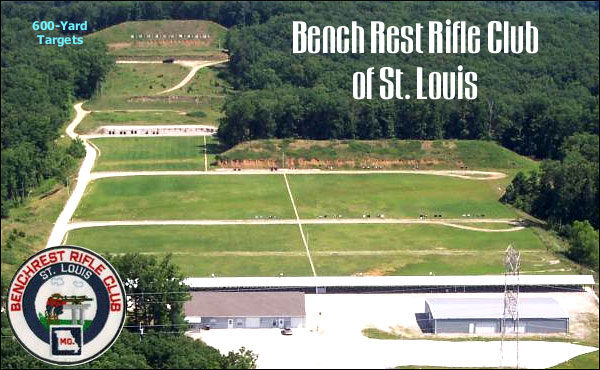
The NBRSA short-range Group Benchrest Nationals commenced this week at the St. Louis Benchrest Club Range in Wright City, Missouri. This will be followed, next week, by the World Benchrest Shooting Federation (WBSF) Championships at the same venue. Lapua staffer (and Forum member) Kevin Thomas trekked to Missouri for this combined National/International event. Kevin reports: “The best benchrest shooters [on the planet] will fight it out over the next two weeks to see who can shoot the smallest groups possible. And I’ve got to say, many of these shooters are truly amazing. It doesn’t hurt a bit that virtually all of them are shooting Lapua brass, either.”
The WBSF event has attracted shooters from around the world. Benchrest aces from Australia, Canada, Great Britain, and South Africa are already in St. Louis, with other international competitors set to arrive next week. On Monday, Day One of the NBRSA Nationals, the Unlimited Class rigs showed off their capabilities. As shown below, these heavy rail guns represent the pinnacle of precision in the 100/200-yard benchrest game.
Here’s living legend Walt Berger, founder of Berger Bullets. Now in his late 80s, Walt is still competing at a very high level. Walt is proof that Benchrest shooting is truly a “sport for a lifetime”.
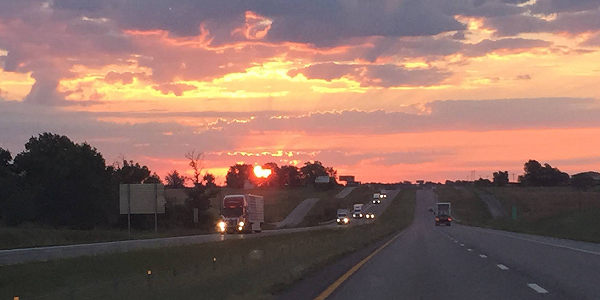
Here’s a beautiful Missouri sunrise captured as Kevin Thomas drove to St. Louis for the 2015 NBRSA Benchrest Championships.
Forum member Evan K. (aka “Katokoch”) has crafted a nice rimfire benchrest rig using a Suhl action fitted into a handsome home-built cedar and carbon fiber stock. This shows what a skilled hobbyist wood-worker can create in his garage. Evan tells us: “Here is my Suhl 150-1 with a factory 1:19″ twist barrel, Leupold 36X scope, Harrell tuner, and my handmade cedar/carbon fiber stock. I started working on the laminate blank a couple years ago and finally finished it earlier this year. I’ve been using it in my IR 50/50 matches this summer. I haven’t shot a 250 with it yet but I know the rifle is very capable — as usual, I am the weak link!”
We think Evan did a great job on his stock, though he has limited stock-building experience. Evan explained: “The stock is my first attempt at making a very lightweight laminate and also gluing both vertical and horizontal seams in a blank. The wood is Spanish and Red Cedar and I made the trigger guard and buttplate with carbon fiber too (great use for small scrap pieces). The finish is hand-rubbed spar urethane and the action is semi-glued-in with Devcon 10110 and stainless pillars.”
USRA-IR50/50 is a popular .22 rimfire benchrest discipline with three (3) classes: 13.5 lb., 10.5 lb., and 7.5 lb. (Sporter). The matches are shot at 50 yards and 50 meters.
As far as we can tell, the first-ever formal benchrest shooting match took place in 1944 at the Tacoma Rifle & Revolver Club in Tacoma, Washington. Known today as the “Sniper King Competition”, this is still a popular event, drawing top shooters from around the country.
Our friend Lou Murdica bested the competition this year to win the Sniper King competition and Benchrest shooting’s oldest trophy. Take a look at that target. That’s a TEN-Shot group at TWO hundred yards. That works out to 0.1299 MOA for ten shots. That’s might impressive…
We have to give Lou credit for his shooting skills and loading spectacularly accurate ammo. Lou was running a Kelbly action, Shilen Barrel, and March scope. He loaded 6mm Berger 65gr BT bullets driven by Accurate LT 30 powder.
Have you ever shot a smaller TEN-shot group, even at 100 yards? If so, tell us about that, by posting a comment below.


 More Mirage on Day Two
 The Mainville Sportsman Club (MSC) was founded in the mid-60s to promote pistol and rifle shooting. With over 400 members, the Club hosts benchrest rifle competitions, pistol matches, Cowboy Action events, Buffalo Shoots, and an annual Ground Hog Shoot.