|
|
April 9th, 2016
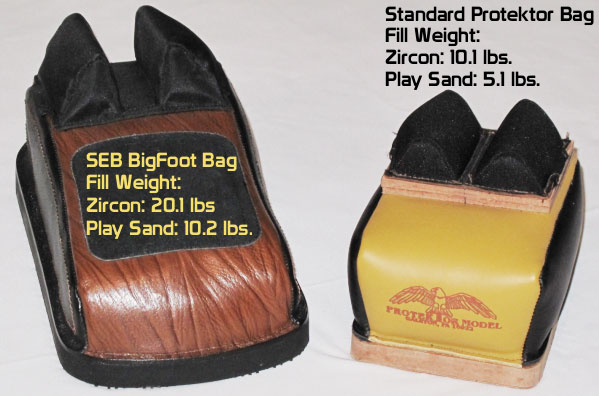
Over the years, noted gunsmith and a Benchrest Hall-of-Fame inductee Thomas ‘Speedy’ Gonzalez has learned a few things about “tuning” rear sandbags for best performance. On his Facebook page, Speedy recently discussed how sand bag fill levels (hard vs. soft) can affect accuracy. Speedy says you don’t want to have both your front and rear sandbags filled up ultra-hard. One or the other bag needs to have some “give” to provide a shock-absorbing function (and prevent stock jump).
SAND BAGS & HOW TO FILL THEM by Speedy Gonzalez
I was asked several times by competitors at the S.O.A. Matches and F-Class Nationals as to how I fill my sand bags for benchrest competition. Here is a copy of a reply I gave several years ago:
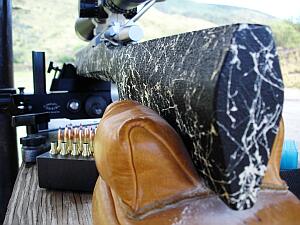 Back in the old days, about the time Fred Flintstone was still alive, I worked for Pat McMillan for free, from time to time to learn all his secrets. One day little Speedy was filling some new sand bags out behind Pat’s shop, stuffing them with more sand than Taco Bell put beans in their Burritos. When Pat stepped out the back door and inquired as to what in the hell was I doing packing them there bags the way I was. Back in the old days, about the time Fred Flintstone was still alive, I worked for Pat McMillan for free, from time to time to learn all his secrets. One day little Speedy was filling some new sand bags out behind Pat’s shop, stuffing them with more sand than Taco Bell put beans in their Burritos. When Pat stepped out the back door and inquired as to what in the hell was I doing packing them there bags the way I was.
I looked up at him with eyes like a kid with his hands in a cookie jar. My reply must have sounded like Homer Simpson “Doooh”. Finally I said “I don’t know, Boss. I just thought you were supposed to fill these babies up and go shoot. I got that ‘You dumb bastard look’ from Pat and I knew it was lecture time. This was what he told me:
You can not have two bags filled so hard that you gun bounces on them in the process of firing round at your target, especially if you have a rig with a very flexible stock. The bags must be set up in a manner for them to absorb the initial shock of the firing pin moving forward and igniting the primer. Then [they must] maintain their shape and absorb the second shock wave as well the rearward thrust and torque of the rifle. What happens to the rifle when this is not done? Well let me tell you. The rifles have a very bad tendency to jump and roll in the bags. This causes many of those wild, lost shots that one can’t explain.
Charles Huckaba, Ken Terrell, Larry Baggett, Ralph Stewart and some of us Texas shooters talk about this phenomena quite often. We have all agreed that:
- 1: You can not have two hard bags [i.e. both front AND rear] in your set-up.
- 2: Heavy sand magnifies these phenomena.
- 3: If you are a bag squeezer, pack ears hard and leave bag pliable enough to squeeze for the movement required. You may pack front bag as hard as rules permit.
- 4: Free recoil shooters pack both bags firm, but not so hard as to allow stock jump. Especially if you have a stock with a very flexible forearm.
- 5: We use play-ground sand, also know as silica sand. I sift mine to get any large impurities out then mix it with 25% to 50% with Harts parakeet gravel to the desired hardness that I am looking for. The bird gravel keeps the sand from packing itself into that solid as a brick state.
Speaking of bricks — another thing that happens when shooters employ that heavy zircon sand is the ears form a low spot under them from recoil and then tend to rock back and forth with the rifle causing many low shots to crop up. Edgewood makes an Edgewood/Speedy rear bag specially reinforced under the ears to eliminate this scenario.
One last note –If you use the Cordura bags keep them sprayed with a good silicon spray or “Rain-Ex”. This keeps them from getting sticky. Hey guys, try that and see if it helps. — Speedy
P.S.: I do not like the solid double-stitched leather bottoms. While this seems like a good idea, I see more shooters have problems because of them. They tend to slide around the bench and or slide with the rifle on recoil. The standard Protektor with Cordura rabbit ears and an Otto ring bag with a Cordura front would be what I would suggest to the new shooter or one of the Edgewood / Speedy rear bags, these mimic the “Donut” and feature a ring of leather around the bottom circumference that keep the bottom from rocking on the bench or ground if that is where you reside these days…
March 14th, 2016

No doubt you’ve heard the term “reticle” before, but it probably brings to mind the cross-hair you see through a rifle-scope. This term “reticle” can also describe an optical aid used to score targets. This story discusses a new scoring reticle with precisely-defined circles etched on clear plexiglass. This scoring reticle (as attached to a magnifying crystal) is used to determine whether bullet holes fall inside or outside the scoring circles on targets. This unique new scoring reticle allows match scorers to “equalize” the shot placements of all popular calibers from .204 up to .308. This way, there’s a “level playing field” for all calibers, and any caliber rifle can compete on an equal basis with the 30s.
New ‘Equalizer’ VFS Scoring Reticle
by Ron Goodger
The ubiquitous controversy over the advantage of larger caliber bullets in VFS (Varmint for Score) matches still rages, but there is a simple solution that is being embraced by all to whom I have shown it. The concept is simple, and it accomplishes the same thing the UBR (Ultimate Benchrest) targets do with the advantage that it can be used on any target a club happens to have on hand.
I had heard shooters complain about the advantage that larger calibers have many times and wish there was a fair way to score targets that would level the playing field for all calibers. The UBR concept came along and I read up on it. When a match was held close enough that I could enter, I did so and observed first hand what it was all about. The UBR targets essentially make the distance from the bullet hole center to the scoring ring edge the same for each caliber by using different-sized rings on the caliber-specific targets. After seeing the accompanying disadvantages of using this method (the chief one being the large number of targets required by UBR rules and the resulting increased time required to hold a match), I began searching for a simpler way to accomplish the same thing. I was aware of a number of mid-West clubs wanting to make scoring fair but unwilling to use the UBR method because of the disadvantages.

I came up with an idea late in 2015 and designed a scoring reticle that would do the job. The following diagrams graphically explain how UBR and my scoring reticle accomplish the same thing. The illustration above shows how different caliber bullets hitting the same center point of impact will each just score the 10 ring edge on the different-sized, caliber-specific UBR 10 Rings . It is clear that it is the distance from the center of the bullet to the scoring ring that is made uniform by the different 10 Ring sizes.

The illustration below shows how my VFS scoring reticle accomplishes the same thing by scoring every shot with an .308-equivalent ring that circumscribes the inner caliber-specific ring. The dotted line shows that the center of each bullet hits the same distance from the edge of the scoring ring. It is clear that, using current VFS scoring techniques, the .224, .243, and .257 bullets would score misses. However, scoring each bullet with the .308 ring around the hole illustrates that all calibers would be scored the same.
Scoring Reticle Converts Any Caliber Shot to a .308-Equivalent Hole

The above photo of an IBS 100-yard target has a 6mm hole that is clearly a nine (9), using current scoring methods. But consider that, if a .308 bullet from a 30 BR hit in the very same location, that .30-caliber shot would score in the Ten Ring. Why should the 6mm bullet, whose center was just as close to the middle of the target, be penalized because of the bullet diameter? The image on the right shows the scoring reticle with the 6mm scoring ring centered on this hole. With this scoring reticle, the .308 ring around the 6mm hole clearly scores the 10 Ring, just as a 30-caliber bullet centered in the same spot would do. That is as fair as it can get.

The above image (two shots per frame) from a Hillsdale Michigan varmint target has two 6mm holes that scored a 16. Score values are 10 points for a shot in the white, 5 points for a shot in the orange, and 1 point for hitting the center dot. This was a match that had 30BRs shooting in it. The next photo shows how scoring this frame with the VFS reticle would have resulted in a 21 because the left side of the reticle’s .308 circle just extends into the 10-point white bulls-eye region. So, in effect, there were two (2) shots in the white for 2×10 points (based on the .308 equalizer effect of the reticle). This shows how the reticle will level the VFS playing field regardless of what target is being used.
VFS Scoring Reticle Features and Specifications
The 6mm circles have been placed in the center of the reticle because it is expected to be the most commonly-used caliber, and that makes it easier to see in the crystal. Any of the ring sets can be used for a .308. The sizes of the circles are guaranteed accurate to within .001″ on the outside edge of the circle by the reticle’s manufacturer. I have found the best magnifier crystal to use is a genuine Badash crystal that measures 3.25″ in diameter. They are available from several eBay sellers and are easily attached using a piece of packing tape about 3/4-inch wide around the edge of the reticle (visible on the crystal in the lower part of the photo). That makes the Plexiglas reticles easy to replace in the event they become scratched up from frequent use.
A number of Midwest rifle clubs have already purchased these scoring reticles. The Plexiglas reticles are available for $15.00 each plus $2.04 shipping from the author (does not include the crystal). Email him at LRGoodger [at] gmail dot com for more information.
December 30th, 2015
 .009″ — The Record That Stood for 40 Years. .009″ — The Record That Stood for 40 Years.
In 1973 Mac McMillan shot an amazing 100-yard, .009″ five-shot group in a benchrest match. The .009″ group was measured with a 60x microscope for verification. Mac McMillan shot the group using a handbuilt prototype McMillan rifle with an early McMillan stock.
Mac’s .009″ group was the “Holy Grail” of rifle accuracy. This .009″ record was considered by many to be unbreakable, a record that would “stand for all time”. Well, it took 40 years, but someone finally broke Mac’s record with an even smaller group. In 2013, Mike Stinnett shot a .0077″ five-shot group using a 30 Stewart, a .30 caliber wildcat based on the 6.5 Grendel. Stinnett’s .0077″ group now stands as the smallest 100-yard group ever shot in registered benchrest competition.*
Read About .0077″ group HERE.
Stinnett’s success doesn’t diminish the significance of Mac McMillan’s .009″ group in the history of benchrest competition. For four decades Mac’s group stood as the ultimate standard of rifle accuracy*. For those of you who have never seen Mac McMillan’s .009″ group, here it is, along with the NBRSA World Record certificate. The target now hangs in the McMillan Family Museum.


*Somebody else might claim a smaller group, but unless moving backers or electronic targets were used, it cannot be verified. Moving target backers are used at registered benchrest matches to ensure that five (5) shots are actually fired in each group. That eliminates any doubt.
December 17th, 2015
Butch Lambert of ShadeTree Engineering provided this tip. Butch notes that many 6 PPC benchrest group shooters also enjoy shooting in score matches. But to be really competitive in the BR for score game, that means shooting a 30BR, which has a wider, .308-class rim (0.4728″ diameter). Likewise, if you want to compete in 600-yard registered BR events or in varmint matches, you probably want to run a bigger case, such as the 6BR, 6mm Dasher, or 6-6.5×47. Those cartridges also have the larger 0.4728″ rims.
To convert a PPC-boltface action to shoot the bigger cases you can spend a ton of money and buy a new bolt. That can cost hundreds of dollars. The simpler solution is to turn down the diameter of the larger cases on a lathe. Butch explains: “We’ve seen plenty of interest in rebating case rims. This lets you shoot a 30BR in score matches using your PPC action. All you need is a new barrel. This saves buying another bolt, receiver, or rifle if you have a PPC boltface. Anyone who has access to a lathe can do this job pretty easily. Yesterday I turned 150 case in about an hour.” Below are photos of a rebated 6BR case, along with the lathe form tool Butch uses to rebate the case rims.
Cutting Head for Rebating Rims

December 16th, 2015

Rodney Wagner shot the smallest 5-shot, 600-yard group in the history of competitive rifle shooting. First measured at a mere 0.349″, then certified on the IBS Record books at 0.336″, Rodney’s group is mind-blowingly small — and it was centered for a 50 score. This amazing group shows what can be done with a great gun, a talented shooter, and superb hand-loaded ammunition. Today’s Tech Tip reveals some of Rodney’s reloading methods that helped him put five shots you could cover with a dime into a target 600 yards away.
Creating Ultra-Accurate Benchrest Ammunition
Rodney takes great care in loading his brass, and he employs a few tricks to get superior consistency.
Fire-Forming — To prepare his cases for fire-forming, Rodney starts by turning his Lapua brass to just past where the new neck-shoulder junction will be: “I just cut enough for the 6mm Dasher neck. A little bit of the cut shows on the shoulder after forming.” Then Rodney runs a .25-caliber K&M mandrel through the whole neck, expanding the neck diameter. After the entire neck is expanded, Rodney re-sizes the top section with a Wilson bushing, creating a false shoulder. Then, as further insurance that the case will be held firmly in place during fire-forming, Rodney seats his bullets long — hard into the lands. When fire-forming, Rodney uses a normal 6mmBR load of 29.8 grains of Varget: “I don’t like to stress my brass before it has been hardened. I load enough powder to form the shoulder 95%. Any more than that is just wasted.” Rodney adds: “When fire-forming, I don’t want to use a super-hard primer. I prefer to use a Federal 205, CCI 200, or Winchester — something soft.” Using a softer primer lessens the likelihood that the case will drive forward when hit by the firing pin, so this helps achieve more consistent “blow lengths”.

Ammo Loading — Rodney is fastidious with his brass and weighs his charges very precisely. Charges are first dispensed with an RFD manual powder measure, then Rodney trickles kernel by kernel using a highly-precise Sartorius GD-503 laboratory scale. He tries to maintain charge-weight consistency within half a tenth of a grain — about two kernels of Varget powder.
 One important technique Rodney employs is sorting by bullet-seating force. Rodney batch-sorts his loaded rounds based on seating force indicated by the dial gauge on his K&M arbor press: “I use a K&M arbor press with dial indicator strain gauge. When I’m loading I pay lots of attention to seating effort and I try to batch five rounds that feel the same. For record rounds I try to make sure I get five of the same number (on the dial). When sorting based on the force-gauge readout, you need to go slow. If you go too fast the needle will spike up and down before you can see it.” One important technique Rodney employs is sorting by bullet-seating force. Rodney batch-sorts his loaded rounds based on seating force indicated by the dial gauge on his K&M arbor press: “I use a K&M arbor press with dial indicator strain gauge. When I’m loading I pay lots of attention to seating effort and I try to batch five rounds that feel the same. For record rounds I try to make sure I get five of the same number (on the dial). When sorting based on the force-gauge readout, you need to go slow. If you go too fast the needle will spike up and down before you can see it.”
In practice, Rodney might select five rounds with a gauge value of 25, then another five with a gauge read-out of 30 and so on. He places the first five like-value rounds in one row of his ammo caddy. The next like-value set of five will go in the next row down. By this method, he ensures that all five cartridges in a five-round set for a record target will have bullets seated with very consistent seating force.
Unlike some top shooters, Rodney does not regularly anneal his cases. However, after every firing, he does tumble his Dasher brass in treated corncob media. After sizing his brass, before seating the bullets, he runs a nylon brush in the necks: “The last thing I do before firing is run a well-worn 30 caliber nylon brush in the necks, using a small 6-volt drill for power. This is a quick operation — just in and out the neck”. Sometimes, at the end of the season, he will anneal, but Rodney adds: “If I can get 10 firings out of the case I’ve done good.” He usually makes up new brass when he fits a new barrel: “If it is a good barrel (that I may shoot at the Nationals), I’ll usually go ahead and prepare 200 pieces of good brass.”
Tips for 600-Yard Shooters New to the Game
In the course of our interview with Rodney, we asked if he had any tips for shooters who are getting started in the 600-yard Benchrest Game. Rodney offered some sensible advice:
1. Don’t try to go it alone. Find an old-timer to mentor you. As a novice, go to matches, watch and ask questions.
2. Go with a proven cartridge. If you are shooting 600 yards stick with a 6mmBR or one of the 6BR improveds (BRX or Dasher). Keep it simple. I tried some of the larger cartridges, the 6XC and 6-6.5×47 Lapua. I was trying to be different, but I was not successful. It wasn’t a disaster — I learned something. But I found the larger cases were not as accurate as a 6BR or Dasher. Those bigger cartridges are competitive for score but not for group.
3. You don’t have to spend a fortune to be competitive. Buy a used rifle from somebody and find out if you like the sport. You can save a lot with a used rifle, but do plan on buying a new barrel immediately.
4. Don’t waste weeks or months struggling with a barrel that isn’t shooting. My best barrels, including this record-setting Brux, started shooting exceptionally well right from the start.

Rodney’s record group was measured at 0.349″ at the match, then IBS record-certified at 0.336″.
December 13th, 2015
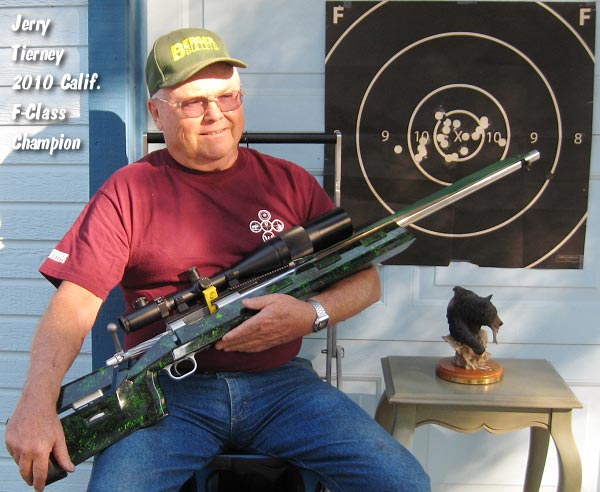
I am very sad to announce that a good friend (and a brilliant shooter) Jerry Tierney, has passed away at age 77. I have worked on this site for 11 years, and Jerry was one of the most helpful and talented men I’ve met along the way. Though he won many championships, Jerry was a modest man who always was there to help other shooters. I will really miss him. AccurateShooter.com owes a debt of gratitude to Jerry. With his technical expertise, he helped me greatly with my understanding of rifle accuracy. Jerry was small in stature, but big in talent. Rest in Peace Jerry. We’ll miss your smarts, your good humor, and your love for the sport. — Paul McM, Editor in Chief.
Jerry Tierney shot competitively for nearly 50 years and won multiple championships in various rifle disciplines. Fellow shooter Donovan Moran noted: “Jerry was the leading member of the NBRSA ‘Long Range Hall of Fame’ — well deserved! He was a very friendly man, a mentor to the sport, and one of the best Long Range competition shooters there’s ever been.”
With great natural talent and the mind of a scientist, Jerry could win events in ways not thought possible. He is certainly the only man I know who won a Benchrest Championship shooting a prone-type tube gun. He pioneered the .284 Win as an F-Open weapon. A self-declared “iron-sight prone guy”, he competed for many seasons in the full-bore and Palma disciplines, but in the last decade he turned his attention to 600-yard and 1000-yard benchrest and F-Class. He won multiple NBRSA Nationals, due in no small part to superb wind-doping skills and mastery of the “mental game”.
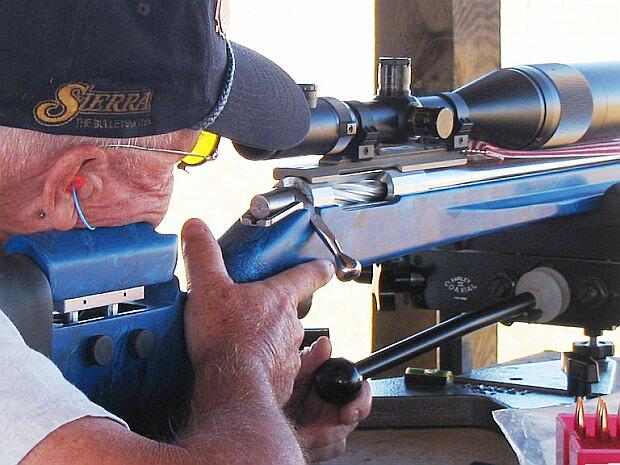
A former computer engineer with IBM, Jerry was an extremely bright guy who took a systematic approach to the sport. He made decisions based on hard data. He did things many shooters once considered radical (such as cleaning his barrels infrequently), but he always had the data to back up his methods. He was a forward thinker who wasn’t afraid to depart from conventional wisdom if he found a better way to do things. For me, Jerry Tierney was an important mentor — he showed me how the “state of the art” could be pushed to higher levels with careful experimentation and a willingness to try new things.

We did a lengthy interview with Jerry way back in 2005, when Jerry won the NBRSA 1000-yard Nationals. That performance helped proved the worth of the .284 Win in 1K competition, a cartridge that now is a leading choice for F-Open. Read this interview carefully — even ten years later, Jerry offers many nuggets of advice that can help with your reloading and shooting:
READ Interview with Jerry Tierney with Discussion of Wind Reading and .284 Winchester.
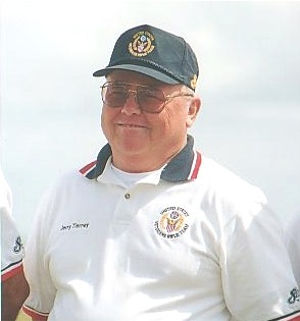 Danny Biggs Remembers Jerry Tierney Danny Biggs Remembers Jerry Tierney
Past National F-Class Champion Danny Biggs wrote: “Our long-time shooting friend, Jerry Tierney, left the range last night. Jerry was 77 years old, and was overtaken by bad health over the past year…cancer and other ailments. An accomplished Palma Rifle shooter, his home range was the Sacramento Valley Shooting Center, near Sacramento, CA, and, just 16 miles from his front door, outside Plymouth, CA.
Jerry was a frequent contributor to [Rifle Blogs] in past years. In particular, about 7 years ago, he published considerable results of his testing of the Winchester .284 cartridge. This testing convinced several of us to transition from the venerable 6.5-284 to the straight .284 for both long range ‘sling’ and F-Class Open. Jerry’s testing was primarily in the realm of F-Open; wherein, he fell ‘in cahoots’ with a young F-Open shooter, Charles Ballard, who set an F-Class Open National record that stood for many years. (By the way, Incahoots is the name of Jerry’s favorite restaurant in Plymouth, CA, near his home; where I’ve enjoyed many an evening meal with him.)
Many others have contributed to the legacy of the Winchester .284… but, if you happen to be shooting a .284 in F-Open today, you might just give a thought to Jerry at your next trigger-pull. More than likely, you are shooting some of his data.” — Danny Biggs
Forum Member Killshot added:
“I only new Jerry for a few years, as I began shooting F-Class in 2010 — but he always answered my questions, helped me with my first Wildcat chambering and I never, ever, saw or heard of him ‘Big Timing’ anyone. I’ll miss his gap-toothed grin, like he knew something you didn’t. (and probably did!)
We’re better off for knowing him and worse off for not having him around any longer. So, appreciate your friendships and shoot small… Jerry would.”
December 8th, 2015

Here’s good news for short-range benchrest shooters. The two most popular powders for the 6PPC, Vihtavuori N133 and Accurate LT-32, are now in-stock at Powder Valley Inc. (PVI). In fact, Powder Valley even has the hard-to-find 8-lb jugs of N133 and LT-32.
For you 30BR score shooters, PVI has both Hodgdon H4198 and Accurate LT-30 in stock, the two most popular powders for the 30BR. A slightly faster-burning version of LT-32, LT-30 is a very promising powder for the 30 BR, while H4198 has traditionally been the “go-to” choice for the 100/200-yard score shooting game. PVI has 1-lb and 8-lb containers of both these ultra-accurate powders in stock now. Visit PowderValleyinc.com, and click on the “Powders” link in the Menu.
| 6PPC Powders |
30 BR Powders |
|
– PVI has 1-pound LT-32 for $27.10
— PVI has 8-pound LT-32 for $204.30
— PVI has 1-pound N133 for $31.25
— PVI has 8-pound N133 for $202.00 |
– PVI has 1-lb LT-30 for $27.10
— PVI has 8-pound LT-32 for $204.30
— PVI has 1-pound H4198 for $23.25
— PVI has 8-pound H4198 for $165.00 |

November 27th, 2015

If you’re thinking about acquiring a 17 HMR rifle, you should read the 17 HMR Two-Gun Comparison in our Gun of the Week Archives. This two-gun shoot-out compares the performance of a Volquartsen 17 HMR semi-auto and a Ruger 77/17 bolt-action. Glen Robinson, the owner of both rifles, has done some serious comparison testing with both guns, trying out a half-dozen varieties of 17 HMR ammo. The overall results may surprise you. The semi-auto out-shot the bolt gun by a significant margin, with all types of ammo tested.
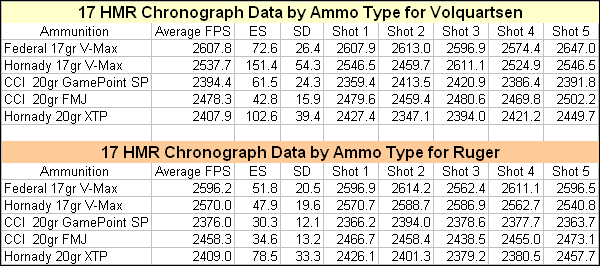

Comparing the Qualities of the Two 17 HMR Rifles
By Glen Robinson
While the Volquartsen proved to be the more accurate of my pair of 17 HMRs, I still enjoy owning both rifles. Each gun has its strong points and weak points.
Ruger Strong Points: From any angle, the Ruger 77/17 is a nice-looking rifle with classic lines. I like the gray-finish stainless barrel — it goes well with the gray laminated stock. With the addition of the aftermarket sear, the trigger is crisp and the bolt function is smooth. The action is strong and dependable. The conventional “open rear” action allows you to clean “normally” with a bore guide, cleaning rod, and patches/brushes. I feel I can do a better job of cleaning with the Ruger than with the boresnake on the Volquartsen.

Ruger Weak Points: Accuracy is somewhat disappointing. The best 100-yard group the Ruger has shot was about 0.82″ and the gun averages well over 1.25″ for 5 shots. In fairness, I haven’t done anything exotic in terms of bedding the action/barrel, and I would expect that an aftermarket barrel, perhaps combined with a barrel pre-load (up-pressure) pad, could improve the accuracy.
Volquartsen Strong Points: The Volquartsen is a well-made, accurate, dependable rifle. The gun cycles very reliably and requires very little maintenance. To clean it, just pull a boresnake through the bore. The gun exhibits very nice machining, and the VX-5000 stock rides steady on a front sand-bag, even though it’s only about 1.75″ wide. Even without any tweaking the trigger is very good, and the pull weight is fine for varminting.

Volquartsen Weak Points: The VX-5000 stock is not ideal for bench work — the comb is a bit too high, though I like the feel of the vertical grip. This stock profile is really more suited for silhouette shooting, but this stock seemed to be the best option offered by Volquartsen that could be used for both paper-punching and varminting. The receiver design limits your options for barrel cleaning.

Conclusion — The Volquartsen Takes the Prize
Having shot both rifles extensively, if I had to pick one gun, it would be the Volquartsen. The Volquartsen is much more accurate and it offers much faster follow-up shots. For varminting the Volquartsen would be superior, no question about it. I’m happy I bought the Volquartsen and the VX-5000 stock. It is a fun, versatile gun that lives up to the accuracy claims.
Read Full Article HERE.
November 18th, 2015

We congratulate Rebecca Richards of Australia for her incredible shooting in the recent RBA Benchrest Grand Prix at the Sydney International Shooting Centre. Consider this, out of the five (5) benchrest classes competing (two air rifle, and three rimfire) Rebecca won four classes outright while placing third in the fifth class. Wow — that represents complete and total domination. Remarkably, Rebecca dropped only 10 points in four days of shooting.
Rebecca’s amazing 4-day performance was near perfection. Overall, she scored 2740 out of a total of 2750 possible points. She shot four of 11 targets with perfect 250/250 scores, and six more with 249/250. Over the course of the event she hit 152 “dots” (center bulls) out of a total possible 275. That’s pretty amazing if you understand how small those center bulls really are. Take a look at the target photo below — the center dot is tiny.

All in all, this was a performance for the ages — one of the best combined airgun/rimfire benchrest performances in Southern Hemisphere history. Kudos to Rebecca for her brilliant performance.
Here’s the modern Sydney International Shooting Centre…

Now THAT’s a Shooting Range… CLICK HERE for Slide Show.

CREDIT: Thanks to March Scopes for providing this story. Rebecca uses many March scopes including a 10-60X, 5-32X, and 40X Benchrest model.
November 15th, 2015
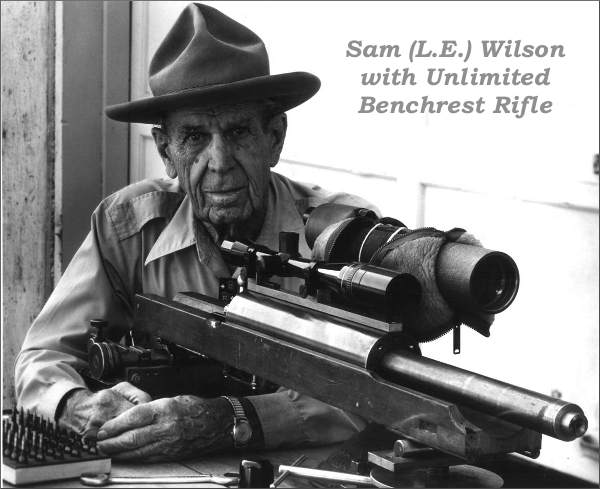
Sam (L.E.) Wilson actively competed in benchrest matches until he passed. He’s shown here with an Unlimited benchrest rifle of his own design.
If you’ve used hand dies with an arbor press, chances are you’ve seen the L.E. Wilson company name. You may not know that the founder of L.E. Wilson Inc. was an avid benchrest competitor who pioneered many of the precision reloading methods we used today. Known as “Sam” to his friends, L.E. Wilson was one of the great accuracy pioneers who collected many trophies for match victories during his long shooting career.

The photo above shows Sam (foreground) with all of his children at a shoot. Behind Sam are Jim, Jack and Mary, shooting in the Unlimited Class. What do they say — “the family that plays together stays together”? Note the long, externally-adjusted scopes being used. Learn more about Sam (L.E.) Wilson and his company on the L.E. Wilson Inc. Facebook Page.
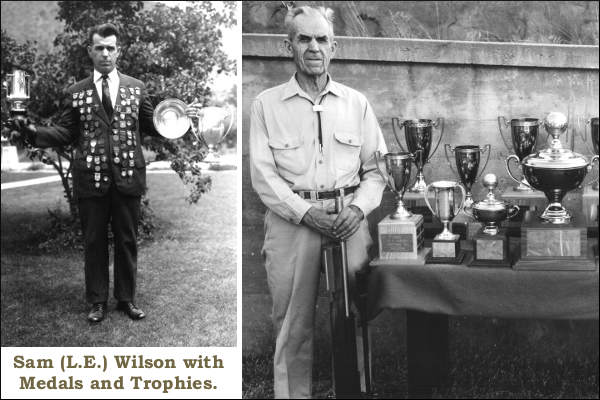
Unlimited Class was Sam’s favorite discipline, because in the “good old days” top competitors normally would craft both the rifle and the front/rear rests. This rewarded Sam’s ingenuity and machining/fabrication skills. In the “build-it-yourself” era, one couldn’t just order up an unlimited rail gun on the internet. How times have changed…
|


