How well can the 6mm Dasher perform at 1000 yards when conditions are good, and the shooter is riding a hot streak? Well here’s a shot-by-shot record of Scott Nix’s 4.554″ 10-shot group shot at Missoula, Montana at the Northwest 1000-yard Championship a few years back. All 10 shots were centered for a 100-6X score. That’s about as good as it gets. If Scott had stopped after 5 shots, his group would have been under 3 inches!
Video Demonstrates Amazing 1000-Yard Accuracy
Watch the video. You can see the group form up, shot by shot. It’s pretty amazing. Scott’s first shot (at the 45-second mark of the video) was right in the X-Ring, and four of Scott’s first five shots were Xs. That’s drilling them! This video was recorded from the pits at the 1000-yard line, during record fire.
For the International Benchrest Shooters (IBS) by Frank Danisienka
The IBS Executive Board has voted to create two new awards. These awards recognize the significant performance of a select number of shooters. Patches for Score shooting a perfect score of 750, and a perfect target of 250-25X, were designed by the board. To score 250, you need to shoot five (5) tens on each of the five record targets at a particular yardage. To score 750 you need to do that at all THREE yardages — 100, 200, and 300 yards. Certificates accompanying the patches document the commitment to excellence and dedication by these shooters to our sport.
Perfect 750 Multi-Yardage Score — A Rare Occurrence
In the long history of IBS competition only 16 members have shot a perfect score of 750 in one match! That’s 250 at 100 yards, 200 yards, and 300 yards. This very select group of shooters includes: Al Weaver, Rod Morton, Dave Short, Dennis Collins, Ken Livengood, Wayne Shaw, Dick Spencer, Hal Drake, Kim Llewellyn, Shaun Shank, Roy Hunter (2), Dean Breeden, John Bosley, Wayne France, Ricky Read and John Cascarino.
Dean Breeden is one of only 16 Shooters to have recorded a 750 total score in a match.
All Xs — the Perfect Target, 250-25X
The remarkable feat of shooting a perfect 250-25X target has been accomplished 37 times by 26 members. They are: Dennis Collins (2), Ted Parreco, Jeff Buchannan, Carl Baker, James Goody, Joe Enterkin, Rich Whiteash, Dean Breeden (2), David Apple, Al Weaver, Rod Morton, Mike Bigelow, Ken Livengood (3), Roger Avery (2), Joe Pellegrene, Mark Ludinsky (3). Herb Llewellyn (2), Jackie Stogsdill, Hal Drake (2), Johnny Lorick, Ron Collins, Wayne France (2), Shaun Shank, Steve Jaynes, Kevin Donalds Jr., Randy Jarvais (2).
Our sport continues to evolve toward perfection both in the quality of the equipment and the skill of our members and these awards recognize them for their accomplishments.
22nd Bud Pryor Memorial Matchby Dick Grosbier
Saturday June 11th was the 148th running of the Belmont Stakes in New York, and the 22nd running of the Bud Pryor Memorial Match at Thurmont, Maryland. Since this is a shooting website, I will be writing about the “Bud”. This year’s offering was a two-day match with 100-yard and 200-yard relays on Saturday followed by the 300-yard match on Sunday. This was a return to the format used from 1994 until we started having to turn shooters away in 2004.
It was typical “Bud” weather — hot well into the mid-90s on Saturday. Sunday was considerably cooler and with extremely challenging wind conditions all day long. There was no rain on Saturday but a big threat of a thunderstorm on Sunday. Luckily the thunderstorm held off as the shooters had their hands full just dealing with the high winds.
Wayne Lewis from South Carolina took the early lead in Varmint For Score (VFS) class, by winning the 100-yard stage with a fine 250-23X score. Wayne France, Dave Short, and Jim Cline were right behind him with 21X each. K.L. Miller won the 100-yard event in Hunter class with a 250-16X Score. Millers’s score with his 6X power-scoped rifle would have put him in the top half of VFS class. That’s impressive shooting with a low-power optic.
Pennsylvania shooter Dave Short won the 200-yard VFS with a 250-8X. Paul Bielec took second place honors with a 249-4X. Unfortunately Paul had a misstep at 100 yards on the final match. Cross-firing onto the target of the empty bench to his right and incurring a 5-point penalty marred his otherwise excellent performance for the weekend. Paul’s situation left Dave Short as the only shooter who was not at least two points down going into the 300-yard section on Sunday. Meanwhile in Hunter Class, K.L. Miller trudged along, beating second-place Orland Bunker with a 243-0X to Orland’s 241-6X.
Here are some of the top shooters. Left to Right: Richard Sissel (300-yard VFS Winner), K.L. Miller (Hunter 1st Grand Agg), Hillary Martinez (3rd VFS Grand Agg), Dan Breedan (2nd VFS Grand Agg).
EQUIPMENT Report:
Notably, the top three shooters all used Vihtavuori N130 powder, not Hodgdon H4198, the “go-to” choice for the 30BR for many years. Could this start a trend? Federal 205m primers were used by nearly all, and BAT actions were favored by the majority of competitors. Most of the Top 20 barrels were Kriegers, but Brux barrels took the number two and three spots overall. There were mostly high-end March and Nightforce scopes on the line, but overall winner Dave Short ran a 36X Weaver, proving you don’t need to spend two grand on a scope to win a big match.
Bud Pryor Memorial Shoot Equipment List (Listed in Order of Grand Agg Score) Click Chart to View larger, easier-to-read complete Equipment List
Sunday was the 300-yard stage, this is always the big equalizer in a 100/200/300 match. As previously mentioned, conditions were unusually challenging Sunday. This was demonstrated by the fact that Richard Sissel won the Aggregate with a 243-3X. Dave Short was a close 2nd with a 243-2X. Dean Breeden & Michael Clayton also turned in 243s; after that the scores fell off fairly fast. Back in Hunter Class once again K.L. Miller finished on top with a 238-1X. Scott Garman from Maine turned in a nice performance with a 236-3X.
Grand Aggregate Results — Dave Short Wins Over Runner-Up Breeden
When all the scores were totaled, Dave Short easily won the VFS Grand Aggregate with a 743-31X, Dean Breeden was 2nd with 741-27X, Hillary Martinez 3rd with 739-31X, and 100-yard winner Wayne Lewis was 4th with 739-29X. It looked like Wayne had a second-place finish in he grand until the last target of the day when instead of dropping 1 point per target as he had been doing all day, he dropped 5 points moving him to sixth place. In the Hunter Class, K.L. Miller led the entire weekend. Miller’s 731-17X Grand Agg Score put a substantial distance between himself and second-place Orland Bunker.
File photo from 2014 Bud Pryor match.
All in all I think everybody had a good time (some better than others) and I believe most will be seen back in Maryland the second weekend in June 2017 for the 23rd Annual Bud Pryor Memorial. Unless perhaps they go to New York for a horse race.
About the Bud Pryor Memorial Match Bud Pryor was a fine gentleman who started shooting IBS matches in 1983. He was a machinest turned gunsmith who made friends and got many people started in shooting IBS registered matches over the next few years. Bud and Dick Grosbier ran the first IBS match at the Thurmont range in April 1983. CLICK HERE to see vintage photos of the 1983 match.
After Bud’s untimely passing a few years later, the club decided to put on a big match and dedicate it to him. As Thurmont is one of the few ranges around with 100/200/300 yard capabilities, we decided to put on a 3-yardage Grand Aggregate match. This was not as simple as it seems, since 100/200/300 was not an IBS-recognized Aggregate. After an agenda item was approved at an IBS winter meeting, 100/200/300 records were set at Thurmont. Over the years most records have stayed at this scenic range. There are a total of four IBS ranges now holding 100/200/300 yard matches in 2014.
When a rifle isn’t shooting up to it’s potential, we need to ask: “Is it the gun or the shooter?” Having multiple shooters test the same rifle in the same conditions with the same load can be very revealing…
When developing a load for a new rifle, one can easily get consumed by all the potential variables — charge weight, seating depth, neck tension, primer options, neck lube, and so on. When you’re fully focused on loading variables, and the results on the target are disappointing, you may quickly assume you need to change your load. But we learned that sometimes the load is just fine — the problem is the trigger puller, or the set-up on the bench.
Here’s an example. A while back we tested two new Savage F-Class rifles, both chambered in 6mmBR. Initial results were promising, but not great — one gun’s owner was getting round groups with shots distributed at 10 o’clock, 2 o’clock, 5 o’clock, 8 o’clock, and none were touching. We could have concluded that the load was no good. But then another shooter sat down behind the rifle and put the next two shots, identical load, through the same hole. Shooter #2 eventually produced a 6-shot group that was a vertical line, with 2 shots in each hole but at three different points of impact. OK, now we can conclude the load needs to be tuned to get rid of the vertical. Right? Wrong. Shooter #3 sat down behind the gun and produced a group that strung horizontally but had almost no vertical.
Hmmm… what gives?
Shooting Styles Created Vertical or Horizontal Dispersion
What was the problem? Well, each of the three shooters had a different way of holding the gun and adjusting the rear bag. Shooter #1, the gun’s owner, used a wrap-around hold with hand and cheek pressure, and he was squeezing the bag. All that contact was moving the shot up, down, left and right. The wrap-around hold produced erratic results.
Shooter #2 was using no cheek pressure, and very slight thumb pressure behind the tang, but he was experimenting with different amounts of bag “squeeze”. His hold eliminated the side push, but variances in squeeze technique and down pressure caused the vertical string. When he kept things constant, the gun put successive shots through the same hole.
Shooter #3 was using heavy cheek pressure. This settled the gun down vertically, but it also side-loaded the rifle. The result was almost no vertical, but this shooting style produced too much horizontal.
A “Second Opinion” Is Always Useful
Conclusion? Before you spend all day fiddling with a load, you might want to adjust your shooting style and see if that affects the group size and shape on the target. Additionally, it is nearly always useful to have another experienced shooter try your rifle. In our test session, each time we changed “drivers”, the way the shots grouped on the target changed significantly. We went from a big round group, to vertical string, to horizontal string.
Interestingly, all three shooters were able to diagnose problems in their shooting styles, and then refine their gun-handling. As a result, in a second session, we all shot that gun better, and the average group size dropped from 0.5-0.6 inches into the threes — with NO changes to the load.
That’s right, we cut group size in half, and we didn’t alter the load one bit. Switching shooters demonstrated that the load was good and the gun was good. The skill of the trigger-puller(s) proved to be the limiting factor in terms of group size.
Barrel-maker Dan Lilja’s website has an excellent FAQ page that contains a wealth of useful information. On the Lilja FAQ Page as you’ll find informed answers to many commonly-asked questions. For example, Dan’s FAQ addresses the question of barrel life. Dan looks at factors that affect barrel longevity, and provides some predictions for barrel life, based on caliber, chambering, and intended use.
Dan cautions that “Predicting barrel life is a complicated, highly variable subject — there is not a simple answer. Signs of accurate barrel life on the wane are increased copper fouling, lengthened throat depth, and decreased accuracy.” Dan also notes that barrels can wear prematurely from heat: “Any fast varmint-type cartridge can burn out a barrel in just a few hundred rounds if those rounds are shot one after another without letting the barrel cool between groups.”
Q. What Barrel Life, in number of rounds fired, can I expect from my new barrel?
A: That is a good question, asked often by our customers. But again there is not a simple answer. In my opinion there are two distinct types of barrel life. Accurate barrel life is probably the type most of us are referencing when we ask the question. But there is also absolute barrel life too. That is the point where a barrel will no longer stabilize a bullet and accuracy is wild. The benchrest shooter and to a lesser extent other target shooters are looking at accurate barrel life only when asking this question. To a benchrest shooter firing in matches where group size is the only measure of precision, accuracy is everything. But to a score shooter firing at a target, or bull, that is larger than the potential group size of the rifle, it is less important. And to the varmint hunter shooting prairie dog-size animals, the difference between a .25 MOA rifle or one that has dropped in accuracy to .5 MOA may not be noticeable in the field.
The big enemy to barrel life is heat. A barrel looses most of its accuracy due to erosion of the throat area of the barrel. Although wear on the crown from cleaning can cause problems too. The throat erosion is accelerated by heat. Any fast varmint-type cartridge can burn out a barrel in just a few hundred rounds if those rounds are shot one after another without letting the barrel cool between groups. A cartridge burning less powder will last longer or increasing the bore size for a given powder volume helps too. For example a .243 Winchester and a .308 Winchester both are based on the same case but the .308 will last longer because it has a larger bore.
And stainless steel barrels will last longer than chrome-moly barrels. This is due to the ability of stainless steel to resist heat erosion better than the chrome-moly steel.
Barrel Life Guidelines by Caliber and Cartridge Type
As a very rough rule of thumb I would say that with cartridges of .222 Remington size you could expect an accurate barrel life of 3000-4000 rounds. And varmint-type accuracy should be quite a bit longer than this.
For medium-size cartridges, such as the .308 Winchester, 7×57 and even the 25-06, 2000-3000 rounds of accurate life is reasonable.
Hot .224 caliber-type cartridges will not do as well, and 1000-2500 rounds is to be expected.
Bigger magnum hunting-type rounds will shoot from 1500-3000 accurate rounds. But the bigger 30-378 Weatherby types won’t do as well, being closer to the 1500-round figure.
These numbers are based on the use of stainless steel barrels. For chrome-moly barrels I would reduce these by roughly 20%.
The .17 and .50 calibers are rules unto themselves and I’m pressed to predict a figure.
The best life can be expected from the 22 long rifle (.22 LR) barrels with 5000-10,000 accurate rounds to be expected. We have in our shop one our drop-in Anschutz barrels that has 200,000 rounds through it and the shooter, a competitive small-bore shooter reported that it had just quit shooting.
Remember that predicting barrel life is a complicated, highly variable subject. You are the best judge of this with your particular barrel. Signs of accurate barrel life on the wane are increased copper fouling, lengthened throat depth, and decreased accuracy.
Benchrest Barrel Life — You May Be Surprised
I thought it might be interesting to point out a few exceptional Aggregates that I’ve fired with 6PPC benchrest rifles with barrels that had thousands of rounds through them. I know benchrest shooters that would never fire barrels with over 1500 shots fired in them in registered benchrest matches.
I fired my smallest 100-yard 5-shot Aggregate ever in 1992 at a registered benchrest match in Lewiston, Idaho. It was a .1558″ aggregate fired in the Heavy Varmint class. And that barrel had about 2100 rounds through it at the time.
Another good aggregate was fired at the 1997 NBRSA Nationals in Phoenix, Arizona during the 200-yard Light Varmint event. I placed second at this yardage with a 6PPC barrel that had over 2700 rounds through it at the time. I retired this barrel after that match because it had started to copper-foul quite a bit. But accuracy was still good.
Nightforce’s 42x44mm fixed-power Benchrest scope mounted on James Mock’s 6mm Dasher.
Nightforce 42x44mm Comp Scope for Benchrest Shooters, by James Mock
Among long range shooters the name Nightforce has long commanded respect because of NF’s great optics and durability. However, the Benchrest disciplines that require either a 10-lb or 10.5-lb rifle had to forego the use of the Nightforce scopes because of their two+ pounds of weight. Some used the Benchrest model in the Heavy Varmint category (13.5-lb max weight) but not many in the Light Varmint, Sporter, or Hunter categories. That may change thanks to a new scope from Nightforce.
The folks at Nightforce Optics listened to benchrest shooters in the lighter classes and developed a new, light weight 42x44mm Competition Scope that weighs just 20.7 ounces. This scope comes as a fixed-power 42X and is without some of the “bells and whistles” of its larger cousins.
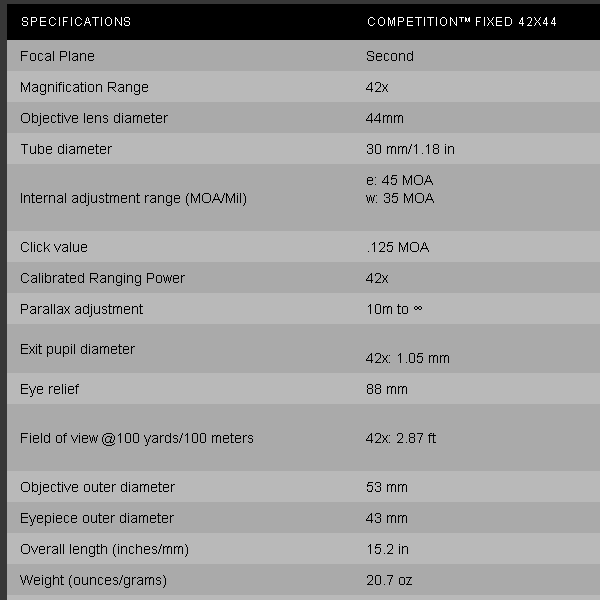
Key features of this scope important to Benchrest shooters are: ED glass, 42X power, 44mm objective lens, 88mm eye relief (~3.5 inches), 45 MOA elevation adjustment, 35 MOA windage, 10 MOA per revolution, 2.87-foot field of view at 100 yards, quick focus, click value of .125 inch, parallax adjustment from 10 meters (~33 ft.) to infinity, and an overall length of 15.2 inches. Also, you can set a “zero” easily. After obtaining conventional zero simply loosen one set screw per turret and set the dial at zero.
I received this scope on Monday, February 15th and mounted it on my BAT-action 6mm Dasher and zeroed it for a 600-yard match on Saturday, February 20th. My first impression of this scope was the amazing image produced by the ED glass. Although it is made with a 44mm objective lens (to save weight), one cannot say that the image is not clear. The image is outstanding from edge to edge and the image color is true. Nightforce offers two reticle options: the CTR-2 and CTR-3. Both reticles feature .016″ MOA vertical and horizontal lines, but the CTR-2 includes a .095 MOA center dot.
It took a small amount of faith to shoot the scope in a 600-yard match a few days after receiving it. Although I had shot only a few rounds with the scope mounted on my BAT Dasher, I knew that the Nightforce reputation was solid and my results would depend on the “nut” at the end of the rifle.
At the match, I fired a few shots to confirm zero and really appreciated the scope’s crisp 1/8th-MOA clicks. The adjustments were spot on at the 600-yard range and there was no problem getting my zero at the 600-yard distance. Remember, I had not shot at 600 yards with this scope, but I dialed in 11.5 MOA from my 100 yard zero and the resulting impact was correct. Each eight clicks delivered a precise one-MOA movement (about 6 inches) on the 600-yard target. The picture below is at the range as I was preparing for the first relay.
Our 600-yard match (non-registered) features 20 record rounds fired on the IBS target with steel gongs for sighters. The winter mirage can be brutal in this part of the country, but the Nightforce handled it without problems. Before the match was over, the left to right wind caused me to dial in two minutes (~12 inches) of windage and the scope was precise and I posted my 3rd best score with 191/200. The very fine .095″ dot allows for great precision in aiming.
Actual target shot by James Mock at 300 yards using Nightforce 42x44mm scope. James won the match.
My next match to use the scope was a 300-yard score match on March 5th. I had one chance to zero my rifle for this match and again I had no trouble changing the zero with the crisp, repeatable adjustments of this fine scope. The day was cool with bright sunshine and switchy tail winds. The new Nightforce handled the conditions very well, even with the horrible mirage. We shot two, 10-shot targets on the IBS 300-yard target. I shot 99-3X on the first and 99-3X on the second to win the match by one point over Mitch Young. Above is my second target, and the new scope let me see every shot through the mirage. There were many others who said that they could not see their bullet holes.
Summary of Nightforce 42x44mm Review
This 42x44mm optic is everything that I want in a scope. The 1/8th-MOA adjustments are crisp and repeatable. The center dot is small (.095 MOA). The image is sharp and clear all the way to the edges, and the ED glass provides a sensational image. The turret markings are distinct and there are 10 MOA per revolution. And you get all this in a scope that weighs 20.7 ounces with a 44mm objective lens. The low weight makes this scope viable for all benchrest classes. I believe the short range Benchrest shooters will welcome this scope and pay the sales price of $1742.00 (MSRP is $1795.00). Good shooting — James Mock
It’s Super Shoot time. The “Top Guns” of Point Blank Benchrest are battling for prizes and glory at Kelbly’s Rifle Range in North Lawrence, Ohio. This annual event, held May 25-28 this year, draws some of the best 100-yard and 200-yard benchrest shooters in the world. Recent Super Shoots have drawn 300+ competitors from the USA and more than a dozen other countries (about 15% of the competitors come from overseas).
Past Super Shoot Highlights Video (Watch This — It’s Very Well Done!)
If you’ve never attended the Super Shoot before, and don’t know what to expect, former Sinclair International President Bill Gravatt offers some insights into this great event:
Super Shoot — What It’s All About
The excitement and anticipation leading up to a Super Shoot can be hard to explain to those who haven’t been to one. Every year, some shooters arrive at the Super Shoot a week early to dial in their rifles, learn wind conditions for the range, and enjoy the camaraderie of their fellow shooters. As the match draws closer, campers and RVs fill the area behind the range, and shooters stake out turf all over the property with their reloading and cleaning equipment setups.
Many shooters choose to load cartridges in the main barn directly behind the 60-bench firing line, while others decide to work in pop-ups, campers and other outbuildings around the facility. Benchrest shooters tend to load in small batches, and some most load cartridges between each match. Many shooters clean their rifles after each match, while others sometimes go two or three matches between cleanings, depending on the number of rounds they fire.
Another part of high-level benchrest competition that will amaze first-time attendees is the quality and amount of equipment benchrest shooters use. Just in front of the shooting benches and the targets, range flags of all kinds sprout up, from the typical “daisy wheel” flags to very sophisticated velocity indicators that show varying wind intensity. Shooters adjust their flags to align with the particular target in front of a specific bench, just slightly below the path of the bullet but still partially visible in the high-powered scopes.
The rifles represent a variety of actions, usually custom, with heavy benchrest barrels by various barrel makers. The most popular cartridge used is the 6mm PPC, but occasionally you will run into someone using a 6mm BR or a slightly modified 6mm BR, and as well as a few other cartridges. Rifle rests used are typically heavy tripods or plate rests. You see a lot of Sinclair rests, Farley rests, and a variety of others, including a few homemade rests. Bags are typically Edgewood or Protektor.
Super Shoot — Runners, Pickers and the Pursuit of Perfection
The techniques vary between shooters, and they are interesting to observe. Some shooters “run” their targets and will shoot a quick sighter and then run all 5 shots as fast as they can before conditions change. Others are “pickers” and shoot each shot carefully, going back and forth between the record target and the sighter target to verify wind conditions and bullet drift. These guys will sometimes shoot up to 10 sighters and use the full seven minutes. Both styles of shooting work and many shooters use both techniques depending on the match conditions[.]
Anyone who attends the Super Shoot will come away with a greater appreciation of precision benchrest shooting. Experienced benchresters already know there will be windy days that drive them crazy, and less experienced shooters can get completely lost when… holding off a shot in the wind. But the reward is worth it. It’s very satisfying to hold off a full inch at 100 yards because the wind changes during your string and drop your fifth shot into a sub 0.100″ group with only seconds remaining on the clock. And that’s what the Super Shoot is all about.
Nate Boop Memorial Match 2016, By Hal Drake, IBS Group Committee Chair
This year marked the 30th anniversary of the Nate Boop Memorial Tournament. 60 shooters from the USA and Canada traveled to Weikert, Pennsylvania, to attend the first IBS benchrest-for-group match of the year. This range is set in some of the most beautiful countryside in the East. All the amenities you could want are within easy walking distance: 30 amp electric hookups, nice covered loading area, restaurant/bar, and even a trout stream! With all this and much more, it’s tough to imagine a more welcoming range than Weikert. It’s not advertised much, but this is a money match (like the Super Shoot), which pays a nice bounty to the top finishers in the Grand Aggs.
File photo
Most shooters showed up on Thursday or Friday, and were greeted by heavy rains that made for somewhat uncomfortable practice sessions. As I walked down the line on Friday morning, I couldn’t help notice the number of rifles that wear stocks by Roy Hunter. Roy started making stocks just a few short years ago, after a long career as a custom furniture maker. Top gunsmiths like Sid Goodling, Jim Borden, and Dave Bruno feel that Hunter stocks are at the top of the game. Dave told me that he’s extremely impressed with how “dead” the stock is compared to some of the other top end stock makers. Roy’s design has changed quite a bit since he first started, with the latest creations featuring a thicker area behind the tang, and a very robust forend. I have just recently put a new gun together with the latest Hunter stock, and a Rimrock BR action, and can’t say enough about how this new rig handles. His long range versions have a good following as well.
File photo
Potential New Records Set by Allen Arnett and Howie Levy
It stayed cool throughout the weekend, with Saturday being the best day for shooting small Aggs. On Saturday morning, Allen Arnette threw down a potential new Light Varmint 100-yard Aggregate Record of .1478″ (and there were five other LV 100 teen Aggs shot that morning). Amongst Allen’s targets was a potential single-group record of .040″. Boat Tail bullets have been all the rage in the short-range group game for some years, but Allen continues to prove that his flat base bullets are as good as any out there. In the afternoon, Howie Levy compiled a .1386″ Heavy Varmint Agg, a potential new Heavy Varmint 100-Yard Aggregate record (there were six HV teen Aggs). Howie is a Boat Tail guy for the most part, and he left a mark with his new Dave Bruno-chambered Brux barrel, and his own pills.
When the shooting was finished on Saturday, we were treated to a pig roast with enough fixins to make Roy Rogers proud. Dale brought in a caterer who delivered a great meal. He showed up on Friday evening, set up his smoker, and got the pig going in the early morning hours. After getting the flags moved for the next day’s 200, we all gathered in the loading area and enjoyed a pretty special feast.
The crew at Union County Benchrest always puts on a great match, and this year’s 30-year Anniversary made for an even more special event. As usual, the Trutt and Boop Families deserve a big “Thank You” for putting so much time and effort into running seamless matches at one of the premier Benchrest facilities in the country. Hats off to the target crew as well, whom I would put up against any target crew in the country.
Sunday morning brought heavy winds that would only get worse as the day progressed. Dave Bruno had the right stuff in the morning to bring home the win with a .2485″ HV 200-yard Agg. As the afternoon started, damaging winds were ripping up wind flags and trailer awnings. Russ Boop showed us how to get it done though, with a .3046″ Aggregate in the trying conditions. When all the dust cleared, the Grand Aggs were split by Howie Levy and Dave Bruno, with Howie narrowly sneaking by Dave for the Two-Gun win. Kevin Donalds Senior put on a strong showing to take third.
Boop Memorial Shoot 2016 Top Results by Division
Light Varmint Grand Agg Top Five
Howie Levy .2697″
Dave Bruno .2797″
Harley Baker .2813″
Russell Rains .2818″
Kevin Donalds Sr. .2849″
Heavy Varmint Grand Agg Top Five
1. Dave Bruno .2394″
2. Howie Levy .2442″
3. Kevin Donalds Sr. .2522″
4. Allen Arnette .2532″
5. Craig Rowe .2587″
Boop Memorial Two-Gun Top Ten Shooters
1. Howie Levy .2570″
2. Dave Bruno .2596″
3. Kevin Donalds Sr. .2685″
5. Allen Arnette .2758″
5. Harley Baker .2832″
6. Russell Rains .2876″
7. Craig Rowe .2968″
8. Russ Boop .2985″
9. Dale Boop .2989″
10. Tony Cerone .3029″
The Boop Brothers Dale and Russ Boop, shown above, are the sons of Nate Boop, in whose honor this Match has been held for 30 straight years. The Brothers Boop have been shooting Benchrest since they were little kids.
Here is Ernie Bishop’s pride and joy, a specialty pistol nicknamed “Batman” because the black carbon-fiber stock looks like the Batmobile. This is one sophisticated handgun. Complete with scope, the Batman pistol weighs under 7.5 pounds, thanks to the ultra-light stock. The carbon stock is 6 inches wide at the fore-end, yet weighs just one pound. Ernie tells us: “This gun shoots amazing and is easy to shoot especially with my SEB MAX Rest.” Ernie adds, “The gun will soon also have a field-usable rear-grip stock so I can shoot it prone from a bipod as well.”
The Batman pistol is chambered for the 6mm “Long Dasher”, a 6mm 40°-shouldered variant of the 6.5×47 Lapua. Ernie loads Berger 105gr Hybrid bullets pushed by Hodgdon H-4350 powder.
Gun Specifications The gun, crafted by Eric Wallance of Nawaka Firearms, features an XP-100 action, Jewell trigger, and 15″-long, Brux 1:8″-twist barrel with aluminum muzzle brake. Interestingly, this gun does not have a traditional recoil lug. Instead, gunsmith Wallace milled out a lug from the bottom of the XP-100 action to save weight. On top of the action, the rig carries a Sightron Inc S-III 6-24X56mm scope in Kelbly rings on a custom +20 MOA rail.
Long Dasher Wildcat
Shown at right is a “Long Dasher” 40° wildcat created by Forum member Sunbuilder. This is very similar to Ernie Bishop’s chambering, though there may be small variations related to reamer design (such as freebore). Sunbuilder’s 6-6.5×47 Improved (aka “Long Dasher”) reamer was made by Dave Kiff of Pacific, Tool & Gauge. This wildcat cartridge adds about 2.0 grains capacity to the 6.5×47 necked down to 6mm. The case certainly is impressive with that 40° shoulder. We’re just waiting for the tactical guys to starting run this improved cartridge with its original 6.5mm bore.
Here are three FIVE-shot groups at 500 yards, shot by Ernie’s Batman pistol:
Bart Sauter of Barts Custom Bullets has acquired a LabRadar chronograph. He was curious to see how his loads performed in actual match conditions, so he brought his LabRadar to a match and set it up right on his benchtop. What he learned was quite surprising. For one thing, Bart found that tuning for the best accuracy (in the conditions), was NOT simply a matter of maintaining velocity. Read all about Bart’s experience in this AccurateShooter Forum Thread.
LabRadar Report by Bart Sauter
Bart posted: “I shot a short range NBRSA match [in March] with the LabRadar on the bench! The benches were quite close, but the LabRadar was able to pick up my shots even with the other guns going off very close to it. This is a pretty impressive piece of gear.”
It’s great for tuning. I can’t say for sure but what I saw with the PPC is that just maintaining a certain velocity will not keep the gun in tune.”
One Forum member asked: “Was the LabRadar able to pick up shots that far back (behind the muzzle) and to the side? What setting did you have it set at?”
Bart’s LabRadar unit had no trouble picking up shots when set on the bench, a bit behind the muzzle. In fact, Bart noted: “Yes it can go a long way back. At home I could get back up to around 8 feet and pick up the bullet. It’s more sensitive about the side distance. I had mine on level 4. You can be a lot farther behind the muzzle then advertised. You can also point it at your buddy’s target and get his velocity.”
Bart set his LabRadar to be triggered by the shot: “I had a tuner on the gun but no muzzle brake. [The Chrono] was set to be triggered by the sound of the gun. When you move back you have to play with the trigger level. I put mine on a tripod and was able to pick up projectiles 8 feet back, but from the side had to be within 18 inches.”
Long-Life Battery Power
Powering the LabRadar at the range is not a problem. Bart used a portable battery pack that can power the LabRadar for a long time: “I bought a RavPower battery pack from Amazon.com. It was the most powerful compact cell phone charger they had and [it costs about $30.00]. It was able to run the LabRadar for two full days without recharging and still had juice.”
The LabRadar is a pretty expensive piece of kit, but there’s nothing else like it on the market. Bart notes: “The LabRadar itself is about $560.00. The stand is $29.95 for the bench mount and the padded carry case is $39.95. So you’re around $630.00 plus shipping.”
LabRadar Field Test by Ray Gross
If you are considering purchasing a LabRadar Chronograph system, we strongly suggest you read the very thorough and informative LabRadar Review by Ray Gross, Captain of the USA F-TR team.


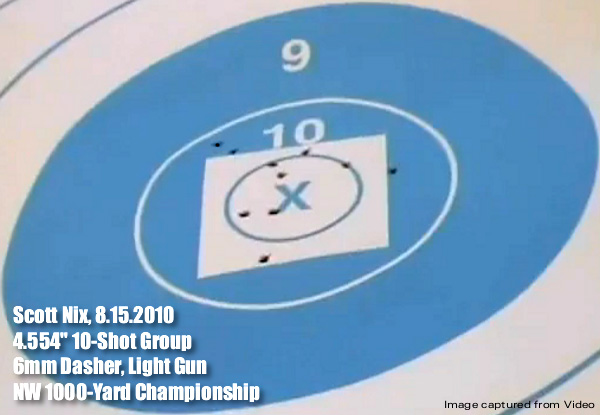
 How well can the 6mm Dasher perform at 1000 yards when conditions are good, and the shooter is riding a hot streak? Well here’s a shot-by-shot record of Scott Nix’s 4.554″ 10-shot group shot at Missoula, Montana at the Northwest 1000-yard Championship a few years back. All 10 shots were centered for a 100-6X score. That’s about as good as it gets. If Scott had stopped after 5 shots, his group would have been under 3 inches!


 Bud Pryor was a fine gentleman who started shooting IBS matches in 1983. He was a machinest turned gunsmith who made friends and got many people started in shooting IBS registered matches over the next few years. Bud and Dick Grosbier ran the first IBS match at the Thurmont range in April 1983.




 It’s Super Shoot time. The “Top Guns” of Point Blank Benchrest are battling for prizes and glory at




 The gun, crafted by Eric Wallance of Nawaka Firearms, features an XP-100 action, Jewell trigger, and 15″-long, Brux 1:8″-twist barrel with aluminum muzzle brake. Interestingly, this gun does not have a traditional recoil lug. Instead, gunsmith Wallace milled out a lug from the bottom of the XP-100 action to save weight. On top of the action, the rig carries a Sightron Inc S-III 6-24X56mm scope in Kelbly rings on a custom +20 MOA rail.