At the request of our readers, we provide select “Deals of the Week”. Every Monday morning we offer our Bargain selections. Here are some of the best deals on firearms, hardware, reloading components, and shooting accessories. Be aware that sale prices are subject to change, and once clearance inventory is sold, it’s gone for good. You snooze you lose.
The LabRadar is the most advanced chronograph on the market. When it was first released, you had to wait months to get one of these Doppler Radar units. Now they are in-stock and ready to ship at Bruno Shooters Supply for $559.95. Once you learn how to position and adjust the LabRadar, you should find the machine reliable and versatile. We do recommend getting a separate battery pack. If you are considering purchasing a LabRadar Chronograph, we strongly suggest you read the very thorough and informative LabRadar Review by Ray Gross, Captain of the USA F-TR team.
2. CDNN — ANSI Z87.1-Approved Safety Eyewear, $1.35 Each
You won’t find a better deal on name-brand ANSI Z87.1-approved safety glasses. Choose from Pyramex, Radians, or Winchester brands on sale now at CDNN Sports. We have used Pyramex safety eyewear for years. These are lightweight, comfortable and fairly rugged. The Radians Maverick features a stylish silver frame, while the Winchester eyewear features wrap-around amber lenses.
3. Eurooptic.com — Leupold VX-6 Scope Super-Sale
Eurooptic.com has received hundreds of brand-new Leupold VX-6 riflescopes, and will sell them at very deep discounts. Leupold’s VX-6 line spans 15 models, all with 6:1 zoom magnification ranges. From the 1-6x24mm CDS optic to the impressive 7-42x56mm Side Focus Target model, you can find a VX-6 for virtually any rifle application. And now you can save hundreds by purchasing overstock VX-6s on sale.
Benchrest Matches have been won (and many records set) with 36X Weaver T-Series optics. Our friend Boyd Allen observed “You can pay three or four times as much for a scope but not necessarily be more competitive — a 36X front objective Weaver is enough to win with…” The Classic T-Series Weaver has proven to be one of the most reliable high-magnification scopes ever made. The “old-fashioned” adjustable objective works well and the Weaver Micro-Trac turret system delivers precise and repeatable elevation and windage control. Now just $369.99 at Natchez, this is a great deal.
5. Able Ammo — 247 Rounds .223 Rem, HP Bullets
Here you go — instant varmint safari. This Hornady-made .223 Rem ammo features quality hollowpoint bullets, rather than the not-so-accurate FMJ bullets with most bulk .223 ammo. This stuff is much more accurate (with lower ES/SD) than other low-priced ammo. Users report sub-MOA accuracy with this stuff. If you’re planning a varmint safari this spring but don’t have the time (or gear) to reload, pick up a couple boxes of this stuff and you’re good to go. There are 247 rounds in each polymer ammo “can”. This ammo usually comes loaded with Hornady’s XTP (eXtreme Terminal Performance) bullets which work great on varmints.
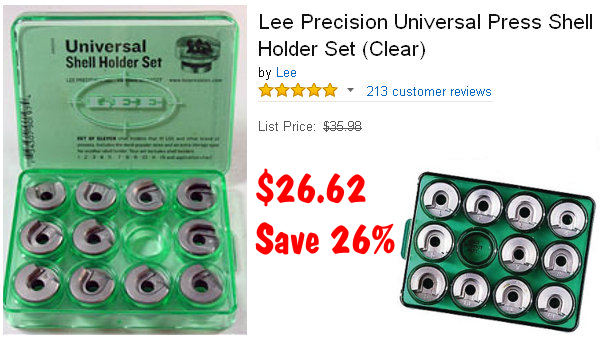
6. Amazon.com — Lee Universal Shell Holder Set, $26.62
Every hand-loader needs one of these Lee Universal Shell Holder Sets. The kit contains 11 shell-holders for most popular rifle and pistol cartridge types. This editor bought one of these kits 25 years ago, and I still use it every week. It’s nice having one, compact container that has every shell-holder I need for both pistol and rifle cartridges. Even if you prefer more expensive Redding shell-holders, this 11-piece kit serves as a valuable back-up. Right now the Shell Holder Set is on sale at Amazon.com for $26.62, with free shipping for Amazon Prime members.
This is quality, CCI made-in-USA ammo with reloadable, brass casings. We have used this CCI-made Blazer 9mm ammo in Sig, HK, and Glock pistols and it performed very well. This stuff won’t last long at this price (less than $0.20 per round). If you need 9mm practice ammo, order soon — this very same 1000-round case of Blazer 9mm ammo costs $60.00 more at MidwayUSA. Blazer Brass is loaded in boxer-primed, reloadable brass cases for added value.
Our friend and product tester Joe Friedrich is the proud owner of a spectacular Pappas front rest. Built by James Pappas, this rest is used for both air rifle and rimfire benchrest matches. The fancy Pappas front rest is a shortened, front-support-only version of the Pappas one-piece rest, which is popular with rimfire benchresters. Pappas engineered this rest to comply with air rifle benchrest rules which do not allow use of integrated (one-piece) front and rear rests. The end result was a 30.8-lb masterpiece of machining. Sadly, James Pappas passed away in 2014. This beautifully-crafted rest, built in 2011, is one of the finest examples of his work — a fitting legacy.
The workmanship on this Pappas front rest is astounding. Accurately described as a “work of art” by Joe Friedrich, this rest, crafted of aircraft-grade aluminum, sets new standards for “Benchrest BLING”. It looks like it should be on display in an art museum. Nearly all components of this rest, including the adjustment controls, have been polished to a mirror finish.
Convenient Rear Windage and Elevation Controls
The Pappas front rest features separate fine-tuning controls for windage and elevation, plus a central gross-elevation control. Normally, once the rest is centered-up on the target, you can make all needed elevation and windage adjustments with the rear (fine-adjustment) controls. In the video below, Joe explains how the controls work as he practices with his modified Theoben Rapid MFR air rifle. (Note: In the last minute of the video, the back-lighting was so intensely bright that we lost detail in the foreground. We apologize for that flaw, but you can still hear the audio.)
Price for this Masterpiece? Don’t Ask…
If you are interested in getting a similar rest, visit PappasRimfireProducts.com, or call (325) 754-5771. Be forewarned — “If you need to ask about the price, you probably can’t afford it.” This is truly the “Rolls-Royce” of front rests, and it will be priced accordingly.
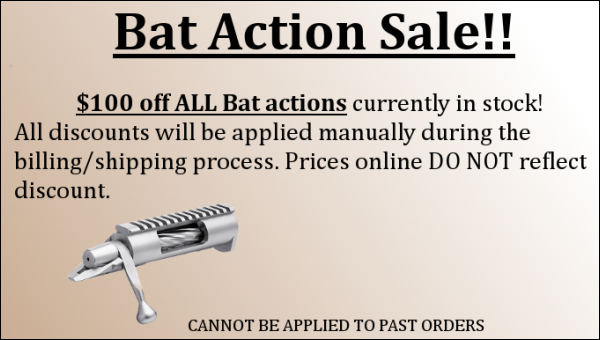
Who wouldn’t like to save a cool hundred bucks, particularly on a BAT action? BAT Machine Co. in Idaho produces some of the most beautifully-machined, and smooth-running custom actions you can buy. There’s a reason so many world Benchrest and F-Class records have been set with BAT actions — they really are THAT good. The quality of machining, smoothness of bolt operation, precision of firing pin function, and general fit and finish are top-flight.
Right now you can SAVE $100.00 on all BAT Machine actions in stock at Bruno Shooters Supply. NOTE: This is a limited-time offer that applies to current, in-stock inventory only. All listed BAT action prices are a check or money order price. Any action purchased with a credit card will incur an additional 4% service fee. Moreover, there is an additional $40.00 for shipping per action, which must be shipped to a FFL dealer since the action itself is considered the “firearm” under Federal law.
Match Report by David and Donna Matthews
The 2016 IBS 1000-Yard National Championships were held September 4-5 at the Cool Acres Sporting Camp in Swainsboro, Georgia. The event was well attended with 87 Registered Light Gun shooters and 76 Heavy Gun competitors. After a hurricane-filled practice day, the competitors put forth their best effort to master the sometimes tricky Georgia range. The 1000-Yard National Match for 2016 featured a three-target Aggregate for each Division (i.e. six targets total for both classes).
The Cool Acres Range and Facility is one of the best in the country. The facility features a wide 1000-yard range lined with Georgia pines on each side. Conditions held constant for most relays. Mother Nature blessed the shooters with temperatures that were cooler than during preceding weeks. The management of Cool Acres put on a great event this year. In addition, upgraded restrooms and a new cleaning shed were added — these were very much appreciated by all. Several shooters had very positive comments about the upgrades and changes made to the Cool Acres facility in Swainsboro.
The Two-Gun Champion and Overall winner was Tom Mousel from Montana with 24 rank points. Tom also won the Light Gun Overall title. Notably, Tom placed first in Light Gun Group with a stunning 3.356″ Group Agg — remember this was at 1000 yards folks. That’s a 1/3 MOA Agg at 1000 yards — truly remarkable precision.
Tom came to Georgia with one thing on his mind and that was winning. He accomplished that with his Wheeler Accuracy-built 6mm Dashers with Krieger barrels. Tom ran Vapor Trail bullets pushed by Hodgdon H4895. Finishing second in the Two-Gun Overall was 2015 winner Jim Bauer with 36 rank points. Jim took First Place honors in Light Gun Score with his Gordy Gritters-built 6mm Dasher shooting Vapor Trails pushed by Hodgdon Varget powder. The bright star of the show was Junior Division Winner Amber Brewer. Remarkably, this talented young lady topped the entire Heavy Gun field, winning Heavy Gun Score (97.667 average) and winning Heavy Gun Overall against all comers (of all ages). Her father, Henry Brewer Jr., played a role in her HG win — Henry smithed Amber’s class-winning 6.5×47 Lapua Heavy Gun, and even crafted the stock. Amber shot Berger bullets with H4895. Sally Bauer was top female shooter with her Douglas-barreled 6mm Dashers LG and HG, both built by Gordy Gritters. Sally also shot Vapor Trail Bullets with Varget.
Mousel won Light Gun Group with a stunning 3.356″ 5-shot Group Aggregate. That’s a 1/3 MOA Agg at 1000 yards — amazing, awe-inspiring accuracy.
Overall Winner Tom Mousel shot the 6mm Dasher cartridge in both Light Gun and Heavy Gun Classes. This little wildcat, shown below, has accuracy to spare. Alex Wheeler smithed Tom’s Rifles. Tom is shown below at his home range in Montana with an older rifle (not one used in Georgia this year).
Follow Link for Full Match Results and Equipment List
The IBS website has results for all major IBS Matches. Complete Results and Equipment Lists for the IBS 2016 1000-Yard Nationals can be found by CLICKING THIS LINK for the Nationals Results Page.
Big Prize Table — Over $18,000 Worth of Hardware
Over $18,000 worth of prizes were awarded at this year’s IBS 1000-Yard Nationals. Prizes included: Nightforce scopes, Sightron Scopes, SEB Coaxial Rest, BAT Action, Bench Source Annealing Machine, Defiance Action, Baity Action, Shehane stocks, reloading tools, Sierra bullets, Berger bullets, and much more. Many thanks go to Stanley Taylor from Douglas Barrels for his time and energy in acquiring prizes for the match. And the IBS thanks ALL of the generous sponsors for the 2016 1K Nationals.
Great Southern Hospitality and BBQ
On Saturday evening competitors were rewarded with a fantastic Southern meal prepared by the talented cooks of Real South BBQ from Swainsboro, Georgia, sponsored by Vapor Trail Bullets.
Sierra has just announced a new, high-BC .30-caliber projectile. This provides a very interesting new option for F-TR competitors and long-range benchrest shooters. The new 195-grain Tipped MatchKing (TMK) boasts an impressive 0.610 G1 Ballistic Coefficient. That compares well with any conventional bullet in this caliber and weight range. The key to the high BC is the green acetal resin tip that lowers drag while making the BC more consistent for every bullet in the box. NOTE: This .30-caliber 195 grain TMK requires a twist rate of 1:10” or faster to stabilize.
The new 30 cal. 195 grain Tipped MatchKing® bullets will be available in 500-ct boxes (product #7795C) with a $243.84 MSRP as well as 100-ct boxes (product #7795) with MSRP of $51.19 per box. Note, this new 195gr TMK is designed for competition use — primarily as a paper-puncher. Sierra says: “Tipped MatchKing® bullets are not recommended for most hunting applications.”
New Product Tip from EdLongrange. We welcome reader submissions.
We first ran this story a few years back. But it’s still a very interesting subject for benchrest shooters. Shown above, the 30 BR (a 6mmBR necked up to .30 Caliber) currently rules the benchrest-for-score game. However, a 30 BR Improved offers some potential advantages, particularly when the winds are strong or tricky. In this article Al Nyhus explains his 30 BRX wildcat. Running Hodgdon H4198, Al says he gets an easy 150 -200 FPS more than the conventional 30 BR. That can translate to less drift in the wind. It also lets you pursue a higher speed node, which can lead to improved accuracy with some barrels.
Forum member Al Nyhus is a top-level score shooter who has competed successfully with the 30 BR cartridge in VFS (Varmint for Score) matches. Al has been working on an “improved” 30 BR cartridge that delivers extra velocity. Al’s 30 BRX cartridge is inspired by the 6mm BRX cartridge, popular in 600-yard benchrest and across-the-course competition. The 6mm BRX cartridge maintains the same sidewall profile and shoulder angle as the parent 6mmBR case. Likewise, the 30 BRX retains the 30° shoulder used on the popular 30 BR cartridge.
Al reports: “Thought you might like to see what I’ll be working with in my VFS gun this season. It’s a true 30 BRX — a 30 BR with the shoulder moved forward 0.100″ with the standard BR shoulder angle. Stan Ware of SGR Custom Rifles built one last season for Steve Grosvenor and I was really impressed by the performance of Steve’s gun. The 30 BR barrel on my VFS gun needed replacing, so the new 30 BRX got the nod.”
30 BRX Delivers 150-200 FPS More Velocity than 30 BR
Al says his 30 BRX gives a solid 150-200 fps speed gain over the 30 BR at the top, while needing just 2.5-3.0 more grains of Hodgdon H4198 to do so. A 30 BR case holds on average 40.8 grains of water, while the 30 BRX holds 42.3 grains (roughly 4% more). So the 30 BRX delivers a 7% increase in velocity with a mere 4% increase in H20 capacity. That’s pretty good efficiency. [Editor’s Note: Assuming 34 grains of H4198 is a typical 30 BR match load, Al’s increase of 2.5-3.0 grains for the 30 BRX represents roughly a 7.5-8.5% increase in actual powder burned. That explains the higher velocities.]
Why did Nyhus decide to try an “improved” 30 BR?
Al explains: “The 30 BRX was created to operate at a [higher] velocity level than can be achieved with the standard 30 BR case, while at the same time keeping the easy-tuning characteristics of the standard 30 BR case. We also wanted to use the same powders currently used with the 30 BR and maintain similar operating pressures.” Is the 30BRX harder to shoot because of the increased velocity? Al doesn’t think so: “In a 13.5-lb HV gun, the 30 BRX case is a pleasure to shoot with just a flea bite of recoil.”
Will the 30 BRX Replace the 30 BR in Score Competition?
The 30 BR is already an exceptionally accurate cartridge that dominates short-range Benchrest for Score competition. Will the 30 BRX make the standard 30 BR obsolete? Nyhus doesn’t think so. However, Al believes the 30 BRX offers a small but important edge in some situations: “On any given day, it’s the shooter that hits the flags best and makes the fewest mistakes that ends up on top. No amount of velocity will save you when you press the trigger at the wrong time. Missing a switch or angle change at 200 yards that results in 3/4″ of bullet displacement on the target can’t be compensated for with another 200 fps. That’s the hard fact of benchrest shooting. But on those days when, as Randy Robinett says, ‘our brains are working’, the BRX may offer enough of an advantage to turn a close-but-no-cigar 10 into an ‘X’ at 200 yards. Or turn a just-over-the-line 9 into a beggar 10.” Given the fierce competition in Score matches, an extra 10 or another X can make the difference between a podium finish and also-ran status.
Yes, there are ten (10) shots. In the lower left (7 o’clock) of the group, two shots overlap!
Stunning 1000-Yard 10-Shot Group You’re looking at a stunning feat of rifle accuracy. That’s a sub-3″, ten-shot group shot at 1000 yards, all 10s or Xs. Measured at 2.856 inches, this group by shooter Mike Gaizauskas works out to 0.2727 MOA. Nearly quarter-MOA for ten shots at 1K! And the vertical for 7 of 10 shots is under an inch. Now that’s impressive. This was done with an IBS Heavy Class Benchrest gun, chambered for the 6.5×47 Lapua, a mid-sized cartridge originally designed for 300m competition.
Gun Specs: 6.5×47 Lapua chambering, Krieger 30″, 1:8″-twist barrel, Lapua 139 grain Scenars, Hodgdon H4350, CCI BR4 primers, Nightforce NSX scope. Smithed by Mark King, stock by Mike Gaizaukaus.
This amazing group, which establishes new IBS world records, was shot at the Harry Jones Memorial 1000-Yard Gun Club range in Fairview, West Virginia. Set in wooded, rolling hills, this range is shielded on all sides by thick stands of trees. It’s a beautiful facility, and you can see why, when conditions are right, the Harry Jones range can be about as close to shooting in a “tunnel” as you’ll ever get at 1000 yards. The Harry Jones Club in WV hosted the 2014 IBS Long-Range Nationals.
Mike’s remarkable 10-shot performance may be a Score Record as well as a group record, because all ten shots were in the 10-Ring and, under IBS rules, group size is the tie-breaker, rather than X-Count. Mike’s target was scored 100-3X, with two of the three Xs just clipping the outside of the X-Ring. Match directors reported: “On 7/24/2016, two new pending IBS 1000-yard world records were shot by Mike Gaizauskas with a 6.5X47 Lapua: 1) Heavy Gun Group (2.856″) and 2) Heavy Gun Score (100-3X). Congratulations Mike!” Here are the listed IBS records that will be broken, when this target is certified:
► Current IBS 1000-Yard Heavy Gun 10-Shot Single Group Record: 3.044″, Joel Pendergraft, 4/18/2009.
► Current IBS 1000-Yard Heavy Gun 10-Shot Single Group Score Record: 100 points, with 3.353″ group size tie-breaker, Gary Nicholson, 7/27/13.
Best 1000-Yard 10-Shot Groups Ever
This jaw-dropping 2.856″ group by Mike Gaizauskas also handily breaks the current NBRSA 1000-Yard, ten-shot Heavy Gun Record, which was 3.9912″ set by Bill Johnston on November 17, 2015. FYI: IBS and NBRSA Light Guns only shoot five-shot groups, so there is no equivalent IBS or NBRSA Light Gun 1K ten-shot record.
Only one other 10-shot, 100-score 1000-yard group was better than this in the history of rifle competition on this planet. Back in 2010, at a Williamsport match, Matt Kline shot a 2.815″ 100-4X. Depending on how Mike’s 2016 2.856″ group is finally measured, it could end up smaller than Matt’s. The difference (before final IBS verification) is only 0.041″, a mere four hundredths of an inch.
In 2014, Jim Richards fired a 10-shot Light Gun group at 1000 yards initially measured at 2.6872″. Shot under Williamsport Rules at the Deep Creek Range in Montana, that 10-shot group may be the smallest ever at 1K. However, the whole group was out in the 8 Ring, for a score of 80, not 100.
About the 6.5×57 Lapua Cartridge
To learn more about the record-setting 6.5×47 Lapua cartridge, including bullet and powder options and reloading tips, visit our comprehensive 6.5×47 Lapua Cartridge Guide.
The 6.5x47mm Lapua was developed in 2005 as a precision cartridge for 300m CISM rifle matches. Lapua (of Finland) and Swiss rifle-maker Grünig & Elmiger created this new cartridge to match the “pure accuracy” of the 6mmBR, but with even better ballistics. Following its debut as a 300m match cartridge, the 6.5×47 has proven to be a popular “jack of all trades”. Shooters have adopted this efficient, mid-sized cartridge because it offers excellent accuracy, mild recoil, good ballistics, and ample barrel life (plus it feeds well from a magazine). The 6.5×47 Lapua has won two NBRSA 600-yard Nationals. Now that this modern, mid-sized cartridge has set an all-time record for grouping precision at 1000 yards, we expect more shooters to experiment with this cartridge in the mid- and long-range benchrest disciplines.
Story Tip by Boyd Allen. We welcome reader submissions
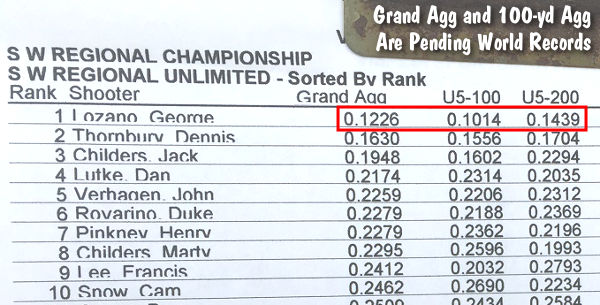
You are looking at one of the most impressive examples of precision shooting in history. On each of those five targets is a five-shot group made at 100 yards. This is the best set of five targets ever shot consecutively at 100 yards in the history of firearms competition on this planet. That’s right, nobody has ever drilled a better set of five, five-shot targets. The combined Aggregate for these five targets is a stunning 0.1014″, with the individual groups measuring: 0.102″, 0.168″, 0.123″, 0.053″, and 0.061″. So, two of the five groups were in the Zeros. And the 0.1014″ Agg handily beats existing world records.
This is an amazing accomplishment that beats both the existing NBRSA and IBS records. The NBRSA Record 100-yard Unlimited 5×5 Aggregate is 0.1242 set by Jerry Lahr in 2012. The IBS Record Heavy Benchrest 100-yard Aggregate (for five, 5-shot groups) is 0.134″, set by R. Howell in 2004.
But there’s more…
Lozano Grand Agg of 0.1226 also Breaks IBS and NBRSA World Records
George Lozano also shot a superb five-target Aggregate at 200 yards: 0.1439. This gave him a combined 100 + 200 Grand Aggregate of .1226 which is also a new world record. NOTE: for the 200-yard Agg, the actual group measurements (in inches) are summed, averaged and then divided by two to provide equivalency with the 100-yard results. Lozano’s actual group measurements at 200 yards were: 0.205″, 0.307″, 0.220″, 0.409″, and 0.298″. As averaged and divided by two, that is 0.1439. When combined with George’s 0.1014 100-yard Agg, Lozano’s 100+200 Grand Agg is a stunning 0.1226.
Lozano’s 0.1226 Grand Agg breaks both NBRSA and IBS World Records. The current NBRSA Unlimited Grand Agg Record for five, 5-shot groups at both 100 and 200 yards is a 0.133 by Dave Dowd in 2012. The equivalent 100 + 200 IBS Heavy Benchrest Grand Agg Record is a 0.1575 by Lester Bruno in 2004.
The talented shooter, George Lozano (shown above), was modest about his achievement: “Thanks, guys. I appreciate your very kind compliments. It was a good Father’s Day weekend and a fun match.”
NOTE: These records are pending verification by the NBRSA official records committee. But based on the numbers we’ve seen, it looks like Lozano will soon find his name in the record books.
Technical Details
We don’t know much about George Lozano’s load — either the powder or bullet. We’re told he was shooting a 6PPC cartridge in an Unlimited Benchrest rig, also known as a “railgun”. Here is a photo of a modern benchrest railgun. This is NOT Lozano’s record-breaking rig, but it shows the type of hardware used in the modern Unlimited Class.
IBS Match Report by Kenneth Frehm
The International Benchrest Shooters (IBS) held its New York State Championships and Annual Pro-Am Group Shoot at the Camillus Sportsmen’s Club on July 9-10, 2016. Forty-nine benchrest competitors vied for glory and trophies. Among these forty-nine, we were fortunate to have two of the fairer sex (such as Donna Sutton, below), as well as youngsters and seniors taking part. The event provided ample opportunities for old friends to reacquaint with each other, as well as time for making new ones. The great camaraderie exhibited by these competitors helps define our sport of Benchrest shooting.
Donna Sutton was “Pretty in Pink” — even down to her pink rifle stock.
As early as the Thursday before, new arrivals tried to learn and master the prevailing conditions at the range. Of course, once the shooting events started, Mother Nature had a few surprises in store for the folks on the line. The surrounding topography at our Camillus Range assures that wind is ever-present, fickle and as changeable as can be! Both days presented the shooters with difficult wind and weather challenges. Saturday was sunny, warm and the winds ranged from two to approximately ten miles per hour. However, twitchy tails on the wind flags made for unpredictable holes appearing in the targets.
Saturday, the wind direction changed constantly making each relay different from the ones before or the ones upcoming. Flags spun along the 100-yard span showing different colors and their streamers indicated the constant changing velocities. Of course, the top shooters managed to correctly analyze these variables and produce Aggs in the “point one+” range — impressive shooting given the conditions.
On Sunday everything changed. We were greeted with what we natives call “Syracuse Sunshine”. This is cold weather, gray skies, with rain showers that came and went all day long. On rare occasions, the sun peeked out along with its partner mirage. However, for most of the day, the 200-yard contestants had to deal with extremely high winds.
Although a left-to-right direction prevailed, wind probes were pegged, their streamers stood straight out, vibrating to gusts that may have topped 25 mph! Those intrepid shooters who didn’t put “dope” on their scopes braved shots that almost went completely off their targets!
Those few opportunities to shoot in a constant condition were rare and only lasted for a few seconds in duration. As in the day prior, the top guns conquered these difficulties. The men were separated from the “boys” as those with the most well-honed skills prevailed.
As for equipment — almost everyone shot 6 PPCs in all classes. This is still very much the cartridge of choice in 100/200 group benchrest competition. There was one .22-caliber rig and Bruce LaChapelle experimented with a new “Wildcat .20 Caliber” rig that he designed and machined himself.
There were many interesting T-Shirts on display at the match:
Pro-Am Competition with Two-Person Teams
One interesting element of this match was the “Pro-Am” competition. The “Pro-Am” features two-person teams with one experienced top-level BR shooter and one amateur shooter. For each two-man team, both shooters’ Two-Gun Aggregates are combined. The Pro-Am winning team is the twosome with the best winning combined, Two-Gun Aggregate. Both shooters receive First Place Pro-Am plaques. The winning amateur, Chris Jeffers (below), also won a barrel blank from Hart Rifle Barrels.
Under Pro-Am rules, an “amateur” is a shooter who has participated in registered BR events for five years or less. The “Pro” level includes shooters who have competed in registered events for six years or more. The Pro-Am was started 18 years ago to encourage new shooters and recognize amateurs in hopes they will continue with the sport. This is a good concept that could be tried at other events.
L to R: Todd Jeffers, Bob Brushingham, Bill Goad, Paul Mitchell, Wyatt Peinhardt, Cody Kurtz, Kevin Donalds Sr.
Our hats are off to the many folks who worked so hard to make this two-day event successful. I didn’t hear any grumbling or nary one complaint. Hal DeBoer, our new club President, ran the line and kept everything running smoothly and safely. Event chairman Bob Hamister had crews of club members working weeks in advance, preparing targets and organizing the many tasks that needed to be accomplished. Colin Hillman and his crew from the Syracuse Police Dept. and Jim Palumbo with the Youth Clay Targets Program were in charge of the target crews. They managed four different target crews, one for each morning and afternoon.
The ladies in the scoring booth (see above) had to analyze each relay, carefully scoring and posting the scores. They did this so efficiently that score sheets were posted immediately after each match. We also were fortunate to have Christopher’s Catering crew who provided breakfast, lunch and dinner during the two days. The food was delicious, plentiful, and affordably-priced.
Top Shooters by Category/Class:
Pro-Am Event Winners: Chris Jeffers (Amateur) and Dale Boop (Pro). Two-Gun: Harley Baker, Bob Hamister, Paul Mitchell, Wyatt Peinhardt, Bill Goad, Dale Boop. Heavy Varmint: Harley Baker, Paul Mitchell, Bob Hamister, Dave Bruno, Mike Mastrogiovanni. Light Varmint: Wyatt Peinhardt, Todd Jeffers, Bill Goad, Bob Brushingham, Barney Small.
I really enjoyed my job as photographer and roving reporter. I don’t have to worry about reloading, getting to the line on time, or trying to shoot small groups. I had ample opportunities to chat with competitors. I learned a little about them, where they lived, and had a chance to pick their brains about their ongoing quest for accuracy. I saw many different styles of loading at the benches and the many variances in equipment, shooting styles and techniques.
Once again, my most important take-away was that this group of sportsmen and sportswomen are friendly, helpful and genuine. Shooting tips, local knowledge, and advice are shared openly by all and help is there, charitably given to anyone who seeks it. — Kenneth Frehm
Harold Seagroves’ 3-time Hickory Ground Hog Match-Winning Rifle
At clubs across the country, varmint fun shoots (also known as “groundhog matches”) are becoming more popular every year. In these matches, usually shot from the bench, you engage paper targets, clay pigeons, steel “critter” silhouettes, or some combination of paper and reactive targets. Shooters like these matches because you can shoot a wide variety of rifles, you don’t have to spend a fortune to be competitive, and there is fun for the whole family. Rules are inclusive — you won’t be turned away because your rifle is two ounces overweight. A large percentage of the match fees usually go back to shooters in the form of cash prizes. And the level of camaraderie is high.
Inclusive Rules Welcome All Shooters
Forum member Danny Reever has explained the appeal of groundhog matches: “We don’t have a governing organization, or have to pay $50 a year membership just to compete in matches. Sure the rules vary from club to club, but you adapt. You build your rifle (or even pistol) to fall within the rules of either the clubs you shoot, or to fit all the clubs rules. If not there still is a class for you to compete in. If your factory rifle doesn’t conform to the rules, it can shoot in a custom class. If your custom doesn’t make weight for Light Custom (usually 17 pounds and under), you shoot it in heavy custom class. If you want to try your Tactical rifle or F-Class rig, bring it out there’s a class you can shoot it in. If you don’t like one club’s rules, you just don’t shoot there. It’s no big deal.
There are no National records, or Hall of Fame points — just individual range records. If you want to shoot in BIG matches (with big prizes), there is the Hickory Ground Hog Shoot among others. If competition isn’t your bag, many clubs offer mid-week fun matches that you can shoot just for fun. You shoot the same targets but with a more relaxed atmosphere with no time limits.
The best part is you don’t have to shoot perfect at every yardage. You always have a chance because in this sport it really isn’t over until the last shot is fired. Typically ALL the entry money goes to the host club, with much of the cash returned back to the shooters via prizes. Junior shooters often shoot for free, or at a reduced rate. That lessens the burden on the family’s wallet (not a small thing in these economic times). The low entry cost also encourages young guys to get involved who don’t have $4000 custom rifles or the money to buy them.
More Fun, Fewer Complications
There isn’t a sea of wind flags to shoot over or to put up and take down. If the range has a couple of flags so much the better, but after all it is a varmint match. No pits to spot shots and slow things down either. If you can’t see your hits through your rifle scope or spotting scope well you are in the same boat as everybody else. That’s what makes it interesting/ sometimes frustrating!
As for calibers, I’ve seen everything from .223 Rem to .338 Lapua and everything in between. Our range record at my club is held by Bill Slattery, who shot a 147 out of a possible 150 with a 22BR 13 months ago. That’s on a target with a 1.250 ten ring at 200/300/500 meters. That record will stand for awhile, and shows you that some very good shooting is done at groundhog matches.
The best part is it’s laid back, everyone gets along, there is no place for big egos here. We who shoot the Ground Hog Matches don’t begrudge the other organizations and shooting disciplines, or those that shoot in them, heck some of us cross over and compete in registered benchrest matches too. Life’s too short, live and let live is our motto so just come out and have fun!”
Fellow Forum members chimed in:
FdShuster: “I’ve competed in our local ground hog matches for several years now, have introduced a number of others to them, and we all enjoy them and more importantly, continue to learn from them. Distances are as close as 100 yards, (with a 5/8″ 10 ring) to as far as 500 meters. With a 2″ 10 ring. Wind, mirage, bullet trajectories, all make them a challenge, and unlike shooting for group, where the group can be anywhere on the paper, in this game they must be very small, but also in the 10 ring. With the different classes — Custom, Factory, Hunter — almost any rifle will fit in somewhere. And Danny is correct about the friendly attitudes. I’ve seen competitors go out of their way, and jeopardize their chances of winning, to help someone else who may have a problem on the line.”
Mike C: “Here in Texas, our version of groundhog matches involves shooting at clay pigeons at 400 yards. We use 60mm, 90mm, and 108mm clay pigeons attached to target boards. You have 10 shots to break 8 clays, with a seven-minute time limit. We have developed a good following at these matches. In past years, a Shooter of the Year Award was given based on the Aggregate score for three of our matches, which are held in Utopia, San Angelo, and Huntsville.”
40X Guy: “I would have to say upon finishing my first year ever of groundhog matches, that the average Joe can grab his Swift, or his 25-06, or his 22-250 and go rip some holes in paper. Everybody is having a good time and its a gathering of like-minded people who have all shot chucks at some point or another. Even if one does not win the match, you can look at your target and say “darn that chuck target has five holes in him at 400 yards and he’s dead” just as well as the next guy shooting a custom bench rifle. Everybody fits in and everybody, 8 to 80, is having fun! It is addictive and will drive you to spend your hard-earned currency for sure!”








 Forum member Al Nyhus is a top-level score shooter who has competed successfully with the
 You’re looking at a stunning feat of rifle accuracy. That’s a sub-3″, ten-shot group shot at 1000 yards, all 10s or Xs. Measured at 2.856 inches, this group by shooter Mike Gaizauskas works out to 0.2727 MOA. Nearly quarter-MOA for ten shots at 1K! And the vertical for 7 of 10 shots is under an inch. Now that’s impressive. This was done with an IBS Heavy Class Benchrest gun, chambered for the 6.5×47 Lapua, a mid-sized cartridge originally designed for 300m competition.




 Inclusive Rules Welcome All Shooters
 More Fun, Fewer Complications
 Mike C: “Here in Texas, our version of groundhog matches involves shooting at clay pigeons at 400 yards. We use 60mm, 90mm, and 108mm clay pigeons attached to target boards. You have 10 shots to break 8 clays, with a seven-minute time limit. We have developed a good following at these matches. In past years, a Shooter of the Year Award was given based on the Aggregate score for three of our matches, which are held in Utopia, San Angelo, and Huntsville.”


