Setpoint Ammunition, a subsidiary of Setpoint Systems Inc., has finalized an OEM distribution agreement with Berger Bullets. The agreement allows Setpoint Ammunition to offer a selection of Berger’s precision bullets for use in custom cartridges sold on their SetpointAmmo.com website. Setpoint Ammunition will initially offer three Berger projectiles for use in their 7.62×51 / .308 WIN cartridges: 155gr Match Hybrid; 185gr Long Range BT;and 168gr Match Hunting VLD.
“The agreement with Berger Bullets allows us to offer some of the best projectiles available for use in our precision ammunition,” said Brad Angus, President of Setpoint Ammunition. Angus went on to say that this agreement has been anticipated for some time. “Teaming with Berger has always been one of our goals. When you combine the well-known reputation of Berger Bullets with the unprecedented precision that we’ve built into our ammunition loading process, you get the best custom rifle ammunition available on the commercial market today.”
Setpoint’s Unique Manufacturing Process
The revolutionary Setpoint Ammunition ordering and manufacturing process allows customers to dictate the case, projectile, powder load and overall length of the cartridge via the online ordering system. This unique process gives consumers the ability to fine-tune their ammo to fit their specific firearm and application.
The order is relayed from the website to the manufacturing facility, where fully-automated machines (designed and built for Setpoint Ammunition by Setpoint Systems,) load and assemble the cartridges to high levels of precision. By mechanizing the entire loading process, precision and consistency are maximized. The final outcome is affordable, reliable, high-performance ammunition. (Sales packages are available for military, law enforcement and tactical security groups.)
Applied Balllistics LLC, run by Bryan Litz, has just released new .308 Winchester Tactical Ammunition. This new ammo employs a brand-new 175gr “Tactical OTM” bullet from Berger Bullets. This new projectile is unique in that it was designed to “fly right” even at transonic and subsonic speeds. The new 175gr bullets are loaded to magazine length (2.800″) in new Lapua brass, so the ammo will fit all popular detachable box magazines in tactical bolt guns and gas guns. Bryan recommends a 1:13″ (or faster) twist barrel.
New Tactical Ammo Has Individually-Weighed Charges and Low ES
Unlike most “factory ammo”, Bryan’s new Tactical Ammo features individually weighed charges. That’s right — the charge for each and every round is weighed before it goes in the case. As a result, the new ammo typically delivers Muzzle Velocity (MV) Standard Deviation (SD) under 10 FPS (for 10 shots). That’s a low number, on a par with quality handloads. Bryan has shot this ammo at 1000 yards through a LaRue OBR AR10-type rifle. The ammo shot under one MOA at 1000 yards. Another benefit of the weighed charges is that this allows the use of high-quality extruded (stick) powders. The stick powders are known to deliver great accuracy while being consistent through a wide temperature range.
Berger’s NEW .30 Caliber 175gr Tactical OTM Bullet
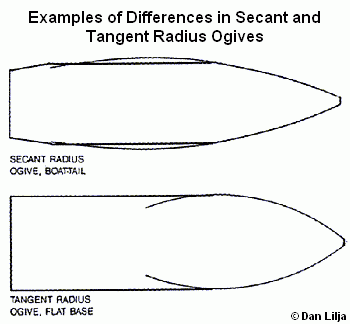
This bullet was designed by Berger Ballistician Bryan Litz specifically to optimize performance of the M118LR class of ammunition. The design objectives were to maximize BC while staying within the 2.800” COAL for magazine feeding, and the requirement for the bullet to remain stable through transonic speeds. All of these design objectives were achieved, according to Bryan. The bullet has a length-tolerant tangent ogive shape, so it is less sensitive to seating depth than secant-ogive bullets.
The BC of this bullet is 7% higher than the 175 grain Sierra MatchKing currently used in most M118LR ammunition, and 2% higher than the Hornady 178 grain option. The average G1 BC of the Berger 175gr Tactical bullet is 0.510 from 3000 to 1500 fps. The G7 BC is 0.259, and is a more accurate representation of this bullets performance over a wide range of speeds. (CLICK HERE to read about G1 vs. G7 BC.)
The Berger 175gr Tactical OTM bullet requires a minimum twist rate of 1:13″ to be stable from the muzzle. Transonic stability was verified from a 20″-barreled LaRue OBR with a 1:11.25″ twist.
Early Tests Show Bullet Shoots Great — Report by Robert Whitley
Robert Whitley got a box of early-run 175gr Tactical bullets. He says they shoot great in his own handloads: “I just received some of the new Berger .30 cal 175gr Tactical OTM (Open Tip Match) bullets. Wow — what great bullets for the .308 Winchester! I did some range testing and these things really shoot! As you can see below, I had a 5-shot group around 0.2″ and, then, shooting prone, I produced a 20-shot group that just tore out the X-Ring.” (NOTE: these targets were shot with Robert’s handloads, not the Applied Ballistics pre-loaded ammo.)
While the words “Open Tip Match” might lead one to believe it has a large open tip, this BTHP bullet actually has a small meplat. Robert suspects that, for this bullet’s potential tactical and military applications, it was felt the words “hollow point” should be avoided in favor of “open tip”.
Bullets Are Positioned Optimally When Loaded at 2.800″ Mag Length
These bullets were also made to be loaded at magazine feeding length in the .308 Winchester (2.800″ OAL). Robert reports: “When loaded at a 2.800″ OAL length, the bullets sit perfectly in the neck of the .308 Winchester, with the full bearing surface of the bullet up in the neck of the case, and the junction of the boat tail and bearing surface of the bullet just forward of the junction of the neck and shoulder of the case.”
If you are going to shoot these bullets and expect them to be supersonic the whole way, a 1:13″ or faster twist is recommended, and if you are going to run them at velocities where they might be subsonic/transonic, Bryan confirmed they’ll work in 1:11.25″ twist barrels. Robert notes that his company, AR-X Enterprises, carries 1:11.25″ twist Bartlein .30 Cal barrels as a regularly-stocked item in both the M24/M40/Rem Tactical contour and the Remington Heavy Varmint/Sendero contour.
Whitley concludes “This is a great offering by Berger Bullets”. While the bullets can be purchased through Berger or Berger’s dealers, the new Applied Ballistics’ loaded ammo should be ordered through Bryan’s website. The price is $40 (plus shipping) for 20 rounds.
CLICK HERE to order through the Applied Ballistics secure shopping cart.
Disclosure: Applied Ballistics LLC advertises Bryan Litz’s Ballisitics Book on this site.
In discussions of ballistics, you’ll see references to “tangent” and “secant” bullet shapes. We know that, for many readers, these terms can be confusing. To add to the confusion, bullet makers don’t always identify their projectiles as secant or tangent designs. This article provides a basic explanation of tangent and secant designs, to help you understand the characteristics of both bullet shapes.
Tangent Ogive vs. Secant Ogive vs. Hybrid
Most match bullets produced today use a tangent ogive profile, but the modern VLD-style bullets employ a secant profile. To further complicate matters, the latest generation of “Hybrid” projectiles from Berger Bullets feature a blended secant + tangent profile to combine the best qualities of both nose shapes. The secant section provides reduced drag, while the tangent section makes the bullet easier to tune, i.e. less sensitive to seating depth position.
Berger Bullets ballistician Bryan Litz explains tangent and secant bullet ogive designs in a glossary section of his Applied Ballistics website, which we reprint below. Bryan then explains how tangent and secant profiles can be combined in a “hybrid” design.
How Bullet Ogive Curves are Defined
While the term “ogive” is often used to describe the particular point on the bullet where the curve reaches full bullet diameter, in fact the “ogive” properly refers to the entire curve of the bullet from the tip to the full-diameter straight section — the shank. Understanding then, that the ogive is a curve, how is that curve described?
LITZ: The ogive of a bullet is usually characterized by the length of its radius. This radius is often given in calibers instead of inches. For example, an 8 ogive 6mm bullet has an ogive that is a segment of a circular arc with a radius of 8*.243 = 1.952”. A .30-caliber bullet with an 8 ogive will be proportionally the same as the 8 ogive 6mm bullet, but the actual radius will be 2.464” for the .30 caliber bullet.
For a given nose length, if an ogive is perfectly tangent, it will have a very specific radius. Any radius longer than that will cause the ogive to be secant. Secant ogives can range from very mild (short radius) to very aggressive (long radius). The drag of a secant ogive is minimized when its radius is twice as long as a tangent ogive radius. In other words, if a tangent ogive has an 8 caliber radius, then the longest practical secant ogive radius is 16 calibers long for a given nose length.”
Secant Ogive vs. Tangent Ogive
Ogive metrics, and Rt/R
LITZ: There is a number that’s used to quantify how secant an ogive is. The metric is known as the Rt/R ratio and it’s the ratio of the tangent ogive radius to the actual ogive radius for a given bullet. In the above example, the 16 caliber ogive would have an Rt/R ratio of 0.5. The number 0.5 is therefore the lowest practical value for the Rt/R ratio, and represents the minimum drag ogive for a given length. An ogive that’s perfectly tangent will have an Rt/R ratio of 1.0. Most ogives are in between an Rt/R of 1.0 and 0.5. The dimensioned drawings at the end of my Applied Ballistics book provide the bullets ogive radius in calibers, as well as the Rt/R ratio. In short, the Rt/R ratio is simply a measure of how secant an ogive is. 1.0 is not secant at all, 0.5 is as secant as it gets.
Hybrid Bullet Design — Best of Both Worlds?
Bryan Litz has been developing a number of modern “Hybrid” design bullets for Berger. The objective of Bryan’s design work has been to achieve a very low drag design that is also “not finicky”. Normal (non-hybrid) secant designs, such as the Berger 105gr VLD, deliver very impressive BC values, but the bullets can be sensitive to seating depth. Montana’s Tom Mousel has set world records with the Berger 105gr VLD in his 6mm Dasher, but he tells us “seating depth is critical to the best accuracy”. Tom says a change of .005″ in seating depth “can cause the group size to increase substantially”. In an effort to produce more forgiving high-BC bullets, Bryan Litz has developed a hybrid tangent/secant bullet shape. This is explained in the illustration below.
Bryan Litz, Ballistician for Berger Bullets, has created a fantastic 10-minute video that covers the recent Berger Southwest Long-Range Nationals from start to finish. Bryan, Overall Match Winner in the Sling Division, had his still and video cameras rolling for each phase of the popular event, including the Tuesday training seminars, Wednesday’s mid-range fun match, three days of scored long-range shooting (Friday – Sunday), and the awards ceremonies. The 2011 SW Nationals was a big success, drawing 161 shooters from 12 states and even Canada. There were clear skies with 70° highs every day — welcome weather for the Snow-birds who came down to compete.
Video Offers “Shooter’s Eye View”
During the score matches, Bryan had multiple cameras running, with one focused through a spotting scope. This allows you to see shooting, shot-marking, and target movement in real time. If you watch carefully, you can also see bullet trace on many shots. Bryan delivers a “Shooter’s Eye View” of the match with these multiple camera sequences.
Bryan covers all the top shooters and winning teams. One of the highlights of Bryan’s video is an interview with Danny Biggs, who set a new National F-Open class record, shooting 200-15X, not once but twice (the second time in really tough conditions). Danny was shooting a 7mm RSAUM with Berger 180gr Hybrid bullets, using a Barnard action and straight-contour 1:9″-twist Krieger barrel. He was loading Hodgdon H4350 in Remington Brass. NF Benchrest scope of course.
Berger Awards 30,000 Bullets and $2,000+ in Cash Prizes
Berger did a great job sponsoring this event. Overall, Berger awarded 30,000 bullets to shooters, along with over $2,000 in cash prizes. Engineer Hat’s off to Bryan for making such a fine video. And remember… Bryan managed to shoot this video, while finishing First Overall in Sling Division. Impressive.
The big news at Berger Bullets for 2011 is the Hybrid. No, Walt isn’t switching to a Prius… but Berger IS committing to the dual-shape hybrid design for a full range of calibers. The hybrid design combines a secant ogive (VLD-style) profile in the front of the bullet, with a tangent profile further back. This gives bullets the high BC of the VLD-style bullets, but the tangent section makes the bullets less sensitive to small variations in seating depth. The tangent ogive is a more gentle curve. Tangent ogive bullets, generally speaking, are more “forgiving” or easier to tune. They also will stay in tune better as a barrel throat erodes.
What Berger has done with the hybrid bullet is put an easy-tuning geometry on the part of the bullet that actually engages the rifling, while using a more streamlined front end for improved ballistics. This hybrid design was introduced in 2010 with hybrid 7mm and .338 bullets. Both new hybrid designs proved very successful. The hybrid designs were developed with significant design input from Bryan Litz, Berger’s ballistician. Before Bryan signed on with Berger, he literally worked as a rocket scientist, so he knows something about low-drag shapes. In the video below, Bryan explains why Berger will introduced more hybrid bullets in more calibers, in the months ahead. Bryan also talks about other products Berger has in the works, including its much-awaited reloading manual.
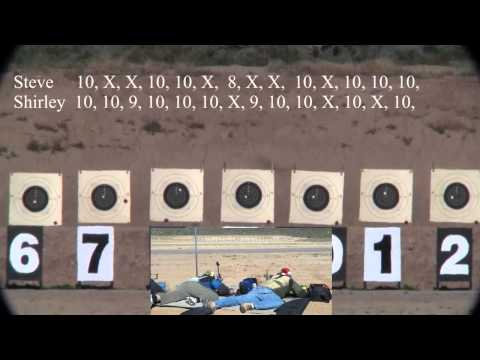
A “Dream Team” composed of four of America’s top lady shooters set a new national long-range Palma record at the Rocky Mountain Palma Championships at Raton, NM last week. The four-woman squad of Trudie Fay (Captain), Michelle Gallagher, Noma Mayo, and Nancy Tompkins shot brilliantly to establish a new National Palma record of 1796-112X, breaking the existing 1791-102X record held by the USAMU (Praslick) team.
Officially listed as “The U.S. National Team”, but dubbed “Team Estrogen” by one of the gals, this squad of four female High Masters was coached by Steve Conico, a veteran long range shooter from New Mexico. Michelle told us that Coach Conico did a great job calling the wind, and all the team members performed well: “Our strategy was simple: lay down, shoot, let Steve think for everybody. Steve’s a fantastic coach. We all just had a good day. All four trigger-pullers were on top of our game. The combination of good conditions (for Raton), great coaching, and good shooting allowed a memorable team performance. That combination is rare. It’s not going to happen again any time soon.”
SCORES: T. Fay: 448-39X | M. Gallagher: 450-35X | N. Mayo: 449-26X | N. Tompkins: 449-22X
For Michelle, competing in this match with a team of female all-stars (who are all close friends) was a dream come true: “We’ve been planning to have a womens’ team for 10 years and it finally happened. It’s fun getting everyone together. We’re all delighted it worked out so well. And I loved being able to shoot with my mom.” Michelle shot a perfect 450 in the match, not dropping a single point.
Record-Setting Equipment
All four Dream-Teamers were shooting conventional single-shot .308 Winchester Palma rifles — no tube-guns in this arsenal. Nancy Tompkins’ rifle featured a wood stock, Stolle Panda action, and 30″ Krieger barrel. Michelle’s rifle was similarly configured but she used a fiberglass McMillan stock. Nancy and Michelle shot ammo loaded with Hodgdon Varget powder, Wolf (Russian) primers, and the 155.5gr Berger Palma bullet. The other two team members, Noma and Trudie, may have been using Sierra #2156 155gr Palma bullets but that’s not confirmed.
Loading for the 155.5gr Berger Palma Bullet
Michelle observed that the 155.5gr Berger Palma bullet doesn’t require any special tuning: “With the 155.5, it’s pretty easy to swap out any load you’ve used successfully with any of the other 155s. The 155.5 doesn’t require a lot of extra load development. As far as seating depth goes, some people are successful jumping them, some people are successful jammin’ them in. Personally I’ve always soft seated. I haven’t found them to be very finicky.” Editor’s note: “Soft Seating” refers to deliberately loading the bullets long, with fairly light neck tension, and then allowing the bullet to find it’s position as one closes the bolt. The potential benefit is that the bullet ogive is always in the same position relative to the start of the rifling.
Good Conditions Aid Record-Setting Team Performance
During the July 10 team match, the weather gods smiled, providing good conditions (by Raton standards) for the female Dream Team’s record-setting performance. Michelle observed: “Have you ever shot at Raton? It can be the devil. Raton can be really nasty, but it was a pretty benign day by Raton standards. The wind was switchy but not what I’d call ‘blow you off the paper’ wind. We were all able to concentrate on the mechanics — just ‘lay down and squeeze’. Steve did all the work.”


 “The agreement with Berger Bullets allows us to offer some of the best projectiles available for use in our precision ammunition,” said Brad Angus, President of Setpoint Ammunition. Angus went on to say that this agreement has been anticipated for some time. “Teaming with Berger has always been one of our goals. When you combine the well-known reputation of Berger Bullets with the unprecedented precision that we’ve built into our ammunition loading process, you get the best custom rifle ammunition available on the commercial market today.”






 Record-Setting Equipment


