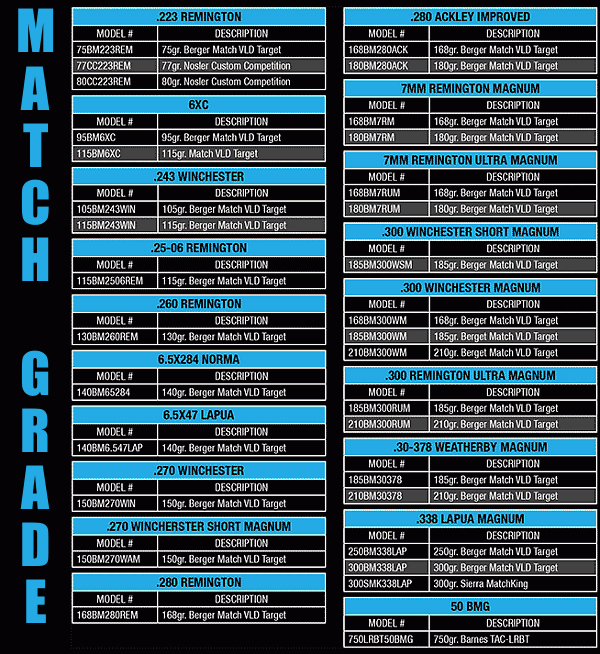
A new ammunition manufacturer has started up in Stevensville, Montana. ProGrade Ammunition will be offering a wide spectrum of ammo products, with components selected for particular types of shooting. Prograde will eventually offer nine separate types of pistol and rifle ammunition: Defense Grade, Varmint Grade, Cowboy Grade, Hunter Grade, Bear Grade, Range Grade, Match Grade, Safari Grade and Tactical Grade. Our readers will probably be most interested in the “Match Grade” and “Varmint Grade” lines. The Match Grade ammo features mostly Berger bullets (with some Noslers and Sierras), while Varmint Grade ammo is loaded with Barnes, Hornady, and Nosler bullets.
Click Images to Load Full-Size Images (with larger type)
We have no idea whether ProGrade Ammunition will shoot well and prove reliable. We don’t know what brass, powders, or primers ProGrade will be using. In a recent press release, ProGrade touts its Match Grade products: “Match Grade rounds are all hand-loaded in the United States and use premium components that are held to higher standards of consistency, leaving little room for inaccuracy. Match Grade means every element is made to be as uniform as possible in weight, primer pocket and neck size. This means everything — from bullet weight and powder weight to brass thickness and case length — is as precise as possible.”
Time (and rounds on target) will determine if ProGrade ammo is good stuff. But in this period of shortages, with ammunition of all kinds being hard to find, it is good to see a new domestic ammo-maker getting into the business, and producing cartridges with high-quality projectiles. We wish the folks at ProGrade success in their endeavor. To learn about ProGrade’s full line of ammunition, call (435) 865-5995, or visit www.progradeammo.com.
Back in May, IBS shooter Rodney Wagner shot a 0.349″ (50-2X) 5-shot group that became the talk of the shooting community. This was the smallest 600-yard group shot in the history of recorded rifle competition. Rodney’s group cuts the existing IBS 600-yard record in half. Rodney put five shots under the size of a dime at the distance of six football fields. Just pause and think about that…
News of this amazing feat spread like wildfire via the internet. People were amazed at what Rodney accomplished. Here are some actual comments posted on various shooting forums:
308Nut: Simply Astounding.
Coues Sniper: That’s insanity.
PapaJohn: I strut around like a peacock if my rifles will shoot under a half-inch at 100 yards. His group was better than that at six times the distance… that’s just unfathomable. I don’t see anyone breaking that record for a loooooooooooong time!
Given the spectacular (and historic) nature of Rodney’s 600-yard group, many folks wanted to learn more about Rodney’s equipment and his shooting techniques. For that reason, we’ve compiled this follow-up report. Rodney was kind enough to provide a short video showing his equipment and shooting technique. In his video demonstration, Rodney runs off a 5-shot group in about 19 seconds. When he actually shot the 0.349″ group, Rodney estimates he got the five shots down-range in 12-15 seconds. (He slowed down a bit for the video!)
Watch Rodney Wagner Fire Five Shots in Under 20 Seconds
Rodney comments: “You’ll notice I hold the stock with my left hand while working the bolt to keep it from losing its ‘track’ (that slows me down a lot). I have just gotten into the habit of doing that because I feel tracking is one of the most important things not to take for granted. With this technique I don’t have to ‘saw’ the stock into the bags as much when I get on to the record target.”
Record-Setting Load: Varget Powder, CCI Primers, and Berger 108s Jumped
Rodney’s record 0.349″ group works out to 0.055 MOA at 600 yards. To shoot a “zero” group at 600 yards you need the finest components and insanely good reloading techniques (not to mention the grace of God.) As he does with all his 600-yard ammo, Rodney pre-loaded before the match. This particular ammo had been loaded 5-6 days before the match. Here are specs on Rodney’s load:
32.5 Grains of Hodgdon Varget Powder and CCI 450 Primers.
108gr Berger BT Match bullets seated 0.020″ away from the lands.
Lapua 6mmBR brass fire-formed to 6 Dasher and turned to 0.265″ loaded round for a 0.268″-neck chamber.
Neck-sized with a 0.262″ Redding bushing.
Note that Rodney was using Berger 108s, not the 105gr VLDs or Berger’s popular 105gr Hybrids. Rodney found his Brux barrel shot best with the 108s: “I’d get really nice 4-shot groups with the VLDs, but it seemed there would be four together and one out. The 108s seem to have less fliers.” Rodney experimented with seating depths before he settled on a .020″ jump: “I shot them for a long time 3 to 5 thousandths in the lands, just barely in the lands. But I knew Sam Hall had really good luck jumping. So I went to .020″ jump and it all came together. The 108s have shot good like that in three different Brux barrels (all chambered with the same reamer) so I just start at that setting now — twenty off the lands.”
Record-Setting Equipment
Rodney was shooting a 17-lb Light Gun. It features a BAT Machine ‘B’ action, and a 29″ Brux barrel chambered for the 6mm Dasher with a 0.268″ neck. The 0.236″-land, 4-groove barrel was fairly new when the record group was shot — it had about 300 rounds through it, and had shot 30 rounds since its last cleaning. Rodney chambered the barrel himself. The stock is a Shehane ST-1000 fiberglass tracker, inletted and bedded by Tom Meredith. A March 10-60x52mm scope is held in Burris Signature Zee rings on a +10 MOA rail. These rings are inexpensive, but they work just fine, notes Rodney: “With the inserts I can align the scope mechanically and keep the windage pretty much centered in its travel.”
Supporting his rifle, Rodney used a Farley co-axial rest up front (on Super-Feet) and a Protektor Doctor bag in the rear. The Farley features a Borden top carrying an Edgewood bag. Rodney notes: “In the front, I use the black diamond blasting sand, because it doesn’t pack as hard as regular sand. You can buy it at tractor supply stores in the welding section. It’s not as heavy as heavy sand.”
In the rear, Rodney runs a flat-top Protektor Doctor bag with Cordura ears. Rodney uses Sinclair heavy sand in his rear bag. He says “it’s got some squish — not much but just a little — call it a medium-hard fill”. Interestingly, Rodney sets up the bag so that the flat on the bottom of the stock rides on the stitches between the ears: “I like the stock to touch the top of the bag between the ears — I don’t like to see daylight.”
Conditions for the Record — You May Be Surprised
Many folks who have commented on Rodney’s 0.349″ group have wrongly assumed that the 0.349″ group was shot in “perfect” zero-wind conditions. Not so. There were switchy 5 mph winds with gusts to 10 mph. Rodney notes that on his second target of the day, he had to hold in three different places to manage a decent-sized group. So for those who think the group was shot in miraculous conditions, we have to say that wasn’t the case.
Creating Ultra-Accurate 6mm Dasher Ammunition
Rodney takes great care in loading his brass, and he employs a few tricks to get superior consistency.
Fire-Forming — To prepare his cases for fire-forming, Rodney starts by turning his Lapua brass to just past where the new neck-shoulder junction will be: “I just cut enough for the 6mm Dasher neck. A little bit of the cut shows on the shoulder after forming.” Then Rodney runs a .25-caliber K&M mandrel through the whole neck, expanding the neck diameter. After the entire neck is expanded, Rodney re-sizes the top section with a Wilson bushing, creating a false shoulder. Then, as further insurance that the case will be held firmly in place during fire-forming, Rodney seats his bullets long — hard into the lands. When fire-forming, Rodney uses a normal 6mmBR load of 29.8 grains of Varget: “I don’t like to stress my brass before it has been hardened. I load enough powder to form the shoulder 95%. Any more than that is just wasted.” Rodney adds: “When fire-forming, I don’t want to use a super-hard primer. I prefer to use a Federal 205, CCI 200, or Winchester — something soft.” Using a softer primer lessens the likelihood that the case will drive forward when hit by the firing pin, so this helps achieve more consistent “blow lengths”.
Ammo Loading — Rodney is fastidious with his brass and weighs his charges very precisely. Charges are first dispensed with an RFD manual powder measure, then Rodney trickles kernel by kernel using a highly-precise Sartorius GD-503 laboratory scale. He tries to maintain charge-weight consistency within half a tenth of a grain — about two kernels of Varget powder.
One important technique Rodney employs is sorting by bullet-seating force. Rodney batch-sorts his loaded rounds based on seating force indicated by the dial gauge on his K&M arbor press: “I use a K&M arbor press with dial indicator strain gauge. When I’m loading I pay lots of attention to seating effort and I try to batch five rounds that feel the same. For record rounds I try to make sure I get five of the same number (on the dial). When sorting based on the force-gauge readout, you need to go slow. If you go too fast the needle will spike up and down before you can see it.”
In practice, Rodney might select five rounds with a gauge value of 25, then another five with a gauge read-out of 30 and so on. He places the first five like-value rounds in one row of his ammo caddy. The next like-value set of five will go in the next row down. By this method, he ensures that all five cartridges in a five-round set for a record target will have bullets seated with very consistent seating force.
Unlike some top shooters, Rodney does not regularly anneal his cases. However, after every firing, he does tumble his Dasher brass in treated corncob media. After sizing his brass, before seating the bullets, he runs a nylon brush in the necks: “The last thing I do before firing is run a well-worn 30 caliber nylon brush in the necks, using a small 6-volt drill for power. This is a quick operation — just in and out the neck”. Sometimes, at the end of the season, he will anneal, but Rodney adds: “If I can get 10 firings out of the case I’ve done good.” He usually makes up new brass when he fits a new barrel: “If it is a good barrel (that I may shoot at the Nationals), I’ll usually go ahead and prepare 200 pieces of good brass.”
Shooting Techniques — Piloting a 600-yard Group into the Zeros Gun-handling and Rate of Fire — As you can see from the video, Rodney shoots with very minimal contact on the rifle. He normally shoots a string fast, but he remains calm and steady — almost machine-like. In the video he runs five shots in about 19 seconds, but he figures he shot the 0.349″ group in 12-15 seconds. Rodney says: “I’m not quite as fast as Sam Hall but I can usually run ‘em under fifteen seconds, sometimes closer to 10 on a good day. But when I shot the 0.349″ I couldn’t see the flags for the last shot so I dipped the joystick down between 4th and 5th shots, and that took a couple seconds. The flags had not changed, so I kept the same point of aim for 4th and 5th shot. I’d been watching that flag all morning, so to satisfy my curiosity I kind of dipped down for a second.”
Aiming for the Nine — To shoot ultra-small at long range, you must aim very, very precisely. When shooting at 600 yards, Rodney lines up his cross-hairs on the white number “9” in the blue field above the ten ring. This is visible through his rifle-scope at 600 yards, and it provides an aim point smaller than the center “X”.
Rodney explains: “I always aim for the number 9 up in the blue field. It provides for a smaller aim point. I noticed a difference when I started doing that. I learned that from some guys from South Dakota. It made sense so I’ve been doing it ever sense.”
Tips for 600-Yard Shooters New to the Game
In the course of our interview with Rodney, we asked if he had any tips for shooters who are getting started in the 600-yard Benchrest Game. Rodney offered some sensible advice:
1. Don’t try to go it alone. Find an old-timer to mentor you. As a novice, go to matches, watch and ask questions.
2. Go with a proven cartridge. If you are shooting 600 yards stick with a 6mmBR or one of the 6BR improveds (BRX or Dasher). Keep it simple. I tried some of the larger cartridges, the 6XC and 6-6.5×47 Lapua. I was trying to be different, but I was not successful. It wasn’t a disaster — I learned something. But I found the larger cases were not as accurate as a 6BR or Dasher. Those bigger cartridges are competitive for score but not for group.
3. You don’t have to spend a fortune to be competitive. Buy a used rifle from somebody and find out if you like the sport. You can save a lot with a used rifle, but do plan on buying a new barrel immediately.
4. Don’t waste weeks or months struggling with a barrel that isn’t shooting. My best barrels, including this record-setting Brux, started shooting exceptionally well right from the start.
Another long-range benchrest record was set recently — this time at the Williamsport Range in Pennsylvania. On Saturday, May 18, 2013, Paul Martinez shot a fantastic 3.505″ 10-shot group at 1000 yards. It was nicely centered for a 99-6X score as well. Paul’s 3.505″ group should be a new 10-shot record for the 17-lb Light Gun Class under Williamsport Rules. The previous best was a 3.746″ (99-1X) group shot by Scott Weber at Williamsport last summer. Congrats to Paul for some great shooting!
Paul’s 17-lb Light Gun was chambered as a .300 WSM and Paul was loading heavy-weight .30-caliber Berger bullets. Paul’s rifle was smithed by Eric Springman of Springman Rifles in Allenwood, PA. Paul’s record-setting rifle featured a Borden action, Krieger barrel, McMillan MBR Tooley stock, and Nightforce Benchrest model scope (we don’t know if this was the old BR scope or the new-for-2013 version). Eric Springman notes: “This was not a fluke — Paul has shot several small groups with this gun and has shot under 4″ at 1000 yards before.”
Under Williamsport Rules, the Light Gun Class shoots 10-shot groups at 1000 yards. Under IBS and NBRSA Rules, Light Guns shoot 5-shot groups at 1000 yards, so there is no comparable IBS or NBRSA 10-shot record for the 17-lb class. However, IBS and NBRSA Heavy Guns DO shoot 10-shot groups at 1000 yards. The current IBS Heavy Gun 10-shot record is 3.044″, shot by Joel Pendergraft in 2009. The NBRSA 10-Shot Heavy Gun record is 4.322″ by Dave Tooley, posted in 2006. Looking at those numbers, Paul Martinez’s 3.505″ beats the existing NBRSA HG record by 0.817″ and Paul’s group is just 0.461″ off the IBS HG record. Any way you look at it, that is great shooting with a 17-lb rifle.
Effects Of Cartridge Over All Length (COAL) And Cartridge Base To Ogive (CBTO) – Part 1 by Bryan Litz forBerger Bullets.
Many shooters are not aware of the dramatic effects that bullet seating depth can have on the pressure and velocity generated by a rifle cartridge. Cartridge Overall Length (COAL) is also a variable that can be used to fine-tune accuracy. It’s also an important consideration for rifles that need to feed rounds through a magazine. In this article, we’ll explore the various effects of COAL, and what choices a shooter can make to maximize the effectiveness of their hand loads.
Sporting Arms and Ammunition Manufacturers’ Institute (SAAMI)
Most loading manuals (including the Berger Manual), present loading data according to SAAMI (Sporting Arms and Ammunition Manufacturers’ Institute) standards. SAAMI provides max pressure, COAL and many other specifications for commercial cartridges so that rifle makers, ammo makers, and hand loaders can standardize their products so they all work together. As we’ll see later in this article, these SAAMI standards are in many cases outdated and can dramatically restrict the performance potential of a cartridge.
Bullet seating depth is an important variable in the accuracy equation. In many cases, the SAAMI specified COAL is shorter than what a hand loader wants to load their rounds to for accuracy purposes. In the case where a hand loader seats the bullets longer than SAAMI specified COAL, there are some internal ballistic effects that take place which are important to understand.
Effects of Seating Depth / COAL on Pressure and Velocity
The primary effect of loading a cartridge long is that it leaves more internal volume inside the cartridge. This extra internal volume has a well known effect; for a given powder charge, there will be less pressure and less velocity produced because of the extra empty space. Another way to look at this is you have to use more powder to achieve the same pressure and velocity when the bullet is seated out long. In fact, the extra powder you can add to a cartridge with the bullet seated long will allow you to achieve greater velocity at the same pressure than a cartridge with a bullet seated short.
Figure 1. When the bullet is seated farther out of the case, there is more volume available for powder. This enables the cartridge to generate higher muzzle velocity with the same pressure.
When you think about it, it makes good sense. After all, when you seat the bullet out longer and leave more internal case volume for powder, you’re effectively making the cartridge into a bigger cartridge by increasing the size of the combustion chamber. Figure 1 illustrates the extra volume that’s available for powder when the bullet is seated out long.
Before concluding that it’s a good idea to start seating your bullets longer than SAAMI spec length, there are a few things to consider.
Geometry of a Chamber Throat
The chamber in a rifle will have a certain throat length which will dictate how long a bullet can be loaded. The throat is the forward portion of the chamber that has no rifling. The portion of the bullet’s bearing surface that projects out of the case occupies the throat (see Figure 2).
The length of the throat determines how much of the bullet can stick out of the case. When a cartridge is chambered and the bullet encounters the beginning of the rifling, known as the lands, it’s met with hard resistance. This COAL marks the maximum length that a bullet can be seated. When a bullet is seated out to contact the lands, its initial forward motion during ignition is immediately resisted by an engraving force.
Seating a bullet against the lands causes pressures to be elevated noticeably higher than if the bullet were seated just a few thousandths of an inch off the lands.
A very common practice in precision reloading is to establish the COAL for a bullet that’s seated to touch the lands. This is a reference length that the hand loader works from when searching for the optimal seating depth for precision. Many times, the best seating depth is with the bullet touching or very near the lands. However, in some rifles, the best seating depth might be 0.100″ or more off the lands. This is simply a variable the hand loader uses to tune the precision of a rifle.
Sinclair Int’l now carries Bullet Sample Packs from Bullet Proof Samples LLC. These 12-bullet packs are available for Berger, Barnes, and Nosler bullets in popular weights, types, and calibers. With the sample packs, during load development, you can try out a variety of projectiles without investing in an entire box of each type. That’s smart. Sample packs range in price from $5.99 to $15.99 (for twelve bullets per pack). Most of the Berger bullet packs are priced under $10.00, with many in the $6-$7 range.
CLICK HERE for the Sinclair Int’l bullet sample pack webpage. (Once there, select Barnes, Berger, or Nosler). You’ll also find the sample packs on page six of the Sinclair Int’l print catalog. To place an order, or for additional information, call 800-717-8211 or visit www.sinclairintl.com.
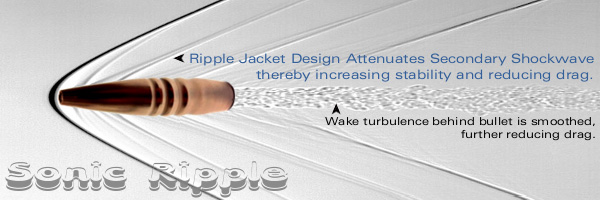
At the end of this year, Berger Bullets plans to introduce a new projectile that may truly be the most revolutionary bullet design since the advent of jacketed spitzers in the late 19th Century. Berger’s new bullet is unlike anything we have ever seen before. It features concentric curved ridges, or “ripples”, on the bearing surface. Tests show that this new projectile, dubbed the “Sonic Ripple Bullet”, has signficantly less drag than conventional bullets (no matter what their ogive configuration). In addition, the Sonic Ripple design provides increased stability at all velocities (allowing barrels with slower twist rates for a given bullet weight).
So, what does all this mean in practical terms? Well, compared to conventional bullets (of similar weight/size), the Sonic Ripple Bullet will shoot a flatter trajectory, buck the wind better, retain energy longer, and remain stable for a much longer distance. That’s big news for competitive shooters, tactical shooters, and long-range hunters.
The Science of the Sonic Ripple Bullet Design
Bryan Litz, Ballistician for Berger Bullets, explains: “This radical leap forward in bullet design was made possible by advanced, new bullet-making technologies. The unusual bullet appearance is only part of the revolutionary ‘Sonic Ripple’ system. The curvilinear waves or ripples in the bullet jacket are designed to create a specific resonance when fired from a specially ‘tuned’ barrel system. The result is an optimization of the sonic wavefront created by the bullet as it travels through its trajectory. This wavefront optimization simultaneously reduces bullet drag while increasing bullet stability.”
In essence, the supersonic shock-wave is smoothed out, dramatically reducing secondary wave fronts. This is all good, as Bryan explains: “If all the internal ballistic requirements are met, the Sonic Ripple bullet exits the muzzle with a harmonically-stabilized launch dynamic. As a further benefit of the ripple design, tests show that the concentric ripples also enhance boundary layer airflow attachment on the bullet. This, in turn, dramatically reduces wake turbulence and attendant drag.”
The reduction of wake turbulence (combined with wavefront optimization) represents a “major breakthrough” which should increase projectile BC by at least 0.14 (on G7 scale), according to Bryan. But, we wondered, might the increased surface area associated with the ripples slow the bullet down in flight? Actually, no. Bryan explained: “Eddies in the boundary layer around the ripples actually lower skin friction drag which more than compensates for increased surface area, resulting in a net friction drag loss at all velocities — both supersonic and transonic.”
Sonic Ripple Bullets Available by the End of 2013
When will we see Sonic Ripple Bullets on dealers’ shelves? Maybe this year. Berger’s marketing department told us: “The Sonic Ripple technology is currently under development and is expected to mature enough for commercial application by late fall, 2013.”
Berger Bullets has released its “new and improved” Ballistics Calculator on the Berger Bullets website. Much work, and several weeks of testing, went into Berger’s new web-based ballistics calculator. But Berger is pleased to announce that the handy Balllistics Calculator is now up and running! CLICK HERE for Calculator.
How to Use Berger’s Ballistic Calculator
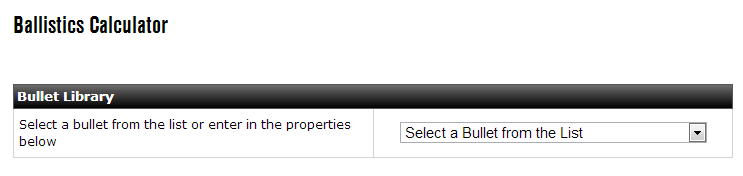
On the top of Berger’s home-page you’ll find a link that says “Ballistics”, with a drop-down menu for Berger’s Twist Rate Calculator and Ballistics Calculator. When using the Ballistics Calculator, the first element you’ll see is the bullet library. This convenient tool automatically fills in the bullet properties fields with the correct information when you select a bullet from the list.
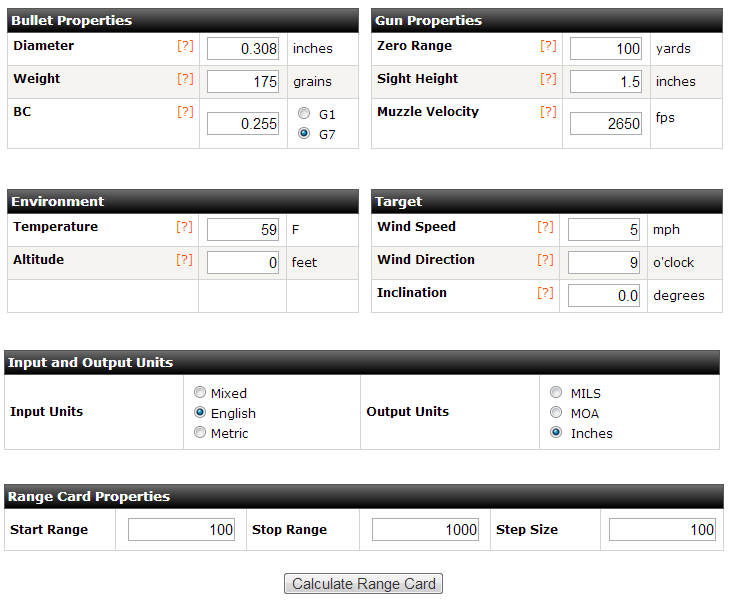
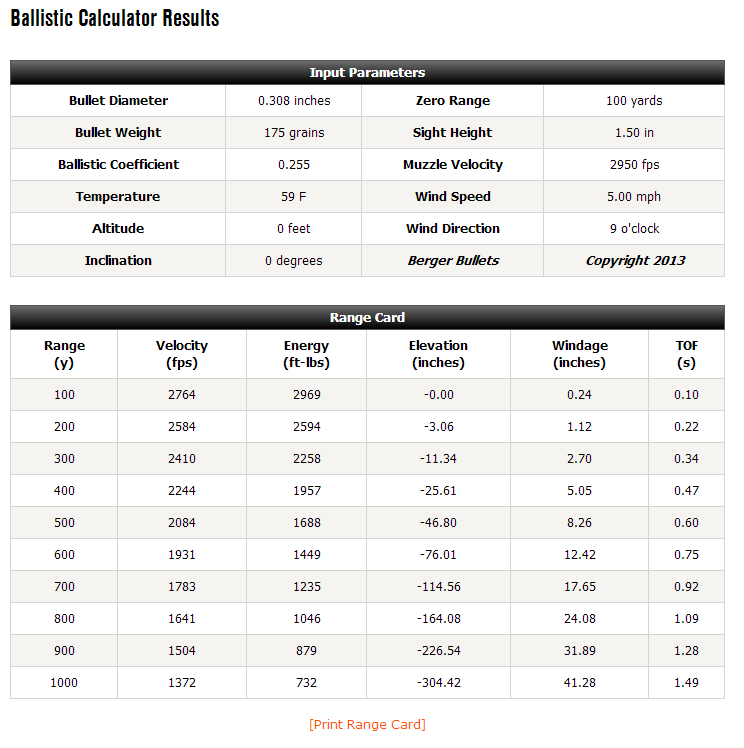
Below, you will see the bullet properties fields are filled in with the 30 Cal 175gr VLD Berger Target Bullet information. You would then manually change the Gun Properties, Environment, Target, and the rest of the fields to correspond with the conditions you will be shooting under. After you have filled in all the variables properly, click “Calculate Range Card” to generate a ballistic solution showing your load’s trajectory, with come-up values at various distances.
Once the Calculator Results are given, you can print them out and take them with you to the range or on your hunt. Here is an example of the calculated results:
If you have questions about the Ballistics Calculator CLICK this link or use the contact info below. Berger also plans to release a mobile version of the Ballistics Calculator in the near future. This should work well on smart-phones and tablets, so watch for it!
Berger Bullets
Marketing and Shooter Services
Phone: 714-447-5422 (option 2)
M-F 8am to 4:30pm pst
Story tip from EdLongrange. We welcome reader submissions.
Berger Bullets has launched a great new web resource, the Berger Bullets Events Calendar. This online calendar highlights important shooting matches and other shooting-related events (such as trade shows). We commend Berger for developing this Calendar, which will make it easier for shooters to locate match information and plan ahead. Berger states: “The main goal of this project is to help people get involved in the shooting community and build lasting relationships between shooters. A strong community is the best way to ensure that the shooting sports continue for future generations to enjoy.”
How to Use the Calendar
The Events Calendar employs different colors for different event types — Berger Yellow for Target Matches, Tan for Tactical Competitions, Light Orange for Varmint Competitions, Blaze Orange for Hunting Competitions, Blue for Tradeshows, and Forest Green for Fundraisers.
CLICK Image to Access LIVE Calendar
Click Event on Calendar to See Detailed Information
If you click on an event in the calendar grid, a window pops up showing details for that event — match date, match location, match description, and contact(s) for match registration. Here is an example for the Berger Southwest Nationals.
Map Links and Links to Match Websites
On the window that pops up when you click on a calendar item, you’ll notice one or two colored buttons (the colors correspond to event type). The View Map button links to a map of the match venue, so you can find the shooting range and plan your travel. If there is web page for the event, you’ll see a second colored button linking to that website. Simply click the Event Link for more information.
Berger invites readers to submit events for the Berger Events Calendar. Visit the Calendar Submission Page to provide information on an upcoming event. Note: Berger may not list all submitted items, particularly where there are conflicts with previously listed major events.
Story tip by EdLongrange. We welcome reader submissions.
McMillan Group International (McMillan) has added three new lines of ammunition: Extreme Velocity ammo (optimized for long range), McMillan Precision ammo (match quality for hunting), and McMillan Tactical ammo. All three new types of ammo are loaded with premium bullets. McMillan claims that its precision cartridge-loading methods ensure: “better concentricity, better uniformity of velocity, [and] better uniformity of pressure”. Along with these three NEW ammo types, McMillan already offers African Dangerous Game ammunition (ADG).
McMillan Extreme Velocity Ammunition — Long Range McMillan’s Extreme Velocity (ExVel) ammunition utilizes high-BC Berger Bullets exclusively. Powders are selected for High FPS and low ES to minimize vertical spread at long range. ExVel ammo was designed with input from Bob Beck of Extreme Outer Limits TV.
McMillan Precision Ammunition — Hunting In its new Precision line, McMillan offers traditional hunting cartridge types. Barnes LRX, TSX, and TTSX bullets with excellent accuracy AND strong terminal performance are used. All critical cartridge measurements are held to precision tolerances and Powders are selected for consistent velocity. Each round is hand inspected.
McMillan Tactical Ammunition McMillan’s Tactical ammunition offers .308, .300 WM, .338 LM, and 50 BMG cartridges loaded to “match-quality standards”. Bullets are carefully selected for mission-specific applications and powders are selected for low ES to minimize vertical spread at extreme long ranges. Each round is hand inspected.
The better, up-to-date ballistics programs let you select either G1 or G7 Ballistic Coefficient (BC) values when calculating a trajectory. The ballistic coefficient (BC) of a body is a measure of its ability to overcome air resistance in flight. You’ve probably seen that G7 values are numerically lower than G1 values for the same bullet (typically). But that doesn’t mean you should select a G1 value simply because it is higher.
Some readers are not quite sure about the difference between G1 and G7 models. One forum member wrote us: “I went on the JBM Ballistics website to use the web-based Trajectory Calculator and when I got to the part that gives you a choice to choose between G1 and G7 BC, I was stumped. What determines how, or which one to use?”
The simple answer to that is the G1 value normally works better for shorter flat-based bullets, while the G7 value should work better for longer, boat-tailed bullets.
G1 vs. G7 Ballistic Coefficients — Which Is Right for You?
G1 and G7 refer both refer to aerodynamic drag models based on particular “standard projectile” shapes. The G1 shape looks like a flat-based bullet. The G7 shape is quite different, and better approximates the geometry of a modern long-range bullet. So, when choosing your drag model, G1 is preferrable for flat-based bullets, while G7 is ordinarily a “better fit” for longer, boat-tailed bullets.
Drag Models — G7 is better than G1 for Long-Range Bullets
Many ballistics programs still offer only the default G1 drag model. Bryan Litz, author of Applied Ballistics for Long Range Shooting, believes the G7 standard is preferrable for long-range, low-drag bullets: “Part of the reason there is so much ‘slop’ in advertised BCs is because they’re referenced to the G1 standard which is very speed sensitive. The G7 standard is more appropriate for long range bullets. Here’s the results of my testing on two low-drag, long-range boat-tail bullets, so you can see how the G1 and G7 Ballistic coefficients compare:
G1 BCs, averaged between 1500 fps and 3000 fps:
Berger 180 VLD: 0.659 lb/in²
JLK 180: 0.645 lb/in²
The reason the BC for the JLK is less is mostly because the meplat was significantly larger on the particular lot that I tested (0.075″ vs 0.059″; see attached drawings).
For bullets like these, it’s much better to use the G7 standard. The following BCs are referenced to the G7 standard, and are constant for all speeds.
Many modern ballistics programs, including the free online JBM Ballistics Program, are able to use BCs referenced to G7 standards. When available, these BCs are more appropriate for long range bullets, according to Bryan.
[Editor’s NOTE: BCs are normally reported simply as an 0.XXX number. The lb/in² tag applies to all BCs, but is commonly left off for simplicity.]



 Back in May, IBS shooter Rodney Wagner shot a 0.349″ (50-2X) 5-shot group that became the talk of the shooting community. This was the smallest 600-yard group shot in the history of recorded rifle competition. Rodney’s group cuts the existing IBS 600-yard record in half. Rodney put five shots under the size of a dime at the distance of six football fields. Just pause and think about that…


 One important technique Rodney employs is sorting by bullet-seating force. Rodney batch-sorts his loaded rounds based on seating force indicated by the dial gauge on his K&M arbor press: “I use a K&M arbor press with dial indicator strain gauge. When I’m loading I pay lots of attention to seating effort and I try to batch five rounds that feel the same. For record rounds I try to make sure I get five of the same number (on the dial). When sorting based on the force-gauge readout, you need to go slow. If you go too fast the needle will spike up and down before you can see it.”

 Aiming for the Nine — To shoot ultra-small at long range, you must aim very, very precisely. When shooting at 600 yards, Rodney lines up his cross-hairs on the white number “9” in the blue field above the ten ring. This is visible through his rifle-scope at 600 yards, and it provides an aim point smaller than the center “X”.


 Effects Of Cartridge Over All Length (COAL) And Cartridge Base To Ogive (CBTO) – Part 1


 The Science of the Sonic Ripple Bullet Design

 If you have questions about the Ballistics Calculator


 McMillan’s
  In its new
  McMillan’s
  The better, up-to-date ballistics programs let you select either G1 or G7 Ballistic Coefficient (BC) values when calculating a trajectory. The ballistic coefficient (BC) of a body is a measure of its ability to overcome air resistance in flight. You’ve probably seen that G7 values are numerically lower than G1 values for the same bullet (typically). But that doesn’t mean you should select a G1 value simply because it is higher.
 Drag Models — G7 is better than G1 for Long-Range Bullets


