Review by Alan de Lacy ofF-TR Ireland
EVO Leisure (the makers of Third Eye Tactical products) provided four brand-new EVO F-TR bipods for review and testing. When we collected the bipods from Stuart Anselm of Osprey Rifles, the European and Worldwide exporter of Third Eye Tactical products, I was struck by the lightness of the bipods. Carrying four bipods under one arm, I noted how light, neat, and tidy they were.
Build-quality is excellent, as one might expect from a Third Eye Tactical product. Manufactured from what appears to be hard-anodized CNC-machined solid aluminum parts — each element appears to have been machined from solid billet aluminum. No pressed- or sintered-aluminum parts here!
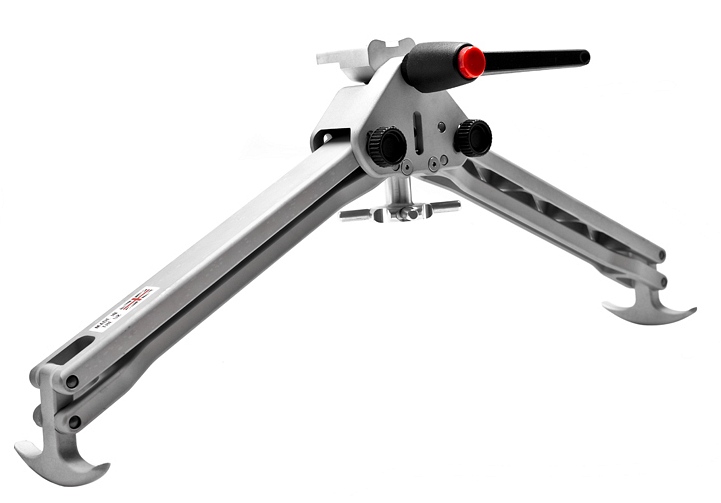
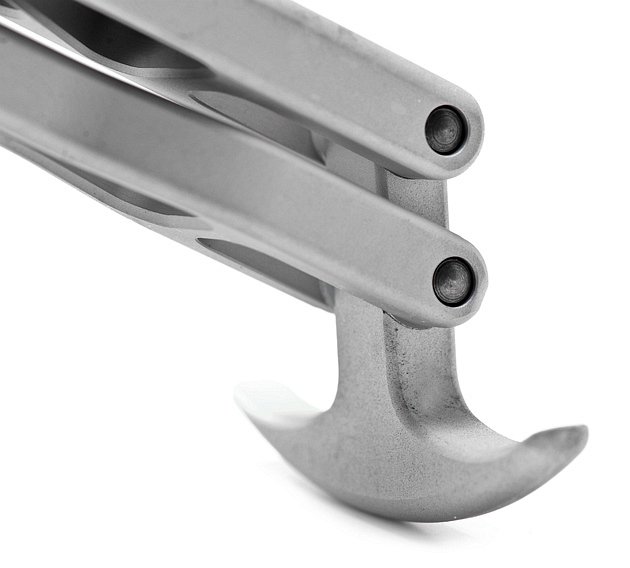
These EVO-FTR bipods are available in two colors: A very tacticool satin black and a nice satin gray. The finish appears to be hard-anodized, rather than painted or powder-coated. Milled from solid aluminum, the structural integrity is retained, while reducing the weight, by machining out sections of the aluminum to form a “honey-comb” or lattice-structure within the leg elements, on the underside.
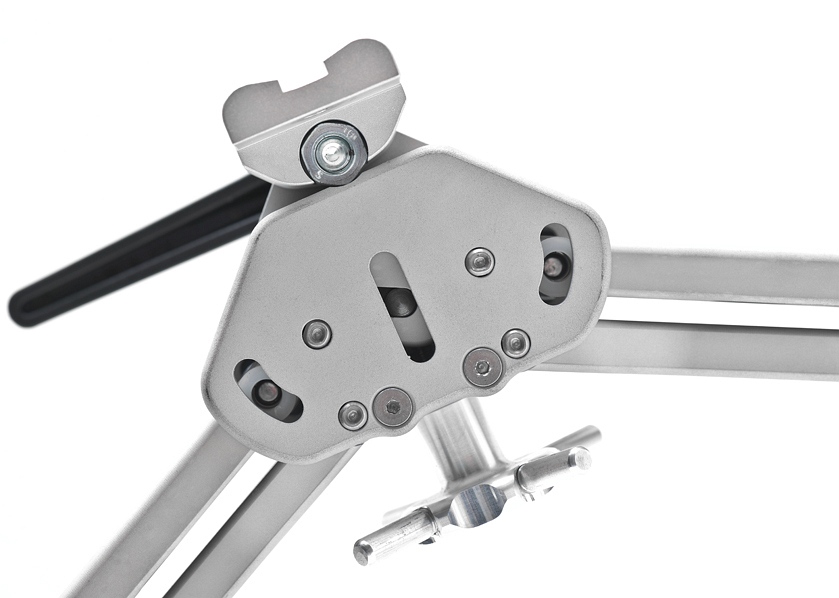
Vertical adjustment is by way of a capstan turn-wheel, readily accessible from the prone position (even for those with short arms). The vertical adjustment is fast yet positive. When set, there doesn’t appear to have any play or backlash. The aluminum feet are decent-sized, 75mm-long curved sled-feet, finished to match the bipod.
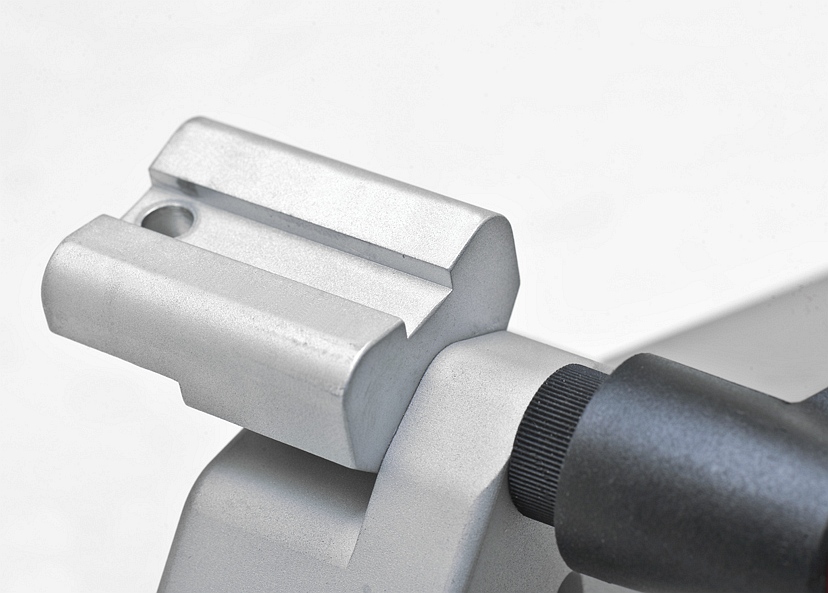
Attachment to the rifle is by way of an aluminum mounting-block which fits quickly and neatly to a standard Universal Rail. Securing the mount is by way of a PodLoc-type lever and fixing is positive and secure. Also available from Osprey Rifles is a mount for a standard-sized QD sling-stud. The adjustment for cant is also easily provided by way of a Podloc lever and has a wide range. Again, this can be operated and adjusted while in the prone position.
EVO F-TR Bipod Specifications:
Overall Weight (including attachment): A fraction under 1.75 lbs. (800 grams)
Field-Testing at Long Range
To provide two qualified opinions and to ensure that the new bipods were truly put through their paces, the reviewer, Alan de Lacy, was duly assisted by his regular F-TR team-mate and shooting-buddy, Adrian Casey. After some initial short-range bench-testing completed, we headed out to the 1000-yard Firing Line for the serious field-test. As F-TR shooters, we were shooting prone from-the-ground at 1000 yards onto the standard ICFRA F-Class 800-1000 yard target. The .308 Win rifles used in the range-test were a factory Sako TRG-22 (with a custom 32″ barrel) and a Savage 12 FTR (with custom 32″ barrel and stock). Both rifles had Anschutz-type UIT Universal accessory rails to which the bipods were attached. Both rifles are tried and tested in national and international competitions.
Adjustment (Range and Ease of Use) – The range of vertical adjustment is excellent as is the speed with which the EVO can be adjusted. A couple of quick rotations (3 or 4) of the capstan-wheel and the cross-hairs were on the target. No more time-consuming fiddling to bring the cross-hairs out of the vegetation or down from the clouds! While the vertical adjustment is as fast and extensive as we’ve seen on any F/TR bipod, the capstan-wheel also allows for a surprisingly welcome amount of fine-tuning of the vertical point-of-aim. The fine-tune vertical adjustment is positive and solid. Both guns stayed in position and the scopes’ point-of-aim did not falter once during the entire range-day.
Solidity – Throughout the day’s shooting, the rifles remain solidly planted in position. Any initial misgivings we may have had about a small amount of slack and looseness “in-the-hand” were dispelled once the ‘pods were fitted onto the rifles and weight of the guns loaded onto the bipods. Set-up on the firing point, the bipods (and the rifles) were rock-solid.
Tracking – Over the day, both shooters fired the equivalent of roughly three details each, all at 1000 yards, with over 100 rounds sent down-range. Rifle tracking and the guns’ return-to-battery were exceptional. “What I like best about this bipod is it tracks like it’s on rails”, commented tester Adrian.
Summary
Craig Coote of Third Eye Tactical, with design input from 2011 Euro F-Class FTR Champion Stuart Anselm, has produced one of the best bipods we have had the pleasure of using. Adrian was so impressed with the one he tested, he wouldn’t hand it back! While there are indeed lighter bipods and there are cheaper bipods, we think the EVO F-TR bipod has set a benchmark in terms of build-quality, adjustment, and ease of use. This bipod, while aimed squarely toward the F-Class F-TR market, would be equally at home on any range and in other disciplines. Everyone who has tested and inspected this new bipod is convinced that we’ve found a cost-effective, performance-for-weight optimized, great-tracking and great-looking new piece of equipment.
A more detailed version of this review originally appeared on the F-TR Ireland Facebook Page. CLICK HERE to read full review with more field test information and shooter comments.
Gary Eliseo of Competition Shooting Stuff (CSS) is about to release his new Heavy-Duty (HD) bipod for his CSS tubegun chassis systems. In development for over a year, this unit is very innovative. To place the bipod’s rotational (swivel) axis as close as possible to the bore axis, the bipod actually attaches with a cylindrical bushing fitted to the front tube (handguard). This keeps the center of gravity low and significantly reduces perceived torque, particularly with .308 and larger calibers.
You’ll also notice the large half-spherical leg bases. These have been called “golf-ball” feet or, alternatively, “mushroom heads”. Extensive testing showed that this design works really well, particularly for shooting off an uneven or inclined surface. Because the half-spheres contact the ground in just one point, you can easily adjust your rifle’s angle to the target. By contrast, some of the popular sled-type and ski-type bipod feet will dig one end into the ground if the rifle is angled up or down significantly relative to the ground plane. With the golf-ball feet you can shoot on a steep down-angle hill with no problems.
Gary also found that the spherical “mushroom head”-style feet work real well on a shooting mat, sliding back smoothly on recoil without hopping too much. This is good for those guys who like to allow their rifle to slide back a bit to smooth out the recoil and follow-through. If you prefer to hold hard and brace firmly against the backward push of the rifle, you can screw down pointed spikes from the bottom of the ball feet. These spikes can be planted in the ground to anchor the gun against rearward movement. So, the spherical bases offer a choice of two shooting styles.
Gary explains: “The new CSS HD Bipod is designed specifically for my chassis systems. As you can see, the bipod mounts in the end of the hand guard so the rifle rotates on its central axis. Our testing shows that this mounting system works really well at controlling torque effects. The spherical feet are made of delrin so they slide easy if you want to let the recoil move back on recoil. But the round leg bases are drilled and tapped to accept track shoe spikes so you pre-load the bipod and hold hard if you prefer.”
Both bipod legs are individually adjustable for height with an inner rod sliding in an outer tube on each side. Adjustment is continuous, with height fixed by way of a tensioning knob. It’s fast and easy to adjust height. One or both legs can also be retracted upwards in an arc, so they can be stowed parallel to the barrel (with tips facing either to the front or to the rear). The new Eliseo HD Bipod weighs 1 pound, 10 ounces — reasonably light considering how sturdy these units are. Pricing has not yet been set, but Gary says they should retail for under $200.00. For info, visit CompetitionShootingStuff.com.
Sinclair Int’l has started shipping its new, improved “3rd Gen” F-Class bipods. These are nearly a pound lighter than before, but just as stable. The key new feature is an optional, central rotary height adjustment. This was successfully tested by Danny Biggs, who won some big matches with a prototype height-adjusting bipod. While the new bipod is designed for F-TR competition, Sinclair’s wide-base bipods have also been used successfully by some F-Open Class competitors, and they have been popular with varmint hunters. Two versions of the new “3rd Gen” bipod are offered. The basic version, without central height adjustment, is currently in-stock for $199.95. The deluxe version, with central quick-adjust height control, can be pre-ordered for $249.95.
Sinclair tells us: “The Sinclair F-Class Bipod was designed with input from many of our customers, including members of Team Sinclair. The new third generation Sinclair F-Class Bipod is offered with an optional quick-adjust elevation knob. Made from 7075 T6 aluminum, the 3rd gen bipod is lighter yet more rigid — nearly a full pound less than the previous generation.” The latest F-Class Bipod now also includes handy laser-etched height markings on the adjustable legs.
Popular features of Sinclair’s previous F-Class bipod designs have been retained, notes Sinclair: “The bipod locking feature enables you to adjust rifle cant quickly and easily. The bipod can be mounted to the rifle’s sling swivel stud in just a few seconds with the captured, hardened pin system. Two tensioning knobs then pull the stock against heavy, low-compression felt pads for a movement-free mount.”
Two Oregonians, Joe Huddleston and John Weil, have developed one of the most sophisticated bipods you can buy. The new Center Shot carbon-fiber bipod is ultra-light, weighing just 19 ounces (0.55 kg). John Weil used a prototype version at the 2009 F-Class world championships in Bisley, England. John was a member of the USA Team which won the F-TR Team Championship.
The Center Shot bipod offers a very wide “wheelbase” for stability. The bipod’s long feet, shaped like helicopter skids, help the rifle recoil straight back, rather than hop or twist. The bipod is designed to attach securely via a standard accessory rail on the bottom of the rifle’s forearm. The bipod can easily be adjusted for height and cant (tilt angle), allowing the bipod to adjust to uneven terrain. The height adjustment also allows shooters to easily adapt the bipod to their rear bag height and shooting style.
The Center Shot Bipod comes in two versions. The basic model costs $450.00, while for $465, you can get one with the shooter’s national colors on the top rod assembly (see photo below). For more information, email joe [at] censhot.com or john weil at jhw1 [at] ix.netcom.net. You can also call (503) 622-3815, or write: Center Shot Engineering, 26810 E. Elk Park Rd., Welches, OR 97067.
Centershot Bipod Specifications
Weight: 19 ounces
Full height to rail: 9.25 inches | Foot Print at 9.25 inches: 16.3 inches
Lowest height to rail: 4.5 inches | Foot Print at 4.5 inches: 20.5 inches
Materials: Aluminum, carbon fiber, stainless hardware Continuous adjustment from lowest to highest setting.
We’ve confirmed that Danny Biggs, the Spirit of America’s F-Open Class Winner, shot the match using a bipod, rather than a pedestal rest. This is pretty remarkable because top F-Open competitors have traditionally preferred the stability and quick adjustability you get with a deluxe pedestal rest such as a Farley, John Loh (J.J. Industries), or SEB. Of course, Danny had a trick up his sleeve — his prototype Sinclair International bipod features a quick-adjusting elevation control. No, you can’t buy a bipod like Danny’s — at least not yet. Sinclair Int’l hopes to offer production versions before the end of 2010.
Sinclair staffer Pete Petros competed at the 2010 SOA Match, and recounted his experiences in Sinclair’s Reloading Press. Concerning Biggs’ bipod, Petros wrote:
An interesting fact about Biggs’ win is that he was shooting off of the Sinclair F-Class Bipod which is generally used in F-TR competition. In F-Class open most competitors shoot off of a bench-type rest modified to shoot off of the ground in the prone position. The bipod Biggs [used] is a new-model Sinclair Elevation-Adjustable version of the newer Sinclair F-Class Bipod. Danny has been testing this product for us during the past year and obviously is having great results. We should have these bipods ready for production in a few months. Keep posted to our website for announcements. But trust me, I think Danny would shoot well balancing his gun on a rock –- he’s that good!
While most F-Open shooters used a front pedestal rest, either a joystick design or a center column pedestal with remote-adjustable windage top, Danny used a wide-base bipod, as he had done at past Nationals in the F-TR class. But Danny’s bipod was very special. It is a prototype, modified Sinclair design with height adjustment via a central, vertical-axis knob.
As you can see from the pictures below, the left and right bipod legs are attached to a T-shaped silver (aluminum) bracket. This bracket moves up and down as the silver knob is turned clockwise or counter-clockwise. As the knob turns, its threads pull the T-shaped bracket up and down relative to a center block of aluminum bolted to the bipod’s attachment to the rifle’s forearm accessory rail. With this system, Danny can easily reach forward and make precise adjustments in elevation. Note that the Sinclair bipod’s secure rail attachment is retained and Danny can still adjust rifle cant (tilt), using the rear push-button handle. This rear handle functions like a Pod-lock allowing the rifle to be tilted a few degrees to one side or the other to compensate for side-sloping terrain.
Danny Biggs, two-time F-TR National Champion, decided to shoot Open Class at this year’s 2010 F-Class National Championships in Sacramento. Danny did very well, finishing third overall in F-Open with a score of 1324-67X. Danny’s X-count, the highest of all competitors, was 10 Xs higher than F-Open winner Derek Rogers and runner-up Ken Dickerman, who both finished with 57X.
While most F-Open shooters used a front pedestal rest, either a joystick design or a center column pedestal with remote-adjustable windage top, Danny used a wide-base bipod, as he had done at past Nationals in the F-TR class. But Danny’s bipod was very special. It is a prototype, modified Sinclair design with height adjustment via a central, vertical-axis knob. As you can see from the pictures below, the left and right bipod legs are attached to a T-shaped silver (aluminum) bracket. This bracket moves up and down as the silver knob is turned clockwise or counter-clockwise. As the knob turns, its threads pull the T-shaped bracket up and down relative to a center block of aluminum bolted to the bipod’s attachment to the rifle’s forearm accessory rail. With this system, Danny can easily reach forward and make precise adjustments in elevation. Note that the Sinclair bipod’s secure rail attachment is retained and Danny can still adjust rifle cant (tilt), using the rear push-button handle. This rear handle functions like a Pod-lock allowing the rifle to be tilted a few degrees to one side or the other to compensate for side-sloping terrain.
We watched Danny shoot with this heigh-adjustable bipod, and it worked superbly. With its wide foot-print, the bipod is ultra-stable. During recoil, the ski-type feet slide evenly straight back. Danny was able to quickly dial in a little vertical, as needed, during his string of fire. This gave him more precise control over elevation than other bipod shooters who had to slide their guns forward or backward or pinch the ears of their rear bags to make small changes in rifle elevation.
Production Plans Not Yet Certain
Wondering “Where can I get one?” Unfortunately, the Biggs Bipod adjuster is not in production yet, and we don’t know for sure if this design (or something like it) will be added to the Sinclair Int’l F-Class Bipod in the future. But Danny Biggs certainly demonstrated that the concept works superbly. We expect micro-adjusting vertical controls to appear on other F-Class bipods at future matches.
Sinclair Int’l has added many new products to its catalog, including recently-introduced reloading products from Hornady: AutoCharge electronic powder measure ($249.95), Lock-N-Load Concentricity Gauge ($99.95), and the Lock-N-Load UltraSonic Cleaning machine ($99.95). In addition, Sinclair has rolled out some impressive new products of its own, such as the new fully-adjustable, quick-attach Tactical/Varmint Bipod.
Sinclair Int’l Tactical/Varmint Bipod
With a hefty $229.95 MSRP, the new Sinclair Tactical/Varmint Bipod (item 04-8500) is nearly three times the price of a Harris bipod. Is it worth the extra money? For a typical varmint hunter, the answer might be no. But for the tactical competitor, the enhanced performance (and extra features) of the Sinclair tactical/varmint bipod may well be worth the extra coin.
The new Sinclair Tactical/Varmint Bipod is a strong, rugged design with billet aluminum and stainless steel construction throughout. There are many enhanced features compared to a Harris. First, the Sinclair Bipod’s individually adjustable legs can spread much wider (and lower) than on a Harris. The legs adjust from 6 1/2 inches to 12 1/2 inches in length, and there is a positive stop on each leg. The Sinclair Bipod also comes with a built-in “Pod-Loc” style cant adjuster, a really important feature that must be retrofitted (for about $27) on a Harris. In addition to the cant adjustment lever, the Sinclair bipod has a secure quick-release attachment system — the same system used on Sinclair’s popular F-Class Bipod. This lets you install or remove the bipod in seconds without any tools. Showing attention to detail, Sinclair also included an extra swivel stud on the bipod upper section, so you can attach a sling. Overall, the new 1 lb., 12 oz. Sinclair Tactical Bipod looks like a very good product that offers real advantages over a Harris for the tactical shooter. We just wish the price was lower.
Hornady AutoCharge Electronic Powder Scale & Dispenser
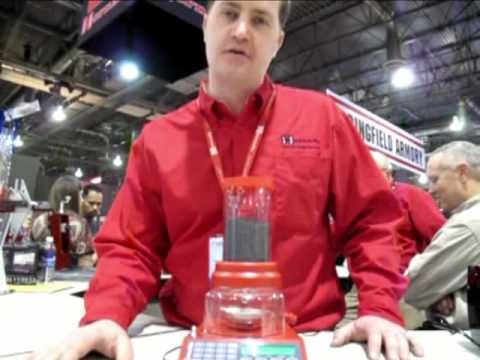
Here’s the first look at Hornady’s brand new Lock-N-Load AutoCharge electronic powder scale/dispenser. This unit can measure up to 1000 grains of powder. According to Hornady, the unit will calculate weight precisely to within ± 0.1 grains. That would put it on a par with the RCBS Chargemaster, though the Hornady unit sells for $60-$80 less than the “green machine”. The Hornady has many nice features, such as an easily readable, back-lit display, trickle function, calibration weights suitable to both low and high powder charges, and plenty of memory for your favorite loads. The Hornady, priced at $249.95 (item 050068) at Sinclair, also features three, user-selectable dispensing speeds — something you won’t find on the RCBS ChargeMaster. Those three speed settings let you optimize dispensing flow for the type of powder you’re using.
We hope to get one of these Hornady AutoCharge units soon and run a head-to-head comparison with our RCBS Chargemaster. Below is a video from SHOT Show 2010 of an early production Hornady AutoCharge.
On the GunsandHunting.com (Shooting Illustrated) website, you’ll find a well-written, in-depth review of the updated Accuracy International AE MKII rifle in .308 Winchester. (The MKII title means the rifle has a threaded barrel with brake.) The reviewer, Steve Adelmann, is a former Army sniper, so he certainly knows his tactical rifles. Adelmann praised the rifle’s ergonomics and folding stock. He also said the detachable mag system is one of the best available: “AI’s rifles also allow the magazine to be pushed straight into and dropped from the magazine well[.] The feeding and function of the five- and 10-round magazines were flawless during my evaluation, totaling 230 rounds.”
We often hear claims about tactical rifles delivering “benchrest-quality accuracy” when shot from bipod with factory ammo. We always take such reports with a grain of salt. For this article, at 100 yards, Adelmann tested two types of factory ammo, and three sets of handloaded ammo. The average accuracy of ALL the ammunition, based on five, 5-shot groups for each type, was right around one MOA (see chart).
We’re pleased Adelmann published honest results with five groups per load. Some testers will only shoot one or two 3-shot groups, which can give a false impression of the rifle’s true accuracy. Adelman writes: “The rifle still managed sub-MOA performance with the best factory ammo and handloads averaged together for all distances.”
The Editor Speaketh: For the past two and a half years, every day I’ve prepared new Daily Bulletin postings for you guys. Rain or shine, without a single day off — 956 days in a row to be precise. But today’s my birthday, and, well, I decided to take a day off and go shooting.
Don’t fret — so dedicated readers don’t go through Bulletin withdrawal, here are quick links to some of our “Greatest Hits” from 2009 — the coolest videos and the most interesting stories. For each item, click the blue link to read the full, original story. NOTE: when you get to the bottom of the page, click “Older Posts” for even MORE Greatest Hits!
The 2009 F-Class Nationals are underway right now at Camp Butner, NC. While riflescopes are allowed in both F-Open and F-TR classes, many competitors use a spotting scope as well. With a low-mounted spotting scope placed near the shooter, you can keep your riflescope trained on the target, then quickly check wind flags or mirage by looking through the spotter.
Here’s a smart product from Ray-Vin.com that lets F-Class and prone shooters mount their spotting scopes in the ideal viewing position. Ray-Vin’s patented MKII F-Stand is solid and sturdy, and “floats” the scope close to the shooter’s head without interfering with the placement of a front pedestal rest or ultra-wide bipod. The base can sit off the shooter’s mat.
How much? The entire F-Stand package costs $310.00, including 8″ bottom for prone, two 24″ extensions, Ray-Vin 360 Head, and Take-Off Knob. But if you don’t need the extensions, you can purchase components separately.
The F-Stand is shown with Ray-Vin’s $85.00 Scope Head. This head allows the shooter to adjust scope height, rotation (around the stand shaft), scope angular elevation, and eyepiece orientation, all with one control. Some other scope heads, though more expensive, require you to use multiple knobs or friction adjusters. Conveniently, most of the adjustments can be done easily with one hand, using the black adjusting handle. Smart engineering we’d say.
You can see that the F-Stand places the spotting scope right where the shooter wants it, yet the legs do not interfere with the shooting position. A heavy-duty milled metal bracket clamps the base stud and scope rod securely. The F-stand will hold even heavy 80mm spotting scopes without flexing.


 These EVO-FTR bipods are available in two colors: A very tacticool satin black and a nice satin gray. The finish appears to be hard-anodized, rather than painted or powder-coated. Milled from solid aluminum, the structural integrity is retained, while reducing the weight, by machining out sections of the aluminum to form a “honey-comb” or lattice-structure within the leg elements, on the underside.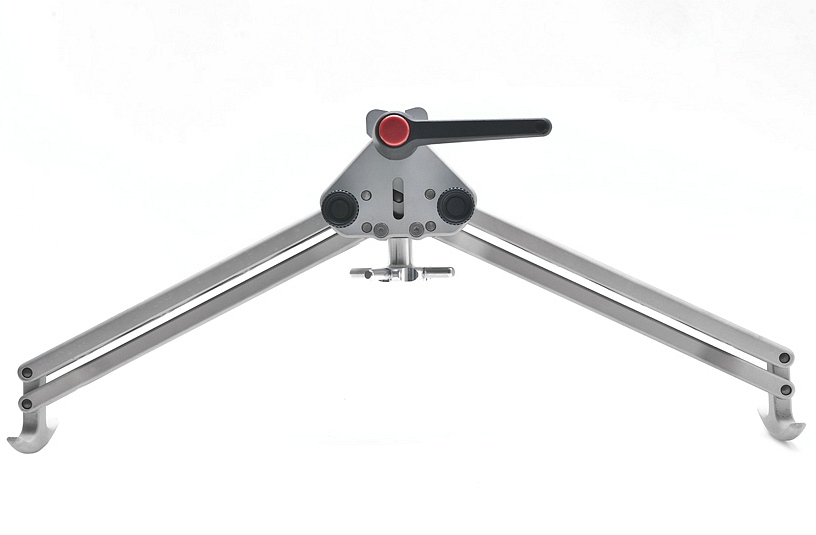



 Both bipod legs are individually adjustable for height with an inner rod sliding in an outer tube on each side. Adjustment is continuous, with height fixed by way of a tensioning knob. It’s fast and easy to adjust height. One or both legs can also be retracted upwards in an arc, so they can be stowed parallel to the barrel (with tips facing either to the front or to the rear). The new Eliseo HD Bipod weighs 1 pound, 10 ounces — reasonably light considering how sturdy these units are. Pricing has not yet been set, but Gary says they should retail for under $200.00. For info, visit


 We’ve confirmed that Danny Biggs, the Spirit of America’s F-Open Class Winner, shot the match using a bipod, rather than a pedestal rest. This is pretty remarkable because top F-Open competitors have traditionally preferred the stability and quick adjustability you get with a deluxe pedestal rest such as a Farley, John Loh (J.J. Industries), or SEB. Of course, Danny had a trick up his sleeve — his prototype
  While most F-Open shooters used a front pedestal rest, either a joystick design or a center column pedestal with remote-adjustable windage top, Danny used a wide-base bipod, as he had done at past Nationals in the F-TR class. But Danny’s bipod was very special. It is a prototype, modified Sinclair design with height adjustment via a central, vertical-axis knob.

 Danny Biggs, two-time F-TR National Champion, decided to shoot Open Class at this year’s 2010 F-Class National Championships in Sacramento. Danny did very well, finishing third overall in F-Open with a score of 1324-67X. Danny’s X-count, the highest of all competitors, was 10 Xs higher than F-Open winner Derek Rogers and runner-up Ken Dickerman, who both finished with 57X.

 On the GunsandHunting.com (Shooting Illustrated) website, you’ll find a well-written, in-depth review of the updated


 The F-Stand is shown with Ray-Vin’s $85.00 Scope Head. This head allows the shooter to adjust scope height, rotation (around the stand shaft), scope angular elevation, and eyepiece orientation, all with one control. Some other scope heads, though more expensive, require you to use multiple knobs or friction adjusters. Conveniently, most of the adjustments can be done easily with one hand, using the black adjusting handle. Smart engineering we’d say.


