The USAMU recently published a “how-to” article about bullet sorting. While many of us may sort bullets by base-to-ogive length (and/or weight), the USAMU story explores the “how and why” of sorting bullets by Overall Length (OAL). Read the article highlights below, and make your own decision as to whether OAL sorting is worth the time and effort. Bryan Litz of Applied Ballistics says that sorting by OAL is not a bad idea, but base-to-ogive bullet sorting probably represents a better investment of your time.
Bullet Sorting by Overall Length
We’d like to share a specialized handloading technique which we’ve long found beneficial to our long-range (600 yards and beyond) accuracy. Sorting of bullets for extreme long range (LR) accuracy is not difficult to do, but some background in theory is needed.
Here at USAMU’s Handloading Shop, we only sort individual bullets for the most demanding Long-Range applications and important competitions. Only the most accurate rifles and shooters can fully exploit the benefits of this technique. The basic sorting process involves measuring the Overall Length (OAL) of the bullets, and grouping them in 0.001″ increments. It’s not unusual to find lots of match bullets that vary as much as 0.015″-0.020″ in length throughout the lot, although lots with much less variation are seen as well. Even in bullet lots with 0.015″ OAL variation, the bullet base-to-ogive length will show much less variation. Hence, our basic sort is by bullet OAL. One obvious benefit of sorting is easily seen in the attached photo. The few bullets that are VERY different from the average are culled out, reducing probable fliers.
How does one know what OAL increments to use when sorting? The answer is simple. As each lot of bullets is unique in its OAL distribution, it’s best to sample your bullet lot and see how they are distributed. In the attached photo, you will see a set of loading trays with a strip of masking tape running along the bottom. Each vertical row of holes is numbered in 0.001″ increments corresponding to the bullets’ OAL. A digital caliper makes this task much easier. As each bullet is measured, it is placed in the line of holes for its’ OAL, and gradually, a roughly bell-shaped curve begins to form.
Note that near the center, bullets are much more plentiful than near the edges. At the extreme edges, there are a few that differ markedly from the average, and these make great chronograph or sighting-in fodder. We recommend using a sample of 200 bullets from your lot, and 300 is even better. Some bullet lots are very consistent, with a tall, narrow band of highly-uniform bullets clustered together over just a few thousandths spread. Other lots will show a long, relatively flat curve (less uniform), and you may also see curves with 2 or more “spikes” separated by several 0.001″ OAL increments.
Bullet Sorting (OAL vs. Base-to-Ogive vs. Weight) — Litz Talks
I’m often asked what is a the best measure to sort bullets by, and the answer (to this and many other questions in ballistics) is: it depends.
Choosing to sort by overall length (OAL), base to ogive (BTO), bearing surface, weight, etc. can get overwhelming. Shooters typically look for something they can measure, which shows a variation and sort by that. It’s common for dimensional variations to correlate. For example, bullets which are longer in OAL are typically also shorter in BTO, and have longer noses. All these are symptoms of a bullet that was pushed a little further into the pointing die, or possibly had more than average lube while being swaged. So in essence, if you sort by BTO, you’re measuring one symptom which can indicate a pattern in the bullets shape.
So, the question still stands — what should you measure? You’ll always see more variation in OAL than BTO, so it’s easier to sort by OAL. But sometimes the bullet tips can be jagged and have small burrs which can be misleading. Measuring BTO will result in a lower spread, but is a more direct measure of bullet uniformity.
Then there’s the question of; how much variation is too much, or, how many bins should you sort into? Shooters who see 0.025” variation in BTO may choose to sort into 5 bins of 0.005”. But if you have only 0.005” variation in the box, you’ll still sort into 5 bins of 0.001”. What’s correct? You have to shoot to know. Live fire testing will answer more questions, and answer them more decisively than any amount of discussion on the subject. The test I recommend is to identify bullets on the extreme short end of the spectrum, and some on the extreme long end. Load at least 10 rounds of each, and take turns shooting 5-shot groups with them. If there is a difference, it will be evident. The results of the testing will answer your question of: should I sort based on X, Y, or Z?”
You can read more discussion on this and other similar subjects in the new Ballistics & Bullets board in the Accurateshooter.com forum. Heres a link to the thread which is discussing bullet sorting: Bullet Sorting Thread
After the success of its recent winter Ballistics seminar in Michigan, Applied Ballistics has decided to take its show on the road, offering additional Ballistics seminars in three different states (Texas, Michigan, and North Carolina). These three seminars will cover a wide range of topics, with the primary focus on basic to advanced ballistics principles as applied to long-range shooting. Registration is now open for the three (3) upcoming Ballistics Seminars:
This video explains the subjects covered by Applied Ballistics Seminars:
Ballistician (and current F-TR National Mid-Range and Long-Range Champion) Bryan Litz will be the primary speaker at the spring, summer, and fall seminars. He will present material from his books and the Applied Ballistics Lab, and he will discuss his experience shooting in various disciplines. The seminar will feature structured presentations by Bryan and other noted speakers, but a great deal of time will be alloted for questions and discussion. By the end of the seminar, participants should have a much better understanding of how to apply ballistics in the real world to hit long-range targets. Along with Bryan, other respected experts will include:
Emil Praslick III – Head coach of the U.S. Palma team and retired head coach of the U.S. Army Marksmanship Unit. Emil will discuss tactics, strategy, and mindset for successful wind-reading.
Eric Stecker – Master Bulletsmith and President of Berger Bullets. Eric will be presenting on precision bullet making technology.
Nick Vitalbo – Owner of nVisti Tactical Innovations and chief engineer for Applied Ballistics. Nick will discuss the state of the art in laser rangefinders and wind reading devices.
Mitch Fitzpatrick – Applied Ballistics intern and owner of Lethal Precision Arms. Mitch specializes in Extended Long Range (ELR) cartridge selection and rifle design.
Ballistic Solvers – How they work, best practices, demos.
Weapon Employment Zone (WEZ) Analysis – How to determine and improve hit percentage.
Optics and Laser Technology – State of the Art.
The seminars costs $500.00. But consider this — each seminar participant will receive the entire library of Applied Ballistics books and DVDs, valued at $234.75, PLUS a free copy of Applied Ballistics Analytics software, valued at $200.00. So you will be getting nearly $435.00 worth of books, DVDs, and software. In addition, a DVD of the seminar will be mailed to each attendee after the seminar concludes.
Are you looking to improve your long-range shooting? Doubtless you’ve been thinking about upgrading your rifle or optics, but wonder what to buy (and how to get the best “bang for your buck”). In this video, Bryan Litz of Applied Ballistics offers “solid gold” advice on equipment selection for mid-level shooters (i.e. those who are somewhere between “newbie” and “Master of the Universe”). Bryan explains the logical first step is a barrel upgrade — a new tube from a top-barrel maker can make a huge difference. Then you should research the best factory ammo for your rifle, or get started in precision hand-loading. Bryan also offers advice on choosing a scope and optics accessories.
Equipment Upgrades: Barrel, Optics, Ammoby Bryan Litz
Every equipment element can be upgraded. You can run that factory rifle for a period of time, but the barrel eventually is going to be what holds you back. The twist rate probably won’t be fast enough to stabilize the high-BC bullets that you want to shoot at long range. So, the first thing you want to upgrade on your factory rifle is probably going to be the barrel. [With a new custom barrel] you’re going to get a fast twist rate, you’re going to get a chamber that’s optimized with a throat for your … bullet. And a good quality custom barrel is going to be easier to clean, won’t foul out as much, and it’s going to improve to overall accuracy and precision of your shooting. Barrel swaps are very common and routine thing for gunsmiths to do.
The next thing is improving your scope. If you don’t have a quality optic it’s going to hold you back. The job of the scope is to precisely and perfectly delineate [the target] within a half a degree (from 100 to 1000 yards is only a half a degree). The scope has got to put you on the money within that half a degree. So, it’s not a piece of equipment you want to go cheap on.
The other big factor is your ammunition. Getting into hand-loading is meticulous and it takes a long time to learn, but ultimately you’ll be making ammunition that is tailored for your rifle, and there simply won’t be anything better for your rifle than what you can develop through individual handloads.
So that’s typically the upgrade path: Get your factory rifle re-barreled, don’t skimp on a scope (or anything that attaches to it), improve your ammunition (whether by upgrading to better factory ammo or hand-loading on your own). All through this process is continuous learning… Once you have the best equipment (and it doesn’t get any better), the process of learning and education never ends. That is something you build on every single time you go to the range, and it’s what going to allow you to continually improve your skills.”
No matter what kind of rifle you shoot, whether it be an AR or a brenchrest rig, the principles are the same — develop a good load, learn the gun, hone your wind-reading skills, and practice in all conditions. Making a video of a practice session can help you identify and correct bad habits.
Bryan Litz says “don’t skimp on your scope”. Purchase a quality scope, rings, and scope level. Successful long-range shooting all begins with your view of the target.
Even with a top-of-the-line F-TR rig like this, you still have to practice diligently, putting in the “trigger time” needed to improve your game.
Checking conditions at break of day. This week Phoenix will offer cool nights and warm days, with daytime temps in the mid- to high 80s (F).
The Berger Southwest Nationals (SWN), is the biggest, most prestigious long-range shooting match west of the Mississipi. The SW Nationals, which run February 9-14, 2016, kicked off on Tuesday the 9th with a shooting clinic at the Ben Avery 1000-yard Range. This gave competitors a chance to confirm their zeros, study the conditions at Ben Avery, and prep their “mental game” for the upcoming competition. This will be a huge event, with over 370 shooters from all over the USA and many foreign countries. The SW Nationals attracts top F-Class and Sling shooters, lured by the quality of the competition and a huge prize table. This is truly a “world-class” event.
Tuesday’s shooting clinic started with a class on Exterior Ballistics hosted by Bryan Litz. Following the ballistics class, shooters made their way to the firing line for one-on-one instruction with experienced shooters in each discipline (sling, F-TR and F-Open). During this segment of the clinic, champion shooters worked directly with novice and intermediate shooters. Bryan said: “It was great to see the ‘top guns’ sharing their knowledge.”
File photo from 2015.
Nat’l Mid-Range and Long-Range F-TR Champion Bryan Litz instructs during Tuesday’s Clinic at the Ben Avery Shooting Facility.
Eliseo Tubegun with Nightforce Competition scope. These versatile rifle chassis systems are produced by Competition Machine in Cottonwood, Arizona.
The Berger Southwest Nationals event is less than two weeks away… so get your bags packed and ammo loaded boys and girls. The SW Nationals run February 9-14, 2016, kicking off on Tuesday the 9th with a shooting clinic.
Photo by Phil Kelley at Ben Avery Range.
This prestigious rifle competition, hosted at the Ben Avery Shooting Facility, outside Phoenix, Arizona, draws top F-Class and sling shooters from around the country. The Berger SW Nationals event is the premier long-range match of the year in the Western United States. Over 360 shooters have already registered for the SWN. NOTE: there are a few spots left. To register, go to the Berger SWN Entry Page.
To help you prepare for the Berger SW Nationals, here are some competition tips from Bryan Litz. Bryan knows the Ben Avery range well. He won the Mid-Range and Long-Range F-TR National Championships there last year. And twice he has won the sling division at the Southwest Nationals. Here are wise words from Bryan:
Competition TIP ONE. Improving your scores in long range competition is a constant process of self-assessment. After each match, carefully analyze how you lost points and make a plan to improve. Beginning shooters will lose a lot of points to fundamental things like sight alignment and trigger control. Veteran shooters will lose far fewer points to a smaller list of mistakes. At every step along the way, always ask yourself why you’re losing points and address the issues. Sometimes the weak links that you need to work on aren’t your favorite thing to do, and success will take work in these areas as well.
Competition TIP TWO. Select your wind shooting strategy carefully. For beginners and veterans, most points are typically lost to wind. Successful shooters put a lot of thought into their approach to wind shooting. Sometimes it’s best to shoot fast and minimize the changes you’ll have to navigate. Other times it’s best to wait out a condition which may take several minutes. Develop a comfortable rest position so you have an easier time waiting when you should be waiting.
Competition TIP THREE. Actively avoid major train wrecks. Sounds obvious but it happens a lot. Select equipment that is reliable, get comfortable with it and have back-ups for important things. Don’t load on the verge of max pressure, don’t go to an important match with a barrel that’s near shot out, physically check tightness of all important screws prior to shooting each string. Observe what train wrecks you and others experience, and put measures in place to avoid them.
Competition TIP FOUR. If your long range ballistic predictions aren’t tracking, always come back and verify your 100-yard zero. Sometimes a simple zero shift can be misconstrued as errors in long range ballistics predictions.
We will be interviewing Bryan Litz of Applied Ballistics tomorrow at SHOT Show in Las Vegas. As a sneak preview of some of the topics we’ll cover, here are some highlights of some important, original research conducted by Bryan and his Applied Ballistics team. Bryan wanted to know how much velocity was altered by twist rate. The “real world” test results may surprise you….
The Applied Ballistics team tested six (6) same-length/same-contour Bartlein barrels to observe how twist rate might affect muzzle velocity. This unique, multi-barrel test is featured in the book Modern Advancements in Long Range Shooting. That book includes many other fascinating field tests, including a comprehensive chronograph comparison.
Barrel Twist Rate vs. Velocity — What Tests Reveal by Bryan Litz
When considering barrel twist rates, it’s a common belief that faster twist rates will reduce muzzle velocity. The thinking is that the faster twist rate will resist forward motion of the bullet and slow it down. There are anecdotal accounts of this, such as when someone replaces a barrel of one brand/twist with a different brand and twist and observes a different muzzle velocity. But how do you know the twist rate is what affected muzzle velocity and not the barrel finish, or bore/groove dimensions? Did you use the same chronograph to measure velocity from both barrels? Do you really trust your chronograph?
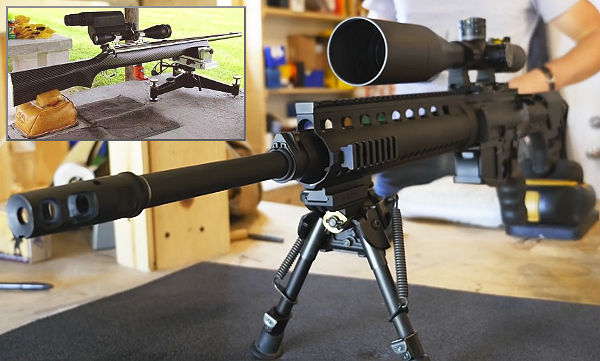
Savage Test Rifle with Six Bartlein Barrels
Most shooters don’t have access to the equipment required to fully explore questions like this. These are exactly the kinds of things we examine in the book Modern Advancements in Long Range Shooting. In that book, we present experiments conducted in the Applied Ballistics lab. Some of those experiments took on a “Myth Buster” tone as we sought to confirm (or deny) popular pre-conceptions. For example, here’s how we approached the question of barrel twist and muzzle velocity.
Six .308 Win Barrels from Bartlein — All Shot from the Same Rifle
We acquired six (6) barrels from the same manufacturer (Bartlein), all the same length and contour, and all chambered with the same reamer (SAAMI spec .308 Winchester). All these barrels were fitted to the same Savage Precision Target action, and fired from the same stock, and bench set-up. Common ammo was fired from all six barrels having different twist rates and rifling configurations. In this way, we’re truly able to compare what effect the actual twist rate has on muzzle velocity with a reasonable degree of confidence.
Prior to live fire testing, we explored the theoretical basis of the project, doing the physics. In this case, an energy balance is presented which predicts how much velocity you should expect to lose for a bullet that’s got a little more rotational energy from the faster twist. In the case of the .30 caliber 175 grain bullets, the math predicts a loss of 1.25 fps per inch-unit of barrel twist (e.g. a 1:8″ twist is predicted to be 1.25 fps slower than a 1:9″ twist).
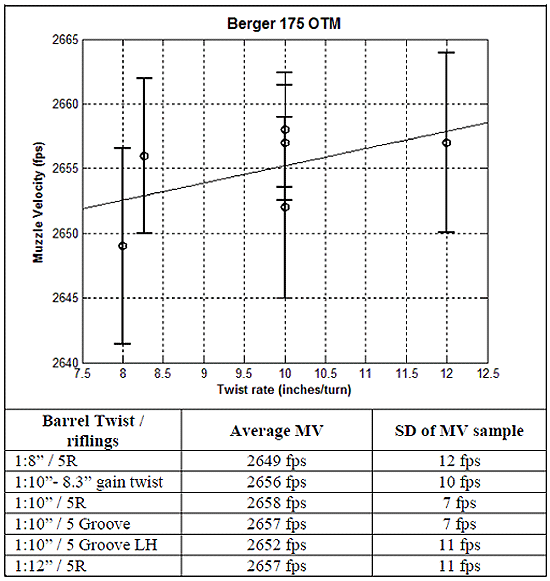
Above, data shows relationship between Twist Rate and Muzzle Velocity (MV) for various barrel twist rates and rifling types. From fast to slow, the three 1:10″ twist barrels are: 5R (canted land), 5 Groove, 5 Groove left-hand twist.
We proceeded with the testing in all 6 barrels from 1:8” to 1:12”. After all the smoke cleared, we found that muzzle velocity correlates to twist rate at the rate of approximately 1.33 fps per inch of twist. In other words, your velocity is reduced by about 5 fps if you go from a 1:12” twist to a 1:8” twist. [Editor: That’s a surprising number — much less than most folks would predict.] In this case the math prediction was pretty close, and we have to remember that there’s always uncertainty in the live fire results. Uncertainty is always considered in terms of what conclusions the results can actually support with confidence.
This is just a brief synopsis of a single test case. The coverage of twist rates in Modern Advancements in Long-Range Shooting is more detailed, with multiple live fire tests. Results are extrapolated for other calibers and bullet weights. Needless to say, the question of “how twist rate affects muzzle velocity” is fully answered.
Other chapters in the book’s twist rate section include: · Stability and Drag – Supersonic
· Stability and Drag – Transonic
· Spin Rate Decay
· Effect of Twist rate on Precision
Other sections of the book include: Modern Rifles, Scopes, and Bullets as well as Advancements in Predictive Modeling. This book is sold through the Applied Ballistics online store. Modern Advancements in Long Range Shooting is also available in eBook format in the Amazon Kindle store.
SHOT Show 2016 kicks off in two weeks in Las Vegas. While at SHOT Show next month, we plan to get the “inside scoop” on new bullet designs from Berger, Hornady, Lapua, Nosler and Sierra.
A while back, at SHOT Show 2012 we chatted with Berger Ballistician Bryan Litz about Berger’s popular line of Hybrid bullets. Berger now offers a wide range of Hybrids in multiple calibers and weights. In fact, for .30-Caliber shooters, Berger now offers seven different Hybrid match bullets, with weights from 155 grains up to 230 grains. Two .338-caliber OTM Tactical Hybrids were introduced in 2012 (a 250-grainer and a 300-grainer).
Bryan tells us: “The hybrid design is Berger’s solution to the age old problem of precision vs. ease of use. This design is making life easier for handloaders as well as providing opportunities for commercial ammo loaders who need to offer a high performance round that also shoots precisely in many rifles with various chamber/throat configurations.”
For those not familiar with Hybrid bullets, the Hybrid design blends two common bullet nose shapes on the front section of the bullet (from the tip to the start of the bearing surface). Most of the curved section of the bullet has a Secant (VLD-style) ogive for low drag. This then blends in a Tangent-style ogive curve further back, where the bullet first contacts the rifling. The Tangent section makes seating depth less critical to accuracy, so the Hybrid bullet can shoot well through a range of seating depths, even though it has a very high Ballistic Coefficient (BC).
In the video we asked Bryan for recommended seating depths for 7mm and .30-Caliber Hybrid bullets. Bryan advises that, as a starting point, Hybrid bullets be seated .015″ (fifteen thousandths) off the lands in most barrels. Watch the video for more tips how to optimize your loads with Hybrid bullets.
The Coriolis Effect comes into play with extreme long-range shots like this. The rotation of the earth actually moves the target a small distance (in space) during the course of the bullet’s flight. Photo by Dustin Ellermann at Whittington Center Range.
When you’re out at the range, the Earth seems very stable. But it is actually a big sphere zooming through space while spinning around its axis, one complete turn every 24 hours. The rotation of the earth can create problems for extreme long-range shooters. During extended bullet flight times, the rotation of the planet causes an apparent deflection of the bullet path over very long distances. This is the ballistics manifestation of the Coriolis Effect.
Bryan Litz of Applied Ballistics has produced a short video that explains the Coriolis Effect. Bryan notes that Coriolis is “a very subtle effect. People like to make more of it than it is because it seems mysterious.” In most common shooting situations inside 1K, Coriolis is not important. At 1000 yards, the Effect represents less than one click (for most cartridge types). Even well past 1000 yards, in windy conditions, the Coriolis Effect may well be “lost in the noise”. But in very calm conditions, when shooting at extreme ranges, Bryan says you can benefit from adjusting your ballistics solution for Coriolis.
Bryan explains: “The Coriolis Effect… has to do with the spin of the earth. You are basically shooting from one point to another on a rotating sphere, in an inertial reference frame. The consequence of that is that, if the flight time of the bullet gets significantly long, the bullet can have an apparent drift from its intended target. The amount [of apparent drift] is very small — it depends on your latitude and azimuth of fire on the planet.”
Coriolis is a very subtle effect. With typical bullet BCs and velocities, you must get to at least 1000 yards before Coriolis amounts to even one click. Accordingly, Bryan advises: “Coriolis Effect is NOT something to think about on moving targets, it is NOT something to think about in high, uncertain wind environments because there are variables that are dominating your uncertainty picture, and the Coriolis will distract you more than the correction is worth.”
“Where you could think about Coriolis, and have it be a major impact on your hit percentage, is if you are shooting at extended range, at relatively small targets, in low-wind conditions. Where you know your muzzle velocity and BC very well, [and there are] pristine conditions, that’s where you’re going to see Coriolis creep in. You’ll receive more refinement and accuracy in your ballistics solutions if you account for Coriolis on those types of shots. But in most practical long-range shooting situations, Coriolis is NOT important. What IS important is to understand is when you should think about it and when you shouldn’t, i.e. when applying it will matter and when it won’t.”
The Coriolis Effect — General Physics
The Coriolis Effect is the apparent deflection of moving objects when the motion is described relative to a rotating reference frame. The Coriolis force acts in a direction perpendicular to the rotation axis and to the velocity of the body in the rotating frame and is proportional to the object’s speed in the rotating frame.
A commonly encountered rotating reference frame is the Earth. The Coriolis effect is caused by the rotation of the Earth and the inertia of the mass experiencing the effect. Because the Earth completes only one rotation per day, the Coriolis force is quite small, and its effects generally become noticeable only for motions occurring over large distances and long periods of time. This force causes moving objects on the surface of the Earth to be deflected to the right (with respect to the direction of travel) in the Northern Hemisphere and to the left in the Southern Hemisphere. The horizontal deflection effect is greater near the poles and smallest at the equator, since the rate of change in the diameter of the circles of latitude when travelling north or south, increases the closer the object is to the poles. (Source: Wikipedia)
iPhone owners rejoice. The much-awaited iOS Ballistics App for the Kestrel LiNK Weather Meter is now available. Now you can sync your 5700 Series Kestrel wirelessly with your iPhone, iPod, or iPad. With Apple iOS devices being so popular among serious shooters, this is an important software release. Bryan Litz of Applied Ballistics was proud to announce the new development: “Kestrel LiNK Ballistics is now available for iOS! It has been available for Android, and was also recently updated to fix some issues. Android users should be on version 1.67 by now. We say thank you to those who have been patiently waiting for the iOS version”. The software is a FREE download from the Apple App Store. For supporting info and Users’ Guides for both iOS and Android versions, visit the Applied Ballistics Resource Site.
This App is designed to work with the new 5700-series Kestrel Elite Weather Meter (5700AL) or Kestrel Sportsman Weather Meter (5700SL) with LiNK, powered by Bluetooth Smart.
Bryan Litz with his F-TR Nat’l Championship-winnning rifle, and the man who built it, John Pierce.
Bryan Litz knows something about bullet shapes and dimensions. He’s the chief designer of many of Berger’s projectiles, including the successful line of Hybrid bullets. Bryan also understands how bullets actually perform in “real world” competition. Bryan won BOTH the Mid-Range and Long-Range National F-TR Championships this year, a remarkable accomplishment. With Bryan’s technical expertise combined with his shooting skills, few people are better qualified to answer the question: “how should I sort bullets when loading for competition?”
Bullet Sorting Strategies — OAL vs. Base to Ogive
At the 2015 Berger Southwest Nationals, Forum member Erik Cortina cornered Bryan Litz of Applied Ballistics. Erik was curious about bullet sorting. Knowing that bullets can be sorted by many different criteria (e.g. weight, overall length, base to ogive length, actual bearing surface length etc.) Erik asked Bryan to specify the most important dimension to consider when sorting. Bryan recommended sorting by “Base to Ogive”. Litz noted that: “Sorting by overall length can be misleading because of the nature of the open-tip match bullet. You might get a bullet that measures longer because it has a jagged [tip], but that bullet might not fly any different. But measuring base to ogive might indicate that the bullet is formed differently — basically it’s a higher resolution measurement….”
Ballistics Q & A in Shooter’s Forum
Got more questions about bullets? Our Shooters’ Forum has a special area for Bullets & Ballistics topics. There you can get your own questions about bullets and ballistics answered by Bryan Litz and other experts from Applied Ballistics.




 The
The 




 When you’re out at the range, the Earth seems very stable. But it is actually a big sphere zooming through space while spinning around its axis, one complete turn every 24 hours. The rotation of the earth can create problems for extreme long-range shooters. During extended bullet flight times, the rotation of the planet causes an apparent deflection of the bullet path over very long distances. This is the ballistics manifestation of the

 iPhone owners rejoice. The much-awaited iOS Ballistics App for the Kestrel LiNK Weather Meter is now available. Now you can sync your 5700 Series Kestrel wirelessly with your iPhone, iPod, or iPad. With Apple iOS devices being so popular among serious shooters, this is an important software release. Bryan Litz of


